

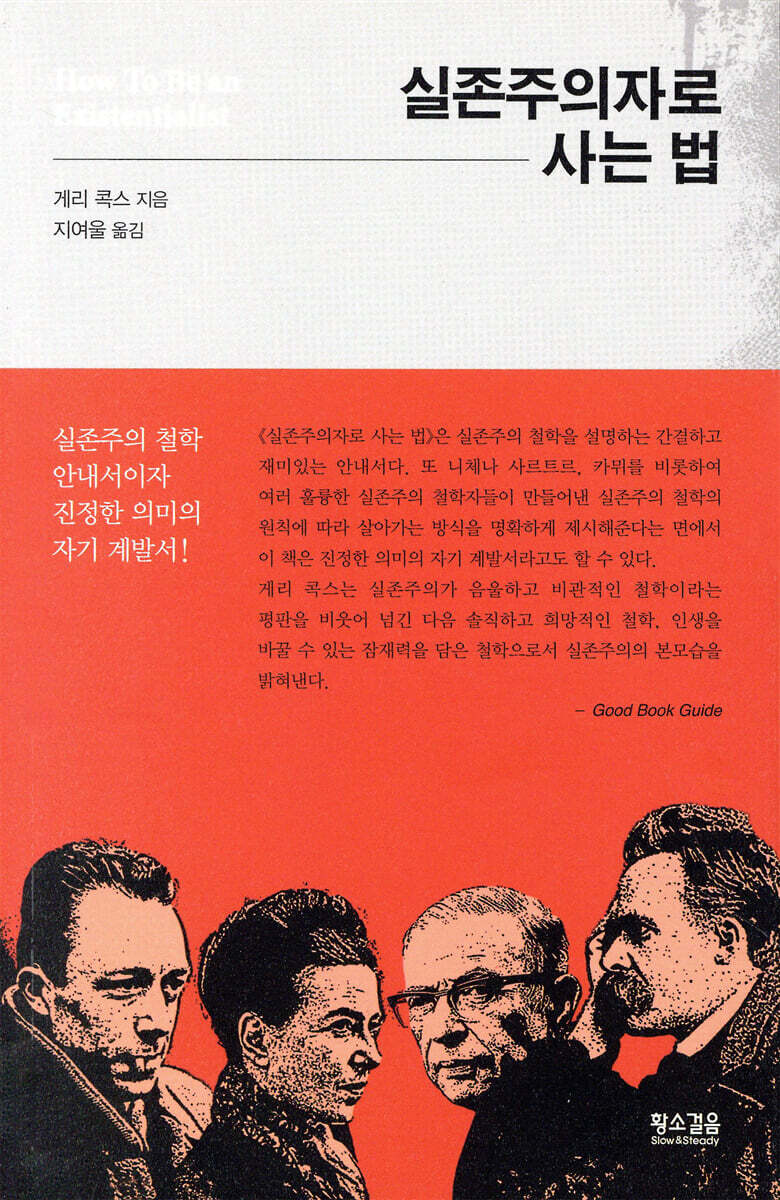
How to Live as an Existentialist
 |
Description
Book Introduction
A guide to existential philosophy and a true self-help book.
"How to Live as an Existentialist" is a concise and entertaining guide to existentialist philosophy.
This book can also be considered a true self-help book in the sense that it clearly presents a way of living according to the principles of existential philosophy created by various existentialist philosophers, including Nietzsche, Sartre, and Camus.
Using accessible examples and his signature humor, Gary Cox reveals the true nature of existentialism: a philosophy that is honest and hopeful, one that holds the potential to transform lives.
According to him, existentialism is a brutally honest philosophy that faces human life as it is, and it is a positive and anti-nihilistic philosophy.
This is because existentialism is a philosophy that claims that we can live honestly and worthily despite the fact that human existence is essentially meaningless and irrational, and it shows us how to do so.
"How to Live as an Existentialist" spreads the philosophy of existentialism in a flowing manner.
The author succeeds in properly explaining concepts that can be easily confused, such as 'authenticity' and 'self-deception'.
Armed with existentialist philosophy, this book will equip readers to embrace the inevitability and absurdity of death, which strikes them unexpectedly in places like dental waiting rooms, airports, gyms, dog kennels, and hot air balloons." -The Guardian
"How to Live as an Existentialist" is a concise and entertaining guide to existentialist philosophy.
This book can also be considered a true self-help book in the sense that it clearly presents a way of living according to the principles of existential philosophy created by various existentialist philosophers, including Nietzsche, Sartre, and Camus.
Using accessible examples and his signature humor, Gary Cox reveals the true nature of existentialism: a philosophy that is honest and hopeful, one that holds the potential to transform lives.
According to him, existentialism is a brutally honest philosophy that faces human life as it is, and it is a positive and anti-nihilistic philosophy.
This is because existentialism is a philosophy that claims that we can live honestly and worthily despite the fact that human existence is essentially meaningless and irrational, and it shows us how to do so.
"How to Live as an Existentialist" spreads the philosophy of existentialism in a flowing manner.
The author succeeds in properly explaining concepts that can be easily confused, such as 'authenticity' and 'self-deception'.
Armed with existentialist philosophy, this book will equip readers to embrace the inevitability and absurdity of death, which strikes them unexpectedly in places like dental waiting rooms, airports, gyms, dog kennels, and hot air balloons." -The Guardian
- You can preview some of the book's contents.
Preview
index
Entering
Chapter 1: What is an Existentialist?
Chapter 2: What is Existentialism?
Overview and History of Existentialism
Existentialism and Consciousness
Temporariness
Substitute existence
Freedom and Responsibility
Freedom and Disability
The limits of freedom
Freedom and Anxiety
Chapter 3: How Not to Be an Existentialist
Self-deception is not self-deception.
A light woman and a woman who is passionate
Employees and actors
Representatives of homosexuality, integrity, and transcendence
deliberate ignorance
An existential digestive that digests contingency, vomiting, and self-deception.
Mustache and 'Salo'
Chapter 4: The Path to Authenticity
Authenticity, Facing Reality
existence in a situation
Freedom as a value
The Problem with 'Truly Existing'
Authenticity and intelligence
Authenticity and Others
Nietzsche's Authenticity: Regret Nothing
Heidegger's Authenticity: Being Toward Death
Chapter 5: Existential Counseling
main
Chapter 1: What is an Existentialist?
Chapter 2: What is Existentialism?
Overview and History of Existentialism
Existentialism and Consciousness
Temporariness
Substitute existence
Freedom and Responsibility
Freedom and Disability
The limits of freedom
Freedom and Anxiety
Chapter 3: How Not to Be an Existentialist
Self-deception is not self-deception.
A light woman and a woman who is passionate
Employees and actors
Representatives of homosexuality, integrity, and transcendence
deliberate ignorance
An existential digestive that digests contingency, vomiting, and self-deception.
Mustache and 'Salo'
Chapter 4: The Path to Authenticity
Authenticity, Facing Reality
existence in a situation
Freedom as a value
The Problem with 'Truly Existing'
Authenticity and intelligence
Authenticity and Others
Nietzsche's Authenticity: Regret Nothing
Heidegger's Authenticity: Being Toward Death
Chapter 5: Existential Counseling
main
Publisher's Review
Why existentialism now?
Perhaps because it encompasses such a diverse spectrum that it is difficult to define in a single word, few philosophies are as misunderstood as existentialism.
Because it defines meaninglessness and absurdity as essential, it is sometimes misunderstood as a gloomy and pessimistic philosophy, and because of Sartre's Marxist tendencies and Camus's rebellious human type, it is sometimes misunderstood as a dangerous ideology.
But in this book, Gary Cox reveals the true nature of existentialism as a philosophy with hopeful and life-changing potential.
Existentialism is ultimately a positive, optimistic, and anti-nihilistic philosophy! No kidding, really.
How could that be?
Because existentialist philosophy argues that we can live with integrity and worth, despite the inherent meaninglessness and irrationality of human existence, and it teaches us how to do so (p. 33).
It doesn't stop at revealing the true face of existentialism.
Gary Cox distinguishes between existentialists and existentialist philosophers.
Just because you know a lot about existentialist philosophy doesn't mean you can be called an existentialist.
And it tells us how to live as a true existentialist.
Life is terribly unfair.
Even a person who exerts himself to the point of shaking heaven and earth and tearing every tendon in his body can still be defeated by an opponent with innate talent.
Impossible communism, situations beyond your control, and sometimes even that damn weather can cause you to lose.
But that doesn't matter.
The important issue here is not whether it is fair to everyone.
It's not that I avoid harsh words because I'm worried about hurting the other person.
It is important to determine a desirable attitude toward life.
Living a desirable, dignified, and existential way does not involve making excuses like, “I did my best.”
Maybe I didn't do my best, but I can do much better next time.
Maintaining dignity and respect is a true existential virtue. (p. 174)
Our society is facing a more dire reality than ever before: college entrance exam competition, youth unemployment, job insecurity, extreme income disparity, the world's highest suicide rate, and the world's lowest birth rate.
People who are driven into a terrible reality tremble with anxiety and look for a place to lean on.
A society in need of healing is an unhappy society.
Comfort is important, but isn't the attitude of facing reality as it is and confronting it what our society really needs?
The reason most people fail to see the existential truth surrounding human reality is not because they lack knowledge, but because they do not want to see it.
Of course, the fact that people do not want to see the truth implies that they have seen the truth.
Having witnessed the existential truth surrounding human reality, and so disturbed by its appearance, people desperately seek to avoid it by resorting to self-deception, hoping to avoid facing it again. (p. 180)
Existentialists believe that the ability to know the truth, to understand the way things exist, and to face life as it is requires not so much intellectual ability as courage and sincerity to face reality.
I hope that through this book, our young people will gain the courage and sincerity to face reality.
Perhaps because it encompasses such a diverse spectrum that it is difficult to define in a single word, few philosophies are as misunderstood as existentialism.
Because it defines meaninglessness and absurdity as essential, it is sometimes misunderstood as a gloomy and pessimistic philosophy, and because of Sartre's Marxist tendencies and Camus's rebellious human type, it is sometimes misunderstood as a dangerous ideology.
But in this book, Gary Cox reveals the true nature of existentialism as a philosophy with hopeful and life-changing potential.
Existentialism is ultimately a positive, optimistic, and anti-nihilistic philosophy! No kidding, really.
How could that be?
Because existentialist philosophy argues that we can live with integrity and worth, despite the inherent meaninglessness and irrationality of human existence, and it teaches us how to do so (p. 33).
It doesn't stop at revealing the true face of existentialism.
Gary Cox distinguishes between existentialists and existentialist philosophers.
Just because you know a lot about existentialist philosophy doesn't mean you can be called an existentialist.
And it tells us how to live as a true existentialist.
Life is terribly unfair.
Even a person who exerts himself to the point of shaking heaven and earth and tearing every tendon in his body can still be defeated by an opponent with innate talent.
Impossible communism, situations beyond your control, and sometimes even that damn weather can cause you to lose.
But that doesn't matter.
The important issue here is not whether it is fair to everyone.
It's not that I avoid harsh words because I'm worried about hurting the other person.
It is important to determine a desirable attitude toward life.
Living a desirable, dignified, and existential way does not involve making excuses like, “I did my best.”
Maybe I didn't do my best, but I can do much better next time.
Maintaining dignity and respect is a true existential virtue. (p. 174)
Our society is facing a more dire reality than ever before: college entrance exam competition, youth unemployment, job insecurity, extreme income disparity, the world's highest suicide rate, and the world's lowest birth rate.
People who are driven into a terrible reality tremble with anxiety and look for a place to lean on.
A society in need of healing is an unhappy society.
Comfort is important, but isn't the attitude of facing reality as it is and confronting it what our society really needs?
The reason most people fail to see the existential truth surrounding human reality is not because they lack knowledge, but because they do not want to see it.
Of course, the fact that people do not want to see the truth implies that they have seen the truth.
Having witnessed the existential truth surrounding human reality, and so disturbed by its appearance, people desperately seek to avoid it by resorting to self-deception, hoping to avoid facing it again. (p. 180)
Existentialists believe that the ability to know the truth, to understand the way things exist, and to face life as it is requires not so much intellectual ability as courage and sincerity to face reality.
I hope that through this book, our young people will gain the courage and sincerity to face reality.
GOODS SPECIFICS
- Date of issue: November 10, 2023
- Page count, weight, size: 224 pages | 344g | 136*210*15mm
- ISBN13: 9791186821909
- ISBN10: 1186821906
You may also like
카테고리
korean


korean

![GQ KOREA Mark (Monthly): December [2025]](http://librairie.coreenne.fr/cdn/shop/files/8ef265dbbfbf186523ed75ba7319009d.jpg?v=1765340328&width=3840)


