

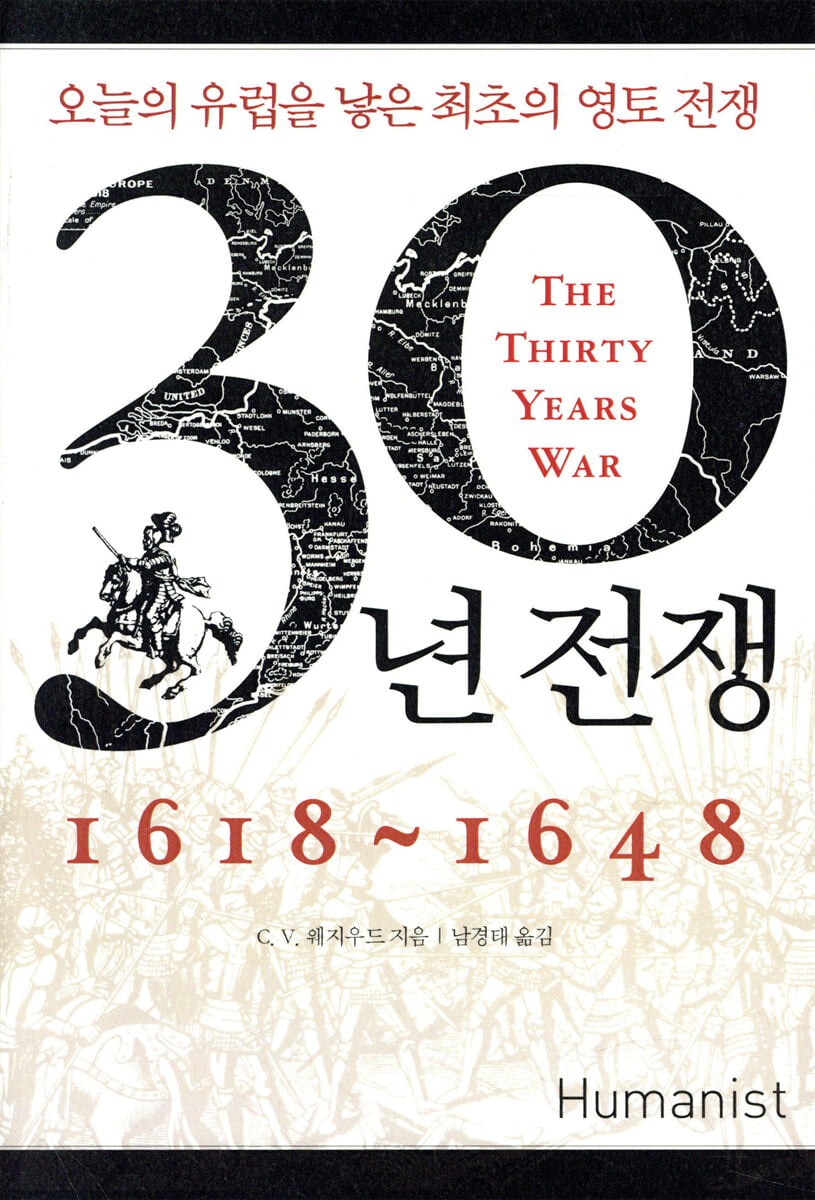
Thirty Years' War 1618–1648
 |
Description
Book Introduction
The last religious war and the first territorial war of mankind
Everything About the Thirty Years' War
When talking about the European world, the most important turning point would be the 'Thirty Years' War' of the 17th century.
This war was the starting point of the final stage that concluded thousands of years of European history, and it was an event that directly shaped the European world of today.
The early 17th century was a time when the aftereffects of the Reformation were still lingering, so the Thirty Years' War began as a religious war and ended as a territorial war.
In that respect, this war serves as a link between medieval warfare and modern warfare.
The wars that followed until the 20th century were wars fought over the territory and wealth of nation-states.
This book, which describes the unfolding of the Thirty Years' War in great depth and detail, unravels the tumultuous events of the Thirty Years' War, which affected all of Europe except England, and shows the intricate relationships of countless characters, their individual personalities and psychology, and at times even boldly speculates on hidden intentions.
It is a magnificent action and historical drama that can be called the European version of 'Romance of the Three Kingdoms'.
Author Wedgwood, a woman in her late twenties, weaves together a modern classic from complex and significant historical events with a masterful skill that belies her.
Everything About the Thirty Years' War
When talking about the European world, the most important turning point would be the 'Thirty Years' War' of the 17th century.
This war was the starting point of the final stage that concluded thousands of years of European history, and it was an event that directly shaped the European world of today.
The early 17th century was a time when the aftereffects of the Reformation were still lingering, so the Thirty Years' War began as a religious war and ended as a territorial war.
In that respect, this war serves as a link between medieval warfare and modern warfare.
The wars that followed until the 20th century were wars fought over the territory and wealth of nation-states.
This book, which describes the unfolding of the Thirty Years' War in great depth and detail, unravels the tumultuous events of the Thirty Years' War, which affected all of Europe except England, and shows the intricate relationships of countless characters, their individual personalities and psychology, and at times even boldly speculates on hidden intentions.
It is a magnificent action and historical drama that can be called the European version of 'Romance of the Three Kingdoms'.
Author Wedgwood, a woman in her late twenties, weaves together a modern classic from complex and significant historical events with a masterful skill that belies her.
- You can preview some of the book's contents.
Preview
index
Preface to the 1963 edition 1
Preface to the 1656 edition 2
Translator's Note: The Thirty Years' War That Shaped Modern Europe
Recommendation: The pinnacle of Wedgwood's narrative
Chapter 1: Germany and Europe: 1618
Chapter 2 The Crown of Bohemia: 1617–19
Chapter 3: The Alarm in Spain, the Alarm in Germany: 1619–21
Chapter 4: Emperor Ferdinand and Elector Maximilian: 1621–25
Chapter 5: Towards the Baltic: 1625–28
Chapter 6: Deadlock: 1628–30
Chapter 7 The Kings of Sweden: 1630–32
Chapter 8 From Lützen to Nördlingen and Beyond: 1632–35
Chapter 9: The Battle of the Rhine: 1635–1639
Chapter 10: The Fall of Spain: 1639–43
Chapter 11: Towards Peace: 1643–48
Chapter 12 After Peace
Notes in the text
References
The Habsburg dynasty's marriage chart
Family tree of representative Shinto dynasties
Search
Preface to the 1656 edition 2
Translator's Note: The Thirty Years' War That Shaped Modern Europe
Recommendation: The pinnacle of Wedgwood's narrative
Chapter 1: Germany and Europe: 1618
Chapter 2 The Crown of Bohemia: 1617–19
Chapter 3: The Alarm in Spain, the Alarm in Germany: 1619–21
Chapter 4: Emperor Ferdinand and Elector Maximilian: 1621–25
Chapter 5: Towards the Baltic: 1625–28
Chapter 6: Deadlock: 1628–30
Chapter 7 The Kings of Sweden: 1630–32
Chapter 8 From Lützen to Nördlingen and Beyond: 1632–35
Chapter 9: The Battle of the Rhine: 1635–1639
Chapter 10: The Fall of Spain: 1639–43
Chapter 11: Towards Peace: 1643–48
Chapter 12 After Peace
Notes in the text
References
The Habsburg dynasty's marriage chart
Family tree of representative Shinto dynasties
Search
Publisher's Review
Discovering the Roots of 21st-Century Europe Through the War of 400 Years - Overview of this Book
The Thirty Years' War was written by British historian C.
This book is a Korean translation of V. Wedgwood's "The Thirty Years War."
The author, who majored in modern European history, created this book by freely exercising his historical and literary imagination based on meticulous research and investigation.
The Thirty Years' War was first published in 1938, and even now, over 70 years later, it is still the best book on the Thirty Years' War, and its value is recognized among the numerous historical books on the subject of war.
The Thirty Years' War was a religious war between Protestants and Catholics that took place in the Holy Roman Empire (present-day Germany) from 1618 to 1648.
The war began as a religious conflict, but as the great powers seeking their own interests intervened, the religious issue was diluted and it degenerated into an international war.
When the war that had engulfed almost all of Europe ended, the topography of Europe looked completely different than before.
This is because the current borders were established through postwar treaties, and it is no exaggeration to say that this war is the root of what formed today's Europe.
If we were to choose the most important stepping stone on the war-like bridge that the European world was on, it would be the Thirty Years' War of the 17th century.
This war was the starting point of the final stage that concluded thousands of years of European history, and it was an event that directly shaped the European world of today.
The early 17th century was a time when the aftereffects of the Reformation were still lingering, so the Thirty Years' War began as a religious war and ended as a territorial war.
In that respect, this war serves as a link between medieval warfare and modern warfare.
- From the Translator's Note
From religious wars to territorial wars, a fierce battle spanning 30 years
- What kind of war was the Thirty Years' War?
After Martin Luther's religious reform in 1517, European Christianity was divided into Protestantism and Catholicism, and even after 100 years, division and conflict continued.
The Peace of Augsburg, the final stage of the Reformation, also allowed only limited freedom of religion.
The Calvinists, feeling uneasy, formed the Protestant Union centered around Elector Frederick V of the Palatinate, and in response, the Catholic group formed the Catholic League.
In 1617, while the tension was still high and the confrontation was ongoing, King Ferdinand II of Bohemia began to oppress Protestants in order to unify under Catholicism, and the Bohemian nobles collectively resisted this, igniting the fuse of war.
It was the beginning of the Thirty Years' War (1618-1648).
The war began as a conflict between the Protestant and Catholic religions, but as time passed, religious issues took a back seat, and the war grew in a completely different direction as great powers, blinded by interests such as territorial and trade interests, intervened.
Protestant countries such as the Netherlands, Denmark, and Sweden entered the war supporting the Protestants, while the Holy Roman Empire of the Habsburg dynasty sided with the Catholics.
Here, France, a Catholic nation wary of Spain and the Holy Roman Empire, supported Protestantism, and the war escalated into a catastrophe that involved almost all of the countries of Europe.
The justification for the participating nations was to protect their own religious groups, but their true intention was to take advantage of the chaos and expand their territory.
The war ended in 1648 with the signing of the Peace of Westphalia, the first multilateral treaty in history.
However, the impact and repercussions of the 30-year-long conflict were as significant as the passage of time.
France, the biggest beneficiary after the war, expanded its borders to Alsace-Lorraine, Sweden took over the Baltic Sea, and the Netherlands gained independence from Spain.
In contrast, the Holy Roman Empire lost a third of its population and was reduced to a mere shell as its principalities effectively became independent, while Spain, which had been dominating Europe, gradually degenerated into a toothless tiger.
There are many different perspectives on the Thirty Years' War.
Some call it 'the war that defined Europe's borders', 'the war that changed the topography of Europe', while others focus on the nature of the war, calling it 'the last religious war, the first territorial war'.
What is undoubtedly clear is that this war, which originated from the medieval conflict of 'religion' and evolved into the modern conflict of 'conflict over interests between nations', is the starting point for understanding modern and contemporary European history.
A classic war history that goes beyond a "history of war" to become a "story."
- Features of this book
With her delicate eye, she brings characters and scenes from the past to life, dynamically telling a devastating and tragic story of human evil, folly, and destructive instinct.
The young author offers a profound insight into the 17th-century German world, a world where Baroque splendor and misery coexist, and impressively introduces the prominent events of the time.
What she emphasizes above all else is character.
(Omitted) The strict completeness and clarity of her work are reminiscent of the works of Edward Gibbon, whom she considered her hero.
But she has a startling clarity of insight and portrayal of the horrors of the past and present that would have made even the most sober historian of the Roman Empire lose his composure.
The Thirty Years' War is the pinnacle of her epic.
- From 'Recommendation'
C.
V. Wedgwood (1910-1997) was a promising history student who lectured at Somerville College, Oxford University, but he chose the path of writing to inform and share history with the public rather than becoming a scholar.
The Thirty Years' War was written by Wedgwood when he was 29 years old and first published in 1938.
It has been 73 years since the first edition was published, but it is still being read through repeated reprints.
Despite the numerous books dealing with the Thirty Years' War, it is clear why Wedgwood's The Thirty Years' War has retained its resonance over the years.
This is because Wedgwood was a historian who focused on ‘stories’ rather than ‘chronicles.’
The first thing that stands out about this book is its flowing sentences and dramatic structure, as if reading a novel.
As a historian renowned for his "classic and outstanding prose," Wedgwood's writings bring history back to life so vividly that readers feel as if they were present at the scene of the war in Europe 400 years ago.
But this book was not created solely from the author's imagination.
Wedgwood meticulously researched original documents in five or six languages, gathering facts directly as if he were mining coal.
Rather than simply listing the facts discovered, we meticulously explored and researched them.
In other words, Wedgwood's outstanding writing skills, which are fully demonstrated in "The Thirty Years' War," are based on his ability to reconstruct history based on thorough analysis of historical materials.
In his analysis of the historical sources, Wedgwood focused on the history of 'how' rather than the history of 'why' that academia emphasizes.
Her narrative on the 'Thirty Years' War' is also not biased towards the structural, social, and economic explanations of this event.
By telling a detailed and vivid story centered on the characters who appear in detail, it unravels how a certain person went about doing something.
In his preface, Wedgwood admitted that it is inevitable for historians to be biased.
Depending on one's own perspective and the characteristics of the times, one inevitably ends up focusing on certain aspects.
In the 1930s, when Wedgwood was writing this book, countless people were suffering from the Great Depression, Hitler's government, and the Spanish Civil War.
As he himself revealed, it seems natural that Wedgwood's "The Thirty Years' War," which lived in an era marked by these sufferings, focuses on "human suffering."
The Thirty Years' War, as the author sees it, is, in a word, an unnecessary tragedy.
The book ends with these words:
“The war solved no problems.
The consequences of the war, whether direct or indirect, were negative and disastrous.
The war, which saw moral decay, economic collapse, social corruption, a wavering cause, and a ruined outcome, was a prime example of the pointless conflicts of European history.
… … They did not realize then, and they have not realized since, that one war only leads to another.” However, when the author wrote this book (in the 1930s), World War I had ended, and there was still one more peak of that “pointless conflict” to come.
- From the Translator's Note
The Thirty Years' War was written by British historian C.
This book is a Korean translation of V. Wedgwood's "The Thirty Years War."
The author, who majored in modern European history, created this book by freely exercising his historical and literary imagination based on meticulous research and investigation.
The Thirty Years' War was first published in 1938, and even now, over 70 years later, it is still the best book on the Thirty Years' War, and its value is recognized among the numerous historical books on the subject of war.
The Thirty Years' War was a religious war between Protestants and Catholics that took place in the Holy Roman Empire (present-day Germany) from 1618 to 1648.
The war began as a religious conflict, but as the great powers seeking their own interests intervened, the religious issue was diluted and it degenerated into an international war.
When the war that had engulfed almost all of Europe ended, the topography of Europe looked completely different than before.
This is because the current borders were established through postwar treaties, and it is no exaggeration to say that this war is the root of what formed today's Europe.
If we were to choose the most important stepping stone on the war-like bridge that the European world was on, it would be the Thirty Years' War of the 17th century.
This war was the starting point of the final stage that concluded thousands of years of European history, and it was an event that directly shaped the European world of today.
The early 17th century was a time when the aftereffects of the Reformation were still lingering, so the Thirty Years' War began as a religious war and ended as a territorial war.
In that respect, this war serves as a link between medieval warfare and modern warfare.
- From the Translator's Note
From religious wars to territorial wars, a fierce battle spanning 30 years
- What kind of war was the Thirty Years' War?
After Martin Luther's religious reform in 1517, European Christianity was divided into Protestantism and Catholicism, and even after 100 years, division and conflict continued.
The Peace of Augsburg, the final stage of the Reformation, also allowed only limited freedom of religion.
The Calvinists, feeling uneasy, formed the Protestant Union centered around Elector Frederick V of the Palatinate, and in response, the Catholic group formed the Catholic League.
In 1617, while the tension was still high and the confrontation was ongoing, King Ferdinand II of Bohemia began to oppress Protestants in order to unify under Catholicism, and the Bohemian nobles collectively resisted this, igniting the fuse of war.
It was the beginning of the Thirty Years' War (1618-1648).
The war began as a conflict between the Protestant and Catholic religions, but as time passed, religious issues took a back seat, and the war grew in a completely different direction as great powers, blinded by interests such as territorial and trade interests, intervened.
Protestant countries such as the Netherlands, Denmark, and Sweden entered the war supporting the Protestants, while the Holy Roman Empire of the Habsburg dynasty sided with the Catholics.
Here, France, a Catholic nation wary of Spain and the Holy Roman Empire, supported Protestantism, and the war escalated into a catastrophe that involved almost all of the countries of Europe.
The justification for the participating nations was to protect their own religious groups, but their true intention was to take advantage of the chaos and expand their territory.
The war ended in 1648 with the signing of the Peace of Westphalia, the first multilateral treaty in history.
However, the impact and repercussions of the 30-year-long conflict were as significant as the passage of time.
France, the biggest beneficiary after the war, expanded its borders to Alsace-Lorraine, Sweden took over the Baltic Sea, and the Netherlands gained independence from Spain.
In contrast, the Holy Roman Empire lost a third of its population and was reduced to a mere shell as its principalities effectively became independent, while Spain, which had been dominating Europe, gradually degenerated into a toothless tiger.
There are many different perspectives on the Thirty Years' War.
Some call it 'the war that defined Europe's borders', 'the war that changed the topography of Europe', while others focus on the nature of the war, calling it 'the last religious war, the first territorial war'.
What is undoubtedly clear is that this war, which originated from the medieval conflict of 'religion' and evolved into the modern conflict of 'conflict over interests between nations', is the starting point for understanding modern and contemporary European history.
A classic war history that goes beyond a "history of war" to become a "story."
- Features of this book
With her delicate eye, she brings characters and scenes from the past to life, dynamically telling a devastating and tragic story of human evil, folly, and destructive instinct.
The young author offers a profound insight into the 17th-century German world, a world where Baroque splendor and misery coexist, and impressively introduces the prominent events of the time.
What she emphasizes above all else is character.
(Omitted) The strict completeness and clarity of her work are reminiscent of the works of Edward Gibbon, whom she considered her hero.
But she has a startling clarity of insight and portrayal of the horrors of the past and present that would have made even the most sober historian of the Roman Empire lose his composure.
The Thirty Years' War is the pinnacle of her epic.
- From 'Recommendation'
C.
V. Wedgwood (1910-1997) was a promising history student who lectured at Somerville College, Oxford University, but he chose the path of writing to inform and share history with the public rather than becoming a scholar.
The Thirty Years' War was written by Wedgwood when he was 29 years old and first published in 1938.
It has been 73 years since the first edition was published, but it is still being read through repeated reprints.
Despite the numerous books dealing with the Thirty Years' War, it is clear why Wedgwood's The Thirty Years' War has retained its resonance over the years.
This is because Wedgwood was a historian who focused on ‘stories’ rather than ‘chronicles.’
The first thing that stands out about this book is its flowing sentences and dramatic structure, as if reading a novel.
As a historian renowned for his "classic and outstanding prose," Wedgwood's writings bring history back to life so vividly that readers feel as if they were present at the scene of the war in Europe 400 years ago.
But this book was not created solely from the author's imagination.
Wedgwood meticulously researched original documents in five or six languages, gathering facts directly as if he were mining coal.
Rather than simply listing the facts discovered, we meticulously explored and researched them.
In other words, Wedgwood's outstanding writing skills, which are fully demonstrated in "The Thirty Years' War," are based on his ability to reconstruct history based on thorough analysis of historical materials.
In his analysis of the historical sources, Wedgwood focused on the history of 'how' rather than the history of 'why' that academia emphasizes.
Her narrative on the 'Thirty Years' War' is also not biased towards the structural, social, and economic explanations of this event.
By telling a detailed and vivid story centered on the characters who appear in detail, it unravels how a certain person went about doing something.
In his preface, Wedgwood admitted that it is inevitable for historians to be biased.
Depending on one's own perspective and the characteristics of the times, one inevitably ends up focusing on certain aspects.
In the 1930s, when Wedgwood was writing this book, countless people were suffering from the Great Depression, Hitler's government, and the Spanish Civil War.
As he himself revealed, it seems natural that Wedgwood's "The Thirty Years' War," which lived in an era marked by these sufferings, focuses on "human suffering."
The Thirty Years' War, as the author sees it, is, in a word, an unnecessary tragedy.
The book ends with these words:
“The war solved no problems.
The consequences of the war, whether direct or indirect, were negative and disastrous.
The war, which saw moral decay, economic collapse, social corruption, a wavering cause, and a ruined outcome, was a prime example of the pointless conflicts of European history.
… … They did not realize then, and they have not realized since, that one war only leads to another.” However, when the author wrote this book (in the 1930s), World War I had ended, and there was still one more peak of that “pointless conflict” to come.
- From the Translator's Note
GOODS SPECIFICS
- Date of publication: June 13, 2011
- Page count, weight, size: 727 pages | 1,162g | 153*224*40mm
- ISBN13: 9788958624028
- ISBN10: 8958624027
You may also like
카테고리
korean


korean

![GQ KOREA Mark (Monthly): December [2025]](http://librairie.coreenne.fr/cdn/shop/files/8ef265dbbfbf186523ed75ba7319009d.jpg?v=1765340328&width=3840)


