

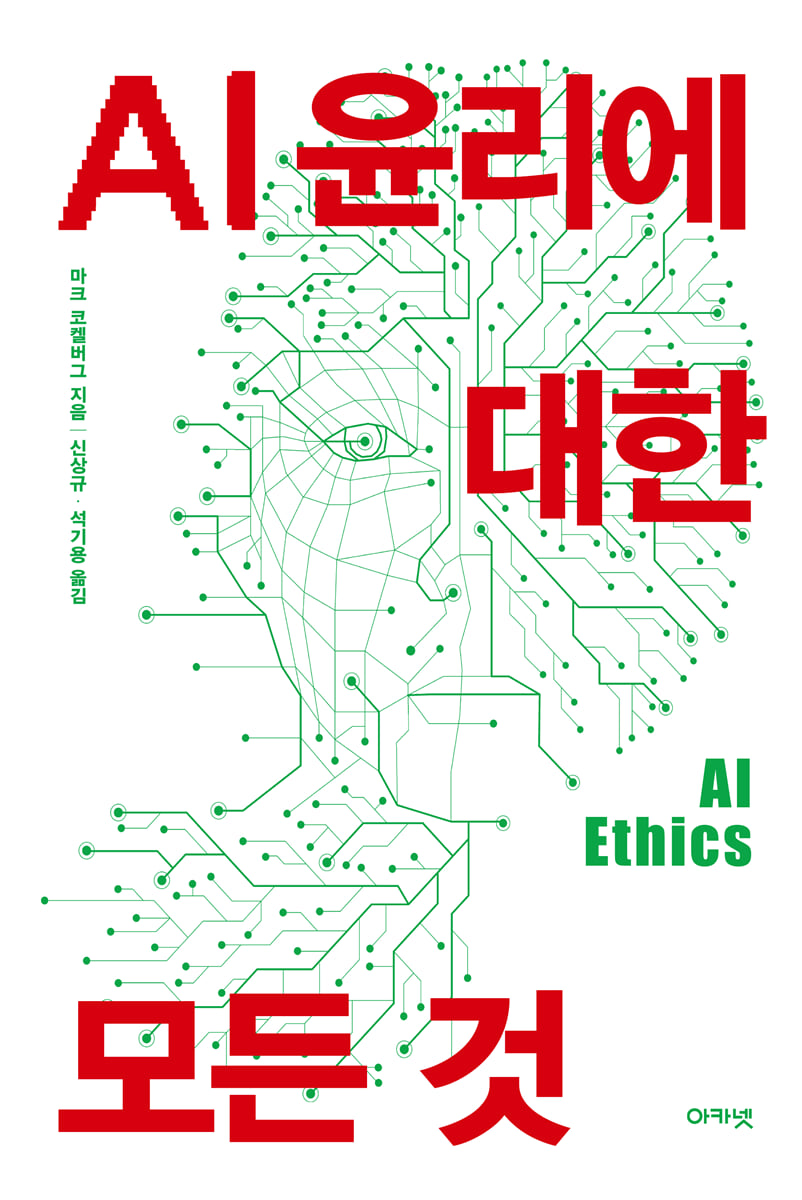
All About AI Ethics
 |
Description
Book Introduction
Guided by world-renowned technology philosopher Mark Cockelberg
All About AI Ethics
The ultimate guide to comprehensive and systematic coverage of ethical issues related to AI.
"Everything About AI Ethics," a translation of AI Ethics (2020), one of MIT Press's "Essential Knowledge Series," is a book that comprehensively and systematically covers ethical issues related to artificial intelligence technology, often referred to as the modern-day "Promethean Fire," while suggesting practical ways to respond to them.
The "Second Machine Age," which followed the 18th-century Industrial Revolution and ushered in with the dazzling innovations of AI technology, is simultaneously evoking conflicting emotions: profound admiration for AI and existential fear.
Today, AI is already being used in many fields, including transportation, marketing, healthcare, finance and insurance, security, military, science, education, office work, entertainment, the arts, agriculture, manufacturing, and even in court decision-making and law enforcement.
As machines evolve beyond simply 'supplementing' humans to the point of 'replacing' them, scenes once depicted only in science fiction are now entering the real world.
This unprecedented technological leap not only poses profound challenges to humanity's self-understanding, but also raises a host of ethical, social, and political issues.
For example, concepts like “superintelligence” and “technological singularity”—the idea that machines will surpass human intelligence—are shaking our long-held beliefs about human exceptionalism or humanism to their core, stoking fears that AI could take over and threaten human lives, and raising questions about how we should assign moral responsibility for self-driving cars or lethal autonomous weapons, and who should be held accountable when something goes wrong.
Concerns about AI-induced privacy violations, the risk of totalitarianism, and the exacerbation of social inequality and prejudice are also constantly being raised.
AI has been compared to Oppenheimer's atomic bomb in that new technologies can have unintended consequences.
This book transcends the numerous exaggerated narratives surrounding AI, comprehensively addressing nearly every issue and controversy related to AI ethics from multiple perspectives, providing a broader perspective on the new technological world we face. While several books on AI ethics have already been published in Korea, following the AI craze, most of them focus on specific issues or are intended for light reading as a general education.
This book, which stands out from other books in its comprehensive, systematic, and precise approach to its subject matter and approach to the problem, presents a critically important topic for reflecting on the harmonious coexistence of humans and machines, making it more relevant to us now than ever.
Mark Coeckelbergh, the author, currently teaches philosophy of media technology at the University of Vienna in Austria and is a former president of the Society for Philosophy and Technology. He is a world-renowned scholar from Belgium who has been leading the discourse on science and technology, including artificial intelligence, and is considered one of the most versatile, profound, and original thinkers in the field of philosophy of technology of our time.
Appointed as a member of UNESCO's World Commission on the Ethics of Science and Technology and participating in policy advisory work, he demonstrates a deep philosophical understanding of human nature and the future, while also presenting policy responses to pressing issues arising from technology, demonstrating his talents as both a theorist and practitioner in this book.
All About AI Ethics
The ultimate guide to comprehensive and systematic coverage of ethical issues related to AI.
"Everything About AI Ethics," a translation of AI Ethics (2020), one of MIT Press's "Essential Knowledge Series," is a book that comprehensively and systematically covers ethical issues related to artificial intelligence technology, often referred to as the modern-day "Promethean Fire," while suggesting practical ways to respond to them.
The "Second Machine Age," which followed the 18th-century Industrial Revolution and ushered in with the dazzling innovations of AI technology, is simultaneously evoking conflicting emotions: profound admiration for AI and existential fear.
Today, AI is already being used in many fields, including transportation, marketing, healthcare, finance and insurance, security, military, science, education, office work, entertainment, the arts, agriculture, manufacturing, and even in court decision-making and law enforcement.
As machines evolve beyond simply 'supplementing' humans to the point of 'replacing' them, scenes once depicted only in science fiction are now entering the real world.
This unprecedented technological leap not only poses profound challenges to humanity's self-understanding, but also raises a host of ethical, social, and political issues.
For example, concepts like “superintelligence” and “technological singularity”—the idea that machines will surpass human intelligence—are shaking our long-held beliefs about human exceptionalism or humanism to their core, stoking fears that AI could take over and threaten human lives, and raising questions about how we should assign moral responsibility for self-driving cars or lethal autonomous weapons, and who should be held accountable when something goes wrong.
Concerns about AI-induced privacy violations, the risk of totalitarianism, and the exacerbation of social inequality and prejudice are also constantly being raised.
AI has been compared to Oppenheimer's atomic bomb in that new technologies can have unintended consequences.
This book transcends the numerous exaggerated narratives surrounding AI, comprehensively addressing nearly every issue and controversy related to AI ethics from multiple perspectives, providing a broader perspective on the new technological world we face. While several books on AI ethics have already been published in Korea, following the AI craze, most of them focus on specific issues or are intended for light reading as a general education.
This book, which stands out from other books in its comprehensive, systematic, and precise approach to its subject matter and approach to the problem, presents a critically important topic for reflecting on the harmonious coexistence of humans and machines, making it more relevant to us now than ever.
Mark Coeckelbergh, the author, currently teaches philosophy of media technology at the University of Vienna in Austria and is a former president of the Society for Philosophy and Technology. He is a world-renowned scholar from Belgium who has been leading the discourse on science and technology, including artificial intelligence, and is considered one of the most versatile, profound, and original thinkers in the field of philosophy of technology of our time.
Appointed as a member of UNESCO's World Commission on the Ethics of Science and Technology and participating in policy advisory work, he demonstrates a deep philosophical understanding of human nature and the future, while also presenting policy responses to pressing issues arising from technology, demonstrating his talents as both a theorist and practitioner in this book.
- You can preview some of the book's contents.
Preview
index
Chapter 1 Mirror, Mirror
Artificial Intelligence Hype and Fears: Mirror, Mirror, On the Wall, Which of Us is the Smartest? | The Impact of AI | For a Discussion on Ethical and Social Issues
Chapter 2: Superintelligence, Monsters, and the Apocalypse
Superintelligence and Transhumanism | Frankenstein's New Monster | Transcendence and the Apocalypse of AI | Beyond Competing Narratives and Exaggerated Stories
Chapter 3: All About Humans
Is General Artificial Intelligence Possible? | Modernity, (Post)Humanism, and Post-Phenomenology
Chapter 4 Just a machine?
The Moral Status of AI | Moral Agency | Moral Passivity | Toward More Practical Ethical Issues
Chapter 5 Technology
What is Artificial Intelligence? | Various Approaches and Subfields | Applications and Impact
Chapter 6: Don't Forget Data (Science)
Machine Learning | Data Science | Applications
Chapter 7: Privacy and Other Potential Suspects
Privacy and Data Protection | Manipulation, Exploitation, and Vulnerable Users | The Dangers of Fake News, Totalitarianism, and the Impact on Personal Relationships | Safety and Security
Chapter 8: Irresponsible Machines and Inexplicable Decisions
How Can We Assign Moral Responsibility? | Transparency and Explainability
Chapter 9: Bias and the Meaning of Life
Bias | The Future of Work and the Meaning of Life
Chapter 10 Policy Proposals
What needs to be done and the questions policymakers need to answer | Ethical principles and legitimacy | Technical solutions and methods, and operational issues
Chapter 11: Challenges for Policymakers
Proactive Ethics | Practice-Oriented and Bottom-Up | Toward Positive Ethics | Interdisciplinary Research and Transdisciplinary Transcendence | The Perils of AI Winter and the Risks of Indiscriminate AI Use
Chapter 12: It's the Climate, You Stupid!
Should AI ethics be human-centered? | Setting priorities correctly | AI, climate change, and the Anthropocene | The new space craze and the Platonic temptation | Returning to Earth | In search of intelligence and wisdom
Acknowledgements
annotation
Translator's Note
Glossary of Terms
References
Recommended Resources
Artificial Intelligence Hype and Fears: Mirror, Mirror, On the Wall, Which of Us is the Smartest? | The Impact of AI | For a Discussion on Ethical and Social Issues
Chapter 2: Superintelligence, Monsters, and the Apocalypse
Superintelligence and Transhumanism | Frankenstein's New Monster | Transcendence and the Apocalypse of AI | Beyond Competing Narratives and Exaggerated Stories
Chapter 3: All About Humans
Is General Artificial Intelligence Possible? | Modernity, (Post)Humanism, and Post-Phenomenology
Chapter 4 Just a machine?
The Moral Status of AI | Moral Agency | Moral Passivity | Toward More Practical Ethical Issues
Chapter 5 Technology
What is Artificial Intelligence? | Various Approaches and Subfields | Applications and Impact
Chapter 6: Don't Forget Data (Science)
Machine Learning | Data Science | Applications
Chapter 7: Privacy and Other Potential Suspects
Privacy and Data Protection | Manipulation, Exploitation, and Vulnerable Users | The Dangers of Fake News, Totalitarianism, and the Impact on Personal Relationships | Safety and Security
Chapter 8: Irresponsible Machines and Inexplicable Decisions
How Can We Assign Moral Responsibility? | Transparency and Explainability
Chapter 9: Bias and the Meaning of Life
Bias | The Future of Work and the Meaning of Life
Chapter 10 Policy Proposals
What needs to be done and the questions policymakers need to answer | Ethical principles and legitimacy | Technical solutions and methods, and operational issues
Chapter 11: Challenges for Policymakers
Proactive Ethics | Practice-Oriented and Bottom-Up | Toward Positive Ethics | Interdisciplinary Research and Transdisciplinary Transcendence | The Perils of AI Winter and the Risks of Indiscriminate AI Use
Chapter 12: It's the Climate, You Stupid!
Should AI ethics be human-centered? | Setting priorities correctly | AI, climate change, and the Anthropocene | The new space craze and the Platonic temptation | Returning to Earth | In search of intelligence and wisdom
Acknowledgements
annotation
Translator's Note
Glossary of Terms
References
Recommended Resources
Into the book
This book aims to provide readers with a comprehensive overview of the ethical issues of AI, from influential narratives about the future of AI and philosophical questions about human nature and the future, to ethical concerns about responsibility and bias, and how policy can address the real-world practical problems raised by the technology. It aims to provide readers with a comprehensive overview of the ethical issues of AI, as soon as possible.
--- p.21-22
Is Western thinking about AI doomed to remain imprisoned by these modern fears and fascinations, along with their ancient roots? Can we move beyond the hype, or will the discussion continue to focus on superintelligence? I believe there is a way out.
First, we can find non-Frankensteinian narratives and non-Platonic ways of thinking about technology outside Western culture.
--- p.41
Continental philosophers usually emphasize that humans and minds are fundamentally different from machines, and they focus on self-conscious human experience and human existence, which cannot and should not be reduced to formal techniques or scientific explanations.
However, other philosophers, usually from the analytic philosophy tradition, support AI researchers' view of humanity.
They believe that the human brain and mind are actually like computer models and work that way.
--- p.48
It is worth noting again that even scientists and philosophers who believe that, in principle, there are many similarities between humans and machines, and that general AI is theoretically possible, often reject Bostrom's vision of superintelligence or similar notions that human-like AI is imminent.
--- p.50
Let's briefly examine three divisions that indirectly shape the ethical debate about AI.
The first is the split between the Enlightenment and Romanticism that arose in the early modern period.
The other two are relatively recent developments.
One is the division between humanism and transhumanism, which are situated in the tension of modernity, and the other is the division between humanism and posthumanism, which seeks to transcend modernity.
--- p.52
Posthumanists question the centrality of humans in modern ontology and ethics.
According to them, nonhumans are also important, and we should not be afraid to cross the boundary between human and nonhuman.
This is an interesting direction of inquiry because it moves beyond the narrative of competition between humans and machines.
--- p.56
This posthumanism seems to free AI from the burden of imitating or reconstructing humans, allowing it to explore various non-human types of existence, intelligence, and creativity. AI need not necessarily be created in human form.
Progress here means opening oneself to nonhuman beings beyond the human and learning from them.
--- p.57-58
Thinking about AI doesn't just tell us something about AI, it tells us something about ourselves.
About how we think, how we actually relate to non-humans, and how we should relate to them.
(Omitted) Questions about AI open up an abyss of critical questions about the nature of human knowledge, human society, and human morality.
--- p.77
Another implication of the statement that AI does not exist in itself is that technology is always social and human. AI is not just about technology, but also about what humans do with it, how they use it, how they perceive and experience it, and how they embed it within the broader social and technological environment.
This is important for ethics, which is also about human decisions, and means that ethics also needs to include historical, social, and cultural perspectives.
--- p.96
The danger here is that even in today's democratic societies, AI could lead to new forms of manipulation, surveillance, and totalitarianism, not necessarily in the form of authoritarian politics, but in more insidious but highly effective ways.
--- p.120
Another issue specific to AI is bias. Bias can arise when AI makes decisions, or more precisely, when it recommends decisions.
That the decision may be unfair or unjust to a particular individual or group.
--- p.149
Beyond the negative ethics that set boundaries, we need to explicitly and precisely develop a positive ethics that advances the vision of a good life and a good society.
--- p.21-22
Is Western thinking about AI doomed to remain imprisoned by these modern fears and fascinations, along with their ancient roots? Can we move beyond the hype, or will the discussion continue to focus on superintelligence? I believe there is a way out.
First, we can find non-Frankensteinian narratives and non-Platonic ways of thinking about technology outside Western culture.
--- p.41
Continental philosophers usually emphasize that humans and minds are fundamentally different from machines, and they focus on self-conscious human experience and human existence, which cannot and should not be reduced to formal techniques or scientific explanations.
However, other philosophers, usually from the analytic philosophy tradition, support AI researchers' view of humanity.
They believe that the human brain and mind are actually like computer models and work that way.
--- p.48
It is worth noting again that even scientists and philosophers who believe that, in principle, there are many similarities between humans and machines, and that general AI is theoretically possible, often reject Bostrom's vision of superintelligence or similar notions that human-like AI is imminent.
--- p.50
Let's briefly examine three divisions that indirectly shape the ethical debate about AI.
The first is the split between the Enlightenment and Romanticism that arose in the early modern period.
The other two are relatively recent developments.
One is the division between humanism and transhumanism, which are situated in the tension of modernity, and the other is the division between humanism and posthumanism, which seeks to transcend modernity.
--- p.52
Posthumanists question the centrality of humans in modern ontology and ethics.
According to them, nonhumans are also important, and we should not be afraid to cross the boundary between human and nonhuman.
This is an interesting direction of inquiry because it moves beyond the narrative of competition between humans and machines.
--- p.56
This posthumanism seems to free AI from the burden of imitating or reconstructing humans, allowing it to explore various non-human types of existence, intelligence, and creativity. AI need not necessarily be created in human form.
Progress here means opening oneself to nonhuman beings beyond the human and learning from them.
--- p.57-58
Thinking about AI doesn't just tell us something about AI, it tells us something about ourselves.
About how we think, how we actually relate to non-humans, and how we should relate to them.
(Omitted) Questions about AI open up an abyss of critical questions about the nature of human knowledge, human society, and human morality.
--- p.77
Another implication of the statement that AI does not exist in itself is that technology is always social and human. AI is not just about technology, but also about what humans do with it, how they use it, how they perceive and experience it, and how they embed it within the broader social and technological environment.
This is important for ethics, which is also about human decisions, and means that ethics also needs to include historical, social, and cultural perspectives.
--- p.96
The danger here is that even in today's democratic societies, AI could lead to new forms of manipulation, surveillance, and totalitarianism, not necessarily in the form of authoritarian politics, but in more insidious but highly effective ways.
--- p.120
Another issue specific to AI is bias. Bias can arise when AI makes decisions, or more precisely, when it recommends decisions.
That the decision may be unfair or unjust to a particular individual or group.
--- p.149
Beyond the negative ethics that set boundaries, we need to explicitly and precisely develop a positive ethics that advances the vision of a good life and a good society.
--- p.204
Publisher's Review
Beyond the hype surrounding AI
This book begins by introducing influential narratives that speak to the development and future of AI.
The most representative example is the story of superintelligence, which states that ultimately, machines will rule us rather than us ruling them.
This is closely related to the idea of a technological singularity, a point at which human history will end as explosive technological advancements make it impossible to understand what is happening to the world.
So the challenge we face today is how to control AI as we wish, and some argue that to do so, humans must upgrade themselves into "gods" using advanced technology.
The author seeks a solution to transcending this narrative of competition between humans and machines, or the 'Frankenstein complex,' outside of Western culture.
There is no eschatological thought there, no Platonic desire to constantly defend human beings as fundamentally superior to machines and to transcend materiality, and one finds a more friendly attitude towards machines.
The author then goes beyond the hype surrounding AI and examines, one by one, whether human-like intelligence is possible in machines, what the differences are between humans and machines, and whether AI is simply a machine or deserves some form of moral consideration, in an effort to avoid limiting ethical discussions about AI to mere dreams or nightmares about the future.
The author then moves beyond philosophical discussions and historical contextualization of AI to explain how AI technology actually operates in our lives today, introducing technologies like symbolic AI and neural network AI along with the history of AI, and taking a closer look at machine learning and data science.
We then outline the issues addressed in AI ethics, including privacy, transparency, explainability, bias, fairness, and inequality, and then examine how to approach these issues from a policy perspective.
Finally, by linking global issues like climate change and energy issues to AI, we delve deeper into how to build a sustainable life.
The translator says this:
“Rather than vaguely fearing AI, blindly trusting it, or passively accepting its benefits and harms, thinking we have no choice, I hope this book provides an opportunity to think about AI and what we can and should do with it.”
This book begins by introducing influential narratives that speak to the development and future of AI.
The most representative example is the story of superintelligence, which states that ultimately, machines will rule us rather than us ruling them.
This is closely related to the idea of a technological singularity, a point at which human history will end as explosive technological advancements make it impossible to understand what is happening to the world.
So the challenge we face today is how to control AI as we wish, and some argue that to do so, humans must upgrade themselves into "gods" using advanced technology.
The author seeks a solution to transcending this narrative of competition between humans and machines, or the 'Frankenstein complex,' outside of Western culture.
There is no eschatological thought there, no Platonic desire to constantly defend human beings as fundamentally superior to machines and to transcend materiality, and one finds a more friendly attitude towards machines.
The author then goes beyond the hype surrounding AI and examines, one by one, whether human-like intelligence is possible in machines, what the differences are between humans and machines, and whether AI is simply a machine or deserves some form of moral consideration, in an effort to avoid limiting ethical discussions about AI to mere dreams or nightmares about the future.
The author then moves beyond philosophical discussions and historical contextualization of AI to explain how AI technology actually operates in our lives today, introducing technologies like symbolic AI and neural network AI along with the history of AI, and taking a closer look at machine learning and data science.
We then outline the issues addressed in AI ethics, including privacy, transparency, explainability, bias, fairness, and inequality, and then examine how to approach these issues from a policy perspective.
Finally, by linking global issues like climate change and energy issues to AI, we delve deeper into how to build a sustainable life.
The translator says this:
“Rather than vaguely fearing AI, blindly trusting it, or passively accepting its benefits and harms, thinking we have no choice, I hope this book provides an opportunity to think about AI and what we can and should do with it.”
GOODS SPECIFICS
- Date of issue: August 25, 2023
- Page count, weight, size: 264 pages | 438g | 140*210*17mm
- ISBN13: 9788957338834
- ISBN10: 8957338837
You may also like
카테고리
korean


korean

![GQ KOREA Mark (Monthly): December [2025]](http://librairie.coreenne.fr/cdn/shop/files/8ef265dbbfbf186523ed75ba7319009d.jpg?v=1765340328&width=3840)


