

I hesitated again today and the day passed by.
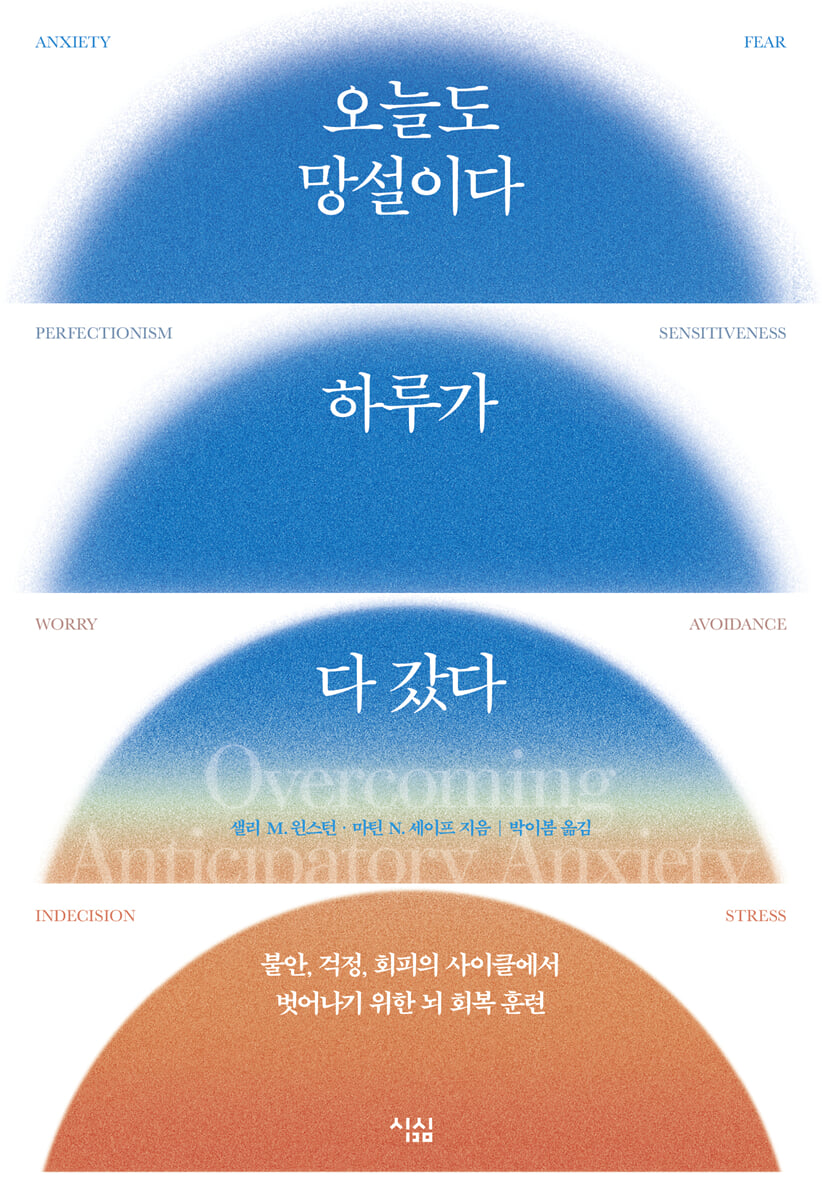 |
Description
Book Introduction
“There is no need to see the destination in advance.
“You just have to look at the one meter in front of you.”
For you who imagine the worst-case scenario at every turn in life.
The psychology of confrontation and recovery guided by an anxiety disorder expert who has treated thousands of people for over 40 years.
Do you frequently experience a fear, days or weeks before an event or occasion, that something terribly bad is about to happen? Do you find yourself procrastinating, making excuses or finding ways to avoid it, and thus reluctant to attend? Instead of feeling excited and thrilled about future events, do you resign yourself to the prospect of experiencing anxiety again? Do you find yourself constantly missing out on desirable experiences because of your timidity and fear? Do you constantly seek safe alternatives and criticize yourself for your lack of confidence? At some point in your life, do you find yourself stuck, unable to move forward, unable to make ends meet?
"Today, I hesitated and the day passed by" is a psychological guide for people who cannot move forward because of worries about the future and the fear that bad things might happen.
The author, an anxiety disorder specialist who has treated thousands of people for over 40 years, analyzes the causes and various types of cycles of anxiety, worry, and avoidance based on brain science and psychological theories, and systematically provides methods to escape chronic hesitation and anticipatory anxiety.
“You just have to look at the one meter in front of you.”
For you who imagine the worst-case scenario at every turn in life.
The psychology of confrontation and recovery guided by an anxiety disorder expert who has treated thousands of people for over 40 years.
Do you frequently experience a fear, days or weeks before an event or occasion, that something terribly bad is about to happen? Do you find yourself procrastinating, making excuses or finding ways to avoid it, and thus reluctant to attend? Instead of feeling excited and thrilled about future events, do you resign yourself to the prospect of experiencing anxiety again? Do you find yourself constantly missing out on desirable experiences because of your timidity and fear? Do you constantly seek safe alternatives and criticize yourself for your lack of confidence? At some point in your life, do you find yourself stuck, unable to move forward, unable to make ends meet?
"Today, I hesitated and the day passed by" is a psychological guide for people who cannot move forward because of worries about the future and the fear that bad things might happen.
The author, an anxiety disorder specialist who has treated thousands of people for over 40 years, analyzes the causes and various types of cycles of anxiety, worry, and avoidance based on brain science and psychological theories, and systematically provides methods to escape chronic hesitation and anticipatory anxiety.
- You can preview some of the book's contents.
Preview
index
preface
1.
Anticipatory anxiety
Fear of the future and the urge to avoid it | Anticipatory anxiety is different from vague anxiety | You're not alone | It occurs at any age | How decisions affect anticipatory anxiety | Coping strategies that unintentionally increase anticipatory anxiety | Types of anticipatory anxiety: imagination, memory, trauma, anxiety sensitivity, and mood states
2.
chronic hesitation
Procrastination is an attitude, not a personality trait | Four ways to avoid decisions | How chronic procrastination manifests itself in everyday life | The cost of inaction
3.
How Our Brain Responds to False Alarms
How the Brain Triggers Anticipatory Anxiety | Our Brain's Alarm Center | The Difference Between Fear and Anxiety | Biological Factors Influencing Anticipatory Anxiety | The Relationship Between Stress and Anticipatory Anxiety | How Real-Life Events Affect Anticipatory Anxiety | The More Important the Event, the Greater the Anguish of Choosing
4.
The cycle of anxiety, worry, and avoidance
Behavioral avoidance | Experiential avoidance | Subtle avoidance that blocks opportunities for success
5.
Anxiety-driven thinking
Six Reasons Why It's Hard to Stop Anxious Thinking | When Effort Backfires | You Can Escape It
6.
Perfectionism, a desire for certainty, and a fear of regret
Perfectionism: An all-or-nothing mentality | The desire for certainty: Constant doubt | The fear of regret: Negative imagery surrounding every choice | Overcoming perfectionism, uncertainty, and the fear of regret
7.
A mindset and metacognitive perspective toward healing
Observing and Dissociating: The Core of a Metacognitive Perspective | Misconceptions About Worry | Shifting Your Mindset to Healing | The Three Inner Voices
8.
Letting go and commitment
Shifting Perspective and Mindset for Recovery | A Non-Judgmental Attitude | DANCE: Five Principles of Letting Go for Healing | Deliberately Expose Yourself to Anxiety | Moving Forward with a Steadfast Attitude
9.
Frequently Asked Questions and Answers
10.
Flexibility and confidence
The place where anxiety disappears | Don't be discouraged by false alarms | Build confidence | It doesn't have to be perfect | P.S.
Acknowledgements
Huzhou
1.
Anticipatory anxiety
Fear of the future and the urge to avoid it | Anticipatory anxiety is different from vague anxiety | You're not alone | It occurs at any age | How decisions affect anticipatory anxiety | Coping strategies that unintentionally increase anticipatory anxiety | Types of anticipatory anxiety: imagination, memory, trauma, anxiety sensitivity, and mood states
2.
chronic hesitation
Procrastination is an attitude, not a personality trait | Four ways to avoid decisions | How chronic procrastination manifests itself in everyday life | The cost of inaction
3.
How Our Brain Responds to False Alarms
How the Brain Triggers Anticipatory Anxiety | Our Brain's Alarm Center | The Difference Between Fear and Anxiety | Biological Factors Influencing Anticipatory Anxiety | The Relationship Between Stress and Anticipatory Anxiety | How Real-Life Events Affect Anticipatory Anxiety | The More Important the Event, the Greater the Anguish of Choosing
4.
The cycle of anxiety, worry, and avoidance
Behavioral avoidance | Experiential avoidance | Subtle avoidance that blocks opportunities for success
5.
Anxiety-driven thinking
Six Reasons Why It's Hard to Stop Anxious Thinking | When Effort Backfires | You Can Escape It
6.
Perfectionism, a desire for certainty, and a fear of regret
Perfectionism: An all-or-nothing mentality | The desire for certainty: Constant doubt | The fear of regret: Negative imagery surrounding every choice | Overcoming perfectionism, uncertainty, and the fear of regret
7.
A mindset and metacognitive perspective toward healing
Observing and Dissociating: The Core of a Metacognitive Perspective | Misconceptions About Worry | Shifting Your Mindset to Healing | The Three Inner Voices
8.
Letting go and commitment
Shifting Perspective and Mindset for Recovery | A Non-Judgmental Attitude | DANCE: Five Principles of Letting Go for Healing | Deliberately Expose Yourself to Anxiety | Moving Forward with a Steadfast Attitude
9.
Frequently Asked Questions and Answers
10.
Flexibility and confidence
The place where anxiety disappears | Don't be discouraged by false alarms | Build confidence | It doesn't have to be perfect | P.S.
Acknowledgements
Huzhou
Detailed image
.jpg)
Into the book
Anticipatory anxiety is worry about the future, the fear that bad things might happen, or the fear that you might not be able to successfully complete something you start.
This is also the anxiety we feel when we anticipate a difficult decision, action, or situation.
It is also the feeling that arises when you creatively imagine worries about what bad things might happen and believe them to be true.
Anticipatory anxiety seems to anticipate danger.
It feels like a warning not to go any further, or at least to proceed cautiously.
--- p.20
Some people who exhibit chronic indecision have general indecision across all areas.
On the other hand, some people have no difficulty making choices in some aspects of their lives, but in other areas, chronic indecision paralyzes their decision-making.
For example, you may be proactive and decisive at work, but passive and make poor choices in romantic relationships.
Or, while they may appear confident in their daily lives, they may find things like choosing a hair salon or deciding where to go on vacation incredibly difficult.
--- p.70
The anticipatory anxiety we feel when we have to make a decision often begins with the question, "What if..."
Also, feeling unable to do anything, like being stuck in a bind, is an attempt to avoid thoughts or feelings like 'I wish I had done something differently' or 'I wish I had done something differently'.
In other words, you feel like you will regret it if you act.
As a result, doing nothing feels safer.
Because inaction leaves us feeling like we're in a temporarily unresolved situation (i.e., a situation with the potential for a "positive" outcome), we postpone and ignore the consequences of our inaction itself.
--- p.94
The amygdala (and certain brain structures surrounding it) is the brain's alarm center.
This alarm center has an evolutionary purpose: to alert us to danger and prepare our bodies and minds to respond to threats.
You've probably heard of it, but this is the fight-or-flight-or-freeze response.
--- p.105
Avoiding stress is not the right way to overcome anticipatory anxiety; rather, it is just another form of avoidance.
And avoidance limits our opportunities to live a flexible life and build confidence in the face of challenges.
In other words, all forms of anxiety are sensitive to stress, but stress is not the cause.
--- p.123
Types of avoidance range from obvious to obvious to both ourselves and others to subtle and difficult to detect.
Ultimately, figuring out what type of avoidance style you have is the first step toward recovery.
Whether it's behavioral avoidance (things you do or don't do) or experiential avoidance (things you think or feel when anxiety arises).
--- p.134
Because avoidance provides almost immediate relief from anxious feelings, we can feel a very strong desire to avoid it.
Unfortunately, the relief from anxiety achieved through avoidance is temporary.
This is because the reduction in anxiety negatively reinforces the avoidance impulses and anticipatory anxiety that precede it.
Avoidance increases the impact of anticipatory anxiety while simultaneously reducing our sense of control.
--- p.147
Without experiencing new things that challenge your false assumptions about yourself, you remain stuck, relying solely on old memories and imagination.
This is because the brain always follows the old paths it has always taken.
Therefore, if you want to grow beyond this, you must avoid avoidance.
--- p.149
Anticipatory anxiety actually calms down when left alone.
If you dwell on it or try to resolve it—that is, if you continue to ruminate or avoid it—the anticipatory anxiety will only get worse.
Trying so hard to calm down your anticipatory anxiety while feeling the urgency and pressure to calm down quickly is as paradoxical and irrational as yelling at yourself, “If you don’t fall asleep soon, I won’t leave you alone.”
--- p.172
Metacognition encompasses our beliefs about our own minds, our evaluations of what our minds experience, and our attitudes toward thoughts, memories, sensations, and emotions.
It's about broadening your perspective, stepping back and observing yourself.
And when we say, 'I am thinking about a thought,' it is the ability to identify the 'I' who is thinking by separating it from the thought itself.
--- p.213
What matters is not the content of the thoughts you worry about.
How the thought arises and feels over time is much more important, but worrying thoughts are usually repetitive and make you feel terrible.
And the internal dialogue between the worried voice and the false comfort continues to become entangled in the content of catastrophic imagination and cannot escape.
It is this very entanglement, not the content of the thoughts, that is the crux of the problem.
The metacognitive shift that a wise mind brings about is to step back from the content of those thoughts and look at the process.
--- p.237
Recovery means separating yourself from the imaginary content that causes anxiety and not being disturbed when anxious thoughts, sensations, and emotions appear.
And while acknowledging the discomfort you felt in the past, you don't let that memory stop you.
Recovery also doesn't mean never having anxiety-inducing imaginations or never hesitating over choices.
It also doesn't mean being completely free from the influence of worry.
--- pp.316~317
However, it is important not to be discouraged when you see these false alarms or other anxiety symptoms.
This should be considered part of the recovery process.
Also, when something like this happens, we must not get lost in the question of 'why'.
It's okay to allow automatic arousal and fleeting anxious imaginations to simply exist in the background of your experiences.
If you can just separate yourself from those imaginary contents, you don't have to try hard.
You also take all of this as evidence that you have achieved a lot, that you are still recovering, and that your brain circuits are being rewired.
--- p.320
As I said before, nothing builds confidence more than seeing yourself bravely moving forward.
Even if you're not 'sure' that you can succeed, you can only build confidence by taking action and moving forward.
Each time we overcome the urge to avoid something, we create a new attitude toward ourselves.
With that attitude, you can live a life true to the present moment, be kind to yourself when you feel anxious, and prove to yourself that you can do it even when you feel anxious.
Anticipatory anxiety and chronic hesitation can no longer torment us.
Because even if such problems arise, we will not give them power.
This is also the anxiety we feel when we anticipate a difficult decision, action, or situation.
It is also the feeling that arises when you creatively imagine worries about what bad things might happen and believe them to be true.
Anticipatory anxiety seems to anticipate danger.
It feels like a warning not to go any further, or at least to proceed cautiously.
--- p.20
Some people who exhibit chronic indecision have general indecision across all areas.
On the other hand, some people have no difficulty making choices in some aspects of their lives, but in other areas, chronic indecision paralyzes their decision-making.
For example, you may be proactive and decisive at work, but passive and make poor choices in romantic relationships.
Or, while they may appear confident in their daily lives, they may find things like choosing a hair salon or deciding where to go on vacation incredibly difficult.
--- p.70
The anticipatory anxiety we feel when we have to make a decision often begins with the question, "What if..."
Also, feeling unable to do anything, like being stuck in a bind, is an attempt to avoid thoughts or feelings like 'I wish I had done something differently' or 'I wish I had done something differently'.
In other words, you feel like you will regret it if you act.
As a result, doing nothing feels safer.
Because inaction leaves us feeling like we're in a temporarily unresolved situation (i.e., a situation with the potential for a "positive" outcome), we postpone and ignore the consequences of our inaction itself.
--- p.94
The amygdala (and certain brain structures surrounding it) is the brain's alarm center.
This alarm center has an evolutionary purpose: to alert us to danger and prepare our bodies and minds to respond to threats.
You've probably heard of it, but this is the fight-or-flight-or-freeze response.
--- p.105
Avoiding stress is not the right way to overcome anticipatory anxiety; rather, it is just another form of avoidance.
And avoidance limits our opportunities to live a flexible life and build confidence in the face of challenges.
In other words, all forms of anxiety are sensitive to stress, but stress is not the cause.
--- p.123
Types of avoidance range from obvious to obvious to both ourselves and others to subtle and difficult to detect.
Ultimately, figuring out what type of avoidance style you have is the first step toward recovery.
Whether it's behavioral avoidance (things you do or don't do) or experiential avoidance (things you think or feel when anxiety arises).
--- p.134
Because avoidance provides almost immediate relief from anxious feelings, we can feel a very strong desire to avoid it.
Unfortunately, the relief from anxiety achieved through avoidance is temporary.
This is because the reduction in anxiety negatively reinforces the avoidance impulses and anticipatory anxiety that precede it.
Avoidance increases the impact of anticipatory anxiety while simultaneously reducing our sense of control.
--- p.147
Without experiencing new things that challenge your false assumptions about yourself, you remain stuck, relying solely on old memories and imagination.
This is because the brain always follows the old paths it has always taken.
Therefore, if you want to grow beyond this, you must avoid avoidance.
--- p.149
Anticipatory anxiety actually calms down when left alone.
If you dwell on it or try to resolve it—that is, if you continue to ruminate or avoid it—the anticipatory anxiety will only get worse.
Trying so hard to calm down your anticipatory anxiety while feeling the urgency and pressure to calm down quickly is as paradoxical and irrational as yelling at yourself, “If you don’t fall asleep soon, I won’t leave you alone.”
--- p.172
Metacognition encompasses our beliefs about our own minds, our evaluations of what our minds experience, and our attitudes toward thoughts, memories, sensations, and emotions.
It's about broadening your perspective, stepping back and observing yourself.
And when we say, 'I am thinking about a thought,' it is the ability to identify the 'I' who is thinking by separating it from the thought itself.
--- p.213
What matters is not the content of the thoughts you worry about.
How the thought arises and feels over time is much more important, but worrying thoughts are usually repetitive and make you feel terrible.
And the internal dialogue between the worried voice and the false comfort continues to become entangled in the content of catastrophic imagination and cannot escape.
It is this very entanglement, not the content of the thoughts, that is the crux of the problem.
The metacognitive shift that a wise mind brings about is to step back from the content of those thoughts and look at the process.
--- p.237
Recovery means separating yourself from the imaginary content that causes anxiety and not being disturbed when anxious thoughts, sensations, and emotions appear.
And while acknowledging the discomfort you felt in the past, you don't let that memory stop you.
Recovery also doesn't mean never having anxiety-inducing imaginations or never hesitating over choices.
It also doesn't mean being completely free from the influence of worry.
--- pp.316~317
However, it is important not to be discouraged when you see these false alarms or other anxiety symptoms.
This should be considered part of the recovery process.
Also, when something like this happens, we must not get lost in the question of 'why'.
It's okay to allow automatic arousal and fleeting anxious imaginations to simply exist in the background of your experiences.
If you can just separate yourself from those imaginary contents, you don't have to try hard.
You also take all of this as evidence that you have achieved a lot, that you are still recovering, and that your brain circuits are being rewired.
--- p.320
As I said before, nothing builds confidence more than seeing yourself bravely moving forward.
Even if you're not 'sure' that you can succeed, you can only build confidence by taking action and moving forward.
Each time we overcome the urge to avoid something, we create a new attitude toward ourselves.
With that attitude, you can live a life true to the present moment, be kind to yourself when you feel anxious, and prove to yourself that you can do it even when you feel anxious.
Anticipatory anxiety and chronic hesitation can no longer torment us.
Because even if such problems arise, we will not give them power.
--- p.322
Publisher's Review
Chronic hesitation and the urge to avoid are attitudes, not personality traits.
Brain recovery training to break free from the cycle of anxiety, worry, and avoidance.
According to the 2021 Mental Health Survey conducted by the Ministry of Health and Welfare, 9.3% of Koreans are diagnosed with an anxiety disorder at least once in their lifetime, and the proportion of people who experienced an anxiety disorder between 2020 and 2021 reached 3.1%.
This rate is even higher than that of depression. The most frequently felt emotions among Generation MZ were anxiety and helplessness.
As such, anxiety is a very common emotion felt by modern people.
Anxiety is usually accompanied by concerns about the future and doubts about one's own performance, safety, or well-being, and it affects many of the choices one makes in daily life (p. 19).
Anxiety, in a word, puts the brakes on my freedom to lead my life as I wish.
Anxiety comes in countless forms and shapes, including phobias, social anxiety, and panic attacks, but most people who experience anxiety experience certain symptoms.
It is 'anticipatory anxiety'.
Anticipatory anxiety is the impulse to anticipate and avoid risks due to worries about the future, fears that bad things might happen, or fears that things might not be completed successfully.
Most studies estimate that about 15 percent of the general population is affected by anticipatory anxiety (p. 30).
"Today, I hesitated and the day passed by" is a book for people who suffer from chronic hesitation and anticipatory anxiety, trapped in a cycle of anxiety, worry, and avoidance due to fear of what might happen in the future.
The authors, who are psychologists and anxiety disorder experts who have studied anxiety disorders for over 40 years, analyze the causes and various types of anticipatory anxiety and chronic hesitation based on their experience treating thousands of people and the latest brain science and psychological theories, and suggest ways to escape from anticipatory anxiety and chronic hesitation.
The biggest difference of this book is that it helps you eradicate anxious thoughts by introducing a metacognitive perspective, practicing the process of observing your own attitudes and separating the content of your thoughts and emotions.
The authors emphasize that true healing and recovery can only be achieved by changing one's attitude and way of thinking about anxiety, rather than trying to deny and eliminate anxious feelings.
The beauty of this book is that it encourages us to recognize that anxiety is a universal feeling, that chronic hesitation is an attitude, not an innate trait, and that it can be overcome with effort.
Recognizing this fact is the starting point for changing your mindset.
“I was born this way”, “I procrastinate a lot.
If you tend to criticize and blame yourself for things like, “I’m an untrustworthy person,” or “I’m dependent, vulnerable, and insecure,” follow the guidance in this book and train your brain to focus on the “present” rather than the “future.”
By stepping back from anxious fantasies about the future, you can understand what's happening now, face your fears, make decisions big and small, and live a more vibrant life.
What am I hesitating and avoiding?
The first step toward breaking free from behavioral patterns created by anxious thinking.
This book says that to escape the cycle of anxiety, worry, and avoidance, you must first understand the true nature of the 'hesitation' and 'avoidance' you experience.
Anticipatory anxiety causes another problem called "chronic indecision," which is a state of near-paralysis in which you are unable to make decisions, big or small.
For example, you might spend years researching something to buy and never make a decision, or you might feel like every decision you have to make feels like a huge, complex ordeal, and then you end up putting off the decision again.
Because of their perfectionist tendencies, they make a list of pros and cons for each option, but sometimes they find it difficult to reject any option, so they take no action.
According to the book, this behavior occurs because the imagination created by anxious thoughts takes over the mind, causing cognitive distortion.
This can be assuming the worst outcome for any experience, focusing only on risk-taking to avoid actions, selectively emphasizing memories (memories of mistakes, failures, losses, and embarrassments), or taking errors in thinking as serious warnings.
Avoidance also activates and maintains anticipatory anxiety and chronic hesitation, because temporarily avoiding an event or behavior provides immediate relief from anxious feelings.
Identifying your avoidance style is the first step toward recovery. This book introduces the types of avoidance: behavioral avoidance (things you do or don't do) and experiential avoidance (things you think or feel when anxiety arises), and analyzes how avoidance worsens anticipatory anxiety (p. 145).
This cycle of anxiety, worry, and avoidance limits our actions and blocks our opportunities for success.
The author has been running a treatment program for aviophobia for over 17 years, and says that most participants realize after successfully completing the flying experience that their expectation that they would not be able to fly was an absurd imagination (p. 156).
Many people who actually suffer from aviophobia have lost their jobs or missed seeing loved ones who live across the continent because of their fear of flying.
To break free from the behavioral patterns created by anxious thinking, it's important to examine which of your anxious thoughts are unfounded beliefs, whether you're relying on your intuition or feelings in an undesirable way rather than making decisions based on facts, and to distinguish between "realistic predictions" and "false imaginations."
False alarms from your brain and body distort your imagination.
Thought exercises to shake off unwanted emotions and thoughts
So where do "false imaginations" come from? We're all born without any sense of anxiety, but through experience, we naturally develop the ability to imagine danger—for example, being wary of hot pots or being afraid of walking at night.
The amygdala in the brain evolved to act as an 'alarm center', helping one generation survive until it passes on its DNA to the next.
The amygdala sounds false alarms ('false alarms') at the slightest sign of danger, because although a false alarm may not affect survival, a failure to warn of real danger could be disastrous (p. 105).
When the amygdala sounds a false alarm, people who are genetically predisposed to "anxiety sensitivity" and have a tendency to have trouble letting go of unnecessary thoughts are more likely to experience anticipatory anxiety and chronic hesitation.
Even when we experience tension or arousal due to false alarms, which are a natural part of our body's emergency response system and not a dangerous situation at all, people perceive an accelerated heart rate as harmful when it is caused by an alarm response.
The author says that the alarm system is sending false signals, causing the body to react as if a real danger exists, and that nothing bad is actually happening, and that it is important to distinguish between these two (p. 116).
The book suggests that simply making a conscious effort to discern false alarms can reduce the likelihood of experiencing anticipatory anxiety.
For example, if you recognize that you are more sensitive at certain moments, it can help you understand the situation and look at yourself objectively when anticipatory anxiety arises.
Because we can remember that sometimes the danger we perceive is exaggerated.
It may also be helpful to write down when you find it more difficult to let go of unwanted feelings and thoughts in your life and see if you can spot any particular patterns (p. 128).
What matters is not what you think about, but how you think about it.
Letting Go Strategies to Conquer Worry and Fear and Move Toward Healing
Many people have misconceptions about 'worry'.
I believe that worrying about someone is love and concern for that person, and that worry protects you from mistakes.
But worrying too much can actually have the opposite effect.
A mother who tried to protect her daughter from various stresses, dangers, and mistakes discovered later that her daughter was being bullied at school.
The daughter was afraid that her mother would always step in and offer to help, so she couldn't say anything for fear that she would make things worse.
Many people also believe that worrying helps them solve problems and protects them.
If you're worried about a friend's wedding in December and you're afraid of driving in the snow, you might end up fantasizing about it, which is unproductive, even though nothing has actually happened.
The authors argue that misconceptions about worry are the basis of anticipatory anxiety, and that overcoming them requires changing our attitudes and thinking about anxiety.
Here, the attitude toward anxiety means changing to anticipate, accept, and allow anxious feelings to arise (p. 228).
Fighting anxious feelings and trying to force them to calm down only leads to impatience and desperation, which is not helpful.
The key to changing your mindset is to step back from your anxious feelings, observe them, and separate yourself from the content of your thoughts.
For example, if you're worried about something like, "What if I have a panic attack when I get on the train?", you can say, "Don't worry.
Rather than getting involved in your thoughts like, 'Nothing that bad will happen,' you can acknowledge your thoughts and anxieties by saying, 'I'm having thoughts that are making me anxious right now,' and distance yourself from those thoughts and feelings.
The authors define this process as “letting go toward healing,” and introduce a practice method based on five principles (identifying, accepting, rejecting, committing, and embracing) to help you learn it yourself (p. 273).
The journey to recovery can be slow, with anticipatory anxiety and chronic hesitation.
The author says that, above all, if you let go of the idea that you have to be perfect, observe yourself without judging yourself, and build confidence by taking action one by one even if you feel uneasy, you can live a more flexible and free life.
“You don’t have to see everything you’re going to pass on the road; you just have to look at the distance of about a meter in front of you.”
Brain recovery training to break free from the cycle of anxiety, worry, and avoidance.
According to the 2021 Mental Health Survey conducted by the Ministry of Health and Welfare, 9.3% of Koreans are diagnosed with an anxiety disorder at least once in their lifetime, and the proportion of people who experienced an anxiety disorder between 2020 and 2021 reached 3.1%.
This rate is even higher than that of depression. The most frequently felt emotions among Generation MZ were anxiety and helplessness.
As such, anxiety is a very common emotion felt by modern people.
Anxiety is usually accompanied by concerns about the future and doubts about one's own performance, safety, or well-being, and it affects many of the choices one makes in daily life (p. 19).
Anxiety, in a word, puts the brakes on my freedom to lead my life as I wish.
Anxiety comes in countless forms and shapes, including phobias, social anxiety, and panic attacks, but most people who experience anxiety experience certain symptoms.
It is 'anticipatory anxiety'.
Anticipatory anxiety is the impulse to anticipate and avoid risks due to worries about the future, fears that bad things might happen, or fears that things might not be completed successfully.
Most studies estimate that about 15 percent of the general population is affected by anticipatory anxiety (p. 30).
"Today, I hesitated and the day passed by" is a book for people who suffer from chronic hesitation and anticipatory anxiety, trapped in a cycle of anxiety, worry, and avoidance due to fear of what might happen in the future.
The authors, who are psychologists and anxiety disorder experts who have studied anxiety disorders for over 40 years, analyze the causes and various types of anticipatory anxiety and chronic hesitation based on their experience treating thousands of people and the latest brain science and psychological theories, and suggest ways to escape from anticipatory anxiety and chronic hesitation.
The biggest difference of this book is that it helps you eradicate anxious thoughts by introducing a metacognitive perspective, practicing the process of observing your own attitudes and separating the content of your thoughts and emotions.
The authors emphasize that true healing and recovery can only be achieved by changing one's attitude and way of thinking about anxiety, rather than trying to deny and eliminate anxious feelings.
The beauty of this book is that it encourages us to recognize that anxiety is a universal feeling, that chronic hesitation is an attitude, not an innate trait, and that it can be overcome with effort.
Recognizing this fact is the starting point for changing your mindset.
“I was born this way”, “I procrastinate a lot.
If you tend to criticize and blame yourself for things like, “I’m an untrustworthy person,” or “I’m dependent, vulnerable, and insecure,” follow the guidance in this book and train your brain to focus on the “present” rather than the “future.”
By stepping back from anxious fantasies about the future, you can understand what's happening now, face your fears, make decisions big and small, and live a more vibrant life.
What am I hesitating and avoiding?
The first step toward breaking free from behavioral patterns created by anxious thinking.
This book says that to escape the cycle of anxiety, worry, and avoidance, you must first understand the true nature of the 'hesitation' and 'avoidance' you experience.
Anticipatory anxiety causes another problem called "chronic indecision," which is a state of near-paralysis in which you are unable to make decisions, big or small.
For example, you might spend years researching something to buy and never make a decision, or you might feel like every decision you have to make feels like a huge, complex ordeal, and then you end up putting off the decision again.
Because of their perfectionist tendencies, they make a list of pros and cons for each option, but sometimes they find it difficult to reject any option, so they take no action.
According to the book, this behavior occurs because the imagination created by anxious thoughts takes over the mind, causing cognitive distortion.
This can be assuming the worst outcome for any experience, focusing only on risk-taking to avoid actions, selectively emphasizing memories (memories of mistakes, failures, losses, and embarrassments), or taking errors in thinking as serious warnings.
Avoidance also activates and maintains anticipatory anxiety and chronic hesitation, because temporarily avoiding an event or behavior provides immediate relief from anxious feelings.
Identifying your avoidance style is the first step toward recovery. This book introduces the types of avoidance: behavioral avoidance (things you do or don't do) and experiential avoidance (things you think or feel when anxiety arises), and analyzes how avoidance worsens anticipatory anxiety (p. 145).
This cycle of anxiety, worry, and avoidance limits our actions and blocks our opportunities for success.
The author has been running a treatment program for aviophobia for over 17 years, and says that most participants realize after successfully completing the flying experience that their expectation that they would not be able to fly was an absurd imagination (p. 156).
Many people who actually suffer from aviophobia have lost their jobs or missed seeing loved ones who live across the continent because of their fear of flying.
To break free from the behavioral patterns created by anxious thinking, it's important to examine which of your anxious thoughts are unfounded beliefs, whether you're relying on your intuition or feelings in an undesirable way rather than making decisions based on facts, and to distinguish between "realistic predictions" and "false imaginations."
False alarms from your brain and body distort your imagination.
Thought exercises to shake off unwanted emotions and thoughts
So where do "false imaginations" come from? We're all born without any sense of anxiety, but through experience, we naturally develop the ability to imagine danger—for example, being wary of hot pots or being afraid of walking at night.
The amygdala in the brain evolved to act as an 'alarm center', helping one generation survive until it passes on its DNA to the next.
The amygdala sounds false alarms ('false alarms') at the slightest sign of danger, because although a false alarm may not affect survival, a failure to warn of real danger could be disastrous (p. 105).
When the amygdala sounds a false alarm, people who are genetically predisposed to "anxiety sensitivity" and have a tendency to have trouble letting go of unnecessary thoughts are more likely to experience anticipatory anxiety and chronic hesitation.
Even when we experience tension or arousal due to false alarms, which are a natural part of our body's emergency response system and not a dangerous situation at all, people perceive an accelerated heart rate as harmful when it is caused by an alarm response.
The author says that the alarm system is sending false signals, causing the body to react as if a real danger exists, and that nothing bad is actually happening, and that it is important to distinguish between these two (p. 116).
The book suggests that simply making a conscious effort to discern false alarms can reduce the likelihood of experiencing anticipatory anxiety.
For example, if you recognize that you are more sensitive at certain moments, it can help you understand the situation and look at yourself objectively when anticipatory anxiety arises.
Because we can remember that sometimes the danger we perceive is exaggerated.
It may also be helpful to write down when you find it more difficult to let go of unwanted feelings and thoughts in your life and see if you can spot any particular patterns (p. 128).
What matters is not what you think about, but how you think about it.
Letting Go Strategies to Conquer Worry and Fear and Move Toward Healing
Many people have misconceptions about 'worry'.
I believe that worrying about someone is love and concern for that person, and that worry protects you from mistakes.
But worrying too much can actually have the opposite effect.
A mother who tried to protect her daughter from various stresses, dangers, and mistakes discovered later that her daughter was being bullied at school.
The daughter was afraid that her mother would always step in and offer to help, so she couldn't say anything for fear that she would make things worse.
Many people also believe that worrying helps them solve problems and protects them.
If you're worried about a friend's wedding in December and you're afraid of driving in the snow, you might end up fantasizing about it, which is unproductive, even though nothing has actually happened.
The authors argue that misconceptions about worry are the basis of anticipatory anxiety, and that overcoming them requires changing our attitudes and thinking about anxiety.
Here, the attitude toward anxiety means changing to anticipate, accept, and allow anxious feelings to arise (p. 228).
Fighting anxious feelings and trying to force them to calm down only leads to impatience and desperation, which is not helpful.
The key to changing your mindset is to step back from your anxious feelings, observe them, and separate yourself from the content of your thoughts.
For example, if you're worried about something like, "What if I have a panic attack when I get on the train?", you can say, "Don't worry.
Rather than getting involved in your thoughts like, 'Nothing that bad will happen,' you can acknowledge your thoughts and anxieties by saying, 'I'm having thoughts that are making me anxious right now,' and distance yourself from those thoughts and feelings.
The authors define this process as “letting go toward healing,” and introduce a practice method based on five principles (identifying, accepting, rejecting, committing, and embracing) to help you learn it yourself (p. 273).
The journey to recovery can be slow, with anticipatory anxiety and chronic hesitation.
The author says that, above all, if you let go of the idea that you have to be perfect, observe yourself without judging yourself, and build confidence by taking action one by one even if you feel uneasy, you can live a more flexible and free life.
“You don’t have to see everything you’re going to pass on the road; you just have to look at the distance of about a meter in front of you.”
GOODS SPECIFICS
- Date of issue: June 23, 2023
- Page count, weight, size: 340 pages | 414g | 137*200*23mm
- ISBN13: 9791156754183
- ISBN10: 1156754186
You may also like
카테고리
korean


korean

![GQ KOREA Mark (Monthly): December [2025]](http://librairie.coreenne.fr/cdn/shop/files/8ef265dbbfbf186523ed75ba7319009d.jpg?v=1765340328&width=3840)


