

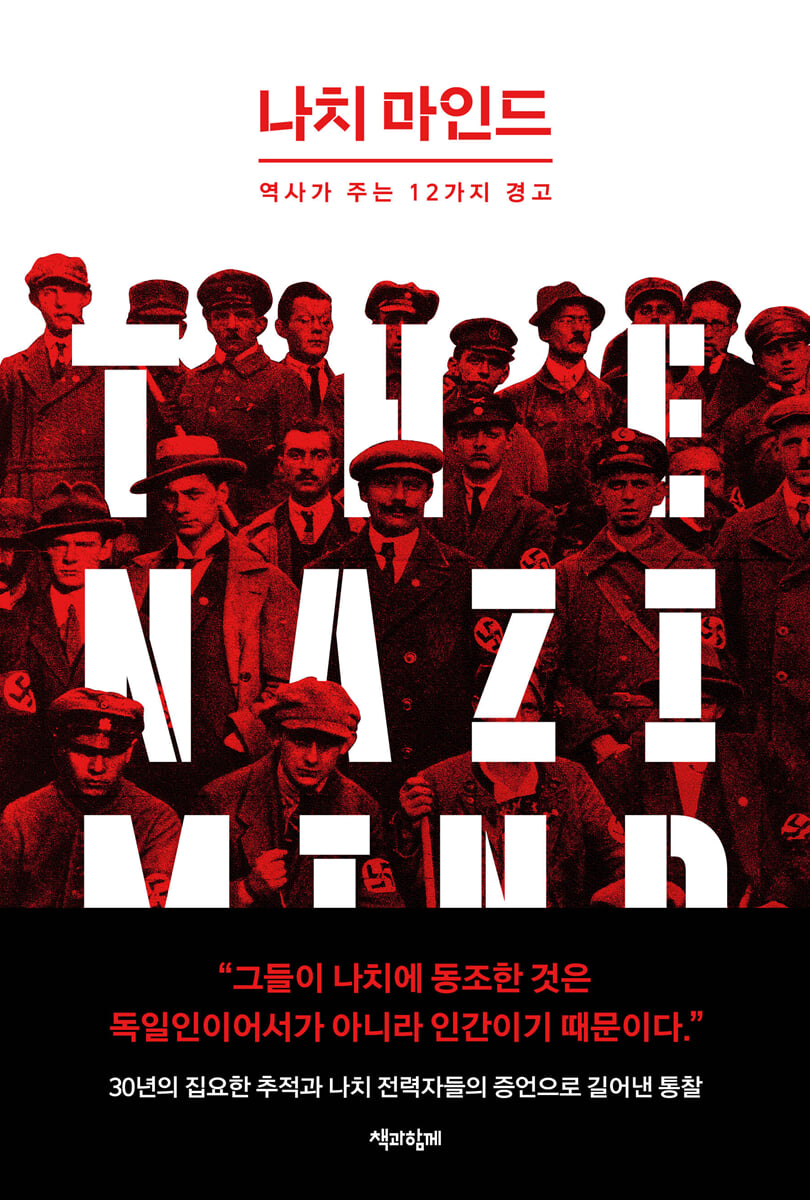
Nazi Mind
 |
Description
Book Introduction
The Nazis are gone, but the essence of Nazism lives on.
How they captured the hearts of ordinary people
A sharp warning that cuts to the heart of Nazi propaganda tactics.
How did the Nazis, a small minority, seize control of Germany? Why were educated people drawn to Nazi propaganda? Lawrence Riess, who has doggedly pursued the Nazis for over 30 years, combines history and psychology to delve into the dark abyss of Nazism and humanity.
It traces the rise and fall of the Nazis, drawing on newly revealed testimonies of former Nazis, the memories of a generation that grew up under the Nazi regime, and the latest advances in psychology, including research on authority, obedience, group psychology, and the brain.
This book does not explain Nazi history as a simple series of political events.
It details twelve strategies Hitler and the Nazis used at crucial moments, including spreading conspiracy theories, dividing groups, corrupting youth, and instilling fear.
This provides a three-dimensional view of how the Nazis encroached upon society as a whole, undermining democracy, and how ordinary people gradually became desensitized and ultimately participated in genocide.
The author emphasizes that the Nazis' crimes were the result of a combination of historical conditions and the vulnerability of human psychology, and argues that although the Nazis have disappeared, the essence of Nazism—hatred, scapegoating, anti-Semitism, racism, and extreme nationalism—still remains.
More significantly, it is a warning that history does not always repeat itself, and that a similar situation could befall us as well.
How should I act then? The author argues that the answer must be found in history.
How they captured the hearts of ordinary people
A sharp warning that cuts to the heart of Nazi propaganda tactics.
How did the Nazis, a small minority, seize control of Germany? Why were educated people drawn to Nazi propaganda? Lawrence Riess, who has doggedly pursued the Nazis for over 30 years, combines history and psychology to delve into the dark abyss of Nazism and humanity.
It traces the rise and fall of the Nazis, drawing on newly revealed testimonies of former Nazis, the memories of a generation that grew up under the Nazi regime, and the latest advances in psychology, including research on authority, obedience, group psychology, and the brain.
This book does not explain Nazi history as a simple series of political events.
It details twelve strategies Hitler and the Nazis used at crucial moments, including spreading conspiracy theories, dividing groups, corrupting youth, and instilling fear.
This provides a three-dimensional view of how the Nazis encroached upon society as a whole, undermining democracy, and how ordinary people gradually became desensitized and ultimately participated in genocide.
The author emphasizes that the Nazis' crimes were the result of a combination of historical conditions and the vulnerability of human psychology, and argues that although the Nazis have disappeared, the essence of Nazism—hatred, scapegoating, anti-Semitism, racism, and extreme nationalism—still remains.
More significantly, it is a warning that history does not always repeat itself, and that a similar situation could befall us as well.
How should I act then? The author argues that the answer must be found in history.
- You can preview some of the book's contents.
Preview
index
Entering
1.
Spreading conspiracy theories
2.
Distinguishing between 'them' and 'us'
3.
Leading as a hero
4.
Corrupting the youth
5.
Conspiring with the elite
6.
Attacking human rights
7.
Using faith
8.
Assessing the enemy
9.
Breaking the Resistance
10.
Strengthening racialism
11.
Kill from a distance
12.
Raising fear
In conclusion
12 warnings
Acknowledgements
Translator's Note
main
Search
1.
Spreading conspiracy theories
2.
Distinguishing between 'them' and 'us'
3.
Leading as a hero
4.
Corrupting the youth
5.
Conspiring with the elite
6.
Attacking human rights
7.
Using faith
8.
Assessing the enemy
9.
Breaking the Resistance
10.
Strengthening racialism
11.
Kill from a distance
12.
Raising fear
In conclusion
12 warnings
Acknowledgements
Translator's Note
main
Search
Into the book
My meeting with Margot Hilscher had a profound impact on me, as did my meeting with the Waffen-SS officer who considered the Third Reich to be Germany's "golden age."
Both of them asked me how I would have behaved if I had lived at that time in German history.
But since we are each a product of the complex relationship between our ecology and the environment in which we live, I'm not sure how I would have done it.
So I asked myself a related question:
If my life changed drastically today, how would I act? …
As many examples in this book demonstrate, human behavior changes as circumstances change.
Understanding why things have changed so dramatically and what we can learn from that history for today is a difficult task we must tackle.
--- p.21 「Introduction
Given the optimistic atmosphere of May 1918, it is no wonder that many Germans sought to explain the catastrophic turn of events with all sorts of conspiracy theories.
These conspiracy theories often included delusions of betrayal orchestrated by Jews and socialist politicians.
But the real reason for Germany's defeat was more prosaic.
It is true that the German army made great progress in the spring of 1918, but this was achieved at great cost.
The number of dead, wounded, prisoners of war, and missing exceeded 680,000.
--- p.45 「1.
From "Spreading Conspiracy Theories"
It is neuroscientifically inevitable that the average human being will very quickly and powerfully be drawn into the "them/us" dichotomy and develop a tendency to think that "they" are not such great people.
So it's incredibly easy to manipulate people into thinking who they consider them and who they consider us.
Germany and Hitler in general are a lesson in the power of false speciation [i.e., judging who belongs to a type of 'them' that is hardly different from 'us'].” If we look at this history, we will see many examples of how important the 'them/us dichotomy' was to Nazism.
It is no exaggeration to say that this is the true core of that ideology.
Hitler intuitively understood the power of this approach without having studied neuroscience or psychology.
--- p.67-68 「2.
From “Distinguishing Between ‘Them’ and ‘Us’”
For Goebbels, who was steeped in nationalist yearning for a strong figure to emerge and save Germany, Hitler was bound to be attractive, especially after his "heroic" performance at the Putsch trials.
In this way, Nazism filled the gap in Goebbels' personality.
Nazism not only gave him something to believe in.
Nazism completely changed his life.
Although his physical disability had prevented him from going to war, he now threw himself into this new struggle with the fervor of a fanatic.
--- p.125 「3.
From "Leading as a Hero"
Psychological research helps us understand why so many young people were easily swayed by the Nazis' extreme and radical message and why the Nazis so skillfully targeted youth.
Here's why it's important.
The prefrontal cortex, the area of the brain that controls emotional stimuli and analyzes problems, isn't fully formed until around age twenty-five.
… Professor Sapolsky says this:
“The most interesting thing about adolescence is that it is not only the time in life when you are most likely to become a murderer, but also the time when you are most likely to dedicate your life to becoming Mother Teresa.
If you're thinking of starting a new religion, then this is the time.
If you foolishly want to impress your parents by donating all your savings to charity, then that's the time.
If you want to embrace the ideology of hate, then this is the time.
Puberty is an extreme state.
--- p.151-152 「4.
From "Corrupting Youth"
It is clear that Hindenburg and the elite around him had a tendency toward groupthink.
This psychological phenomenon occurs when group members become convinced that they have arrived at the right solution to a problem, even if they have not adequately considered all the negative implications and potential alternatives.
This is especially likely to occur when decisions are made under pressure and when there is a lack of diversity among the members of the decision-making group.
This is exactly the case.
The group, which had the same elite background as Hindenburg, could not foresee the consequences of appointing Hitler as chancellor.
Instead, they were fooled into thinking they could control Hitler once he took office.
…
In the end, Hitler easily came to power with the tacit approval of the German elite.
Removing him turns out to be a much more difficult task.
--- p.203-204 「5.
From “Conspiring with the Elite”
Adolf Hitler believed he knew the great secrets of the human mind.
In 1927 he said:
“Be assured that we also prioritize faith over perception.
A person must believe in a cause.
Only faith creates this nation.
What motivates people to subscribe to and fight for religious ideologies? It's not perception.
“It is blind faith.” …
Hitler also thought he knew the best way to create faith.
The key was to reach people through emotion, not logic.
He wrote in Mein Kampf:
“The art of propaganda lies in understanding the emotional perceptions of the majority and finding ways to win the attention, and subsequently the hearts, of a large mass of people in a psychologically sound manner.
--- p.249 「7.
From “Using Faith”
The war had been a racist confrontation from the moment German tanks rolled across the border into Poland on September 1, 1939, but that racism had now reached a new level.
Hitler declared to his military commanders that any war against the Soviet Union would be a “war of extermination” and ordered them to kill, not take prisoner, the “political commissars”—the political leaders of the Soviet army—along with the “Communist intellectuals.”
He said it was very important to remember this point.
“A Communist is not a comrade, either before or after battle.” German commanders “must make personal sacrifices to overcome the burden of their conscience.”
--- p.376 「10.
From “Strengthening Racism”
The suffering of those massacred by gas vans in Chełmno was in every way as horrifying as the suffering of those shot.
Long after the war, one villager could not forget the screams of Jews dying in the cargo hold of a gas van.
But for the SS, it was not simply a method of massacre to save strength.
It was less psychologically traumatic than shooting a Jew in the face.
It would have been even less, as the prisoners were made to do the gruesome job of removing the bodies from the van and burying them.
--- p.429 「11.
From "Killing from afar"
Joseph Goebbels faced the most difficult psychological challenge he had ever faced.
He had to persuade those whose faith was crumbling to remain strong in the face of adversity.
The first and most vicious attempt at this was the "total war" speech of February 18, 1943.
It was less than three weeks after the Germans were defeated at Stalingrad.
Goebbels not only appealed to the German people to redouble their efforts and trust that the regime would turn things around, but he also did his best to instill fear with these words.
If the Soviets won the war, it would mean “the destruction of our entire intelligentsia and leadership, and the reduction of our workers to the slavery of the Bolshevik Jews.”
Both of them asked me how I would have behaved if I had lived at that time in German history.
But since we are each a product of the complex relationship between our ecology and the environment in which we live, I'm not sure how I would have done it.
So I asked myself a related question:
If my life changed drastically today, how would I act? …
As many examples in this book demonstrate, human behavior changes as circumstances change.
Understanding why things have changed so dramatically and what we can learn from that history for today is a difficult task we must tackle.
--- p.21 「Introduction
Given the optimistic atmosphere of May 1918, it is no wonder that many Germans sought to explain the catastrophic turn of events with all sorts of conspiracy theories.
These conspiracy theories often included delusions of betrayal orchestrated by Jews and socialist politicians.
But the real reason for Germany's defeat was more prosaic.
It is true that the German army made great progress in the spring of 1918, but this was achieved at great cost.
The number of dead, wounded, prisoners of war, and missing exceeded 680,000.
--- p.45 「1.
From "Spreading Conspiracy Theories"
It is neuroscientifically inevitable that the average human being will very quickly and powerfully be drawn into the "them/us" dichotomy and develop a tendency to think that "they" are not such great people.
So it's incredibly easy to manipulate people into thinking who they consider them and who they consider us.
Germany and Hitler in general are a lesson in the power of false speciation [i.e., judging who belongs to a type of 'them' that is hardly different from 'us'].” If we look at this history, we will see many examples of how important the 'them/us dichotomy' was to Nazism.
It is no exaggeration to say that this is the true core of that ideology.
Hitler intuitively understood the power of this approach without having studied neuroscience or psychology.
--- p.67-68 「2.
From “Distinguishing Between ‘Them’ and ‘Us’”
For Goebbels, who was steeped in nationalist yearning for a strong figure to emerge and save Germany, Hitler was bound to be attractive, especially after his "heroic" performance at the Putsch trials.
In this way, Nazism filled the gap in Goebbels' personality.
Nazism not only gave him something to believe in.
Nazism completely changed his life.
Although his physical disability had prevented him from going to war, he now threw himself into this new struggle with the fervor of a fanatic.
--- p.125 「3.
From "Leading as a Hero"
Psychological research helps us understand why so many young people were easily swayed by the Nazis' extreme and radical message and why the Nazis so skillfully targeted youth.
Here's why it's important.
The prefrontal cortex, the area of the brain that controls emotional stimuli and analyzes problems, isn't fully formed until around age twenty-five.
… Professor Sapolsky says this:
“The most interesting thing about adolescence is that it is not only the time in life when you are most likely to become a murderer, but also the time when you are most likely to dedicate your life to becoming Mother Teresa.
If you're thinking of starting a new religion, then this is the time.
If you foolishly want to impress your parents by donating all your savings to charity, then that's the time.
If you want to embrace the ideology of hate, then this is the time.
Puberty is an extreme state.
--- p.151-152 「4.
From "Corrupting Youth"
It is clear that Hindenburg and the elite around him had a tendency toward groupthink.
This psychological phenomenon occurs when group members become convinced that they have arrived at the right solution to a problem, even if they have not adequately considered all the negative implications and potential alternatives.
This is especially likely to occur when decisions are made under pressure and when there is a lack of diversity among the members of the decision-making group.
This is exactly the case.
The group, which had the same elite background as Hindenburg, could not foresee the consequences of appointing Hitler as chancellor.
Instead, they were fooled into thinking they could control Hitler once he took office.
…
In the end, Hitler easily came to power with the tacit approval of the German elite.
Removing him turns out to be a much more difficult task.
--- p.203-204 「5.
From “Conspiring with the Elite”
Adolf Hitler believed he knew the great secrets of the human mind.
In 1927 he said:
“Be assured that we also prioritize faith over perception.
A person must believe in a cause.
Only faith creates this nation.
What motivates people to subscribe to and fight for religious ideologies? It's not perception.
“It is blind faith.” …
Hitler also thought he knew the best way to create faith.
The key was to reach people through emotion, not logic.
He wrote in Mein Kampf:
“The art of propaganda lies in understanding the emotional perceptions of the majority and finding ways to win the attention, and subsequently the hearts, of a large mass of people in a psychologically sound manner.
--- p.249 「7.
From “Using Faith”
The war had been a racist confrontation from the moment German tanks rolled across the border into Poland on September 1, 1939, but that racism had now reached a new level.
Hitler declared to his military commanders that any war against the Soviet Union would be a “war of extermination” and ordered them to kill, not take prisoner, the “political commissars”—the political leaders of the Soviet army—along with the “Communist intellectuals.”
He said it was very important to remember this point.
“A Communist is not a comrade, either before or after battle.” German commanders “must make personal sacrifices to overcome the burden of their conscience.”
--- p.376 「10.
From “Strengthening Racism”
The suffering of those massacred by gas vans in Chełmno was in every way as horrifying as the suffering of those shot.
Long after the war, one villager could not forget the screams of Jews dying in the cargo hold of a gas van.
But for the SS, it was not simply a method of massacre to save strength.
It was less psychologically traumatic than shooting a Jew in the face.
It would have been even less, as the prisoners were made to do the gruesome job of removing the bodies from the van and burying them.
--- p.429 「11.
From "Killing from afar"
Joseph Goebbels faced the most difficult psychological challenge he had ever faced.
He had to persuade those whose faith was crumbling to remain strong in the face of adversity.
The first and most vicious attempt at this was the "total war" speech of February 18, 1943.
It was less than three weeks after the Germans were defeated at Stalingrad.
Goebbels not only appealed to the German people to redouble their efforts and trust that the regime would turn things around, but he also did his best to instill fear with these words.
If the Soviets won the war, it would mean “the destruction of our entire intelligentsia and leadership, and the reduction of our workers to the slavery of the Bolshevik Jews.”
--- p.456 「12.
From “Raising Fear”
From “Raising Fear”
Publisher's Review
The Nazis are gone, but the essence of Nazism lives on.
How they captured the hearts of ordinary people
A sharp warning that cuts to the heart of Nazi propaganda tactics.
How did the Nazis, a small minority, seize control of Germany? Why were educated people drawn to Nazi propaganda? Lawrence Riess, who has doggedly pursued the Nazis for over 30 years, combines history and psychology to delve into the dark abyss of Nazism and humanity.
It follows the rise and fall of the Nazis, drawing on newly revealed testimonies of former Nazis, the memories of a generation that grew up under the Nazi regime, and the latest advances in psychology, including research on authority, obedience, group psychology, and the brain.
This book does not explain Nazi history as a simple series of political events.
It details twelve strategies Hitler and the Nazis used at crucial moments, including spreading conspiracy theories, dividing groups, corrupting youth, and instilling fear.
This provides a three-dimensional view of how the Nazis encroached upon society as a whole, undermining democracy, and how ordinary people gradually became desensitized and ultimately participated in genocide.
The author emphasizes that the Nazis' crimes were the result of a combination of historical conditions and the vulnerability of human psychology, and argues that although the Nazis have disappeared, the essence of Nazism—hatred, scapegoating, anti-Semitism, racism, and extreme nationalism—still remains.
More significantly, it is a warning that history does not always repeat itself, and that a similar situation could befall us as well.
How should I act then? The author argues that the answer must be found in history.
A combination of historical and psychological research
The Nazi propaganda strategy is clearly revealed.
“After studying the Nazi psychology more deeply, I now believe I can offer more concrete warnings to be drawn from that history.” - From “Introduction”
What really stands out about this book is that it uses the latest psychological research to analyze Hitler and the Nazis' strategies and delves into the minds of the people of the time.
By intricately combining this with historical events, it shows how “the beliefs of those who bore the Nazi Party badge, as well as the psychology of others who supported the regime,” developed over time.
The Nazis, who were a minority party, were able to rise to power and take control of Germany because of the psychological strategies they employed.
The author uses neuropsychology and evolutionary psychology to explain various characteristics that appeared during the Nazi rise to power, such as conspiracy theories, anti-Semitism, and youth radicalization, and utilizes psychological concepts of a "fair world" and cognitive biases such as negativity bias, confirmation bias, and loss aversion.
This answers the question of how well-educated citizens became Nazism believers and even joined the SS's SWAT team to enjoy cold-blooded murder.
For example, before the mid-20s, the frontal cortex is not fully formed, so critical thinking skills are not fully developed, while the part of the brain that seeks out novelty and excitement is already fully developed.
Although Hitler did not know this theory, he instinctively understood it and actively attracted young people and teenagers through organizations such as the Hitler Youth and the League of German Girls.
The use of methods such as obedience to authority and gas chambers to kill without seeing the victims, which facilitated the slaughter that was difficult for humans to endure, can also be explained psychologically.
Humiliating the Jews of Vienna by making them scrub the streets is a sophisticated strategy to transform the enemy from a threatening presence into a helpless presence, and the denial of reality shown during the Nazi collapse is introduced as a typical example of 'cognitive dissonance'.
From conspiracy theories to human rights abuses
How did the minority Nazis come to power?
Based on this analysis, the author selects and presents twelve signs that can be learned from the history of Hitler and the Nazis.
It is organized so that the flow of history can be seen at a glance by introducing the strategies and technologies utilized at each important moment in chronological order from the rise of Nazism to its downfall.
However, the strategies were not repeated at one point in time, but were constantly repeated whenever necessary.
This reveals how easily they undermine democracy.
The roots of the rise of Nazism lie in World War I.
The perception of being “stabbed in the back,” the humiliating Treaty of Versailles, and the conspiracy theory that Jews and socialists were responsible for Germany’s defeat fostered strong anti-Semitism and nationalism within Germany.
Hitler, with his unique oratorical skills, justified the anger that was lodged in the hearts of countless people and gave them hope and expectation.
In particular, he argued that a national community should be built by combining anti-Semitism and extreme nationalism by blaming all of Germany's difficulties on Jews and communists and distinguishing between "them" and "us."
Hitler, who even manipulated the party's records to present himself as the sole heroic leader, succeeded in inducing blind faith in his own ideology and that of the party through speeches and propaganda.
The decisive moment for the Nazis to seize power was Hitler's appointment as chancellor, which was achieved through collusion with the ruling elite, including President Hindenburg, who were attempting to circumvent democratic procedures.
And soon after President Hindenburg died, Hitler and the Nazis suspended the constitution and began their dictatorship by passing an enabling law that gave the legislature legislative power to the executive.
Hitler gradually took away human rights and freedoms from his people, deceiving them into thinking that it was for the common good.
Strengthening racism, inciting fear…
The Nazis who brought about the Holocaust and World War II
Hitler and the Nazis' rise to power soon led to the Holocaust and World War II.
At its core was racism.
Hitler, advocating racialism, which believed that it was the natural order for the strong to take everything, targeted Jews and Slavs externally and the disabled internally, slaughtering them.
Nazi racism is pseudo-Darwinism.
Nation is in the 'blood', and nature is a cruel struggle for survival.
It was necessary to exterminate the Jews who were plotting across borders and to establish a Greater German Empire of the great German people.
The reason Germans could kill Jewish newborns without any sense of guilt, believing that "I live only if you die", was because of their racialistic belief that it is the law of nature for a strong nation to take everything.
Furthermore, the preservation and prosperity of the national community became a question of space, and eventually, the Second World War began with the invasion of other countries by force.
The Nazis attempted to ideologically and racially transform the people of the conquered territories during the war, and their brutal actions, especially during the invasion of Poland, provoked a backlash both domestically and internationally.
But by mercilessly crushing this resistance, they fostered fear.
Germany enjoyed great success in the early stages of the war, but the situation became unfavorable after defeats such as the Battle of Stalingrad. Germany attempted to boost the fighting spirit by increasing fear and terror of the enemy, but was unable to turn the tide and was defeated.
This finally led to the downfall of the Nazis.
New testimony from Nazi ex-convicts revealed for the first time
Why Their Messages Are More Chilling Today
“What changed my understanding the most was meeting people who experienced that history firsthand.
It's a kind of privilege that no one can have these days.
“Because almost all of the people we have researched and interviewed over the past 30 years are no longer alive.” - From “Introduction”
Lawrence Riess, a documentary filmmaker and writer who has been tracing the history of the Nazis and World War II for over 30 years, makes public for the first time and actively utilizes the testimonies he has collected so far in this book, befitting his career.
Many of the testimonies are from people who assisted the Nazis at the time or grew up in that generation. These materials are mixed with the stories of notorious key figures of the Nazis, such as Adolf Hitler, Heinrich Himmler, and Hermann Göring, to provide a more realistic picture of Nazi history.
What is more noteworthy is the chilling message contained in those testimonies.
Most of them continued to believe in the Nazis even after their fall and insisted that their actions were not wrong.
Bernd Rin, who was a member of the SS at the time, said Nazi Germany was “a good time.
“Germany was steadily improving,” he said. “The whole world was against us, against the empire.
“It was natural to defend ourselves against this,” he said.
Wolfgang Teuberth, a former member of the Nazi stormtroopers, also assessed that the “positive aspects of the Nazi regime greatly outweighed the negative aspects” and made the groundless claim that “only ‘300,000 to 400,000’ people died in the Holocaust.”
Other power holders even evaded responsibility by asking the author, “How would you have acted if you had lived in that time?”
The author asks himself before that question.
How would I react if faced with a similar situation? "I'm not sure," he confesses candidly.
Because as circumstances change, thoughts can also change at any time.
As the author says, the Nazis are gone today, but the essence of Nazism—hatred, scapegoating, anti-Semitism, racism, and extreme nationalism—still lives on.
History doesn't repeat itself in the same way, but its signs can always reappear.
This book is a cold, sobering warning to help you identify and be alert to the signs.
How they captured the hearts of ordinary people
A sharp warning that cuts to the heart of Nazi propaganda tactics.
How did the Nazis, a small minority, seize control of Germany? Why were educated people drawn to Nazi propaganda? Lawrence Riess, who has doggedly pursued the Nazis for over 30 years, combines history and psychology to delve into the dark abyss of Nazism and humanity.
It follows the rise and fall of the Nazis, drawing on newly revealed testimonies of former Nazis, the memories of a generation that grew up under the Nazi regime, and the latest advances in psychology, including research on authority, obedience, group psychology, and the brain.
This book does not explain Nazi history as a simple series of political events.
It details twelve strategies Hitler and the Nazis used at crucial moments, including spreading conspiracy theories, dividing groups, corrupting youth, and instilling fear.
This provides a three-dimensional view of how the Nazis encroached upon society as a whole, undermining democracy, and how ordinary people gradually became desensitized and ultimately participated in genocide.
The author emphasizes that the Nazis' crimes were the result of a combination of historical conditions and the vulnerability of human psychology, and argues that although the Nazis have disappeared, the essence of Nazism—hatred, scapegoating, anti-Semitism, racism, and extreme nationalism—still remains.
More significantly, it is a warning that history does not always repeat itself, and that a similar situation could befall us as well.
How should I act then? The author argues that the answer must be found in history.
A combination of historical and psychological research
The Nazi propaganda strategy is clearly revealed.
“After studying the Nazi psychology more deeply, I now believe I can offer more concrete warnings to be drawn from that history.” - From “Introduction”
What really stands out about this book is that it uses the latest psychological research to analyze Hitler and the Nazis' strategies and delves into the minds of the people of the time.
By intricately combining this with historical events, it shows how “the beliefs of those who bore the Nazi Party badge, as well as the psychology of others who supported the regime,” developed over time.
The Nazis, who were a minority party, were able to rise to power and take control of Germany because of the psychological strategies they employed.
The author uses neuropsychology and evolutionary psychology to explain various characteristics that appeared during the Nazi rise to power, such as conspiracy theories, anti-Semitism, and youth radicalization, and utilizes psychological concepts of a "fair world" and cognitive biases such as negativity bias, confirmation bias, and loss aversion.
This answers the question of how well-educated citizens became Nazism believers and even joined the SS's SWAT team to enjoy cold-blooded murder.
For example, before the mid-20s, the frontal cortex is not fully formed, so critical thinking skills are not fully developed, while the part of the brain that seeks out novelty and excitement is already fully developed.
Although Hitler did not know this theory, he instinctively understood it and actively attracted young people and teenagers through organizations such as the Hitler Youth and the League of German Girls.
The use of methods such as obedience to authority and gas chambers to kill without seeing the victims, which facilitated the slaughter that was difficult for humans to endure, can also be explained psychologically.
Humiliating the Jews of Vienna by making them scrub the streets is a sophisticated strategy to transform the enemy from a threatening presence into a helpless presence, and the denial of reality shown during the Nazi collapse is introduced as a typical example of 'cognitive dissonance'.
From conspiracy theories to human rights abuses
How did the minority Nazis come to power?
Based on this analysis, the author selects and presents twelve signs that can be learned from the history of Hitler and the Nazis.
It is organized so that the flow of history can be seen at a glance by introducing the strategies and technologies utilized at each important moment in chronological order from the rise of Nazism to its downfall.
However, the strategies were not repeated at one point in time, but were constantly repeated whenever necessary.
This reveals how easily they undermine democracy.
The roots of the rise of Nazism lie in World War I.
The perception of being “stabbed in the back,” the humiliating Treaty of Versailles, and the conspiracy theory that Jews and socialists were responsible for Germany’s defeat fostered strong anti-Semitism and nationalism within Germany.
Hitler, with his unique oratorical skills, justified the anger that was lodged in the hearts of countless people and gave them hope and expectation.
In particular, he argued that a national community should be built by combining anti-Semitism and extreme nationalism by blaming all of Germany's difficulties on Jews and communists and distinguishing between "them" and "us."
Hitler, who even manipulated the party's records to present himself as the sole heroic leader, succeeded in inducing blind faith in his own ideology and that of the party through speeches and propaganda.
The decisive moment for the Nazis to seize power was Hitler's appointment as chancellor, which was achieved through collusion with the ruling elite, including President Hindenburg, who were attempting to circumvent democratic procedures.
And soon after President Hindenburg died, Hitler and the Nazis suspended the constitution and began their dictatorship by passing an enabling law that gave the legislature legislative power to the executive.
Hitler gradually took away human rights and freedoms from his people, deceiving them into thinking that it was for the common good.
Strengthening racism, inciting fear…
The Nazis who brought about the Holocaust and World War II
Hitler and the Nazis' rise to power soon led to the Holocaust and World War II.
At its core was racism.
Hitler, advocating racialism, which believed that it was the natural order for the strong to take everything, targeted Jews and Slavs externally and the disabled internally, slaughtering them.
Nazi racism is pseudo-Darwinism.
Nation is in the 'blood', and nature is a cruel struggle for survival.
It was necessary to exterminate the Jews who were plotting across borders and to establish a Greater German Empire of the great German people.
The reason Germans could kill Jewish newborns without any sense of guilt, believing that "I live only if you die", was because of their racialistic belief that it is the law of nature for a strong nation to take everything.
Furthermore, the preservation and prosperity of the national community became a question of space, and eventually, the Second World War began with the invasion of other countries by force.
The Nazis attempted to ideologically and racially transform the people of the conquered territories during the war, and their brutal actions, especially during the invasion of Poland, provoked a backlash both domestically and internationally.
But by mercilessly crushing this resistance, they fostered fear.
Germany enjoyed great success in the early stages of the war, but the situation became unfavorable after defeats such as the Battle of Stalingrad. Germany attempted to boost the fighting spirit by increasing fear and terror of the enemy, but was unable to turn the tide and was defeated.
This finally led to the downfall of the Nazis.
New testimony from Nazi ex-convicts revealed for the first time
Why Their Messages Are More Chilling Today
“What changed my understanding the most was meeting people who experienced that history firsthand.
It's a kind of privilege that no one can have these days.
“Because almost all of the people we have researched and interviewed over the past 30 years are no longer alive.” - From “Introduction”
Lawrence Riess, a documentary filmmaker and writer who has been tracing the history of the Nazis and World War II for over 30 years, makes public for the first time and actively utilizes the testimonies he has collected so far in this book, befitting his career.
Many of the testimonies are from people who assisted the Nazis at the time or grew up in that generation. These materials are mixed with the stories of notorious key figures of the Nazis, such as Adolf Hitler, Heinrich Himmler, and Hermann Göring, to provide a more realistic picture of Nazi history.
What is more noteworthy is the chilling message contained in those testimonies.
Most of them continued to believe in the Nazis even after their fall and insisted that their actions were not wrong.
Bernd Rin, who was a member of the SS at the time, said Nazi Germany was “a good time.
“Germany was steadily improving,” he said. “The whole world was against us, against the empire.
“It was natural to defend ourselves against this,” he said.
Wolfgang Teuberth, a former member of the Nazi stormtroopers, also assessed that the “positive aspects of the Nazi regime greatly outweighed the negative aspects” and made the groundless claim that “only ‘300,000 to 400,000’ people died in the Holocaust.”
Other power holders even evaded responsibility by asking the author, “How would you have acted if you had lived in that time?”
The author asks himself before that question.
How would I react if faced with a similar situation? "I'm not sure," he confesses candidly.
Because as circumstances change, thoughts can also change at any time.
As the author says, the Nazis are gone today, but the essence of Nazism—hatred, scapegoating, anti-Semitism, racism, and extreme nationalism—still lives on.
History doesn't repeat itself in the same way, but its signs can always reappear.
This book is a cold, sobering warning to help you identify and be alert to the signs.
GOODS SPECIFICS
- Date of issue: September 25, 2025
- Page count, weight, size: 656 pages | 954g | 152*225*31mm
- ISBN13: 9791194263661
- ISBN10: 1194263666
You may also like
카테고리
korean


korean

![GQ KOREA Mark (Monthly): December [2025]](http://librairie.coreenne.fr/cdn/shop/files/8ef265dbbfbf186523ed75ba7319009d.jpg?v=1765340328&width=3840)


