

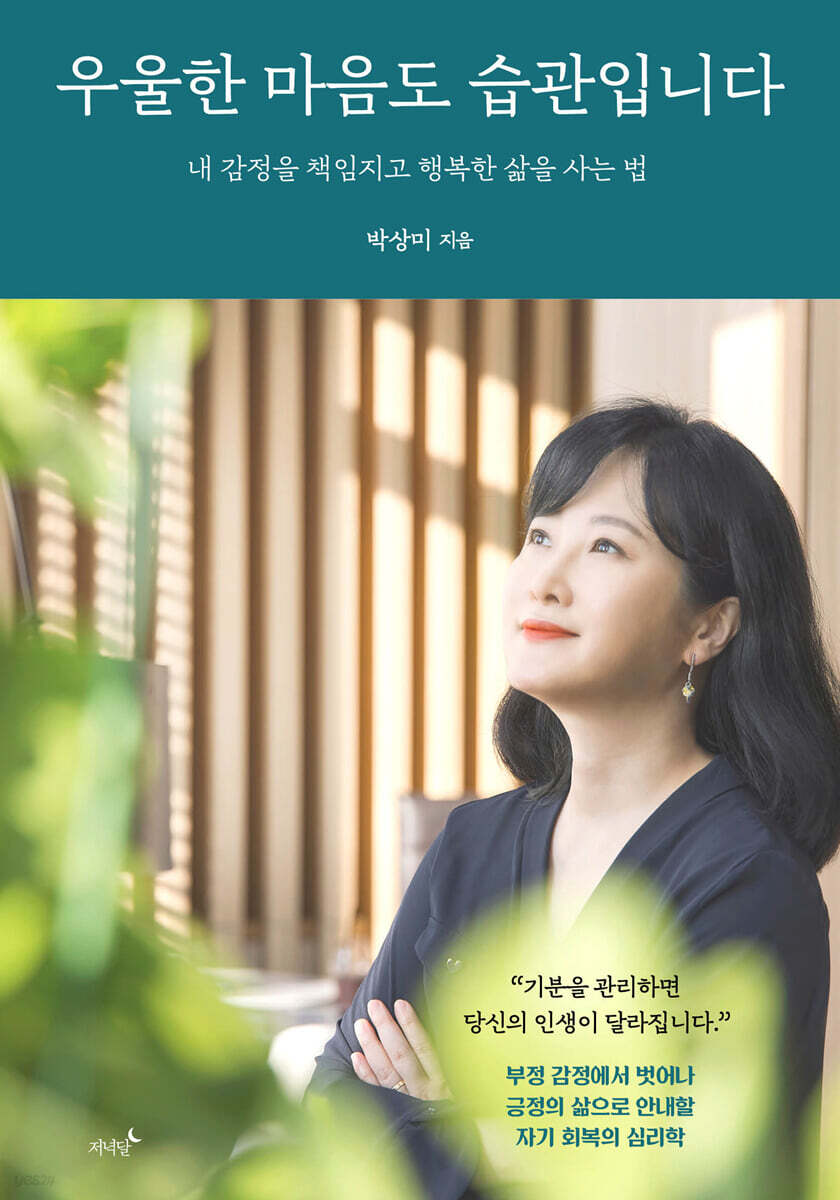
Feeling depressed is also a habit
 |
Description
Book Introduction
The latest work from Park Sang-mi, author of the best-selling book "Relationships Need Practice Too" and Korea's leading psychological counselor!
The psychology of self-healing that will guide you away from negative emotions and toward a positive life!
In a life where depression and helplessness are repeated
A psychological healing book for those of you looking for an escape!
'Life is not fun.
I don't want to do anything.
It's hard and painful.
'I'm going to end up living like this.' If you're always thinking like this, you may be addicted to negative emotions.
If you feel tired no matter how hard you try, don't want to do anything, and don't find life fun, then the negative emotions that have built up inside you without you even realizing it are making you more miserable.
Because we are in the bad habit of unconsciously choosing only negative emotions and thinking negatively, we are unable to recognize the real emotions that need to be properly cared for.
The reason we keep feeling depressed and depressed is because of the bad habits created by our depressed brain.
This means that when faced with difficult situations, we have become so accustomed to expressing and acting out negative emotions that we are trapped in the shackles of negative automatic thought patterns.
If you allow negative emotions to become behaviors, you are more likely to develop neurotic disorders such as depression and anxiety.
Moreover, the habit of repeatedly thinking negatively actually rapidly deteriorates brain function, thereby impairing cognitive function.
In fact, it is natural to feel negative emotions in negative situations, but in order to choose positive emotions in those situations, you need to train your mind on a regular basis.
"Depression is also a habit" is a book written by Park Sang-mi, a leading psychological counselor in Korea, based on her own experience and research, which contains all the methods for recognizing one's emotions and breaking free from negative automatic thoughts.
We introduce a psychological prescription for choosing good emotions and good thoughts in any situation, and how to create a habit of positive automatic thinking by repeating it for 21 days.
Additionally, the book includes light and refreshing photo images that can help you shake off feelings of depression and helplessness, so that you can feel like you are going outside for a walk or traveling while reading the book.
If you start studying emotions and habits with this book, which will make your life a little better every day, you will be able to enjoy a comfortable and happy life.
The psychology of self-healing that will guide you away from negative emotions and toward a positive life!
In a life where depression and helplessness are repeated
A psychological healing book for those of you looking for an escape!
'Life is not fun.
I don't want to do anything.
It's hard and painful.
'I'm going to end up living like this.' If you're always thinking like this, you may be addicted to negative emotions.
If you feel tired no matter how hard you try, don't want to do anything, and don't find life fun, then the negative emotions that have built up inside you without you even realizing it are making you more miserable.
Because we are in the bad habit of unconsciously choosing only negative emotions and thinking negatively, we are unable to recognize the real emotions that need to be properly cared for.
The reason we keep feeling depressed and depressed is because of the bad habits created by our depressed brain.
This means that when faced with difficult situations, we have become so accustomed to expressing and acting out negative emotions that we are trapped in the shackles of negative automatic thought patterns.
If you allow negative emotions to become behaviors, you are more likely to develop neurotic disorders such as depression and anxiety.
Moreover, the habit of repeatedly thinking negatively actually rapidly deteriorates brain function, thereby impairing cognitive function.
In fact, it is natural to feel negative emotions in negative situations, but in order to choose positive emotions in those situations, you need to train your mind on a regular basis.
"Depression is also a habit" is a book written by Park Sang-mi, a leading psychological counselor in Korea, based on her own experience and research, which contains all the methods for recognizing one's emotions and breaking free from negative automatic thoughts.
We introduce a psychological prescription for choosing good emotions and good thoughts in any situation, and how to create a habit of positive automatic thinking by repeating it for 21 days.
Additionally, the book includes light and refreshing photo images that can help you shake off feelings of depression and helplessness, so that you can feel like you are going outside for a walk or traveling while reading the book.
If you start studying emotions and habits with this book, which will make your life a little better every day, you will be able to enjoy a comfortable and happy life.
- You can preview some of the book's contents.
Preview
index
Entering
Part 1: Studying Emotions to Stop Being Swayed
- When I become aware of my emotions, my life becomes clearer.
Core emotions - the unconscious that rules my life
Defense Mechanisms - Strategies for Coping with Uncomfortable Emotions
Anger - the power that protects me from injustice
Helplessness - Not Laziness, Just Being in a Swamp
Depression - fear arising from faulty assumptions and assumptions
Anxiety - a feeling born of past discomfort and future uncertainty
Separation anxiety - fear of being alone
Inferiority complex - an illusion created by a sense of victimization
Fear - a learned fearful emotion
Competence - the desire for growth that expands me infinitely
Solitude - The Power to Overcome False Loneliness
Compassion - a heart that cares for me kindly
Gratitude - A remarkable human ability
How to Manage Depression 1 - Sigh
How to Manage Depression Part 2 - Mindfulness
How to Manage Depression Part 3 - Stress Management
Part 2: Studying Habits for a Bright and Shining Life
- How to break free from negative automatic thoughts and choose positive emotions
Why I'm Always Feeling Depressed - The Trap of Automatic Thinking
Practice Breaking Free from Negative Automatic Thoughts - The Power of Positive Thinking
Designing Thought Habits to Overcome Everyday Addictions - How to Break Bad Habits and Develop Good Habits
Small Habits That Can Help Anxious People Feel Better - 3 Things to Do When You're Feeling Anxious
Broken Thoughts That Destroy Me - Thinking Errors That Interfere with Rational Judgment
How Negative Perfectionists Can Be Happy - Why You Should Be Kind to Yourself
The Secret to Cheerful, Bright Lives - The Power of Optimistic Thinking
Everyone else is an enlightenment to me - How to Be Free from Human Relationships
Nevertheless, we must find happiness - the power to heal myself lies within me.
Part 1: Studying Emotions to Stop Being Swayed
- When I become aware of my emotions, my life becomes clearer.
Core emotions - the unconscious that rules my life
Defense Mechanisms - Strategies for Coping with Uncomfortable Emotions
Anger - the power that protects me from injustice
Helplessness - Not Laziness, Just Being in a Swamp
Depression - fear arising from faulty assumptions and assumptions
Anxiety - a feeling born of past discomfort and future uncertainty
Separation anxiety - fear of being alone
Inferiority complex - an illusion created by a sense of victimization
Fear - a learned fearful emotion
Competence - the desire for growth that expands me infinitely
Solitude - The Power to Overcome False Loneliness
Compassion - a heart that cares for me kindly
Gratitude - A remarkable human ability
How to Manage Depression 1 - Sigh
How to Manage Depression Part 2 - Mindfulness
How to Manage Depression Part 3 - Stress Management
Part 2: Studying Habits for a Bright and Shining Life
- How to break free from negative automatic thoughts and choose positive emotions
Why I'm Always Feeling Depressed - The Trap of Automatic Thinking
Practice Breaking Free from Negative Automatic Thoughts - The Power of Positive Thinking
Designing Thought Habits to Overcome Everyday Addictions - How to Break Bad Habits and Develop Good Habits
Small Habits That Can Help Anxious People Feel Better - 3 Things to Do When You're Feeling Anxious
Broken Thoughts That Destroy Me - Thinking Errors That Interfere with Rational Judgment
How Negative Perfectionists Can Be Happy - Why You Should Be Kind to Yourself
The Secret to Cheerful, Bright Lives - The Power of Optimistic Thinking
Everyone else is an enlightenment to me - How to Be Free from Human Relationships
Nevertheless, we must find happiness - the power to heal myself lies within me.
Detailed image
.jpg)
Into the book
It's not that you don't want to act, but rather that you don't have the strength to take action, which is what makes you feel helpless.
Helplessness is more dangerous than depression.
If the vicious cycle of 'anxiety-helplessness-self-reproach' is repeated, self-efficacy will decrease and you will fall into a swamp of self-abandonment, losing the strength to even struggle.
During this process, negative thoughts also automatically arise in abundance.
'Why am I so lazy?'
'Why am I like this?'
'I'm beyond help.'
'I can't get out of here.'
Maybe you made a mistake at work and got severely reprimanded, or someone you trusted betrayed you, or you suffered a huge loss in an investment, or your health suddenly deteriorated…
If you feel helpless because there is a 'big reason' for it, you will feel less guilty.
However, if you feel helpless without any 'reason', you will suffer from severe self-reproach.
While you feel pathetic for falling into a state of helplessness when nothing is particularly difficult, your self-esteem plummets to the bottom.
Helplessness is the feeling we experience when we feel we have no control over something.
When you become lethargic, your concentration decreases and your memory deteriorates.
Your motivation will disappear and you will not want to do anything, so your energy will also decrease.
You can't just leave me to my own devices at this point.
I need to get back on my feet and find self-control, the belief that I can control my own life.
I need to stop obsessing over things I can't change and start being overwhelmed by external stimuli. I need to trust myself and find the strength I possess.
I need to face the situation I'm in and look at it properly.
That power exists in everyone, and it exists in me too.
I just couldn't watch because I was having a hard time.
---From "Part 1: Studying Emotions to No Longer Be Swayed - Helplessness, p.62-63"
Clayton Paul Alderfer, an American psychologist who expanded on Maslow's hierarchy of needs, argued that humans have three needs: existence, relatedness, and growth, through his ERG (Existence, Relatedness & Growth) theory.
Growth needs are an extension of Maslow's 4th and 5th levels of needs.
As you can see, wanting to be a better person and do well is a basic desire.
When people feel that they are growing, they feel hopeful, they begin to accept themselves, and their sense of competence increases.
When I believe that I am growing, I love myself more.
Don't compare yourself to others, focus on your own growth.
Just think about realizing yourself and developing your potential.
People with a strong inferiority complex only try to package themselves.
Stop hiding and be honest with yourself as you are, and think about what your growth needs are.
When I become a benefactor to the world, when I feel that I and others are growing together, I will realize that I am a unique and precious being in the world.
---From "Part 1: Studying Emotions to No Longer Be Swayed - Competence, p.117-119"
Positive and negative brains are not genetically determined.
It's just our unconsciousness that leads us that way.
The unconscious realm is influenced by my childhood upbringing and experiences.
Many experiences of failure or fear can accumulate to create a negative unconscious.
But even those unconscious areas can be reset through positive thinking habits.
What kind of thinking habits does your brain have? Do you tend to have positive automatic thoughts? Do you tend to have negative automatic thoughts? Some might say it's not always positive or always negative, but rather changes depending on your condition.
If you're feeling overwhelmed by a lot of things going on at once, you might be more inclined to think negatively. However, if you're feeling healthy, in a good mood, and have no worries, it might be easier to think positively.
I will practice recognizing and changing the thinking mistakes hidden in my automatic thoughts.
Practicing positive thinking can also help you break the habit of changing your attitude depending on your mood.
---From "Part 2: Studying Habits for a Bright and Shining Life - Broken Thoughts That Ruin Me pp. 259-260"
People who grow up with perfectionist parents have a low self-esteem.
Because the choices I made were often denied.
You come to think of yourself as someone who cannot live up to other people's expectations and satisfy their needs.
This also affects interpersonal relationships.
So I often think about this.
"Why am I so sensitive? Why do people hurt me so much? Why am I always so listless and insecure about everything?" It's not that the person is lacking, but rather that the expectations of those around them, or even of themselves, are so high that they can't easily be satisfied and end up feeling inferior.
This is the hallmark of a negative perfectionist.
They are much stricter with me than with others.
If you look closely, they are all bundles of strengths, but they have a habit of not seeing their strengths at all and only seeing their weaknesses.
We often, knowingly or unknowingly, have the idea that we should be superior to others, or that we are superior.
Me too.
He may seem humble, but inside he says, 'I want to do better.'
I want to get better.
I want to grow more.
The desire to be wiser is very strong.
Although we may not express it verbally, we all honestly have a desire to be more successful, to develop more, and to grow more than others.
We all have a sense of superiority and a sense of competition.
Everyone does that.
But if I don't express those feelings and just suffer inside, I end up berating myself too much, thinking, "I want to do better, but why can't I? Why am I so lazy? Why can't I put in the effort?"
And I focus too much on my flaws.
They underestimate physical flaws, appearance, and abilities.
Perfectionism can serve as a motivator for achievement, but it can also have negative psychological effects.
In fact, people with perfectionist tendencies are said to experience more negative emotions.
Several psychological studies have shown a strong correlation between perfectionism and depression, obsessive-compulsive disorder, and eating disorders.
Negative perfectionists, in particular, suffer more psychological distress because they fear negative evaluations from others and strive to achieve excessively high goals, but often end up dissatisfied.
The difference between positive and negative perfectionists lies in whether or not their self-esteem is lowered when they fail to achieve their high goals.
Negative perfectionists think of their efforts in binary terms, either as success or failure, and therefore define failure to achieve a goal as "failure."
Meanwhile, positive perfectionists are less likely to think in dichotomous terms.
All perfectionists feel frustrated and distressed when they fail to achieve their goals.
However, if you endure the frustration after failure and believe that you can do better next time, you will develop positive emotions.
---From "Part 2: Studying Habits for a Bright and Shining Life - How Negative Perfectionists Become Happy, pp. 276-279"
We all have a desire to be happy, to laugh, and to live cheerfully.
It means that you can develop the strength to do your best to live cheerfully even when you are in pain.
There is a sentence like this in the book Theory of the Novel by Georg Lukács.
“Cheerfulness is not the absence of suffering or the stability of existence, but rather actions and responses that arise from inner desire.”
This is a sentence I really like.
There are people who always live cheerfully and brightly no matter what the circumstances.
Is it because we live in a stable environment, free from suffering, that we can live brightly? As Lukács said, cheerfulness isn't something given by circumstances, but rather something that springs from an inner desire.
“I want to live brightly.
“I want to find happiness even in misfortune.”
Cheerfulness is something that starts from my desires.
You don't laugh because you're happy, but because you want to be happy, and you live a more cheerful life, and then happiness follows naturally.
Laughing a lot, thinking positively, trying to live as cheerfully as possible - these are my efforts, choices, and habits that determine the direction of my life.
Helplessness is more dangerous than depression.
If the vicious cycle of 'anxiety-helplessness-self-reproach' is repeated, self-efficacy will decrease and you will fall into a swamp of self-abandonment, losing the strength to even struggle.
During this process, negative thoughts also automatically arise in abundance.
'Why am I so lazy?'
'Why am I like this?'
'I'm beyond help.'
'I can't get out of here.'
Maybe you made a mistake at work and got severely reprimanded, or someone you trusted betrayed you, or you suffered a huge loss in an investment, or your health suddenly deteriorated…
If you feel helpless because there is a 'big reason' for it, you will feel less guilty.
However, if you feel helpless without any 'reason', you will suffer from severe self-reproach.
While you feel pathetic for falling into a state of helplessness when nothing is particularly difficult, your self-esteem plummets to the bottom.
Helplessness is the feeling we experience when we feel we have no control over something.
When you become lethargic, your concentration decreases and your memory deteriorates.
Your motivation will disappear and you will not want to do anything, so your energy will also decrease.
You can't just leave me to my own devices at this point.
I need to get back on my feet and find self-control, the belief that I can control my own life.
I need to stop obsessing over things I can't change and start being overwhelmed by external stimuli. I need to trust myself and find the strength I possess.
I need to face the situation I'm in and look at it properly.
That power exists in everyone, and it exists in me too.
I just couldn't watch because I was having a hard time.
---From "Part 1: Studying Emotions to No Longer Be Swayed - Helplessness, p.62-63"
Clayton Paul Alderfer, an American psychologist who expanded on Maslow's hierarchy of needs, argued that humans have three needs: existence, relatedness, and growth, through his ERG (Existence, Relatedness & Growth) theory.
Growth needs are an extension of Maslow's 4th and 5th levels of needs.
As you can see, wanting to be a better person and do well is a basic desire.
When people feel that they are growing, they feel hopeful, they begin to accept themselves, and their sense of competence increases.
When I believe that I am growing, I love myself more.
Don't compare yourself to others, focus on your own growth.
Just think about realizing yourself and developing your potential.
People with a strong inferiority complex only try to package themselves.
Stop hiding and be honest with yourself as you are, and think about what your growth needs are.
When I become a benefactor to the world, when I feel that I and others are growing together, I will realize that I am a unique and precious being in the world.
---From "Part 1: Studying Emotions to No Longer Be Swayed - Competence, p.117-119"
Positive and negative brains are not genetically determined.
It's just our unconsciousness that leads us that way.
The unconscious realm is influenced by my childhood upbringing and experiences.
Many experiences of failure or fear can accumulate to create a negative unconscious.
But even those unconscious areas can be reset through positive thinking habits.
What kind of thinking habits does your brain have? Do you tend to have positive automatic thoughts? Do you tend to have negative automatic thoughts? Some might say it's not always positive or always negative, but rather changes depending on your condition.
If you're feeling overwhelmed by a lot of things going on at once, you might be more inclined to think negatively. However, if you're feeling healthy, in a good mood, and have no worries, it might be easier to think positively.
I will practice recognizing and changing the thinking mistakes hidden in my automatic thoughts.
Practicing positive thinking can also help you break the habit of changing your attitude depending on your mood.
---From "Part 2: Studying Habits for a Bright and Shining Life - Broken Thoughts That Ruin Me pp. 259-260"
People who grow up with perfectionist parents have a low self-esteem.
Because the choices I made were often denied.
You come to think of yourself as someone who cannot live up to other people's expectations and satisfy their needs.
This also affects interpersonal relationships.
So I often think about this.
"Why am I so sensitive? Why do people hurt me so much? Why am I always so listless and insecure about everything?" It's not that the person is lacking, but rather that the expectations of those around them, or even of themselves, are so high that they can't easily be satisfied and end up feeling inferior.
This is the hallmark of a negative perfectionist.
They are much stricter with me than with others.
If you look closely, they are all bundles of strengths, but they have a habit of not seeing their strengths at all and only seeing their weaknesses.
We often, knowingly or unknowingly, have the idea that we should be superior to others, or that we are superior.
Me too.
He may seem humble, but inside he says, 'I want to do better.'
I want to get better.
I want to grow more.
The desire to be wiser is very strong.
Although we may not express it verbally, we all honestly have a desire to be more successful, to develop more, and to grow more than others.
We all have a sense of superiority and a sense of competition.
Everyone does that.
But if I don't express those feelings and just suffer inside, I end up berating myself too much, thinking, "I want to do better, but why can't I? Why am I so lazy? Why can't I put in the effort?"
And I focus too much on my flaws.
They underestimate physical flaws, appearance, and abilities.
Perfectionism can serve as a motivator for achievement, but it can also have negative psychological effects.
In fact, people with perfectionist tendencies are said to experience more negative emotions.
Several psychological studies have shown a strong correlation between perfectionism and depression, obsessive-compulsive disorder, and eating disorders.
Negative perfectionists, in particular, suffer more psychological distress because they fear negative evaluations from others and strive to achieve excessively high goals, but often end up dissatisfied.
The difference between positive and negative perfectionists lies in whether or not their self-esteem is lowered when they fail to achieve their high goals.
Negative perfectionists think of their efforts in binary terms, either as success or failure, and therefore define failure to achieve a goal as "failure."
Meanwhile, positive perfectionists are less likely to think in dichotomous terms.
All perfectionists feel frustrated and distressed when they fail to achieve their goals.
However, if you endure the frustration after failure and believe that you can do better next time, you will develop positive emotions.
---From "Part 2: Studying Habits for a Bright and Shining Life - How Negative Perfectionists Become Happy, pp. 276-279"
We all have a desire to be happy, to laugh, and to live cheerfully.
It means that you can develop the strength to do your best to live cheerfully even when you are in pain.
There is a sentence like this in the book Theory of the Novel by Georg Lukács.
“Cheerfulness is not the absence of suffering or the stability of existence, but rather actions and responses that arise from inner desire.”
This is a sentence I really like.
There are people who always live cheerfully and brightly no matter what the circumstances.
Is it because we live in a stable environment, free from suffering, that we can live brightly? As Lukács said, cheerfulness isn't something given by circumstances, but rather something that springs from an inner desire.
“I want to live brightly.
“I want to find happiness even in misfortune.”
Cheerfulness is something that starts from my desires.
You don't laugh because you're happy, but because you want to be happy, and you live a more cheerful life, and then happiness follows naturally.
Laughing a lot, thinking positively, trying to live as cheerfully as possible - these are my efforts, choices, and habits that determine the direction of my life.
---From "Part 2: Studying Habits for a Bright and Shining Life - The Secrets of People Who Live Brightly and Cheerfully, pp. 290-291"
Publisher's Review
“Manage your mood and your life will change!”
A book that will save you from the suffering of being trapped in the shackles of negative emotions!
Now free from dark and painful emotions
For those who want to start over
An intense and special psychology class!
We often hear advice to live positively.
Positive thinking creates good energy and makes life happier.
When you hit a snag, say, 'Let's give it a try.'
People who think, 'I can do it,' and put in their best effort will achieve what they want, grow, and live a better life.
We already know that the power of positivity has a positive influence, but putting it into practice is not easy.
Moreover, when you go to work or school and are stressed out due to work and interpersonal relationships, your body and mind are bound to become exhausted, and it is not easy to think positively in a situation where you feel negative emotions.
This is because it is natural for negative emotions to lead to negative thoughts.
It takes training to think positively in any difficult situation.
Park Sang-mi, a leading psychological counselor in Korea and the author of the best-selling book, “Relationships Need Practice Too,” says that frequently feeling negative emotions and automatically having negative thoughts are also “habits.”
This means that I am trapped in a 'shackle of negative thinking habits' where I do not properly recognize the emotions such as depression or anxiety that have built up inside me, and I act on them, blame myself, and then become depressed again.
The recently published book, "Depression is also a Habit," is a guide to breaking free from negative thinking habits and creating positive ones so that you can enjoy a bright and comfortable life.
Back to life again
Gives me the strength to take care of myself
Affectionate and warm advice
It will help you notice your emotions and increase your sense of competence.
Positive Thinking Habit Training and Behavioral Prescription
'Life is not fun.
I don't want to do anything.
It's hard and painful.
I'm going to end up living like this.'
If you find yourself thinking like this all the time, you may be addicted to negative emotions.
If you feel tired no matter how hard you try, don't want to do anything, and don't find life fun, then the negative emotions that have built up inside you without you even realizing it are making you more miserable.
Because we are in the bad habit of unconsciously choosing only negative emotions and thinking negatively, we are unable to recognize the real emotions that need to be properly cared for.
The reason we keep feeling depressed and depressed is because of the bad habits created by our depressed brain.
This means that when faced with difficult situations, we have become so accustomed to expressing and acting out negative emotions that we are trapped in the shackles of negative automatic thought patterns.
If you allow negative emotions to become behaviors, you are more likely to develop neurotic disorders such as depression and anxiety.
Moreover, the habit of repeatedly thinking negatively actually rapidly deteriorates brain function, even leading to cognitive decline.
Our brains have evolved to remember negative emotions longer and more strongly than positive emotions.
This is because the basic principle of how the brain works is survival orientation.
It is inevitable that unpleasant and shocking memories will be imprinted longer than happy and exciting memories.
Therefore, I need to have a lot of positive experiences and positive emotions stored in me so that I can immediately bring out positive emotions even in difficult situations.
If you have a lot of negative emotions built up, when you encounter an event or situation, you will have negative automatic thoughts based on the negative experience.
To prevent negative automatic thoughts from working, you need to go outside, feel the wind, walk, look at the trees, look at the sky, meet good people, and accumulate many positive experiences and emotions.
"Depression is also a Habit" introduces numerous mind training methods that will help you change your depressed brain into a positive one.
The author, who has suffered from depression and obsession for a long time,
Realized through numerous experiences and research
How to regain a comfortable and happy life
"Depression is also a habit" is a book written by Park Sang-mi, a leading psychological counselor in Korea, based on her own experience and research, which contains all the methods for recognizing one's emotions and breaking free from negative automatic thoughts.
We introduce a psychological prescription for choosing good emotions and good thoughts in any situation, and how to create a habit of positive automatic thinking by repeating it for 21 days.
If you repeat this for 66 days, a positive thinking habit will be created in your subconscious.
Meanwhile, the book includes light and refreshing photo images to help you shake off feelings of depression and helplessness, allowing you to feel like you're going out for a walk or traveling while reading the book.
If you start studying emotions and habits with this book, which will make your life a little better every day, you will be able to enjoy a comfortable and happy life.
A book that will save you from the suffering of being trapped in the shackles of negative emotions!
Now free from dark and painful emotions
For those who want to start over
An intense and special psychology class!
We often hear advice to live positively.
Positive thinking creates good energy and makes life happier.
When you hit a snag, say, 'Let's give it a try.'
People who think, 'I can do it,' and put in their best effort will achieve what they want, grow, and live a better life.
We already know that the power of positivity has a positive influence, but putting it into practice is not easy.
Moreover, when you go to work or school and are stressed out due to work and interpersonal relationships, your body and mind are bound to become exhausted, and it is not easy to think positively in a situation where you feel negative emotions.
This is because it is natural for negative emotions to lead to negative thoughts.
It takes training to think positively in any difficult situation.
Park Sang-mi, a leading psychological counselor in Korea and the author of the best-selling book, “Relationships Need Practice Too,” says that frequently feeling negative emotions and automatically having negative thoughts are also “habits.”
This means that I am trapped in a 'shackle of negative thinking habits' where I do not properly recognize the emotions such as depression or anxiety that have built up inside me, and I act on them, blame myself, and then become depressed again.
The recently published book, "Depression is also a Habit," is a guide to breaking free from negative thinking habits and creating positive ones so that you can enjoy a bright and comfortable life.
Back to life again
Gives me the strength to take care of myself
Affectionate and warm advice
It will help you notice your emotions and increase your sense of competence.
Positive Thinking Habit Training and Behavioral Prescription
'Life is not fun.
I don't want to do anything.
It's hard and painful.
I'm going to end up living like this.'
If you find yourself thinking like this all the time, you may be addicted to negative emotions.
If you feel tired no matter how hard you try, don't want to do anything, and don't find life fun, then the negative emotions that have built up inside you without you even realizing it are making you more miserable.
Because we are in the bad habit of unconsciously choosing only negative emotions and thinking negatively, we are unable to recognize the real emotions that need to be properly cared for.
The reason we keep feeling depressed and depressed is because of the bad habits created by our depressed brain.
This means that when faced with difficult situations, we have become so accustomed to expressing and acting out negative emotions that we are trapped in the shackles of negative automatic thought patterns.
If you allow negative emotions to become behaviors, you are more likely to develop neurotic disorders such as depression and anxiety.
Moreover, the habit of repeatedly thinking negatively actually rapidly deteriorates brain function, even leading to cognitive decline.
Our brains have evolved to remember negative emotions longer and more strongly than positive emotions.
This is because the basic principle of how the brain works is survival orientation.
It is inevitable that unpleasant and shocking memories will be imprinted longer than happy and exciting memories.
Therefore, I need to have a lot of positive experiences and positive emotions stored in me so that I can immediately bring out positive emotions even in difficult situations.
If you have a lot of negative emotions built up, when you encounter an event or situation, you will have negative automatic thoughts based on the negative experience.
To prevent negative automatic thoughts from working, you need to go outside, feel the wind, walk, look at the trees, look at the sky, meet good people, and accumulate many positive experiences and emotions.
"Depression is also a Habit" introduces numerous mind training methods that will help you change your depressed brain into a positive one.
The author, who has suffered from depression and obsession for a long time,
Realized through numerous experiences and research
How to regain a comfortable and happy life
"Depression is also a habit" is a book written by Park Sang-mi, a leading psychological counselor in Korea, based on her own experience and research, which contains all the methods for recognizing one's emotions and breaking free from negative automatic thoughts.
We introduce a psychological prescription for choosing good emotions and good thoughts in any situation, and how to create a habit of positive automatic thinking by repeating it for 21 days.
If you repeat this for 66 days, a positive thinking habit will be created in your subconscious.
Meanwhile, the book includes light and refreshing photo images to help you shake off feelings of depression and helplessness, allowing you to feel like you're going out for a walk or traveling while reading the book.
If you start studying emotions and habits with this book, which will make your life a little better every day, you will be able to enjoy a comfortable and happy life.
GOODS SPECIFICS
- Date of issue: March 30, 2023
- Page count, weight, size: 312 pages | 390g | 140*200*25mm
- ISBN13: 9791189217167
- ISBN10: 1189217163
You may also like
카테고리
korean


korean

![GQ KOREA Mark (Monthly): December [2025]](http://librairie.coreenne.fr/cdn/shop/files/8ef265dbbfbf186523ed75ba7319009d.jpg?v=1765340328&width=3840)


