

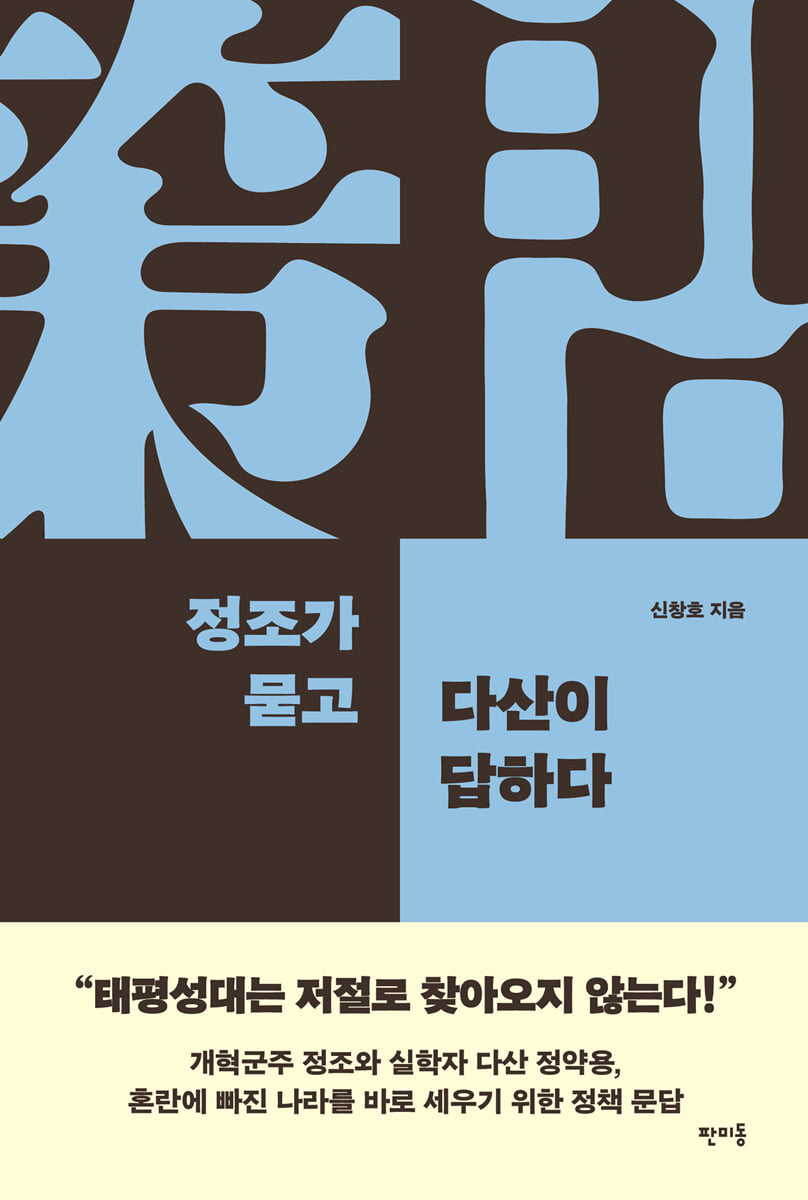
Jeongjo asks and Dasan answers.
 |
Description
Book Introduction
“An era of peace doesn’t come by itself!”
To set right the country in chaos
A policy dialogue between the reformist monarch Jeongjo and the scholar Dasan
How do the two geniuses express their opinions?
Have you created a vision for the country?
King Jeongjo, who sought to realize Confucian ideals and the spirit of reform, and Dasan Jeong Yak-yong, a Silhak scholar who put these ideals into practice in practical policies.
『Jeongjo Asks, Dasan Answers』, which easily explains the conversation between two people as they ponder the future of the nation, has been published by Panmidong.
This book is a compilation of policy questions and counter-questions between the reformist monarch Jeongjo and the scholar Dasan, organized by major fields such as personnel, economy, national defense, education, and culture.
Professor Shin Chang-ho, who has led the popularization of humanities classics, has added faithful commentary to ensure that today's readers can clearly understand the original text while preserving its format.
When King Jeongjo identified a problem and sought alternatives, Dasan played a key role in analyzing it and implementing it into policy based on his own scholarship and insight.
King Jeongjo, a representative scholar-monarch, asked questions covering almost all fields, including politics, administration, and culture, and Dasan's answers demonstrated a high level of policy insight and outstanding writing skills, enough to actually select him as the top candidate in the civil service examination.
"Jeongjo Asks, Dasan Answers" is a historical example of how the "politics of dialogue" was created and developed by two people with different perspectives on ideals and reality, based on their respective academic and political capabilities. It can also be said to be an attempt to restore the concerns and wisdom of that era through a modern perspective.
Times have changed, but their dialogue shows how dialogue and reflection can lead to real reform.
To set right the country in chaos
A policy dialogue between the reformist monarch Jeongjo and the scholar Dasan
How do the two geniuses express their opinions?
Have you created a vision for the country?
King Jeongjo, who sought to realize Confucian ideals and the spirit of reform, and Dasan Jeong Yak-yong, a Silhak scholar who put these ideals into practice in practical policies.
『Jeongjo Asks, Dasan Answers』, which easily explains the conversation between two people as they ponder the future of the nation, has been published by Panmidong.
This book is a compilation of policy questions and counter-questions between the reformist monarch Jeongjo and the scholar Dasan, organized by major fields such as personnel, economy, national defense, education, and culture.
Professor Shin Chang-ho, who has led the popularization of humanities classics, has added faithful commentary to ensure that today's readers can clearly understand the original text while preserving its format.
When King Jeongjo identified a problem and sought alternatives, Dasan played a key role in analyzing it and implementing it into policy based on his own scholarship and insight.
King Jeongjo, a representative scholar-monarch, asked questions covering almost all fields, including politics, administration, and culture, and Dasan's answers demonstrated a high level of policy insight and outstanding writing skills, enough to actually select him as the top candidate in the civil service examination.
"Jeongjo Asks, Dasan Answers" is a historical example of how the "politics of dialogue" was created and developed by two people with different perspectives on ideals and reality, based on their respective academic and political capabilities. It can also be said to be an attempt to restore the concerns and wisdom of that era through a modern perspective.
Times have changed, but their dialogue shows how dialogue and reflection can lead to real reform.
- You can preview some of the book's contents.
Preview
index
Preface - Chastity and Fertility: Their Messages Today
Part 1: Creating the World with Like-minded People
Don't forget the importance of talent selection.
Let's create a personnel policy that promotes professionalism.
Putting people to the right use
Discover hidden talent
The sentences are imbued with the spirit of the times.
Reflect on our language and sentences
[Dasan's Question ①] How to Correct the Abuses of Our Nation
[Dasan's Question ②] Examine the scholars of the countryside and the provinces.
Part 2: Dreaming of a country where we all prosper together
Think about making a living and achieving economic prosperity.
Production is the work of heaven, earth, and people.
Awaken your diligence so that you have no regrets.
Dreaming of a prosperous society
There is reason to make a living.
[Dasan's Question ③] Shouldn't we overcome hardship together?
[Dasan's Question ④] Let's Find Solutions for National Governance in Salt
Part 3: Seeing the future of the nation in small things
Soldiers and farmers are one
Fight off pirates and stay vigilant.
Protect our country with one heart
Repair the castle walls and strengthen national defense.
Remember the ancient nations that existed on the Korean Peninsula
[Dasan's Question ⑤] National defense is, by all accounts, the last bastion.
[Dasan's Question ⑥] Unifying Weights and Measures is the Foundation of Fairness
Part 4: Leading Balanced Development Across the Nation
Geography is the birthplace of the people's economy.
Geographical surveys and policies tailored to the current situation are needed.
Look back on the beautiful development of Joseon's eight provinces.
Consider the characteristics of the land and tax issues together.
Geography is knowing yourself
Isn't the world so vast?
Explore interesting myths and legends
[Dasan's Question ⑦] Strengthening the National Finances through Waterway Transport
[Dasan's Question ⑧] Currency Reform: How Should We Do It?
Cultivating a Right Mind through the Five Classics
Interpreting scriptures appropriate to the times is important.
Read the scriptures passionately
Practice the teachings of the Doctrine of the Mean
Learn from the lessons of Mencius
The Mencius is read differently over time.
[Dasan's Question ⑨] Examine the principles that permeate the direction.
[Dasan's Question ⑩] Use Bamboo Practically
Appendix - The Life of Dasan Jeong Yak-yong
Part 1: Creating the World with Like-minded People
Don't forget the importance of talent selection.
Let's create a personnel policy that promotes professionalism.
Putting people to the right use
Discover hidden talent
The sentences are imbued with the spirit of the times.
Reflect on our language and sentences
[Dasan's Question ①] How to Correct the Abuses of Our Nation
[Dasan's Question ②] Examine the scholars of the countryside and the provinces.
Part 2: Dreaming of a country where we all prosper together
Think about making a living and achieving economic prosperity.
Production is the work of heaven, earth, and people.
Awaken your diligence so that you have no regrets.
Dreaming of a prosperous society
There is reason to make a living.
[Dasan's Question ③] Shouldn't we overcome hardship together?
[Dasan's Question ④] Let's Find Solutions for National Governance in Salt
Part 3: Seeing the future of the nation in small things
Soldiers and farmers are one
Fight off pirates and stay vigilant.
Protect our country with one heart
Repair the castle walls and strengthen national defense.
Remember the ancient nations that existed on the Korean Peninsula
[Dasan's Question ⑤] National defense is, by all accounts, the last bastion.
[Dasan's Question ⑥] Unifying Weights and Measures is the Foundation of Fairness
Part 4: Leading Balanced Development Across the Nation
Geography is the birthplace of the people's economy.
Geographical surveys and policies tailored to the current situation are needed.
Look back on the beautiful development of Joseon's eight provinces.
Consider the characteristics of the land and tax issues together.
Geography is knowing yourself
Isn't the world so vast?
Explore interesting myths and legends
[Dasan's Question ⑦] Strengthening the National Finances through Waterway Transport
[Dasan's Question ⑧] Currency Reform: How Should We Do It?
Cultivating a Right Mind through the Five Classics
Interpreting scriptures appropriate to the times is important.
Read the scriptures passionately
Practice the teachings of the Doctrine of the Mean
Learn from the lessons of Mencius
The Mencius is read differently over time.
[Dasan's Question ⑨] Examine the principles that permeate the direction.
[Dasan's Question ⑩] Use Bamboo Practically
Appendix - The Life of Dasan Jeong Yak-yong
Detailed image

Into the book
I once likened the misfortunes that arise from factions to a "competition for food."
The real mistake was that he monopolized the food.
Nevertheless, he says, 'There was no consideration for etiquette or order in front of food, such as who should eat first between adults and children, or who should receive more.'
In reality, the competition is about 'who will get the position or salary?', but it is said that 'righteousness and morality were not taken into consideration.'
That's really funny.
--- From "Discover Hidden Talent"
When something gets old and breaks down, it is called '폐弊'.
Since breaking is the natural law of heaven and earth, there is nothing that does not break even after it has been a long time.
Therefore, if clothes fall off, they must be patched, and if a cart breaks, it must be repaired.
Likewise, when a machine breaks down, it must be repaired, and when a house collapses, it must be repaired.
So, can the country's evils be corrected and repaired?
--- From "How to Correct the Abuses of the Nation"
The problem of weak border defenses is indeed a concern of Your Majesty.
There is a saying, “Even if a soldier is not used for a hundred years, he should not be unprepared for even a single day.”
In the Book of Changes, it is said, “Because I carefully gave orders and prepared for defense, I had no worries even if a war broke out in the middle of the night!”
--- From "Defeat the Pirates and Don't Let Your Guard Down"
I looked into the fact that about half of Balhae's land was absorbed into the Khitans.
After Goguryeo and Baekje fell, Balhae rose in succession. During the reign of Emperor Xuanzong of Tang, Balhae King Dae Jo-yeong took over all of the lands of Buyeo, Okjeo, and Joseon, extending the territory of the country to thousands of li in all directions.
(…) However, after the Liao Dynasty destroyed Balhae, the entire region north of the Yalu River came under the control of the Liao Dynasty.
Only the regions of Boju and Jeongju south of the Yalu River were somewhat subordinate to Silla, and even King Taejo of Goryeo was unable to recover the old territory of Balhae.
It is truly a pity.
--- From "Remember the Ancient Nations on the Korean Peninsula"
Zigong, a disciple of Confucius, said, “You can read Confucius’s writings and words, but you cannot hear his words about nature or the natural order of the universe!”
Even Zigong, who could be said to be Confucius's closest confidant, could not hear about things that his grandson Zisi personally experienced at home and incorporated the core ideas into the Doctrine of the Mean.
The real mistake was that he monopolized the food.
Nevertheless, he says, 'There was no consideration for etiquette or order in front of food, such as who should eat first between adults and children, or who should receive more.'
In reality, the competition is about 'who will get the position or salary?', but it is said that 'righteousness and morality were not taken into consideration.'
That's really funny.
--- From "Discover Hidden Talent"
When something gets old and breaks down, it is called '폐弊'.
Since breaking is the natural law of heaven and earth, there is nothing that does not break even after it has been a long time.
Therefore, if clothes fall off, they must be patched, and if a cart breaks, it must be repaired.
Likewise, when a machine breaks down, it must be repaired, and when a house collapses, it must be repaired.
So, can the country's evils be corrected and repaired?
--- From "How to Correct the Abuses of the Nation"
The problem of weak border defenses is indeed a concern of Your Majesty.
There is a saying, “Even if a soldier is not used for a hundred years, he should not be unprepared for even a single day.”
In the Book of Changes, it is said, “Because I carefully gave orders and prepared for defense, I had no worries even if a war broke out in the middle of the night!”
--- From "Defeat the Pirates and Don't Let Your Guard Down"
I looked into the fact that about half of Balhae's land was absorbed into the Khitans.
After Goguryeo and Baekje fell, Balhae rose in succession. During the reign of Emperor Xuanzong of Tang, Balhae King Dae Jo-yeong took over all of the lands of Buyeo, Okjeo, and Joseon, extending the territory of the country to thousands of li in all directions.
(…) However, after the Liao Dynasty destroyed Balhae, the entire region north of the Yalu River came under the control of the Liao Dynasty.
Only the regions of Boju and Jeongju south of the Yalu River were somewhat subordinate to Silla, and even King Taejo of Goryeo was unable to recover the old territory of Balhae.
It is truly a pity.
--- From "Remember the Ancient Nations on the Korean Peninsula"
Zigong, a disciple of Confucius, said, “You can read Confucius’s writings and words, but you cannot hear his words about nature or the natural order of the universe!”
Even Zigong, who could be said to be Confucius's closest confidant, could not hear about things that his grandson Zisi personally experienced at home and incorporated the core ideas into the Doctrine of the Mean.
--- From “Practice the Teachings of the Doctrine of the Mean”
Publisher's Review
Politics of dialogue, not dogmatism,
A national vision built through asking and answering questions together
The relationship between Jeongjo and Dasan was not just that of monarch and subject; they were political and intellectual partners who designed the nation's vision together through dialogue.
The two men, who possessed the greatest scholarship and political insight of their time, continuously engaged in in-depth discussions about the direction of national administration and the tasks of reform.
The dialogue was not a superficial exchange of knowledge, but a realistic and intense exploration of 'how to rebuild a country mired in corruption and chaos.'
Such dialogue was possible thanks to the mutual respect and tense cooperation that existed between King Jeongjo, a mature man in his 40s, and Jeong Yak-yong, an energetic scholar in his 30s.
The two people jointly drew the direction of national administration through questions and answers, reflection and reflection, rather than through unilateral instructions or arbitrary decisions.
This conversation between the two men amidst the turbulent political climate of the late Joseon Dynasty reminds us once again that 'politics is created through questions.'
Inclusiveness that transcends all barriers,
A Timeless Leadership Textbook
The author focuses on the 'politics of inclusion' that Jeongjo and Dasan demonstrated in their discussions on appointing talented people.
Jeongjo expressed his intention to directly discover talented individuals rather than rely solely on the civil service examination system, and Dasan responded, “If someone is truly talented, they should be promoted regardless of their social status or region.”
Despite the structural constraints of the caste system and factional politics, they pursued a personnel policy centered on ability, transcending origins and backgrounds, and their foundation was the recognition that "inclusion equals innovation."
Jeongjo and Dasan's reflections on "reform through people," "achievable ideals," and "the public responsibility of intellectuals" demonstrate a timeless prototype of leadership and offer meaningful implications that remain relevant even today.
“Historian E.
H. Carr said, “History is an unending dialogue between the present and the past.”
In that sense, the policy dialogue between the reformist monarch Jeongjo and the Silhak scholar Dasan is still relevant in the current reality of the Republic of Korea, and in today's era when the government is asking questions of the people.
The more chaotic the times, the more we must return to the roots.
“The serious reflections and fierce attitude toward the people’s livelihood revealed in this book, and the efforts to pursue the right path for humanity and run the country properly together will resonate deeply in our society today, which is in chaos.” - From the preface
A national vision built through asking and answering questions together
The relationship between Jeongjo and Dasan was not just that of monarch and subject; they were political and intellectual partners who designed the nation's vision together through dialogue.
The two men, who possessed the greatest scholarship and political insight of their time, continuously engaged in in-depth discussions about the direction of national administration and the tasks of reform.
The dialogue was not a superficial exchange of knowledge, but a realistic and intense exploration of 'how to rebuild a country mired in corruption and chaos.'
Such dialogue was possible thanks to the mutual respect and tense cooperation that existed between King Jeongjo, a mature man in his 40s, and Jeong Yak-yong, an energetic scholar in his 30s.
The two people jointly drew the direction of national administration through questions and answers, reflection and reflection, rather than through unilateral instructions or arbitrary decisions.
This conversation between the two men amidst the turbulent political climate of the late Joseon Dynasty reminds us once again that 'politics is created through questions.'
Inclusiveness that transcends all barriers,
A Timeless Leadership Textbook
The author focuses on the 'politics of inclusion' that Jeongjo and Dasan demonstrated in their discussions on appointing talented people.
Jeongjo expressed his intention to directly discover talented individuals rather than rely solely on the civil service examination system, and Dasan responded, “If someone is truly talented, they should be promoted regardless of their social status or region.”
Despite the structural constraints of the caste system and factional politics, they pursued a personnel policy centered on ability, transcending origins and backgrounds, and their foundation was the recognition that "inclusion equals innovation."
Jeongjo and Dasan's reflections on "reform through people," "achievable ideals," and "the public responsibility of intellectuals" demonstrate a timeless prototype of leadership and offer meaningful implications that remain relevant even today.
“Historian E.
H. Carr said, “History is an unending dialogue between the present and the past.”
In that sense, the policy dialogue between the reformist monarch Jeongjo and the Silhak scholar Dasan is still relevant in the current reality of the Republic of Korea, and in today's era when the government is asking questions of the people.
The more chaotic the times, the more we must return to the roots.
“The serious reflections and fierce attitude toward the people’s livelihood revealed in this book, and the efforts to pursue the right path for humanity and run the country properly together will resonate deeply in our society today, which is in chaos.” - From the preface
GOODS SPECIFICS
- Date of issue: May 14, 2025
- Format: Paperback book binding method guide
- Page count, weight, size: 316 pages | 145*215*30mm
- ISBN13: 9791170526032
- ISBN10: 1170526039
You may also like
카테고리
korean


korean

![ELLE 엘르 스페셜 에디션 A형 : 12월 [2025]](http://librairie.coreenne.fr/cdn/shop/files/b8e27a3de6c9538896439686c6b0e8fb.jpg?v=1766436872&width=3840)


