

Hamilton's Greco-Roman Mythology
 |
Description
Book Introduction
Celebrating the 80th anniversary of the first edition, which has overwhelmingly ranked first in cumulative sales in the Amazon mythology category, this fully revised edition includes 100 color illustrations.
“No writer has ever brought to life the glory of Greece and the grandeur of Rome as vividly as Hamilton.”
_The New York Times
Greco-Roman mythology, along with the Christian Bible, has formed two pillars of Western civilization.
It has served as a source of Western scholarship and thought, including literature, history, anthropology, and psychology, and has also provided abundant inspiration and creativity to the arts, including painting, sculpture, architecture, and music.
Today, it is the 'source of storytelling' that provides a never-ending supply of attractive motifs in popular culture, including novels, dramas, movies, and games.
Edith Hamilton, the greatest mythologist and storyteller of the 20th century, studied the ancient texts of numerous sages, from the ancient Greek writers Homer, Hesiod, and Euripides to the Roman writers Ovid and Virgil, as well as Herodotus, the father of history, and Plato, the father of philosophy, in this book, first published in 1942, and selected the best works to capture only the essence of myth.
The ancient Greeks tried to explain the world rationally in their own way.
Thunder and lightning were what happened when Zeus struck down his thunderbolts, and volcanic eruptions were what happened when a monster trapped in a huge mountain tried to escape.
The Big Dipper never set below the horizon by the goddess's command.
Therefore, in Hamilton's view, myth was not 'fantasy' but 'ancient science'.
Edith, who saw the beginning of a new revolution in thought, moving away from the worship of inhuman magic and sorcery, uniquely reinterprets myth from this perspective.
Although times have changed and places have changed, humans have constantly read and reinterpreted myths, building their own temples in their hearts.
To capture these brilliant footsteps, this book contains a selection of 100 paintings and sculptures based on Greek and Roman mythology created by dozens of artists from ancient Greece through the Renaissance, Baroque, and 20th century.
By appreciating the colorful images and masterpieces alongside the text, readers will learn to savor and enjoy mythology from a variety of perspectives.
“No writer has ever brought to life the glory of Greece and the grandeur of Rome as vividly as Hamilton.”
_The New York Times
Greco-Roman mythology, along with the Christian Bible, has formed two pillars of Western civilization.
It has served as a source of Western scholarship and thought, including literature, history, anthropology, and psychology, and has also provided abundant inspiration and creativity to the arts, including painting, sculpture, architecture, and music.
Today, it is the 'source of storytelling' that provides a never-ending supply of attractive motifs in popular culture, including novels, dramas, movies, and games.
Edith Hamilton, the greatest mythologist and storyteller of the 20th century, studied the ancient texts of numerous sages, from the ancient Greek writers Homer, Hesiod, and Euripides to the Roman writers Ovid and Virgil, as well as Herodotus, the father of history, and Plato, the father of philosophy, in this book, first published in 1942, and selected the best works to capture only the essence of myth.
The ancient Greeks tried to explain the world rationally in their own way.
Thunder and lightning were what happened when Zeus struck down his thunderbolts, and volcanic eruptions were what happened when a monster trapped in a huge mountain tried to escape.
The Big Dipper never set below the horizon by the goddess's command.
Therefore, in Hamilton's view, myth was not 'fantasy' but 'ancient science'.
Edith, who saw the beginning of a new revolution in thought, moving away from the worship of inhuman magic and sorcery, uniquely reinterprets myth from this perspective.
Although times have changed and places have changed, humans have constantly read and reinterpreted myths, building their own temples in their hearts.
To capture these brilliant footsteps, this book contains a selection of 100 paintings and sculptures based on Greek and Roman mythology created by dozens of artists from ancient Greece through the Renaissance, Baroque, and 20th century.
By appreciating the colorful images and masterpieces alongside the text, readers will learn to savor and enjoy mythology from a variety of perspectives.
- You can preview some of the book's contents.
Preview
index
preface
introduction
Part 1: The Gods, the Creation of the World, and the Early Heroes
Chapter 1: The Gods
The Titans and the Twelve Gods of Olympus
Zeus (Jupiter)
Hera (Yuno)
Poseidon (Neptune)
Hades (Pluton)
Pallas Athena (Minerva)
Phoebus Apollo
Artemis (Diana)
Aphrodite (Venus)
Hermes (Mercury)
Ares (Mars)
Hephaestus (Vulcan, or Mulkiber)
Hestia (Vesta)
The lesser gods of Olympus
Water Gods
Underworld
Ordinary gods on earth
Roman gods
Chapter 2: The Two Great Gods of the Earth
Demeter (Ceres)
Dionysus or Bacchus
Chapter 3: How the World and Humanity Were Created
Chapter 4: Early Heroes
Prometheus and Io
Europa
Cyclops Polyphemus
Legends of Flowers: Narcissus, Hyacinthus, Adonis
Part 2: A Story of Love and Adventure
Chapter 5: Cupid and Psyche
Chapter 6: Eight Short Stories About Lovers
Pyramus and Thisbe
Orpheus and Eurydice
Cakes and Alcyone
Pygmalion and Galatea
Baucis and Philemon
Endymion
Daphne
Alpheus and Arethusa
Chapter 7: In Search of the Golden Fleece
Chapter 8 Four Great Adventures
Phaethon
Pegasus and Bellerophon
Othos and Ephialtes
Daedalus
Part 3: Great Heroes Before the Trojan War
Chapter 9 Perseus
Chapter 10 Theseus
Chapter 11 Hercules
Chapter 12 Atalanta
Part 4: Heroes of the Trojan War
Chapter 13: The Trojan War
Origin: The Judgment of Paris
Trojan War
Chapter 14: The Fall of Troy
Chapter 15: The Adventures of Odysseus
Chapter 16: The Adventures of Aeneas
From Troy to Italy
Descending into the afterlife
War in Italy
Part 5: The Great Families in Mythology
Chapter 17: The House of Atreus
Tantalus and Niobe
Agamemnon and his children
The Taurians and Iphigenia
Chapter 18: The Royal House of Thebes
Cadmus and his children
Oedipus
Antigone
Seven generals who attacked Thebes
Chapter 19: The Athenian Royal Family
Cecrops
Procne and Philomela
Procris and Cephalus
Oreitia and Boreas
Creusa and Ion
Part 6: Other Myths
Chapter 20: Midas and Other Characters
Asclepius
The Danais sisters
Glaucus and Scylla
Erysichthon
Pomona and Vertumnus
Chapter 21: Short Myths, Arranged Alphabetically
Comparison of Greek and Roman God Names
Main family tree
introduction
Part 1: The Gods, the Creation of the World, and the Early Heroes
Chapter 1: The Gods
The Titans and the Twelve Gods of Olympus
Zeus (Jupiter)
Hera (Yuno)
Poseidon (Neptune)
Hades (Pluton)
Pallas Athena (Minerva)
Phoebus Apollo
Artemis (Diana)
Aphrodite (Venus)
Hermes (Mercury)
Ares (Mars)
Hephaestus (Vulcan, or Mulkiber)
Hestia (Vesta)
The lesser gods of Olympus
Water Gods
Underworld
Ordinary gods on earth
Roman gods
Chapter 2: The Two Great Gods of the Earth
Demeter (Ceres)
Dionysus or Bacchus
Chapter 3: How the World and Humanity Were Created
Chapter 4: Early Heroes
Prometheus and Io
Europa
Cyclops Polyphemus
Legends of Flowers: Narcissus, Hyacinthus, Adonis
Part 2: A Story of Love and Adventure
Chapter 5: Cupid and Psyche
Chapter 6: Eight Short Stories About Lovers
Pyramus and Thisbe
Orpheus and Eurydice
Cakes and Alcyone
Pygmalion and Galatea
Baucis and Philemon
Endymion
Daphne
Alpheus and Arethusa
Chapter 7: In Search of the Golden Fleece
Chapter 8 Four Great Adventures
Phaethon
Pegasus and Bellerophon
Othos and Ephialtes
Daedalus
Part 3: Great Heroes Before the Trojan War
Chapter 9 Perseus
Chapter 10 Theseus
Chapter 11 Hercules
Chapter 12 Atalanta
Part 4: Heroes of the Trojan War
Chapter 13: The Trojan War
Origin: The Judgment of Paris
Trojan War
Chapter 14: The Fall of Troy
Chapter 15: The Adventures of Odysseus
Chapter 16: The Adventures of Aeneas
From Troy to Italy
Descending into the afterlife
War in Italy
Part 5: The Great Families in Mythology
Chapter 17: The House of Atreus
Tantalus and Niobe
Agamemnon and his children
The Taurians and Iphigenia
Chapter 18: The Royal House of Thebes
Cadmus and his children
Oedipus
Antigone
Seven generals who attacked Thebes
Chapter 19: The Athenian Royal Family
Cecrops
Procne and Philomela
Procris and Cephalus
Oreitia and Boreas
Creusa and Ion
Part 6: Other Myths
Chapter 20: Midas and Other Characters
Asclepius
The Danais sisters
Glaucus and Scylla
Erysichthon
Pomona and Vertumnus
Chapter 21: Short Myths, Arranged Alphabetically
Comparison of Greek and Roman God Names
Main family tree
Detailed image

Into the book
The Apostle Paul said that the unseen must be understood by what is seen.
This was Greek thought, not Hebrew thought.
In the ancient world, only in Greece were people so obsessed with what they saw.
They were looking for ways to satisfy their desires through what actually existed in the world around them.
When sculptors watched athletes competing, they felt they could not imagine a more beautiful being than a young, strong body.
So he made a statue of Apollo.
The myth writers would have discovered Hermes among the passers-by on the street.
As Homer put it, writers saw the god Hermes as 'a young man in the most beautiful bloom of youth.'
Greek artists and poets realized how wonderful, upright, fast, and strong humans are.
Humans were the embodiment of the beauty pursued by Greek artists.
They did not want to create a form that could only be completed in the imagination.
All Greek art and thought were centered on humans.
Although Greek mythology consists of stories about various gods and goddesses, it should not be understood as a kind of scripture explaining Greek religion.
According to recent theories, actual myths have nothing to do with religion.
A myth is simply an explanation of something that exists in nature.
For example, it explains how all things in the universe or a specific object came into existence.
Of course, this includes everything that exists and everything that happens: humans, animals, various trees and flowers, the sun, the moon, stars, storms, volcanic eruptions, earthquakes, and so on.
Thunder and lightning are what happens when Zeus strikes down his thunderbolts, and volcanic eruptions are what happen when a monster trapped in a huge mountain tries to escape.
The Big Dipper, also known as the Great Bear, never sets below the horizon because an angry goddess commanded it not to sink into the sea.
So to speak, mythology is an ancient science, and it can be said to be the result of humans' first attempt to explain the beings around them.
---From the "Introduction"
Zeus constantly falls in love with women and resorts to all kinds of shameless tricks to keep his wife from discovering his infidelity.
Why would a god of the highest majesty act like that?
According to scholars, this is because several gods were fused together to form songs and stories about Zeus.
As the worship of Zeus spread in cities where a dominant god already existed, the two gods gradually merged into one.
And the wife of the god who had previously existed was transferred to Zeus.
But the results were unfortunate, and later Greeks were not very fond of Zeus's endless love affairs.
But even in the earliest records, Zeus was already majestic.
In the Iliad, Agamemnon prays:
“Zeus, most glorious and great, the storm god who rules the sky.” Zeus demands not only sacrifices from humans, but also righteous behavior.
The Greek army stationed at Troy heard this.
“Father Zeus never helps liars or oath breakers.” In this way, the base Zeus and the noble Zeus have coexisted side by side for a long time.
---From "Chapter 1: Gods"
Unlike most gods, there were two gods who could truly be called mankind's best friends.
They were Demeter, the goddess of grain, known in Latin as Ceres, the daughter of Cronus and Rhea, and Dionysus, the god of wine, also known as Bacchus.
Of the two gods, Demeter was obviously the older one.
It was only natural that these two gods were worshipped together.
Because both gods are associated with eating bread and drinking wine, which are the great gifts of the earth and the food of life.
The festival of Dionysus was also held during the harvest season, which was also the time when grapes were transformed into wine.
But Dionysus was not always happy, and Demeter was not happy during the summer either.
Both gods knew what pain was as much as joy.
They were similar in that they were gods who suffered in that way.
After the grain harvest and the grape harvest, what happens to the grain stalks and the once-fruitful grapevines when the black frost descends, killing the young shoots in the fields? This is the question people of the time asked themselves, inventing stories to explain the constant changes unfolding before their eyes: day and night, the seasons, the movements of the stars.
Demeter and Dionysus were happy gods during the harvest season, but things were very different during the winter.
They were in sorrow and the earth was in mourning.
Long ago, people wondered why this happened and made up stories to explain it.
---From "Chapter 2: The Two Great Gods of the Earth"
In all these ideas about the beginning, there was not yet a clear distinction between space and existence.
The earth was a solid foundation, yet it had a vague sense of personality.
The sky was a blue expanse high up in the sky, but in some ways it was behaving like a human being.
To those who told this story, the entire universe existed with life forms just like the ones they knew.
Since all things had individual personalities, everything that moved and changed, everything that formed the distinct characteristics of life, was personified.
The land of winter and summer, the sky full of moving stars, and the restless sea are all personified.
But since nature was still vaguely personified, it was something vast and vague that brought about change through movement and thus came to life.
Early storytellers set the stage for the emergence of humanity by telling of the advent of love and light, and began to personify nature more accurately.
Authors have given unique forms to the forces of nature.
Writers have regarded the forces of nature as the forerunners of humanity, defining each as a person more clearly than heaven or earth.
Authors portrayed the forces of nature as if they were human actions.
For example, the forces of nature walked and ate like humans, although the earth and sky certainly did not.
The sky and the earth were separate.
If those two were alive, they would have existed in a very unique way that only they had.
---From Chapter 3: How the World and Humanity Were Created
The first hero to complete a great journey in Europe was the leader of the expedition in search of the Golden Fleece.
He is thought to have lived a generation before Odysseus, the hero of the Odyssey and Greece's most famous wanderer.
The journey was, of course, a sea journey.
Rivers, lakes, and seas were the only highways at the time.
There was no land route.
Travelers were faced with equally dangerous situations on land as on water.
Since ships could not sail at night, sailors had to go ashore to anchor their ships, even if there were monsters or wizards living there who could do more harm than storms or shipwrecks.
So it took a lot of courage to travel, especially outside of Greece.
Nothing demonstrates this better than the experiences of the heroes who sailed on the Argo in search of the Golden Fleece.
As you listen to the story, you might start to doubt whether the expedition actually made the voyage that required them to face so many dangers.
But all were heroes of great fame, some of whom were considered the best in Greece and whose adventures were as famous as theirs.
---From Chapter 7, In Search of the Golden Fleece
The great Greek hero Hercules is of completely different lineage from the great Athenian hero Theseus.
Hercules was the most revered hero by all Greeks except the Athenians.
The Athenians were a little different from other Greeks, so naturally their heroes were also different.
Theseus was brave like all other heroes, but unlike other heroes, he was a man of great humanity and intelligence.
The Athenians, unlike other peoples in Greece, valued the power of thought highly, so it was natural that they would worship such a hero.
The ideals of the Athenians were realized through Theseus.
Hercules, on the other hand, embodies what the rest of Greece held most dear.
The qualities of Hercules were generally admired and revered by the Greeks.
Apart from his indomitable courage, Hercules' qualities were different from those that distinguished Theseus.
---From "Chapter 11 Hercules"
Finally, at midnight, the door to the wooden horse opened.
The chieftains came down from the horse one by one.
As they crept up to the city gate and flung it wide open, the Greek army surged into the city that had been in deep sleep.
At first, the Greek army did everything quietly without making a sound.
Soon the whole city began to catch fire.
Before the Trojans, awakened from their sleep, could even begin to realize what had happened, they instinctively tried to arm themselves, and the whole of Troy was engulfed in flames.
All the panicked people ran out into the streets.
The Greek army waited and killed those who came out one by one.
It was not a battle, it was a massacre.
Many Trojans died without even a chance to fight back.
As the Trojans began to gather a little further from the city center, the Greeks found themselves in a difficult situation.
The Greek army was exhausted from fighting the Trojans who were desperately killing each other.
The Greek army knew that the only hope for survival for the conquered people was the drainage system.
There were many instances where Bae Soo-jin's spirit turned the tide.
When the agile Trojans put on the armor of the dead Greeks, the Greeks considered them their allies.
The moment they realized they were the enemy, it was too late, and they lost their lives as a result of their mistake.
This was Greek thought, not Hebrew thought.
In the ancient world, only in Greece were people so obsessed with what they saw.
They were looking for ways to satisfy their desires through what actually existed in the world around them.
When sculptors watched athletes competing, they felt they could not imagine a more beautiful being than a young, strong body.
So he made a statue of Apollo.
The myth writers would have discovered Hermes among the passers-by on the street.
As Homer put it, writers saw the god Hermes as 'a young man in the most beautiful bloom of youth.'
Greek artists and poets realized how wonderful, upright, fast, and strong humans are.
Humans were the embodiment of the beauty pursued by Greek artists.
They did not want to create a form that could only be completed in the imagination.
All Greek art and thought were centered on humans.
Although Greek mythology consists of stories about various gods and goddesses, it should not be understood as a kind of scripture explaining Greek religion.
According to recent theories, actual myths have nothing to do with religion.
A myth is simply an explanation of something that exists in nature.
For example, it explains how all things in the universe or a specific object came into existence.
Of course, this includes everything that exists and everything that happens: humans, animals, various trees and flowers, the sun, the moon, stars, storms, volcanic eruptions, earthquakes, and so on.
Thunder and lightning are what happens when Zeus strikes down his thunderbolts, and volcanic eruptions are what happen when a monster trapped in a huge mountain tries to escape.
The Big Dipper, also known as the Great Bear, never sets below the horizon because an angry goddess commanded it not to sink into the sea.
So to speak, mythology is an ancient science, and it can be said to be the result of humans' first attempt to explain the beings around them.
---From the "Introduction"
Zeus constantly falls in love with women and resorts to all kinds of shameless tricks to keep his wife from discovering his infidelity.
Why would a god of the highest majesty act like that?
According to scholars, this is because several gods were fused together to form songs and stories about Zeus.
As the worship of Zeus spread in cities where a dominant god already existed, the two gods gradually merged into one.
And the wife of the god who had previously existed was transferred to Zeus.
But the results were unfortunate, and later Greeks were not very fond of Zeus's endless love affairs.
But even in the earliest records, Zeus was already majestic.
In the Iliad, Agamemnon prays:
“Zeus, most glorious and great, the storm god who rules the sky.” Zeus demands not only sacrifices from humans, but also righteous behavior.
The Greek army stationed at Troy heard this.
“Father Zeus never helps liars or oath breakers.” In this way, the base Zeus and the noble Zeus have coexisted side by side for a long time.
---From "Chapter 1: Gods"
Unlike most gods, there were two gods who could truly be called mankind's best friends.
They were Demeter, the goddess of grain, known in Latin as Ceres, the daughter of Cronus and Rhea, and Dionysus, the god of wine, also known as Bacchus.
Of the two gods, Demeter was obviously the older one.
It was only natural that these two gods were worshipped together.
Because both gods are associated with eating bread and drinking wine, which are the great gifts of the earth and the food of life.
The festival of Dionysus was also held during the harvest season, which was also the time when grapes were transformed into wine.
But Dionysus was not always happy, and Demeter was not happy during the summer either.
Both gods knew what pain was as much as joy.
They were similar in that they were gods who suffered in that way.
After the grain harvest and the grape harvest, what happens to the grain stalks and the once-fruitful grapevines when the black frost descends, killing the young shoots in the fields? This is the question people of the time asked themselves, inventing stories to explain the constant changes unfolding before their eyes: day and night, the seasons, the movements of the stars.
Demeter and Dionysus were happy gods during the harvest season, but things were very different during the winter.
They were in sorrow and the earth was in mourning.
Long ago, people wondered why this happened and made up stories to explain it.
---From "Chapter 2: The Two Great Gods of the Earth"
In all these ideas about the beginning, there was not yet a clear distinction between space and existence.
The earth was a solid foundation, yet it had a vague sense of personality.
The sky was a blue expanse high up in the sky, but in some ways it was behaving like a human being.
To those who told this story, the entire universe existed with life forms just like the ones they knew.
Since all things had individual personalities, everything that moved and changed, everything that formed the distinct characteristics of life, was personified.
The land of winter and summer, the sky full of moving stars, and the restless sea are all personified.
But since nature was still vaguely personified, it was something vast and vague that brought about change through movement and thus came to life.
Early storytellers set the stage for the emergence of humanity by telling of the advent of love and light, and began to personify nature more accurately.
Authors have given unique forms to the forces of nature.
Writers have regarded the forces of nature as the forerunners of humanity, defining each as a person more clearly than heaven or earth.
Authors portrayed the forces of nature as if they were human actions.
For example, the forces of nature walked and ate like humans, although the earth and sky certainly did not.
The sky and the earth were separate.
If those two were alive, they would have existed in a very unique way that only they had.
---From Chapter 3: How the World and Humanity Were Created
The first hero to complete a great journey in Europe was the leader of the expedition in search of the Golden Fleece.
He is thought to have lived a generation before Odysseus, the hero of the Odyssey and Greece's most famous wanderer.
The journey was, of course, a sea journey.
Rivers, lakes, and seas were the only highways at the time.
There was no land route.
Travelers were faced with equally dangerous situations on land as on water.
Since ships could not sail at night, sailors had to go ashore to anchor their ships, even if there were monsters or wizards living there who could do more harm than storms or shipwrecks.
So it took a lot of courage to travel, especially outside of Greece.
Nothing demonstrates this better than the experiences of the heroes who sailed on the Argo in search of the Golden Fleece.
As you listen to the story, you might start to doubt whether the expedition actually made the voyage that required them to face so many dangers.
But all were heroes of great fame, some of whom were considered the best in Greece and whose adventures were as famous as theirs.
---From Chapter 7, In Search of the Golden Fleece
The great Greek hero Hercules is of completely different lineage from the great Athenian hero Theseus.
Hercules was the most revered hero by all Greeks except the Athenians.
The Athenians were a little different from other Greeks, so naturally their heroes were also different.
Theseus was brave like all other heroes, but unlike other heroes, he was a man of great humanity and intelligence.
The Athenians, unlike other peoples in Greece, valued the power of thought highly, so it was natural that they would worship such a hero.
The ideals of the Athenians were realized through Theseus.
Hercules, on the other hand, embodies what the rest of Greece held most dear.
The qualities of Hercules were generally admired and revered by the Greeks.
Apart from his indomitable courage, Hercules' qualities were different from those that distinguished Theseus.
---From "Chapter 11 Hercules"
Finally, at midnight, the door to the wooden horse opened.
The chieftains came down from the horse one by one.
As they crept up to the city gate and flung it wide open, the Greek army surged into the city that had been in deep sleep.
At first, the Greek army did everything quietly without making a sound.
Soon the whole city began to catch fire.
Before the Trojans, awakened from their sleep, could even begin to realize what had happened, they instinctively tried to arm themselves, and the whole of Troy was engulfed in flames.
All the panicked people ran out into the streets.
The Greek army waited and killed those who came out one by one.
It was not a battle, it was a massacre.
Many Trojans died without even a chance to fight back.
As the Trojans began to gather a little further from the city center, the Greeks found themselves in a difficult situation.
The Greek army was exhausted from fighting the Trojans who were desperately killing each other.
The Greek army knew that the only hope for survival for the conquered people was the drainage system.
There were many instances where Bae Soo-jin's spirit turned the tide.
When the agile Trojans put on the armor of the dead Greeks, the Greeks considered them their allies.
The moment they realized they were the enemy, it was too late, and they lost their lives as a result of their mistake.
---From "Chapter 14: The Fall of Troy"
Publisher's Review
Greek and Roman mythology,
With the Christian Bible
Forming the two pillars of Western civilization
Western civilization was built on two great pillars: Hellenism and Hebraism.
In a broad sense, Hellenism refers to ancient Greek civilization, and Hebraism refers to Christian culture that originated in the ancient Near East.
If ‘humanity’ was at the center of Hellenism, ‘God’ was at the center of Hebraism.
Western civilization has passed through the Age of Enlightenment, a period of rediscovery of the 'human' of the classical era, following the millennium of the Middle Ages ruled by 'God', and has reached the present.
Mythology seems somehow out of place in human-centered Hellenism.
But Greco-Roman mythology contains the most human ideas.
In the introduction, Edith Hamilton, the author of this book, mentions 'the Greek miracle' and says that in ancient Greece, a new perspective that the world had never dreamed of before began to sprout.
Until then, humans were insignificant beings, but with the emergence of Greece, humans became the center and most important beings of the universe.
The Greeks created gods in their own image.
Unlike the inhuman and unrealistic gods of ancient Mesopotamia and ancient Egypt, the most human and realistic human aspects were projected onto the gods.
Even looking at the ancient Greek statues depicting the gods, they were depicted with the bodies of young, strong people, and I thought it was impossible to imagine a more beautiful being.
However, this does not mean that the Greek gods are perfect beings like the Christian gods.
Sometimes he is portrayed as a very 'human' being who gets jealous, gets angry, and makes mistakes.
In this way, Greco-Roman mythology, which resulted from the ‘rediscovery of humanity,’ became the prototype of Western civilization and, further, of human civilization.
Greek and Roman mythology has been the source of Western scholarship and thought, including literature, history, anthropology, and psychology, and has also provided abundant inspiration and creativity to the arts, including painting, sculpture, architecture, and music.
Even today, it continues to be the 'source of storytelling', providing endlessly attractive motifs to popular culture, including novels, dramas, movies, and games, like an inexhaustible spring.
Edith Hamilton, the greatest mythologist of the 20th century,
A selection of the best works from ancient texts
Edith Hamilton, author of Hamilton's Greek and Roman Myths, was coincidentally born in 1867, the year Thomas Bulfinch passed away.
She had a remarkable sense of language, learning various languages including Greek, Latin, French, and German from the age of seven.
In the 19th century, when it was difficult for women to receive public education, she majored in Greek and Latin at university, receiving bachelor's and master's degrees. After retiring from her position as principal, where she had served for 26 years, she continued to study the classics for 40 years and wrote various works, establishing herself as an outstanding mythologist.
At the age of 90, he was made an honorary citizen of Athens in recognition of his research and writing, and he also received numerous honorary degrees and awards.
At the time, it was popular among female writers to adapt or embellish Greek and Roman mythology so that it could be read easily by the general public.
However, with the pride characteristic of a classicist, Hamilton chose to preserve the flavor of the original text as much as possible rather than adapting it.
From the ancient Greek writers Homer, Hesiod, and Euripides to the Roman writers Ovid and Virgil, and even to the father of history, Herodotus, and the father of philosophy, Plato, we studied numerous ancient texts and carefully selected only the best works to capture the essence of mythology.
With his extraordinary passion for classical literature and his meticulous analytical skills, he was able to leave behind the masterpiece, “Hamilton’s Greek and Roman Mythology.”
Hamilton did not simply 'collect' the classics.
After comparing and analyzing ancient original texts, at the beginning of each story, a concise explanation was provided of which author's work was referenced, and what the author's characteristics and points of view were.
For example, it was pointed out that Hesiod, who came from a peasant background, was distinguished by a pure and pious style, while Ovid, who came from an urban aristocracy, was distinguished by a refined and rhetorical style.
The reinterpretation of Greco-Roman mythology is also impressive.
The ancient Greeks tried to explain the world rationally through mythology.
In their minds, thunder and lightning were what happened when Zeus struck down his thunderbolts, and volcanic eruptions were what happened when a monster trapped in a huge mountain tried to escape.
The Big Dipper never set below the horizon by the goddess's command.
In the author's view, mythology was not 'fantasy' but 'ancient science'.
According to the author, this period saw the beginning of a new revolution in thinking, moving away from the worship of inhuman magic and sorcery.
From ancient Greece to the 20th century
A total of 100 works of art
Savoring Greco-Roman mythology
In the West, as the Middle Ages came to a close and the Renaissance began, a massive project was undertaken to 'resurrect' the lost ancient Greek and Roman culture.
Artists have realistically recreated famous scenes from Greco-Roman mythology on canvas.
Breaking away from the rigid and uniform style of the Middle Ages, he created a free and dynamic feast of myths on canvas.
It was a moment when human awareness and desire, which had been suppressed for millennia during the Middle Ages, exploded.
The reproduction of this desire reaches its peak in the Baroque period.
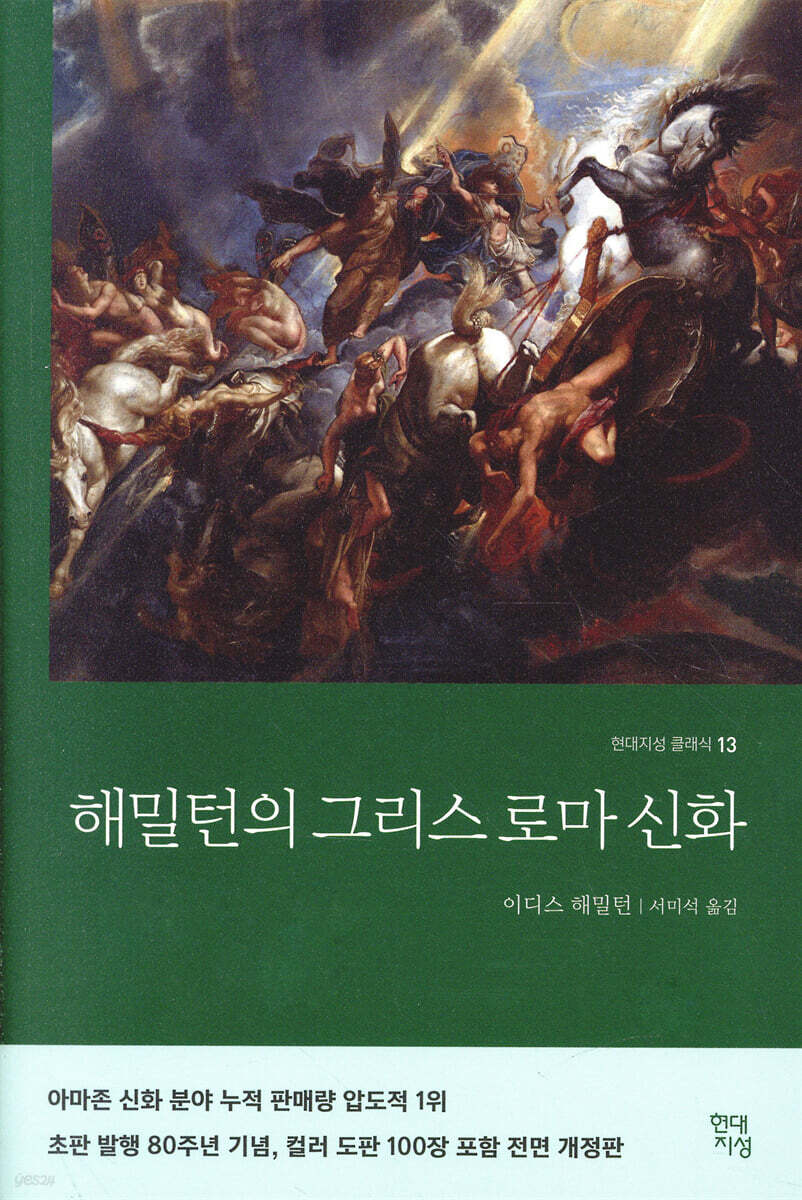
Peter Paul Rubens, whose portrait is also featured on the cover of this book, was a representative Flemish painter of the Baroque era.
He passionately expressed the hopes and frustrations, joy and sorrow, good and evil of the human mind using sensual physical descriptions, dynamic movements, and techniques of light and shadow.
"The Fall of Phaethon" densely depicts in a single painting the endless desire of humans to ascend to the sky and their frustration at their limitations.
Although times have changed and places have changed, humans have constantly read and reinterpreted myths, building their own temples in their hearts.
To capture these brilliant footsteps, this book contains a selection of 100 paintings and sculptures based on Greek and Roman mythology created by dozens of artists from ancient Greece through the Renaissance, Baroque, and 20th century.
The sculptures are mostly ancient works of unknown authors, but also include modern works by artists such as Canova.
Most of the paintings are from after the Renaissance.
This book contains a selection of works by masters spanning 500 years from the 16th to the 20th centuries, including Leonardo da Vinci, Raphael, Botticelli, Jacques-Louis David, Caravaggio, Rubens, Rembrandt, Jean Gérôme, Matisse, and John William Waterhouse.
By appreciating the colorful images and masterpieces alongside the text, readers will learn to savor and enjoy mythology from a variety of perspectives.
With the Christian Bible
Forming the two pillars of Western civilization
Western civilization was built on two great pillars: Hellenism and Hebraism.
In a broad sense, Hellenism refers to ancient Greek civilization, and Hebraism refers to Christian culture that originated in the ancient Near East.
If ‘humanity’ was at the center of Hellenism, ‘God’ was at the center of Hebraism.
Western civilization has passed through the Age of Enlightenment, a period of rediscovery of the 'human' of the classical era, following the millennium of the Middle Ages ruled by 'God', and has reached the present.
Mythology seems somehow out of place in human-centered Hellenism.
But Greco-Roman mythology contains the most human ideas.
In the introduction, Edith Hamilton, the author of this book, mentions 'the Greek miracle' and says that in ancient Greece, a new perspective that the world had never dreamed of before began to sprout.
Until then, humans were insignificant beings, but with the emergence of Greece, humans became the center and most important beings of the universe.
The Greeks created gods in their own image.
Unlike the inhuman and unrealistic gods of ancient Mesopotamia and ancient Egypt, the most human and realistic human aspects were projected onto the gods.
Even looking at the ancient Greek statues depicting the gods, they were depicted with the bodies of young, strong people, and I thought it was impossible to imagine a more beautiful being.
However, this does not mean that the Greek gods are perfect beings like the Christian gods.
Sometimes he is portrayed as a very 'human' being who gets jealous, gets angry, and makes mistakes.
In this way, Greco-Roman mythology, which resulted from the ‘rediscovery of humanity,’ became the prototype of Western civilization and, further, of human civilization.
Greek and Roman mythology has been the source of Western scholarship and thought, including literature, history, anthropology, and psychology, and has also provided abundant inspiration and creativity to the arts, including painting, sculpture, architecture, and music.
Even today, it continues to be the 'source of storytelling', providing endlessly attractive motifs to popular culture, including novels, dramas, movies, and games, like an inexhaustible spring.
Edith Hamilton, the greatest mythologist of the 20th century,
A selection of the best works from ancient texts
Edith Hamilton, author of Hamilton's Greek and Roman Myths, was coincidentally born in 1867, the year Thomas Bulfinch passed away.
She had a remarkable sense of language, learning various languages including Greek, Latin, French, and German from the age of seven.
In the 19th century, when it was difficult for women to receive public education, she majored in Greek and Latin at university, receiving bachelor's and master's degrees. After retiring from her position as principal, where she had served for 26 years, she continued to study the classics for 40 years and wrote various works, establishing herself as an outstanding mythologist.
At the age of 90, he was made an honorary citizen of Athens in recognition of his research and writing, and he also received numerous honorary degrees and awards.
At the time, it was popular among female writers to adapt or embellish Greek and Roman mythology so that it could be read easily by the general public.
However, with the pride characteristic of a classicist, Hamilton chose to preserve the flavor of the original text as much as possible rather than adapting it.
From the ancient Greek writers Homer, Hesiod, and Euripides to the Roman writers Ovid and Virgil, and even to the father of history, Herodotus, and the father of philosophy, Plato, we studied numerous ancient texts and carefully selected only the best works to capture the essence of mythology.
With his extraordinary passion for classical literature and his meticulous analytical skills, he was able to leave behind the masterpiece, “Hamilton’s Greek and Roman Mythology.”
Hamilton did not simply 'collect' the classics.
After comparing and analyzing ancient original texts, at the beginning of each story, a concise explanation was provided of which author's work was referenced, and what the author's characteristics and points of view were.
For example, it was pointed out that Hesiod, who came from a peasant background, was distinguished by a pure and pious style, while Ovid, who came from an urban aristocracy, was distinguished by a refined and rhetorical style.
The reinterpretation of Greco-Roman mythology is also impressive.
The ancient Greeks tried to explain the world rationally through mythology.
In their minds, thunder and lightning were what happened when Zeus struck down his thunderbolts, and volcanic eruptions were what happened when a monster trapped in a huge mountain tried to escape.
The Big Dipper never set below the horizon by the goddess's command.
In the author's view, mythology was not 'fantasy' but 'ancient science'.
According to the author, this period saw the beginning of a new revolution in thinking, moving away from the worship of inhuman magic and sorcery.
From ancient Greece to the 20th century
A total of 100 works of art
Savoring Greco-Roman mythology
In the West, as the Middle Ages came to a close and the Renaissance began, a massive project was undertaken to 'resurrect' the lost ancient Greek and Roman culture.
Artists have realistically recreated famous scenes from Greco-Roman mythology on canvas.
Breaking away from the rigid and uniform style of the Middle Ages, he created a free and dynamic feast of myths on canvas.
It was a moment when human awareness and desire, which had been suppressed for millennia during the Middle Ages, exploded.
The reproduction of this desire reaches its peak in the Baroque period.
Peter Paul Rubens, whose portrait is also featured on the cover of this book, was a representative Flemish painter of the Baroque era.
He passionately expressed the hopes and frustrations, joy and sorrow, good and evil of the human mind using sensual physical descriptions, dynamic movements, and techniques of light and shadow.
"The Fall of Phaethon" densely depicts in a single painting the endless desire of humans to ascend to the sky and their frustration at their limitations.
Although times have changed and places have changed, humans have constantly read and reinterpreted myths, building their own temples in their hearts.
To capture these brilliant footsteps, this book contains a selection of 100 paintings and sculptures based on Greek and Roman mythology created by dozens of artists from ancient Greece through the Renaissance, Baroque, and 20th century.
The sculptures are mostly ancient works of unknown authors, but also include modern works by artists such as Canova.
Most of the paintings are from after the Renaissance.
This book contains a selection of works by masters spanning 500 years from the 16th to the 20th centuries, including Leonardo da Vinci, Raphael, Botticelli, Jacques-Louis David, Caravaggio, Rubens, Rembrandt, Jean Gérôme, Matisse, and John William Waterhouse.
By appreciating the colorful images and masterpieces alongside the text, readers will learn to savor and enjoy mythology from a variety of perspectives.
GOODS SPECIFICS
- Date of issue: April 8, 2022
- Page count, weight, size: 552 pages | 958g | 150*225*35mm
- ISBN13: 9791139703603
- ISBN10: 1139703609
You may also like
카테고리
korean


korean

![GQ KOREA Mark (Monthly): December [2025]](http://librairie.coreenne.fr/cdn/shop/files/8ef265dbbfbf186523ed75ba7319009d.jpg?v=1765340328&width=3840)


