

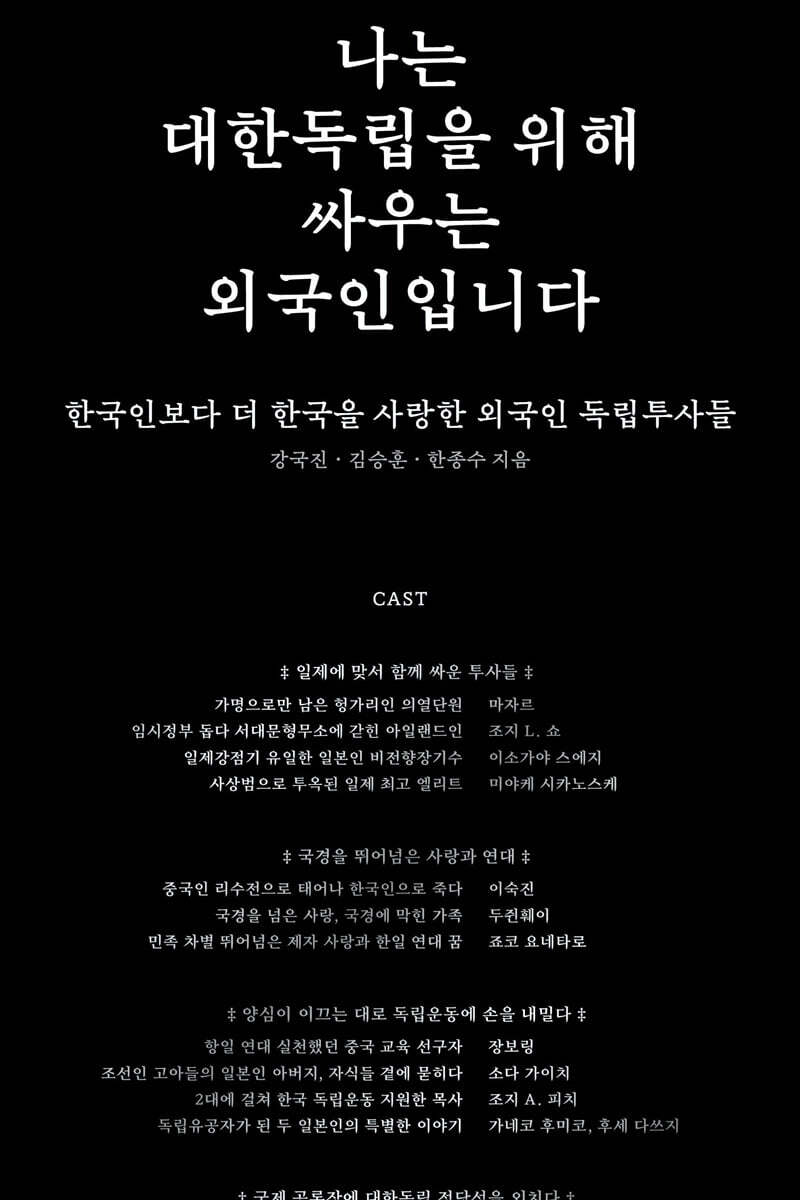
I am a foreigner fighting for Korean independence.
 |
Description
Book Introduction
- A word from MD
-
Although our nationalities differ, our dream of Korean independence remains the same.Today, on the 80th anniversary of liberation, this book highlights 25 foreign independence activists whom many people either do not know about or, even if they do know, do not pay attention to.
Those who fought alongside us to defend the values of humanity, freedom, and justice.
Even their names are unfamiliar, and even their records are vague, but thanks to their dedication and struggle, our fight was not lonely.
February 28, 2025. History PD Ahn Hyun-jae
80th anniversary of liberation, there are heroes we have ignored and forgotten!
25 foreign independence fighters who fought, were imprisoned, and died for Korea.
2025 marks the 80th anniversary of liberation.
We are well aware that numerous independence activists, including Kim Gu, Yu Gwan-sun, Ahn Jung-geun, Yun Bong-gil, and Kim Jwa-jin, fought against the Japanese.
But, many people either don't know that there are foreigners among them, or even if they do know, they don't really care.
The authors seek to revive and remember the achievements of foreign independence activists who have been forgotten amidst such ignorance and indifference.
And we want to remember and honor the universal human values they pursued: humanity, freedom, and justice.
This book introduces the lives and achievements of 25 foreign independence activists who deserve recognition as independence activists but have been forgotten without even receiving a medal, as well as foreign independence activists who have received medals but have not been properly recognized.
Westerners of various nationalities, including Bethel, Allen, Hulbert, and Suk Ho-pil (Schofield), Chinese people including Sun Yat-sen's family and Chiang Kai-shek, and Japanese people including Soda Kai-ichi.
The story of foreigners whose names I have only heard but not known, and strangers whose names I have never even heard, dedicating themselves to the independence movement unfolds in a heartbreaking way.
25 foreign independence fighters who fought, were imprisoned, and died for Korea.
2025 marks the 80th anniversary of liberation.
We are well aware that numerous independence activists, including Kim Gu, Yu Gwan-sun, Ahn Jung-geun, Yun Bong-gil, and Kim Jwa-jin, fought against the Japanese.
But, many people either don't know that there are foreigners among them, or even if they do know, they don't really care.
The authors seek to revive and remember the achievements of foreign independence activists who have been forgotten amidst such ignorance and indifference.
And we want to remember and honor the universal human values they pursued: humanity, freedom, and justice.
This book introduces the lives and achievements of 25 foreign independence activists who deserve recognition as independence activists but have been forgotten without even receiving a medal, as well as foreign independence activists who have received medals but have not been properly recognized.
Westerners of various nationalities, including Bethel, Allen, Hulbert, and Suk Ho-pil (Schofield), Chinese people including Sun Yat-sen's family and Chiang Kai-shek, and Japanese people including Soda Kai-ichi.
The story of foreigners whose names I have only heard but not known, and strangers whose names I have never even heard, dedicating themselves to the independence movement unfolds in a heartbreaking way.
- You can preview some of the book's contents.
Preview
index
Entering
Part 1: Fighters Who Fought Together Against Japanese Imperialism
Chapter 1: Hungarian members of the Righteous Army who remain only under pseudonyms: Magyar
Chapter 2: Irishman Imprisoned in Seodaemun Prison for Aiding the Provisional Government: George L.
show
Chapter 3: The Only Japanese Long-Term Prisoner of Conversion During the Japanese Colonial Period: Isogaya Sueji
Chapter 4: Japan's Top Elite Imprisoned as a Thought Criminal: Miyake Shikanosuke
Part 2: Love and Solidarity Beyond Borders
Chapter 5: Born as a Chinese Li Shuzhen, Dying as a Korean: Lee Sook-jin
Chapter 6: Love Across Borders, Family Blocked by Borders: Du Junhui
Chapter 7: Love for Disciples and the Dream of Korea-Japan Solidarity that Transcends National Discrimination: Joko Yonetaro
Part 3: Reaching Out to the Independence Movement, Guided by Conscience
Chapter 8: Chinese Education Pioneers Who Practiced Anti-Japanese Solidarity: Zhang Boring
Chapter 9: The Japanese Father of Korean Orphans Buried Next to His Children: Soda Kaichi
Chapter 10: A Pastor Who Supported the Korean Independence Movement for Two Generations: George A.
pitch
Chapter 11: The Extraordinary Stories of Two Japanese People Who Became Independence Activists: Fumiko Kaneko and Tatsuji Fuse
Part 4: Calling for Independence and Legitimacy in the International Public Sphere
Chapter 12: Journalists Who Shouted Korean Independence to the World: Bethel, Mackenzie, and Story
Chapter 13: Louis Marin, the French politician who advocated for the million-person signature campaign for Korean independence
Chapter 14: Great Stars of Modern Chinese History Who Became Korean Independence Activists: Sun Yat-sen, Chiang Kai-shek, Song Mei-ling, and Sun Ke
Chapter 15 Homer B., a blue-eyed Korean language scholar who traveled the world as Emperor Gojong's secret envoy.
Hulbert
Part 5: Spreading the Word about the March 1st Movement to the World
Chapter 16 The only foreigner to receive both the Korean Empire and the Republic of Korea medals: Horace N.
Allen
Chapter 17 3 · 1 The first journalist to introduce the Declaration of Independence to America: Valentine S.
McClatchy
Chapter 18, Part 3 · 1st Movement 34th National Representative: Frank W.
Schofield
Chapter 19: Traces of Korean Love Remaining in Dilkusha: Albert W.
Taylor
Going out
References
Part 1: Fighters Who Fought Together Against Japanese Imperialism
Chapter 1: Hungarian members of the Righteous Army who remain only under pseudonyms: Magyar
Chapter 2: Irishman Imprisoned in Seodaemun Prison for Aiding the Provisional Government: George L.
show
Chapter 3: The Only Japanese Long-Term Prisoner of Conversion During the Japanese Colonial Period: Isogaya Sueji
Chapter 4: Japan's Top Elite Imprisoned as a Thought Criminal: Miyake Shikanosuke
Part 2: Love and Solidarity Beyond Borders
Chapter 5: Born as a Chinese Li Shuzhen, Dying as a Korean: Lee Sook-jin
Chapter 6: Love Across Borders, Family Blocked by Borders: Du Junhui
Chapter 7: Love for Disciples and the Dream of Korea-Japan Solidarity that Transcends National Discrimination: Joko Yonetaro
Part 3: Reaching Out to the Independence Movement, Guided by Conscience
Chapter 8: Chinese Education Pioneers Who Practiced Anti-Japanese Solidarity: Zhang Boring
Chapter 9: The Japanese Father of Korean Orphans Buried Next to His Children: Soda Kaichi
Chapter 10: A Pastor Who Supported the Korean Independence Movement for Two Generations: George A.
pitch
Chapter 11: The Extraordinary Stories of Two Japanese People Who Became Independence Activists: Fumiko Kaneko and Tatsuji Fuse
Part 4: Calling for Independence and Legitimacy in the International Public Sphere
Chapter 12: Journalists Who Shouted Korean Independence to the World: Bethel, Mackenzie, and Story
Chapter 13: Louis Marin, the French politician who advocated for the million-person signature campaign for Korean independence
Chapter 14: Great Stars of Modern Chinese History Who Became Korean Independence Activists: Sun Yat-sen, Chiang Kai-shek, Song Mei-ling, and Sun Ke
Chapter 15 Homer B., a blue-eyed Korean language scholar who traveled the world as Emperor Gojong's secret envoy.
Hulbert
Part 5: Spreading the Word about the March 1st Movement to the World
Chapter 16 The only foreigner to receive both the Korean Empire and the Republic of Korea medals: Horace N.
Allen
Chapter 17 3 · 1 The first journalist to introduce the Declaration of Independence to America: Valentine S.
McClatchy
Chapter 18, Part 3 · 1st Movement 34th National Representative: Frank W.
Schofield
Chapter 19: Traces of Korean Love Remaining in Dilkusha: Albert W.
Taylor
Going out
References
Detailed image

Publisher's Review
· Strongly recommended by Hwang Hyeon-pil and Shim Yong-hwan
· The first historical textbook introducing the discovery of foreign independence activists
Foreign independence fighters in movies and dramas
Fiction or fact?
In movies and dramas set during the Japanese colonial period, it is not uncommon for foreigners to appear as supporting actors, extras, or characters who participate in the independence movement.
Most of us just accept these characters as necessary for the plot, and don't think about them seriously or examine them deeply.
But is this "foreign independence activist" character really nothing more than a fiction, invented by the director to heighten interest and dramatic effect? Could it be that such figures actually existed within the history of the independence movement?
In the movie "The Age of Shadows," a European man named Rubik appears, who disguises himself as a married couple with Yeon Gye-sun, a member of the Uiyoldan, and participates in an operation to bring bombs into the country.
Is Rubik a fictional character? No.
The real model for Rubik is the Hungarian 'Magyar', who fought against the Japanese while serving as the 'bomb maker' of the Uiyoldan in Shanghai.
The touching ending scene of the drama "Mr. Sunshine" features a Western reporter named Mackenzie, who interviews and takes photos of anti-Japanese resistance fighters during the late Joseon Dynasty.
Frederick A., the Far East correspondent for the Daily Mail, who reported directly on the Japanese invasion, the independence movement, and the activities of the anti-Japanese volunteer army and made them known to the world.
Mackenzie is the one.
The photo taken by Mackenzie is the only remaining true image of the anti-Japanese volunteer soldier.
The movie "Anarchist from Colony" features Park Yeol's Japanese wife, who devotes herself to the independence movement along with her husband.
The real person who shouted “Hurrah!” when the judge sentenced her to death, refused to have her sentence reduced, and eventually collapsed on the execution ground is Fumiko Kaneko.
Our fight was not lonely
From Magyar to Seokho Pil, the independence movement brought together conscience and humanity from around the world.
There are foreign independence activists who said that no Korean should forget Ahn Jung-geun even for a day.
There are foreign independence fighters whom Mr. Baekbeom Kim Gu said that all of our descendants and compatriots should respect, look up to, and admire.
Foreign heroes who fought, were imprisoned, exiled, and even gave their lives for the freedom and independence of a foreign country and a foreign people.
This book vividly and movingly tells the story of each and every one of their lives and achievements.
Through this, the authors seek to recall and honor the noble spirit of sacrifice of Korean independence fighters abroad, the universal human values of freedom and justice they pursued, and the humanity they bestowed upon us.
How were our countless uprisings and armed struggles possible when our sovereignty and territory were robbed? How were the harsh realities of the Japanese colonial period, their oppression and exploitation, and the March 1st Movement and the Declaration of Independence made known to the world? How were independence activists, including key figures in the Provisional Government of the Republic of Korea, able to persevere in their anti-Japanese struggle despite the harsh surveillance of the Japanese police and military police? All of these efforts were aided and sacrificed by the unsung heroes of independence from abroad.
However, today, on the 80th anniversary of liberation, foreign independence activists have become forgotten due to our ignorance and indifference.
As of November 2024, among the 18,162 independence activists who have received decorations, 76 are foreigners.
Through this book, the authors aim to shed light on foreign independence fighters who received honors but are not well known to us.
They include Lee Sook-jin, Du Jun-hui, Homer Hulbert, Ernest Bethel (Bae Seol), Frank Schofield (Seok Ho-pil), Frederick Mackenzie, Douglas Story, Louis Marin, George Shaw, Sun Yat-sen, Chiang Kai-shek, Kaneko Fumiko, and Fuse Tatsuji.
We also want to make the world more aware of foreign independence fighters who have contributed greatly to independence.
They include Magyar, Valentine McClatchy, Albert Taylor, Jang Bo-ring, Isogaya Sueji, Miyake Shikanosuke, Soda Kaichi, and Joko Yonetaro.
We must also not forget that there were countless other foreign heroes in Korea.
Because of them, our fight was never lonely.
· The first historical textbook introducing the discovery of foreign independence activists
Foreign independence fighters in movies and dramas
Fiction or fact?
In movies and dramas set during the Japanese colonial period, it is not uncommon for foreigners to appear as supporting actors, extras, or characters who participate in the independence movement.
Most of us just accept these characters as necessary for the plot, and don't think about them seriously or examine them deeply.
But is this "foreign independence activist" character really nothing more than a fiction, invented by the director to heighten interest and dramatic effect? Could it be that such figures actually existed within the history of the independence movement?
In the movie "The Age of Shadows," a European man named Rubik appears, who disguises himself as a married couple with Yeon Gye-sun, a member of the Uiyoldan, and participates in an operation to bring bombs into the country.
Is Rubik a fictional character? No.
The real model for Rubik is the Hungarian 'Magyar', who fought against the Japanese while serving as the 'bomb maker' of the Uiyoldan in Shanghai.
The touching ending scene of the drama "Mr. Sunshine" features a Western reporter named Mackenzie, who interviews and takes photos of anti-Japanese resistance fighters during the late Joseon Dynasty.
Frederick A., the Far East correspondent for the Daily Mail, who reported directly on the Japanese invasion, the independence movement, and the activities of the anti-Japanese volunteer army and made them known to the world.
Mackenzie is the one.
The photo taken by Mackenzie is the only remaining true image of the anti-Japanese volunteer soldier.
The movie "Anarchist from Colony" features Park Yeol's Japanese wife, who devotes herself to the independence movement along with her husband.
The real person who shouted “Hurrah!” when the judge sentenced her to death, refused to have her sentence reduced, and eventually collapsed on the execution ground is Fumiko Kaneko.
Our fight was not lonely
From Magyar to Seokho Pil, the independence movement brought together conscience and humanity from around the world.
There are foreign independence activists who said that no Korean should forget Ahn Jung-geun even for a day.
There are foreign independence fighters whom Mr. Baekbeom Kim Gu said that all of our descendants and compatriots should respect, look up to, and admire.
Foreign heroes who fought, were imprisoned, exiled, and even gave their lives for the freedom and independence of a foreign country and a foreign people.
This book vividly and movingly tells the story of each and every one of their lives and achievements.
Through this, the authors seek to recall and honor the noble spirit of sacrifice of Korean independence fighters abroad, the universal human values of freedom and justice they pursued, and the humanity they bestowed upon us.
How were our countless uprisings and armed struggles possible when our sovereignty and territory were robbed? How were the harsh realities of the Japanese colonial period, their oppression and exploitation, and the March 1st Movement and the Declaration of Independence made known to the world? How were independence activists, including key figures in the Provisional Government of the Republic of Korea, able to persevere in their anti-Japanese struggle despite the harsh surveillance of the Japanese police and military police? All of these efforts were aided and sacrificed by the unsung heroes of independence from abroad.
However, today, on the 80th anniversary of liberation, foreign independence activists have become forgotten due to our ignorance and indifference.
As of November 2024, among the 18,162 independence activists who have received decorations, 76 are foreigners.
Through this book, the authors aim to shed light on foreign independence fighters who received honors but are not well known to us.
They include Lee Sook-jin, Du Jun-hui, Homer Hulbert, Ernest Bethel (Bae Seol), Frank Schofield (Seok Ho-pil), Frederick Mackenzie, Douglas Story, Louis Marin, George Shaw, Sun Yat-sen, Chiang Kai-shek, Kaneko Fumiko, and Fuse Tatsuji.
We also want to make the world more aware of foreign independence fighters who have contributed greatly to independence.
They include Magyar, Valentine McClatchy, Albert Taylor, Jang Bo-ring, Isogaya Sueji, Miyake Shikanosuke, Soda Kaichi, and Joko Yonetaro.
We must also not forget that there were countless other foreign heroes in Korea.
Because of them, our fight was never lonely.
GOODS SPECIFICS
- Date of issue: March 1, 2025
- Page count, weight, size: 376 pages | 474g | 140*210*20mm
- ISBN13: 9791193528488
- ISBN10: 1193528488
You may also like
카테고리
korean


korean

![ELLE 엘르 스페셜 에디션 A형 : 12월 [2025]](http://librairie.coreenne.fr/cdn/shop/files/b8e27a3de6c9538896439686c6b0e8fb.jpg?v=1766436872&width=3840)


