

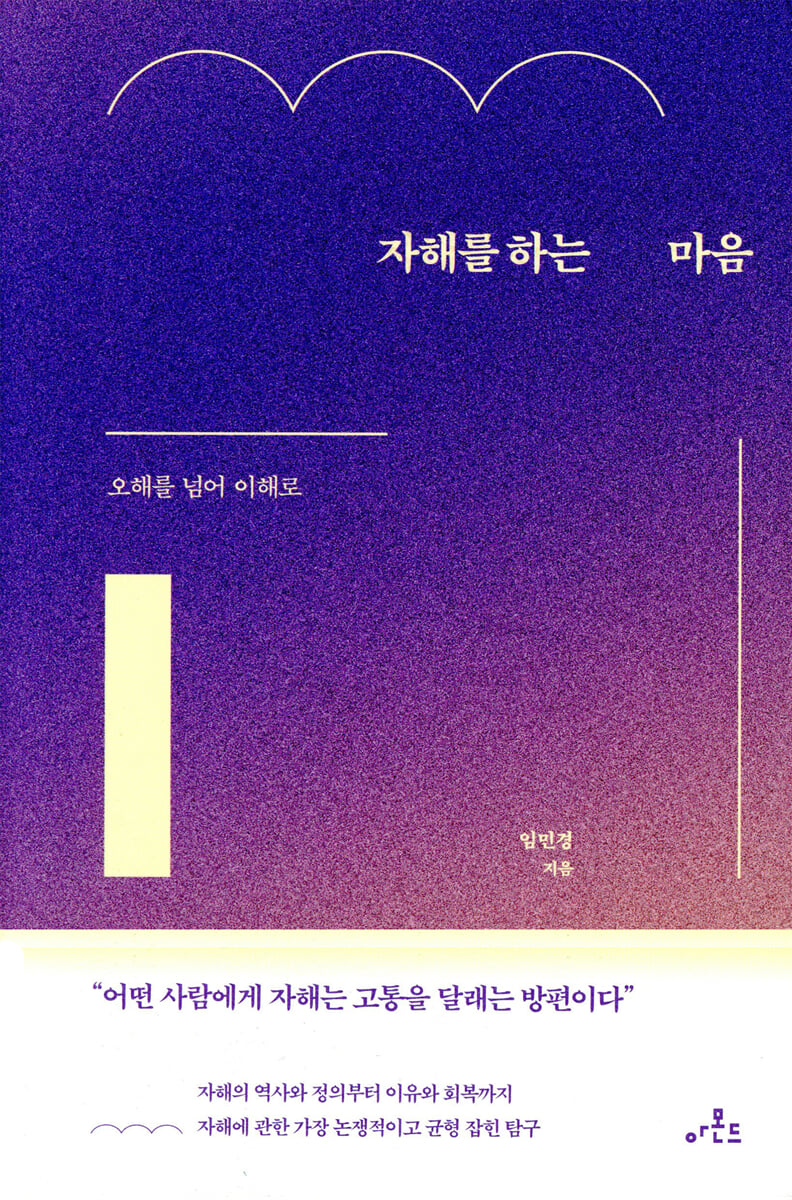
Self-harming mind
 |
Description
Book Introduction
“For the one person this book means something to”
A former self-harmer and current clinical psychologist writes about two worlds.
A secret love letter and a tender report
"The Mind of Self-Harm" is the first popular book to delve into self-harm, a topic that has previously been consumed as sensational articles or dealt with only in academic circles.
The author of this book, Lim Min-kyung, is a clinical psychologist who studies self-harm and a former self-harmer.
In his book, he carefully reveals the experiences, thoughts, and feelings of the person at the time from the perspective of the person involved, while maintaining a scientific and objective perspective as a researcher, meticulously examining domestic and international research papers and historical documents.
With the intention of going beyond my own limited experience and capturing the true feelings of more self-harmers, I also included interviews with ten people who are currently self-harming or have self-harmed in the past but have recently stopped.
I also met with a teacher who works as a guidance counselor at school and talked to him.
This is why this book maintains a 'balanced' perspective without appealing to emotions or stereotyping the self-harmer from an observer's perspective, simply asking for understanding of self-harm.
What's the point of choosing a dark and dangerous topic, let alone bringing up a story that some might not be particularly interested in?
The author hesitated many times over whether to continue writing the book and even considered giving up.
However, he finds courage in a word from the counselor who gives him advice.
“Keep writing for the one person this book will mean to.”
Although he wrote in the preface that he was “too greedy to choose just one person,” readers who read the book to the end will realize that this book is a secret love letter to his past self (and to all those who have self-harmed in the present), and at the same time, a cautious suggestion to think together about what a “life worth living” is.
A former self-harmer and current clinical psychologist writes about two worlds.
A secret love letter and a tender report
"The Mind of Self-Harm" is the first popular book to delve into self-harm, a topic that has previously been consumed as sensational articles or dealt with only in academic circles.
The author of this book, Lim Min-kyung, is a clinical psychologist who studies self-harm and a former self-harmer.
In his book, he carefully reveals the experiences, thoughts, and feelings of the person at the time from the perspective of the person involved, while maintaining a scientific and objective perspective as a researcher, meticulously examining domestic and international research papers and historical documents.
With the intention of going beyond my own limited experience and capturing the true feelings of more self-harmers, I also included interviews with ten people who are currently self-harming or have self-harmed in the past but have recently stopped.
I also met with a teacher who works as a guidance counselor at school and talked to him.
This is why this book maintains a 'balanced' perspective without appealing to emotions or stereotyping the self-harmer from an observer's perspective, simply asking for understanding of self-harm.
What's the point of choosing a dark and dangerous topic, let alone bringing up a story that some might not be particularly interested in?
The author hesitated many times over whether to continue writing the book and even considered giving up.
However, he finds courage in a word from the counselor who gives him advice.
“Keep writing for the one person this book will mean to.”
Although he wrote in the preface that he was “too greedy to choose just one person,” readers who read the book to the end will realize that this book is a secret love letter to his past self (and to all those who have self-harmed in the present), and at the same time, a cautious suggestion to think together about what a “life worth living” is.
- You can preview some of the book's contents.
Preview
index
Preface For the one person for whom this book will be meaningful
Chapter 1: The History of Self-Harm
Two worlds
Deep-rooted history
Psychoanalysis and Self-Harm
Quiet Self-Harm Syndrome
Beautiful, sad, angry, and free
Is self-harm just a passing fad?
The rise of the Internet and the rise of self-harmers
Chapter 2 I don't want to die
non-suicidal self-harm
Benefits and Barriers to Self-Harm
Functions of self-harm
Come, sweet pain
Look here
Chapter 3: The Candy Can Born with a Grip
How free are our choices?
The Watson Era and the Rag Monkey Era
Window of Awakening
Bibil Hill
Between misfortune and responsibility
Chapter 4 Recovery and Help
The complex context surrounding recovery
The Journey to Recovery
Validation
What empathy does
References
Americas
Chapter 1: The History of Self-Harm
Two worlds
Deep-rooted history
Psychoanalysis and Self-Harm
Quiet Self-Harm Syndrome
Beautiful, sad, angry, and free
Is self-harm just a passing fad?
The rise of the Internet and the rise of self-harmers
Chapter 2 I don't want to die
non-suicidal self-harm
Benefits and Barriers to Self-Harm
Functions of self-harm
Come, sweet pain
Look here
Chapter 3: The Candy Can Born with a Grip
How free are our choices?
The Watson Era and the Rag Monkey Era
Window of Awakening
Bibil Hill
Between misfortune and responsibility
Chapter 4 Recovery and Help
The complex context surrounding recovery
The Journey to Recovery
Validation
What empathy does
References
Americas
Detailed image

Into the book
Those who commit self-harm cannot help but view self-harm from a largely subjective perspective.
For them, what matters is not self-harm itself, but the emotional and existential pain they are experiencing, and self-harm is merely a means of relieving or expressing that pain.
For this reason, self-harmers may view those who are interested in their self-harm as merely 'concerned with appearances', 'so intent on stopping the self-harm that they fail to see the real problem', or they may feel aversion to any attempt to stop the self-harm.
--- p.15
Self-harm may be an attempt to get attention, but in many cases it is not.
Even if you self-harm to get attention, it is not shameful or deserving of condemnation.
If someone around you is self-harming with that kind of intention, it may not be a sign that you should stop caring about them, but rather that they need a different kind of connection or attention.
--- p.33
Even today, male self-harm is often not immediately interpreted as “self-harming behavior.”
For example, let's say a young male teenager gets so angry that he breaks a window with his hand.
In many cases, people simply express intense emotions and do not consider it self-harm.
Of course, sometimes people do this out of anger, and it's difficult to call such behavior self-harm.
However, if you repeatedly hit a wall, desk, glass, etc. when you are angry, it is important to consider whether this behavior should be considered self-harm.
However, society considers this type of 'expression of anger' as 'a display of masculinity'.
--- p.36
There is a clear difference between simply analyzing the specific behaviors of certain people and listing their different characteristics, labeling them "people who do certain things," and defining them as "generally like this."
Regardless of whether there is any actual scientific or clinical basis for referring to these patients as Cutters, by lumping together a series of images that these doctors noted were "strikingly similar to each other" and calling them "Cutters," they created the stereotypical "Cutter character"—an attractive, intelligent, but often young, white woman with interpersonal problems, lack of affection, and a tendency to depend on drugs.
--- p.51
Self-harm itself is only a part of the problem that is visible above the surface, so dismissing it as “self-harm isn’t cool, it’s just a fad” doesn’t make the real problem underneath, the psychological pain, go away.
Saying things like that does absolutely nothing to effectively prevent or stop self-harm.
Rather, such misunderstanding-based criticism only serves to humiliate those who self-harm, causing them to hide their harm and further increase their stress and pain, worsening various emotional and behavioral symptoms.
If we want to sound a little alarmist about the fact that "self-harm can be contagious" or, to put it more academically, that "self-harm can be socially learned," wouldn't it be more appropriate to argue that we need to create an environment where people who are currently experiencing emotional distress don't so easily encounter or choose self-harm?
--- p.62
The fact that some people (even mental health professionals) secretly crave self-harm needs to be talked about openly rather than hidden.
To answer the question, “Why on earth do people self-harm?”, we must first explain that those who self-harm have good reasons for doing so.
Self-harm is not a universal human behavior and is certainly pathological to some extent, but it is not something “only crazy people do,” and when you look closely, there are some understandable reasons behind it.
--- p.106
People who self-harm often experience interpersonal problems, and they tend to have less social skills and experience more conflict than their non-self-harming peers.
However, in their defense, the high correlation between self-harm and negative interpersonal relationships is partly due to the fact that the environment in which self-harmers live has not been friendly to them.
In general, families of people who self-harm tend to be less accepting, more conflicted, and more critical of each other than families of people who do not self-harm.
--- p.124
Given that adverse childhood experiences have such a pervasive impact, it is only natural that non-suicidal self-injury would fall within their sphere of influence.
A pooled analysis of dozens of individual studies found that childhood abuse is a significant risk factor for nonsuicidal self-harm and suicide in adulthood.
According to these studies, childhood abuse, whether physical or emotional abuse, neglect, or sexual abuse, has a direct or indirect impact on self-harm.
--- p.153
It reveals that what we think of as recovery is actually an incomplete concept, and that this incomplete perception can sometimes even hinder recovery.
People usually think of a state of healing or recovery as a state of complete absence of symptoms, a degree of self-satisfaction, stable interpersonal relationships, and a state of near-constant peace and tranquility.
Of course, this kind of recovery does exist, but to be blunt, it is closer to an 'ideal' or 'best state' than a recovery.
Above all, this is a concept that views recovery too narrowly.
--- p.200~201
Beginner counselors say, 'I know empathy is important, but I'm worried that if I just continue to empathize, I won't be able to provide any real help.
He also asked, "Can we just continue to empathize? How can empathy actually bring about change?"
It's really difficult to answer the question of how empathy can lead to change.
If I were to think about it again from this point on, I would probably answer that people can only change if they are first understood, and that experiencing sufficient validation allows individuals to somewhat break down the defensive walls they have built against the outside world, including others.
For them, what matters is not self-harm itself, but the emotional and existential pain they are experiencing, and self-harm is merely a means of relieving or expressing that pain.
For this reason, self-harmers may view those who are interested in their self-harm as merely 'concerned with appearances', 'so intent on stopping the self-harm that they fail to see the real problem', or they may feel aversion to any attempt to stop the self-harm.
--- p.15
Self-harm may be an attempt to get attention, but in many cases it is not.
Even if you self-harm to get attention, it is not shameful or deserving of condemnation.
If someone around you is self-harming with that kind of intention, it may not be a sign that you should stop caring about them, but rather that they need a different kind of connection or attention.
--- p.33
Even today, male self-harm is often not immediately interpreted as “self-harming behavior.”
For example, let's say a young male teenager gets so angry that he breaks a window with his hand.
In many cases, people simply express intense emotions and do not consider it self-harm.
Of course, sometimes people do this out of anger, and it's difficult to call such behavior self-harm.
However, if you repeatedly hit a wall, desk, glass, etc. when you are angry, it is important to consider whether this behavior should be considered self-harm.
However, society considers this type of 'expression of anger' as 'a display of masculinity'.
--- p.36
There is a clear difference between simply analyzing the specific behaviors of certain people and listing their different characteristics, labeling them "people who do certain things," and defining them as "generally like this."
Regardless of whether there is any actual scientific or clinical basis for referring to these patients as Cutters, by lumping together a series of images that these doctors noted were "strikingly similar to each other" and calling them "Cutters," they created the stereotypical "Cutter character"—an attractive, intelligent, but often young, white woman with interpersonal problems, lack of affection, and a tendency to depend on drugs.
--- p.51
Self-harm itself is only a part of the problem that is visible above the surface, so dismissing it as “self-harm isn’t cool, it’s just a fad” doesn’t make the real problem underneath, the psychological pain, go away.
Saying things like that does absolutely nothing to effectively prevent or stop self-harm.
Rather, such misunderstanding-based criticism only serves to humiliate those who self-harm, causing them to hide their harm and further increase their stress and pain, worsening various emotional and behavioral symptoms.
If we want to sound a little alarmist about the fact that "self-harm can be contagious" or, to put it more academically, that "self-harm can be socially learned," wouldn't it be more appropriate to argue that we need to create an environment where people who are currently experiencing emotional distress don't so easily encounter or choose self-harm?
--- p.62
The fact that some people (even mental health professionals) secretly crave self-harm needs to be talked about openly rather than hidden.
To answer the question, “Why on earth do people self-harm?”, we must first explain that those who self-harm have good reasons for doing so.
Self-harm is not a universal human behavior and is certainly pathological to some extent, but it is not something “only crazy people do,” and when you look closely, there are some understandable reasons behind it.
--- p.106
People who self-harm often experience interpersonal problems, and they tend to have less social skills and experience more conflict than their non-self-harming peers.
However, in their defense, the high correlation between self-harm and negative interpersonal relationships is partly due to the fact that the environment in which self-harmers live has not been friendly to them.
In general, families of people who self-harm tend to be less accepting, more conflicted, and more critical of each other than families of people who do not self-harm.
--- p.124
Given that adverse childhood experiences have such a pervasive impact, it is only natural that non-suicidal self-injury would fall within their sphere of influence.
A pooled analysis of dozens of individual studies found that childhood abuse is a significant risk factor for nonsuicidal self-harm and suicide in adulthood.
According to these studies, childhood abuse, whether physical or emotional abuse, neglect, or sexual abuse, has a direct or indirect impact on self-harm.
--- p.153
It reveals that what we think of as recovery is actually an incomplete concept, and that this incomplete perception can sometimes even hinder recovery.
People usually think of a state of healing or recovery as a state of complete absence of symptoms, a degree of self-satisfaction, stable interpersonal relationships, and a state of near-constant peace and tranquility.
Of course, this kind of recovery does exist, but to be blunt, it is closer to an 'ideal' or 'best state' than a recovery.
Above all, this is a concept that views recovery too narrowly.
--- p.200~201
Beginner counselors say, 'I know empathy is important, but I'm worried that if I just continue to empathize, I won't be able to provide any real help.
He also asked, "Can we just continue to empathize? How can empathy actually bring about change?"
It's really difficult to answer the question of how empathy can lead to change.
If I were to think about it again from this point on, I would probably answer that people can only change if they are first understood, and that experiencing sufficient validation allows individuals to somewhat break down the defensive walls they have built against the outside world, including others.
--- p.223
Publisher's Review
“Self-harm is not a universal human behavior,
“It’s not something only a crazy person would do.”
From the history and definition of self-harm to its causes and recovery.
Korea's first popular educational book to deal with self-harm in depth
“I just want to cut it all off/I just want to let it all go (…) Am I worthy of being loved/You said you hated broadcasting but you put a barcode on me and here I am/Black lines on a white background make me look down at my arm/I wonder if there’s any meaning to living like this.” These are some of the lyrics written by rapper Vinxen, who appeared on Mnet’s 2018 hit “High School Rapper 2.”
At the time, Vinxen received enthusiastic responses from the public beyond his peer group with his outstanding rap skills as well as his lyrics that honestly and rawly expressed his pessimism, self-loathing, and depression in a dark situation.
There was a lot of talk about the experience of self-harm, where he openly revealed his experience of cutting his wrists, as in the metaphorical expression 'black lines on a white background'.
Coincidentally, the number of youth committing suicide increased that year.
In fact, in 2018, several media outlets focused on self-harm through feature articles or one-off articles, and on September 20, the Korean Neuropsychiatric Association even held a special symposium titled “Self-harm Pandemic: What Should South Korea Do?”
The trend of self-harm research conducted domestically also reflects this trend.
From 2010 to 2013, only four research papers on self-harm were published, but this number increased dramatically to 30 during the following four years from 2016 to 2019.
Is self-harm, often described as a “contagion of the mind,” something that is imitated and contagious, like the Werther effect?
From the perspective of looking into the 'dark abyss' of humanity, there have been many books that deal with the subject of suicide.
A variety of books have been published, ranging from essays by people with the disorder to professional books, dealing with pathological aspects such as depression, bipolar disorder, anxiety disorder, and ADHD.
Was it because of the difficulty of the subject itself? Or, as mentioned earlier, because it was considered a "temporary fad"? When it came to self-harm, there were only guidebooks and academic textbooks for therapists or parents, and no books for the general reader.
『The Mind of Self-Harm (Almond Publishing)』 is the first popular educational book on self-harm.
This book is novel and unique in that it comprehensively covers the history, definition, function, and recovery of self-harm, all of which have never been properly introduced before, at a level accessible to the general reader.
The author of the book, Lim Min-kyung, is a clinical psychologist who studies self-harm and a former self-harmer.
In his book, he carefully reveals the experiences, thoughts, and feelings of the person at the time from the perspective of the person involved, while maintaining a scientific and objective perspective as a researcher, meticulously examining domestic and international research papers and historical documents.
With the intention of going beyond my own limited experience and capturing the true feelings of more self-harmers, I also included interviews with ten people who are currently self-harming or have self-harmed in the past but have recently stopped.
I also met with a teacher who works as a guidance counselor at school and talked to him.
This is why this book maintains a 'balanced' perspective without appealing to emotions or stereotyping the self-harmer from an observer's perspective, simply asking for understanding of self-harm.
The invention of 'self-harm = tolerance'
The history of self-harm and self-hatred runs deeper than you might think.
The author, who witnessed the explosion of discussion about self-harm in the late 2010s, confesses that “while I was very welcome to the academic and social interest (which seemed to be the interest shown to me and my friends back then), something also felt off.”
Even though times have changed and social perspectives have changed significantly, prejudice and misunderstandings toward those who commit self-harm have not easily subsided.
For example, questions mixed with contempt, such as “Aren’t kids who self-harm just attention seekers?”, “Isn’t self-harm something only girls do?”, and “When I see everyone else self-harming their wrists, they’re just copying their friends, right?”, are repeated like a cycle, both in the past and present.
But is that really true?
The first chapter of the book is devoted to examining the history of self-harm.
Because the history of self-harm is a story about 'how people reacted to self-harm and those who self-harmed, and how self-harm became a target of prejudice.'
According to the book, the equation 'self-harmer = lenient' was not invented in modern times.
Nineteenth-century doctors and psychoanalysts believed that hysteria was accompanied by 'emotional instability', and since self-harmers often showed emotional instability, they were often diagnosed with hysteria as well.
The problem is that the prejudice that “hysterical patients are very fond of attention and sympathy” has also been accepted (p. 26).
One of the most interesting cases in the history of self-harm is that of Helen Miller, who was admitted to the New York State Asylum in 1875 (p. 28). Immediately after her admission, Miller complained of depression and began self-harming by poking her arms with pieces of glass, nails, and needles.
The medical team at the time wrote in their case report on Miller: “She was happiest when she had the surgeons’ full attention,” “She refused food for several days, but when no attention was paid to her, she would eat again,” and “There was always an element of hysteria in these cases.
(…) self-harm occurred only when medical help was available,” he wrote.
The medical staff's perspective is in line with the current perception that 'self-harmer = accomplice'.
This passage specifically shows that prejudice against self-harm has a long history, just as self-harming behavior itself has.
The author points out that although the perspective and treatment method of medical staff are partially understandable in accordance with the principle of extinction (the principle of eliminating a behavior by not providing the reinforcer that causes the behavior) presented by behaviorism, the more important principle than 'attention prohibition' is that the condition of providing attention in an appropriate manner 'must' be attached.
The fact that the medical community paid relatively little attention to why it was so important to get Miller's attention mirrors our lazy approach to self-harm today.
The author also traces the development of common perceptions that "women self-harm more than men" and that "self-harm is primarily wrist cuts."
Wrist self-harm was not a prominent phenomenon in the United States until the 1950s and early 1960s.
Then, in the 1960s, some psychiatrists in the eastern United States published several papers on 'wrist self-harm syndrome' and developed 'Cutter' (a person who cuts their wrists).
According to their paper, “the typical cutter is an attractive young woman, averaging 23 years old,” and “all of the study subjects experienced significant interpersonal problems” (p. 48).
The author is cautious, stating, “It is unclear whether there was actually a surge in list-cutting among young women in the late 1960s, and if so, what factors influenced it” (p. 47).
However, one may be skeptical of the possibility of bias, as “all 13 of the so-called ‘classic papers’ on this ‘list-cutting syndrome’ were produced by doctors who share a specific opinion at just four hospitals (page 50).”
There is a huge difference between simply analyzing what some people do and listing their different characteristics, calling them "people who do certain things," and defining them as "generally like that."
For some, self-harm is a painkiller.
The true feelings of self-harmers, understood through the definition and function of self-harm.
The first self-mutilator, according to self-harm researchers, was Cleomenes I, a Spartan king from the 5th century BC.
According to Herodotus's "History," he "as soon as he took the sword in his hand, he cut it into small pieces, from the shin to the thigh and abdomen, as if he were slicing meat." (p. 22) This action, which makes one wonder if it was really self-harm, is far from the modern definition of self-harm.
Self-harm, as currently officially defined by mental health researchers, means non-suicidal self-harm, that is, self-harm without suicidal intent.
Chapter 2 examines not only the definition of self-harm but also the reasons for self-harm. It includes detailed information such as ‘What is self-harm (page 77)’, ‘How to distinguish between self-harm with suicidal intent and self-harm without suicidal intent (page 78)’, ‘Does self-harm increase the risk of suicide (page 80)’, and ‘If self-harm increases the risk of suicide, why (page 83)’.
A particularly noteworthy section in Chapter 2 is the section on “Why do some people choose and continue to self-harm?” (p. 104). In psychology, this is called the “function of self-harm,” and the author begins by clarifying that “although the word ‘function’ can be misleading, it is a neutral term that specifically explains the principles by which self-harm is initiated and maintained.”
The function of self-harm is mainly explained by the 'two-factor theory'.
The two factors are divided into ‘individual internal function’ and ‘social function’.
In a word, the personal inner function is the 'emotional regulation function'.
It means self-harming to experience positive feelings or sensations or to relieve negative emotions.
Social functions are literally those that are influenced by or influence interpersonal relationships.
So, there are cases where people 'harm themselves because they want other people's attention.'
However, the proportion is only about 5-10% of the total. (Page 17) The emotional regulation function of self-harm is the core reason why people continue to self-harm today, accounting for 66-81% of the total (varies by study, but generally around 70%).
The 'emotional regulation function' of self-harm can also be confirmed in the everyday language of the self-harmers interviewed by the author.
When describing the function of self-harm, they used words like "stabilizing" and "comforting" (p. 107). Other expressions included "feeling alive," "relieving some of the stress," "liberation," and "catharsis" (p. 108).
Although we may not want to admit it, many people self-harm for emotional regulation purposes.
This is an undeniable 'fact'.
Why on earth is that?
The author cautiously suggests that for some, self-harm acts like a 'pain reliever'.
Why Some People Choose to Self-Harm
About the various reasons and paths toward self-harm
Whether the goal is emotional regulation, a desire to communicate one's pain to others, or a desire to punish oneself, self-harm is, to some extent, an attempt to escape a difficult situation.
However, most self-harm ends up worsening the situation rather than achieving its intended purpose.
It is a very inefficient choice in terms of cost-effectiveness.
However, we should not blame them for making such inefficient choices, because there are clearly people for whom the benefits of self-harm are inevitably greater, and for whom the range of options is limited.
The factors that create this "narrowed range of choices," which the author describes as "being born with a cookie jar," are diverse, including genetics, place of birth, economic status, the presence of disasters, bullying, unemployment, poverty, and having a socially minority identity.
Researchers have managed to identify some particularly risky factors, one of which is adverse childhood experiences or abuse.
The book features a post-mortem of a psychological experiment that vividly illustrates how this seemingly unrelated factor can lead to self-harm.
This is the scene after Harry Harlow's 'wire mother monkey, rag mother monkey' experiment (page 141). Monkeys that were separated from their mothers immediately after birth and deprived of social contact for six months pulled out their hair, scratched themselves, and bit their hands and feet when they saw a photographer who came to cover them.
The author cautiously predicts that what these baby monkeys experienced was a form of abuse called "emotional neglect," and if emotional neglect in monkeys can have such devastating consequences, it's plausible that humans experiencing similar situations would experience the same consequences (p. 146).
In fact, one-third of the self-harmers interviewed by the author reported growing up in complex situations of abuse, with two-thirds experiencing only one type of abuse (p. 150). The author states, "These individuals' self-harm and emotional problems were somehow connected to their past abuse, even if not to a direct causal relationship" (p. 151).
Meanwhile, I offer this advice to readers who feel despair and wonder, "Am I still having such a hard time?" because of childhood abuse, a factor "I cannot choose or control."
“We can look back on the past and understand ourselves, but we can also remember to blame ourselves less and take responsibility for ourselves.”
Beyond misunderstanding to understanding
What exactly is recovery from self-harm?
The final chapter of the book deals with 'recovery'.
However, the way this book deals with 'recovery' is a bit unique.
The author's cautious, theoretical yet warm attitude is most evident in the stories dealing with 'recovery'.
This is because the thoughts of the self-harmer, the therapist, and those around them regarding healing are subtly different and complex.
Among those who self-harm, there are certainly those who feel that self-harm is a top priority and who make efforts to stop on their own.
However, some people hesitate or are reluctant to bring up the topic of self-harm.
They generally believe that self-harm is not a 'real' problem and that they need more help with other underlying issues.
However, when people learn that their children or students are self-harming, they become angry, scold, or cry, focusing only on reducing or eliminating the self-harm itself.
Sometimes, overwhelmed by the situation, they remain silent or ignore it completely.
One reason why recovery and treatment of self-harm are so difficult to address is that it is difficult to define what recovery actually is.
It is usually assumed that ‘stopping self-harm = recovery’.
But if the 'real' problem mentioned above remains, and you continue to feel depressed, anxious, or in pain, will simply stopping self-harm mean recovery?
The author emphasizes that although you may wonder, "What good does that do?", simply stopping self-harm is a very valuable thing.
Even if it is not noticeable at the moment, it may represent an underlying change.
So, what should we do when a loved one, family member, or friend struggles with self-harm? The author argues that while it's impossible to offer specific advice because each individual's temperament and circumstances are different, there are clear principles that apply in every situation.
This principle, which the author painstakingly introduces, is "validation," proposed by world-renowned clinical psychologist Marsha Linehan (p. 209).
Validation is a six-step process, and the author summarizes it as "temporarily suppressing the desire to feel pain and embracing the suffering of others" (p. 212). While acknowledging that validation is "easy to understand intellectually but incredibly difficult to put into practice," the author earnestly urges those around self-harmers to consider validating themselves at least once or twice (p. 225).
What's the point of choosing a dark and dangerous topic, let alone bringing up a story that some might not be particularly interested in?
The author hesitated many times over whether to continue writing the book and even considered giving up.
However, he finds courage in a word from the counselor who gives him advice.
“Keep writing for the one person this book will mean to.”
Although he wrote in the preface that he was “too greedy to choose just one person,” readers who read the book to the end will realize that this book is a secret love letter to his past self (and to all those who have self-harmed in the present), and at the same time, a cautious suggestion to think together about what a “life worth living” is.
“It’s not something only a crazy person would do.”
From the history and definition of self-harm to its causes and recovery.
Korea's first popular educational book to deal with self-harm in depth
“I just want to cut it all off/I just want to let it all go (…) Am I worthy of being loved/You said you hated broadcasting but you put a barcode on me and here I am/Black lines on a white background make me look down at my arm/I wonder if there’s any meaning to living like this.” These are some of the lyrics written by rapper Vinxen, who appeared on Mnet’s 2018 hit “High School Rapper 2.”
At the time, Vinxen received enthusiastic responses from the public beyond his peer group with his outstanding rap skills as well as his lyrics that honestly and rawly expressed his pessimism, self-loathing, and depression in a dark situation.
There was a lot of talk about the experience of self-harm, where he openly revealed his experience of cutting his wrists, as in the metaphorical expression 'black lines on a white background'.
Coincidentally, the number of youth committing suicide increased that year.
In fact, in 2018, several media outlets focused on self-harm through feature articles or one-off articles, and on September 20, the Korean Neuropsychiatric Association even held a special symposium titled “Self-harm Pandemic: What Should South Korea Do?”
The trend of self-harm research conducted domestically also reflects this trend.
From 2010 to 2013, only four research papers on self-harm were published, but this number increased dramatically to 30 during the following four years from 2016 to 2019.
Is self-harm, often described as a “contagion of the mind,” something that is imitated and contagious, like the Werther effect?
From the perspective of looking into the 'dark abyss' of humanity, there have been many books that deal with the subject of suicide.
A variety of books have been published, ranging from essays by people with the disorder to professional books, dealing with pathological aspects such as depression, bipolar disorder, anxiety disorder, and ADHD.
Was it because of the difficulty of the subject itself? Or, as mentioned earlier, because it was considered a "temporary fad"? When it came to self-harm, there were only guidebooks and academic textbooks for therapists or parents, and no books for the general reader.
『The Mind of Self-Harm (Almond Publishing)』 is the first popular educational book on self-harm.
This book is novel and unique in that it comprehensively covers the history, definition, function, and recovery of self-harm, all of which have never been properly introduced before, at a level accessible to the general reader.
The author of the book, Lim Min-kyung, is a clinical psychologist who studies self-harm and a former self-harmer.
In his book, he carefully reveals the experiences, thoughts, and feelings of the person at the time from the perspective of the person involved, while maintaining a scientific and objective perspective as a researcher, meticulously examining domestic and international research papers and historical documents.
With the intention of going beyond my own limited experience and capturing the true feelings of more self-harmers, I also included interviews with ten people who are currently self-harming or have self-harmed in the past but have recently stopped.
I also met with a teacher who works as a guidance counselor at school and talked to him.
This is why this book maintains a 'balanced' perspective without appealing to emotions or stereotyping the self-harmer from an observer's perspective, simply asking for understanding of self-harm.
The invention of 'self-harm = tolerance'
The history of self-harm and self-hatred runs deeper than you might think.
The author, who witnessed the explosion of discussion about self-harm in the late 2010s, confesses that “while I was very welcome to the academic and social interest (which seemed to be the interest shown to me and my friends back then), something also felt off.”
Even though times have changed and social perspectives have changed significantly, prejudice and misunderstandings toward those who commit self-harm have not easily subsided.
For example, questions mixed with contempt, such as “Aren’t kids who self-harm just attention seekers?”, “Isn’t self-harm something only girls do?”, and “When I see everyone else self-harming their wrists, they’re just copying their friends, right?”, are repeated like a cycle, both in the past and present.
But is that really true?
The first chapter of the book is devoted to examining the history of self-harm.
Because the history of self-harm is a story about 'how people reacted to self-harm and those who self-harmed, and how self-harm became a target of prejudice.'
According to the book, the equation 'self-harmer = lenient' was not invented in modern times.
Nineteenth-century doctors and psychoanalysts believed that hysteria was accompanied by 'emotional instability', and since self-harmers often showed emotional instability, they were often diagnosed with hysteria as well.
The problem is that the prejudice that “hysterical patients are very fond of attention and sympathy” has also been accepted (p. 26).
One of the most interesting cases in the history of self-harm is that of Helen Miller, who was admitted to the New York State Asylum in 1875 (p. 28). Immediately after her admission, Miller complained of depression and began self-harming by poking her arms with pieces of glass, nails, and needles.
The medical team at the time wrote in their case report on Miller: “She was happiest when she had the surgeons’ full attention,” “She refused food for several days, but when no attention was paid to her, she would eat again,” and “There was always an element of hysteria in these cases.
(…) self-harm occurred only when medical help was available,” he wrote.
The medical staff's perspective is in line with the current perception that 'self-harmer = accomplice'.
This passage specifically shows that prejudice against self-harm has a long history, just as self-harming behavior itself has.
The author points out that although the perspective and treatment method of medical staff are partially understandable in accordance with the principle of extinction (the principle of eliminating a behavior by not providing the reinforcer that causes the behavior) presented by behaviorism, the more important principle than 'attention prohibition' is that the condition of providing attention in an appropriate manner 'must' be attached.
The fact that the medical community paid relatively little attention to why it was so important to get Miller's attention mirrors our lazy approach to self-harm today.
The author also traces the development of common perceptions that "women self-harm more than men" and that "self-harm is primarily wrist cuts."
Wrist self-harm was not a prominent phenomenon in the United States until the 1950s and early 1960s.
Then, in the 1960s, some psychiatrists in the eastern United States published several papers on 'wrist self-harm syndrome' and developed 'Cutter' (a person who cuts their wrists).
According to their paper, “the typical cutter is an attractive young woman, averaging 23 years old,” and “all of the study subjects experienced significant interpersonal problems” (p. 48).
The author is cautious, stating, “It is unclear whether there was actually a surge in list-cutting among young women in the late 1960s, and if so, what factors influenced it” (p. 47).
However, one may be skeptical of the possibility of bias, as “all 13 of the so-called ‘classic papers’ on this ‘list-cutting syndrome’ were produced by doctors who share a specific opinion at just four hospitals (page 50).”
There is a huge difference between simply analyzing what some people do and listing their different characteristics, calling them "people who do certain things," and defining them as "generally like that."
For some, self-harm is a painkiller.
The true feelings of self-harmers, understood through the definition and function of self-harm.
The first self-mutilator, according to self-harm researchers, was Cleomenes I, a Spartan king from the 5th century BC.
According to Herodotus's "History," he "as soon as he took the sword in his hand, he cut it into small pieces, from the shin to the thigh and abdomen, as if he were slicing meat." (p. 22) This action, which makes one wonder if it was really self-harm, is far from the modern definition of self-harm.
Self-harm, as currently officially defined by mental health researchers, means non-suicidal self-harm, that is, self-harm without suicidal intent.
Chapter 2 examines not only the definition of self-harm but also the reasons for self-harm. It includes detailed information such as ‘What is self-harm (page 77)’, ‘How to distinguish between self-harm with suicidal intent and self-harm without suicidal intent (page 78)’, ‘Does self-harm increase the risk of suicide (page 80)’, and ‘If self-harm increases the risk of suicide, why (page 83)’.
A particularly noteworthy section in Chapter 2 is the section on “Why do some people choose and continue to self-harm?” (p. 104). In psychology, this is called the “function of self-harm,” and the author begins by clarifying that “although the word ‘function’ can be misleading, it is a neutral term that specifically explains the principles by which self-harm is initiated and maintained.”
The function of self-harm is mainly explained by the 'two-factor theory'.
The two factors are divided into ‘individual internal function’ and ‘social function’.
In a word, the personal inner function is the 'emotional regulation function'.
It means self-harming to experience positive feelings or sensations or to relieve negative emotions.
Social functions are literally those that are influenced by or influence interpersonal relationships.
So, there are cases where people 'harm themselves because they want other people's attention.'
However, the proportion is only about 5-10% of the total. (Page 17) The emotional regulation function of self-harm is the core reason why people continue to self-harm today, accounting for 66-81% of the total (varies by study, but generally around 70%).
The 'emotional regulation function' of self-harm can also be confirmed in the everyday language of the self-harmers interviewed by the author.
When describing the function of self-harm, they used words like "stabilizing" and "comforting" (p. 107). Other expressions included "feeling alive," "relieving some of the stress," "liberation," and "catharsis" (p. 108).
Although we may not want to admit it, many people self-harm for emotional regulation purposes.
This is an undeniable 'fact'.
Why on earth is that?
The author cautiously suggests that for some, self-harm acts like a 'pain reliever'.
Why Some People Choose to Self-Harm
About the various reasons and paths toward self-harm
Whether the goal is emotional regulation, a desire to communicate one's pain to others, or a desire to punish oneself, self-harm is, to some extent, an attempt to escape a difficult situation.
However, most self-harm ends up worsening the situation rather than achieving its intended purpose.
It is a very inefficient choice in terms of cost-effectiveness.
However, we should not blame them for making such inefficient choices, because there are clearly people for whom the benefits of self-harm are inevitably greater, and for whom the range of options is limited.
The factors that create this "narrowed range of choices," which the author describes as "being born with a cookie jar," are diverse, including genetics, place of birth, economic status, the presence of disasters, bullying, unemployment, poverty, and having a socially minority identity.
Researchers have managed to identify some particularly risky factors, one of which is adverse childhood experiences or abuse.
The book features a post-mortem of a psychological experiment that vividly illustrates how this seemingly unrelated factor can lead to self-harm.
This is the scene after Harry Harlow's 'wire mother monkey, rag mother monkey' experiment (page 141). Monkeys that were separated from their mothers immediately after birth and deprived of social contact for six months pulled out their hair, scratched themselves, and bit their hands and feet when they saw a photographer who came to cover them.
The author cautiously predicts that what these baby monkeys experienced was a form of abuse called "emotional neglect," and if emotional neglect in monkeys can have such devastating consequences, it's plausible that humans experiencing similar situations would experience the same consequences (p. 146).
In fact, one-third of the self-harmers interviewed by the author reported growing up in complex situations of abuse, with two-thirds experiencing only one type of abuse (p. 150). The author states, "These individuals' self-harm and emotional problems were somehow connected to their past abuse, even if not to a direct causal relationship" (p. 151).
Meanwhile, I offer this advice to readers who feel despair and wonder, "Am I still having such a hard time?" because of childhood abuse, a factor "I cannot choose or control."
“We can look back on the past and understand ourselves, but we can also remember to blame ourselves less and take responsibility for ourselves.”
Beyond misunderstanding to understanding
What exactly is recovery from self-harm?
The final chapter of the book deals with 'recovery'.
However, the way this book deals with 'recovery' is a bit unique.
The author's cautious, theoretical yet warm attitude is most evident in the stories dealing with 'recovery'.
This is because the thoughts of the self-harmer, the therapist, and those around them regarding healing are subtly different and complex.
Among those who self-harm, there are certainly those who feel that self-harm is a top priority and who make efforts to stop on their own.
However, some people hesitate or are reluctant to bring up the topic of self-harm.
They generally believe that self-harm is not a 'real' problem and that they need more help with other underlying issues.
However, when people learn that their children or students are self-harming, they become angry, scold, or cry, focusing only on reducing or eliminating the self-harm itself.
Sometimes, overwhelmed by the situation, they remain silent or ignore it completely.
One reason why recovery and treatment of self-harm are so difficult to address is that it is difficult to define what recovery actually is.
It is usually assumed that ‘stopping self-harm = recovery’.
But if the 'real' problem mentioned above remains, and you continue to feel depressed, anxious, or in pain, will simply stopping self-harm mean recovery?
The author emphasizes that although you may wonder, "What good does that do?", simply stopping self-harm is a very valuable thing.
Even if it is not noticeable at the moment, it may represent an underlying change.
So, what should we do when a loved one, family member, or friend struggles with self-harm? The author argues that while it's impossible to offer specific advice because each individual's temperament and circumstances are different, there are clear principles that apply in every situation.
This principle, which the author painstakingly introduces, is "validation," proposed by world-renowned clinical psychologist Marsha Linehan (p. 209).
Validation is a six-step process, and the author summarizes it as "temporarily suppressing the desire to feel pain and embracing the suffering of others" (p. 212). While acknowledging that validation is "easy to understand intellectually but incredibly difficult to put into practice," the author earnestly urges those around self-harmers to consider validating themselves at least once or twice (p. 225).
What's the point of choosing a dark and dangerous topic, let alone bringing up a story that some might not be particularly interested in?
The author hesitated many times over whether to continue writing the book and even considered giving up.
However, he finds courage in a word from the counselor who gives him advice.
“Keep writing for the one person this book will mean to.”
Although he wrote in the preface that he was “too greedy to choose just one person,” readers who read the book to the end will realize that this book is a secret love letter to his past self (and to all those who have self-harmed in the present), and at the same time, a cautious suggestion to think together about what a “life worth living” is.
GOODS SPECIFICS
- Date of issue: January 28, 2022
- Page count, weight, size: 243 pages | 332g | 140*210*20mm
- ISBN13: 9791197689246
- ISBN10: 1197689249
You may also like
카테고리
korean


korean

![GQ KOREA Mark (Monthly): December [2025]](http://librairie.coreenne.fr/cdn/shop/files/8ef265dbbfbf186523ed75ba7319009d.jpg?v=1765340328&width=3840)


