

Japanese customs
 |
Description
Book Introduction
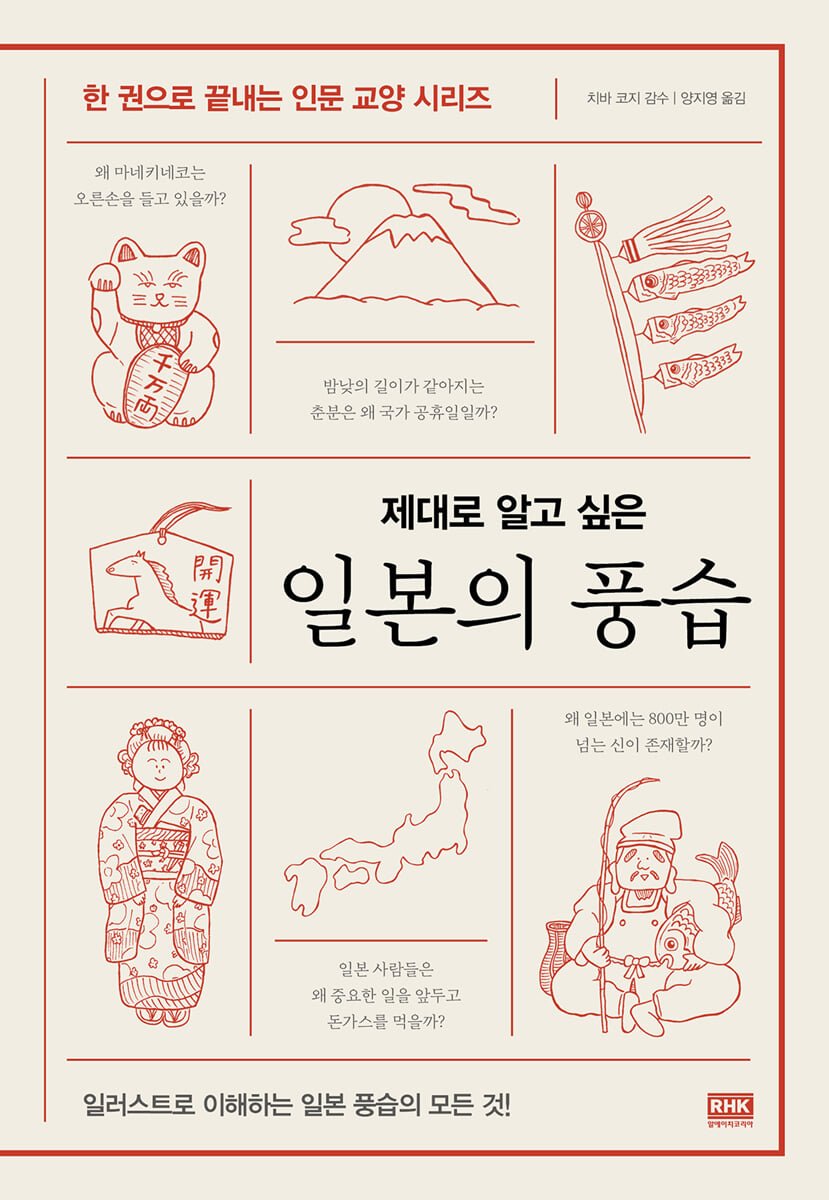
'Why is Maneki Neko raising its right hand?'
Why eat pork cutlet before a test or interview?
A Japan you want to know more about, a Japan you want to delve deeper into!
Japan is the number one overseas travel destination for Koreans.
The number of Koreans traveling to Japan in 2023 reached 7 million.
It is a country that is that close and familiar.
But if you look closely, there are clear cultural differences that seem similar.
Why are there maneki-neko at every restaurant entrance? And why is their right hand raised? Why do Japanese people eat tonkatsu (pork cutlet) before important exams or interviews? And of all the foods, why tonkatsu?
This book introduces the customs of Japan, a close yet unfamiliar country.
We explain the various customs that have been passed down through the ages and the customs that are still alive and breathing in the daily lives of Japanese people, as well as the meanings, origins, and stories contained within them.
Koji Chiba, who supervised this book, said, “Life begins with customs and ends with customs.”
They rejoice in their birth, are thankful for their safe growth, and pray to gods or Buddha for various wishes such as family stability, business prosperity, promotion, and immortality.
And when we reach the end of our lives, we continue to live as people in the next world through the custom of funerals.
There are customs in this way of life.
Knowing a custom is like learning about the people who live within that custom.
Knowing the customs reveals Japan, the Japanese people, and Japanese culture.
You can see as much as you know, and you can feel as much as you see.
Let's delve a little deeper and learn more about Japan and Japanese culture, something you've been curious about but haven't been able to find anywhere.
It will not just be a country you have traveled to or will go to in the future, but a country you want to experience.
Why eat pork cutlet before a test or interview?
A Japan you want to know more about, a Japan you want to delve deeper into!
Japan is the number one overseas travel destination for Koreans.
The number of Koreans traveling to Japan in 2023 reached 7 million.
It is a country that is that close and familiar.
But if you look closely, there are clear cultural differences that seem similar.
Why are there maneki-neko at every restaurant entrance? And why is their right hand raised? Why do Japanese people eat tonkatsu (pork cutlet) before important exams or interviews? And of all the foods, why tonkatsu?
This book introduces the customs of Japan, a close yet unfamiliar country.
We explain the various customs that have been passed down through the ages and the customs that are still alive and breathing in the daily lives of Japanese people, as well as the meanings, origins, and stories contained within them.
Koji Chiba, who supervised this book, said, “Life begins with customs and ends with customs.”
They rejoice in their birth, are thankful for their safe growth, and pray to gods or Buddha for various wishes such as family stability, business prosperity, promotion, and immortality.
And when we reach the end of our lives, we continue to live as people in the next world through the custom of funerals.
There are customs in this way of life.
Knowing a custom is like learning about the people who live within that custom.
Knowing the customs reveals Japan, the Japanese people, and Japanese culture.
You can see as much as you know, and you can feel as much as you see.
Let's delve a little deeper and learn more about Japan and Japanese culture, something you've been curious about but haven't been able to find anywhere.
It will not just be a country you have traveled to or will go to in the future, but a country you want to experience.
- You can preview some of the book's contents.
Preview
index
To begin with, customs are a pleasant spice that adds color to everyday life.
letter.
Let's learn about customs
One_Life is full of customs!
2_The relationship between gods, Buddha, and customs
Set_Harewa Ke's customs
Net_Superstition? The customs of fortune
[Column 01] Yaoyorozu, the land of gods, Japan
Chapter 1.
The spring customs that bring rising fortune
[Spring Customs Calendar]
Hinamatsuri_March 3rd Girls' Event
Ohigan of Spring_7 days before and after the vernal equinox
Ohanami_flower viewing
Kanbutsu-e_Kanbutsue
Jusanmairi_13-year-old worship
The 88th day after the beginning of spring
Dano's Sekkoo_May 5th Boys' Event
[Column 02] The six yogis
Chapter 2.
Summer winds that bring rising luck
[Summer Customs Calendar]
Koromogae_Changing clothes for each season
Natsugoshi no Hara_Summer exorcism event
Yamabiraki Mountain Opening
Tanabata_Chilseok
Ojugen_A gift given during the Central Plains
Toyonoushi no Hi_Eel Eating Day, a Summer Tonic
Obon_Buddhist ceremony to welcome ancestors
[Column 03] Mother's Day, Father's Day, and Senior Citizen's Day
Chapter 3.
Autumn customs that bring rising fortune
[Autumn Customs Calendar]
Setku of the Double Ninth Festival
Otsukimi_Fifteen Nights
Ohigan in Autumn_7 days before and after the autumnal equinox
Ebisukou_Offering to Ebisu, the god of business
Dorinoichi_Only event
Shichi-Go-San_Growth Celebration for 3rd, 5th, and 7th Year Olds
[Column 04] Jisinje and Sangryangsik
Chapter 4.
Winter customs that bring rising luck
[Winter Customs Calendar]
Susuharai_Year-end cleaning
Winter Solstice_The longest night
New Year's decorations_Preparations to wish for a blessed New Year
Omisoka_New Year's Eve
Oshogatsu New Year's Day
Osechi cuisine_New Year's cuisine
Hatsumode_First shrine visit of the New Year
Nanakusagayu_Seven Vegetable Porridge
Coming-of-Age Ceremony: A ceremony to be recognized as an adult
Setsubun_An event to ward off evil spirits
[Column 05] Taboo customs
Chapter 5.
The customs of life that increase one's luck
Life begins with customs and ends with customs.
growth
marriage
longevity
funeral
supplement.
Etiquette to know
Gift etiquette
Letter etiquette
Dining etiquette
letter.
Let's learn about customs
One_Life is full of customs!
2_The relationship between gods, Buddha, and customs
Set_Harewa Ke's customs
Net_Superstition? The customs of fortune
[Column 01] Yaoyorozu, the land of gods, Japan
Chapter 1.
The spring customs that bring rising fortune
[Spring Customs Calendar]
Hinamatsuri_March 3rd Girls' Event
Ohigan of Spring_7 days before and after the vernal equinox
Ohanami_flower viewing
Kanbutsu-e_Kanbutsue
Jusanmairi_13-year-old worship
The 88th day after the beginning of spring
Dano's Sekkoo_May 5th Boys' Event
[Column 02] The six yogis
Chapter 2.
Summer winds that bring rising luck
[Summer Customs Calendar]
Koromogae_Changing clothes for each season
Natsugoshi no Hara_Summer exorcism event
Yamabiraki Mountain Opening
Tanabata_Chilseok
Ojugen_A gift given during the Central Plains
Toyonoushi no Hi_Eel Eating Day, a Summer Tonic
Obon_Buddhist ceremony to welcome ancestors
[Column 03] Mother's Day, Father's Day, and Senior Citizen's Day
Chapter 3.
Autumn customs that bring rising fortune
[Autumn Customs Calendar]
Setku of the Double Ninth Festival
Otsukimi_Fifteen Nights
Ohigan in Autumn_7 days before and after the autumnal equinox
Ebisukou_Offering to Ebisu, the god of business
Dorinoichi_Only event
Shichi-Go-San_Growth Celebration for 3rd, 5th, and 7th Year Olds
[Column 04] Jisinje and Sangryangsik
Chapter 4.
Winter customs that bring rising luck
[Winter Customs Calendar]
Susuharai_Year-end cleaning
Winter Solstice_The longest night
New Year's decorations_Preparations to wish for a blessed New Year
Omisoka_New Year's Eve
Oshogatsu New Year's Day
Osechi cuisine_New Year's cuisine
Hatsumode_First shrine visit of the New Year
Nanakusagayu_Seven Vegetable Porridge
Coming-of-Age Ceremony: A ceremony to be recognized as an adult
Setsubun_An event to ward off evil spirits
[Column 05] Taboo customs
Chapter 5.
The customs of life that increase one's luck
Life begins with customs and ends with customs.
growth
marriage
longevity
funeral
supplement.
Etiquette to know
Gift etiquette
Letter etiquette
Dining etiquette
Detailed image
.jpg)
Publisher's Review
A humanities series that can be completed in one volume!
Japanese customs are introduced in an easy-to-understand way through illustrations.
Understanding Japanese people, their lives, and culture through customs
The 'Humanities and Liberal Arts Series in One Volume' is characterized by its ability to explain a vast amount of specialized knowledge in an easy-to-understand manner and to aid understanding with illustrations.
In particular, this book includes over 100 illustrations to help readers intuitively understand Japanese customs and culture just by looking at them.
It is a friendly composition for those who have difficulty reading books, as well as for adults who want to reacquire liberal arts knowledge.
Only by knowing customs can we understand people and culture, and acquire it as culture and knowledge.
Customs are not simply old, boring habits.
Each of them contains a wish to bring good fortune and luck, to live a long and healthy life, and to show respect to nature, objects, and people.
It is the material and spiritual essence that people have accumulated together over a long period of time.
Customs such as Ohanami, where people predict the year's rice harvest by the state of the flowers in bloom and pray for a good harvest with cherry blossoms in full bloom; Obon, the Japanese festival of the first month of spring, where people light welcoming and sending fires to invite and see off the spirits of their ancestors; and Shichi-Go-San, where people celebrate the safe growth of "children of god" into "children of humans" were ways of coping with the blessings and disasters caused by nature that humans could not control.
It is a custom to worship gods, give thanks for a good harvest, and express gratitude to gods to pray for peace and prosperity in life.
Just as people's lives repeat, these prayers and thanksgivings have been passed down through repetition and are still deeply rooted in history, culture, and the spiritual world of people.
This is also the reason why we must understand humans and life through the keywords of customs and habits.
If you want to delve into the essence of Japanese culture, a country you thought you knew well but didn't fully grasp the meaning behind it, read this book.
Not only are seasonal customs and ceremonies that come with each stage of life explained, but also essential etiquette for each situation, such as when exchanging gifts or letters or when eating, is explained with easy-to-understand explanations and friendly illustrations.
Thanks to this, I was able to understand in detail the country of Japan, which is both close and distant, its culture, and the lifestyle and behavior of the Japanese people.
Let's take a closer look at the unexpected aspects of Japan and Japanese culture, which we didn't know about before, or knew about but didn't fully grasp their meaning, through customs that have been passed down and preserved for a long time.
Japanese customs are introduced in an easy-to-understand way through illustrations.
Understanding Japanese people, their lives, and culture through customs
The 'Humanities and Liberal Arts Series in One Volume' is characterized by its ability to explain a vast amount of specialized knowledge in an easy-to-understand manner and to aid understanding with illustrations.
In particular, this book includes over 100 illustrations to help readers intuitively understand Japanese customs and culture just by looking at them.
It is a friendly composition for those who have difficulty reading books, as well as for adults who want to reacquire liberal arts knowledge.
Only by knowing customs can we understand people and culture, and acquire it as culture and knowledge.
Customs are not simply old, boring habits.
Each of them contains a wish to bring good fortune and luck, to live a long and healthy life, and to show respect to nature, objects, and people.
It is the material and spiritual essence that people have accumulated together over a long period of time.
Customs such as Ohanami, where people predict the year's rice harvest by the state of the flowers in bloom and pray for a good harvest with cherry blossoms in full bloom; Obon, the Japanese festival of the first month of spring, where people light welcoming and sending fires to invite and see off the spirits of their ancestors; and Shichi-Go-San, where people celebrate the safe growth of "children of god" into "children of humans" were ways of coping with the blessings and disasters caused by nature that humans could not control.
It is a custom to worship gods, give thanks for a good harvest, and express gratitude to gods to pray for peace and prosperity in life.
Just as people's lives repeat, these prayers and thanksgivings have been passed down through repetition and are still deeply rooted in history, culture, and the spiritual world of people.
This is also the reason why we must understand humans and life through the keywords of customs and habits.
If you want to delve into the essence of Japanese culture, a country you thought you knew well but didn't fully grasp the meaning behind it, read this book.
Not only are seasonal customs and ceremonies that come with each stage of life explained, but also essential etiquette for each situation, such as when exchanging gifts or letters or when eating, is explained with easy-to-understand explanations and friendly illustrations.
Thanks to this, I was able to understand in detail the country of Japan, which is both close and distant, its culture, and the lifestyle and behavior of the Japanese people.
Let's take a closer look at the unexpected aspects of Japan and Japanese culture, which we didn't know about before, or knew about but didn't fully grasp their meaning, through customs that have been passed down and preserved for a long time.
GOODS SPECIFICS
- Date of issue: October 25, 2024
- Page count, weight, size: 248 pages | 394g | 147*210*16mm
- ISBN13: 9788925574455
- ISBN10: 8925574454
You may also like
카테고리
korean


korean

![ELLE 엘르 스페셜 에디션 A형 : 12월 [2025]](http://librairie.coreenne.fr/cdn/shop/files/b8e27a3de6c9538896439686c6b0e8fb.jpg?v=1766436872&width=3840)


