

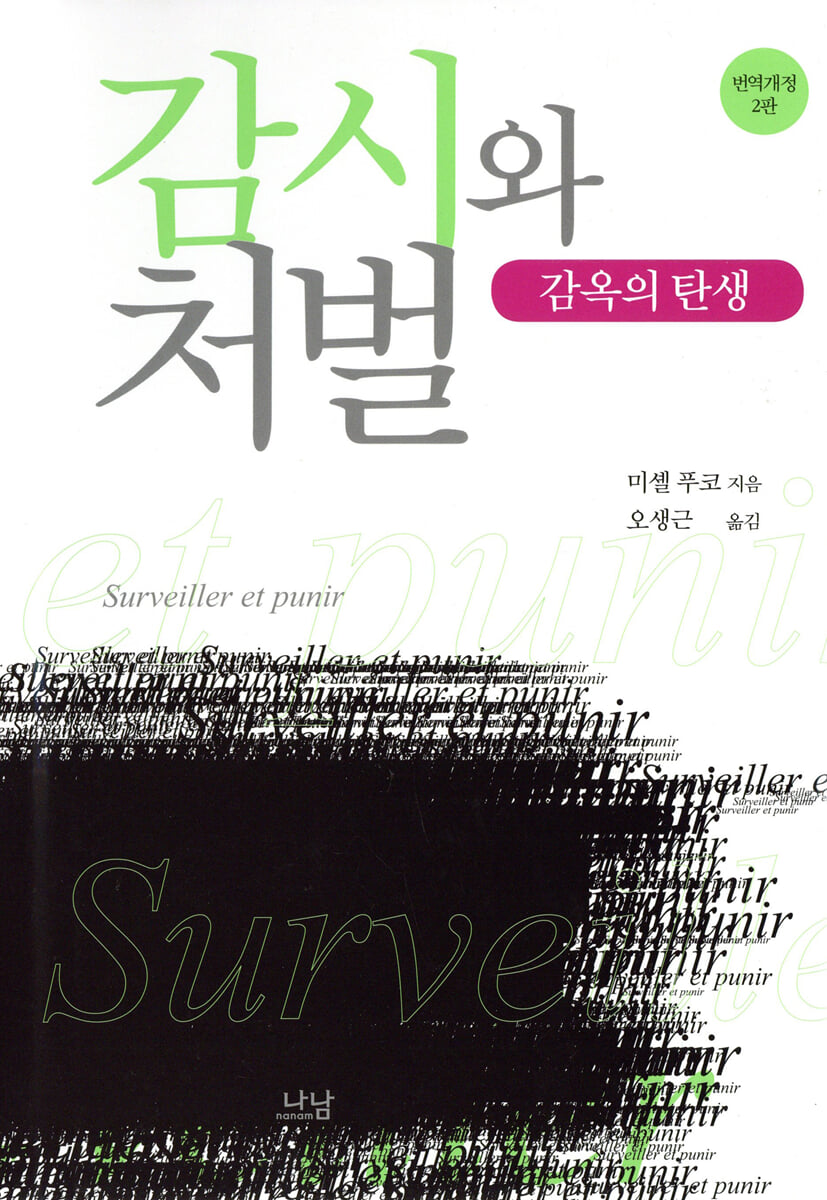
surveillance and punishment
 |
Description
Book Introduction
The history of prisons as explored by fin-de-siècle civilization critic Michel Foucault!
Tracing the origins of the modern surveillance society and the evolution of power.
Since its publication in 1975, Michel Foucault's masterpiece, Discipline and Punish: The Birth of the Prison, has been recognized as a book that fundamentally changed the perspective on knowledge, power, and human subjectivity.
In this book, Foucault genealogically traces the modern transformation of penal practices, revealing that prisons are not simply spaces of isolation, but rather devices of power that discipline the body and mind.
Using Bentham's 'Panopticon' (circular prison) as a core concept, it sharply analyzes how power permeates everyday institutions such as hospitals, schools, the military, and homes to monitor and control human lives.
Foucault argues that this disciplinary power is not a repressive means but rather has a productive function that induces action, offering insights that transcend the framework of existing political philosophy.
Discipline and Punish goes beyond the history of prisons and dissects the invisible power inherent in our everyday lives, which we believe to be free.
It has had a profound influence across various academic disciplines, including philosophy, sociology, law, and literary theory, and is still widely read today as a classic that encourages critical reflection on modern society.
Tracing the origins of the modern surveillance society and the evolution of power.
Since its publication in 1975, Michel Foucault's masterpiece, Discipline and Punish: The Birth of the Prison, has been recognized as a book that fundamentally changed the perspective on knowledge, power, and human subjectivity.
In this book, Foucault genealogically traces the modern transformation of penal practices, revealing that prisons are not simply spaces of isolation, but rather devices of power that discipline the body and mind.
Using Bentham's 'Panopticon' (circular prison) as a core concept, it sharply analyzes how power permeates everyday institutions such as hospitals, schools, the military, and homes to monitor and control human lives.
Foucault argues that this disciplinary power is not a repressive means but rather has a productive function that induces action, offering insights that transcend the framework of existing political philosophy.
Discipline and Punish goes beyond the history of prisons and dissects the invisible power inherent in our everyday lives, which we believe to be free.
It has had a profound influence across various academic disciplines, including philosophy, sociology, law, and literary theory, and is still widely read today as a classic that encourages critical reflection on modern society.
- You can preview some of the book's contents.
Preview
index
Translator's Preface 5
Part 1: Body Type
1.
Prisoner's body 25
2.
The Luxuriousness of the Body Type 75
Part 2 Punishment
1.
Generalized Punishment 145
2.
The Softened Punishment 199
Part 3 Discipline
1.
Obedient Body 251
- The Art of Division 262
- Control of activities 277
- Creation and Formation Process 291
- Assembly of Power 301
2.
Effective Discipline Methods 315
- Hierarchical surveillance 317
- Normative Sanctions 331
- Rating 342
3.
Panopticon Power 359
Part 4 Prison
1.
A Perfect and Strict System 415
2.
Offences and Crimes 465
3.
Prison System 529
Search 554
Part 1: Body Type
1.
Prisoner's body 25
2.
The Luxuriousness of the Body Type 75
Part 2 Punishment
1.
Generalized Punishment 145
2.
The Softened Punishment 199
Part 3 Discipline
1.
Obedient Body 251
- The Art of Division 262
- Control of activities 277
- Creation and Formation Process 291
- Assembly of Power 301
2.
Effective Discipline Methods 315
- Hierarchical surveillance 317
- Normative Sanctions 331
- Rating 342
3.
Panopticon Power 359
Part 4 Prison
1.
A Perfect and Strict System 415
2.
Offences and Crimes 465
3.
Prison System 529
Search 554
Into the book
Although the glamour of the blazing fires still lingered, the somber, punishing festivities were fading away in the late 18th and early 19th centuries.
One is the disappearance of the way punishment was treated as a spectacle.
The concept of punishment was gradually forgotten by the people and became nothing more than a new act in litigation procedures or litigation administration.
--- From "Part 1 'Body Type'"
This study of microphysics assumes the following:
That is, the power exercised there must be understood not as a possession but as a strategy, and the effect of that power domination is achieved not by possession but by arrangement, manipulation, tactics, technology, and action.
--- From "Part 1 'Body Type'"
In fact, the new legal theory of the penal system contains the logic of a new 'political economy' of the right to punish.
In fact, those who were at the starting point of the reform were not the most knowledgeable of the common people who could be tried, nor were they philosophers who opposed despotism and stood on the side of humanity, nor were they even social groups opposing the members of the high court.
--- From "Part 2 'Punishment'"
What can be seen behind the humanization of punishment is that all these regulations allow for, or more precisely, demand, the mitigation of punishment as an economic measure based on the calculations of the power to punish.
But all those regulations also shift where power is applied.
According to Marvel, it is now the mind, not the body.
--- From "Part 2 'Punishment'"
Discipline thus creates a submissive and disciplined body, a 'submissive' body.
Discipline increases the power of the body (in the economic relation of utility) and decreases that same power (in the political relation of obedience).
Simply put, discipline separates the body from the force.
--- From "Part 3 'Discipline'"
The 'Panopticon' is a device that separates the combination of 'looking and being seen'.
That is, inside the circular building surrounding you, you can see everything but nothing, and inside the central tower, you can see everything but nothing is visible.
This is an important device because it makes power automatic and impersonal.
--- From "Part 3 'Discipline'"
There are probably several reasons why the integration of prisons into the penal system did not provoke a fierce backlash.
One of them is that by creating crime, prisons created a single object area for criminal law, one that was justified by the 'several sciences', and that the prison enabled criminal law to function on the general horizon of 'truth'.
--- From "Part 4, 'Prison'"
The prison system generalizes in terms of meaning what it generalizes in terms of tactics.
The monarch's enemies became the enemies of society, and the enemies of society became the delinquents, possessing various dangerous elements such as disorder, crime, and madness.
The prison network links together two long and diverse series of things—the punishable and the deviant—in complex relationships.
One is the disappearance of the way punishment was treated as a spectacle.
The concept of punishment was gradually forgotten by the people and became nothing more than a new act in litigation procedures or litigation administration.
--- From "Part 1 'Body Type'"
This study of microphysics assumes the following:
That is, the power exercised there must be understood not as a possession but as a strategy, and the effect of that power domination is achieved not by possession but by arrangement, manipulation, tactics, technology, and action.
--- From "Part 1 'Body Type'"
In fact, the new legal theory of the penal system contains the logic of a new 'political economy' of the right to punish.
In fact, those who were at the starting point of the reform were not the most knowledgeable of the common people who could be tried, nor were they philosophers who opposed despotism and stood on the side of humanity, nor were they even social groups opposing the members of the high court.
--- From "Part 2 'Punishment'"
What can be seen behind the humanization of punishment is that all these regulations allow for, or more precisely, demand, the mitigation of punishment as an economic measure based on the calculations of the power to punish.
But all those regulations also shift where power is applied.
According to Marvel, it is now the mind, not the body.
--- From "Part 2 'Punishment'"
Discipline thus creates a submissive and disciplined body, a 'submissive' body.
Discipline increases the power of the body (in the economic relation of utility) and decreases that same power (in the political relation of obedience).
Simply put, discipline separates the body from the force.
--- From "Part 3 'Discipline'"
The 'Panopticon' is a device that separates the combination of 'looking and being seen'.
That is, inside the circular building surrounding you, you can see everything but nothing, and inside the central tower, you can see everything but nothing is visible.
This is an important device because it makes power automatic and impersonal.
--- From "Part 3 'Discipline'"
There are probably several reasons why the integration of prisons into the penal system did not provoke a fierce backlash.
One of them is that by creating crime, prisons created a single object area for criminal law, one that was justified by the 'several sciences', and that the prison enabled criminal law to function on the general horizon of 'truth'.
--- From "Part 4, 'Prison'"
The prison system generalizes in terms of meaning what it generalizes in terms of tactics.
The monarch's enemies became the enemies of society, and the enemies of society became the delinquents, possessing various dangerous elements such as disorder, crime, and madness.
The prison network links together two long and diverse series of things—the punishable and the deviant—in complex relationships.
--- From "Part 4, 'Prison'"
Publisher's Review
Michel Foucault's intellectual exploration beyond the boundaries of philosophy
Michel Foucault (1926-1984) is a thinker who occupies a unique position in the history of modern thought.
He has had a profound influence on the humanities and social sciences, and remains one of the most cited scholars today.
The reason he continues to receive attention is because he explores the issues of power, knowledge, and subjectivity from a unique perspective.
Unlike the classical philosophy that pursues universal truth, Foucault focused on analyzing the institutions and discourses of reality.
He analyzed the relationship between knowledge and power through archaeological methods that analyze the discourse structure of an era and genealogical methods that trace how current institutions and power were formed.
Questions such as “Who creates truth?”, “How are normal and abnormal distinguished?”, and “What is freedom?” form the core of Foucault’s thought.
He linked these explorations to social movements and also played the role of a practical intellectual.
Foucault explored the structures of knowledge and power in response to the problems of each era.
In 『A History of Madness』, he analyzed the social exclusion of the mentally ill, and in 『Words and Things』 and 『The Archaeology of Knowledge』, he analyzed the conditions of cognition and the formation of discourse.
Discipline and Punish deals with the workings of modern power that regulates the body and behavior, while The History of Sexuality deals with the process of subject formation and self-discipline, moving towards the later stages of Foucault's thought.
Reading Society Through Prison: Discipline and Punish
Discipline and Punish: The Birth of the Prison (1975) is Foucault's representative work that combines theory and practice.
Beyond a historical analysis of the origins of the prison system, this book traces how power operates and shapes human agency in modern society.
Foucault explains the changing workings of power through the history of prisons, which shifted from public executions to prison-centered disciplinary systems.
Now power no longer operates through visible oppression, but through surveillance and training to make individuals discipline themselves.
He understands punishment not as a matter of law but as a technique of power, and reveals that prison is a mechanism for controlling not only the body but also behavior and consciousness.
The panopticon, the core concept of this book, is a symbolic image of Foucault's theory of power.
This circular prison, designed by Bentham, effectively embodies the internalization of power by making prisoners watch themselves even when the guards are invisible.
The panopticon model is applied throughout modern society, including hospitals, schools, the military, and factories, and shows how modern people's lives are tamed and organized within power structures.
In other words, 『Discipline and Punish』 is a book that goes beyond criticizing the system and provides an opportunity to reflect on the way modern people live.
A classic that serves as a key to understanding modern society
Since its publication, Discipline and Punish has had a profound influence across various academic fields, including philosophy, sociology, history, and literary theory.
Gilles Deleuze regarded this book as the central work of Foucault's theory of power, and Anthony Giddens emphasized that disciplinary power had become a core concept in social theory.
Eric Hobsbawm and Terry Eagleton also evaluated this book as contributing to a new understanding of the concepts of modernity and power.
Furthermore, this book has also served as a tool for thinking to understand real society.
In an information society where digital surveillance has become a daily occurrence, "Discipline and Punish" makes us rethink freedom and control.
It is also used as an important theoretical resource in resolving issues of surveillance, correction, and human rights in Korean society.
Foucault viewed power not as something possessed by a particular group, but as a microscopic operation inherent in everyday actions, rules, and discourses.
Through this, we have created a new understanding of minorities and those defined as abnormal, and have provided an ideological foundation for various social movements and human rights discourse.
Discipline and Punish is a living classic that serves as an ideological foundation for critical reflection on modern society.
Michel Foucault (1926-1984) is a thinker who occupies a unique position in the history of modern thought.
He has had a profound influence on the humanities and social sciences, and remains one of the most cited scholars today.
The reason he continues to receive attention is because he explores the issues of power, knowledge, and subjectivity from a unique perspective.
Unlike the classical philosophy that pursues universal truth, Foucault focused on analyzing the institutions and discourses of reality.
He analyzed the relationship between knowledge and power through archaeological methods that analyze the discourse structure of an era and genealogical methods that trace how current institutions and power were formed.
Questions such as “Who creates truth?”, “How are normal and abnormal distinguished?”, and “What is freedom?” form the core of Foucault’s thought.
He linked these explorations to social movements and also played the role of a practical intellectual.
Foucault explored the structures of knowledge and power in response to the problems of each era.
In 『A History of Madness』, he analyzed the social exclusion of the mentally ill, and in 『Words and Things』 and 『The Archaeology of Knowledge』, he analyzed the conditions of cognition and the formation of discourse.
Discipline and Punish deals with the workings of modern power that regulates the body and behavior, while The History of Sexuality deals with the process of subject formation and self-discipline, moving towards the later stages of Foucault's thought.
Reading Society Through Prison: Discipline and Punish
Discipline and Punish: The Birth of the Prison (1975) is Foucault's representative work that combines theory and practice.
Beyond a historical analysis of the origins of the prison system, this book traces how power operates and shapes human agency in modern society.
Foucault explains the changing workings of power through the history of prisons, which shifted from public executions to prison-centered disciplinary systems.
Now power no longer operates through visible oppression, but through surveillance and training to make individuals discipline themselves.
He understands punishment not as a matter of law but as a technique of power, and reveals that prison is a mechanism for controlling not only the body but also behavior and consciousness.
The panopticon, the core concept of this book, is a symbolic image of Foucault's theory of power.
This circular prison, designed by Bentham, effectively embodies the internalization of power by making prisoners watch themselves even when the guards are invisible.
The panopticon model is applied throughout modern society, including hospitals, schools, the military, and factories, and shows how modern people's lives are tamed and organized within power structures.
In other words, 『Discipline and Punish』 is a book that goes beyond criticizing the system and provides an opportunity to reflect on the way modern people live.
A classic that serves as a key to understanding modern society
Since its publication, Discipline and Punish has had a profound influence across various academic fields, including philosophy, sociology, history, and literary theory.
Gilles Deleuze regarded this book as the central work of Foucault's theory of power, and Anthony Giddens emphasized that disciplinary power had become a core concept in social theory.
Eric Hobsbawm and Terry Eagleton also evaluated this book as contributing to a new understanding of the concepts of modernity and power.
Furthermore, this book has also served as a tool for thinking to understand real society.
In an information society where digital surveillance has become a daily occurrence, "Discipline and Punish" makes us rethink freedom and control.
It is also used as an important theoretical resource in resolving issues of surveillance, correction, and human rights in Korean society.
Foucault viewed power not as something possessed by a particular group, but as a microscopic operation inherent in everyday actions, rules, and discourses.
Through this, we have created a new understanding of minorities and those defined as abnormal, and have provided an ideological foundation for various social movements and human rights discourse.
Discipline and Punish is a living classic that serves as an ideological foundation for critical reflection on modern society.
GOODS SPECIFICS
- Publication date: April 20, 2020
- Format: Hardcover book binding method guide
- Page count, weight, size: 560 pages | 938g | 152*225*35mm
- ISBN13: 9788930040419
- ISBN10: 8930040411
You may also like
카테고리
korean


korean

![GQ KOREA Mark (Monthly): December [2025]](http://librairie.coreenne.fr/cdn/shop/files/8ef265dbbfbf186523ed75ba7319009d.jpg?v=1765340328&width=3840)


