

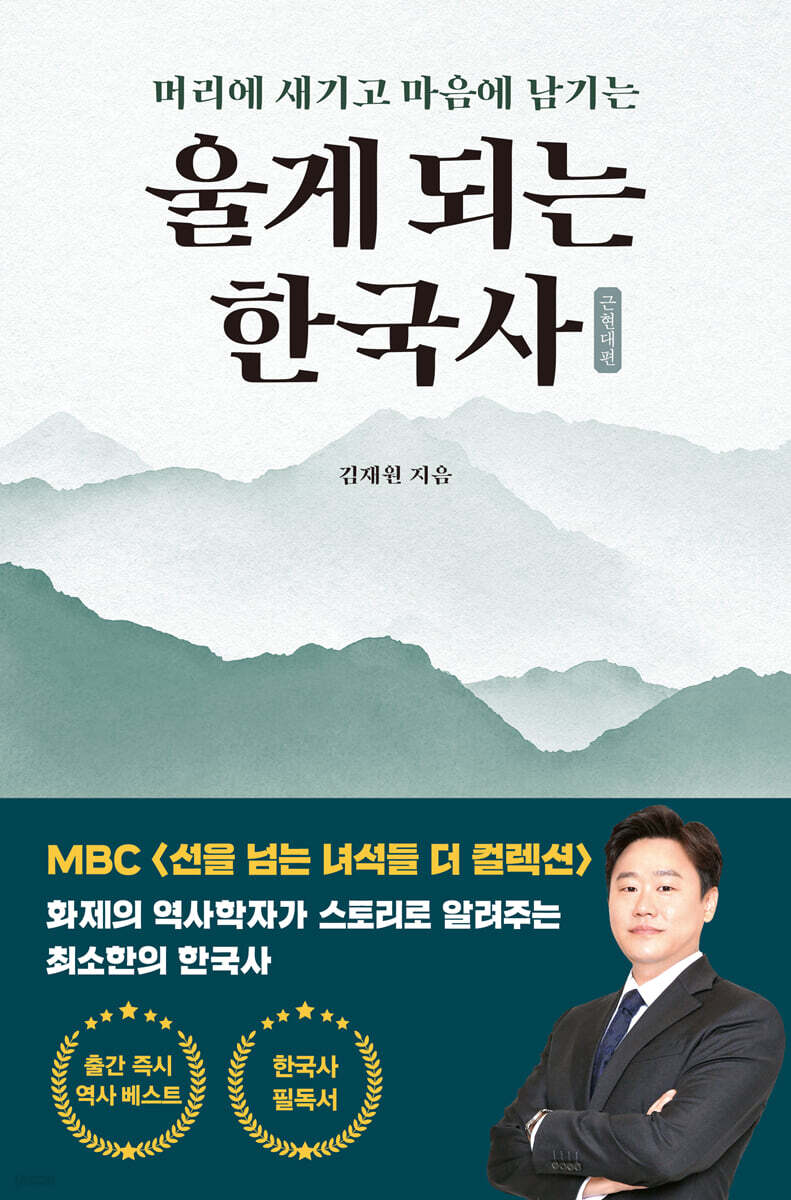
Korean history that will make you cry
 |
Description
Book Introduction
- A word from MD
-
What's important is our history that has not been broken.There have been many particularly tragic events in modern and contemporary history, such as the loss of sovereignty, the Korean War, and the IMF.
But we survived and we overcame.
The stories of those who found hope in the midst of crisis and who rose again and moved forward offer the moving story of overcoming hardship, as well as insight into resolving the crises and conflicts we face today.
July 14, 2023. History PD Ahn Hyun-jae
“How do we rise again in the face of repeated crises?”
The one book that even those who have never read a history book must read
There are many particularly tragic events in Korean history.
Our land was destroyed by countless foreign invasions, our sovereignty was eroded by the Japanese, and our once united nation was divided into two.
But we survived and overcame all these hardships.
"A Korean History That Makes You Cry" reflects on the history of hardship and overcoming that our people have experienced countless times.
It also provides insight into how we should view and overcome the crisis and conflict we are currently facing.
The author, a historian and bestselling author, tells the story focusing on modern and contemporary history, which is filled with particularly tragic events, but which we rarely learn about properly in textbooks.
Our history has been arduous.
But even as the country was falling apart, even as there was no hope, someone wrote a new history.
As we look back on historical moments through the stories of those who persevered and moved forward regardless of the circumstances, we will gain the strength to live on without retreating.
The one book that even those who have never read a history book must read
There are many particularly tragic events in Korean history.
Our land was destroyed by countless foreign invasions, our sovereignty was eroded by the Japanese, and our once united nation was divided into two.
But we survived and overcame all these hardships.
"A Korean History That Makes You Cry" reflects on the history of hardship and overcoming that our people have experienced countless times.
It also provides insight into how we should view and overcome the crisis and conflict we are currently facing.
The author, a historian and bestselling author, tells the story focusing on modern and contemporary history, which is filled with particularly tragic events, but which we rarely learn about properly in textbooks.
Our history has been arduous.
But even as the country was falling apart, even as there was no hope, someone wrote a new history.
As we look back on historical moments through the stories of those who persevered and moved forward regardless of the circumstances, we will gain the strength to live on without retreating.
- You can preview some of the book's contents.
Preview
index
prolog.
Stories of people who lived without giving up at any moment.
Chapter 1.
Modern History: Swept into Rapid Change
[Treaty of Ganghwa Island] The Declining Ambition of Joseon and Japan
[Gapsin Coup] Joseon, withering between Japan and Qing China
[Donghak Peasant Revolution] "I'd rather die fighting than starve."
[Eulmi Incident] The assassinated queen and the runaway king
[Agwanpacheon] How a Monarch Without Philosophy Approaches Reform
[Dispatch of a special envoy to The Hague] Losing the country in the end
[Battle of Bongodong and Battle of Cheongsanri] Why They Fought at Bongodong and Cheongsanri
[Kantō Massacre] “The enemy is Korean.
“Kill them all”
[Baehwa Riot] Violence and hatred breed more violence and hatred.
[Lee Bong-chang's Righteous Deed and Yun Bong-gil's Righteous Deed] The Last Method to Overcome the Crisis of the Independence Movement
[Forced Conscription and Liberation on August 15] The decision to become a rioter rather than die for Japan
Chapter 2.
Modern History: The Cold War, Still Ongoing
[Jeju April 3 Incident and Yeosu-Suncheon Incident] Those Who Couldn't Become Human: The Birth of the "Reds"
[Special Committee on Anti-Japanese Activities] Why did we fail to purge pro-Japanese collaborators?
[Korean War] The bullets of war are indiscriminate.
[Formation of Chongryon and Mindan] Koreans in Japan Divided by Ideology
[August Sectarian Incident] That August Day When Yesterday's Comrades Became Today's Enemies
[April 19 Revolution, May 16 Military Coup] How did the coup become a revolution?
[Korea-Japan Talks] 36 Years of Humiliation, Sold for a Bargain Price
[Gwangju Complex Incident] The Rise of the Middle Class and the Tragedy of the Urban Poor
[Spring in Seoul] Yushin was crumbling from within.
[May 18th Democratization Movement] The Isolated Sacrifice of Ordinary People Who Demanded Democracy
[Finding Separated Families] A country where one-quarter of the population is separated from their families.
[IMF Foreign Exchange Crisis] The Winter of 1997, When the Miracle on the Han River Collapsed
Epilogue.
Now, again, to write a new history
Stories of people who lived without giving up at any moment.
Chapter 1.
Modern History: Swept into Rapid Change
[Treaty of Ganghwa Island] The Declining Ambition of Joseon and Japan
[Gapsin Coup] Joseon, withering between Japan and Qing China
[Donghak Peasant Revolution] "I'd rather die fighting than starve."
[Eulmi Incident] The assassinated queen and the runaway king
[Agwanpacheon] How a Monarch Without Philosophy Approaches Reform
[Dispatch of a special envoy to The Hague] Losing the country in the end
[Battle of Bongodong and Battle of Cheongsanri] Why They Fought at Bongodong and Cheongsanri
[Kantō Massacre] “The enemy is Korean.
“Kill them all”
[Baehwa Riot] Violence and hatred breed more violence and hatred.
[Lee Bong-chang's Righteous Deed and Yun Bong-gil's Righteous Deed] The Last Method to Overcome the Crisis of the Independence Movement
[Forced Conscription and Liberation on August 15] The decision to become a rioter rather than die for Japan
Chapter 2.
Modern History: The Cold War, Still Ongoing
[Jeju April 3 Incident and Yeosu-Suncheon Incident] Those Who Couldn't Become Human: The Birth of the "Reds"
[Special Committee on Anti-Japanese Activities] Why did we fail to purge pro-Japanese collaborators?
[Korean War] The bullets of war are indiscriminate.
[Formation of Chongryon and Mindan] Koreans in Japan Divided by Ideology
[August Sectarian Incident] That August Day When Yesterday's Comrades Became Today's Enemies
[April 19 Revolution, May 16 Military Coup] How did the coup become a revolution?
[Korea-Japan Talks] 36 Years of Humiliation, Sold for a Bargain Price
[Gwangju Complex Incident] The Rise of the Middle Class and the Tragedy of the Urban Poor
[Spring in Seoul] Yushin was crumbling from within.
[May 18th Democratization Movement] The Isolated Sacrifice of Ordinary People Who Demanded Democracy
[Finding Separated Families] A country where one-quarter of the population is separated from their families.
[IMF Foreign Exchange Crisis] The Winter of 1997, When the Miracle on the Han River Collapsed
Epilogue.
Now, again, to write a new history
Detailed image

Into the book
About 430 years ago, Joseon was hit by the great wave of the Imjin War, and less than 40 years after the war ended, it suffered the humiliation of the Byeongja War.
And after 30 years, an unprecedented famine occurred, killing hundreds of thousands of people.
What is strange is that the country did not fall into ruin even after going through all this.
To be more precise, the people endured and overcame all of this.
Even when the country was in disarray due to the politics of factions and when the powerful expropriated property under absurd pretexts, the people still lived their lives.
He cultivated the land and farmed to survive, and sometimes, unable to bear it any longer, he raised a bamboo spear and begged the king to spare his life.
(…) So, did the descendants of Koreans who overcame hardship live better lives? Unfortunately, just like the Koreans who were forced to live through war and famine, it was the children of these Koreans who were forced to live lives of bleakness and heartbreak.
They are our grandfathers, grandmothers, or great-grandparents who were born just over 100 years ago.
This is also the moment when the current identity of 'Korean' was created.
In other words, the sense of community called 'we' was created as a result of the camaraderie of overcoming difficulties together in a tearful history.
---"prolog.
From “Stories of people who lived without giving up at any moment (pages 5-6 of the text)”
On the dawn of the fateful October 8th, the Japanese soldiers and ronin entered through the west gate of Gyeongbokgung Palace and moved quickly to find the queen.
Surprisingly, King Gojong actually witnessed this entire process firsthand.
Gojong immediately requested Minister Miura to disband the Japanese army and asked the Russian and American embassies for help.
At this very moment, the swift Japanese ronin enter the queen's quarters.
King Gojong, who was in his quarters, encounters Japanese ronin.
The Japanese ronin pushed Gojong's shoulder and assaulted Joseon's court ladies as they searched for the queen.
Lee Gyeong-jik, the Minister of the Imperial Household, tried to stop the Japanese ronin in order to save the queen, but ended up having both of his arms cut off by the ronin's swords.
When Lee Gyeong-jik, who was being assaulted, tried to run away, the ronin shot him in front of King Gojong and eventually stabbed him to death.
After that, the ronin, not knowing who the queen was, began to kill every woman in the palace they saw.
(…) At 6 o’clock in the morning, the Japanese ronin who were searching for the queen discovered that one of the bodies lying around was the queen of Joseon.
It was a shameful death for the queen of Joseon, wearing only white underwear.
---From “The Assassinated Queen and the Runaway King (pp. 55-57)”
Lee Bong-chang started out as a low-ranking employee at Yongsan Station when he was nineteen and quickly rose through the ranks.
Afterwards, he goes through the official post and becomes a train driver and a connecting person.
As I got promoted, my salary went up and I gained financial freedom.
However, Lee Bong-chang gradually realizes that Japanese and Koreans are being treated differently.
(…) At the same time, the cruel reality that ‘we must eat and live despite everything’ torments Lee Bong-chang.
This alienation led him to indulge in lust and gambling, and he soon resigned from his job to pay off his entertainment debts with his severance pay.
The place he headed to after leaving Yongsan Station was surprisingly Japan.
(…) Then one day.
Lee Bong-chang (…) headed to Kyoto to see the Emperor.
(…) Lee Bong-chang was carrying a letter partially written in Korean, and during the search, this letter was discovered, and he was imprisoned in a detention center for ten days simply because he was Korean.
This incident turns Lee Bong-chang's life upside down.
The resentment caused by discrimination and the desire to become a true Japanese soon become defined as the identity of a Korean.
Returning to Osaka, Lee Bong-chang hears that there is a Korean government in Shanghai and heads to Shanghai, dreaming of living an honorable life as a Korean.
---From "The Last Method to Overcome the Crisis of the Independence Movement (pp. 118-119)"
On June 30, 1983, a special live broadcast titled “Finding Separated Families” was broadcast nationwide to commemorate the 33rd anniversary of the Korean War and the 30th anniversary of the armistice.
(…) The response to the broadcast was tremendous.
In addition to the 150 or so applicants who had already been selected, the hosts began interviewing the stories of separated families sitting in the audience.
The telephones installed for broadcasting rang nonstop, and when the line went dead, the entire KBS line rang.
In a country where one-quarter of the population is separated from their families, perhaps this chaos was foretold.
(…) The special live broadcast lasted well over an hour and a half, and lasted until 2:29 a.m. the next day, with a total of 29 families successfully meeting.
(…) The viewership ratings soared to 78%, and the special live broadcast to find separated families continued for five days.
The events that took place in the first week of July 1983 were no ordinary television program.
It was a cultural phenomenon, an event, a festival.
This festival brought together separated families from all over the country and the world, each with their own stories, to Yeouido Square.
Unable to ignore this yearning for both sadness and joy, KBS continued the special live broadcast, which lasted a total of 138 days until November 14th.
It was a time that made the word special seem meaningless.
Ultimately, out of over 100,000 applications received over 138 days, over 50,000 people showed up, and a total of 10,189 separated families were reunited.
And after 30 years, an unprecedented famine occurred, killing hundreds of thousands of people.
What is strange is that the country did not fall into ruin even after going through all this.
To be more precise, the people endured and overcame all of this.
Even when the country was in disarray due to the politics of factions and when the powerful expropriated property under absurd pretexts, the people still lived their lives.
He cultivated the land and farmed to survive, and sometimes, unable to bear it any longer, he raised a bamboo spear and begged the king to spare his life.
(…) So, did the descendants of Koreans who overcame hardship live better lives? Unfortunately, just like the Koreans who were forced to live through war and famine, it was the children of these Koreans who were forced to live lives of bleakness and heartbreak.
They are our grandfathers, grandmothers, or great-grandparents who were born just over 100 years ago.
This is also the moment when the current identity of 'Korean' was created.
In other words, the sense of community called 'we' was created as a result of the camaraderie of overcoming difficulties together in a tearful history.
---"prolog.
From “Stories of people who lived without giving up at any moment (pages 5-6 of the text)”
On the dawn of the fateful October 8th, the Japanese soldiers and ronin entered through the west gate of Gyeongbokgung Palace and moved quickly to find the queen.
Surprisingly, King Gojong actually witnessed this entire process firsthand.
Gojong immediately requested Minister Miura to disband the Japanese army and asked the Russian and American embassies for help.
At this very moment, the swift Japanese ronin enter the queen's quarters.
King Gojong, who was in his quarters, encounters Japanese ronin.
The Japanese ronin pushed Gojong's shoulder and assaulted Joseon's court ladies as they searched for the queen.
Lee Gyeong-jik, the Minister of the Imperial Household, tried to stop the Japanese ronin in order to save the queen, but ended up having both of his arms cut off by the ronin's swords.
When Lee Gyeong-jik, who was being assaulted, tried to run away, the ronin shot him in front of King Gojong and eventually stabbed him to death.
After that, the ronin, not knowing who the queen was, began to kill every woman in the palace they saw.
(…) At 6 o’clock in the morning, the Japanese ronin who were searching for the queen discovered that one of the bodies lying around was the queen of Joseon.
It was a shameful death for the queen of Joseon, wearing only white underwear.
---From “The Assassinated Queen and the Runaway King (pp. 55-57)”
Lee Bong-chang started out as a low-ranking employee at Yongsan Station when he was nineteen and quickly rose through the ranks.
Afterwards, he goes through the official post and becomes a train driver and a connecting person.
As I got promoted, my salary went up and I gained financial freedom.
However, Lee Bong-chang gradually realizes that Japanese and Koreans are being treated differently.
(…) At the same time, the cruel reality that ‘we must eat and live despite everything’ torments Lee Bong-chang.
This alienation led him to indulge in lust and gambling, and he soon resigned from his job to pay off his entertainment debts with his severance pay.
The place he headed to after leaving Yongsan Station was surprisingly Japan.
(…) Then one day.
Lee Bong-chang (…) headed to Kyoto to see the Emperor.
(…) Lee Bong-chang was carrying a letter partially written in Korean, and during the search, this letter was discovered, and he was imprisoned in a detention center for ten days simply because he was Korean.
This incident turns Lee Bong-chang's life upside down.
The resentment caused by discrimination and the desire to become a true Japanese soon become defined as the identity of a Korean.
Returning to Osaka, Lee Bong-chang hears that there is a Korean government in Shanghai and heads to Shanghai, dreaming of living an honorable life as a Korean.
---From "The Last Method to Overcome the Crisis of the Independence Movement (pp. 118-119)"
On June 30, 1983, a special live broadcast titled “Finding Separated Families” was broadcast nationwide to commemorate the 33rd anniversary of the Korean War and the 30th anniversary of the armistice.
(…) The response to the broadcast was tremendous.
In addition to the 150 or so applicants who had already been selected, the hosts began interviewing the stories of separated families sitting in the audience.
The telephones installed for broadcasting rang nonstop, and when the line went dead, the entire KBS line rang.
In a country where one-quarter of the population is separated from their families, perhaps this chaos was foretold.
(…) The special live broadcast lasted well over an hour and a half, and lasted until 2:29 a.m. the next day, with a total of 29 families successfully meeting.
(…) The viewership ratings soared to 78%, and the special live broadcast to find separated families continued for five days.
The events that took place in the first week of July 1983 were no ordinary television program.
It was a cultural phenomenon, an event, a festival.
This festival brought together separated families from all over the country and the world, each with their own stories, to Yeouido Square.
Unable to ignore this yearning for both sadness and joy, KBS continued the special live broadcast, which lasted a total of 138 days until November 14th.
It was a time that made the word special seem meaningless.
Ultimately, out of over 100,000 applications received over 138 days, over 50,000 people showed up, and a total of 10,189 separated families were reunited.
---From “A country where one-quarter of the population is separated from their families (pp. 250-252)”
Publisher's Review
“The moment I closed the last page, my eyes welled up with tears!”
Decisive moments in Korean history that have continued unwavering through any moment.
There are many particularly tragic events in Korean history.
Our land was destroyed by countless foreign invasions, our sovereignty was eroded by the Japanese, and our once united nation was divided into two.
But the country stubbornly did not fall, and the people endured and overcame all the hardships.
Even in times of hopelessness, there were those who sought to write a new history to create a better country.
This book, "Korean History That Makes You Cry," reflects on the history of hardship and overcoming that our people have experienced countless times.
It also provides insight into how we should view and overcome the crisis and conflict we are currently facing.
A shocking event that has never been introduced in popular history books until now.
New truths revealed through recent research
- King Gojong, who witnessed the assassination of Empress Myeongseong with his own eyes
- The aftermath of the Battle of Cheongsan-ri and Bongodong, known as the "Great Battle"
The Kanto Massacre began with a single line of "fake news."
The Pear Riots: The Roots of Anti-Chinese Sentiment That Remains Today
There's a saying that "all history is a spoiler," but as you read this book, you'll be surprised and wonder, "I didn't know this much about history?"
Kim Jae-won, the author of this book and one of the most notable young historians of recent times, introduces the latest historical research findings never before presented in any popular history book, and corrects previously held misconceptions.
In particular, he explains that the 'real estate gap' and 'hatred', which are social problems in South Korea today, have their roots in modern and contemporary history.
"A Korean History That Will Make You Cry" goes beyond simply listing tragic events, introducing our history from victims to perpetrators, and also adopts a mature attitude of reflection.
In addition, it examines and interprets the turbulent history of Korea, beyond the history of the Korean Peninsula, within the context of East Asian and world history.
This is because all historical facts inevitably arise in relation to various surrounding countries.
“Do you remember the day colonial rule began?”
Why We Need to Find Hope in a History of Crisis
Chapter 1 of "A Korean History That Will Make You Cry" explains the internal and external changes Joseon experienced after the opening of its ports, and the process through which the country was taken away.
We know that Joseon eventually perished, was colonized by Japan, and was liberated.
However, what we should be interested in is the ‘process’ rather than the ‘ending’.
We need to know what choices have come together to create results so we can write a new history going forward.
Chapter 2 deals with a series of events that occurred as the Cold War order was being completed in Korean history.
We reflect on how the people of the South, the North, and the Republic of Korea were divided by ideology and why they ultimately turned their guns on each other, and ponder together how to overcome the Cold War era that has not yet ended.
Our history has been arduous.
But it got better little by little.
Just as we must prepare for times of hardship in moments of hope, shouldn't we also look back to the past in times of crisis to find clues of hope? Only then can we move forward without giving up, no matter the moment.
And because our lives and choices come together, we can create a new history together.
Decisive moments in Korean history that have continued unwavering through any moment.
There are many particularly tragic events in Korean history.
Our land was destroyed by countless foreign invasions, our sovereignty was eroded by the Japanese, and our once united nation was divided into two.
But the country stubbornly did not fall, and the people endured and overcame all the hardships.
Even in times of hopelessness, there were those who sought to write a new history to create a better country.
This book, "Korean History That Makes You Cry," reflects on the history of hardship and overcoming that our people have experienced countless times.
It also provides insight into how we should view and overcome the crisis and conflict we are currently facing.
A shocking event that has never been introduced in popular history books until now.
New truths revealed through recent research
- King Gojong, who witnessed the assassination of Empress Myeongseong with his own eyes
- The aftermath of the Battle of Cheongsan-ri and Bongodong, known as the "Great Battle"
The Kanto Massacre began with a single line of "fake news."
The Pear Riots: The Roots of Anti-Chinese Sentiment That Remains Today
There's a saying that "all history is a spoiler," but as you read this book, you'll be surprised and wonder, "I didn't know this much about history?"
Kim Jae-won, the author of this book and one of the most notable young historians of recent times, introduces the latest historical research findings never before presented in any popular history book, and corrects previously held misconceptions.
In particular, he explains that the 'real estate gap' and 'hatred', which are social problems in South Korea today, have their roots in modern and contemporary history.
"A Korean History That Will Make You Cry" goes beyond simply listing tragic events, introducing our history from victims to perpetrators, and also adopts a mature attitude of reflection.
In addition, it examines and interprets the turbulent history of Korea, beyond the history of the Korean Peninsula, within the context of East Asian and world history.
This is because all historical facts inevitably arise in relation to various surrounding countries.
“Do you remember the day colonial rule began?”
Why We Need to Find Hope in a History of Crisis
Chapter 1 of "A Korean History That Will Make You Cry" explains the internal and external changes Joseon experienced after the opening of its ports, and the process through which the country was taken away.
We know that Joseon eventually perished, was colonized by Japan, and was liberated.
However, what we should be interested in is the ‘process’ rather than the ‘ending’.
We need to know what choices have come together to create results so we can write a new history going forward.
Chapter 2 deals with a series of events that occurred as the Cold War order was being completed in Korean history.
We reflect on how the people of the South, the North, and the Republic of Korea were divided by ideology and why they ultimately turned their guns on each other, and ponder together how to overcome the Cold War era that has not yet ended.
Our history has been arduous.
But it got better little by little.
Just as we must prepare for times of hardship in moments of hope, shouldn't we also look back to the past in times of crisis to find clues of hope? Only then can we move forward without giving up, no matter the moment.
And because our lives and choices come together, we can create a new history together.
GOODS SPECIFICS
- Date of issue: July 12, 2023
- Page count, weight, size: 276 pages | 408g | 145*220*18mm
- ISBN13: 9791193128008
- ISBN10: 1193128005
You may also like
카테고리
korean


korean

![ELLE 엘르 스페셜 에디션 A형 : 12월 [2025]](http://librairie.coreenne.fr/cdn/shop/files/b8e27a3de6c9538896439686c6b0e8fb.jpg?v=1766436872&width=3840)


