

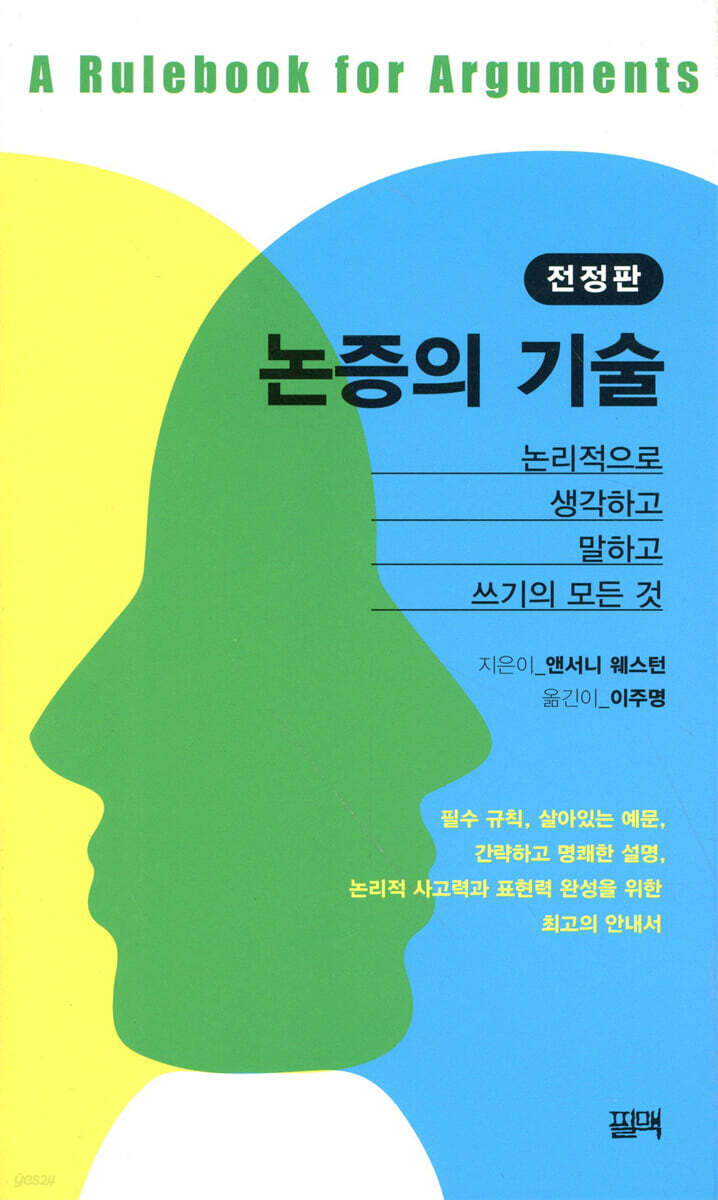
The Art of Argumentation
 |
Description
Book Introduction
"The Art of Argumentation" is a book that clearly organizes the rules that must be followed when thinking logically and expressing those thoughts persuasively in speech or writing.
Unlike other logic books that are difficult to understand or other writing books that only convey tips, this book presents the core rules of argumentation and provides clear explanations with examples for each rule, allowing anyone to easily understand and master the art of argumentation.
This practical guidebook can be used by high school students preparing for college entrance essay tests, test takers for various aptitude tests (PSAT, LEET, DEET, MEET), college or graduate students writing dissertations, office workers drafting business proposals, writers or journalists whose job is writing, and politicians or corporate salespeople who need to persuade others.
Unlike other logic books that are difficult to understand or other writing books that only convey tips, this book presents the core rules of argumentation and provides clear explanations with examples for each rule, allowing anyone to easily understand and master the art of argumentation.
This practical guidebook can be used by high school students preparing for college entrance essay tests, test takers for various aptitude tests (PSAT, LEET, DEET, MEET), college or graduate students writing dissertations, office workers drafting business proposals, writers or journalists whose job is writing, and politicians or corporate salespeople who need to persuade others.
index
preface
Putting out the front page
Introduction
Chapter 1: Simple Argumentation: Some General Rules
Rule 1: Distinguish between premises and conclusions.
Rule 2: Unfold your thoughts in a natural order.
Rule 3: Start with a credible premise.
Rule 4: Be specific and concise.
Rule 5: Don't rely on sentiment, provide substantive evidence.
Rule 6: Be consistent in your language.
Chapter 2: Argument by Example
Rule 7: Give more than two examples.
Rule 8: Give Representative Examples
Rule 9: Background ratio can be crucial.
Rule 10: Statistics Need to Be Critical
Rule 11: Consider counterexamples
Chapter 3: Argument by Yu-bi
Rule 12: Analogies require appropriately similar examples.
Chapter 4 Argument from Authority
Rule 13: Cite your sources.
Rule 14: Find an Authoritative Source
Rule 15: Find impartial sources of information.
Rule 16: Cross-check your sources.
Rule 17: Use the Internet wisely.
Chapter 5: Arguments for Cause
Rule 18: Causal arguments begin with correlation.
Rule 19: Correlations can be explained in many ways.
Rule 20: Find the most likely explanation.
Rule 21: Expect Complexity
Chapter 6: Deductive Argument
Rule 22: Form of affirming the antecedent
Rule 23: Forms that negate the consequent
Rule 24: Hypothetical Syllogism
Rule 25: Declarative Syllogism
Rule 26: Dilemma
Rule 27: The Law of Reductio ad absurdum
Rule 28: Multi-step deductive argument
Chapter 7: Extension of the Argument
Rule 29: Explore the Issue
Rule 30: Write down your basic idea as an argument.
Rule 31: Defend even the basic premises with arguments.
Rule 32: Consider opposing views.
Rule 33: Explore Alternatives
Chapter 8 Argumentative Essay
Rule 34: Jump right in
Rule 35: State your claim or proposal clearly.
Rule 36: Outline your argument.
Rule 37: Describe and Respond to Opposing Views in Detail
Rule 38: Seek and Use Feedback
Rule 39: Please be humble!
Chapter 9 Oral Argument
Rule 40: Ask to Be Heard
Rule 41: Focus on the scene
Rule 42: Insert the sign actively.
Rule 43: Tailor your visuals to fit your argument.
Rule 44: Finish with Style
Chapter 10: Public Debate
Rule 45: Argue with confidence
Rule 46: Build your position by listening and learning.
Rule 47: Offer something positive.
Rule 48: Find Your Way in the Empathy Zone
Rule 49: At least be polite.
Rule 50: Give yourself time to think.
Appendix 1: Common Mistakes
Appendix 2: Definitions
Rule D1: When a term is unclear, specify its definition.
Rule D2: When a term is disputed, start with a concrete case.
Rule D3: Definitions cannot replace arguments.
References
Translator's Note
Putting out the front page
Introduction
Chapter 1: Simple Argumentation: Some General Rules
Rule 1: Distinguish between premises and conclusions.
Rule 2: Unfold your thoughts in a natural order.
Rule 3: Start with a credible premise.
Rule 4: Be specific and concise.
Rule 5: Don't rely on sentiment, provide substantive evidence.
Rule 6: Be consistent in your language.
Chapter 2: Argument by Example
Rule 7: Give more than two examples.
Rule 8: Give Representative Examples
Rule 9: Background ratio can be crucial.
Rule 10: Statistics Need to Be Critical
Rule 11: Consider counterexamples
Chapter 3: Argument by Yu-bi
Rule 12: Analogies require appropriately similar examples.
Chapter 4 Argument from Authority
Rule 13: Cite your sources.
Rule 14: Find an Authoritative Source
Rule 15: Find impartial sources of information.
Rule 16: Cross-check your sources.
Rule 17: Use the Internet wisely.
Chapter 5: Arguments for Cause
Rule 18: Causal arguments begin with correlation.
Rule 19: Correlations can be explained in many ways.
Rule 20: Find the most likely explanation.
Rule 21: Expect Complexity
Chapter 6: Deductive Argument
Rule 22: Form of affirming the antecedent
Rule 23: Forms that negate the consequent
Rule 24: Hypothetical Syllogism
Rule 25: Declarative Syllogism
Rule 26: Dilemma
Rule 27: The Law of Reductio ad absurdum
Rule 28: Multi-step deductive argument
Chapter 7: Extension of the Argument
Rule 29: Explore the Issue
Rule 30: Write down your basic idea as an argument.
Rule 31: Defend even the basic premises with arguments.
Rule 32: Consider opposing views.
Rule 33: Explore Alternatives
Chapter 8 Argumentative Essay
Rule 34: Jump right in
Rule 35: State your claim or proposal clearly.
Rule 36: Outline your argument.
Rule 37: Describe and Respond to Opposing Views in Detail
Rule 38: Seek and Use Feedback
Rule 39: Please be humble!
Chapter 9 Oral Argument
Rule 40: Ask to Be Heard
Rule 41: Focus on the scene
Rule 42: Insert the sign actively.
Rule 43: Tailor your visuals to fit your argument.
Rule 44: Finish with Style
Chapter 10: Public Debate
Rule 45: Argue with confidence
Rule 46: Build your position by listening and learning.
Rule 47: Offer something positive.
Rule 48: Find Your Way in the Empathy Zone
Rule 49: At least be polite.
Rule 50: Give yourself time to think.
Appendix 1: Common Mistakes
Appendix 2: Definitions
Rule D1: When a term is unclear, specify its definition.
Rule D2: When a term is disputed, start with a concrete case.
Rule D3: Definitions cannot replace arguments.
References
Translator's Note
Into the book
“It is truly a disgrace to have allowed a once proud passenger train to decline.
America must revive passenger trains now, with honor on the line!”
This appears to be an argument for the revival of passenger train service.
However, only words with bones were shown, and no evidence was presented to support that conclusion.
--- p.35
The attitude that one can always tell the truth as one sees it is not always sufficient.
Even the truth as seen honestly can be biased.
We tend to see only what we want to see.
--- p.86
“Students who travel abroad learn to understand other countries.
It would be a good thing if understanding between different countries increased.
“Therefore, we need to send more students abroad.”
Although this general argument captures one basic idea, it is actually somewhat too basic.
This argument barely speaks to the extent that it goes much beyond a simple assertion.
--- p.152
When having a public debate, debaters often find themselves stuck, unable to find a good way forward.
This is partly because both sides focus too much on the negative, or what is wrong with what the other side is saying.
A better argument presents people with something to affirm—something appealing and positive.
America must revive passenger trains now, with honor on the line!”
This appears to be an argument for the revival of passenger train service.
However, only words with bones were shown, and no evidence was presented to support that conclusion.
--- p.35
The attitude that one can always tell the truth as one sees it is not always sufficient.
Even the truth as seen honestly can be biased.
We tend to see only what we want to see.
--- p.86
“Students who travel abroad learn to understand other countries.
It would be a good thing if understanding between different countries increased.
“Therefore, we need to send more students abroad.”
Although this general argument captures one basic idea, it is actually somewhat too basic.
This argument barely speaks to the extent that it goes much beyond a simple assertion.
--- p.152
When having a public debate, debaters often find themselves stuck, unable to find a good way forward.
This is partly because both sides focus too much on the negative, or what is wrong with what the other side is saying.
A better argument presents people with something to affirm—something appealing and positive.
--- p.215
Publisher's Review
Should we maintain the death penalty? Is the national pension system still viable? Should we expand the basic income system? Should the National Security Act be abolished? How should we address the problem of private education? How can we prevent the negative impact of an aging population on economic growth? What additional measures are needed to stem the decline in the birth rate?
Perhaps it's because advances in information technology have made it easier to exchange knowledge and opinions and communicate. Discussions are becoming increasingly heated on television, radio, the internet, and in various gatherings.
The debaters participating in the debate are no longer limited to people of high social status or intellectuals.
It is said that all French people are philosophers and debaters.
Is it time for our people to hear such words? Looking at the content and process of the debate, it seems our debate culture has yet to leave its infancy.
There are still many debaters who make partisan arguments based on black-and-white logic, and there is a lot of nonsensical, leap-of-the-pants arguments.
Debates are not limited to national issues or grand topics.
In our daily lives, whether at home, at school, or at work, we constantly express our opinions, encounter opposition, and attempt to persuade others.
At home, there are endless discussions about children's career paths and family matters, at school, about learning topics or school issues, and at work, about business decisions and work methods.
Discussions do not only take place in specially prepared settings, but also inevitably occur in our daily lives as we communicate with each other, just as we breathe and eat.
This book is an introductory guide to the method of argumentation, which is the backbone of such discussions: 'how to logically develop one's argument and support it with evidence, etc.'
Above all, this book provides a quick overview of the basic rules that anyone who wants to argue must remember.
The author's skill in listing the rules of argument step by step, starting from the most basic rules and progressing to somewhat more complex and advanced rules, and providing clear explanations for each, is truly impressive.
Moreover, the explanations are provided through various examples that cross over literature, science, and humanities, making it a very enjoyable read.
The explanations the author adds to the examples he cites are so general that they can be readily applied to many other problems, not just those addressed in the examples.
For example, reading the part explaining the argument about 'learning other cultures' (Rule 31) will make you think of the issue of 'multicultural society', which is a hot topic in our country, and reading the part explaining the definition of the term 'meeting' as stipulated in the law of the state of Wisconsin in the U.S. (Rule D1) will make you think about what countermeasures are possible for the 'hurry-up bill processing' that is frequently committed in our National Assembly.
Readers who read this book carefully will be able to easily point out critical errors and mistakes in the arguments put forward by others.
For example, if you apply Rule 5 (don't rely on sentiment, provide substantive evidence), Rule 11 (consider counterexamples), Rule 15 (find unbiased sources of information), and the various types of "common errors" listed in Appendix 1 to someone who makes far-fetched claims or uses sophistry, you will be able to construct and present a rebuttal argument in any number of ways.
Readers themselves can fall into the trap of error, so if you use this book as a guide to quickly recognize and correct your own mistakes and errors, you will be able to speak and write more persuasively.
This book is the fifth edition of the book first published in 2004 under the same title based on the translation, and is the fifth edition of the book first published in 1987 based on the original.
The book's unwavering popularity over the past 30 years is largely due to the author's consistent after-sales service, which includes meticulously improving its structure and style through four revisions and refreshingly updating its materials and examples.
This edition also contains many corrections, improvements, and additions compared to the previous edition.
In particular, many of the examples and cases presented have changed from the previous version, and content regarding public discussion has been added.
Yet, the author carefully trimmed and refined the entire content to ensure that the book's strength of conciseness was not sacrificed.
Recently, in Korea, courses on logic, critical thinking, and argumentative writing have become mandatory courses at universities, and many tests for verifying logical ability, including the university essay test and the Public Service Aptitude Test (PSAT), have been introduced and implemented.
Even major corporations such as Samsung, Hyundai, and LG consider applicants' logical thinking skills to be an important evaluation factor in the selection process for new employees.
This trend further enhances the practical value of this book.
Perhaps it's because advances in information technology have made it easier to exchange knowledge and opinions and communicate. Discussions are becoming increasingly heated on television, radio, the internet, and in various gatherings.
The debaters participating in the debate are no longer limited to people of high social status or intellectuals.
It is said that all French people are philosophers and debaters.
Is it time for our people to hear such words? Looking at the content and process of the debate, it seems our debate culture has yet to leave its infancy.
There are still many debaters who make partisan arguments based on black-and-white logic, and there is a lot of nonsensical, leap-of-the-pants arguments.
Debates are not limited to national issues or grand topics.
In our daily lives, whether at home, at school, or at work, we constantly express our opinions, encounter opposition, and attempt to persuade others.
At home, there are endless discussions about children's career paths and family matters, at school, about learning topics or school issues, and at work, about business decisions and work methods.
Discussions do not only take place in specially prepared settings, but also inevitably occur in our daily lives as we communicate with each other, just as we breathe and eat.
This book is an introductory guide to the method of argumentation, which is the backbone of such discussions: 'how to logically develop one's argument and support it with evidence, etc.'
Above all, this book provides a quick overview of the basic rules that anyone who wants to argue must remember.
The author's skill in listing the rules of argument step by step, starting from the most basic rules and progressing to somewhat more complex and advanced rules, and providing clear explanations for each, is truly impressive.
Moreover, the explanations are provided through various examples that cross over literature, science, and humanities, making it a very enjoyable read.
The explanations the author adds to the examples he cites are so general that they can be readily applied to many other problems, not just those addressed in the examples.
For example, reading the part explaining the argument about 'learning other cultures' (Rule 31) will make you think of the issue of 'multicultural society', which is a hot topic in our country, and reading the part explaining the definition of the term 'meeting' as stipulated in the law of the state of Wisconsin in the U.S. (Rule D1) will make you think about what countermeasures are possible for the 'hurry-up bill processing' that is frequently committed in our National Assembly.
Readers who read this book carefully will be able to easily point out critical errors and mistakes in the arguments put forward by others.
For example, if you apply Rule 5 (don't rely on sentiment, provide substantive evidence), Rule 11 (consider counterexamples), Rule 15 (find unbiased sources of information), and the various types of "common errors" listed in Appendix 1 to someone who makes far-fetched claims or uses sophistry, you will be able to construct and present a rebuttal argument in any number of ways.
Readers themselves can fall into the trap of error, so if you use this book as a guide to quickly recognize and correct your own mistakes and errors, you will be able to speak and write more persuasively.
This book is the fifth edition of the book first published in 2004 under the same title based on the translation, and is the fifth edition of the book first published in 1987 based on the original.
The book's unwavering popularity over the past 30 years is largely due to the author's consistent after-sales service, which includes meticulously improving its structure and style through four revisions and refreshingly updating its materials and examples.
This edition also contains many corrections, improvements, and additions compared to the previous edition.
In particular, many of the examples and cases presented have changed from the previous version, and content regarding public discussion has been added.
Yet, the author carefully trimmed and refined the entire content to ensure that the book's strength of conciseness was not sacrificed.
Recently, in Korea, courses on logic, critical thinking, and argumentative writing have become mandatory courses at universities, and many tests for verifying logical ability, including the university essay test and the Public Service Aptitude Test (PSAT), have been introduced and implemented.
Even major corporations such as Samsung, Hyundai, and LG consider applicants' logical thinking skills to be an important evaluation factor in the selection process for new employees.
This trend further enhances the practical value of this book.
GOODS SPECIFICS
- Date of publication: August 15, 2019
- Page count, weight, size: 272 pages | 338g | 125*207*20mm
- ISBN13: 9791162950159
- ISBN10: 1162950153
You may also like
카테고리
korean


korean

![GQ KOREA Mark (Monthly): December [2025]](http://librairie.coreenne.fr/cdn/shop/files/8ef265dbbfbf186523ed75ba7319009d.jpg?v=1765340328&width=3840)


