

Why Life Became a Burden
 |
Description
Book Introduction
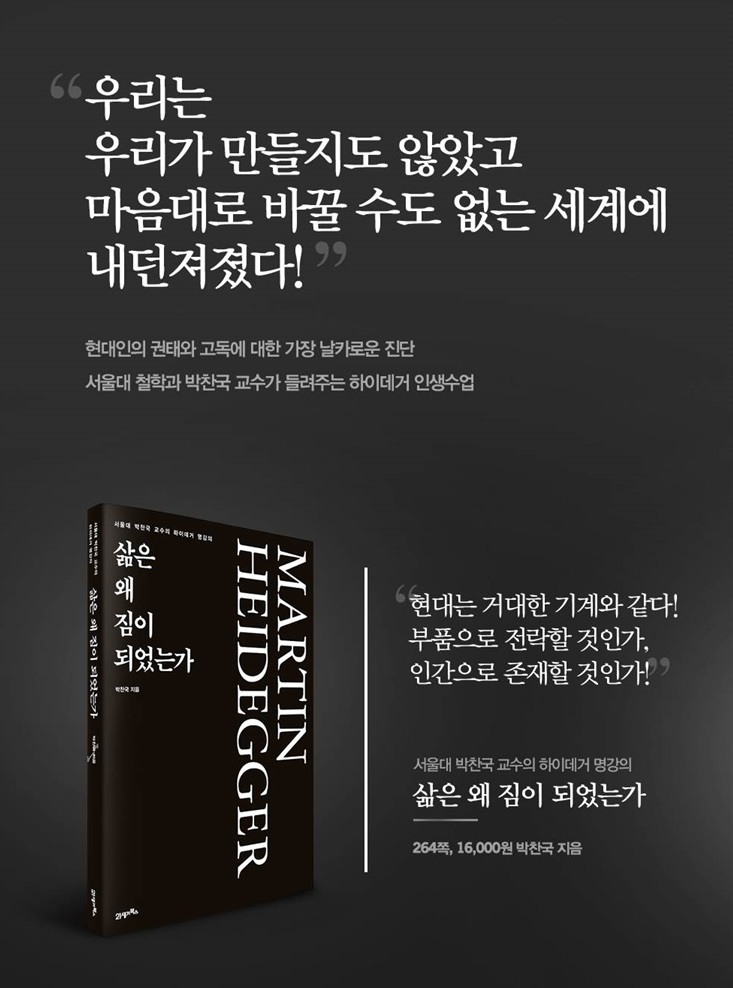
Heidegger's Life Lessons from Seoul National University's Department of Philosophy Professor Park Chan-guk
Where do the anxiety, loneliness, depression, and apathy that dominate our daily lives come from? Heidegger, a thinker who dedicated his life to confronting the crisis of modern society and contemplating ways to recover from it, asked.
Heidegger says that in order for our lives to be fulfilled, we must recover the uniquely human emotion of wonder and joy toward all that exists, including nature and things.
Professor Park Chan-guk of Seoul National University's Department of Philosophy, a leading authority on Heidegger's philosophy, introduces the essence of Heidegger's philosophy through friendly lecture-style explanations and reliable, detailed commentary.
This book diagnoses the problems of a life that is becoming increasingly empty and desolate, and presents alternatives. It will be an opportunity to reflect on the things we have been missing in our busy lives.
Where do the anxiety, loneliness, depression, and apathy that dominate our daily lives come from? Heidegger, a thinker who dedicated his life to confronting the crisis of modern society and contemplating ways to recover from it, asked.
Heidegger says that in order for our lives to be fulfilled, we must recover the uniquely human emotion of wonder and joy toward all that exists, including nature and things.
Professor Park Chan-guk of Seoul National University's Department of Philosophy, a leading authority on Heidegger's philosophy, introduces the essence of Heidegger's philosophy through friendly lecture-style explanations and reliable, detailed commentary.
This book diagnoses the problems of a life that is becoming increasingly empty and desolate, and presents alternatives. It will be an opportunity to reflect on the things we have been missing in our busy lives.
- You can preview some of the book's contents.
Preview
index
Note
Prologue: Heidegger, a Thinker in an Age of Poverty
Chapter 1: The Age of Loss of Home
The abundance of hometown, the poverty of the big city
The gods left and the earth was destroyed.
Are humans masters or slaves of technological civilization?
It is not reason, but madness that rules this age.
Chapter 2: Idolatry of Science and Technology
Are science and technology truly human tools?
Science and technology have become idols
A world ruled by necrophilia
Beyond understanding the technical world
Chapter 3: Why Are Our Lives So Empty?
Existence has escaped from the existent.
What it means that 'being exists'
A life dominated by comparison, gossip, and curiosity
An era dominated by the emptiness of loss of existence
Chapter 4: What is a fundamental mood?
We always exist in a mood
Wonder, Silence, and the Light of Being
Information language and poetic language
Awakening the fundamental mood
Chapter 5: Roses Exist for No Reason
Calculative and poetic thinking
I looked closely and saw a single primrose in bloom.
A life dominated by comparison
Chapter 6: Why Do Humans Feel Anxious?
The Death of Ivan Ilyich
What is existence?
The relationship between anxiety and death
How Anxiety Disrupts Everyday Life
We must pass through the purgatory fire of anxiety
Chapter 7: What Kind of Being Are Humans?
Only humans see life as a burden.
Just be like a dog, and the world will be peaceful.
Differences between humans and animals
How to overcome loneliness, helplessness, and emptiness
Chapter 8: What is Language?
Heidegger's understanding of the world
The relationship between the world and things
Language is the home of existence
The fundamental feeling of destruction and shock at the fundamental world
From ruler of beings to guardian of existence
Chapter 9: The Essence of Architecture and Poetic Thought
What is the essence of architecture?
The Greek temple just stands there.
Poetic thinking makes true architecture possible.
Chapter 10: Nature is a Great Temple
A simple and rustic life in nature
Henry David Thoreau and Heidegger
Nature is a great temple
Natural science distorts nature
Epilogue Towards a Life as a Poet
References
Prologue: Heidegger, a Thinker in an Age of Poverty
Chapter 1: The Age of Loss of Home
The abundance of hometown, the poverty of the big city
The gods left and the earth was destroyed.
Are humans masters or slaves of technological civilization?
It is not reason, but madness that rules this age.
Chapter 2: Idolatry of Science and Technology
Are science and technology truly human tools?
Science and technology have become idols
A world ruled by necrophilia
Beyond understanding the technical world
Chapter 3: Why Are Our Lives So Empty?
Existence has escaped from the existent.
What it means that 'being exists'
A life dominated by comparison, gossip, and curiosity
An era dominated by the emptiness of loss of existence
Chapter 4: What is a fundamental mood?
We always exist in a mood
Wonder, Silence, and the Light of Being
Information language and poetic language
Awakening the fundamental mood
Chapter 5: Roses Exist for No Reason
Calculative and poetic thinking
I looked closely and saw a single primrose in bloom.
A life dominated by comparison
Chapter 6: Why Do Humans Feel Anxious?
The Death of Ivan Ilyich
What is existence?
The relationship between anxiety and death
How Anxiety Disrupts Everyday Life
We must pass through the purgatory fire of anxiety
Chapter 7: What Kind of Being Are Humans?
Only humans see life as a burden.
Just be like a dog, and the world will be peaceful.
Differences between humans and animals
How to overcome loneliness, helplessness, and emptiness
Chapter 8: What is Language?
Heidegger's understanding of the world
The relationship between the world and things
Language is the home of existence
The fundamental feeling of destruction and shock at the fundamental world
From ruler of beings to guardian of existence
Chapter 9: The Essence of Architecture and Poetic Thought
What is the essence of architecture?
The Greek temple just stands there.
Poetic thinking makes true architecture possible.
Chapter 10: Nature is a Great Temple
A simple and rustic life in nature
Henry David Thoreau and Heidegger
Nature is a great temple
Natural science distorts nature
Epilogue Towards a Life as a Poet
References
Detailed image
Into the book
Just as a vacuum cleaner sucks up dust, a big city is sucking up countless people even at this very moment.
Here, envy, jealousy and competition rule people, covertly or openly.
Although we may be materially richer than in the past, our hearts are infinitely empty and lonely.
--- p.21
In the Western philosophical tradition, humans were understood as rational animals, and this understanding of humanity reached its peak in scientific and technological civilization. In this era, science and technology have become omnipotent, godlike beings.
We live proudly believing ourselves to be the driving force behind scientific and technological civilization, but in reality, we are merely being consumed as parts in the vast machine that is modernity.
--- p.59
In Being and Time, Heidegger saw our everyday lives as filled with chatter and curiosity.
We are constantly caught up in the daily ritual of comparing ourselves to others, and we define ourselves based on worldly values like academic performance, social status, and wealth.
--- p.71
Gilesius sang, “The rose is not interested in itself, nor does it ask whether people see it.”
But we often worry about how others perceive us.
And by being so concerned about the gaze of others, we become more conscious of ourselves.
The reason why other people's gaze is uncomfortable is because the existence of 'me' is completely reduced to an object of their evaluation.
--- p.109-110
Humans are the only animals that can feel the fleetingness of their lives when they think about death.
Of course, animals other than humans also struggle to survive just before death due to the fear of death.
But no animal lives feeling that it is a fleeting existence.
--- p.122
Heidegger was twice invited to become a professor at the University of Berlin, but he declined.
Rather than a flashy city, I chose simple, rustic nature.
Heidegger did most of his research and writing in a mountain hut on Todtnau, and he felt that his thinking was rooted in the hut, the surrounding natural landscape, and the world of the peasants.
Here, envy, jealousy and competition rule people, covertly or openly.
Although we may be materially richer than in the past, our hearts are infinitely empty and lonely.
--- p.21
In the Western philosophical tradition, humans were understood as rational animals, and this understanding of humanity reached its peak in scientific and technological civilization. In this era, science and technology have become omnipotent, godlike beings.
We live proudly believing ourselves to be the driving force behind scientific and technological civilization, but in reality, we are merely being consumed as parts in the vast machine that is modernity.
--- p.59
In Being and Time, Heidegger saw our everyday lives as filled with chatter and curiosity.
We are constantly caught up in the daily ritual of comparing ourselves to others, and we define ourselves based on worldly values like academic performance, social status, and wealth.
--- p.71
Gilesius sang, “The rose is not interested in itself, nor does it ask whether people see it.”
But we often worry about how others perceive us.
And by being so concerned about the gaze of others, we become more conscious of ourselves.
The reason why other people's gaze is uncomfortable is because the existence of 'me' is completely reduced to an object of their evaluation.
--- p.109-110
Humans are the only animals that can feel the fleetingness of their lives when they think about death.
Of course, animals other than humans also struggle to survive just before death due to the fear of death.
But no animal lives feeling that it is a fleeting existence.
--- p.122
Heidegger was twice invited to become a professor at the University of Berlin, but he declined.
Rather than a flashy city, I chose simple, rustic nature.
Heidegger did most of his research and writing in a mountain hut on Todtnau, and he felt that his thinking was rooted in the hut, the surrounding natural landscape, and the world of the peasants.
--- p.231
Publisher's Review
“When life gets tough, that’s the time to read Heidegger!”
The most penetrating diagnosis of modern man's boredom and loneliness.
Modern people, despite living in an age of material abundance, suffer from mental devastation and emptiness, such as burnout society, burnout syndrome, and death from loneliness.
What is the reason? Heidegger says that modern society is an era in which the weight of human existence has fallen to its lowest point ever.
Humans have been reduced to mere cogs in the giant machine that is modernity, capable of being used and exploited at will.
Just as in the Middle Ages, when belief in God thoroughly determined human life, today science and technology have become our masters, dominating every aspect of our lives.
The nature of science, which seeks to quantify and numerically transform everything, applies not only to objects but also to humans.
To compensate for the anxiety, loneliness, helplessness, and emptiness that this creates, we consume material things, indulge in stimulating things like entertainment and pleasure, and fill our days with gossip and small talk that exposes the flaws of others to confirm our own superiority.
But what remains after such a life is only greater emptiness and boredom.
Heidegger says of this, “Today, humans have forgotten existence.”
What can fill the emptiness that comes from this loss of existence?
Why did the philosopher dream of becoming a poet?
The philosophy of healing from the master of philosophy, Heidegger
Humans are always anxious because they are the only animals that think about the future.
Because we all know that we will die, but we don't know when or how we will die.
This feeling comes as 'anxiety' and invades our lives.
However, Heidegger says that the feeling of anxiety is the fundamental way of human existence that can open up the possibility of life.
Heidegger argues that rather than seeking a substitute to alleviate the anxiety that lurks at the root of life, we should transform this feeling into a joyful 'wonder'.
'Wonder' is a unique human emotion that makes us feel the mystery of a single blade of grass blooming on the roadside and the joy we feel from all things, including nature and objects.
It's a question of will, of having to completely change your way of life.
As a representative example, Heidegger talks about poets.
The poet always listens to the simple and plain sounds of nature, and concretizes the sound of existence through poetic language.
As a poet views the world, when we escape the chatter and curiosity of the world and find a quiet peace of mind, our lives are filled with a gentle joy.
Heidegger believed that this way of life was the only way to overcome the crisis of modern society.
The nation's leading authority on Heidegger studies,
The most complete introductory book by Seoul National University Professor Park Chan-guk
Heidegger's philosophy is notoriously difficult to understand.
Heidegger is like an unclimbable mountain not only for Koreans but also for Germans.
This is because most of his sentences are difficult to understand and feel unfamiliar because he developed his own thoughts by creating new words and philosophical concepts that did not exist before.
Nevertheless, it is clear why Heidegger is called a giant of philosophy today.
His influence has reached every philosophical current that dominated the intellectual world of the 20th century, including existential philosophy, phenomenology, postmodernism, political philosophy, philosophy of language, philosophy of science, literary criticism, psychology, theology, and even ecology.
Professor Park Chan-guk, who focused on the crises and solutions of modern society that Heidegger faced, said, “Although more than 40 years have passed since Heidegger’s death, his thoughts still have the power to hit us like a rain of rain.”
This book, which contains the essence of Heidegger's later thought, including the concept of anxiety and the meaning of human existence, will provide an opportunity to think about the direction in which our lives should proceed.
The most penetrating diagnosis of modern man's boredom and loneliness.
Modern people, despite living in an age of material abundance, suffer from mental devastation and emptiness, such as burnout society, burnout syndrome, and death from loneliness.
What is the reason? Heidegger says that modern society is an era in which the weight of human existence has fallen to its lowest point ever.
Humans have been reduced to mere cogs in the giant machine that is modernity, capable of being used and exploited at will.
Just as in the Middle Ages, when belief in God thoroughly determined human life, today science and technology have become our masters, dominating every aspect of our lives.
The nature of science, which seeks to quantify and numerically transform everything, applies not only to objects but also to humans.
To compensate for the anxiety, loneliness, helplessness, and emptiness that this creates, we consume material things, indulge in stimulating things like entertainment and pleasure, and fill our days with gossip and small talk that exposes the flaws of others to confirm our own superiority.
But what remains after such a life is only greater emptiness and boredom.
Heidegger says of this, “Today, humans have forgotten existence.”
What can fill the emptiness that comes from this loss of existence?
Why did the philosopher dream of becoming a poet?
The philosophy of healing from the master of philosophy, Heidegger
Humans are always anxious because they are the only animals that think about the future.
Because we all know that we will die, but we don't know when or how we will die.
This feeling comes as 'anxiety' and invades our lives.
However, Heidegger says that the feeling of anxiety is the fundamental way of human existence that can open up the possibility of life.
Heidegger argues that rather than seeking a substitute to alleviate the anxiety that lurks at the root of life, we should transform this feeling into a joyful 'wonder'.
'Wonder' is a unique human emotion that makes us feel the mystery of a single blade of grass blooming on the roadside and the joy we feel from all things, including nature and objects.
It's a question of will, of having to completely change your way of life.
As a representative example, Heidegger talks about poets.
The poet always listens to the simple and plain sounds of nature, and concretizes the sound of existence through poetic language.
As a poet views the world, when we escape the chatter and curiosity of the world and find a quiet peace of mind, our lives are filled with a gentle joy.
Heidegger believed that this way of life was the only way to overcome the crisis of modern society.
The nation's leading authority on Heidegger studies,
The most complete introductory book by Seoul National University Professor Park Chan-guk
Heidegger's philosophy is notoriously difficult to understand.
Heidegger is like an unclimbable mountain not only for Koreans but also for Germans.
This is because most of his sentences are difficult to understand and feel unfamiliar because he developed his own thoughts by creating new words and philosophical concepts that did not exist before.
Nevertheless, it is clear why Heidegger is called a giant of philosophy today.
His influence has reached every philosophical current that dominated the intellectual world of the 20th century, including existential philosophy, phenomenology, postmodernism, political philosophy, philosophy of language, philosophy of science, literary criticism, psychology, theology, and even ecology.
Professor Park Chan-guk, who focused on the crises and solutions of modern society that Heidegger faced, said, “Although more than 40 years have passed since Heidegger’s death, his thoughts still have the power to hit us like a rain of rain.”
This book, which contains the essence of Heidegger's later thought, including the concept of anxiety and the meaning of human existence, will provide an opportunity to think about the direction in which our lives should proceed.
GOODS SPECIFICS
- Date of publication: September 20, 2017
- Page count, weight, size: 264 pages | 418g | 140*210*20mm
- ISBN13: 9788950971991
- ISBN10: 8950971992
You may also like
카테고리
korean


korean

![GQ KOREA Mark (Monthly): December [2025]](http://librairie.coreenne.fr/cdn/shop/files/8ef265dbbfbf186523ed75ba7319009d.jpg?v=1765340328&width=3840)


