

Information INFORMATION
 |
Description
Book Introduction
Information, communication, mathematics, cryptography, language, psychology, philosophy, genetics, evolution, computers, quantum mechanics, Google, and even smartphones.
Colorful figures such as Claude Shannon, Alan Turing, Wittgenstein, and Richard Dawkins,
"An ambitious book that introduces the history and theory of information, as well as the implications of the information revolution."
With the development of the Internet, social media, and messengers, communicating and sharing one's thoughts, opinions, and feelings with others has become a daily occurrence in this day and age.
We live in an age where anyone with a computer or smartphone can transmit information and communicate with any country in the world in real time.
But it wasn't that long ago that this happened.
Before the advent of telecommunications, it was not easy to transmit 'news' or 'information' to distant places.
Native Africans beat drums to communicate with people far away through the sound of the drums, and during the Joseon Dynasty, they also used signal fires or beacons to notify of enemy invasions or urgent matters.
After writing a letter, they often sent someone on a walk for several days to deliver it in person.
However, with the invention of the telegraph in 19th century Europe, communication and communications reached a major turning point.
How were the convenient communication tools we use today, such as telephones, faxes, the Internet, and smartphones, invented and developed?
Information is a book that contains detailed and meticulous information about human communication, information exchange, and the history and theory of information.
Professor Lee Sang-wook (Department of Philosophy, Hanyang University) recommended this book, saying, “Information is not simply a message in a letter or data processed by a computer, but the ultimate form of the universe.
“It has successfully achieved its ambitious goal of introducing the history and theory of information and the implications of the information revolution,” he says.
In short, this book can be said to tell the 'big history of information contained in humans and the universe.'
Colorful figures such as Claude Shannon, Alan Turing, Wittgenstein, and Richard Dawkins,
"An ambitious book that introduces the history and theory of information, as well as the implications of the information revolution."
With the development of the Internet, social media, and messengers, communicating and sharing one's thoughts, opinions, and feelings with others has become a daily occurrence in this day and age.
We live in an age where anyone with a computer or smartphone can transmit information and communicate with any country in the world in real time.
But it wasn't that long ago that this happened.
Before the advent of telecommunications, it was not easy to transmit 'news' or 'information' to distant places.
Native Africans beat drums to communicate with people far away through the sound of the drums, and during the Joseon Dynasty, they also used signal fires or beacons to notify of enemy invasions or urgent matters.
After writing a letter, they often sent someone on a walk for several days to deliver it in person.
However, with the invention of the telegraph in 19th century Europe, communication and communications reached a major turning point.
How were the convenient communication tools we use today, such as telephones, faxes, the Internet, and smartphones, invented and developed?
Information is a book that contains detailed and meticulous information about human communication, information exchange, and the history and theory of information.
Professor Lee Sang-wook (Department of Philosophy, Hanyang University) recommended this book, saying, “Information is not simply a message in a letter or data processed by a computer, but the ultimate form of the universe.
“It has successfully achieved its ambitious goal of introducing the history and theory of information and the implications of the information revolution,” he says.
In short, this book can be said to tell the 'big history of information contained in humans and the universe.'
- You can preview some of the book's contents.
Preview
index
From Beat to Existence _Kim Sang-wook
prolog
Chapter 1: The Talking Book - Code, Not Code
Chapter 2: The Persistence of Words - The Mind Has No Dictionary
Chapter 3: Two Glossaries - Uncertainty in Writing, Inconsistency in Spelling
Chapter 4. The Power of Thought in Gears - Behold, the Arithmetician in Ecstasy!
Chapter 5: Earth's Nervous System - What Can You Expect from a Few Shabby Wires?
Chapter 6: New Fronts, New Logic - Nothing Else Is More Unknown
Chapter 7: Information Theory - What I'm Pursuing Is Just an Ordinary Brain
Chapter 8: The Transition to Information - The Fundamentals of Building Intelligence
Chapter 9: Entropy and Its Goblins - You Can't Mix and Divide
Chapter 10: The Unique Code of Life - The Complete Manual for Organisms Is Already Written in the Egg
Chapter 11: Into the Meme Pool - You Infect My Brain
Chapter 12: The Sense of Randomness - Falling into a State of Sin
Chapter 13: Information is Physical - From Bits to Existence
Chapter 14: After the Flood - The Great Album of Babel
Chapter 15: New News Every Day - and Similar News
Epilogue - The Return of Meaning
Acknowledgements
main
References
Search
prolog
Chapter 1: The Talking Book - Code, Not Code
Chapter 2: The Persistence of Words - The Mind Has No Dictionary
Chapter 3: Two Glossaries - Uncertainty in Writing, Inconsistency in Spelling
Chapter 4. The Power of Thought in Gears - Behold, the Arithmetician in Ecstasy!
Chapter 5: Earth's Nervous System - What Can You Expect from a Few Shabby Wires?
Chapter 6: New Fronts, New Logic - Nothing Else Is More Unknown
Chapter 7: Information Theory - What I'm Pursuing Is Just an Ordinary Brain
Chapter 8: The Transition to Information - The Fundamentals of Building Intelligence
Chapter 9: Entropy and Its Goblins - You Can't Mix and Divide
Chapter 10: The Unique Code of Life - The Complete Manual for Organisms Is Already Written in the Egg
Chapter 11: Into the Meme Pool - You Infect My Brain
Chapter 12: The Sense of Randomness - Falling into a State of Sin
Chapter 13: Information is Physical - From Bits to Existence
Chapter 14: After the Flood - The Great Album of Babel
Chapter 15: New News Every Day - and Similar News
Epilogue - The Return of Meaning
Acknowledgements
main
References
Search
Into the book
It was not easy to summarize the main points of this paper, which had the simple yet grandiose title of “A Mathematical Theory of Communication.”
But the world began to move around this paper.
As with transistors, a new word has emerged here too.
It was 'bit'.
Of course, the word was not coined by a naming committee, but by the author of the paper, 32-year-old Claude Shannon alone.
The bit is now established as a definite quantity, a basic unit of measurement, like the inch, pound, quart, and minute.
So what does a bit measure? Shannon wrote, "A bit is a unit of measurement for information," as if there were some measurable, quantifiable piece of information.
--- p.
17~18
It was a time when the concept itself was changing, so in order to understand the entire body, we had to change our way of thinking.
There were also incidents that occurred because people did not know the new meanings of frequently used words (pure words like 'send' and words with many meanings like 'message').
For example, a woman went to the Karlsruhe telegraph office to buy pickled cabbage to 'send' to her son in Rastatt.
This happened because the soldiers misunderstood the words 'being sent' to the front via telegraph.
Another man brought a 'message' to the telegraph office in Bangor, Maine.
The telegraph operator operated the telegraph key and hung the paper on the hook.
The man still saw the paper hanging on the hook and protested why the 'message' wasn't being sent.
--- p.210-211
Shannon was a founding father of the information age, to the point where he would be sad to be second.
Shannon also contributed to the creation of cyberspace.
Although he told his last interviewer in 1987 that he was researching the idea of a mirror room, Shannon was unaware of cyberspace.
“I’m thinking of a room where, wherever you look in the room, the space is divided into many rooms, and in each of those rooms you are, and this continues infinitely without contradiction.” Shannon tried to create a mirrored hall in his home near MIT, but never got around to it.
--- p.503-504
Wikipedia's unexpected rise to cultural prominence was partly due to its unintended synergy with Google.
Wikipedia has become a touchstone for the concept of collective intelligence.
Users constantly debated the theoretical and practical reliability of articles written by people with no degrees, no identification, and no known biases, often with a pretentious air.
--- p.518
There is too much information, and too much information is lost.
An Internet site without an index is a purgatory, like a book on the wrong shelf in a library.
This is also why successful and influential companies in the information economy are based on filtering and search.
Even Wikipedia combines search and filtering.
In other words, it's a combination of searches, mostly done by Google, and massive, collaborative filters that try to gather the right facts and block the wrong ones.
Search and filtering are all that separates this world from the Library of Babel.
But the world began to move around this paper.
As with transistors, a new word has emerged here too.
It was 'bit'.
Of course, the word was not coined by a naming committee, but by the author of the paper, 32-year-old Claude Shannon alone.
The bit is now established as a definite quantity, a basic unit of measurement, like the inch, pound, quart, and minute.
So what does a bit measure? Shannon wrote, "A bit is a unit of measurement for information," as if there were some measurable, quantifiable piece of information.
--- p.
17~18
It was a time when the concept itself was changing, so in order to understand the entire body, we had to change our way of thinking.
There were also incidents that occurred because people did not know the new meanings of frequently used words (pure words like 'send' and words with many meanings like 'message').
For example, a woman went to the Karlsruhe telegraph office to buy pickled cabbage to 'send' to her son in Rastatt.
This happened because the soldiers misunderstood the words 'being sent' to the front via telegraph.
Another man brought a 'message' to the telegraph office in Bangor, Maine.
The telegraph operator operated the telegraph key and hung the paper on the hook.
The man still saw the paper hanging on the hook and protested why the 'message' wasn't being sent.
--- p.210-211
Shannon was a founding father of the information age, to the point where he would be sad to be second.
Shannon also contributed to the creation of cyberspace.
Although he told his last interviewer in 1987 that he was researching the idea of a mirror room, Shannon was unaware of cyberspace.
“I’m thinking of a room where, wherever you look in the room, the space is divided into many rooms, and in each of those rooms you are, and this continues infinitely without contradiction.” Shannon tried to create a mirrored hall in his home near MIT, but never got around to it.
--- p.503-504
Wikipedia's unexpected rise to cultural prominence was partly due to its unintended synergy with Google.
Wikipedia has become a touchstone for the concept of collective intelligence.
Users constantly debated the theoretical and practical reliability of articles written by people with no degrees, no identification, and no known biases, often with a pretentious air.
--- p.518
There is too much information, and too much information is lost.
An Internet site without an index is a purgatory, like a book on the wrong shelf in a library.
This is also why successful and influential companies in the information economy are based on filtering and search.
Even Wikipedia combines search and filtering.
In other words, it's a combination of searches, mostly done by Google, and massive, collaborative filters that try to gather the right facts and block the wrong ones.
Search and filtering are all that separates this world from the Library of Babel.
--- p.558
Publisher's Review
James Gleick, author of the worldwide bestseller Chaos, presents his masterpiece, Information.
He speaks most knowledgeably and clearly about 'information', which is at the center of the information age.
The author of the new book, The Information: A History, A Theory, A Flood, is science writer James Gleick.
His previous work, Chaos (Dong-Asia, 2013), is considered to be the most influential popular science book in the world, and is a legendary bestseller among popular science books that has sold over 1 million copies in the United States alone, imprinting the “butterfly effect” on people around the world.
It is widely known as a bestseller in Korea and was selected as one of the '100 Recommended Books by Seoul National University'.
Glick is one of the most popular science writers, and his books have been translated into 30 languages worldwide.
In Korea, four years after the publication of 『Chaos』, 『Information』 was published again by East Asia Publishing (January 18, 2017).
The book systematically introduces and explains information theory and the history of information.
James Gleick's characteristically meticulous and extensive research has organized a variety of topics and theories in an engaging way.
It provides a friendly understanding of the field of information theory by providing vivid stories of famous scholars and scientists such as Claude Shannon, Charles Babbage, Norbert Wiener, Russell, Gödel, Alan Turing, Wittgenstein, and Richard Dawkins, as well as discussing their theories from various angles.
It also covers a wider range of fields and has more extensive knowledge about 'information' than any other book, including information, communication, computers, mathematics, information theory, communication theory, telecommunications, information revolution, cryptography, language, psychology, philosophy, genetics, evolution, history of science, biology, physics, bits, quantum mechanics, Wikipedia, Google, etc.
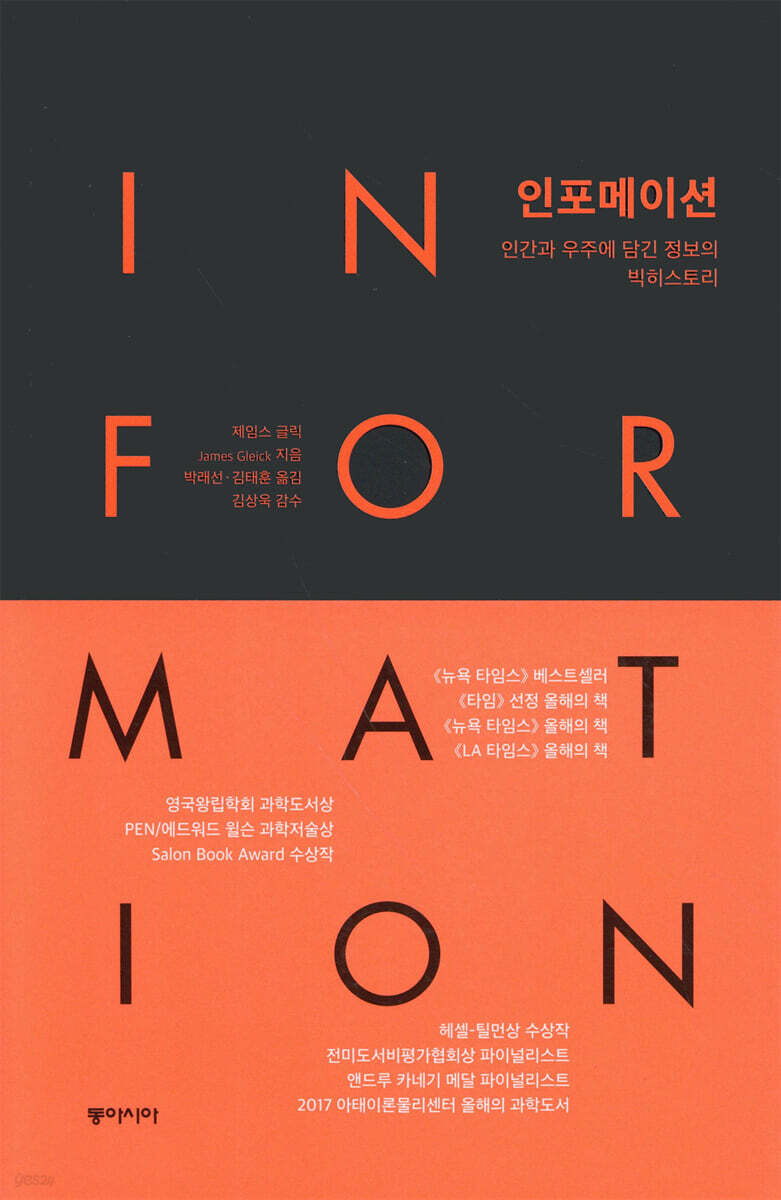
A New York Times bestseller and Time's Book of the Year
Royal Society Science Book Award, PEN/Edward Wilson Science Writing Award
“Absolutely stunning, lucid, and theoretically sexy” — The New York Times
When 『Information』 was first published in the English-speaking world, it received favorable reviews from numerous foreign media outlets.
“Absolutely stunning, lucid, and theoretically sexy” (The New York Times) / “No one writes such grand stories as well as James Gleick.
“He’s a master at weaving historical narratives, explaining complex theories clearly, and writing science in a popular way.” (The Wall Street Journal) / “This book is a powerful, rigorous, and at times heartbreaking account of the history of information.” (Time)
This book was selected as a 2011 New York Times Bestseller, a 2011 Time Book of the Year, a 2011 New York Times Book of the Year, a 2011 LA Times Book of the Year, a 2011 Boston Globe Book of the Year, and a 2011 Publisher's Weekly Book of the Year.
He has also won the Royal Society Winton Prize for Science Books (2012) and the PEN/Edward Wilson Prize for Science Writing (2013).
He has won the O. Wilson Literary Science Writing Award (2012), the Salon Book Award (2011), and the Hessell-Tiltman Prize (2012), and was a finalist for the National Book Critics Circle Award (2011) and the Andrew Carnegie Medal for Excellence in Nonfiction (2012).
Despite these impressive awards and favorable reviews from overseas media outlets, the most important thing in a translation is accurate translation and delivery of the content.
That is why Professor Sang-wook Kim (Department of Physics Education, Pusan National University), who can be called a so-called ‘James Gleick expert’ who reviewed ‘Chaos’, took on the role of reviewer this time as well.
Professor Kim Sang-wook says in his [Editor's Note], "I reviewed the translated manuscript twice, and read it once when it was published in its original form, so I read the book a total of three times before it was published in Korea."
This episode, which demonstrates his deep connection with the author, shows that Professor Kim Sang-wook, following his work on "Chaos," is once again serving as an excellent bridge between Glick and domestic readers.
In English-speaking countries, he is known as the "trusted and read James Gleick," but in Korea, some readers may be unfamiliar with his name or find the content of his books difficult.
The new book, "Information," has been meticulously translated and reviewed to make it easier for domestic readers to read the book.
What is information? And why is it important?
"No book has ever told such a vast story in such a broad way."
The 'information age' that defines our time has 'information' at its center.
And in 『Information』, we also talk about ‘information’.
But it is not easy to express it exactly in words.
In short, we can say that “information is data, it is material, it is state, and it is knowledge.”
This book explores how information transforms the world.
James Gleick looks at 'information' from three perspectives: 'history, theory, and flood.'
Starting with the sounds of African drums, we trace the history of information back to the era of hieroglyphics.
The invention of writing created not only a system of records but also a system of thought itself, such as categorization, generalization, and logic.
Written language evolved and dictionaries were born.
With the invention of the dictionary, abstract concepts were differentiated and concretized, and knowledge was systematized.
The invention of printing increased the speed of book production, and the widespread distribution of information led to the Renaissance, the Reformation, and the Scientific Revolution, fundamentally transforming Western society.
The invention of the telegraph also dramatically changed the speed at which information could be transmitted.
In the book, Glick focuses on how information is symbolized rather than the medium through which it is transmitted.
Ultimately, the fact that all information can be represented as a one-dimensional array of 0s and 1s marks a turning point in the history of information.
All information can be expressed in numbers.
Numbers are the oldest form of writing and an important form of information.
The study of numbers is called mathematics.
Mathematics, as the language of logic, is also the most solid foundation of philosophy.
Now, numbers are not just tools of mathematics, but the ultimate symbols for expressing information, revealing the contradictions of mathematics itself.
This is Gödel's 'incompleteness theorem', which shows the incompleteness of the mathematical axiomatic system itself.
Information science giants such as Gödel, Turing, and Shannon say that all thinking and logic in the world is nothing more than information processing, and that information can be expressed as numbers.
Ultimately, thinking and logic are calculations, and calculations are algorithms.
“It from bit!”
Information is 'cosmic', 'physical', and 'biological'.
A must-read for modern people living in the 21st century smart era.
Glick also guides readers through the theory of information.
Shannon quantifies information as 'entropy' because quantifying information is the beginning and the end of information.
Surprisingly, Shannon's entropy had the same form as the entropy of statistical physics, which deals with thermodynamics.
Entropy in thermodynamics is a 'real' physical quantity that determines whether an engine can operate or a chemical reaction can occur.
That's why information theory becomes physics.
When information physics meets quantum mechanics, it becomes ‘quantum information.’
Then the world enters a superposition state where it can be both 0 and 1 at the same time.
Eventually, we come across Rolf Landauer's "Information is Physical" and John Archibald Wheeler's "It form bit".
The universe becomes information.
Information is not only physical but also biological.
Modern biology began with DNA and realized that information is the core of life. DNA is an information tape composed of four symbols, and life is an "information transmission machine."
Also, other 'things' that transmit information, even if they are not organic, can behave like living things.
Chain letters, fads, religions, these are the 'memes' that Richard Dawkins talks about.
Information thus encompasses life beyond life itself.
The 21st century is an era of information overload.
In human history, more information is transmitted at the fastest speed, and the world is more closely intertwined than ever before.
However, Glick avoids making hasty predictions about the future and looks at the past, present, and future from the perspective of information.
Through 『Information』, you can learn what information is, how it has developed, and why information is important.
That is why this book is a must-read for modern people living in the 21st century smart era.
Awards and Recommendations
Winner of the 2012 Royal Society Science Book Award
Winner of the 2012 PEN/Edward Wilson Science Writing Award
2012 Andrew Carnegie Medal Finalist
Winner of the 2012 Hessell-Tiltman Prize
2011 National Book Critics Circle Award Finalist
Winner of the 2011 Salon Book Award
2011 New York Times bestseller
2011 Time's Book of the Year
2011 New York Times Book of the Year
2011 LA Times Book of the Year
2011 Boston Globe Book of the Year
Publisher's Weekly Book of the Year 2011
It covers a vast subject matter, comparable to Bill Bryson's A Short History of Nearly Everything, yet is full of fascinating stories.
According to recent scientific thinking, information is not simply the message in a letter or the data processed by a computer, but the ultimate form of the universe.
"Information" successfully achieves its ambitious goal of introducing the history and theory of information, as well as the implications of the information revolution.
I encourage you to read it with pleasure and think about the information and our future.
Lee Sang-wook (Professor of Philosophy of Science, Hanyang University)
“It’s absolutely stunning, lucid, and theoretically sexy.” _The New York Times
“A colorful and fascinating book.” _The Washington Post
“No one writes such grand stories as well as James Gleick.
“He is a master of everything: he can weave historical narratives, explain complex theories clearly, and write popular science.” _The Wall Street Journal
“Glick has done what only the best science writers can do.
It puts a topic that most of us only know superficially at the center of the world.
“This book is a powerful, rigorous, and at times heartbreaking account of the history of information.” _Time
“An enlightening and engagingly written book.” _Nature
“Fun, entertaining, and full of energy.” _New Scientist
“Beautiful, passionate, and unmissable.
“A flawless investigation and full of fascinating stories.” _The Boston Globe
“Glick is one of the greatest science writers of our time.
“This book on the history of information technology is fascinating and informative.” _American Scientist
“Writing about the history of information is not a task that can be accomplished with ambition alone.
That's really bold.
But Glick did it.
“This is a book of exquisite elegance.” _USA Today
“A magnificent, lucid, and awe-inspiring book.” _Salon
“A classy book, an elegant and insightful study.” _The Los Angeles Times
“The book covers everything from biology to particle physics, and explores the relationship between information and communication, data and meaning, from early humans to the present.
“The story is quite wild and fascinating.” _The Economist
“James Gleick, a gifted science writer, explains how we went from treating information as an expression of human thought and emotion to treating it as a commodity to be processed, like wheat or plutonium.
“This grand, complex, and important story is transformed into a captivating and engrossing tale in Glick’s hands.”
Nicholas Carr (author of "The Unthinking")
To understand what information truly means, Gleick draws on linguistics, logic, communications engineering, code, computer science, mathematics, philosophy, cosmology, quantum theory, and genetics.
Few writers can do this work so beautifully and authoritatively.
Philip Ball, The Observer
He speaks most knowledgeably and clearly about 'information', which is at the center of the information age.
The author of the new book, The Information: A History, A Theory, A Flood, is science writer James Gleick.
His previous work, Chaos (Dong-Asia, 2013), is considered to be the most influential popular science book in the world, and is a legendary bestseller among popular science books that has sold over 1 million copies in the United States alone, imprinting the “butterfly effect” on people around the world.
It is widely known as a bestseller in Korea and was selected as one of the '100 Recommended Books by Seoul National University'.
Glick is one of the most popular science writers, and his books have been translated into 30 languages worldwide.
In Korea, four years after the publication of 『Chaos』, 『Information』 was published again by East Asia Publishing (January 18, 2017).
The book systematically introduces and explains information theory and the history of information.
James Gleick's characteristically meticulous and extensive research has organized a variety of topics and theories in an engaging way.
It provides a friendly understanding of the field of information theory by providing vivid stories of famous scholars and scientists such as Claude Shannon, Charles Babbage, Norbert Wiener, Russell, Gödel, Alan Turing, Wittgenstein, and Richard Dawkins, as well as discussing their theories from various angles.
It also covers a wider range of fields and has more extensive knowledge about 'information' than any other book, including information, communication, computers, mathematics, information theory, communication theory, telecommunications, information revolution, cryptography, language, psychology, philosophy, genetics, evolution, history of science, biology, physics, bits, quantum mechanics, Wikipedia, Google, etc.
A New York Times bestseller and Time's Book of the Year
Royal Society Science Book Award, PEN/Edward Wilson Science Writing Award
“Absolutely stunning, lucid, and theoretically sexy” — The New York Times
When 『Information』 was first published in the English-speaking world, it received favorable reviews from numerous foreign media outlets.
“Absolutely stunning, lucid, and theoretically sexy” (The New York Times) / “No one writes such grand stories as well as James Gleick.
“He’s a master at weaving historical narratives, explaining complex theories clearly, and writing science in a popular way.” (The Wall Street Journal) / “This book is a powerful, rigorous, and at times heartbreaking account of the history of information.” (Time)
This book was selected as a 2011 New York Times Bestseller, a 2011 Time Book of the Year, a 2011 New York Times Book of the Year, a 2011 LA Times Book of the Year, a 2011 Boston Globe Book of the Year, and a 2011 Publisher's Weekly Book of the Year.
He has also won the Royal Society Winton Prize for Science Books (2012) and the PEN/Edward Wilson Prize for Science Writing (2013).
He has won the O. Wilson Literary Science Writing Award (2012), the Salon Book Award (2011), and the Hessell-Tiltman Prize (2012), and was a finalist for the National Book Critics Circle Award (2011) and the Andrew Carnegie Medal for Excellence in Nonfiction (2012).
Despite these impressive awards and favorable reviews from overseas media outlets, the most important thing in a translation is accurate translation and delivery of the content.
That is why Professor Sang-wook Kim (Department of Physics Education, Pusan National University), who can be called a so-called ‘James Gleick expert’ who reviewed ‘Chaos’, took on the role of reviewer this time as well.
Professor Kim Sang-wook says in his [Editor's Note], "I reviewed the translated manuscript twice, and read it once when it was published in its original form, so I read the book a total of three times before it was published in Korea."
This episode, which demonstrates his deep connection with the author, shows that Professor Kim Sang-wook, following his work on "Chaos," is once again serving as an excellent bridge between Glick and domestic readers.
In English-speaking countries, he is known as the "trusted and read James Gleick," but in Korea, some readers may be unfamiliar with his name or find the content of his books difficult.
The new book, "Information," has been meticulously translated and reviewed to make it easier for domestic readers to read the book.
What is information? And why is it important?
"No book has ever told such a vast story in such a broad way."
The 'information age' that defines our time has 'information' at its center.
And in 『Information』, we also talk about ‘information’.
But it is not easy to express it exactly in words.
In short, we can say that “information is data, it is material, it is state, and it is knowledge.”
This book explores how information transforms the world.
James Gleick looks at 'information' from three perspectives: 'history, theory, and flood.'
Starting with the sounds of African drums, we trace the history of information back to the era of hieroglyphics.
The invention of writing created not only a system of records but also a system of thought itself, such as categorization, generalization, and logic.
Written language evolved and dictionaries were born.
With the invention of the dictionary, abstract concepts were differentiated and concretized, and knowledge was systematized.
The invention of printing increased the speed of book production, and the widespread distribution of information led to the Renaissance, the Reformation, and the Scientific Revolution, fundamentally transforming Western society.
The invention of the telegraph also dramatically changed the speed at which information could be transmitted.
In the book, Glick focuses on how information is symbolized rather than the medium through which it is transmitted.
Ultimately, the fact that all information can be represented as a one-dimensional array of 0s and 1s marks a turning point in the history of information.
All information can be expressed in numbers.
Numbers are the oldest form of writing and an important form of information.
The study of numbers is called mathematics.
Mathematics, as the language of logic, is also the most solid foundation of philosophy.
Now, numbers are not just tools of mathematics, but the ultimate symbols for expressing information, revealing the contradictions of mathematics itself.
This is Gödel's 'incompleteness theorem', which shows the incompleteness of the mathematical axiomatic system itself.
Information science giants such as Gödel, Turing, and Shannon say that all thinking and logic in the world is nothing more than information processing, and that information can be expressed as numbers.
Ultimately, thinking and logic are calculations, and calculations are algorithms.
“It from bit!”
Information is 'cosmic', 'physical', and 'biological'.
A must-read for modern people living in the 21st century smart era.
Glick also guides readers through the theory of information.
Shannon quantifies information as 'entropy' because quantifying information is the beginning and the end of information.
Surprisingly, Shannon's entropy had the same form as the entropy of statistical physics, which deals with thermodynamics.
Entropy in thermodynamics is a 'real' physical quantity that determines whether an engine can operate or a chemical reaction can occur.
That's why information theory becomes physics.
When information physics meets quantum mechanics, it becomes ‘quantum information.’
Then the world enters a superposition state where it can be both 0 and 1 at the same time.
Eventually, we come across Rolf Landauer's "Information is Physical" and John Archibald Wheeler's "It form bit".
The universe becomes information.
Information is not only physical but also biological.
Modern biology began with DNA and realized that information is the core of life. DNA is an information tape composed of four symbols, and life is an "information transmission machine."
Also, other 'things' that transmit information, even if they are not organic, can behave like living things.
Chain letters, fads, religions, these are the 'memes' that Richard Dawkins talks about.
Information thus encompasses life beyond life itself.
The 21st century is an era of information overload.
In human history, more information is transmitted at the fastest speed, and the world is more closely intertwined than ever before.
However, Glick avoids making hasty predictions about the future and looks at the past, present, and future from the perspective of information.
Through 『Information』, you can learn what information is, how it has developed, and why information is important.
That is why this book is a must-read for modern people living in the 21st century smart era.
Awards and Recommendations
Winner of the 2012 Royal Society Science Book Award
Winner of the 2012 PEN/Edward Wilson Science Writing Award
2012 Andrew Carnegie Medal Finalist
Winner of the 2012 Hessell-Tiltman Prize
2011 National Book Critics Circle Award Finalist
Winner of the 2011 Salon Book Award
2011 New York Times bestseller
2011 Time's Book of the Year
2011 New York Times Book of the Year
2011 LA Times Book of the Year
2011 Boston Globe Book of the Year
Publisher's Weekly Book of the Year 2011
It covers a vast subject matter, comparable to Bill Bryson's A Short History of Nearly Everything, yet is full of fascinating stories.
According to recent scientific thinking, information is not simply the message in a letter or the data processed by a computer, but the ultimate form of the universe.
"Information" successfully achieves its ambitious goal of introducing the history and theory of information, as well as the implications of the information revolution.
I encourage you to read it with pleasure and think about the information and our future.
Lee Sang-wook (Professor of Philosophy of Science, Hanyang University)
“It’s absolutely stunning, lucid, and theoretically sexy.” _The New York Times
“A colorful and fascinating book.” _The Washington Post
“No one writes such grand stories as well as James Gleick.
“He is a master of everything: he can weave historical narratives, explain complex theories clearly, and write popular science.” _The Wall Street Journal
“Glick has done what only the best science writers can do.
It puts a topic that most of us only know superficially at the center of the world.
“This book is a powerful, rigorous, and at times heartbreaking account of the history of information.” _Time
“An enlightening and engagingly written book.” _Nature
“Fun, entertaining, and full of energy.” _New Scientist
“Beautiful, passionate, and unmissable.
“A flawless investigation and full of fascinating stories.” _The Boston Globe
“Glick is one of the greatest science writers of our time.
“This book on the history of information technology is fascinating and informative.” _American Scientist
“Writing about the history of information is not a task that can be accomplished with ambition alone.
That's really bold.
But Glick did it.
“This is a book of exquisite elegance.” _USA Today
“A magnificent, lucid, and awe-inspiring book.” _Salon
“A classy book, an elegant and insightful study.” _The Los Angeles Times
“The book covers everything from biology to particle physics, and explores the relationship between information and communication, data and meaning, from early humans to the present.
“The story is quite wild and fascinating.” _The Economist
“James Gleick, a gifted science writer, explains how we went from treating information as an expression of human thought and emotion to treating it as a commodity to be processed, like wheat or plutonium.
“This grand, complex, and important story is transformed into a captivating and engrossing tale in Glick’s hands.”
Nicholas Carr (author of "The Unthinking")
To understand what information truly means, Gleick draws on linguistics, logic, communications engineering, code, computer science, mathematics, philosophy, cosmology, quantum theory, and genetics.
Few writers can do this work so beautifully and authoritatively.
Philip Ball, The Observer
GOODS SPECIFICS
- Date of issue: January 18, 2017
- Page count, weight, size: 656 pages | 902g | 145*224*35mm
- ISBN13: 9788962621693
- ISBN10: 896262169X
You may also like
카테고리
korean


korean

![GQ KOREA Mark (Monthly): December [2025]](http://librairie.coreenne.fr/cdn/shop/files/8ef265dbbfbf186523ed75ba7319009d.jpg?v=1765340328&width=3840)


