

Atlas of Korean History
 |
Description
Book Introduction
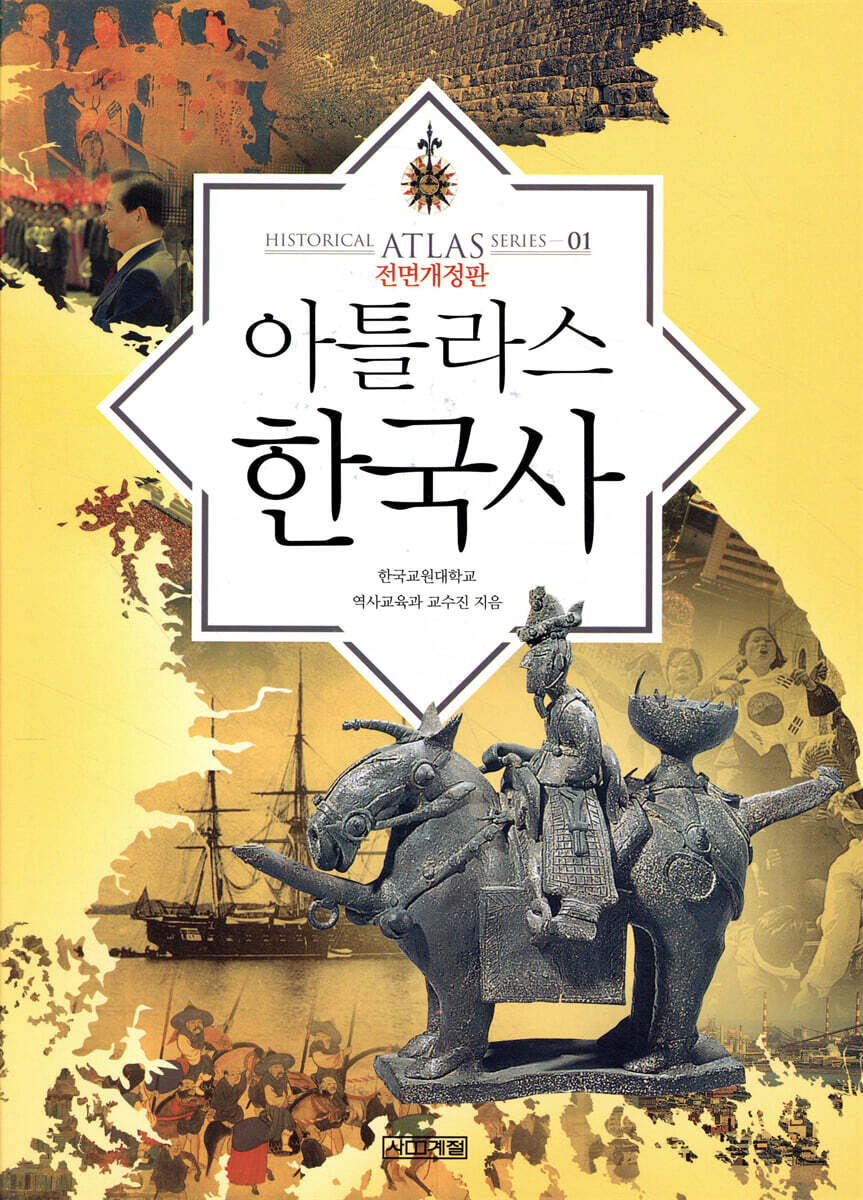
『Atlas of Korean History』 by Sageseul Publishing, a leader in the field of historical maps A completely revised edition published after 18 years! The Atlas History series by Sageseul Publishing, which advertises itself as a “history book to read with maps,” began with “Atlas Korean History” in 2004, and has since been followed by five volumes: “Atlas World History” (2004), “Atlas Chinese History” (2007), “Atlas Japanese History” (2011), and “Atlas Central Eurasian History” (2016), bringing a breath of fresh air to the history book market, which had been dominated by text-based books. In particular, 『Atlas of Korean History』, the first volume in the series and the first attempt in Korean publishing history to present history through maps, has been greatly loved by numerous readers over the past 18 years and was recognized for its achievements by winning the 57th Korean Publishing Culture Award. Celebrating its 40th anniversary in 2022, Sageseul Publishing Company has comprehensively revised this book, a representative work in the humanities and history fields, in collaboration with professors from the Department of History Education at Korea National University of Education. The fully revised edition of "Atlas of Korean History" expands the core topics of Korean history from the Paleolithic Age to the present day in the 21st century from 93 to 113, and provides 281 maps and graphs, 202 plates, and adds "special" topics not found in the previous edition, covering politics, war, economy, and even life and culture. The authors have not only completely revamped historical interpretation and content descriptions to reflect new academic research findings, but also improved the readability of existing historical maps and developed numerous new ones, vividly conveying important moments in Korean history to readers. Featuring map illustrations and visual aid designs that are significantly more colorful than those in previous editions, this book will serve as a useful reference not only for students just beginning their study of Korean history but also for those seeking to further their studies. |
- You can preview some of the book's contents.
Preview
index
004 Author's Preface
Part 1 Primitive
010 Development of the Primitive Age / 012 Use of Bronze and the Formation of the State
Part 2 Ancient
016 The formation and development of Gojoseon / 018 Buyeo, Samhan, and the Four Commanderies of Han / 020 The founding and growth of Goguryeo / 022 The founding and growth of Baekje / 024 The founding and growth of Silla / 026 The rise and fall of the Gaya confederacy / 028 The conquests of King Gwanggaeto and King Jangsu / 030 The development of Baekje during the Ungjin and Sabi periods / 032 Special feature: Baekje's foreign relations through the sea / 034 The development of Silla / 036 The ideology and culture of the Three Kingdoms
Part 3: North-South States Period
040 Goguryeo-Sui War / 042 Goguryeo-Tang War / 044 Special Feature: Goguryeo's Foreign Relations as Seen through Murals and Inscriptions / 046 Silla's Unification of the Three Kingdoms / 048 War between Silla and Tang / 050 Unified Silla's Governing Organization and Political System / 052 Unified Silla's People's Lives / 054 Balhae's Politics and Society / 056 Silla's Commercial Development and Foreign Trade / 058 Special Feature: Jang Bogo, the Maritime King / 060 Balhae's Foreign Trade / 062 Thought and Culture of the North-South States Period / 064 The Rise of Aristocrats in the Later Silla Period / 066 Special Feature: Formation of the East Asian Cultural Sphere
Consideration of Part 4
070 Division of the Later Three Kingdoms / 072 National Unification of Goryeo / 074 War with the Khitan / 076 Development of the Nine Cities and Return of the Territory / 078 Rise of the Aristocracy and Conflicts among the Ruling Class / 080 Military Rule and Civil Rebellions / 082 Mongol Invasion and Resistance Against the Mongols / 084 Goryeo under Yuan Intervention / 086 King Gongmin's Anti-Mongolian Independence Policy / 088 Red Turban Rebels and Japanese Pirates / 090 Special Feature: Relics from Undersea Ships Off the Coast of Sinan / 092 Central and Local Administrative Systems / 094 Agriculture, Handicrafts, and Commerce / 096 Transportation and Postal Routes / 098 Family Life and the Status of Women / 100 Confucianism, Buddhism, and Taoism / 102 The Prevalence of Foreign Trade / 104 The Rise of Goryeo / 106 Special Feature: Cultural Heritage of Goryeo
Part 5 Joseon
112 The process of establishing the national system / 114 Special feature: History books, geography, and maps of the early Joseon period / 116 Territorial expansion / 118 The growth of the Sarim (literati scholars) and Sahwa (puppet governments) / 120 Central and local administrative systems / 122 Education and the civil service examination system / 124 The tax system and transportation / 126 The development of agriculture and the land system / 128 Handicrafts and commerce / 130 The caste system / 132 Seowon (Confucian academies), Hyangyak (local government agreements), and rural society / 134 The development of Neo-Confucianism / 136 The development of science and technology / 138 Foreign relations and trade / 140 Special feature: The circulation of silver and Joseon in the Age of Exploration / 142 The Imjin and Jeongyu Wars / 144 The Manchu invasions of Korea (the Qing invasions of 1537 and 1548) / 146 The development of factional politics / 148 Reform of the tax system and social change / 150 The development of industry and economic change / 152 Changes in rural society / 154 The Spread and Diversification of Popular Culture / 156 Foreign Relations in the Late Joseon Dynasty / 158 Special Feature: Exchanges and Cultural Awareness Brought About by Drifting / 160 The Development of Silhak / 162 Peasant Uprisings in the 19th Century / 164 The Spread of New Religions and Ideologies / 166 Daewongun's Reforms and Contact with the West / 168 Special Feature: UNESCO World Heritage Sites, Joseon Royal Tombs
Part 6 Modern Times
172 The opening of the country and the conclusion of unequal treaties / 174 The promotion and opposition of enlightenment / 176 The Donghak Peasant Revolution / 178 The Sino-Japanese War and the Gabo Reforms / 180 The competition between the great powers and Joseon's response / 182 Special feature: The world travel of modern intellectuals / 184 The Korean Empire and the Independence Association / 186 The Russo-Japanese War and Japan's invasion of national sovereignty / 188 The Righteous Army Uprising / 190 The Self-Strengthening Enlightenment Movement / 192 The introduction of modern civilization / 194 Special feature: The establishment of modern education / 196 Japan's colonial rule policy / 198 The March 1st Movement / 200 The Provisional Government of the Republic of Korea and overseas independence movements / 202 The development of the national movement in Korea / 204 Mass movements and the dynamism of local communities / 206 The wartime mobilization system and the lives of the people / 208 Special feature: The Korean Diaspora / 210 Efforts toward liberation / 212 The light of modernity and Shadow / 214 Special Feature: Modern Architecture in Seoul
Part 7 Modern
218 Liberation and Division / 220 The Pains Surrounding Nation-Building / 222 The Establishment of the Governments of North and South Korea / 224 The Development and Damage of the Korean War / 226 The Formation of the Post-War Anti-Communist System / 228 The April 19 Revolution / 230 The Establishment of the Park Chung-hee Regime and the Yushin System / 232 The Gwangju Democratization Movement / 234 The June Democracy Movement / 236 The Light and Shadow of Economic Growth / 238 Changes in Social Structure / 240 The Development of Popular Culture / 242 Changes in North Korea / 244 Changes in Inter-Korean Relations and Efforts for Unification / 246 Special Feature: Korea in the Age of Globalization
supplement
248 Major Rulers of History / 250 List of Visual Resources and Sources/Locations / 256 References / 260 Index
Part 1 Primitive
010 Development of the Primitive Age / 012 Use of Bronze and the Formation of the State
Part 2 Ancient
016 The formation and development of Gojoseon / 018 Buyeo, Samhan, and the Four Commanderies of Han / 020 The founding and growth of Goguryeo / 022 The founding and growth of Baekje / 024 The founding and growth of Silla / 026 The rise and fall of the Gaya confederacy / 028 The conquests of King Gwanggaeto and King Jangsu / 030 The development of Baekje during the Ungjin and Sabi periods / 032 Special feature: Baekje's foreign relations through the sea / 034 The development of Silla / 036 The ideology and culture of the Three Kingdoms
Part 3: North-South States Period
040 Goguryeo-Sui War / 042 Goguryeo-Tang War / 044 Special Feature: Goguryeo's Foreign Relations as Seen through Murals and Inscriptions / 046 Silla's Unification of the Three Kingdoms / 048 War between Silla and Tang / 050 Unified Silla's Governing Organization and Political System / 052 Unified Silla's People's Lives / 054 Balhae's Politics and Society / 056 Silla's Commercial Development and Foreign Trade / 058 Special Feature: Jang Bogo, the Maritime King / 060 Balhae's Foreign Trade / 062 Thought and Culture of the North-South States Period / 064 The Rise of Aristocrats in the Later Silla Period / 066 Special Feature: Formation of the East Asian Cultural Sphere
Consideration of Part 4
070 Division of the Later Three Kingdoms / 072 National Unification of Goryeo / 074 War with the Khitan / 076 Development of the Nine Cities and Return of the Territory / 078 Rise of the Aristocracy and Conflicts among the Ruling Class / 080 Military Rule and Civil Rebellions / 082 Mongol Invasion and Resistance Against the Mongols / 084 Goryeo under Yuan Intervention / 086 King Gongmin's Anti-Mongolian Independence Policy / 088 Red Turban Rebels and Japanese Pirates / 090 Special Feature: Relics from Undersea Ships Off the Coast of Sinan / 092 Central and Local Administrative Systems / 094 Agriculture, Handicrafts, and Commerce / 096 Transportation and Postal Routes / 098 Family Life and the Status of Women / 100 Confucianism, Buddhism, and Taoism / 102 The Prevalence of Foreign Trade / 104 The Rise of Goryeo / 106 Special Feature: Cultural Heritage of Goryeo
Part 5 Joseon
112 The process of establishing the national system / 114 Special feature: History books, geography, and maps of the early Joseon period / 116 Territorial expansion / 118 The growth of the Sarim (literati scholars) and Sahwa (puppet governments) / 120 Central and local administrative systems / 122 Education and the civil service examination system / 124 The tax system and transportation / 126 The development of agriculture and the land system / 128 Handicrafts and commerce / 130 The caste system / 132 Seowon (Confucian academies), Hyangyak (local government agreements), and rural society / 134 The development of Neo-Confucianism / 136 The development of science and technology / 138 Foreign relations and trade / 140 Special feature: The circulation of silver and Joseon in the Age of Exploration / 142 The Imjin and Jeongyu Wars / 144 The Manchu invasions of Korea (the Qing invasions of 1537 and 1548) / 146 The development of factional politics / 148 Reform of the tax system and social change / 150 The development of industry and economic change / 152 Changes in rural society / 154 The Spread and Diversification of Popular Culture / 156 Foreign Relations in the Late Joseon Dynasty / 158 Special Feature: Exchanges and Cultural Awareness Brought About by Drifting / 160 The Development of Silhak / 162 Peasant Uprisings in the 19th Century / 164 The Spread of New Religions and Ideologies / 166 Daewongun's Reforms and Contact with the West / 168 Special Feature: UNESCO World Heritage Sites, Joseon Royal Tombs
Part 6 Modern Times
172 The opening of the country and the conclusion of unequal treaties / 174 The promotion and opposition of enlightenment / 176 The Donghak Peasant Revolution / 178 The Sino-Japanese War and the Gabo Reforms / 180 The competition between the great powers and Joseon's response / 182 Special feature: The world travel of modern intellectuals / 184 The Korean Empire and the Independence Association / 186 The Russo-Japanese War and Japan's invasion of national sovereignty / 188 The Righteous Army Uprising / 190 The Self-Strengthening Enlightenment Movement / 192 The introduction of modern civilization / 194 Special feature: The establishment of modern education / 196 Japan's colonial rule policy / 198 The March 1st Movement / 200 The Provisional Government of the Republic of Korea and overseas independence movements / 202 The development of the national movement in Korea / 204 Mass movements and the dynamism of local communities / 206 The wartime mobilization system and the lives of the people / 208 Special feature: The Korean Diaspora / 210 Efforts toward liberation / 212 The light of modernity and Shadow / 214 Special Feature: Modern Architecture in Seoul
Part 7 Modern
218 Liberation and Division / 220 The Pains Surrounding Nation-Building / 222 The Establishment of the Governments of North and South Korea / 224 The Development and Damage of the Korean War / 226 The Formation of the Post-War Anti-Communist System / 228 The April 19 Revolution / 230 The Establishment of the Park Chung-hee Regime and the Yushin System / 232 The Gwangju Democratization Movement / 234 The June Democracy Movement / 236 The Light and Shadow of Economic Growth / 238 Changes in Social Structure / 240 The Development of Popular Culture / 242 Changes in North Korea / 244 Changes in Inter-Korean Relations and Efforts for Unification / 246 Special Feature: Korea in the Age of Globalization
supplement
248 Major Rulers of History / 250 List of Visual Resources and Sources/Locations / 256 References / 260 Index
Detailed image
.jpg)
Into the book
The use of bronze destroyed the primitive society where everyone was equal, and classes arose among people.
Gradually, economic dominance relationships were established between various groups within the tribe, and conflicts between tribes over access to key resources grew, leading to relationships of dominance and subordination among them.
And in the village, cheers and fences for defense appear.
Ulsan Geomdan-ri and Buyeo Songguk-ri are such examples.
Over time, the fence was replaced by a fortress, which resembled a Western castle-state.
---From “The Use of Bronze and the Formation of the State”
As ancient nations developed, the use of Chinese characters in writing began.
As the law was promulgated and document administration expanded, learning to read and write became an essential element of government appointments, and literacy education and Chinese classics were disseminated through institutions such as Gyeongdang and Hwarangdo.
The representative achievement of Chinese literature during the Three Kingdoms period is the Four Books.
The compilation of historical records led by the royal family is a symbolic project that speaks of the growth of an ancient state that pursued a centralized system, and Goguryeo
The concrete results include 『Yugi』 and 『Sinjip』, Silla's 『Guksa』, and Baekje's 『Seoggi』.
---From “Thoughts and Culture of the Three Kingdoms”
In addition to cultivating their own land, ordinary farmers also jointly cultivated the village head's land, the government-owned land, the official land, and the land paid to the state as tribute.
Meanwhile, seeing that the number of trees is also known, it seems that this was also subject to taxation.
In the end, ordinary farmers each owned their own land and were economically independent, but they also had to bear the labor required to jointly cultivate the common land allocated to the village, so it can be seen that a considerable amount of communal order remained.
---From "The Life of the People of Unified Silla"
The forces that led the resistance of the lower classes in each region were diverse, ranging from peasants of hyang, bugok, and so, to government slaves, private slaves, ordinary farmers, and monks, but they had one thing in common: they were poor people exploited by the ruling class.
Some of the rebellions that occurred at the time were unique in that they attempted to unite the local population by advocating for the revival of Silla, Goguryeo, and Baekje.
The legitimacy of the military regime was challenged by their resistance, and the entire ruling system appeared to be shaking.
However, the civil unrest of this era failed to bring about reform of the system and was buried in the national crisis of the Mongol invasion.
---From "Unmanned Rule and Civil War"
In order to make the expanded area into a permanent territory by establishing the 4th Army and 6th Garrison, it was necessary to secure farmland and faithfully maintain the people.
To this end, we actively promoted a civil policy at the national level.
After the northern territory expanded with the development of the 4th Army and 6th Garrison of Sejongdae, the immigration of civilians was actively promoted.
Of course, the target areas for civilians were not limited to the 4th Army and 6th Division.
Up to Sejong University, the target population is the local immigrant population.
It was the center and its purpose was to recover and protect the northern territory.
After King Sejo, the target of the private sector was expanded to include the people of the lower three provinces, and the reclamation of the idle land was promoted as the main goal.
The policy of favoring the common people continued until the reign of King Seongjong.
As a result of the migration of tens of thousands of people, the population of Pyeongan and Hamgyeong provinces increased significantly and the region developed.
---From "Expansion of Territory"
Although clan villages existed in Goryeo society, they increased significantly in the late Joseon Dynasty.
Most of the folk villages we are familiar with today were created in their current form during the late Joseon Dynasty.
For example, Hahoe Village in Andong, famous enough to be visited by Queen Elizabeth II of England when she visited Korea, has been around for a long time, but it was not until the 18th century that it became a village of the Pungsan Ryu clan, as it is today, after several clans lived together.
… However, these efforts by the Yangban aristocracy could not stop the social changes of the late Joseon Dynasty.
In the process of rapid social change, the personalities of members of society have become more complex.
Many of the nobles fell into ruin in terms of social status and economic power, becoming no different from commoners.
---From "Changes in Rural Society"
The railroad served as a spearhead of modernization and a springboard for economic and military aggression by imperialist powers.
Because of this, each imperialist country put in effort to obtain the right to build railroads in Korea.
The construction rights for the Gyeongbu Line and Gyeongwon Line were acquired by Japan, the Gyeongin Line by the United States, and the Gyeongui Line by France. However, later, the construction rights for both the Gyeongin Line and Gyeongui Line were also transferred to Japan.
Japan opened its first railway between Seoul and Incheon in 1899, followed by the Gyeongbu Line in 1905 and the Gyeongui Line in 1906, connecting the Korean Peninsula with a railway line running from Busan to Sinuiju.
This railroad served as a springboard for the Japanese army to invade the continent, and was a major means of transporting materials from the Korean Peninsula, including rice from Honam, which Japan needed, to Busan.
In 1914, after Joseon was completely colonized, the Honam Line and Gyeongwon Line were opened, completing the railroad network connecting the Korean Peninsula in an X shape.
---From "The Great Powers' Rivalry and Joseon's Response"
As the dictatorship surrendered to the people, demands for democracy from all walks of life, which had been suppressed for so long, poured out like a flood.
In particular, workers who were suffering from inhumane treatment without even being guaranteed the right to survive went on strike at major industrial complexes across the country, including Ulsan, and established over 1,000 democratic labor unions.
The great labor struggle that unfolded between July and September served as an opportunity for the labor movement, which had been centered around the light industry sector in the metropolitan area, to expand nationwide and to large-scale factories, emerging as an important social movement.
Gradually, economic dominance relationships were established between various groups within the tribe, and conflicts between tribes over access to key resources grew, leading to relationships of dominance and subordination among them.
And in the village, cheers and fences for defense appear.
Ulsan Geomdan-ri and Buyeo Songguk-ri are such examples.
Over time, the fence was replaced by a fortress, which resembled a Western castle-state.
---From “The Use of Bronze and the Formation of the State”
As ancient nations developed, the use of Chinese characters in writing began.
As the law was promulgated and document administration expanded, learning to read and write became an essential element of government appointments, and literacy education and Chinese classics were disseminated through institutions such as Gyeongdang and Hwarangdo.
The representative achievement of Chinese literature during the Three Kingdoms period is the Four Books.
The compilation of historical records led by the royal family is a symbolic project that speaks of the growth of an ancient state that pursued a centralized system, and Goguryeo
The concrete results include 『Yugi』 and 『Sinjip』, Silla's 『Guksa』, and Baekje's 『Seoggi』.
---From “Thoughts and Culture of the Three Kingdoms”
In addition to cultivating their own land, ordinary farmers also jointly cultivated the village head's land, the government-owned land, the official land, and the land paid to the state as tribute.
Meanwhile, seeing that the number of trees is also known, it seems that this was also subject to taxation.
In the end, ordinary farmers each owned their own land and were economically independent, but they also had to bear the labor required to jointly cultivate the common land allocated to the village, so it can be seen that a considerable amount of communal order remained.
---From "The Life of the People of Unified Silla"
The forces that led the resistance of the lower classes in each region were diverse, ranging from peasants of hyang, bugok, and so, to government slaves, private slaves, ordinary farmers, and monks, but they had one thing in common: they were poor people exploited by the ruling class.
Some of the rebellions that occurred at the time were unique in that they attempted to unite the local population by advocating for the revival of Silla, Goguryeo, and Baekje.
The legitimacy of the military regime was challenged by their resistance, and the entire ruling system appeared to be shaking.
However, the civil unrest of this era failed to bring about reform of the system and was buried in the national crisis of the Mongol invasion.
---From "Unmanned Rule and Civil War"
In order to make the expanded area into a permanent territory by establishing the 4th Army and 6th Garrison, it was necessary to secure farmland and faithfully maintain the people.
To this end, we actively promoted a civil policy at the national level.
After the northern territory expanded with the development of the 4th Army and 6th Garrison of Sejongdae, the immigration of civilians was actively promoted.
Of course, the target areas for civilians were not limited to the 4th Army and 6th Division.
Up to Sejong University, the target population is the local immigrant population.
It was the center and its purpose was to recover and protect the northern territory.
After King Sejo, the target of the private sector was expanded to include the people of the lower three provinces, and the reclamation of the idle land was promoted as the main goal.
The policy of favoring the common people continued until the reign of King Seongjong.
As a result of the migration of tens of thousands of people, the population of Pyeongan and Hamgyeong provinces increased significantly and the region developed.
---From "Expansion of Territory"
Although clan villages existed in Goryeo society, they increased significantly in the late Joseon Dynasty.
Most of the folk villages we are familiar with today were created in their current form during the late Joseon Dynasty.
For example, Hahoe Village in Andong, famous enough to be visited by Queen Elizabeth II of England when she visited Korea, has been around for a long time, but it was not until the 18th century that it became a village of the Pungsan Ryu clan, as it is today, after several clans lived together.
… However, these efforts by the Yangban aristocracy could not stop the social changes of the late Joseon Dynasty.
In the process of rapid social change, the personalities of members of society have become more complex.
Many of the nobles fell into ruin in terms of social status and economic power, becoming no different from commoners.
---From "Changes in Rural Society"
The railroad served as a spearhead of modernization and a springboard for economic and military aggression by imperialist powers.
Because of this, each imperialist country put in effort to obtain the right to build railroads in Korea.
The construction rights for the Gyeongbu Line and Gyeongwon Line were acquired by Japan, the Gyeongin Line by the United States, and the Gyeongui Line by France. However, later, the construction rights for both the Gyeongin Line and Gyeongui Line were also transferred to Japan.
Japan opened its first railway between Seoul and Incheon in 1899, followed by the Gyeongbu Line in 1905 and the Gyeongui Line in 1906, connecting the Korean Peninsula with a railway line running from Busan to Sinuiju.
This railroad served as a springboard for the Japanese army to invade the continent, and was a major means of transporting materials from the Korean Peninsula, including rice from Honam, which Japan needed, to Busan.
In 1914, after Joseon was completely colonized, the Honam Line and Gyeongwon Line were opened, completing the railroad network connecting the Korean Peninsula in an X shape.
---From "The Great Powers' Rivalry and Joseon's Response"
As the dictatorship surrendered to the people, demands for democracy from all walks of life, which had been suppressed for so long, poured out like a flood.
In particular, workers who were suffering from inhumane treatment without even being guaranteed the right to survive went on strike at major industrial complexes across the country, including Ulsan, and established over 1,000 democratic labor unions.
The great labor struggle that unfolded between July and September served as an opportunity for the labor movement, which had been centered around the light industry sector in the metropolitan area, to expand nationwide and to large-scale factories, emerging as an important social movement.
---From the “June Democracy Movement”
Publisher's Review
The Birth of the Atlas History Series
Sageseul Publishing has devoted itself to popularizing history by publishing large-scale historical publications such as 『History Newspaper』, 『World History Newspaper』, and 『Korean Living History Museum』.
The previous projects were well-received by both the market and academia, and, encouraged by their success, the next challenge was the Historical Atlas, a representative unexplored field in Korean history studies.
Even today, there are only a handful of researchers specializing in historical maps in academia, and historical research that contains intense reflections on historical geography is extremely rare.
However, the importance of geography in history cannot be overemphasized.
Because history is ultimately a story of people unfolding across space.
Just as the West has long focused on historical maps and provided high-quality atlases to the public, it is time for Korea's historical academia and publishing community to move toward emphasizing geographic information.
The Atlas History series was planned with this very will and ambition.
History must be read within a defined scope.
It is said that those who read history must first determine the scope of the text.
Only then can we understand the situation of the occupation, examine the gains and losses of the war, and examine the history of division and annexation.
Sunam An Jeong-bok explains the reason for including a special study on geography in the preface to Dongsa Gangmok as follows.
This means that only by expressing an event or topic in history on a map and spatially understanding it can we vividly understand the true nature of that history.
The Atlas History series revives the will of Ahn Jeong-bok, who emphasized that “one must read after determining the scope,” and the first book in the series is “Atlas Korean History.”
When we approach history, we tend to see it only in terms of the flow of time, but this book shifts that perspective to the process of spatial expansion and seeks to fill the void in our history.
This is what's different in this completely revised edition after 18 years.
* The number of core topics in Korean history has increased by 20 (93 in the old edition → 113 in the completely revised edition).
* Selecting major topics in Korean history that were not covered in the main text, and creating new 'special feature' topics (15 in total)
* Significantly increased number of maps and graphs (229 in the old edition → 281 in the completely revised edition) and illustrations (93 in the old edition → 202 in the completely revised edition)
『Atlas of Korean History』 was loved by both general readers and history majors.
However, as time passed since the book was published, many parts of the text as well as the maps were found to need to be revised and supplemented.
Accordingly, the professors of the Department of History Education at Korea National University of Education gathered together again and began work on a comprehensive revision.
This comprehensively revised edition not only reflects the achievements of Korean history research accumulated over the past 18 years, but also mobilizes all the know-how accumulated over the years in producing the Atlas History Series, reorganizing it from beginning to end.
It presents a comprehensive overview of Korean history from the Paleolithic Age to the present through 113 topics essential for understanding Korean history, and in particular, it significantly reinforces the economic and cultural aspects, from the development of industry and economy to the improvement of culture and lifestyle.
Additionally, 15 'special' topics not found in the previous edition were added to emphasize social and cultural developments over time.
Through special articles such as 'Goguryeo's Foreign Relations as Seen Through Murals and Inscriptions,' 'Relics of Ships Off the Coast of Sinan,' 'A Global Journey of Modern Intellectuals,' and 'The Korean Diaspora,' we aimed to further highlight the strengths of this book, which reveals moments in history through the interplay of maps and text.
At the end of the book, a genealogy of major rulers in Korean history, as well as sources and locations of visual materials, are included.
Sageseul Publishing has devoted itself to popularizing history by publishing large-scale historical publications such as 『History Newspaper』, 『World History Newspaper』, and 『Korean Living History Museum』.
The previous projects were well-received by both the market and academia, and, encouraged by their success, the next challenge was the Historical Atlas, a representative unexplored field in Korean history studies.
Even today, there are only a handful of researchers specializing in historical maps in academia, and historical research that contains intense reflections on historical geography is extremely rare.
However, the importance of geography in history cannot be overemphasized.
Because history is ultimately a story of people unfolding across space.
Just as the West has long focused on historical maps and provided high-quality atlases to the public, it is time for Korea's historical academia and publishing community to move toward emphasizing geographic information.
The Atlas History series was planned with this very will and ambition.
History must be read within a defined scope.
It is said that those who read history must first determine the scope of the text.
Only then can we understand the situation of the occupation, examine the gains and losses of the war, and examine the history of division and annexation.
Sunam An Jeong-bok explains the reason for including a special study on geography in the preface to Dongsa Gangmok as follows.
This means that only by expressing an event or topic in history on a map and spatially understanding it can we vividly understand the true nature of that history.
The Atlas History series revives the will of Ahn Jeong-bok, who emphasized that “one must read after determining the scope,” and the first book in the series is “Atlas Korean History.”
When we approach history, we tend to see it only in terms of the flow of time, but this book shifts that perspective to the process of spatial expansion and seeks to fill the void in our history.
This is what's different in this completely revised edition after 18 years.
* The number of core topics in Korean history has increased by 20 (93 in the old edition → 113 in the completely revised edition).
* Selecting major topics in Korean history that were not covered in the main text, and creating new 'special feature' topics (15 in total)
* Significantly increased number of maps and graphs (229 in the old edition → 281 in the completely revised edition) and illustrations (93 in the old edition → 202 in the completely revised edition)
『Atlas of Korean History』 was loved by both general readers and history majors.
However, as time passed since the book was published, many parts of the text as well as the maps were found to need to be revised and supplemented.
Accordingly, the professors of the Department of History Education at Korea National University of Education gathered together again and began work on a comprehensive revision.
This comprehensively revised edition not only reflects the achievements of Korean history research accumulated over the past 18 years, but also mobilizes all the know-how accumulated over the years in producing the Atlas History Series, reorganizing it from beginning to end.
It presents a comprehensive overview of Korean history from the Paleolithic Age to the present through 113 topics essential for understanding Korean history, and in particular, it significantly reinforces the economic and cultural aspects, from the development of industry and economy to the improvement of culture and lifestyle.
Additionally, 15 'special' topics not found in the previous edition were added to emphasize social and cultural developments over time.
Through special articles such as 'Goguryeo's Foreign Relations as Seen Through Murals and Inscriptions,' 'Relics of Ships Off the Coast of Sinan,' 'A Global Journey of Modern Intellectuals,' and 'The Korean Diaspora,' we aimed to further highlight the strengths of this book, which reveals moments in history through the interplay of maps and text.
At the end of the book, a genealogy of major rulers in Korean history, as well as sources and locations of visual materials, are included.
GOODS SPECIFICS
- Publication date: September 16, 2022
- Page count, weight, size: 280 pages | 1,048g | 197*268*25mm
- ISBN13: 9791160949629
- ISBN10: 116094962X
You may also like
카테고리
korean


korean

![ELLE 엘르 스페셜 에디션 A형 : 12월 [2025]](http://librairie.coreenne.fr/cdn/shop/files/b8e27a3de6c9538896439686c6b0e8fb.jpg?v=1766436872&width=3840)


