

self-determination
 |
Description
Book Introduction
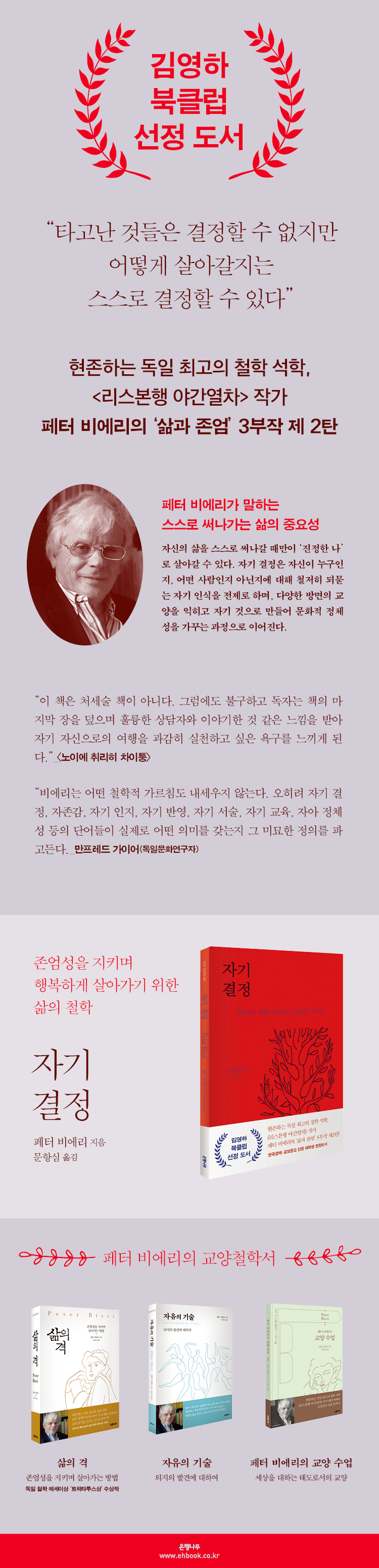
You can't decide what you're born with
You can decide for yourself how to live.
The greatest living German philosopher, author of "Night Train to Lisbon"
The second installment of Peter Bieri's 'Life and Dignity' trilogy!
“This book is not a book on how to live in the world.
Nevertheless, readers will leave the book with the feeling of having spoken with a great counselor and a desire to embark on a bold journey into self-awareness.”
_〈Neue Zurich Zeitung〉
How should we live to be happy? Peter Bieri, author of "Night Train to Lisbon" and one of Germany's greatest philosophers, answers this most fundamental question in philosophy.
The author, who received attention last year when the conflict between the upper and lower classes was a social issue in his book “The Class of Life: How to Live with Dignity” (hereafter “The Class of Life”), which talked about dignity as the most urgent value in life, talks about the philosophy of “self-determination” as a way of life to live happily while maintaining dignity through his new book “Self-Determination: A Happy and Dignified Life is a Life You Decide Yourself” (hereafter “Self-Determination”).
Only when we decide for ourselves how to live at every turning point in life, without being swept away by circumstances or swayed by others, can we truly be happy.
Based on a three-day lecture series titled "How to Live" given in Graz, Austria, the cultural capital of Europe in 2011, this book discusses, in an accessible and accessible manner, what a life of self-determination is, why self-awareness, a prerequisite for self-determination, is important, and how to build a cultural identity based on this.
This is the second installment of the trilogy on 'Life and Dignity' following 'The Rise of Life'. As it was written before 'The Rise of Life', which talks about the dignity we must protect, it can be an excellent guide to Peter Bieri's philosophy, which places 'dignity' as the highest value.
You can decide for yourself how to live.
The greatest living German philosopher, author of "Night Train to Lisbon"
The second installment of Peter Bieri's 'Life and Dignity' trilogy!
“This book is not a book on how to live in the world.
Nevertheless, readers will leave the book with the feeling of having spoken with a great counselor and a desire to embark on a bold journey into self-awareness.”
_〈Neue Zurich Zeitung〉
How should we live to be happy? Peter Bieri, author of "Night Train to Lisbon" and one of Germany's greatest philosophers, answers this most fundamental question in philosophy.
The author, who received attention last year when the conflict between the upper and lower classes was a social issue in his book “The Class of Life: How to Live with Dignity” (hereafter “The Class of Life”), which talked about dignity as the most urgent value in life, talks about the philosophy of “self-determination” as a way of life to live happily while maintaining dignity through his new book “Self-Determination: A Happy and Dignified Life is a Life You Decide Yourself” (hereafter “Self-Determination”).
Only when we decide for ourselves how to live at every turning point in life, without being swept away by circumstances or swayed by others, can we truly be happy.
Based on a three-day lecture series titled "How to Live" given in Graz, Austria, the cultural capital of Europe in 2011, this book discusses, in an accessible and accessible manner, what a life of self-determination is, why self-awareness, a prerequisite for self-determination, is important, and how to build a cultural identity based on this.
This is the second installment of the trilogy on 'Life and Dignity' following 'The Rise of Life'. As it was written before 'The Rise of Life', which talks about the dignity we must protect, it can be an excellent guide to Peter Bieri's philosophy, which places 'dignity' as the highest value.
- You can preview some of the book's contents.
Preview
index
Lecture 1 | What Does a Self-Determined Life Look Like? 7
Lecture 2 | Why Is Self-Awareness Important? 41
Lecture 3 | How is Cultural Identity Born? 71
Reference 99
Acknowledgments 107
Lecture 2 | Why Is Self-Awareness Important? 41
Lecture 3 | How is Cultural Identity Born? 71
Reference 99
Acknowledgments 107
Detailed image
Into the book
As I seek out evidence to confirm or deny what I once believed to be certain, I open the door to an internal process through which those convictions can be transformed.
If this process is repeated enough times, the sum total of my opinions will completely transform, resulting in a change in the identity of my thoughts.
That's why the process of clarifying what's important when faced with it is an act of self-determination.
Choosing a particular political party, joining a religion, or participating in an anti-abortion protest may be because it has been done in the family for generations.
Such a person has lived as a bystander to accidents.
Then, through critical questioning, we take a step back from our familiar thought patterns and, through a process of verification, find the mastery of our thoughts.
---From "What would a life of self-determination look like?"
In storytelling, the center of gravity is oneself.
That is to say, when I tell stories about my past experiences, the stories all revolve around me.
Such stories can never be considered as factual, neutral descriptions.
Because my story is selective, evaluative, and edited to fit my self-image.
So, talking about memories always includes an element of appropriate editing to make it coherent.
---From "What would a life of self-determination look like?"
If so, it is time to examine the truth and validity of the self-image we have had so far, which has been formed through habits, chance encounters, and the education we have received by chance.
And I need to take a closer look at the driving force within me that has been distorted and overshadowed by that self-image.
It's literally about setting out on a journey to find the path to self-awareness.
---From "Why is self-awareness important?"
A literary text is a linguistic expression that artistically represents an experience.
When writers invent fictional stories, they try to figure out how accurately they experience the world and themselves.
It may seem contradictory that we need fictional stories to express our real experiences.
Fiction allows for a condensed experience that rarely occurs in the flow of real experience.
Writing a fictional story can be said to be the work of creating a laboratory-like environment and using dramatic development to shine a particularly bright and vivid light on one aspect of a chaotic inner world.
When you look at it this way, the act of creating another person to understand yourself no longer seems like a contradiction.
---From "Why is self-awareness important?"
A culture is not made up of language and ideas alone.
Culture is also about how humans relate to themselves and to others, and how they experience these relationships.
We spend most of our lives being looked at by others, and who we are is tied to how we experience and respond to this gaze.
Cultural identity is determined by how we feel about intimacy and distance from others, that is, how we think about intimacy and strangeness.
---From "How is cultural identity formed?"
Becoming educated is like waking up from sleep.
The cultural structures I mentioned at the beginning of this article are the ones that come upon us accidentally when we first begin our lives, influencing us and leaving deep marks on us before we have time to reject or do anything about them.
We walk around in it like sleepwalkers.
Move quietly and unobtrusively toward your destination, without any three-dimensionality of emotion or thought, without any reactive distance or awareness of alternatives.
But as we go through the process and stages of acquisition mentioned above, we begin to wake up little by little.
Once you learn to speak the grammar of your given culture and understand it in a larger context, you will see that culture as one of many possibilities.
If this process is repeated enough times, the sum total of my opinions will completely transform, resulting in a change in the identity of my thoughts.
That's why the process of clarifying what's important when faced with it is an act of self-determination.
Choosing a particular political party, joining a religion, or participating in an anti-abortion protest may be because it has been done in the family for generations.
Such a person has lived as a bystander to accidents.
Then, through critical questioning, we take a step back from our familiar thought patterns and, through a process of verification, find the mastery of our thoughts.
---From "What would a life of self-determination look like?"
In storytelling, the center of gravity is oneself.
That is to say, when I tell stories about my past experiences, the stories all revolve around me.
Such stories can never be considered as factual, neutral descriptions.
Because my story is selective, evaluative, and edited to fit my self-image.
So, talking about memories always includes an element of appropriate editing to make it coherent.
---From "What would a life of self-determination look like?"
If so, it is time to examine the truth and validity of the self-image we have had so far, which has been formed through habits, chance encounters, and the education we have received by chance.
And I need to take a closer look at the driving force within me that has been distorted and overshadowed by that self-image.
It's literally about setting out on a journey to find the path to self-awareness.
---From "Why is self-awareness important?"
A literary text is a linguistic expression that artistically represents an experience.
When writers invent fictional stories, they try to figure out how accurately they experience the world and themselves.
It may seem contradictory that we need fictional stories to express our real experiences.
Fiction allows for a condensed experience that rarely occurs in the flow of real experience.
Writing a fictional story can be said to be the work of creating a laboratory-like environment and using dramatic development to shine a particularly bright and vivid light on one aspect of a chaotic inner world.
When you look at it this way, the act of creating another person to understand yourself no longer seems like a contradiction.
---From "Why is self-awareness important?"
A culture is not made up of language and ideas alone.
Culture is also about how humans relate to themselves and to others, and how they experience these relationships.
We spend most of our lives being looked at by others, and who we are is tied to how we experience and respond to this gaze.
Cultural identity is determined by how we feel about intimacy and distance from others, that is, how we think about intimacy and strangeness.
---From "How is cultural identity formed?"
Becoming educated is like waking up from sleep.
The cultural structures I mentioned at the beginning of this article are the ones that come upon us accidentally when we first begin our lives, influencing us and leaving deep marks on us before we have time to reject or do anything about them.
We walk around in it like sleepwalkers.
Move quietly and unobtrusively toward your destination, without any three-dimensionality of emotion or thought, without any reactive distance or awareness of alternatives.
But as we go through the process and stages of acquisition mentioned above, we begin to wake up little by little.
Once you learn to speak the grammar of your given culture and understand it in a larger context, you will see that culture as one of many possibilities.
---From "How is cultural identity formed?"
Publisher's Review
You can't decide what you're born with
You can decide for yourself how to live.
The greatest living German philosopher, author of "Night Train to Lisbon"
The second installment of Peter Bieri's 'Life and Dignity' trilogy!
“This book is not a book on how to live in the world.
Nevertheless, readers will leave the book with the feeling of having spoken with a great counselor and will be inspired to embark on a bold journey into self-awareness.”
_〈Neue Zurich Zeitung〉
How should we live to be happy? Peter Bieri, author of "Night Train to Lisbon" and one of Germany's greatest philosophers, answers this most fundamental question in philosophy.
The author, who received attention last year when the conflict between the upper and lower classes was a social issue in his book “The Class of Life: How to Live with Dignity” (hereafter “The Class of Life”), which talked about dignity as the most urgent value in life, talks about the philosophy of “self-determination” as a way of life to live happily while maintaining dignity through his new book “Self-Determination: A Happy and Dignified Life is a Life You Decide Yourself” (hereafter “Self-Determination”).
Only when we decide for ourselves how to live at every turning point in life, without being swept away by circumstances or swayed by others, can we truly be happy.
Based on a three-day lecture series titled "How to Live" given in Graz, Austria, the cultural capital of Europe in 2011, this book discusses, in an accessible and accessible manner, what a life of self-determination is, why self-awareness, a prerequisite for self-determination, is important, and how to build a cultural identity based on this.
This is the second installment of the trilogy on 'Life and Dignity' following 'The Rise of Life'. As it was written before 'The Rise of Life', which talks about the dignity we must protect, it can be an excellent guide to Peter Bieri's philosophy, which places 'dignity' as the highest value.
A must-have for those who want to hold the key in the storms of life.
A three-day special lecture in Graz, Austria, the cultural capital of Europe.
Are our lives our own decisions? According to "Self-Determination," the happiest life is a life of "self-determination," where we live solely based on ourselves, unconstrained by others or external circumstances. But what kind of lives are we actually living? To answer this question, we must examine what we truly desire, whether our likes and dislikes, political beliefs, and other thoughts that shape our true selves, or whether these are simply thoughts and preferences we've developed from the sway of others.
If you look at your own life without the gaze of others, you will realize that you have been living according to the thoughts of others or the values instilled in you by popular culture without even realizing it.
These influences dominate our lives much more subtly and viciously than direct manipulation.
We must not be consumed by external influences, but must become the masters of our own thoughts and lives.
What we absolutely need at this time is cool-headed self-awareness.
You must objectively and clearly face what kind of person you are, and further, what kind of person you are not.
It is about removing the gaze of others and social pressure and discovering your true self through your own eyes.
A life of self-determination, born of self-awareness, leads to the process of cultivating cultural identity.
Citing authors like Vladimir Nabokov, who was born in Russia but wrote in English, and Samuel Beckett, an Irishman who wrote in French, the author argues that we can build our cultural identity by deciding for ourselves which of the various cultural experiences we encounter throughout our lives to internalize.
At this time, culture becomes a way of life, and that culture is literature, art, thought, and the humanities that will contribute to one's values in life.
Live life as its master, not as a bystander.
Only when you write your own life can you live as your true self.
As a novelist who has written several novels under the pen name 'Pascal Mercier', Peter Bieri considers literature as a necessary tool for a life of self-determination.
Quoting Max Frisch, “He who does not write does not even know what he is not,” he talks about how one can accurately recognize oneself through writing, which expresses one’s life in words.
In addition, if you write literary works, you can discover what kind of person you are not and what kind of person you are by creating a character different from yourself.
Literature has a profound impact on our self-determined lives, not only when we produce it but also when we enjoy it.
Through narrative texts like literature and film, we can reflect on the actions and lives of characters, and the decisions behind them, and ask ourselves, "What would I do?" and use this as a basis for our own decisions.
We have literature.
How can literature help us? What role do reading and writing play in developing self-determination?
Reading literature opens up a spectrum of possibilities in terms of thinking.
It makes you realize how different the way people lead their lives can be.
Before reading a literary work, my imagination has expanded to encompass points I hadn't even considered before.
We can now imagine more diverse life paths and discover more diverse careers, social identities, and relationships.
Not only that, our ability to empathize with the inner perspective of a life grows.
We learn a lot about the successes, failures, and development of our spiritual identities.
And you can see what constitutes self-determination, and how you fail when you fail.
Deepening our understanding of how these phenomena arise through reading literature has crucial implications for those seeking self-determination, questioning what is important to them, and the kind of person they want to become.
_From Chapter 1, “What is a life of self-determination?”
When reading "Self-Determination," one might misinterpret it as suggesting that we should cut ourselves off from others by not being swayed by the gaze or words of others.
Of course, we can willingly act for the benefit or convenience of others.
But at this time, your own decision must be at the center of that action.
Because I feel close to that person and have affection for him, I help that person and sacrifice for him.
Ultimately, a life of self-determination can also impact my relationships with others.
Therefore, the philosophy that Peter Bieri talks about in “Self-Determination” can serve as a compass for us who live stressed by the gaze of others, such as being obsessively concerned about shame or wanting to be recognized by others while associating with people who think differently.
Who I am, what kind of relationships I will have with others, what tastes and identities I will have, what beliefs I will act according to… … In a life of self-determination, we can become true masters of our own lives.
We can't decide things we are born with, like our appearance or our family background, but we can decide how we will live from now on.
You can decide for yourself how to live.
The greatest living German philosopher, author of "Night Train to Lisbon"
The second installment of Peter Bieri's 'Life and Dignity' trilogy!
“This book is not a book on how to live in the world.
Nevertheless, readers will leave the book with the feeling of having spoken with a great counselor and will be inspired to embark on a bold journey into self-awareness.”
_〈Neue Zurich Zeitung〉
How should we live to be happy? Peter Bieri, author of "Night Train to Lisbon" and one of Germany's greatest philosophers, answers this most fundamental question in philosophy.
The author, who received attention last year when the conflict between the upper and lower classes was a social issue in his book “The Class of Life: How to Live with Dignity” (hereafter “The Class of Life”), which talked about dignity as the most urgent value in life, talks about the philosophy of “self-determination” as a way of life to live happily while maintaining dignity through his new book “Self-Determination: A Happy and Dignified Life is a Life You Decide Yourself” (hereafter “Self-Determination”).
Only when we decide for ourselves how to live at every turning point in life, without being swept away by circumstances or swayed by others, can we truly be happy.
Based on a three-day lecture series titled "How to Live" given in Graz, Austria, the cultural capital of Europe in 2011, this book discusses, in an accessible and accessible manner, what a life of self-determination is, why self-awareness, a prerequisite for self-determination, is important, and how to build a cultural identity based on this.
This is the second installment of the trilogy on 'Life and Dignity' following 'The Rise of Life'. As it was written before 'The Rise of Life', which talks about the dignity we must protect, it can be an excellent guide to Peter Bieri's philosophy, which places 'dignity' as the highest value.
A must-have for those who want to hold the key in the storms of life.
A three-day special lecture in Graz, Austria, the cultural capital of Europe.
Are our lives our own decisions? According to "Self-Determination," the happiest life is a life of "self-determination," where we live solely based on ourselves, unconstrained by others or external circumstances. But what kind of lives are we actually living? To answer this question, we must examine what we truly desire, whether our likes and dislikes, political beliefs, and other thoughts that shape our true selves, or whether these are simply thoughts and preferences we've developed from the sway of others.
If you look at your own life without the gaze of others, you will realize that you have been living according to the thoughts of others or the values instilled in you by popular culture without even realizing it.
These influences dominate our lives much more subtly and viciously than direct manipulation.
We must not be consumed by external influences, but must become the masters of our own thoughts and lives.
What we absolutely need at this time is cool-headed self-awareness.
You must objectively and clearly face what kind of person you are, and further, what kind of person you are not.
It is about removing the gaze of others and social pressure and discovering your true self through your own eyes.
A life of self-determination, born of self-awareness, leads to the process of cultivating cultural identity.
Citing authors like Vladimir Nabokov, who was born in Russia but wrote in English, and Samuel Beckett, an Irishman who wrote in French, the author argues that we can build our cultural identity by deciding for ourselves which of the various cultural experiences we encounter throughout our lives to internalize.
At this time, culture becomes a way of life, and that culture is literature, art, thought, and the humanities that will contribute to one's values in life.
Live life as its master, not as a bystander.
Only when you write your own life can you live as your true self.
As a novelist who has written several novels under the pen name 'Pascal Mercier', Peter Bieri considers literature as a necessary tool for a life of self-determination.
Quoting Max Frisch, “He who does not write does not even know what he is not,” he talks about how one can accurately recognize oneself through writing, which expresses one’s life in words.
In addition, if you write literary works, you can discover what kind of person you are not and what kind of person you are by creating a character different from yourself.
Literature has a profound impact on our self-determined lives, not only when we produce it but also when we enjoy it.
Through narrative texts like literature and film, we can reflect on the actions and lives of characters, and the decisions behind them, and ask ourselves, "What would I do?" and use this as a basis for our own decisions.
We have literature.
How can literature help us? What role do reading and writing play in developing self-determination?
Reading literature opens up a spectrum of possibilities in terms of thinking.
It makes you realize how different the way people lead their lives can be.
Before reading a literary work, my imagination has expanded to encompass points I hadn't even considered before.
We can now imagine more diverse life paths and discover more diverse careers, social identities, and relationships.
Not only that, our ability to empathize with the inner perspective of a life grows.
We learn a lot about the successes, failures, and development of our spiritual identities.
And you can see what constitutes self-determination, and how you fail when you fail.
Deepening our understanding of how these phenomena arise through reading literature has crucial implications for those seeking self-determination, questioning what is important to them, and the kind of person they want to become.
_From Chapter 1, “What is a life of self-determination?”
When reading "Self-Determination," one might misinterpret it as suggesting that we should cut ourselves off from others by not being swayed by the gaze or words of others.
Of course, we can willingly act for the benefit or convenience of others.
But at this time, your own decision must be at the center of that action.
Because I feel close to that person and have affection for him, I help that person and sacrifice for him.
Ultimately, a life of self-determination can also impact my relationships with others.
Therefore, the philosophy that Peter Bieri talks about in “Self-Determination” can serve as a compass for us who live stressed by the gaze of others, such as being obsessively concerned about shame or wanting to be recognized by others while associating with people who think differently.
Who I am, what kind of relationships I will have with others, what tastes and identities I will have, what beliefs I will act according to… … In a life of self-determination, we can become true masters of our own lives.
We can't decide things we are born with, like our appearance or our family background, but we can decide how we will live from now on.
GOODS SPECIFICS
- Date of publication: September 21, 2015
- Page count, weight, size: 108 pages | 240g | 147*216*20mm
- ISBN13: 9788956609249
- ISBN10: 8956609241
You may also like
카테고리
korean


korean

![GQ KOREA Mark (Monthly): December [2025]](http://librairie.coreenne.fr/cdn/shop/files/8ef265dbbfbf186523ed75ba7319009d.jpg?v=1765340328&width=3840)


