

When the bomber's moon rises
 |
Description
Book Introduction
★KBS Radio's "Small Bookstore" Recommends "Jang Kang-myeong's Book of Life" (250704)★
"I had so much fun reading it.
"It would be unfair for a nonfiction writer to write like this."
"I was sucked in and read it." _ Authors Jang Kang-myeong and Kim Ji-yoon
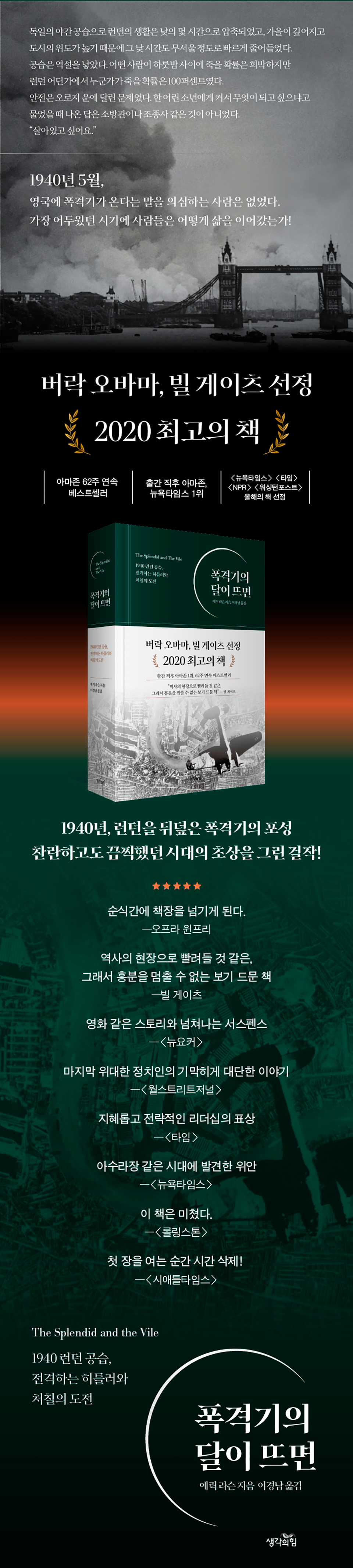
Barack Obama and Bill Gates Name Best Books of 2020
A masterpiece depicting the brilliant and terrifying times of 1940-1941!
May 1940.
It covers the first year since Churchill was appointed Prime Minister.
At the beginning of World War II, Britain was under German air raids and was in a precarious situation where it was impossible to predict what would happen next.
"When the Bomber Moon Rises: The 1940 London Blitz, Hitler's Blitzkrieg and Churchill's Challenge" is a book that vividly and meticulously describes the political situation both inside and outside Britain from May 1940, when Winston Churchill became Prime Minister, to 1941.
Images of fierce battles between the British Royal Air Force (RAF) and the German Luftwaffe, bombed-out cities, and the constant sound of air raid sirens and gunfire overwhelm the reader.
The 'forgotten' stories of British citizens who feared being targeted by bombs even in the faint moonlight are also compelling.
Another fascinating aspect of this book is examining how the tide of war changed according to the perspectives and strategies of British, German, and American leaders.
"I had so much fun reading it.
"It would be unfair for a nonfiction writer to write like this."
"I was sucked in and read it." _ Authors Jang Kang-myeong and Kim Ji-yoon
Barack Obama and Bill Gates Name Best Books of 2020
A masterpiece depicting the brilliant and terrifying times of 1940-1941!
May 1940.
It covers the first year since Churchill was appointed Prime Minister.
At the beginning of World War II, Britain was under German air raids and was in a precarious situation where it was impossible to predict what would happen next.
"When the Bomber Moon Rises: The 1940 London Blitz, Hitler's Blitzkrieg and Churchill's Challenge" is a book that vividly and meticulously describes the political situation both inside and outside Britain from May 1940, when Winston Churchill became Prime Minister, to 1941.
Images of fierce battles between the British Royal Air Force (RAF) and the German Luftwaffe, bombed-out cities, and the constant sound of air raid sirens and gunfire overwhelm the reader.
The 'forgotten' stories of British citizens who feared being targeted by bombs even in the faint moonlight are also compelling.
Another fascinating aspect of this book is examining how the tide of war changed according to the perspectives and strategies of British, German, and American leaders.
- You can preview some of the book's contents.
Preview
index
A word to our readers
A cold prediction
1940
Part 1.
Emerging threats
Part 2.
What a coincidence
Part 3.
awe
Part 4.
Blood and Dust
1941
Part 5.
Americans
Part 6.
Love in the Flames
Part 7.
The day when you turn one year old
Conclusion: Time goes by
Acknowledgements
Americas
References
Search
A cold prediction
1940
Part 1.
Emerging threats
Part 2.
What a coincidence
Part 3.
awe
Part 4.
Blood and Dust
1941
Part 5.
Americans
Part 6.
Love in the Flames
Part 7.
The day when you turn one year old
Conclusion: Time goes by
Acknowledgements
Americas
References
Search
Detailed image
Into the book
People suddenly became interested in the phases of the moon.
Of course, the bombers attacked during the day, but people thought they could find their targets after dark by moonlight.
A convex moon, such as a full moon, a quarter moon, or a waning quarter moon, is called a 'bomber' moon.
---From "Cruel Predictions"
Churchill delivered the same message in his first speech to the House of Commons on Monday, May 13th.
Although he was so confident in his victory, he was also a realist who knew better than anyone the harsh terrain Britain currently faced.
In particular, he clearly revealed such a situation in one word.
“I have nothing to offer but blood, toil, tears, and sweat.”
---From "Chapter 4: The Electric Shock Effect"
As his speech drew to a close, he lit a fire in the brazier.
“We will fight to the end.” His words grew fiercer and more confident.
“We will fight in France, we will fight on the seas and oceans.
The more we fight, the more confident we will become, the more powerful we will become in the air, and we will defend our island at all costs.
We will fight on the shore.
We will fight on the landing ground.
We will fight in the fields and in the streets.
We will fight on the hill.
We will never surrender.”
As the House of Commons roared in approval, Churchill muttered to a neighbouring MP:
“And… we will pick up broken bottles and fight.
“Because that’s all I have.”
---From "Chapter 8, The First Bomb"
It was Adlertag, the 'Eagle Day' that Hermann Goering had been waiting for.
He ordered a general attack on the RAF to secure air superiority over Britain before invading Britain as planned by Hitler.
Last week the Luftwaffe had launched small-scale bombardments of radar stations along the British coast, but now it was time for a full-scale battle.
Goering was determined to astonish the world by displaying his air power, blackening the skies with aircraft.
For this purpose, he mobilized a total of 2,300 aircraft, including 949 bombers, 336 dive bombers, and 1,002 fighters.
The opportunity had finally arrived to demonstrate to Hitler and the world the might of his air force.
---From "Chapter 29: The Eagle's Day"
“That night was cloudless and starry, and the moon was high over Westminster.
There could be no more beautiful sight than this.
The glare of searchlights crossing somewhere on the horizon, the star-like flashes of shells exploding in the sky, the brilliance of fires burning in the distance—all these things added to the scene.
It was magnificent yet terrifying.
Overhead, the drone of enemy aircraft continued incessantly, and the crackle of cannons could be heard, sometimes far away, sometimes close by.
Each time the cannon fired, the light flashed like the signal lights of an electric train in peaceful times.
Countless stars twinkled in the sky.
There were real stars and artificial stars.
“Never before has the contrast between the splendor of nature and the wickedness of man been so striking.”
---From "Chapter 49: Fear"
As winter approached, the immediate threat of invasion diminished, but no one doubted that this was only a temporary lull.
And now another, indefinable danger has taken its place.
The issue of morale came to the fore as the Luftwaffe expanded its offensive and attempted to replicate the Coventry raids against other British cities.
London had proven its ability to recover and, being a large city, was somewhat immune to the Luftwaffe's new scorched-earth tactics.
But as more and more cities experience 'coventration,' will they be able to prove their resilience?
---From "Chapter 64: The Toad at the Door"
It was an unofficial Christmas truce.
“It is truly a holy night in silent night,” wrote John Martin.
“I felt relieved and a little moved.” Neither Germany nor Britain had been bombed, and in every home people remembered what life had once been like.
The only difference was that the church bells were not ringing and there were many empty seats at the tables.
---From "Chapter 67 Christmas"
John Colville, seeing Churchill's outburst over confidentiality, became concerned about his own diary.
His diary was filled with operational secrets and insights into Churchill's actions.
If a German agent were to stumble upon that diary, it would be a great trophy.
Colville knew very well that recording so accurately was very likely illegal.
“The PM distributed a statement regarding the issue of maintaining the confidentiality of records.
“Suddenly, my diary was pricked,” Colville wrote in his diary on New Year’s Day.
“But I have no intention of scrapping it.
“We’ll just have to compromise and enforce it a little more thoroughly.”
---From "Chapter 70 Secrets"
No one in the club heard the explosion.
But everyone saw it and felt it in their bodies.
There was a flash of light.
It was a peculiar flash, a blue flash.
Then a suffocating cloud of dust rose, the smell of gunpowder filled the air, and it became pitch black.
The body of a saxophonist named David Williams was split in two.
One of the Dutch officers who came with Betty Baldwin lost a finger.
Six guests at one table died while still seated, without any signs of trauma.
Charles, the head waiter, was thrown from the balcony to the floor.
I was resting against the pillar on the opposite side when I got hit.
And so he died.
One young woman had her stockings torn by the explosion, but otherwise suffered no other injuries.
Vera Lumley-Kelly, trying to call her mother from a payphone, calmly pressed the button marked 'B'.
The coin came out on the road.
It was quiet at first.
Then came faint sounds here and there, and the sound of debris scattering as survivors moved.
Powdered plaster filled the air and people's hair turned white.
His face was blackened with gunpowder.
---From "Chapter 79 Snake Hips"
The cabinet meeting was heavy with emotion.
With the loss of Benghazi and the imminent fall of Tobruk, everyone was in despair.
A gloomy mood hung over England.
The disappointment was even greater because the result was completely contrary to the hopes of a win in the winter.
Intensified German air raids also fueled this atmosphere.
Some of the raids were more deadly and devastating than those of the previous fall.
German bombers attacked Coventry again and the next night they struck Birmingham.
Darkness continued to frustrate the RAF.
---From "Chapter 84 Major News"
It was midnight when I returned to Checkers.
He was already tired and sad, but now he heard more bad news.
News arrived that a valuable Royal Navy destroyer had sunk off Malta, blocking the entrance to Grand Harbour.
A transport ship carrying tanks to the Middle East was grounded due to engine failure, and British troops attacking Iraq were struggling against unexpectedly strong resistance from the Iraqi army.
Most disheartening of all was President Roosevelt's long and disappointing telegram, which seemed to downplay the importance of defending the Middle East.
“Personally, I am not particularly discouraged by Germany’s expansion of her power to expand her territory,” Roosevelt wrote.
“All those areas combined would be difficult to obtain the raw materials necessary to maintain or supplement a large occupying force,” Roosevelt added, ignorantly.
“I wish you continued success.”
---From "Chapter 90: Depression"
It was just before 11 p.m. when the first bombers crossed the skies over Britain.
This first sortie was made by 20 bombers, following the elite KGr 100 squadron, but given the bright moon and clear sky that night, the signal fires they made were almost unnecessary decoration.
They were followed by hundreds of bombers.
Officially, as in previous raids, their targets were military strongholds such as Victoria and West India Docks and Battersea Power Station, but the pilots knew that if these were the targets, then every civilian area in London would be in for a bombing.
Whether planned or not, the type of damage suggests that the Luftwaffe was determined to destroy some of London's most venerable treasures and thus stifle Churchill and his government.
---From "Chapter 98: A Brutal Air Raid"
Of course, the war would continue for another four years, and by then there was no prospect of an easy way out of the darkness.
With Singapore, Britain's bastion in the Far East, falling into enemy hands, even Japan threatened to topple Churchill's government.
German forces drove the British out of Crete and recaptured Tobruk.
“We are truly walking through the valley of humiliation,” Clementine wrote to Harry Hopkins.
Although twists and turns followed, the tide began to turn in favor of the Allies from late 1942 onwards.
British forces defeated Rommel in a series of desert battles known as the Battle of El Alamein.
The US Navy defeated Japan at Midway.
Hitler's campaign in Russia was stuck in mud, ice, and bloodshed.
After the Allied forces advanced into Italy and France in 1944, the outcome seemed certain.
The air war against Britain was briefly revived in 1944 by the introduction of the V-1 drone bombs and Hitler's "revenge" weapon, the V-2 rocket, but this was Germany's last offensive, a desperate attempt to avoid inevitable defeat and with no other purpose than to join in the fight.
Of course, the bombers attacked during the day, but people thought they could find their targets after dark by moonlight.
A convex moon, such as a full moon, a quarter moon, or a waning quarter moon, is called a 'bomber' moon.
---From "Cruel Predictions"
Churchill delivered the same message in his first speech to the House of Commons on Monday, May 13th.
Although he was so confident in his victory, he was also a realist who knew better than anyone the harsh terrain Britain currently faced.
In particular, he clearly revealed such a situation in one word.
“I have nothing to offer but blood, toil, tears, and sweat.”
---From "Chapter 4: The Electric Shock Effect"
As his speech drew to a close, he lit a fire in the brazier.
“We will fight to the end.” His words grew fiercer and more confident.
“We will fight in France, we will fight on the seas and oceans.
The more we fight, the more confident we will become, the more powerful we will become in the air, and we will defend our island at all costs.
We will fight on the shore.
We will fight on the landing ground.
We will fight in the fields and in the streets.
We will fight on the hill.
We will never surrender.”
As the House of Commons roared in approval, Churchill muttered to a neighbouring MP:
“And… we will pick up broken bottles and fight.
“Because that’s all I have.”
---From "Chapter 8, The First Bomb"
It was Adlertag, the 'Eagle Day' that Hermann Goering had been waiting for.
He ordered a general attack on the RAF to secure air superiority over Britain before invading Britain as planned by Hitler.
Last week the Luftwaffe had launched small-scale bombardments of radar stations along the British coast, but now it was time for a full-scale battle.
Goering was determined to astonish the world by displaying his air power, blackening the skies with aircraft.
For this purpose, he mobilized a total of 2,300 aircraft, including 949 bombers, 336 dive bombers, and 1,002 fighters.
The opportunity had finally arrived to demonstrate to Hitler and the world the might of his air force.
---From "Chapter 29: The Eagle's Day"
“That night was cloudless and starry, and the moon was high over Westminster.
There could be no more beautiful sight than this.
The glare of searchlights crossing somewhere on the horizon, the star-like flashes of shells exploding in the sky, the brilliance of fires burning in the distance—all these things added to the scene.
It was magnificent yet terrifying.
Overhead, the drone of enemy aircraft continued incessantly, and the crackle of cannons could be heard, sometimes far away, sometimes close by.
Each time the cannon fired, the light flashed like the signal lights of an electric train in peaceful times.
Countless stars twinkled in the sky.
There were real stars and artificial stars.
“Never before has the contrast between the splendor of nature and the wickedness of man been so striking.”
---From "Chapter 49: Fear"
As winter approached, the immediate threat of invasion diminished, but no one doubted that this was only a temporary lull.
And now another, indefinable danger has taken its place.
The issue of morale came to the fore as the Luftwaffe expanded its offensive and attempted to replicate the Coventry raids against other British cities.
London had proven its ability to recover and, being a large city, was somewhat immune to the Luftwaffe's new scorched-earth tactics.
But as more and more cities experience 'coventration,' will they be able to prove their resilience?
---From "Chapter 64: The Toad at the Door"
It was an unofficial Christmas truce.
“It is truly a holy night in silent night,” wrote John Martin.
“I felt relieved and a little moved.” Neither Germany nor Britain had been bombed, and in every home people remembered what life had once been like.
The only difference was that the church bells were not ringing and there were many empty seats at the tables.
---From "Chapter 67 Christmas"
John Colville, seeing Churchill's outburst over confidentiality, became concerned about his own diary.
His diary was filled with operational secrets and insights into Churchill's actions.
If a German agent were to stumble upon that diary, it would be a great trophy.
Colville knew very well that recording so accurately was very likely illegal.
“The PM distributed a statement regarding the issue of maintaining the confidentiality of records.
“Suddenly, my diary was pricked,” Colville wrote in his diary on New Year’s Day.
“But I have no intention of scrapping it.
“We’ll just have to compromise and enforce it a little more thoroughly.”
---From "Chapter 70 Secrets"
No one in the club heard the explosion.
But everyone saw it and felt it in their bodies.
There was a flash of light.
It was a peculiar flash, a blue flash.
Then a suffocating cloud of dust rose, the smell of gunpowder filled the air, and it became pitch black.
The body of a saxophonist named David Williams was split in two.
One of the Dutch officers who came with Betty Baldwin lost a finger.
Six guests at one table died while still seated, without any signs of trauma.
Charles, the head waiter, was thrown from the balcony to the floor.
I was resting against the pillar on the opposite side when I got hit.
And so he died.
One young woman had her stockings torn by the explosion, but otherwise suffered no other injuries.
Vera Lumley-Kelly, trying to call her mother from a payphone, calmly pressed the button marked 'B'.
The coin came out on the road.
It was quiet at first.
Then came faint sounds here and there, and the sound of debris scattering as survivors moved.
Powdered plaster filled the air and people's hair turned white.
His face was blackened with gunpowder.
---From "Chapter 79 Snake Hips"
The cabinet meeting was heavy with emotion.
With the loss of Benghazi and the imminent fall of Tobruk, everyone was in despair.
A gloomy mood hung over England.
The disappointment was even greater because the result was completely contrary to the hopes of a win in the winter.
Intensified German air raids also fueled this atmosphere.
Some of the raids were more deadly and devastating than those of the previous fall.
German bombers attacked Coventry again and the next night they struck Birmingham.
Darkness continued to frustrate the RAF.
---From "Chapter 84 Major News"
It was midnight when I returned to Checkers.
He was already tired and sad, but now he heard more bad news.
News arrived that a valuable Royal Navy destroyer had sunk off Malta, blocking the entrance to Grand Harbour.
A transport ship carrying tanks to the Middle East was grounded due to engine failure, and British troops attacking Iraq were struggling against unexpectedly strong resistance from the Iraqi army.
Most disheartening of all was President Roosevelt's long and disappointing telegram, which seemed to downplay the importance of defending the Middle East.
“Personally, I am not particularly discouraged by Germany’s expansion of her power to expand her territory,” Roosevelt wrote.
“All those areas combined would be difficult to obtain the raw materials necessary to maintain or supplement a large occupying force,” Roosevelt added, ignorantly.
“I wish you continued success.”
---From "Chapter 90: Depression"
It was just before 11 p.m. when the first bombers crossed the skies over Britain.
This first sortie was made by 20 bombers, following the elite KGr 100 squadron, but given the bright moon and clear sky that night, the signal fires they made were almost unnecessary decoration.
They were followed by hundreds of bombers.
Officially, as in previous raids, their targets were military strongholds such as Victoria and West India Docks and Battersea Power Station, but the pilots knew that if these were the targets, then every civilian area in London would be in for a bombing.
Whether planned or not, the type of damage suggests that the Luftwaffe was determined to destroy some of London's most venerable treasures and thus stifle Churchill and his government.
---From "Chapter 98: A Brutal Air Raid"
Of course, the war would continue for another four years, and by then there was no prospect of an easy way out of the darkness.
With Singapore, Britain's bastion in the Far East, falling into enemy hands, even Japan threatened to topple Churchill's government.
German forces drove the British out of Crete and recaptured Tobruk.
“We are truly walking through the valley of humiliation,” Clementine wrote to Harry Hopkins.
Although twists and turns followed, the tide began to turn in favor of the Allies from late 1942 onwards.
British forces defeated Rommel in a series of desert battles known as the Battle of El Alamein.
The US Navy defeated Japan at Midway.
Hitler's campaign in Russia was stuck in mud, ice, and bloodshed.
After the Allied forces advanced into Italy and France in 1944, the outcome seemed certain.
The air war against Britain was briefly revived in 1944 by the introduction of the V-1 drone bombs and Hitler's "revenge" weapon, the V-2 rocket, but this was Germany's last offensive, a desperate attempt to avoid inevitable defeat and with no other purpose than to join in the fight.
---From "101 Checkers Weekend"
Publisher's Review
In May 1940, no one doubted that bombers were coming to Britain.
How did people survive in the darkest of times?
*Barack Obama and Bill Gates' 2020 Book of the Year
*Ranked #1 on Amazon and New York Times immediately after publication
*Amazon bestseller for 62 consecutive weeks
*Selected as a Book of the Year by [New York Times] [Time] [NPR] [Washington Post] [Fortune] [Bloomberg] [Kirkus], etc.!
*A masterpiece that has received rave reviews from leading international media outlets!
“You’ll be flipping through the pages in no time.” -Oprah Winfrey
“A rare book that draws you into the historical moment, so exciting you can’t stop.” - Bill Gates
"A cinematic story and overflowing suspense" - [The New Yorker]
"The breathtakingly remarkable story of the last great statesman." - [Wall Street Journal]
"A symbol of wise and strategic leadership" - [Time]
"Solace Found in a Time of Chaos" - [New York Times]
“This book is crazy.” -[Rolling Stone]
"Time is erased the moment you open the first page!" - [Seattle Times]
The sound of bombers covering London in 1940
A masterpiece depicting a brilliant yet terrifying era
"When the Bomber Moon Rises: The 1940 London Blitz, Hitler's Blitzkrieg and Churchill's Challenge" is a book that vividly and meticulously describes the political situation both inside and outside Britain from May 1940, when Winston Churchill became Prime Minister, to 1941.
Author Eric Larson has sold over 10 million copies of his previous work, The White City, as well as Isaac's Storm, Dead Wake, and In the Garden of Beasts, making him a world-renowned bestselling author.
Eric Larson, who became curious about 'wartime London (England) and its citizens and leaders' in the wake of the 9/11 terrorist attacks, researched materials from numerous archives, including the British National Archives, the Churchill Archive, and the manuscript section of the Library of Congress, to create a novel interpretation of that era.
This book is a 'never-before-seen', 'completely new' history book written from a special perspective.
Even during World War II, the most horrific and disastrous war in human history, the people living during that time had a fantasy of daily life and a future they could look forward to.
In "When the Bomber Moon Rises," Eric Larson skillfully unfolds the secret, private stories of survival amidst the vain violence.
The challenge of Hitler and Churchill…
And Roosevelt
In 1940, the situation surrounding Britain was unsettling.
On Winston Churchill's first day as Prime Minister, Adolf Hitler invaded the Netherlands and Belgium, and Poland and Slovakia had already collapsed.
In this situation, Churchill had to instill confidence in Britain and Whitehall that Britain would ultimately prevail under his leadership, even if all objective indicators pointed to him having no 'chance'.
The challenge Churchill faced was to convince the British people, their ministers, their commanders, and, above all, U.S. President Franklin Roosevelt, to believe in him.
Churchill understood the nature of the forces at play in this war, namely that the only way Britain could completely eradicate Germany was by borrowing American industrial and military power.
In this book, the author meticulously captures Churchill's unique leadership and the points at which it manifests itself through the words and records of those around him.
Another fascinating aspect of this book is examining how the tide of war shifted according to the perspectives and strategies of British, German, and American leaders.
Hitler believed that even Churchill would admit that it was foolish to continue opposing him.
To Hitler, the Western Front was virtually over.
“Britain has no hope,” Hitler told his Army Chief of Staff, Franz Halder.
“We won the war.
“It is impossible to reverse this.” Hitler was so confident that Britain would negotiate that he disbanded 40 divisions of the Wehrmacht, representing 25 percent of his army.
But Churchill did not act like a man in his right mind.
Hitler made several indirect peace overtures to gauge their intentions, including through the Swedish king and the Vatican, but all were rejected or ignored.
Hitler, unwilling to miss any clue to a peace agreement, instructed Luftwaffe chief Hermann Göring not to touch any civilian areas of London.
Invasion was a painful and unpleasant undertaking, and even if there were good reasons for it, it was a matter of great caution.
(Page 180)
The assumption that Britain would hold out against German air raids until the United States entered the war was based on the assumption that France, with its powerful army, navy, and Maginot Line, would tie down the Luftwaffe and block all German invasion routes.
But less than two weeks after Churchill became prime minister, the French army was crushed by German panzers, and Britain's strategy was thrown into turmoil.
Britain had to bring the scale of Germany's attack down to a reasonable level while at the same time securing the necessary resources and inducing the United States to enter the war.
In a desperate situation that could have led to defeatism, Britain, with the help of Churchill as its driving force, began to unleash new energy.
Churchill established a new aircraft production department and focused his energies on fighter production, crew training, and defense of aircraft factories.
June 1940 was the beginning of the relentless Battle of Britain, where, faced with German air raids, they had to endure indiscriminate bombings that fell almost every night, seemingly without end.
The war proceeds in a direction that the reader is well aware of.
But behind the devastation of damage and death, there were lives of people who showed resourcefulness and courage and survived those terrible days.
This book exploits those gaps and reveals scenes you never knew existed.
The night the bomber's moon rises
Stories that are easy to forget
London was darkened as blackouts began in preparation for night bombing.
Lighting was restricted in houses, shops, cars, trains, and even traffic lights, allowing only very little light to pass through.
In the heavy darkness that had settled over the city, people began to take an interest in the phases of the moon.
Citizens called the full moon the "bomber's moon" because they feared that it would become a target for bombers even in the faint moonlight.
Leonard Dascomb, a tool gauger at an arms factory, thought the moonlight "on the roofs of the houses" was very splendid on his way to work.
Some people thought that the moon was bright and there was no need to turn on the car's headlights.
“I was even able to read the newspaper.
“It was a really great night,” he said.
Lucy Moseley, daughter of newly elected Mayor John “Jack” Moseley, recalled:
“It was so strangely bright outside.
“I’ve rarely seen such a bright November night,” said one family member, pointing to the moon as the Moseleys sat down for dinner. “It’s a big, really terrible ‘bomber moon.’”
(Page 96)
Hitler launched a bombing campaign that killed 45,000 British people between 1940 and 1941.
Every day, waves of pitch-black bombers surged forward, filling the skies over Britain.
Citizens walked the streets, picnicked, and watched the fierce aerial battle unfolding overhead.
There were even broadcast stations that broadcasted the life-or-death battles between Spitfires, Hurricanes, Me 109s, and Stuka bombers in the skies like a sports broadcast.
The energetic young men would rather go to war than stay in the office.
Fighter pilots were by far the most popular.
Citizens slept in shelters and went to work the next day.
More painful than the fear was the sleeplessness and fatigue caused by the air raid alarms and explosions that rang out all night.
The basement of the bombed-out building was packed with clubgoers.
It was a time when the probability of someone dying somewhere in Britain was 100 percent, although the exact date of death was unknown.
People felt 'alive' today as they watched the bomb narrowly miss.
It was a more vivid life than ever.
"When the Bomber Moon Rises: The London Blitz of 1940, Hitler and Churchill's Challenge" is an ongoing story.
While the key events of the war may be familiar, Eric Larson reconstructs that turbulent, uncertain, and difficult era based on unpublished government reports, diaries kept by Churchill's private secretary, Jock Colville, and his young daughter, Mary, and the Mass Observation diarists tasked with documenting wartime life on a national scale.
Episodes revealing the habits and personality of Churchill, who is considered an outstanding leader, behind-the-scenes stories from the dire wartime situation, wit and jokes found in people's diaries, and ordinary concerns all shine with power in the midst of dire circumstances.
London in 1940 was a veritable pandemonium.
The people who lived in that era, despite the underlying fear of death, were not overwhelmed by fear. Instead, they cultivated their own way through each day, waking up each day anew, successfully overcoming situations far more extreme than the chaos we are experiencing in 2021.
Readers will gain insight and courage through the accounts of those who faced the horrors of a time when everything was destroyed.
How did people survive in the darkest of times?
*Barack Obama and Bill Gates' 2020 Book of the Year
*Ranked #1 on Amazon and New York Times immediately after publication
*Amazon bestseller for 62 consecutive weeks
*Selected as a Book of the Year by [New York Times] [Time] [NPR] [Washington Post] [Fortune] [Bloomberg] [Kirkus], etc.!
*A masterpiece that has received rave reviews from leading international media outlets!
“You’ll be flipping through the pages in no time.” -Oprah Winfrey
“A rare book that draws you into the historical moment, so exciting you can’t stop.” - Bill Gates
"A cinematic story and overflowing suspense" - [The New Yorker]
"The breathtakingly remarkable story of the last great statesman." - [Wall Street Journal]
"A symbol of wise and strategic leadership" - [Time]
"Solace Found in a Time of Chaos" - [New York Times]
“This book is crazy.” -[Rolling Stone]
"Time is erased the moment you open the first page!" - [Seattle Times]
The sound of bombers covering London in 1940
A masterpiece depicting a brilliant yet terrifying era
"When the Bomber Moon Rises: The 1940 London Blitz, Hitler's Blitzkrieg and Churchill's Challenge" is a book that vividly and meticulously describes the political situation both inside and outside Britain from May 1940, when Winston Churchill became Prime Minister, to 1941.
Author Eric Larson has sold over 10 million copies of his previous work, The White City, as well as Isaac's Storm, Dead Wake, and In the Garden of Beasts, making him a world-renowned bestselling author.
Eric Larson, who became curious about 'wartime London (England) and its citizens and leaders' in the wake of the 9/11 terrorist attacks, researched materials from numerous archives, including the British National Archives, the Churchill Archive, and the manuscript section of the Library of Congress, to create a novel interpretation of that era.
This book is a 'never-before-seen', 'completely new' history book written from a special perspective.
Even during World War II, the most horrific and disastrous war in human history, the people living during that time had a fantasy of daily life and a future they could look forward to.
In "When the Bomber Moon Rises," Eric Larson skillfully unfolds the secret, private stories of survival amidst the vain violence.
The challenge of Hitler and Churchill…
And Roosevelt
In 1940, the situation surrounding Britain was unsettling.
On Winston Churchill's first day as Prime Minister, Adolf Hitler invaded the Netherlands and Belgium, and Poland and Slovakia had already collapsed.
In this situation, Churchill had to instill confidence in Britain and Whitehall that Britain would ultimately prevail under his leadership, even if all objective indicators pointed to him having no 'chance'.
The challenge Churchill faced was to convince the British people, their ministers, their commanders, and, above all, U.S. President Franklin Roosevelt, to believe in him.
Churchill understood the nature of the forces at play in this war, namely that the only way Britain could completely eradicate Germany was by borrowing American industrial and military power.
In this book, the author meticulously captures Churchill's unique leadership and the points at which it manifests itself through the words and records of those around him.
Another fascinating aspect of this book is examining how the tide of war shifted according to the perspectives and strategies of British, German, and American leaders.
Hitler believed that even Churchill would admit that it was foolish to continue opposing him.
To Hitler, the Western Front was virtually over.
“Britain has no hope,” Hitler told his Army Chief of Staff, Franz Halder.
“We won the war.
“It is impossible to reverse this.” Hitler was so confident that Britain would negotiate that he disbanded 40 divisions of the Wehrmacht, representing 25 percent of his army.
But Churchill did not act like a man in his right mind.
Hitler made several indirect peace overtures to gauge their intentions, including through the Swedish king and the Vatican, but all were rejected or ignored.
Hitler, unwilling to miss any clue to a peace agreement, instructed Luftwaffe chief Hermann Göring not to touch any civilian areas of London.
Invasion was a painful and unpleasant undertaking, and even if there were good reasons for it, it was a matter of great caution.
(Page 180)
The assumption that Britain would hold out against German air raids until the United States entered the war was based on the assumption that France, with its powerful army, navy, and Maginot Line, would tie down the Luftwaffe and block all German invasion routes.
But less than two weeks after Churchill became prime minister, the French army was crushed by German panzers, and Britain's strategy was thrown into turmoil.
Britain had to bring the scale of Germany's attack down to a reasonable level while at the same time securing the necessary resources and inducing the United States to enter the war.
In a desperate situation that could have led to defeatism, Britain, with the help of Churchill as its driving force, began to unleash new energy.
Churchill established a new aircraft production department and focused his energies on fighter production, crew training, and defense of aircraft factories.
June 1940 was the beginning of the relentless Battle of Britain, where, faced with German air raids, they had to endure indiscriminate bombings that fell almost every night, seemingly without end.
The war proceeds in a direction that the reader is well aware of.
But behind the devastation of damage and death, there were lives of people who showed resourcefulness and courage and survived those terrible days.
This book exploits those gaps and reveals scenes you never knew existed.
The night the bomber's moon rises
Stories that are easy to forget
London was darkened as blackouts began in preparation for night bombing.
Lighting was restricted in houses, shops, cars, trains, and even traffic lights, allowing only very little light to pass through.
In the heavy darkness that had settled over the city, people began to take an interest in the phases of the moon.
Citizens called the full moon the "bomber's moon" because they feared that it would become a target for bombers even in the faint moonlight.
Leonard Dascomb, a tool gauger at an arms factory, thought the moonlight "on the roofs of the houses" was very splendid on his way to work.
Some people thought that the moon was bright and there was no need to turn on the car's headlights.
“I was even able to read the newspaper.
“It was a really great night,” he said.
Lucy Moseley, daughter of newly elected Mayor John “Jack” Moseley, recalled:
“It was so strangely bright outside.
“I’ve rarely seen such a bright November night,” said one family member, pointing to the moon as the Moseleys sat down for dinner. “It’s a big, really terrible ‘bomber moon.’”
(Page 96)
Hitler launched a bombing campaign that killed 45,000 British people between 1940 and 1941.
Every day, waves of pitch-black bombers surged forward, filling the skies over Britain.
Citizens walked the streets, picnicked, and watched the fierce aerial battle unfolding overhead.
There were even broadcast stations that broadcasted the life-or-death battles between Spitfires, Hurricanes, Me 109s, and Stuka bombers in the skies like a sports broadcast.
The energetic young men would rather go to war than stay in the office.
Fighter pilots were by far the most popular.
Citizens slept in shelters and went to work the next day.
More painful than the fear was the sleeplessness and fatigue caused by the air raid alarms and explosions that rang out all night.
The basement of the bombed-out building was packed with clubgoers.
It was a time when the probability of someone dying somewhere in Britain was 100 percent, although the exact date of death was unknown.
People felt 'alive' today as they watched the bomb narrowly miss.
It was a more vivid life than ever.
"When the Bomber Moon Rises: The London Blitz of 1940, Hitler and Churchill's Challenge" is an ongoing story.
While the key events of the war may be familiar, Eric Larson reconstructs that turbulent, uncertain, and difficult era based on unpublished government reports, diaries kept by Churchill's private secretary, Jock Colville, and his young daughter, Mary, and the Mass Observation diarists tasked with documenting wartime life on a national scale.
Episodes revealing the habits and personality of Churchill, who is considered an outstanding leader, behind-the-scenes stories from the dire wartime situation, wit and jokes found in people's diaries, and ordinary concerns all shine with power in the midst of dire circumstances.
London in 1940 was a veritable pandemonium.
The people who lived in that era, despite the underlying fear of death, were not overwhelmed by fear. Instead, they cultivated their own way through each day, waking up each day anew, successfully overcoming situations far more extreme than the chaos we are experiencing in 2021.
Readers will gain insight and courage through the accounts of those who faced the horrors of a time when everything was destroyed.
GOODS SPECIFICS
- Publication date: December 10, 2021
- Page count, weight, size: 752 pages | 972g | 145*220*40mm
- ISBN13: 9791190955461
- ISBN10: 1190955466
You may also like
카테고리
korean


korean

![ELLE 엘르 스페셜 에디션 A형 : 12월 [2025]](http://librairie.coreenne.fr/cdn/shop/files/b8e27a3de6c9538896439686c6b0e8fb.jpg?v=1766436872&width=3840)


