

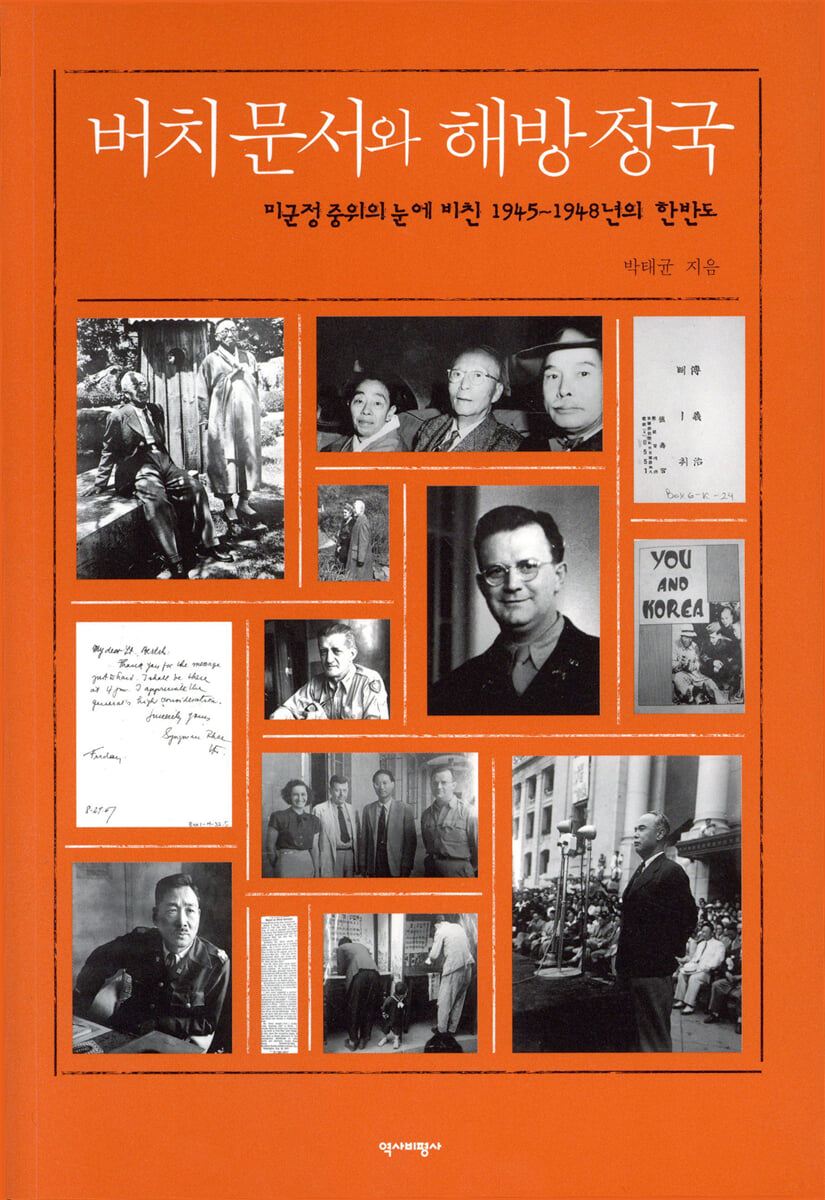
The Birch Document and the Liberation Period
 |
Description
Book Introduction
A box of secret documents shedding new light on the liberation period and the US military government period has been opened.
Rereading post-liberation history through vivid testimonies and data, not political conventions.
Professor Park Tae-gyun was thrilled when he unexpectedly discovered the 'Birch Document Box' at Harvard University's Yenching Library.
Some of it had already been made public in the US military government records, but there was so much unpublished material that Lieutenant Birch had personally kept.
In particular, it was full of precious materials, ranging from documents of research, analysis, and reports on specific individuals or groups, recorded while communicating with Korean politicians at the time, to business cards, letters, photographs, and memos.
First Lieutenant Leonard Bertsch was deployed to Korea on December 15, 1945, and served as a member of the US Military Government Political Advisory Group, primarily responsible for Korean politicians, before returning to the United States shortly after the general election in May 1948.
At the time, immediately after liberation, the Korean Peninsula was a time of chaos, with countless politicians fiercely fighting for the fate of their country.
Birch was a political mediator who interacted with prominent politicians of the time and was more concerned about the future of the Korean Peninsula than the average Korean.
The materials left behind by Birch often shatter our common perceptions about the liberation period.
The political antagonism between the US military government and Syngman Rhee, the differing judgments of Syngman Rhee between the US military government and MacArthur, fake news about the trusteeship and the anti-trusteeship movement, the misunderstandings and truths surrounding Yeo Un-hyeong's pro-Japanese activities, the conspiracy and terrorism carried out out of personal ambition, and the political plans of the US military government, which were ultimately evaluated as a failure - these are all things that Birch's sharp insights and records that penetrate the era, telling us that the history of the liberation period as we knew it must be reexamined.
Rereading post-liberation history through vivid testimonies and data, not political conventions.
Professor Park Tae-gyun was thrilled when he unexpectedly discovered the 'Birch Document Box' at Harvard University's Yenching Library.
Some of it had already been made public in the US military government records, but there was so much unpublished material that Lieutenant Birch had personally kept.
In particular, it was full of precious materials, ranging from documents of research, analysis, and reports on specific individuals or groups, recorded while communicating with Korean politicians at the time, to business cards, letters, photographs, and memos.
First Lieutenant Leonard Bertsch was deployed to Korea on December 15, 1945, and served as a member of the US Military Government Political Advisory Group, primarily responsible for Korean politicians, before returning to the United States shortly after the general election in May 1948.
At the time, immediately after liberation, the Korean Peninsula was a time of chaos, with countless politicians fiercely fighting for the fate of their country.
Birch was a political mediator who interacted with prominent politicians of the time and was more concerned about the future of the Korean Peninsula than the average Korean.
The materials left behind by Birch often shatter our common perceptions about the liberation period.
The political antagonism between the US military government and Syngman Rhee, the differing judgments of Syngman Rhee between the US military government and MacArthur, fake news about the trusteeship and the anti-trusteeship movement, the misunderstandings and truths surrounding Yeo Un-hyeong's pro-Japanese activities, the conspiracy and terrorism carried out out of personal ambition, and the political plans of the US military government, which were ultimately evaluated as a failure - these are all things that Birch's sharp insights and records that penetrate the era, telling us that the history of the liberation period as we knew it must be reexamined.
- You can preview some of the book's contents.
Preview
index
1 Why the US Military Government Failed: "MacArthur Was Stubborn" and "Haji Was Naive"
2. The US military government's courtship of Yeo Woon-hyung - "He's on the run, but he's still important."
3. Find Yeo Woon-hyung's pro-Japanese activities.
4. Final Investigation Report on Yeo Woon-hyung's Pro-Japanese Activities
5 “Should I stop the terrorists’ patriotic acts?”
6. Prevent Syngman Rhee's return to Korea.
7. Syngman Rhee and Kim Gu - The problem was money.
8. Is she the queen of domestic help or the origin of state corruption? - Madame Francesca
9 Do you know Kang Yong-heul?
10 Why did a current police officer kill Jang Deok-su?
11. Undermine Kim Gu's authority - Kim Gu's assassination was planned a year ago.
12 The corner that the US military government trusts is the police, and the corner that the police trusts is Syngman Rhee.
13 Why did the term "Hankook Ilbo Coat" come about?
14 The Playground Tied to Syngman Rhee - Police and Youth League
15 The US military government that the Northwest Youth League was displeased with
16. Exposing the evil deeds of pro-Japanese collaborators
17 Where do the right-wing political funds come from?
18 How to secure food
19 You and Korea published by the US military government
The first lottery after liberation, the Olympic lottery
21 General's Son or Terrorist?
22 Yeo Woon-hyung's death and pro-Japanese police
23 The government the US military government attempted to create - the first draft of the constitution immediately after liberation
24. Stop the Revolution with Land Reform
25 The Conflict Between Birch and the Korean Democratic Party, and the Failure of the Cabinet System
26 The person Birch most admired, Kim Kyu-sik
27 It's not the end, it's the beginning
28 Birch's Evaluation of the US Military Government and Liberation of Korea
29 In Search of the Origins of Current Korean Society - History of the US Military Government
[Appendix l Materials from the Birch Document Box]
· Records of interrogation of former Japanese Governor-General officials for the investigation of Yeo Woon-hyung
· Final report on the investigation into Yeo Un-hyeong's relationship with the Japanese government
· Political materials
· Materials related to fake news
· Analysis of local political situation
· Notes and letters
· Materials after Birch returned to the United States
2. The US military government's courtship of Yeo Woon-hyung - "He's on the run, but he's still important."
3. Find Yeo Woon-hyung's pro-Japanese activities.
4. Final Investigation Report on Yeo Woon-hyung's Pro-Japanese Activities
5 “Should I stop the terrorists’ patriotic acts?”
6. Prevent Syngman Rhee's return to Korea.
7. Syngman Rhee and Kim Gu - The problem was money.
8. Is she the queen of domestic help or the origin of state corruption? - Madame Francesca
9 Do you know Kang Yong-heul?
10 Why did a current police officer kill Jang Deok-su?
11. Undermine Kim Gu's authority - Kim Gu's assassination was planned a year ago.
12 The corner that the US military government trusts is the police, and the corner that the police trusts is Syngman Rhee.
13 Why did the term "Hankook Ilbo Coat" come about?
14 The Playground Tied to Syngman Rhee - Police and Youth League
15 The US military government that the Northwest Youth League was displeased with
16. Exposing the evil deeds of pro-Japanese collaborators
17 Where do the right-wing political funds come from?
18 How to secure food
19 You and Korea published by the US military government
The first lottery after liberation, the Olympic lottery
21 General's Son or Terrorist?
22 Yeo Woon-hyung's death and pro-Japanese police
23 The government the US military government attempted to create - the first draft of the constitution immediately after liberation
24. Stop the Revolution with Land Reform
25 The Conflict Between Birch and the Korean Democratic Party, and the Failure of the Cabinet System
26 The person Birch most admired, Kim Kyu-sik
27 It's not the end, it's the beginning
28 Birch's Evaluation of the US Military Government and Liberation of Korea
29 In Search of the Origins of Current Korean Society - History of the US Military Government
[Appendix l Materials from the Birch Document Box]
· Records of interrogation of former Japanese Governor-General officials for the investigation of Yeo Woon-hyung
· Final report on the investigation into Yeo Un-hyeong's relationship with the Japanese government
· Political materials
· Materials related to fake news
· Analysis of local political situation
· Notes and letters
· Materials after Birch returned to the United States
Into the book
Syngman Rhee knew our hatred for him.
He wrote to a friend in California, saying, "The two most dangerous communists in Korea are General Hodge and Lieutenant Birch."
--- p.19
It can be said that Yeo Un-hyeong was a person who tried to engage in true politics during the Japanese colonial period.
Because he was the only person who could convey the thoughts of the Koreans who were being persecuted in the colony to the Government-General, even if only a little.
Sometimes, it is the attitude of a true politician to talk to the enemy and try to get something out of it, even if it is just a little.
We elected a president to do politics, but Yeo Un-hyeong had a completely different image from the presidents of modern Korean history who did not do politics but only did machinations.
--- p.48
Since his return to Korea in October 1945, Syngman Rhee has been a symbol of division rather than an icon of unification.
He said, “Let’s all come together,” but in reality, he was saying that we should all come together, “excluding those who oppose us.”
He condemned those who did not follow him as communists.
--- p.72
The attitudes of the two men (Syngman Rhee and Kim Gu) toward money stem from their personalities and show fundamental differences.
Syngman Rhee's greed for money was not a means to power, but for himself.
Power itself functions as a means to acquire money.
On the other hand, Kim Gu pursues money as a means to fulfill his proper role as the leader of the group.
When he had a lot of money, he used it to help refugees from North Korea, to help the very poor, and to give to anyone who asked for it.
--- p.78~79
The fact that the assassination was carried out by people in police uniforms had the effect of startling the Korean officials in the interim government.
The assassins did not hide their faces from Jang Deok-su's wife.
--- p.115
The pro-Japanese landlords called in youth groups to take control of the region.
They were the Northwest Youth League and the Liberation Youth League.
They were not from that area.
The once quiet village began to turn into a battlefield in an instant.
--- p.163
Nothing has changed then or now.
Politics was not interested in the people's feelings.
They were only focused on taking power.
What did liberation bring to the Korean people?
--- p.183
In the end, all of the US military government's policies failed.
The assassinations of Yeo Un-hyeong and Jang Deok-su resulted in killing two birds with one stone.
Of course, it is also necessary to evaluate whether the Democratic Party of Korea itself was a party with the ability to become a majority party.
In this situation, the only hope left was Kim Kyu-sik.
In particular, because Birch's relationship with Syngman Rhee was not good, he had to unite other political forces around Kim Kyu-sik.
However, Kim Kyu-sik never moved as Birch hoped.
Kim Kyu-sik's answer was, "It is not the end, but the beginning."
--- p.243
Aside from Kim Kyu-sik's conviction that a divided government should not be established and Syngman Rhee's wealth and political power in the provinces, there was another factor that prevented Kim Kyu-sik from becoming leader.
It was Yeo Woon-hyung's death.
… Kim Gu’s assassination in June 1949 was also a warning to Kim Kyu-sik.
--- p.259
In a piece written shortly after leaving Korea, Birch was particularly critical of the policies of the US military government.
In other words, it was determined that the US policy of employing pro-Japanese collaborators and the US military government's wrong attitude toward Koreans and Korean society were important factors in the failure of the US military government.
--- p.267
Haji and Birch's predictions were right.
Even though the US military government did not want Syngman Rhee to become president, it failed to prevent it.
America's policy toward Korea has repeatedly been hindered by President Syngman Rhee.
As a result, Korea and the United States, despite being allies, have come to distrust each other.
--- p.277
The Birch documents show the history of frustration that Korean society experienced along with the failures of the US military government.
It was a process of losing the very precious opportunity of liberation and the establishment of a unified independent nation.
And the loss of opportunity soon led to the crisis of war, clearly showing that we must never experience such a thing again.
He wrote to a friend in California, saying, "The two most dangerous communists in Korea are General Hodge and Lieutenant Birch."
--- p.19
It can be said that Yeo Un-hyeong was a person who tried to engage in true politics during the Japanese colonial period.
Because he was the only person who could convey the thoughts of the Koreans who were being persecuted in the colony to the Government-General, even if only a little.
Sometimes, it is the attitude of a true politician to talk to the enemy and try to get something out of it, even if it is just a little.
We elected a president to do politics, but Yeo Un-hyeong had a completely different image from the presidents of modern Korean history who did not do politics but only did machinations.
--- p.48
Since his return to Korea in October 1945, Syngman Rhee has been a symbol of division rather than an icon of unification.
He said, “Let’s all come together,” but in reality, he was saying that we should all come together, “excluding those who oppose us.”
He condemned those who did not follow him as communists.
--- p.72
The attitudes of the two men (Syngman Rhee and Kim Gu) toward money stem from their personalities and show fundamental differences.
Syngman Rhee's greed for money was not a means to power, but for himself.
Power itself functions as a means to acquire money.
On the other hand, Kim Gu pursues money as a means to fulfill his proper role as the leader of the group.
When he had a lot of money, he used it to help refugees from North Korea, to help the very poor, and to give to anyone who asked for it.
--- p.78~79
The fact that the assassination was carried out by people in police uniforms had the effect of startling the Korean officials in the interim government.
The assassins did not hide their faces from Jang Deok-su's wife.
--- p.115
The pro-Japanese landlords called in youth groups to take control of the region.
They were the Northwest Youth League and the Liberation Youth League.
They were not from that area.
The once quiet village began to turn into a battlefield in an instant.
--- p.163
Nothing has changed then or now.
Politics was not interested in the people's feelings.
They were only focused on taking power.
What did liberation bring to the Korean people?
--- p.183
In the end, all of the US military government's policies failed.
The assassinations of Yeo Un-hyeong and Jang Deok-su resulted in killing two birds with one stone.
Of course, it is also necessary to evaluate whether the Democratic Party of Korea itself was a party with the ability to become a majority party.
In this situation, the only hope left was Kim Kyu-sik.
In particular, because Birch's relationship with Syngman Rhee was not good, he had to unite other political forces around Kim Kyu-sik.
However, Kim Kyu-sik never moved as Birch hoped.
Kim Kyu-sik's answer was, "It is not the end, but the beginning."
--- p.243
Aside from Kim Kyu-sik's conviction that a divided government should not be established and Syngman Rhee's wealth and political power in the provinces, there was another factor that prevented Kim Kyu-sik from becoming leader.
It was Yeo Woon-hyung's death.
… Kim Gu’s assassination in June 1949 was also a warning to Kim Kyu-sik.
--- p.259
In a piece written shortly after leaving Korea, Birch was particularly critical of the policies of the US military government.
In other words, it was determined that the US policy of employing pro-Japanese collaborators and the US military government's wrong attitude toward Koreans and Korean society were important factors in the failure of the US military government.
--- p.267
Haji and Birch's predictions were right.
Even though the US military government did not want Syngman Rhee to become president, it failed to prevent it.
America's policy toward Korea has repeatedly been hindered by President Syngman Rhee.
As a result, Korea and the United States, despite being allies, have come to distrust each other.
--- p.277
The Birch documents show the history of frustration that Korean society experienced along with the failures of the US military government.
It was a process of losing the very precious opportunity of liberation and the establishment of a unified independent nation.
And the loss of opportunity soon led to the crisis of war, clearly showing that we must never experience such a thing again.
--- p.286
Publisher's Review
The US military government period may be the origin of the dark history of Korean politics today.
Author Park Tae-gyun's purpose in writing "The Birch Document and the Liberation Period" was twofold.
One is to understand the situation during the US military government immediately after liberation more empirically and objectively, and the other is to find the origins of the evils that appear in Korean politics today.
The latter, in particular, are political evils that have remained unremedied for over 70 years: the distortion of the political landscape through fake news, the exclusion or elimination of the most rational politicians, the violence of far-right groups backed by conservative political forces, and the absence of a sound force to replace the vested interests of the mainstream, all of which have been weighing down Korean society since liberation.
In this regard, the author concludes the book by reminding us of the following lessons and offering hope for the future of the Republic of Korea.
“The Birch documents show the history of frustration that Korean society experienced along with the failures of the US military government.
It was a process of losing the very precious opportunity of liberation and the establishment of a unified independent nation.
And the loss of opportunity soon led to the crisis of war, clearly showing that we must never experience such a thing again.
This is precisely why, at a time when the Korean Peninsula stands at a critical turning point, the lessons we can glean from the US military government-era Korean society as seen through the Birch Documents are all the more valuable.
…If the power of citizens saved the Korea ship from the brink of grounding in 2016 and 2017, we must now make continuous efforts to prevent the Korea ship from running aground again.
If the dreams envisioned by Kim Kyu-sik and Yeo Un-hyeong, whom Birch most admired, can be realized even now, 70 years later, Birch's efforts in supporting the Left-Right Joint Committee will not have been in vain.
Media in which the contents of this book were introduced
"Modern Korean History Before and After Liberation: A Look at the Birch Report"
― KBS1 Radio, [Joo Jin-woo Live] August 13, 2021.
Forgotten Heroes of the Liberation Era
― JTBC, [China Class] June 3, 2021.
The Birch Report: The Inside Story of the US Military Government
― KBS, [History Journal That Day] February 18, 2020.
Park Tae-gyun's Birch Report
― [Kyunghyang Shinmun] Serialized from April 1 to October 7, 2018, 27 episodes.
Author Park Tae-gyun's purpose in writing "The Birch Document and the Liberation Period" was twofold.
One is to understand the situation during the US military government immediately after liberation more empirically and objectively, and the other is to find the origins of the evils that appear in Korean politics today.
The latter, in particular, are political evils that have remained unremedied for over 70 years: the distortion of the political landscape through fake news, the exclusion or elimination of the most rational politicians, the violence of far-right groups backed by conservative political forces, and the absence of a sound force to replace the vested interests of the mainstream, all of which have been weighing down Korean society since liberation.
In this regard, the author concludes the book by reminding us of the following lessons and offering hope for the future of the Republic of Korea.
“The Birch documents show the history of frustration that Korean society experienced along with the failures of the US military government.
It was a process of losing the very precious opportunity of liberation and the establishment of a unified independent nation.
And the loss of opportunity soon led to the crisis of war, clearly showing that we must never experience such a thing again.
This is precisely why, at a time when the Korean Peninsula stands at a critical turning point, the lessons we can glean from the US military government-era Korean society as seen through the Birch Documents are all the more valuable.
…If the power of citizens saved the Korea ship from the brink of grounding in 2016 and 2017, we must now make continuous efforts to prevent the Korea ship from running aground again.
If the dreams envisioned by Kim Kyu-sik and Yeo Un-hyeong, whom Birch most admired, can be realized even now, 70 years later, Birch's efforts in supporting the Left-Right Joint Committee will not have been in vain.
Media in which the contents of this book were introduced
"Modern Korean History Before and After Liberation: A Look at the Birch Report"
― KBS1 Radio, [Joo Jin-woo Live] August 13, 2021.
Forgotten Heroes of the Liberation Era
― JTBC, [China Class] June 3, 2021.
The Birch Report: The Inside Story of the US Military Government
― KBS, [History Journal That Day] February 18, 2020.
Park Tae-gyun's Birch Report
― [Kyunghyang Shinmun] Serialized from April 1 to October 7, 2018, 27 episodes.
GOODS SPECIFICS
- Publication date: October 29, 2021
- Page count, weight, size: 376 pages | 448g | 152*224*30mm
- ISBN13: 9788976964489
- ISBN10: 8976964489
You may also like
카테고리
korean


korean

![GQ KOREA Mark (Monthly): December [2025]](http://librairie.coreenne.fr/cdn/shop/files/8ef265dbbfbf186523ed75ba7319009d.jpg?v=1765340328&width=3840)


