

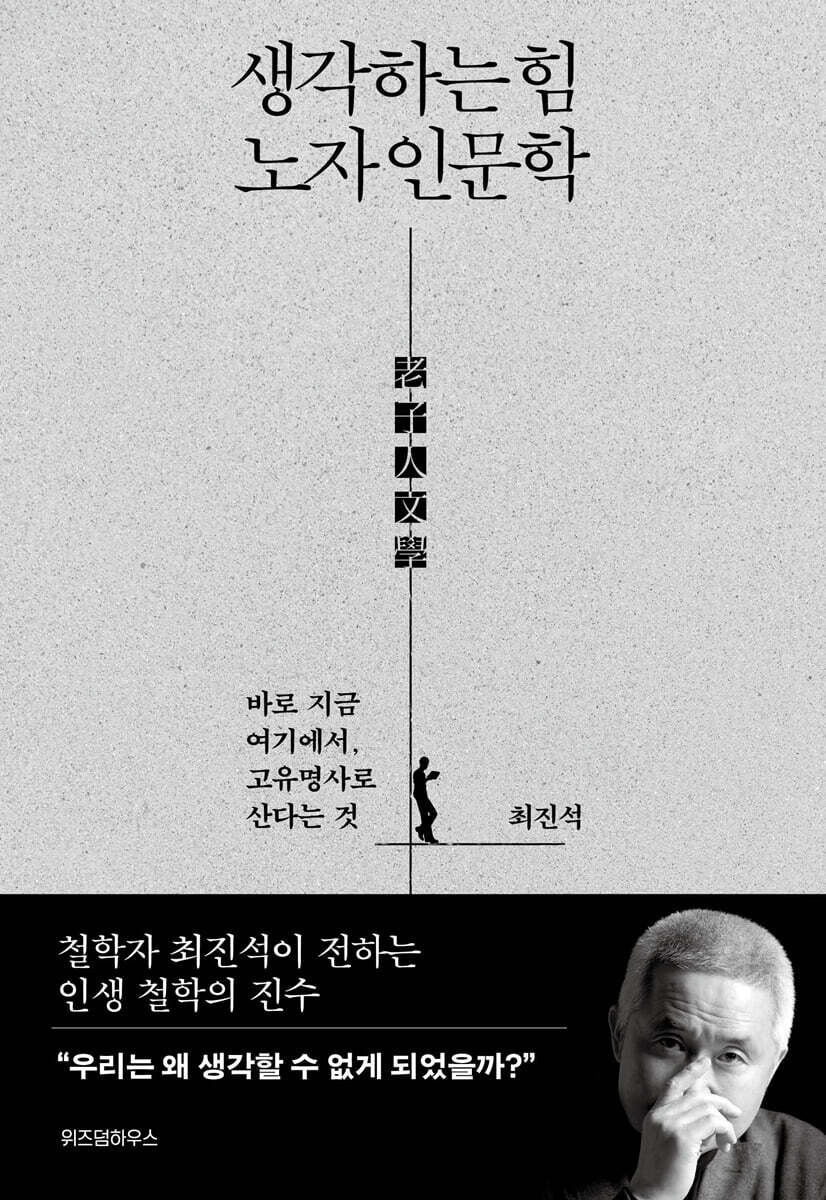
The Power of Thinking Lao Tzu Humanities
 |
Description
Book Introduction
“Are you a practitioner of universal ideals or a realizer of your own dreams?”
“Do you live by what you want, or do you live by what you desire?”
“Are you one of them, the only one?”
-EBS [Humanities Special Lecture] Meet Professor Jinseok Choi's Lao-Tzu lecture, a hot topic, in book form!
These three questions Professor Jinseok Choi posed to the audience in EBS's [Humanities Special Lecture] shocked those who, despite accumulating knowledge and experience, were not more free and happy, and made them even more enthusiastic about his lectures thereafter.
Professor Jinseok Choi, the author, is a master of Eastern philosophy and an evangelist of creative humanities who has worked extensively in universities, corporations, and various organizations, providing clarity to people's thoughts and unexpected insights and inspiration.
Through "The Power of Thinking, Lao-tzu's Humanities," he draws out the "method for modern survival" from Lao-tzu's way of thinking from 2,500 years ago, while also conveying insights that shake up our lives and thinking today.
《The Power of Thinking, Lao-tzu Humanities》 is not a book that simply introduces Lao-tzu's philosophy or explains the 《Tao Te Ching》.
The author begins by examining the historical background that gave birth to human thought and philosophy, using Lao Tzu and the Tao Te Ching as his main topics, and then reveals the essence of life philosophy.
It also goes a step further and explains how Lao Tzu's ideas can be applied to transform society and the nation, going beyond simply changing individual lives.
The author's intellectual adventure of reviving Laozi in a modern way by meticulously comparing it with the ideas of Confucius, Laozi's contemporary counterpart, and comprehensively comparing it with those of modern and contemporary Western thinkers such as Hegel, Darwin, Marx, Freud, and Nietzsche, leads us on the path to properly learning humanistic thinking.
Author: Choi Jin-seok
He completed his bachelor's and master's degrees in philosophy at Sogang University, and went on to study at Heilongjiang University in China, where he received his doctorate in philosophy from Peking University.
He is actively engaged in lectures and writings that contain life wisdom and humanistic insights.
He is currently a professor of philosophy at Sogang University and the first director of Geonmyeongwon, a talent development institute that brings together Korea's top scholars in the humanities, science, and arts.
His published works include “Who Am I?” (co-authored), “Letting Go of That and This,” “The Patterns Humans Draw,” and “Listening to the Tao Te Ching through the Voice of Lao-tzu.” He also provided commentary and translated into Korean books such as “A Brief Introduction to Lao-tzu” (co-translated), “Lessons on Famous Chinese Thought,” “The Philosophy of Zhuangzi,” and “The New Theory of Lao-tzu.”
"The Power of Thinking, Lao Tzu's Humanities" is based on the "EBS Humanities Special Lecture," which has evoked admiration and inspiration from countless people thirsting for the humanities.
In this book, the author argues that the humanities should not simply focus on acquiring knowledge, but rather on developing the ability to think “humanistically.”
It provides an interesting explanation of the birth of Lao-tzu's philosophy, which was previously unknown, and how to cultivate the "power of humanistic thinking" necessary for modern people, based on historical events.
This book will help you regain mental freedom by breaking the mold of your thinking...
And you will find true virtue and happiness.
“Do you live by what you want, or do you live by what you desire?”
“Are you one of them, the only one?”
-EBS [Humanities Special Lecture] Meet Professor Jinseok Choi's Lao-Tzu lecture, a hot topic, in book form!
These three questions Professor Jinseok Choi posed to the audience in EBS's [Humanities Special Lecture] shocked those who, despite accumulating knowledge and experience, were not more free and happy, and made them even more enthusiastic about his lectures thereafter.
Professor Jinseok Choi, the author, is a master of Eastern philosophy and an evangelist of creative humanities who has worked extensively in universities, corporations, and various organizations, providing clarity to people's thoughts and unexpected insights and inspiration.
Through "The Power of Thinking, Lao-tzu's Humanities," he draws out the "method for modern survival" from Lao-tzu's way of thinking from 2,500 years ago, while also conveying insights that shake up our lives and thinking today.
《The Power of Thinking, Lao-tzu Humanities》 is not a book that simply introduces Lao-tzu's philosophy or explains the 《Tao Te Ching》.
The author begins by examining the historical background that gave birth to human thought and philosophy, using Lao Tzu and the Tao Te Ching as his main topics, and then reveals the essence of life philosophy.
It also goes a step further and explains how Lao Tzu's ideas can be applied to transform society and the nation, going beyond simply changing individual lives.
The author's intellectual adventure of reviving Laozi in a modern way by meticulously comparing it with the ideas of Confucius, Laozi's contemporary counterpart, and comprehensively comparing it with those of modern and contemporary Western thinkers such as Hegel, Darwin, Marx, Freud, and Nietzsche, leads us on the path to properly learning humanistic thinking.
Author: Choi Jin-seok
He completed his bachelor's and master's degrees in philosophy at Sogang University, and went on to study at Heilongjiang University in China, where he received his doctorate in philosophy from Peking University.
He is actively engaged in lectures and writings that contain life wisdom and humanistic insights.
He is currently a professor of philosophy at Sogang University and the first director of Geonmyeongwon, a talent development institute that brings together Korea's top scholars in the humanities, science, and arts.
His published works include “Who Am I?” (co-authored), “Letting Go of That and This,” “The Patterns Humans Draw,” and “Listening to the Tao Te Ching through the Voice of Lao-tzu.” He also provided commentary and translated into Korean books such as “A Brief Introduction to Lao-tzu” (co-translated), “Lessons on Famous Chinese Thought,” “The Philosophy of Zhuangzi,” and “The New Theory of Lao-tzu.”
"The Power of Thinking, Lao Tzu's Humanities" is based on the "EBS Humanities Special Lecture," which has evoked admiration and inspiration from countless people thirsting for the humanities.
In this book, the author argues that the humanities should not simply focus on acquiring knowledge, but rather on developing the ability to think “humanistically.”
It provides an interesting explanation of the birth of Lao-tzu's philosophy, which was previously unknown, and how to cultivate the "power of humanistic thinking" necessary for modern people, based on historical events.
This book will help you regain mental freedom by breaking the mold of your thinking...
And you will find true virtue and happiness.
- You can preview some of the book's contents.
Preview
index
introduction
1.
How the idea was born
Humans, creating a 'ground for thought'
The discovery of the existence called 'I'
The inner strength to communicate with God: the emergence of 'yes' and 'virtue'
Believe in the power of humanity more than in the will of heaven
Virtue is not knowledge, but power.
2.
History made by the power of thought
The Reversal of Periphery and Center, and the Birth of 'Philosophy'
Iron Age: Changing the Flow of Wealth
From the age of heaven to the age of earth
What the emergence of law tells us
The path paved by human thought, the Tao
Lao Tzu scolds Confucius
3.
Lao-tzu's thought, completed with existence and non-existence
Confucius and Laozi, How to Overcome the Mandate of Heaven
A Tao that can be defined is not a Tao
Deny the essence and see the relationship
The summary of relational theory: the coexistence of existence and nonexistence
4.
How to avoid being fooled by fakes, relationship theory
'Letting go of the frame of thinking' is non-possession.
If there is no difference, there is no meaning.
Relationship theory in Buddhism
The theory of relationships in the Book of Changes
The End of Relational Philosophy: The Tao Te Ching
5.
Why the modern philosopher Lao Tzu?
What is philosophy?
How to interpret the world
6.
Seeing with clarity, not with knowledge
The world of truth is here, not over there
Embracing the sun and moon
7.
To know is ultimately to not know
The Greatness of a 'Nobody'
Love and separation are one
The power of uncertainty
Stop studying things that don't allow you to express yourself.
8.
Wuwei, the wisdom of living in a changing world
Only living trees sway
Act like an elephant walking on thin ice
I am just another person to another person
There is no need to do so
If you step back, you advance, and if you hide, you shine.
9.
Our Attitude to Inconvenient Laws
See it as it is
The power of not being dominated
Spontaneity of desire and hope
The contradiction of the name 'good'
10.
Living as a 'proper noun'
Revolution from the self
Life is ultimately in 'my body'
Exist as a proper noun, not a common noun
1.
How the idea was born
Humans, creating a 'ground for thought'
The discovery of the existence called 'I'
The inner strength to communicate with God: the emergence of 'yes' and 'virtue'
Believe in the power of humanity more than in the will of heaven
Virtue is not knowledge, but power.
2.
History made by the power of thought
The Reversal of Periphery and Center, and the Birth of 'Philosophy'
Iron Age: Changing the Flow of Wealth
From the age of heaven to the age of earth
What the emergence of law tells us
The path paved by human thought, the Tao
Lao Tzu scolds Confucius
3.
Lao-tzu's thought, completed with existence and non-existence
Confucius and Laozi, How to Overcome the Mandate of Heaven
A Tao that can be defined is not a Tao
Deny the essence and see the relationship
The summary of relational theory: the coexistence of existence and nonexistence
4.
How to avoid being fooled by fakes, relationship theory
'Letting go of the frame of thinking' is non-possession.
If there is no difference, there is no meaning.
Relationship theory in Buddhism
The theory of relationships in the Book of Changes
The End of Relational Philosophy: The Tao Te Ching
5.
Why the modern philosopher Lao Tzu?
What is philosophy?
How to interpret the world
6.
Seeing with clarity, not with knowledge
The world of truth is here, not over there
Embracing the sun and moon
7.
To know is ultimately to not know
The Greatness of a 'Nobody'
Love and separation are one
The power of uncertainty
Stop studying things that don't allow you to express yourself.
8.
Wuwei, the wisdom of living in a changing world
Only living trees sway
Act like an elephant walking on thin ice
I am just another person to another person
There is no need to do so
If you step back, you advance, and if you hide, you shine.
9.
Our Attitude to Inconvenient Laws
See it as it is
The power of not being dominated
Spontaneity of desire and hope
The contradiction of the name 'good'
10.
Living as a 'proper noun'
Revolution from the self
Life is ultimately in 'my body'
Exist as a proper noun, not a common noun
Into the book
The path that humans have established with their own unique abilities is called the ‘Tao.’
The unique human ability we are talking about here is not the power of belief, but the ‘power of thinking.’
Humans must now follow the Tao, not the mandate of heaven.
Only at this stage do we encounter the Tao that is familiar to us.
In this way, the emergence of Tao is the first declaration of human independence that emerged from Chinese civilization.
Before the advent of Tao, the two central axes through which the Chinese interpreted the world were 'Heaven' and 'Deity'.
With the advent of Taoism, the Chinese now had two new central axes for relating to the world, interpreting the world, and finding meaning in life: Tao and virtue.
The 'morality' we commonly refer to is a word that combines the words 'do' and 'deok'. --- Page 71
Lao Tzu's dream was to completely escape human subjectivity and move toward the objectivity of nature.
It is an attempt to break away from the world of 'values' and discover the basis of human order in the world of 'facts' called nature.
The idea was to live by following or imitating the way nature moves.
The goal was to transform the natural order into a human order.
But the order of nature can be observed by anyone.
It is also open to everyone in the same way.
So, it will not only be objective, but also have universality that is transparent to everyone and applies equally everywhere.
Objectivity, universality, and transparency that can overcome the Mandate of Heaven theory were thus secured. ---Page 87
Laozi advocates a local autonomy system, a small country system, rather than a large-scale national system.
However, in order to achieve decentralization or local autonomy, we cannot limit everything to a single standard.
Because we need to acknowledge the different standards that each separate place has.
Therefore, we must abandon the universal ideology that functions as a standard from afar and instead adopt the autonomy of the specific things that exist right here, in other words, "Geopichucha" (去彼取此), a more appropriate approach. ---Page 160
How should our cognitive ability to perceive this world be? According to Lao Tzu, it should be through the method of "clarity," not "knowledge."
We do not see the sun as the sun alone, nor the moon as the moon alone, but we see the moon in its relationship to the sun, and the sun in its relationship to the moon.
Seeing the sun as the sun and the moon as the moon starts from the premise that the sun and the moon are separate.
That which is clearly recognized as separate is called 'knowledge'.
On the other hand, recognizing the sun and moon in their mutual relationship is called 'myeong', which means that the sun and moon are not two separate entities, but rather are viewed as a set of events that form a relationship.
The ability to capture the sun and the moon at the same time, that is 'myeong'.
This is Lao Tzu's insight. ---Page 194
A person who holds the tension of the opposing sides in his heart is neither bold nor fanatic.
Fanaticism usually comes from narrow beliefs.
The previously mentioned saying, “Don’t let those who claim to be smart dare to do something [使夫智者不敢爲也]” means that we should not make people fanatic.
It is said that fanatics are usually smart-alecked.
People who speak boldly with bloodshot eyes, who make arguments while waving their thick arms, who shout with flags, who run around wearing headbands, and who rush to offer advice are usually the smart ones.
The world ruled by the smart-alecked is rough, conflict-ridden, and the competition for clarity is sky-high.
Anyone who knows that the world is a tension of opposing sides—in other words, anyone who can stand on the edge of opposing sides—can only become serious. ---Page 214
Inaction is an attempt to spontaneously and flexibly engage with the changing world, rather than passively relying on conceptual structures such as ideologies and standards.
So, a person with a 'being' attitude sees the world unfolding before him 'as it should be' according to his own standards, but a person with a 'non-being' attitude can see the world 'as it is' because he is not governed by any standards.
Those who see and react to the world “as it is” will move forward, but those who see the world “as it should be” will inevitably remain bound to the past.
Therefore, only by maintaining an attitude of inaction can we come into contact with the changing truth. ---Pages 244-245
The unique human ability we are talking about here is not the power of belief, but the ‘power of thinking.’
Humans must now follow the Tao, not the mandate of heaven.
Only at this stage do we encounter the Tao that is familiar to us.
In this way, the emergence of Tao is the first declaration of human independence that emerged from Chinese civilization.
Before the advent of Tao, the two central axes through which the Chinese interpreted the world were 'Heaven' and 'Deity'.
With the advent of Taoism, the Chinese now had two new central axes for relating to the world, interpreting the world, and finding meaning in life: Tao and virtue.
The 'morality' we commonly refer to is a word that combines the words 'do' and 'deok'. --- Page 71
Lao Tzu's dream was to completely escape human subjectivity and move toward the objectivity of nature.
It is an attempt to break away from the world of 'values' and discover the basis of human order in the world of 'facts' called nature.
The idea was to live by following or imitating the way nature moves.
The goal was to transform the natural order into a human order.
But the order of nature can be observed by anyone.
It is also open to everyone in the same way.
So, it will not only be objective, but also have universality that is transparent to everyone and applies equally everywhere.
Objectivity, universality, and transparency that can overcome the Mandate of Heaven theory were thus secured. ---Page 87
Laozi advocates a local autonomy system, a small country system, rather than a large-scale national system.
However, in order to achieve decentralization or local autonomy, we cannot limit everything to a single standard.
Because we need to acknowledge the different standards that each separate place has.
Therefore, we must abandon the universal ideology that functions as a standard from afar and instead adopt the autonomy of the specific things that exist right here, in other words, "Geopichucha" (去彼取此), a more appropriate approach. ---Page 160
How should our cognitive ability to perceive this world be? According to Lao Tzu, it should be through the method of "clarity," not "knowledge."
We do not see the sun as the sun alone, nor the moon as the moon alone, but we see the moon in its relationship to the sun, and the sun in its relationship to the moon.
Seeing the sun as the sun and the moon as the moon starts from the premise that the sun and the moon are separate.
That which is clearly recognized as separate is called 'knowledge'.
On the other hand, recognizing the sun and moon in their mutual relationship is called 'myeong', which means that the sun and moon are not two separate entities, but rather are viewed as a set of events that form a relationship.
The ability to capture the sun and the moon at the same time, that is 'myeong'.
This is Lao Tzu's insight. ---Page 194
A person who holds the tension of the opposing sides in his heart is neither bold nor fanatic.
Fanaticism usually comes from narrow beliefs.
The previously mentioned saying, “Don’t let those who claim to be smart dare to do something [使夫智者不敢爲也]” means that we should not make people fanatic.
It is said that fanatics are usually smart-alecked.
People who speak boldly with bloodshot eyes, who make arguments while waving their thick arms, who shout with flags, who run around wearing headbands, and who rush to offer advice are usually the smart ones.
The world ruled by the smart-alecked is rough, conflict-ridden, and the competition for clarity is sky-high.
Anyone who knows that the world is a tension of opposing sides—in other words, anyone who can stand on the edge of opposing sides—can only become serious. ---Page 214
Inaction is an attempt to spontaneously and flexibly engage with the changing world, rather than passively relying on conceptual structures such as ideologies and standards.
So, a person with a 'being' attitude sees the world unfolding before him 'as it should be' according to his own standards, but a person with a 'non-being' attitude can see the world 'as it is' because he is not governed by any standards.
Those who see and react to the world “as it is” will move forward, but those who see the world “as it should be” will inevitably remain bound to the past.
Therefore, only by maintaining an attitude of inaction can we come into contact with the changing truth. ---Pages 244-245
--- From the text
Publisher's Review
A path to living each day as yourself and becoming the true master of your own life.
Stop studying and start thinking!
This book suggests a way to restore the 'power of thinking' by penetrating the thought of Lao-tzu, who believed that the world is made up of 'relationships' rather than essence or center.
The author points out that modern people are losing the ability to think for themselves due to the influence of strong beliefs, ideologies, values, and intellectual systems from outside.
And he says that in order to regain the power of thinking, one must become a 'person on the border' who is free from existing beliefs, values, and ideologies.
This means that only by returning to the 'self' free from beliefs and standards can one gain the 'power to think', that is, humanistic insight.
So what does it mean to return to "self"? It means not allowing ourselves to be lost in common nouns, but to revive ourselves as "proper nouns."
The author's message that living as a 'proper noun' ultimately begins with a revolution within oneself will resonate deeply with us who live here and now.
The author says this in the book:
“A life whose way of life does not come from within itself, whose way of relating to the world does not come from within itself, can never be normal.
What is not spontaneous has no life.
Holiness is never far away.
Right here, right now, where you stand, is the primordial soil from which holiness emerges.
“The ideal life is not a struggle to reach some distant place, but rather a steady step that starts right here.”
Now, through Professor Jinseok Choi's direct communication with the public, readers will cultivate the humanistic strength to survive in this age and learn how to become true masters of their own lives.
Stop studying and start thinking!
This book suggests a way to restore the 'power of thinking' by penetrating the thought of Lao-tzu, who believed that the world is made up of 'relationships' rather than essence or center.
The author points out that modern people are losing the ability to think for themselves due to the influence of strong beliefs, ideologies, values, and intellectual systems from outside.
And he says that in order to regain the power of thinking, one must become a 'person on the border' who is free from existing beliefs, values, and ideologies.
This means that only by returning to the 'self' free from beliefs and standards can one gain the 'power to think', that is, humanistic insight.
So what does it mean to return to "self"? It means not allowing ourselves to be lost in common nouns, but to revive ourselves as "proper nouns."
The author's message that living as a 'proper noun' ultimately begins with a revolution within oneself will resonate deeply with us who live here and now.
The author says this in the book:
“A life whose way of life does not come from within itself, whose way of relating to the world does not come from within itself, can never be normal.
What is not spontaneous has no life.
Holiness is never far away.
Right here, right now, where you stand, is the primordial soil from which holiness emerges.
“The ideal life is not a struggle to reach some distant place, but rather a steady step that starts right here.”
Now, through Professor Jinseok Choi's direct communication with the public, readers will cultivate the humanistic strength to survive in this age and learn how to become true masters of their own lives.
GOODS SPECIFICS
- Date of publication: March 12, 2015
- Page count, weight, size: 308 pages | 522g | 148*215*30mm
- ISBN13: 9788960867970
- ISBN10: 8960867977
You may also like
카테고리
korean


korean

![GQ KOREA Mark (Monthly): December [2025]](http://librairie.coreenne.fr/cdn/shop/files/8ef265dbbfbf186523ed75ba7319009d.jpg?v=1765340328&width=3840)


