

The rhythm of life
 |
Description
Book Introduction
Peter Bieri, author of Night Train to Lisbon, returns as a philosopher
The one book that will elevate your quality of life
Winner of the 2014 Tractatus Prize, Germany's top philosophy essay award
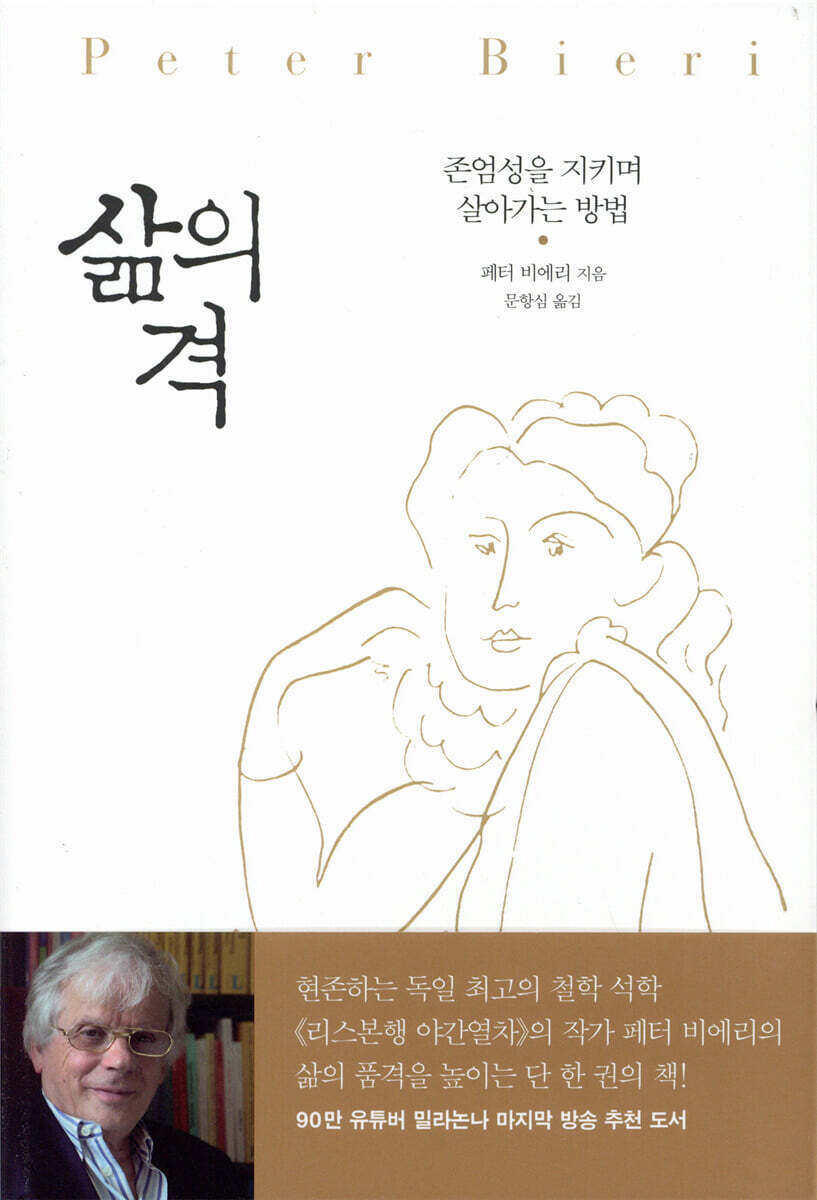
Professor Peter Bieri, a renowned German philosopher and author of Night Train to Lisbon, has published his new book, “The Rise of Life: How to Live with Dignity” (hereafter “The Rise of Life”) as part of the Everyday Humanities series.
The winner of the 2014 Tractatus Prize (Germany's highest philosophy essay award), "The Rise of Life" is a masterpiece that focuses on the issue of human dignity.
Dignity is the greatest spiritual asset of human beings, but it is also the value most vulnerable to threat in life.
How can we live a dignified life while maintaining human dignity?
Approaching this topic as both an observer and a problem-solver, the author draws on numerous examples from everyday life, literature, and film to demonstrate that dignity is not an absolute attribute, but a way of life, a "life style," and that it is revealed when we establish our own standards for independence, truthfulness, and a life of worth.
The one book that will elevate your quality of life
Winner of the 2014 Tractatus Prize, Germany's top philosophy essay award
Professor Peter Bieri, a renowned German philosopher and author of Night Train to Lisbon, has published his new book, “The Rise of Life: How to Live with Dignity” (hereafter “The Rise of Life”) as part of the Everyday Humanities series.
The winner of the 2014 Tractatus Prize (Germany's highest philosophy essay award), "The Rise of Life" is a masterpiece that focuses on the issue of human dignity.
Dignity is the greatest spiritual asset of human beings, but it is also the value most vulnerable to threat in life.
How can we live a dignified life while maintaining human dignity?
Approaching this topic as both an observer and a problem-solver, the author draws on numerous examples from everyday life, literature, and film to demonstrate that dignity is not an absolute attribute, but a way of life, a "life style," and that it is revealed when we establish our own standards for independence, truthfulness, and a life of worth.
- You can preview some of the book's contents.
Preview
index
Introduction: Dignity as a Form of Life
Chapter 1 Dignity as Independence
Becoming a subject/Becoming an end in itself/Slaughterhouse/But what if it is voluntary?/Humiliation through deliberate displays of helplessness/Escape to the inner fortress/Having rights/Guardianship/Sincere intervention/Respect for others and their interventions/Dependency: requests and begging/Emotional begging/Inner independence: Thinking/Inner independence: Will and decision/Inner independence: Emotional turmoil/Inner independence: Self-image and censorship/Humiliation through subordination/Independence through self-awareness/When treatment is needed/Dignity through work/Money
Chapter 2 Dignity as an Encounter
Meeting between subjects/Intervention and distancing/Recognition/Equality/Exhibition/Object of desire/Humanity as a commodity/Ignoring/Talk to me!/Ridicule/When you don't even have the right to know/Manipulation/Trickery/Seduction/Overwhelming/Treatment/I don't want sympathy!/When independent subjects meet each other/Opening the future for the other/Parting that preserves dignity
Chapter 3: Dignity in Respecting Private Confidentiality
The Two Faces of Secrets / The Gaze of Others / What is a Flaw? / The Logic of Shame / From Shame to Humiliation / Preserving Dignity by Overcoming Shame / The Private Sphere / The Deepest Recesses / Revealing with Dignity / Revealing without Dignity / Sharing Intimacy / Loss of Dignity through Betrayal / Secrets Lacking Courage
Chapter 4 Dignity as Authenticity
Lying to others/Lying to yourself/Honesty and its limits/Calling things by their names/Saving face/Foolish vanity
Chapter 5: Dignity as Self-Respect
Dignity as Limiting / Changing Self-Image / Destroyed Self-Respect / Sacrificed Self-Respect / Split Self-Respect / Taking Responsibility for Oneself
Chapter 6 Dignity as Moral Truth
Autonomous Morality/Moral Dignity/Dignity in Sin and Forgiveness/Punishment: Progress, Not Destruction/Are There Moral Boundaries That Must Not Be Crossed?
Chapter 7: Dignity in Recognizing the Weight of Things
The Meaning of Life/Your Own Voice/The Calmness of Maintaining Balance/Seeing Things from the End
Chapter 8: The Dignity of Accepting Finitude
When watching others disappear/Escape/When watching yourself disappear: Denial/When watching yourself disappear: Accepting the end of the day/Death/Letting go/Putting an end to life/When dealing with the deceased
References
Translator's Note
Chapter 1 Dignity as Independence
Becoming a subject/Becoming an end in itself/Slaughterhouse/But what if it is voluntary?/Humiliation through deliberate displays of helplessness/Escape to the inner fortress/Having rights/Guardianship/Sincere intervention/Respect for others and their interventions/Dependency: requests and begging/Emotional begging/Inner independence: Thinking/Inner independence: Will and decision/Inner independence: Emotional turmoil/Inner independence: Self-image and censorship/Humiliation through subordination/Independence through self-awareness/When treatment is needed/Dignity through work/Money
Chapter 2 Dignity as an Encounter
Meeting between subjects/Intervention and distancing/Recognition/Equality/Exhibition/Object of desire/Humanity as a commodity/Ignoring/Talk to me!/Ridicule/When you don't even have the right to know/Manipulation/Trickery/Seduction/Overwhelming/Treatment/I don't want sympathy!/When independent subjects meet each other/Opening the future for the other/Parting that preserves dignity
Chapter 3: Dignity in Respecting Private Confidentiality
The Two Faces of Secrets / The Gaze of Others / What is a Flaw? / The Logic of Shame / From Shame to Humiliation / Preserving Dignity by Overcoming Shame / The Private Sphere / The Deepest Recesses / Revealing with Dignity / Revealing without Dignity / Sharing Intimacy / Loss of Dignity through Betrayal / Secrets Lacking Courage
Chapter 4 Dignity as Authenticity
Lying to others/Lying to yourself/Honesty and its limits/Calling things by their names/Saving face/Foolish vanity
Chapter 5: Dignity as Self-Respect
Dignity as Limiting / Changing Self-Image / Destroyed Self-Respect / Sacrificed Self-Respect / Split Self-Respect / Taking Responsibility for Oneself
Chapter 6 Dignity as Moral Truth
Autonomous Morality/Moral Dignity/Dignity in Sin and Forgiveness/Punishment: Progress, Not Destruction/Are There Moral Boundaries That Must Not Be Crossed?
Chapter 7: Dignity in Recognizing the Weight of Things
The Meaning of Life/Your Own Voice/The Calmness of Maintaining Balance/Seeing Things from the End
Chapter 8: The Dignity of Accepting Finitude
When watching others disappear/Escape/When watching yourself disappear: Denial/When watching yourself disappear: Accepting the end of the day/Death/Letting go/Putting an end to life/When dealing with the deceased
References
Translator's Note
Detailed image
Into the book
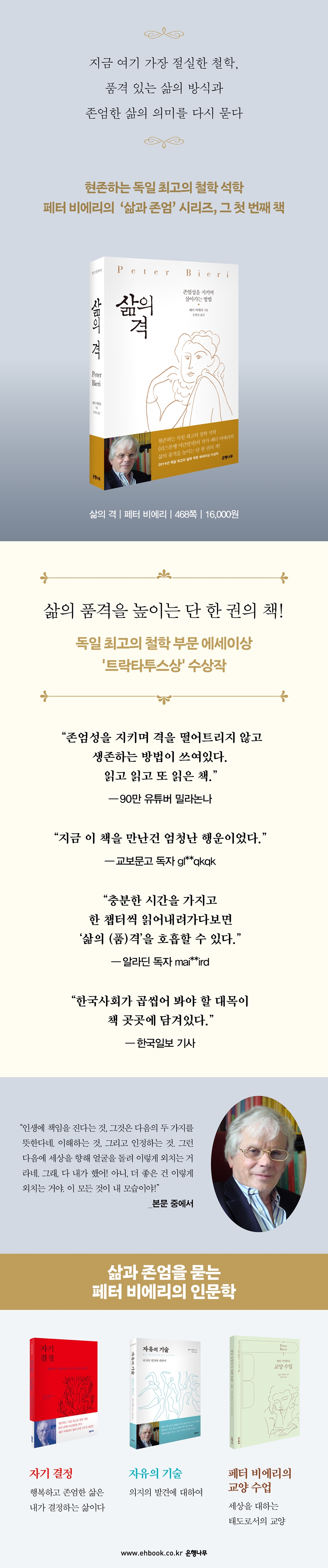
Dignity is something more than what an individual can do with it.
Dignity is not just a matter of the individual; it is something much broader and more objective, transcending the personal dimension.
That is, it has the characteristics of an overall form of life.
It is this whole life that is at stake in the dwarf long throw competition.
Humans are humiliated as they become materialized and instrumentalized.
So dignity is protected through legal mechanisms.
This is a value that is higher than an individual's free decision-making power.
Therefore, no one should throw away their dignity at will.
--- p.36
While the very fact that our helplessness is exposed is horrific, it is when this final element is met that humiliation becomes truly devastating.
This is when we realize how much the abuser enjoys our incompetence and how much he or she sets up the necessary mechanisms to make it clear to us.
This is evident in photos of American soldiers at Abu Ghraib prison stripping prisoners of their clothes and forcing them to lie face down on top of each other, laughing and having fun.
--- p.39~40
Breaking up involves facing the reality that every relationship represents a life you've missed, a life you might have lived, but never lived.
Therefore, when it comes to parting, the open future mentioned above has a particularly important meaning.
It is about acknowledging all possibilities for the future that will unfold for the other person.
--- p.179
“So what is dignity?” “It exists in the gap maintained between oneself and others by refraining from speaking about personal matters.
The reason this space is necessary is because it creates intimacy between people by slightly softening the hardness of silence.
If we were transparent like glass, there would be no intimacy.
“Because there was no distance to be narrowed from the beginning.”
--- p.245
“Taking responsibility for your life means two things:
Understanding and acknowledging.
Then he turns to the world and shouts:
Yeah, I did it all! No, even better, shout it out like this.
“All of this is what I look like!”
Dignity is not just a matter of the individual; it is something much broader and more objective, transcending the personal dimension.
That is, it has the characteristics of an overall form of life.
It is this whole life that is at stake in the dwarf long throw competition.
Humans are humiliated as they become materialized and instrumentalized.
So dignity is protected through legal mechanisms.
This is a value that is higher than an individual's free decision-making power.
Therefore, no one should throw away their dignity at will.
--- p.36
While the very fact that our helplessness is exposed is horrific, it is when this final element is met that humiliation becomes truly devastating.
This is when we realize how much the abuser enjoys our incompetence and how much he or she sets up the necessary mechanisms to make it clear to us.
This is evident in photos of American soldiers at Abu Ghraib prison stripping prisoners of their clothes and forcing them to lie face down on top of each other, laughing and having fun.
--- p.39~40
Breaking up involves facing the reality that every relationship represents a life you've missed, a life you might have lived, but never lived.
Therefore, when it comes to parting, the open future mentioned above has a particularly important meaning.
It is about acknowledging all possibilities for the future that will unfold for the other person.
--- p.179
“So what is dignity?” “It exists in the gap maintained between oneself and others by refraining from speaking about personal matters.
The reason this space is necessary is because it creates intimacy between people by slightly softening the hardness of silence.
If we were transparent like glass, there would be no intimacy.
“Because there was no distance to be narrowed from the beginning.”
--- p.245
“Taking responsibility for your life means two things:
Understanding and acknowledging.
Then he turns to the world and shouts:
Yeah, I did it all! No, even better, shout it out like this.
“All of this is what I look like!”
--- p.313
Publisher's Review
The most urgent philosophy here and now,
Rethinking the meaning of a dignified life and a dignified lifestyle
In fact, the concept of human dignity may seem abstract and difficult to modern people at first glance, but it is also the most urgent philosophical concept in this age of spiritual and material crisis.
Rather than defining a dignified way of life and the meaning of a dignified life, the author introduces various positions through abundant examples and arguments, providing readers with the opportunity to organize and choose their own position.
In this process, the author makes us look at the issue of human dignity from three perspectives: how others treat me, how I treat others, and how I treat myself. By doing so, he awakens us to the fact that all aspects or stages of life that we had never thought of before are related to dignity, that is, to our dignity as human beings.
It persuasively illustrates how to act in situations where it is unclear what should take precedence, especially when the dignity of individuals clashes with that of individuals and when the dignity of individuals and groups clash, to protect the dignity of human beings at risk.
About dignity as a form of life
Transform your life through comprehensive and comprehensive understanding.
《The Grade of Life》 presents various dignity as a form of life from a comprehensive and inclusive perspective over eight chapters and explores their meaning.
This book, which fully demonstrates the author's capabilities and open worldview as a renowned philosopher, is imbued with philosophical weight and depth.
However, unlike typical philosophy books that deal with human dignity, this book provides detailed explanations of the plot and background using examples from Western classical literature and films, as well as fictional conversations and debates between characters, so it can be read with interest without any special prior knowledge or philosophical background.
Above all, the strength of this book lies in its ability to broaden and renew the reader's horizons about life.
It is about bringing about a change in life by looking back on the entirety of life, including all human relationships, including those with lovers or spouses, public life such as work life, the vulnerable inner life of the self, and even death, and understanding it anew from the perspective of dignity.
Chapter 1 Dignity as Independence
Humans are the subjects of all physical, sensory, and emotional experiences, and thus their existence itself becomes a purpose.
To examine the opposite of this proposition, the author uses the 'Dwarf Long Throw Contest', which he personally witnessed and experienced.
Explain why this incident violates human dignity and define "humiliation" as when dignity is violated.
'Interference', thinking and acting on behalf of another person, is also a case of violating dignity, as exemplified by a scene from George Orwell's novel '1984'.
Next, we examine the process of subordination and humiliation that goes from asking to begging through the experiences of Roman, the main character in Arthur Miller's play Death of a Salaryman, at work, and suggest independent thinking, emotional control, and the establishment of a healthy self-image to stand up as a subject.
Chapter 2 Dignity as an Encounter
It deals with the issue of dignity when faced by subjective human beings.
The author calls it a violation of dignity not only to denigrate the other person, but also to not acknowledge him when he should be acknowledged.
It cites various examples of the violation of dignity that occur in human relationships, such as the dwarf throwing competition in Chapter 1, having a patient with a rare disease attend a medical school lecture, treating them as a sexual object (Pipshaw), consuming them as a commodity, withholding the truth (Kafka's The Trial), ignoring, ridiculing, manipulating, deceiving, and seducing (the film Max and the Scrap Metal Merchant), and suppressing and pitying (the film In the Heat of the Night).
Finally, the multifaceted aspects of dignity that arise when two people as subjects meet are embodied through the fictional middle-aged couple in crisis, Zara Winter and Bernhard Winter.
Chapter 3: Dignity in Respecting Private Confidentiality
This chapter raises the question of private secrecy in relation to human dignity.
The author uses French writer Philippe Claudel's prison visit story, The Sound of Keys, as an example to emphasize the inviolability of the minimum private sphere necessary for humans.
However, it explains that there is a dignified way to reveal private secrets, and the opposite, that is, the blatant and undignified way to reveal them, such as through yellow media and paparazzi.
And it presents how private secrets are shared between the most intimate of people, and how the dignity of both oneself and others is simultaneously destroyed when these secrets are leaked, modeled after Edward Albee's Who's Afraid of Virginia Woolf?
Chapter 4 Dignity as Authenticity
Jean-Claude Romand, the protagonist of Carrère's The Adversary, based on a true story, misses his medical school exams for a trivial reason, and from this incident onward, his entire life is built on lies, deception, and trickery.
This loss of authenticity leads to a distortion of self-image and ultimately to a loss of dignity.
On the other hand, the question is raised as to whether honesty that does not care about the opinions of others is really the answer to everything.
The 'taboo' of not directly mentioning something awkward and the dangers that arise when it is violated are also pointed out.
Lies committed solely to preserve one's own dignity, foolish talk born of ignorance that is not acknowledged, and unnecessary words spoken without any consideration for the other person are also causes of lowering the quality of life.
Chapter 5: Dignity as Self-Respect
According to the author, "setting limits" means preserving one's dignity by clearly defining the limits of what one can tolerate, rather than abandoning one's usual convictions and principles, no matter how desperate the situation may be.
However, at the same time, we must also acknowledge cultural limitations to avoid the mistake of imposing our own ideology on others.
The author uses Dürrenmatt's "The Visit of an Old Lady" and George Orwell's "1984" as examples to show scenes where others' self-esteem is destroyed. According to him, a person who undermines the dignity of others is simultaneously undermining his own dignity.
Meanwhile, William Styron's "Sophie's Choice" is an example of sacrificing self-esteem, but it is a sacrifice based on altruism, so it can be used to preserve dignity.
Chapter 6 Dignity as Moral Truth
The question of dignity as moral truth is raised through John Burnham Schwartz's The Saddest Afternoon of My Life and Roman Priester's The Flat Hat, or the Price of Life.
The author addresses various cases, such as whether the death penalty can truly coexist with human dignity, whether institutional punishment destroys humanity itself, how to view the human rights of criminals, and whether a terrorist-piloted plane should be shot down to minimize casualties when it crashes into a building, prompting readers to reexamine their own positions.
And through the mouth of a fictional character, he concludes as follows:
“The limits of the violation of dignity based on a moral crisis must be set as narrowly as possible.
“We must constantly consider what moral truth gives us in a given situation.”
Chapter 7: Dignity in Recognizing the Weight of Things
We must create our own identity, find meaning in life, and change according to the stages of life.
The important thing here too is independence.
Nora, the protagonist of A Doll's House, breaks free from her position as a doll to her father and husband and discovers her own true desires and identity.
As people live, they develop the ability to distinguish between the weight of things, that is, the ability to maintain balance. The author says that this is also a way to express the level of life.
Through the story of two farmers who escalate a petty dispute over personal gain and drive themselves down the path to ruin, [Romeo and Juliet in the Village], the author emphasizes the importance of maintaining a sense of overall balance and the view that this is the way to live while protecting the dignity of others and oneself.
Inner stability, unshaken by every little thing, is difficult to maintain without dignity.
Chapter 8: The Dignity of Accepting Finitude
The author addresses the question of dignity as we enter a gradual decline due to illness, addiction, dementia, disability, or simple aging.
If not only my social and economic abilities, but also my intellectual and mental powers are weakened, and the identity that once made me who I am is disintegrated, leaving me with little to call myself, how can I maintain my dignity, and how should others treat me?
The author first takes a stance that is basically in favor of euthanasia through a hypothetical conversation between a couple. Then, the author allows the reader to organize their thoughts by putting themselves in their own shoes. The author presents a hypothetical conversation between three people: a husband who advocates euthanasia, a doctor who believes that human life is given by God and therefore cannot be manipulated by humans, and a doctor who takes a moderate stance.
Recommendation
Peter Bieri's book offers a clear sense of liberation.
It depicts concretely and warmly that human dignity can take many different forms in life and that one can choose quite conflicting attitudes, but that a human being with dignity is always justified.
A beautiful and important book, highly recommended reading.
_[Frankfurter Allgemeine]
Dignity is not a predetermined future, but an open future.
Dignity means self-respect, not self-disregard, and courage toward truth.
It is also the ability to build strong relationships instead of breaking them up, and it is an autonomous decision rather than a reserved decision or one made by others.
Peter Bieri shows how to write about dignity in a dignified way.
_From German Amazon reader reviews
Rethinking the meaning of a dignified life and a dignified lifestyle
In fact, the concept of human dignity may seem abstract and difficult to modern people at first glance, but it is also the most urgent philosophical concept in this age of spiritual and material crisis.
Rather than defining a dignified way of life and the meaning of a dignified life, the author introduces various positions through abundant examples and arguments, providing readers with the opportunity to organize and choose their own position.
In this process, the author makes us look at the issue of human dignity from three perspectives: how others treat me, how I treat others, and how I treat myself. By doing so, he awakens us to the fact that all aspects or stages of life that we had never thought of before are related to dignity, that is, to our dignity as human beings.
It persuasively illustrates how to act in situations where it is unclear what should take precedence, especially when the dignity of individuals clashes with that of individuals and when the dignity of individuals and groups clash, to protect the dignity of human beings at risk.
About dignity as a form of life
Transform your life through comprehensive and comprehensive understanding.
《The Grade of Life》 presents various dignity as a form of life from a comprehensive and inclusive perspective over eight chapters and explores their meaning.
This book, which fully demonstrates the author's capabilities and open worldview as a renowned philosopher, is imbued with philosophical weight and depth.
However, unlike typical philosophy books that deal with human dignity, this book provides detailed explanations of the plot and background using examples from Western classical literature and films, as well as fictional conversations and debates between characters, so it can be read with interest without any special prior knowledge or philosophical background.
Above all, the strength of this book lies in its ability to broaden and renew the reader's horizons about life.
It is about bringing about a change in life by looking back on the entirety of life, including all human relationships, including those with lovers or spouses, public life such as work life, the vulnerable inner life of the self, and even death, and understanding it anew from the perspective of dignity.
Chapter 1 Dignity as Independence
Humans are the subjects of all physical, sensory, and emotional experiences, and thus their existence itself becomes a purpose.
To examine the opposite of this proposition, the author uses the 'Dwarf Long Throw Contest', which he personally witnessed and experienced.
Explain why this incident violates human dignity and define "humiliation" as when dignity is violated.
'Interference', thinking and acting on behalf of another person, is also a case of violating dignity, as exemplified by a scene from George Orwell's novel '1984'.
Next, we examine the process of subordination and humiliation that goes from asking to begging through the experiences of Roman, the main character in Arthur Miller's play Death of a Salaryman, at work, and suggest independent thinking, emotional control, and the establishment of a healthy self-image to stand up as a subject.
Chapter 2 Dignity as an Encounter
It deals with the issue of dignity when faced by subjective human beings.
The author calls it a violation of dignity not only to denigrate the other person, but also to not acknowledge him when he should be acknowledged.
It cites various examples of the violation of dignity that occur in human relationships, such as the dwarf throwing competition in Chapter 1, having a patient with a rare disease attend a medical school lecture, treating them as a sexual object (Pipshaw), consuming them as a commodity, withholding the truth (Kafka's The Trial), ignoring, ridiculing, manipulating, deceiving, and seducing (the film Max and the Scrap Metal Merchant), and suppressing and pitying (the film In the Heat of the Night).
Finally, the multifaceted aspects of dignity that arise when two people as subjects meet are embodied through the fictional middle-aged couple in crisis, Zara Winter and Bernhard Winter.
Chapter 3: Dignity in Respecting Private Confidentiality
This chapter raises the question of private secrecy in relation to human dignity.
The author uses French writer Philippe Claudel's prison visit story, The Sound of Keys, as an example to emphasize the inviolability of the minimum private sphere necessary for humans.
However, it explains that there is a dignified way to reveal private secrets, and the opposite, that is, the blatant and undignified way to reveal them, such as through yellow media and paparazzi.
And it presents how private secrets are shared between the most intimate of people, and how the dignity of both oneself and others is simultaneously destroyed when these secrets are leaked, modeled after Edward Albee's Who's Afraid of Virginia Woolf?
Chapter 4 Dignity as Authenticity
Jean-Claude Romand, the protagonist of Carrère's The Adversary, based on a true story, misses his medical school exams for a trivial reason, and from this incident onward, his entire life is built on lies, deception, and trickery.
This loss of authenticity leads to a distortion of self-image and ultimately to a loss of dignity.
On the other hand, the question is raised as to whether honesty that does not care about the opinions of others is really the answer to everything.
The 'taboo' of not directly mentioning something awkward and the dangers that arise when it is violated are also pointed out.
Lies committed solely to preserve one's own dignity, foolish talk born of ignorance that is not acknowledged, and unnecessary words spoken without any consideration for the other person are also causes of lowering the quality of life.
Chapter 5: Dignity as Self-Respect
According to the author, "setting limits" means preserving one's dignity by clearly defining the limits of what one can tolerate, rather than abandoning one's usual convictions and principles, no matter how desperate the situation may be.
However, at the same time, we must also acknowledge cultural limitations to avoid the mistake of imposing our own ideology on others.
The author uses Dürrenmatt's "The Visit of an Old Lady" and George Orwell's "1984" as examples to show scenes where others' self-esteem is destroyed. According to him, a person who undermines the dignity of others is simultaneously undermining his own dignity.
Meanwhile, William Styron's "Sophie's Choice" is an example of sacrificing self-esteem, but it is a sacrifice based on altruism, so it can be used to preserve dignity.
Chapter 6 Dignity as Moral Truth
The question of dignity as moral truth is raised through John Burnham Schwartz's The Saddest Afternoon of My Life and Roman Priester's The Flat Hat, or the Price of Life.
The author addresses various cases, such as whether the death penalty can truly coexist with human dignity, whether institutional punishment destroys humanity itself, how to view the human rights of criminals, and whether a terrorist-piloted plane should be shot down to minimize casualties when it crashes into a building, prompting readers to reexamine their own positions.
And through the mouth of a fictional character, he concludes as follows:
“The limits of the violation of dignity based on a moral crisis must be set as narrowly as possible.
“We must constantly consider what moral truth gives us in a given situation.”
Chapter 7: Dignity in Recognizing the Weight of Things
We must create our own identity, find meaning in life, and change according to the stages of life.
The important thing here too is independence.
Nora, the protagonist of A Doll's House, breaks free from her position as a doll to her father and husband and discovers her own true desires and identity.
As people live, they develop the ability to distinguish between the weight of things, that is, the ability to maintain balance. The author says that this is also a way to express the level of life.
Through the story of two farmers who escalate a petty dispute over personal gain and drive themselves down the path to ruin, [Romeo and Juliet in the Village], the author emphasizes the importance of maintaining a sense of overall balance and the view that this is the way to live while protecting the dignity of others and oneself.
Inner stability, unshaken by every little thing, is difficult to maintain without dignity.
Chapter 8: The Dignity of Accepting Finitude
The author addresses the question of dignity as we enter a gradual decline due to illness, addiction, dementia, disability, or simple aging.
If not only my social and economic abilities, but also my intellectual and mental powers are weakened, and the identity that once made me who I am is disintegrated, leaving me with little to call myself, how can I maintain my dignity, and how should others treat me?
The author first takes a stance that is basically in favor of euthanasia through a hypothetical conversation between a couple. Then, the author allows the reader to organize their thoughts by putting themselves in their own shoes. The author presents a hypothetical conversation between three people: a husband who advocates euthanasia, a doctor who believes that human life is given by God and therefore cannot be manipulated by humans, and a doctor who takes a moderate stance.
Recommendation
Peter Bieri's book offers a clear sense of liberation.
It depicts concretely and warmly that human dignity can take many different forms in life and that one can choose quite conflicting attitudes, but that a human being with dignity is always justified.
A beautiful and important book, highly recommended reading.
_[Frankfurter Allgemeine]
Dignity is not a predetermined future, but an open future.
Dignity means self-respect, not self-disregard, and courage toward truth.
It is also the ability to build strong relationships instead of breaking them up, and it is an autonomous decision rather than a reserved decision or one made by others.
Peter Bieri shows how to write about dignity in a dignified way.
_From German Amazon reader reviews
GOODS SPECIFICS
- Date of publication: October 29, 2014
- Page count, weight, size: 468 pages | 638g | 148*218*26mm
- ISBN13: 9788956608075
- ISBN10: 8956608075
You may also like
카테고리
korean


korean

![GQ KOREA Mark (Monthly): December [2025]](http://librairie.coreenne.fr/cdn/shop/files/8ef265dbbfbf186523ed75ba7319009d.jpg?v=1765340328&width=3840)


