

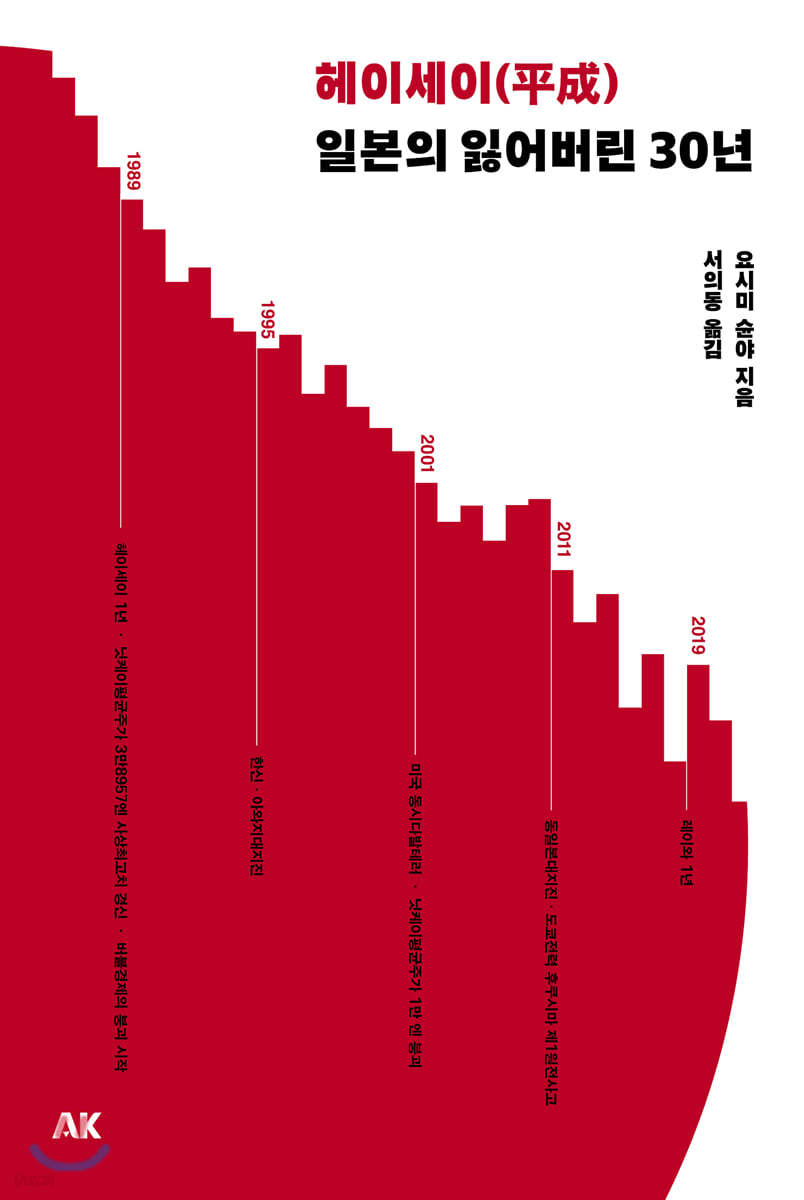
Heisei Japan's Lost 30 Years
 |
Description
Book Introduction
Japan is no longer a country that enjoys abundance or is at the forefront of the world.
It is a country full of anxiety and challenges, with repeated failures and deviations.
(In the text) Japan, in the midst of the shock of the collapse of the economic bubble, the great earthquake, the Aum Shinrikyo incident, and the Fukushima nuclear accident, has seen the decline of the home appliance kingdom, the failure of political reform, and has been plunged into low birth rates and poverty.
The success of the Showa era was breeding the failures and frustrations of the Heisei era.
The "Heisei Failure Museum" built within a book by a prominent Japanese sociologist.
It is a country full of anxiety and challenges, with repeated failures and deviations.
(In the text) Japan, in the midst of the shock of the collapse of the economic bubble, the great earthquake, the Aum Shinrikyo incident, and the Fukushima nuclear accident, has seen the decline of the home appliance kingdom, the failure of political reform, and has been plunged into low birth rates and poverty.
The success of the Showa era was breeding the failures and frustrations of the Heisei era.
The "Heisei Failure Museum" built within a book by a prominent Japanese sociologist.
index
The Failure of Heisei—What Are the "Lost 30 Years"?
The Museum of Failure / The Failure of 'Heisei' / Political Frustration and the Irreversible Minority / The Reversal of 'Showa' / Four Shocks / 'Heisei' in World History
Chapter 1: The Declining Corporate State: Bank Failure, Home Appliance Failure
Japan, strutting on the brink / Interest rate hike delayed by two and a half years / Japan's fortunes fall flat / The shock of Yamaichi Securities' voluntary closure / The Showa era that conceived Yamaichi Securities' collapse / Japan's crushing defeat in the semiconductor market / The curse of 'home appliances' and the end of the myth / Examining Toshiba's failure / Japanese society intoxicated by the Carlos Ghosn myth
Chapter 2: The Disillusionment of Post-War Politics: The Populism of "Reform"
Liquefaction in a Bubble――The Recruit Incident / Changing the System of Political Theater――The Introduction of the Single-Member District System / What the New Japanese Party Boom Left Behind / The Full Story of Electoral System Reform――Reformers and Conservatives / The Betrayal of Labor Unions: The Plight of the Socialist Party / The Chaos of the Socialist Party on the Road to Self-Destruction / Destroying the Liberal Democratic Party――How the Koizumi Theater Works / The Birth of the Democratic Party Government and "Political Leadership" / The Errors and Full Story of the National Strategy Bureau's Concept / The Abe Government――Liquidating Politics and Relations and "Official Residence Leadership"
Chapter 3: Japan Transforming in the Face of Shock—Social Continuity and Discontinuity
Between 'Failure' and 'Shock' / Two Great Earthquakes and the Fukushima Nuclear Accident / The Aum Shinrikyo Incident and the Media's Fiction / The Loss of Self in the First Year of Heisei / The Widening Gap - Young People Despairing About the Future / The Institutionalization of Gap: Heisei Japan's Move to a Class Society / The Unstoppable Aging of the Population / The Vanishing Provinces - Japan's Unsustainability
Chapter 4: Fictionalizing Identity: The Whereabouts of "America Nippon"
A premonition of the 'end' / 'Sea of Corruption' and 'superpowers' / 'America' as the Other = Self / 'Japan' as a fiction / Namie Amuro, women, and Okinawa / A change of protagonists in the midst of a climax - two female stars / The climax and collapse 10 years later - 1989 and 1998 / Cosplaying self-performance / The transition in the late 1990s - the environmentalizing Internet world / The autistic Internet society
The Heisei Era in World History: A Prelude to a Lost Half-Century
Thinking about 'Heisei' as an era / Heading towards the Olympics again / For whom and what are the Olympics? / The relocation of Futenma Air Base and the anger of Okinawa / Looking at Heisei Japan from Okinawa / Rising Asia Alone
Japan's Falling Back / The Demographic Inevitability of the "Lost 30 Years"
Reviews
Translator's Note
Chronology
Key Citations and References
The Museum of Failure / The Failure of 'Heisei' / Political Frustration and the Irreversible Minority / The Reversal of 'Showa' / Four Shocks / 'Heisei' in World History
Chapter 1: The Declining Corporate State: Bank Failure, Home Appliance Failure
Japan, strutting on the brink / Interest rate hike delayed by two and a half years / Japan's fortunes fall flat / The shock of Yamaichi Securities' voluntary closure / The Showa era that conceived Yamaichi Securities' collapse / Japan's crushing defeat in the semiconductor market / The curse of 'home appliances' and the end of the myth / Examining Toshiba's failure / Japanese society intoxicated by the Carlos Ghosn myth
Chapter 2: The Disillusionment of Post-War Politics: The Populism of "Reform"
Liquefaction in a Bubble――The Recruit Incident / Changing the System of Political Theater――The Introduction of the Single-Member District System / What the New Japanese Party Boom Left Behind / The Full Story of Electoral System Reform――Reformers and Conservatives / The Betrayal of Labor Unions: The Plight of the Socialist Party / The Chaos of the Socialist Party on the Road to Self-Destruction / Destroying the Liberal Democratic Party――How the Koizumi Theater Works / The Birth of the Democratic Party Government and "Political Leadership" / The Errors and Full Story of the National Strategy Bureau's Concept / The Abe Government――Liquidating Politics and Relations and "Official Residence Leadership"
Chapter 3: Japan Transforming in the Face of Shock—Social Continuity and Discontinuity
Between 'Failure' and 'Shock' / Two Great Earthquakes and the Fukushima Nuclear Accident / The Aum Shinrikyo Incident and the Media's Fiction / The Loss of Self in the First Year of Heisei / The Widening Gap - Young People Despairing About the Future / The Institutionalization of Gap: Heisei Japan's Move to a Class Society / The Unstoppable Aging of the Population / The Vanishing Provinces - Japan's Unsustainability
Chapter 4: Fictionalizing Identity: The Whereabouts of "America Nippon"
A premonition of the 'end' / 'Sea of Corruption' and 'superpowers' / 'America' as the Other = Self / 'Japan' as a fiction / Namie Amuro, women, and Okinawa / A change of protagonists in the midst of a climax - two female stars / The climax and collapse 10 years later - 1989 and 1998 / Cosplaying self-performance / The transition in the late 1990s - the environmentalizing Internet world / The autistic Internet society
The Heisei Era in World History: A Prelude to a Lost Half-Century
Thinking about 'Heisei' as an era / Heading towards the Olympics again / For whom and what are the Olympics? / The relocation of Futenma Air Base and the anger of Okinawa / Looking at Heisei Japan from Okinawa / Rising Asia Alone
Japan's Falling Back / The Demographic Inevitability of the "Lost 30 Years"
Reviews
Translator's Note
Chronology
Key Citations and References
Into the book
What I'm trying to do now is to create a kind of museum about the failure of the Heisei era, in a single book.
The 30 years of the Heisei era from 1989 to 2019 were, in a word, an "era of failure."
You could call it the 'lost 30 years'.
In this era, countless 'failures' have been repeated in various fields.
However, while it is easy to list the 'failures', it is not easy to reveal how they were all connected and why we were unable to escape the chain of 'failures' for 30 years.
How far did Heisei's 'failure' begin and end, and how was it inevitable?
--- p.10
Already in the late 1980s, the Asian market was growing rapidly.
What is needed to reorganize Japan's postwar industrial system, which developed around the US-Japan alliance, to focus on its relationship with Asia?
It wasn't long before Japanese companies began building factories in Asia en masse, but shouldn't a shift toward a system that fully caters to Asia in terms of demand have been induced through policy starting in the 1980s?
However, such structural changes were postponed, and responses through interest rate cuts were prioritized, resulting in weak effects and absurdly large side effects.
--- p.51
The first factor in the failure was that Japan's major electrical industries failed to fully recognize the end of the TV era and the advent of a mobile network society.
(Omitted) Another reason is that Japanese companies were unable to adapt to the horizontal division of labor structure that has been implemented on a global scale since the 1990s.
This new system rendered meaningless the traditional Japanese concepts of 'affiliation' and 'subcontracting'.
In other words, Japanese companies were required to fundamentally change the organizational principles they had become accustomed to for a long time.
This was not easy for traditional Japanese conglomerates.
--- p.67
The political history of the early Heisei period was marked by debates over electoral reform, particularly the introduction of a single-member district system.
In this respect, both the Liberal Democratic Party and the Socialist Party were split into two factions: the "conservatives" and the "reformists."
Those who were called 'conservatives' were politicians who built their political base within the 55-year system of 'conservative' and 'innovative' confrontation based on the multi-member district system.
The "reformists" were politicians who hoped to build a new power base by destroying the electoral system that had supported factional politics within the Liberal Democratic Party and the complementary relationship between the Liberal Democratic Party and the Social Democratic Party.
(syncopation)
The internal collapse of the government-run labor union centered around the General Assembly significantly weakened the organizational foundation of the Socialist Party.
The Socialist Party, having lost its solid organizational foundation, began to decline in the 1990s.
Not long ago, the Socialist Party had a last chance to transform itself from a left-wing party dependent on the General Council of Trade Unions into a liberal party with a grassroots base like European social democratic parties.
The Doi boom that occurred around the time of the transition from Showa to Heisei was an opportunity.
(syncopation)
What Doi attempted around this time was to shift the focus of the Socialist Party from 'class' to 'gender'.
After this transition, a new socialist party strategy was expected to emerge, centered on the issues of 'region' and 'generation', that is, local areas and the aging population.
--- p.103
The Abe administration rejected the radical political leadership of the Democratic Party of Korea and replaced it with a cunning leadership from the government office.
The official residence was able to manipulate the bureaucrats of the government office as it wished, and the Cabinet Personnel Bureau and the Economic and Financial Advisory Council were sufficient to determine the direction of the budget.
By managing the bureau chief-level personnel of the ministry, the Chief Cabinet Secretary could exert absolute influence over the entire ministry, and by skillfully combining populism and the use of civilians in the Economic and Fiscal Advisory Council, as in the Koizumi administration, he could create an image of "politics-led" public opinion.
--- p.147
The 2011 Great East Japan Earthquake and the 1995 Great Hanshin-Awaji Earthquake share the commonality of fundamentally pointing out the dangers of Japan's high-growth developmentalism.
The earthquake not only exposed the limitations of technologies like nuclear power plants, highways, and artificial islands, but also revealed that the foundations of a society once thought to be unshakeable after the war were surprisingly fragile and unstable.
--- p.167
Ultimately, what Heisei Japanese society was headed toward was the entrenchment of a system in which the entire society exploited young people, women, and foreign workers in irregular employment.
The ideology that justified this was neoliberalism, and the catchphrase mobilized here was ‘structural reform.’
What emerged as this system infiltrated was a 'post-Heisei' class society that overturned the 'postwar' total middle class.
--- p.195
Looking back, there was a chance.
The term 'miniaturization' first appeared in a government white paper in 1992, but at that time, Dankai Juniors were still before the optimal age for childbirth, so there must have been quite effective means available.
However, at the time, Japanese society was desperate to deal with the aftermath of the bubble burst, and at the same time, politics was focused on 'politics-led'.
Even when social welfare policies were put on the agenda, there were many measures to address the aging population, and measures to address the small population were put on the back burner.
It is said that this was because the elderly were eligible, but neither the youth nor the infants were eligible.
--- p.208
Namie Amuro didn't make her breakthrough as an "idol" in the 1990s music scene.
What made his leap possible was not the preference for 'coolness' of his male contemporaries, but the realization of the desire for coolness desired by women, not men.
Amuro's sudden marriage, childbirth, and one-year parental leave were well-received because the core group that accepted him was women.
--- p.241
What was unfortunate about Heisei Japan was that the fundamental transformation of its social system due to globalization and the Internet era coincided with a period of economic and demographic decline.
In cases where these changes coincide with economic and population expansion, such as in emerging countries like China, it is possible to use these changes as the basis for development.
However, the political and economic framework of the high-growth period was established, and Japanese society, which had reached its peak with the bubble, had to go through the Heisei period, which was hit by the bubble burst, population decline, globalization, and the internet society all at once.
--- p.271
Amidst geopolitical changes, Heisei Japan's dependence on the United States deepened.
As they lost confidence, they tried to maintain their centrality by relying more and more on a strong United States.
Just as Japan, which is widening the gap and deepening divisions domestically, has no future, so too does Japan, which continues to depend on the United States, whose hegemony is already beginning to be overshadowed, and refuses to fundamentally rebuild its relationship with Asia, have no future.
The 30 years of the Heisei era from 1989 to 2019 were, in a word, an "era of failure."
You could call it the 'lost 30 years'.
In this era, countless 'failures' have been repeated in various fields.
However, while it is easy to list the 'failures', it is not easy to reveal how they were all connected and why we were unable to escape the chain of 'failures' for 30 years.
How far did Heisei's 'failure' begin and end, and how was it inevitable?
--- p.10
Already in the late 1980s, the Asian market was growing rapidly.
What is needed to reorganize Japan's postwar industrial system, which developed around the US-Japan alliance, to focus on its relationship with Asia?
It wasn't long before Japanese companies began building factories in Asia en masse, but shouldn't a shift toward a system that fully caters to Asia in terms of demand have been induced through policy starting in the 1980s?
However, such structural changes were postponed, and responses through interest rate cuts were prioritized, resulting in weak effects and absurdly large side effects.
--- p.51
The first factor in the failure was that Japan's major electrical industries failed to fully recognize the end of the TV era and the advent of a mobile network society.
(Omitted) Another reason is that Japanese companies were unable to adapt to the horizontal division of labor structure that has been implemented on a global scale since the 1990s.
This new system rendered meaningless the traditional Japanese concepts of 'affiliation' and 'subcontracting'.
In other words, Japanese companies were required to fundamentally change the organizational principles they had become accustomed to for a long time.
This was not easy for traditional Japanese conglomerates.
--- p.67
The political history of the early Heisei period was marked by debates over electoral reform, particularly the introduction of a single-member district system.
In this respect, both the Liberal Democratic Party and the Socialist Party were split into two factions: the "conservatives" and the "reformists."
Those who were called 'conservatives' were politicians who built their political base within the 55-year system of 'conservative' and 'innovative' confrontation based on the multi-member district system.
The "reformists" were politicians who hoped to build a new power base by destroying the electoral system that had supported factional politics within the Liberal Democratic Party and the complementary relationship between the Liberal Democratic Party and the Social Democratic Party.
(syncopation)
The internal collapse of the government-run labor union centered around the General Assembly significantly weakened the organizational foundation of the Socialist Party.
The Socialist Party, having lost its solid organizational foundation, began to decline in the 1990s.
Not long ago, the Socialist Party had a last chance to transform itself from a left-wing party dependent on the General Council of Trade Unions into a liberal party with a grassroots base like European social democratic parties.
The Doi boom that occurred around the time of the transition from Showa to Heisei was an opportunity.
(syncopation)
What Doi attempted around this time was to shift the focus of the Socialist Party from 'class' to 'gender'.
After this transition, a new socialist party strategy was expected to emerge, centered on the issues of 'region' and 'generation', that is, local areas and the aging population.
--- p.103
The Abe administration rejected the radical political leadership of the Democratic Party of Korea and replaced it with a cunning leadership from the government office.
The official residence was able to manipulate the bureaucrats of the government office as it wished, and the Cabinet Personnel Bureau and the Economic and Financial Advisory Council were sufficient to determine the direction of the budget.
By managing the bureau chief-level personnel of the ministry, the Chief Cabinet Secretary could exert absolute influence over the entire ministry, and by skillfully combining populism and the use of civilians in the Economic and Fiscal Advisory Council, as in the Koizumi administration, he could create an image of "politics-led" public opinion.
--- p.147
The 2011 Great East Japan Earthquake and the 1995 Great Hanshin-Awaji Earthquake share the commonality of fundamentally pointing out the dangers of Japan's high-growth developmentalism.
The earthquake not only exposed the limitations of technologies like nuclear power plants, highways, and artificial islands, but also revealed that the foundations of a society once thought to be unshakeable after the war were surprisingly fragile and unstable.
--- p.167
Ultimately, what Heisei Japanese society was headed toward was the entrenchment of a system in which the entire society exploited young people, women, and foreign workers in irregular employment.
The ideology that justified this was neoliberalism, and the catchphrase mobilized here was ‘structural reform.’
What emerged as this system infiltrated was a 'post-Heisei' class society that overturned the 'postwar' total middle class.
--- p.195
Looking back, there was a chance.
The term 'miniaturization' first appeared in a government white paper in 1992, but at that time, Dankai Juniors were still before the optimal age for childbirth, so there must have been quite effective means available.
However, at the time, Japanese society was desperate to deal with the aftermath of the bubble burst, and at the same time, politics was focused on 'politics-led'.
Even when social welfare policies were put on the agenda, there were many measures to address the aging population, and measures to address the small population were put on the back burner.
It is said that this was because the elderly were eligible, but neither the youth nor the infants were eligible.
--- p.208
Namie Amuro didn't make her breakthrough as an "idol" in the 1990s music scene.
What made his leap possible was not the preference for 'coolness' of his male contemporaries, but the realization of the desire for coolness desired by women, not men.
Amuro's sudden marriage, childbirth, and one-year parental leave were well-received because the core group that accepted him was women.
--- p.241
What was unfortunate about Heisei Japan was that the fundamental transformation of its social system due to globalization and the Internet era coincided with a period of economic and demographic decline.
In cases where these changes coincide with economic and population expansion, such as in emerging countries like China, it is possible to use these changes as the basis for development.
However, the political and economic framework of the high-growth period was established, and Japanese society, which had reached its peak with the bubble, had to go through the Heisei period, which was hit by the bubble burst, population decline, globalization, and the internet society all at once.
--- p.271
Amidst geopolitical changes, Heisei Japan's dependence on the United States deepened.
As they lost confidence, they tried to maintain their centrality by relying more and more on a strong United States.
Just as Japan, which is widening the gap and deepening divisions domestically, has no future, so too does Japan, which continues to depend on the United States, whose hegemony is already beginning to be overshadowed, and refuses to fundamentally rebuild its relationship with Asia, have no future.
--- p.307
Publisher's Review
"Japan's Latest State of the Art" delves into the causes of Japan's failures during the Heisei era.
Japan's Heisei era (1989-2019) was a "lost 30 years," marked by the catastrophic events of two major earthquakes and the Fukushima nuclear accident, the failure of political reform experiments, and the subsequent collapse of companies like Sharp and Toshiba, who failed to adapt to the changing global era.
Japanese companies, which accounted for 32 of the world's top 50 companies by market capitalization in 1989, were wiped out by 2018, with the exception of Toyota (ranked 35th).
Socially, various problems such as an increase in irregular employment, population decline, and the crisis of local extinction have occurred, and bizarre incidents such as the subway sarin gas attack by the Aum Shinrikyo cult have also caused shock.
The Great East Japan Earthquake and the nuclear power plant accident completely exposed the limitations of the Japanese system, which was established after the war and had operated relatively smoothly until the Showa era.
The late Heisei period was when "liquefaction," in which soft ground absorbs moisture and turns into a liquid-like state, became prominent in various fields of Japanese society.
The author diagnoses that the liquefaction of Heisei was not a sudden occurrence, but rather a result of ground weakening that occurred during the Showa era.
Although the whirlwind of a major global transformation had been brewing since the late 1970s, Japan was unable to face the changes, caught up in the sense of relief that came from having successfully overcome the oil shock.
The author's diagnosis is that this sense of security led to the formation and collapse of the economic bubble in the 1980s and the failure to respond to the various risks and challenges of globalization that unfolded after the 1990s.
As a result, Japan became frustrated amidst the various shocks that occurred in Heisei Japan (the collapse of the bubble economy, the Great Hanshin-Awaji Earthquake and the Aum Shinrikyo incident, the 2001 simultaneous terrorist attacks in the United States and the subsequent instability of the international situation, the 2011 Great East Japan Earthquake and the Tokyo Electric Power Company Fukushima Daiichi Nuclear Power Plant accident), as well as the concurrent developments of globalization, net society, and low birth rate and aging population, and attempts to overcome these failed.
It goes without saying that the brilliant success story of the Showa era made it difficult for Japan to change course in the Heisei era.
The absurd collapse of Japan's electrical and electronics industry, once considered the world's best, is a prime example.
What is the future of Japan, pushed out of the center of East Asia?
Heisei also marked the end of Japan's position as the center of East Asia.
Japan, which achieved the Meiji Restoration about 150 years ago, adopted Western technology, systems, and knowledge with all its might and grew into an imperialist nation in East Asia in just 30 years.
Even after its defeat in World War II, Japan tried to maintain its centrality through integration with the United States.
However, the author analyzes that during the Heisei era after the Cold War, the center of East Asia shifted from Japan to China.
The author predicts that Japan will become an increasingly aging society, that growth will become an illusion, and that the government will desperately try to stimulate the economy by any means necessary, even if it means taking risks.
Therefore, there is a possibility that a second or third bubble burst may occur.
It was predicted that the deterioration of society as a whole would not stop, as neoliberal policies were further implemented to overcome the economic downturn, and the public sector was further reduced through tax cuts and deregulation, and even if the economy was temporarily stimulated, the gap would widen.
There is also concern that the 'lost 30 years' could become a 'lost half century'.
The author points out that facing the reality of the crisis head-on and making sure everyone understands it as a crisis can be the starting point for overcoming it.
What are the implications for Korea?
The author's greatest concerns in the social sphere of the Heisei era are the ultra-low birth rate and widening gap.
Although the lack of institutions and systems has accelerated the low birth rate, the biggest cause is 'poverty'.
After the bubble burst, companies massively increased the number of non-regular workers, destroying the livelihoods of workers and making it difficult for them to plan their lives, which led to low birth rates.
But this is also a problem that Korea is facing more seriously.
South Korea's total fertility rate fell to 0.98 in 2018 and 0.92 in 2019, recording a fertility rate in the 0s for the second consecutive year.
It is the only country among the 36 member countries of the Organization for Economic Cooperation and Development (OECD) with a birth rate in the 0 range.
Japan, which maintains a total fertility rate of 1.4, is relatively better.
The structural background of the low birth rate phenomenon appears similar at first glance, but in Korea, we cannot help but add that the heavy burden of education and housing costs makes not only childbirth but also marriage itself difficult.
This book is significant in that it presents the most recent trends in modern history of Japan, the country with the most similar system to Korea in the world.
Can Korea avoid the crisis Japan is currently facing?
A look back at Heisei Japan's "museum of failure" could serve as a lesson for Korean readers.
Various figures who shaped modern Japan
This book features a variety of figures from various fields, including Shoko Asahara, the leader of the Aum Shinrikyo cult; Carlos Ghosn, former chairman of Nissan; popular singers Hibari Misora, Tetsuya Komuro, Namie Amuro, and Hikaru Utada; and animation directors Hayao Miyazaki, Hideaki Anno, and Katsuhiro Otomo, and shows how they wove the Heisei era of Japan.
It is also interesting to see how the "apocalypse" narrative, which frequently appears in Japanese subculture, corresponds to the Heisei era.
Japan's Heisei era (1989-2019) was a "lost 30 years," marked by the catastrophic events of two major earthquakes and the Fukushima nuclear accident, the failure of political reform experiments, and the subsequent collapse of companies like Sharp and Toshiba, who failed to adapt to the changing global era.
Japanese companies, which accounted for 32 of the world's top 50 companies by market capitalization in 1989, were wiped out by 2018, with the exception of Toyota (ranked 35th).
Socially, various problems such as an increase in irregular employment, population decline, and the crisis of local extinction have occurred, and bizarre incidents such as the subway sarin gas attack by the Aum Shinrikyo cult have also caused shock.
The Great East Japan Earthquake and the nuclear power plant accident completely exposed the limitations of the Japanese system, which was established after the war and had operated relatively smoothly until the Showa era.
The late Heisei period was when "liquefaction," in which soft ground absorbs moisture and turns into a liquid-like state, became prominent in various fields of Japanese society.
The author diagnoses that the liquefaction of Heisei was not a sudden occurrence, but rather a result of ground weakening that occurred during the Showa era.
Although the whirlwind of a major global transformation had been brewing since the late 1970s, Japan was unable to face the changes, caught up in the sense of relief that came from having successfully overcome the oil shock.
The author's diagnosis is that this sense of security led to the formation and collapse of the economic bubble in the 1980s and the failure to respond to the various risks and challenges of globalization that unfolded after the 1990s.
As a result, Japan became frustrated amidst the various shocks that occurred in Heisei Japan (the collapse of the bubble economy, the Great Hanshin-Awaji Earthquake and the Aum Shinrikyo incident, the 2001 simultaneous terrorist attacks in the United States and the subsequent instability of the international situation, the 2011 Great East Japan Earthquake and the Tokyo Electric Power Company Fukushima Daiichi Nuclear Power Plant accident), as well as the concurrent developments of globalization, net society, and low birth rate and aging population, and attempts to overcome these failed.
It goes without saying that the brilliant success story of the Showa era made it difficult for Japan to change course in the Heisei era.
The absurd collapse of Japan's electrical and electronics industry, once considered the world's best, is a prime example.
What is the future of Japan, pushed out of the center of East Asia?
Heisei also marked the end of Japan's position as the center of East Asia.
Japan, which achieved the Meiji Restoration about 150 years ago, adopted Western technology, systems, and knowledge with all its might and grew into an imperialist nation in East Asia in just 30 years.
Even after its defeat in World War II, Japan tried to maintain its centrality through integration with the United States.
However, the author analyzes that during the Heisei era after the Cold War, the center of East Asia shifted from Japan to China.
The author predicts that Japan will become an increasingly aging society, that growth will become an illusion, and that the government will desperately try to stimulate the economy by any means necessary, even if it means taking risks.
Therefore, there is a possibility that a second or third bubble burst may occur.
It was predicted that the deterioration of society as a whole would not stop, as neoliberal policies were further implemented to overcome the economic downturn, and the public sector was further reduced through tax cuts and deregulation, and even if the economy was temporarily stimulated, the gap would widen.
There is also concern that the 'lost 30 years' could become a 'lost half century'.
The author points out that facing the reality of the crisis head-on and making sure everyone understands it as a crisis can be the starting point for overcoming it.
What are the implications for Korea?
The author's greatest concerns in the social sphere of the Heisei era are the ultra-low birth rate and widening gap.
Although the lack of institutions and systems has accelerated the low birth rate, the biggest cause is 'poverty'.
After the bubble burst, companies massively increased the number of non-regular workers, destroying the livelihoods of workers and making it difficult for them to plan their lives, which led to low birth rates.
But this is also a problem that Korea is facing more seriously.
South Korea's total fertility rate fell to 0.98 in 2018 and 0.92 in 2019, recording a fertility rate in the 0s for the second consecutive year.
It is the only country among the 36 member countries of the Organization for Economic Cooperation and Development (OECD) with a birth rate in the 0 range.
Japan, which maintains a total fertility rate of 1.4, is relatively better.
The structural background of the low birth rate phenomenon appears similar at first glance, but in Korea, we cannot help but add that the heavy burden of education and housing costs makes not only childbirth but also marriage itself difficult.
This book is significant in that it presents the most recent trends in modern history of Japan, the country with the most similar system to Korea in the world.
Can Korea avoid the crisis Japan is currently facing?
A look back at Heisei Japan's "museum of failure" could serve as a lesson for Korean readers.
Various figures who shaped modern Japan
This book features a variety of figures from various fields, including Shoko Asahara, the leader of the Aum Shinrikyo cult; Carlos Ghosn, former chairman of Nissan; popular singers Hibari Misora, Tetsuya Komuro, Namie Amuro, and Hikaru Utada; and animation directors Hayao Miyazaki, Hideaki Anno, and Katsuhiro Otomo, and shows how they wove the Heisei era of Japan.
It is also interesting to see how the "apocalypse" narrative, which frequently appears in Japanese subculture, corresponds to the Heisei era.
GOODS SPECIFICS
- Date of publication: July 11, 2020
- Page count, weight, size: 348 pages | 368g | 128*188*30mm
- ISBN13: 9791127434045
You may also like
카테고리
korean


korean

![ELLE 엘르 스페셜 에디션 A형 : 12월 [2025]](http://librairie.coreenne.fr/cdn/shop/files/b8e27a3de6c9538896439686c6b0e8fb.jpg?v=1766436872&width=3840)


