

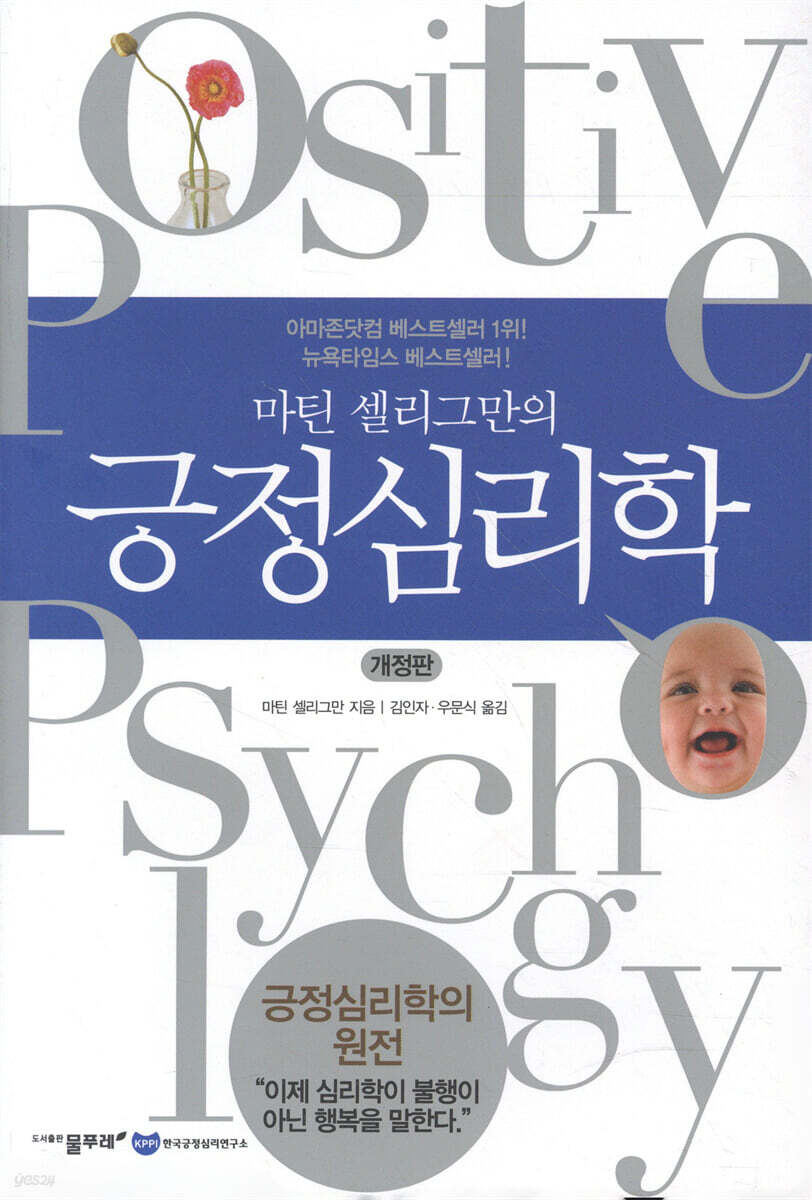
Martin Seligman's Positive Psychology
 |
Description
Book Introduction
If you are not happy now, learn to be happy!
What do people desire most? When Ed Diener and his colleagues asked citizens of major countries around the world, the most common answer was happiness.
So we work, rest, enjoy leisure, and love to be happy.
However, most people not only think that they are unhappy, but also think that happiness is something vague and difficult to achieve in reality.
Why am I so unhappy, even though I'm working so hard to be happy? What exactly is a happy life, and how can I achieve it? Countless people have talked about happiness and published books on it.
But no one, no book, has ever taught us how to scientifically study and create happiness.
That is, until a new applied discipline called positive psychology emerged.
Martin Seligman's 'positive psychology', which has garnered the most attention since Freud and has taken the psychology world by storm, is giving us a new message of hope by scientifically proving that anyone can learn to be happy.
He advises that in order to become happy, we must change our perspective on happiness, and that we can create 'true happiness' by cultivating optimism and positive emotions, finding our strengths, and using them in our daily lives to draw out and cultivate the happiness within us.
What do people desire most? When Ed Diener and his colleagues asked citizens of major countries around the world, the most common answer was happiness.
So we work, rest, enjoy leisure, and love to be happy.
However, most people not only think that they are unhappy, but also think that happiness is something vague and difficult to achieve in reality.
Why am I so unhappy, even though I'm working so hard to be happy? What exactly is a happy life, and how can I achieve it? Countless people have talked about happiness and published books on it.
But no one, no book, has ever taught us how to scientifically study and create happiness.
That is, until a new applied discipline called positive psychology emerged.
Martin Seligman's 'positive psychology', which has garnered the most attention since Freud and has taken the psychology world by storm, is giving us a new message of hope by scientifically proving that anyone can learn to be happy.
He advises that in order to become happy, we must change our perspective on happiness, and that we can create 'true happiness' by cultivating optimism and positive emotions, finding our strengths, and using them in our daily lives to draw out and cultivate the happiness within us.
- You can preview some of the book's contents.
Preview
index
Prologue: Happiness also has its own oily path.
Translator's Preface: The Brilliant Evolution of Positive Psychology
PART 1 Can we create happiness?
1.
Positive emotions and positive traits
2.
Positive Psychology I Discovered
3.
Why do we strive to be happy?
4.
There is a formula for happiness
PART 2 The Secret to Increasing Your Happiness
4.
Cultivating positive emotions from the past
5.
Cultivating positive emotions for the future
6.
Cultivating positive emotions in the present
PART 3 The Path to Satisfaction: Strengths and Virtues
7.
Strengths and virtues create happiness.
8.
What are my key strengths?
PART 4: Leveraging Your Strengths to Create a Happy Life
9.
Job: Pursue immersive experiences rather than material rewards.
10.
Love_The strengths and virtues of the other person make you feel loved.
11.
Parenting: The Key to Building a Happy Child Through Your Child's Strengths
12.
Summary: The Path to True Happiness
13.
Life Beyond Happiness: In Search of Meaning and Purpose
supplement
Acknowledgements
References
Translator's Preface: The Brilliant Evolution of Positive Psychology
PART 1 Can we create happiness?
1.
Positive emotions and positive traits
2.
Positive Psychology I Discovered
3.
Why do we strive to be happy?
4.
There is a formula for happiness
PART 2 The Secret to Increasing Your Happiness
4.
Cultivating positive emotions from the past
5.
Cultivating positive emotions for the future
6.
Cultivating positive emotions in the present
PART 3 The Path to Satisfaction: Strengths and Virtues
7.
Strengths and virtues create happiness.
8.
What are my key strengths?
PART 4: Leveraging Your Strengths to Create a Happy Life
9.
Job: Pursue immersive experiences rather than material rewards.
10.
Love_The strengths and virtues of the other person make you feel loved.
11.
Parenting: The Key to Building a Happy Child Through Your Child's Strengths
12.
Summary: The Path to True Happiness
13.
Life Beyond Happiness: In Search of Meaning and Purpose
supplement
Acknowledgements
References
Publisher's Review
“If you want to be happy, change your perspective on happiness!”
- Martin Seligman
If you are not happy now, learn to be happy!
What do people desire most? When Ed Diener and his colleagues asked citizens of major countries around the world, the most common answer was happiness.
So we work, rest, enjoy leisure, and love to be happy.
However, most people not only think that they are unhappy, but also think that happiness is something vague and difficult to achieve in reality.
Why am I so unhappy, even though I'm working so hard to be happy? What exactly is a happy life, and how can I achieve it? Countless people have talked about happiness and published books on it.
But no one, no book, has ever taught us how to scientifically study and create happiness.
That is, until a new applied discipline called positive psychology emerged.
Martin Seligman's 'positive psychology', which has garnered the most attention since Freud and has taken the psychology world by storm, is giving us a new message of hope by scientifically proving that anyone can learn to be happy.
He advises that in order to become happy, we must change our perspective on happiness, and that we can create 'true happiness' by cultivating optimism and positive emotions, finding our strengths, and using them in our daily lives to draw out and cultivate the happiness within us.
The Surprising Secrets of Positive Psychology for 'True Happiness'
Positive psychology was founded in 1998 by Martin Seligman, a psychology professor at the University of Pennsylvania who was then president of the American Psychological Association.
Positive psychology began with Martin Seligman's realization that the discipline of psychology had focused on human psychological problems and their treatment methods since World War II.
The most fundamental assumption of positive psychology is that humans are endowed with strengths, virtues, and excellences, just as they are endowed with illness, disease, and suffering.
So, positive psychology is interested in positive emotions and strengths as well as negative emotions and flaws of humans.
We are also as interested in making the best of what is wrong in our lives as we are in correcting what is wrong, and we are as interested in helping people achieve healthy lives as we are in healing the wounds of those who suffer.
Above all, positive psychology is a discipline that helps people actively create happiness.
Up until now, numerous psychologists, starting with William James, the founder of 'pragmatism', have mainly tried to make 'anger', 'worry', 'anxiety', 'concern', and 'depression' into a '0' state.
However, positive psychology does not stop at reducing negative emotions such as anger, worry, depression, and anxiety to 0, but rather turns them into + (plus).
The goal of positive psychology is not only to raise people from -5 to 0, but also to raise people from +2 to +6.
In other words, happiness in positive psychology is not satisfied with alleviating negative emotions and making people not unhappy, but rather making people who are not unhappy or only slightly happy happier.
Positive psychology is the academic study of optimal functioning and operation in individuals and organizations.
It is about seeing how positive emotions such as love, gratitude, joy, forgiveness, and job satisfaction, and strengths such as creativity, courage, appreciation, curiosity, and passion, work in our lives and produce what results.
The Impact of Positive Emotions on a Happy Life
The core of positive psychology is positive emotions and character strengths.
This is because how much we expand and build positive emotions through positive experiences on a daily basis and how we demonstrate positive emotions in our daily work, love, and child-rearing are important factors that determine happiness.
There are research results that examine the impact of positive emotions on a happy life.
- When nuns taking their final vows were asked to write a short essay introducing themselves, those who used emotional expressions like "I am truly happy" or "I am very happy" lived significantly longer than those whose essays contained no positive emotions at all.
That is, when researchers with no prior knowledge of the nuns' lifespans studied them based on the sum of their positive emotions, they found that 90% of the nuns in the most vibrant monasteries lived to be 85, while only 34% of the nuns in the least vibrant monasteries lived to be 85.
- In the graduation photo of the 141 students from Mills College's 1960 graduating class, about half had a Duchenne smile (a genuine smile from the heart).
These women met again when they were 27, 47, and 52 years old, and were surveyed about their marital and life satisfaction.
As a result, surprisingly, most of the female students with Duchenne smiles in their graduation photos were married and living happily for 30 years.
This result proves that a positive attitude is directly linked to a happy life.
This book persuasively addresses the topic of "true happiness" by drawing on various scientific research findings, while showing how people with a positive outlook on life cope with life.
However, unlike existing books, it does not provide abstract advice such as emptying the mind, but rather presents specific methods to understand, feel, learn, and practice happiness.
The secret to happiness lies in leveraging your strengths and virtues.
Howard Gardner, Dean of Harvard University's Graduate School of Education and founder of the theory of multiple intelligences, says that Martin Seligman's discovery of personality strengths is the greatest achievement in half a century of psychology.
This means that character strengths have a huge impact on happiness and satisfaction.
In this book, which paved a new path for psychology, Seligman argues that happiness is not the result of good genes or luck, but rather a life of discovering and developing one's own strengths and virtues, just as the "skills" of playing the violin or riding a bicycle are acquired through consistent practice, is the shortcut to "true happiness."
In this book, he describes 24 strengths and virtues.
It is argued that most people possess five "signature strengths" that can be used to discover and develop their greatest potential.
For example, it shows that integrating representative strengths such as kindness, creativity, sense of humor, optimism, curiosity, and passion into your life can increase life satisfaction and lead to a happier life.
This book contains practice tools and various tests to help readers increase their happiness index and positive emotions, and discover their strengths.
Packed with practical examples, advice, and how-tos, this book will help readers learn how to leverage their strengths in work, love, parenting, and leisure.
In particular, this revised edition will be helpful in understanding positive psychology and applying it to individuals and organizations, as it has been compiled by experts to document the evolution and achievements of positive psychology over the past 15 years.
Positive psychology will be the discipline that has brought about the greatest change in human understanding and growth since Freud.
Christopher Peterson, who contributed greatly to the birth of positive psychology, says that positive psychology is a scientific discipline that studies what a good life is in all events/experiences that occur between birth and death.
By understanding positive psychology through this book, you will be able to easily apply it not only to personal happiness, but also to child psychology, the study of the fetus and birth, including pregnant women, family medicine, psychiatry, and even politics, economics, management, literature, education, and social work.
- Martin Seligman
If you are not happy now, learn to be happy!
What do people desire most? When Ed Diener and his colleagues asked citizens of major countries around the world, the most common answer was happiness.
So we work, rest, enjoy leisure, and love to be happy.
However, most people not only think that they are unhappy, but also think that happiness is something vague and difficult to achieve in reality.
Why am I so unhappy, even though I'm working so hard to be happy? What exactly is a happy life, and how can I achieve it? Countless people have talked about happiness and published books on it.
But no one, no book, has ever taught us how to scientifically study and create happiness.
That is, until a new applied discipline called positive psychology emerged.
Martin Seligman's 'positive psychology', which has garnered the most attention since Freud and has taken the psychology world by storm, is giving us a new message of hope by scientifically proving that anyone can learn to be happy.
He advises that in order to become happy, we must change our perspective on happiness, and that we can create 'true happiness' by cultivating optimism and positive emotions, finding our strengths, and using them in our daily lives to draw out and cultivate the happiness within us.
The Surprising Secrets of Positive Psychology for 'True Happiness'
Positive psychology was founded in 1998 by Martin Seligman, a psychology professor at the University of Pennsylvania who was then president of the American Psychological Association.
Positive psychology began with Martin Seligman's realization that the discipline of psychology had focused on human psychological problems and their treatment methods since World War II.
The most fundamental assumption of positive psychology is that humans are endowed with strengths, virtues, and excellences, just as they are endowed with illness, disease, and suffering.
So, positive psychology is interested in positive emotions and strengths as well as negative emotions and flaws of humans.
We are also as interested in making the best of what is wrong in our lives as we are in correcting what is wrong, and we are as interested in helping people achieve healthy lives as we are in healing the wounds of those who suffer.
Above all, positive psychology is a discipline that helps people actively create happiness.
Up until now, numerous psychologists, starting with William James, the founder of 'pragmatism', have mainly tried to make 'anger', 'worry', 'anxiety', 'concern', and 'depression' into a '0' state.
However, positive psychology does not stop at reducing negative emotions such as anger, worry, depression, and anxiety to 0, but rather turns them into + (plus).
The goal of positive psychology is not only to raise people from -5 to 0, but also to raise people from +2 to +6.
In other words, happiness in positive psychology is not satisfied with alleviating negative emotions and making people not unhappy, but rather making people who are not unhappy or only slightly happy happier.
Positive psychology is the academic study of optimal functioning and operation in individuals and organizations.
It is about seeing how positive emotions such as love, gratitude, joy, forgiveness, and job satisfaction, and strengths such as creativity, courage, appreciation, curiosity, and passion, work in our lives and produce what results.
The Impact of Positive Emotions on a Happy Life
The core of positive psychology is positive emotions and character strengths.
This is because how much we expand and build positive emotions through positive experiences on a daily basis and how we demonstrate positive emotions in our daily work, love, and child-rearing are important factors that determine happiness.
There are research results that examine the impact of positive emotions on a happy life.
- When nuns taking their final vows were asked to write a short essay introducing themselves, those who used emotional expressions like "I am truly happy" or "I am very happy" lived significantly longer than those whose essays contained no positive emotions at all.
That is, when researchers with no prior knowledge of the nuns' lifespans studied them based on the sum of their positive emotions, they found that 90% of the nuns in the most vibrant monasteries lived to be 85, while only 34% of the nuns in the least vibrant monasteries lived to be 85.
- In the graduation photo of the 141 students from Mills College's 1960 graduating class, about half had a Duchenne smile (a genuine smile from the heart).
These women met again when they were 27, 47, and 52 years old, and were surveyed about their marital and life satisfaction.
As a result, surprisingly, most of the female students with Duchenne smiles in their graduation photos were married and living happily for 30 years.
This result proves that a positive attitude is directly linked to a happy life.
This book persuasively addresses the topic of "true happiness" by drawing on various scientific research findings, while showing how people with a positive outlook on life cope with life.
However, unlike existing books, it does not provide abstract advice such as emptying the mind, but rather presents specific methods to understand, feel, learn, and practice happiness.
The secret to happiness lies in leveraging your strengths and virtues.
Howard Gardner, Dean of Harvard University's Graduate School of Education and founder of the theory of multiple intelligences, says that Martin Seligman's discovery of personality strengths is the greatest achievement in half a century of psychology.
This means that character strengths have a huge impact on happiness and satisfaction.
In this book, which paved a new path for psychology, Seligman argues that happiness is not the result of good genes or luck, but rather a life of discovering and developing one's own strengths and virtues, just as the "skills" of playing the violin or riding a bicycle are acquired through consistent practice, is the shortcut to "true happiness."
In this book, he describes 24 strengths and virtues.
It is argued that most people possess five "signature strengths" that can be used to discover and develop their greatest potential.
For example, it shows that integrating representative strengths such as kindness, creativity, sense of humor, optimism, curiosity, and passion into your life can increase life satisfaction and lead to a happier life.
This book contains practice tools and various tests to help readers increase their happiness index and positive emotions, and discover their strengths.
Packed with practical examples, advice, and how-tos, this book will help readers learn how to leverage their strengths in work, love, parenting, and leisure.
In particular, this revised edition will be helpful in understanding positive psychology and applying it to individuals and organizations, as it has been compiled by experts to document the evolution and achievements of positive psychology over the past 15 years.
Positive psychology will be the discipline that has brought about the greatest change in human understanding and growth since Freud.
Christopher Peterson, who contributed greatly to the birth of positive psychology, says that positive psychology is a scientific discipline that studies what a good life is in all events/experiences that occur between birth and death.
By understanding positive psychology through this book, you will be able to easily apply it not only to personal happiness, but also to child psychology, the study of the fetus and birth, including pregnant women, family medicine, psychiatry, and even politics, economics, management, literature, education, and social work.
GOODS SPECIFICS
- Date of issue: April 3, 2014
- Page count, weight, size: 488 pages | 659g | 153*224*30mm
- ISBN13: 9788981103194
- ISBN10: 8981103194
You may also like
카테고리
korean


korean

![GQ KOREA Mark (Monthly): December [2025]](http://librairie.coreenne.fr/cdn/shop/files/8ef265dbbfbf186523ed75ba7319009d.jpg?v=1765340328&width=3840)


