

A History of Britain in One Night
 |
Description
Book Introduction
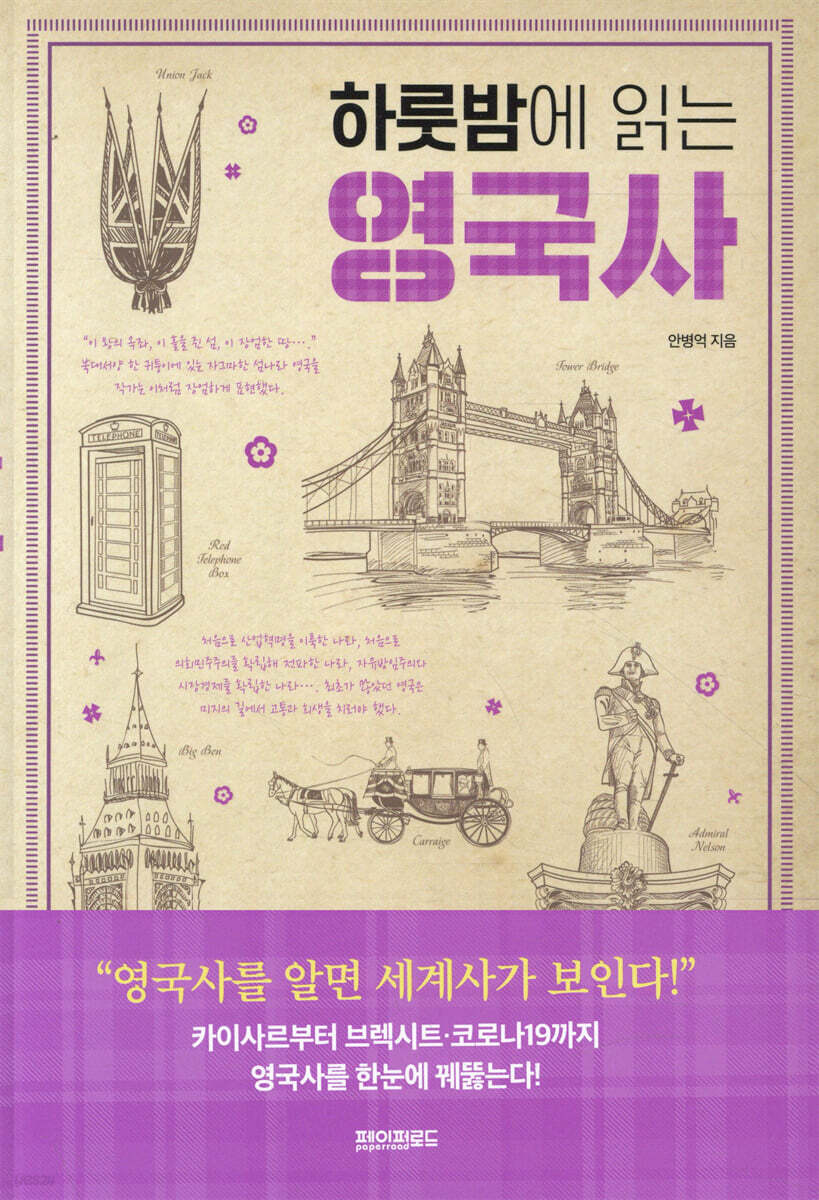
This book covers the history of Britain from Caesar's invasion to the present day, with Brexit and COVID-19.
For the British, world history is British history.
It was not only the British people's thoughts that were true, but it was also true in reality.
From the time of Caesar's expedition to Britain, and the beginning of the historical era, the history of Britain was the history of Europe, and during the period when Europe ruled the world, the history of Europe was the history of the world.
That history sometimes colored the world in a positive light, and sometimes pushed the world into darkness.
However, 『A History of Britain in One Night』 attempts to show these various aspects.
I tried to highlight both the bright side of history and the dark side it created.
Since history is made by people, instead of a simple textbook-style listing, we focused on people's actions, emotions, and motivations.
People create stories within events, and stories come together to form a larger flow that constitutes British history, or rather, world history.
Rather than a single, independent story, I tried to capture the story and the resonance it creates in the book.
The legend of King Arthur leads to the story of Henry VII, who admired him and named his son Arthur, and Arthur's sudden death led to the split in the Church of England.
It fought two Hundred Years' Wars with France (15th and 18th centuries) for hegemony over the European continent, the World Wars led to the creation of the European Union, and the post-war political changes, with the economy as the main focus, continued until today with Brexit.
Photographs, diagrams, detailed maps, and illustrations fill the pages, helping you immerse yourself in the story and organize history into a single flow.
This passage reveals the author's depth of knowledge, having worked as a journalist for over ten years, studied abroad in the UK, and is now a professor of international relations.
For the British, world history is British history.
It was not only the British people's thoughts that were true, but it was also true in reality.
From the time of Caesar's expedition to Britain, and the beginning of the historical era, the history of Britain was the history of Europe, and during the period when Europe ruled the world, the history of Europe was the history of the world.
That history sometimes colored the world in a positive light, and sometimes pushed the world into darkness.
However, 『A History of Britain in One Night』 attempts to show these various aspects.
I tried to highlight both the bright side of history and the dark side it created.
Since history is made by people, instead of a simple textbook-style listing, we focused on people's actions, emotions, and motivations.
People create stories within events, and stories come together to form a larger flow that constitutes British history, or rather, world history.
Rather than a single, independent story, I tried to capture the story and the resonance it creates in the book.
The legend of King Arthur leads to the story of Henry VII, who admired him and named his son Arthur, and Arthur's sudden death led to the split in the Church of England.
It fought two Hundred Years' Wars with France (15th and 18th centuries) for hegemony over the European continent, the World Wars led to the creation of the European Union, and the post-war political changes, with the economy as the main focus, continued until today with Brexit.
Photographs, diagrams, detailed maps, and illustrations fill the pages, helping you immerse yourself in the story and organize history into a single flow.
This passage reveals the author's depth of knowledge, having worked as a journalist for over ten years, studied abroad in the UK, and is now a professor of international relations.
- You can preview some of the book's contents.
Preview
index
Author's Note 4
Prologue: Let's Walk Through the Forest of England 13
Chapter 1 England under Roman Rule and the Anglo-Saxon Period
Are Britain and Turkey related? 23
Roman rule over Britain, which left behind the name Britannia 27
Anglo-Saxons come to Britain, pushed out by the Huns 33
Christianity Grew Alongside Monarchy 39
The Unification of England Amidst Viking Invasion 43
The Vikings who divided England eventually brought William the Conqueror back. 48
King Arthur, the eternal hero of the Celts 52
Chapter 2: England in the Middle Ages: From William the Conqueror to the Wars of the Roses
William the Conqueror, another Viking who conquered England again, 59
One country, two languages: French for the ruling class, English for the common people 67
Henry II, founder of the Plantagenet dynasty, and the martyr Thomas Becket 72
Magna Carta 76, the document in which King John surrendered to the barons
The king's tyranny institutionalized parliament 80
Oxbridge 84, which started as a priestly training institution
The Hundred Years' War (1337–1453) over territory and succession to the throne 88
John Wycliffe, the "Morning Star" of the Reformation, 93
The Black Death and Peasant Uprisings That Accelerated the Collapse of the Feudal System 97
The Wars of the Roses (1455–1485), a struggle for the throne between noble families. 102
Chapter 3: The Tudor and Stuart Eras: Absolute Monarchy and Two Revolutions
Henry VIII breaks with the Pope and becomes head of the Church of England. 109
Elizabeth I, the heroine who laid the foundation for a great empire, 114
"Sheep are eating people": The enclosure movement and the changing socioeconomic landscape 122
The Bloody Battle Between King and Parliament: The Puritan Revolution 1642–1649 127
Oliver Cromwell: Kingslayer or Parliamentarian Hero? 132
Was the Glorious Revolution really bloodless? 136
Absolute Monarch or People: Where Does Sovereignty Lie? Thomas Hobbes and John Locke 142
The United Kingdom of Great Britain was founded in 1707. 146
◆ The Church of England: A Look at Religious Conflicts 154
Chapter 4: The Establishment of the Empire and the Napoleonic Wars
The First Scandal of Political Collusion between the Hanoverian Dynasty and Germany 159
Robinhood and the Provisional Armistice with France 165
World Wars of the 18th Century: The Seven Years' War (1756–1763) 170
France's Revenge, Britain Loses Colonial America 177
Adam Smith Was Not a Market Fundamentalist 182
The Industrial Revolution and Innovation: James Watt and Richard Arkwright 187
The Slave Trade: The Seed Money of the Industrial Revolution 195
China rejects Britain twice 201
Edmund Burke and Thomas Paine: The Clash Between Conservatism and Radicalism 206
The Napoleonic Wars and 'Rule Britannia' 210
The British Museum as a Place of Memory 218
Chapter 5: The British Century: The 19th Century (1815–1913)
The Peterloo Massacre of 1819 and the Workers 227
A very gradual expansion of voting rights to include workers as voters. 231
From factions to political parties: the 1832 electoral reforms and the rise of the Conservative and Liberal parties. 237
The eternal rivals of late 19th-century politics: Gladstone and Disraeli 241
Moving Toward Free Trade: Repeal of the Corn Laws and the Free Trade Agreement with France 245
250 Changes in Universities: Developing Human Resources Necessary for Economic Development
The Long, Long Way to Legalize Trade Unions: The Industrial Revolution and Workers 254
Capitalism Will Inevitably Fail: Karl Marx's Warning 259
The London World's Fair and the Climax of the Industrial Revolution 265
Why Malthus's Population Explosion Didn't Happen: The Development of Economics, a "Gloomy Academic" 271
The Opium War, a "hundred years of humiliation" for China 277
Direct Rule of India and the Great Game with Russia 282
The Balance of Power and the Peace of Britain Pax Britannica 286
Darwin's theory of evolution, which degrades humans, is misused to justify imperialism. 293
The spread of the gold standard and the pound sterling as a reserve currency
The Long Depression (1873–1896) and the Scramble for African Colonies 302
From Autonomy to Independence: The Long, Long Road to Irish Independence 309
◆ Germany's Industrial Revolution: Why "Made in Germany" Overtook British Products 315
Sherlock Holmes, the most famous British figure 317
Chapter 6: From the 20th Century to Brexit: The Two World Wars, the Loss of Empire, and Europe
The First Civil War Between the European Powers: World War I (323)
The Versailles System, which led to the Second Civil War, ignored Keynes's warnings.
From a faction of the Liberal Party to the second largest party, World War I and the rise of the Labour Party 336
Premature Return to the Gold Standard, the Great Depression of the 1930s, and the Bloc Economy 340
Appeasement or Hardline: Could Hitler's Aggressive Ambition Be Stopped? 344
The Labour Party's rise to power after World War II and the establishment of the welfare state 350
Losing the Jewel and Facing the "Winds of Change": Colonial Independence After World War II 355
“I lost my empire, but I haven’t found my role yet.”
Belated Joining of European Integration 362
Thatcher, the "Iron Lady," who transformed the economy but divided the nation 368
The Labour Party's Return from the Wasteland, Its "Modernization," and the "New Labour" Party's 13 Years in Power 374
The Long Road to Peace: Northern Ireland's Peace Process 379
Princess Diana, the commoner's princess, and the royal crisis, the ill-fated Princess Diana 386
The British Royal Family, the Center of National Unity 391
Identity Politics Overwhelms Economic Benefits: Why Brexit Happened 396
Where will Britain go after Brexit? 'Empire 2.0'? 402
Is the relationship between the US and the UK truly special? 408
Is Tony Blair a war criminal? 411
◆ The UK's COVID-19 response received a failing grade, and Europe 413
415 Kings and Prime Ministers of the United Kingdom
Reference 425
map
Map of modern Britain 19
The main road network of 4th-century Britain 32
The Seven Anglo-Saxon Kingdoms 38
England and the Danelaw region, circa the late 9th century. 51
The Seven Years' War and the Major Fronts of Britain and France (Continental Europe) 174
The Seven Years' War and the Major Fronts of Britain and France (North America) 175
The Seven Years' War and the British and French Main Fronts (India) 175
Major cities, coal mines, and railroads during the Industrial Revolution 194
Map of Europe in 1812 217
1897 British Empire (Europe, Africa, Asia, Australia) 306
1897 British Empire (New Zealand, North America, South America) 307
1922 Ireland Map 311
359 African countries that gained independence from British colonies after World War II
Prologue: Let's Walk Through the Forest of England 13
Chapter 1 England under Roman Rule and the Anglo-Saxon Period
Are Britain and Turkey related? 23
Roman rule over Britain, which left behind the name Britannia 27
Anglo-Saxons come to Britain, pushed out by the Huns 33
Christianity Grew Alongside Monarchy 39
The Unification of England Amidst Viking Invasion 43
The Vikings who divided England eventually brought William the Conqueror back. 48
King Arthur, the eternal hero of the Celts 52
Chapter 2: England in the Middle Ages: From William the Conqueror to the Wars of the Roses
William the Conqueror, another Viking who conquered England again, 59
One country, two languages: French for the ruling class, English for the common people 67
Henry II, founder of the Plantagenet dynasty, and the martyr Thomas Becket 72
Magna Carta 76, the document in which King John surrendered to the barons
The king's tyranny institutionalized parliament 80
Oxbridge 84, which started as a priestly training institution
The Hundred Years' War (1337–1453) over territory and succession to the throne 88
John Wycliffe, the "Morning Star" of the Reformation, 93
The Black Death and Peasant Uprisings That Accelerated the Collapse of the Feudal System 97
The Wars of the Roses (1455–1485), a struggle for the throne between noble families. 102
Chapter 3: The Tudor and Stuart Eras: Absolute Monarchy and Two Revolutions
Henry VIII breaks with the Pope and becomes head of the Church of England. 109
Elizabeth I, the heroine who laid the foundation for a great empire, 114
"Sheep are eating people": The enclosure movement and the changing socioeconomic landscape 122
The Bloody Battle Between King and Parliament: The Puritan Revolution 1642–1649 127
Oliver Cromwell: Kingslayer or Parliamentarian Hero? 132
Was the Glorious Revolution really bloodless? 136
Absolute Monarch or People: Where Does Sovereignty Lie? Thomas Hobbes and John Locke 142
The United Kingdom of Great Britain was founded in 1707. 146
◆ The Church of England: A Look at Religious Conflicts 154
Chapter 4: The Establishment of the Empire and the Napoleonic Wars
The First Scandal of Political Collusion between the Hanoverian Dynasty and Germany 159
Robinhood and the Provisional Armistice with France 165
World Wars of the 18th Century: The Seven Years' War (1756–1763) 170
France's Revenge, Britain Loses Colonial America 177
Adam Smith Was Not a Market Fundamentalist 182
The Industrial Revolution and Innovation: James Watt and Richard Arkwright 187
The Slave Trade: The Seed Money of the Industrial Revolution 195
China rejects Britain twice 201
Edmund Burke and Thomas Paine: The Clash Between Conservatism and Radicalism 206
The Napoleonic Wars and 'Rule Britannia' 210
The British Museum as a Place of Memory 218
Chapter 5: The British Century: The 19th Century (1815–1913)
The Peterloo Massacre of 1819 and the Workers 227
A very gradual expansion of voting rights to include workers as voters. 231
From factions to political parties: the 1832 electoral reforms and the rise of the Conservative and Liberal parties. 237
The eternal rivals of late 19th-century politics: Gladstone and Disraeli 241
Moving Toward Free Trade: Repeal of the Corn Laws and the Free Trade Agreement with France 245
250 Changes in Universities: Developing Human Resources Necessary for Economic Development
The Long, Long Way to Legalize Trade Unions: The Industrial Revolution and Workers 254
Capitalism Will Inevitably Fail: Karl Marx's Warning 259
The London World's Fair and the Climax of the Industrial Revolution 265
Why Malthus's Population Explosion Didn't Happen: The Development of Economics, a "Gloomy Academic" 271
The Opium War, a "hundred years of humiliation" for China 277
Direct Rule of India and the Great Game with Russia 282
The Balance of Power and the Peace of Britain Pax Britannica 286
Darwin's theory of evolution, which degrades humans, is misused to justify imperialism. 293
The spread of the gold standard and the pound sterling as a reserve currency
The Long Depression (1873–1896) and the Scramble for African Colonies 302
From Autonomy to Independence: The Long, Long Road to Irish Independence 309
◆ Germany's Industrial Revolution: Why "Made in Germany" Overtook British Products 315
Sherlock Holmes, the most famous British figure 317
Chapter 6: From the 20th Century to Brexit: The Two World Wars, the Loss of Empire, and Europe
The First Civil War Between the European Powers: World War I (323)
The Versailles System, which led to the Second Civil War, ignored Keynes's warnings.
From a faction of the Liberal Party to the second largest party, World War I and the rise of the Labour Party 336
Premature Return to the Gold Standard, the Great Depression of the 1930s, and the Bloc Economy 340
Appeasement or Hardline: Could Hitler's Aggressive Ambition Be Stopped? 344
The Labour Party's rise to power after World War II and the establishment of the welfare state 350
Losing the Jewel and Facing the "Winds of Change": Colonial Independence After World War II 355
“I lost my empire, but I haven’t found my role yet.”
Belated Joining of European Integration 362
Thatcher, the "Iron Lady," who transformed the economy but divided the nation 368
The Labour Party's Return from the Wasteland, Its "Modernization," and the "New Labour" Party's 13 Years in Power 374
The Long Road to Peace: Northern Ireland's Peace Process 379
Princess Diana, the commoner's princess, and the royal crisis, the ill-fated Princess Diana 386
The British Royal Family, the Center of National Unity 391
Identity Politics Overwhelms Economic Benefits: Why Brexit Happened 396
Where will Britain go after Brexit? 'Empire 2.0'? 402
Is the relationship between the US and the UK truly special? 408
Is Tony Blair a war criminal? 411
◆ The UK's COVID-19 response received a failing grade, and Europe 413
415 Kings and Prime Ministers of the United Kingdom
Reference 425
map
Map of modern Britain 19
The main road network of 4th-century Britain 32
The Seven Anglo-Saxon Kingdoms 38
England and the Danelaw region, circa the late 9th century. 51
The Seven Years' War and the Major Fronts of Britain and France (Continental Europe) 174
The Seven Years' War and the Major Fronts of Britain and France (North America) 175
The Seven Years' War and the British and French Main Fronts (India) 175
Major cities, coal mines, and railroads during the Industrial Revolution 194
Map of Europe in 1812 217
1897 British Empire (Europe, Africa, Asia, Australia) 306
1897 British Empire (New Zealand, North America, South America) 307
1922 Ireland Map 311
359 African countries that gained independence from British colonies after World War II
Into the book
“This king’s throne, this scepter-holding island, this magnificent land…….
“This blessed place, this land, this kingdom, this England.” This is a line from Shakespeare’s play Richard II.
A scepter is a staff carried by a king as a symbol of royal authority.
The author expressed the small island nation of Britain, located in a corner of the North Atlantic, in such a magnificent way.
(…) After William, Duke of Normandy, conquered England in 1066, England had never been trampled by the hooves of invasion.
Even Napoleon and Hitler tried to conquer this tiny island, but in vain.
--- From "Prologue - Let's Walk Through the Forest of England"
The research team collected 2,574 DNA samples from people living across the island of Britain.
The sample was then compared for similarity with DNA samples from 10 other European countries, including Norway, Germany, France, Russia, Portugal, Slovenia, and Turkey.
Humans have 23 pairs of chromosomes, of which the Y chromosome is the sex chromosome found only in males.
A father passed it on to his son, and the unique Y chromosome of over 110 million men living on the European continent was almost identical to that of modern-day Turks.
It is said that the distant ancestors of the present-day British were Turks.
--- From "Britain and Turkey are relatives?"
When her husband died in battle with the Roman army and her daughter was raped in front of her, she gathered the surrounding tribes and fought against the Roman army.
In the final fierce battle near Colchester, Boadicea chose suicide rather than surrender.
And he left his name in history as a hero who demonstrated the Celts' spirit of resistance in the face of the elite Roman army with overwhelming force.
(…) Boadicea, or Boudica, is a Celtic word meaning ‘victory.’
Boudica was resurrected as a 'female heroine who protected Britain from foreign powers' during the reign of Queen Victoria, who ruled Britain during its golden age.
The statue in front of the Houses of Parliament was also created during this period and was erected on the site the year after the Queen's death.
--- From "Roman Rule in Britain, Which Left the Name Britannia"
On the eighth day of the battle, when a strong westerly wind blew, Commander Drake loaded gunpowder on an old merchant ship and sailed it close to the large Spanish warship. From a distance, he fired flaming arrows at the gunpowder on board the warship.
This fire attack disintegrated the Spanish fleet, with five ships lost that day alone.
The Spanish fleet turned towards Ireland and barely managed to return after two months.
It was a painful retreat in which 43 ships were lost and half of the soldiers were killed.
--- From "Appointing a Pirate as Commander and Defeating the Spanish Armada"
Queen Anne, who ascended the throne in 1702, gave birth to several children before her accession, but all of them died before they could survive childhood.
Parliament, judging that it would be difficult for the queen's children to succeed to the throne, enacted the Act of Succession in 1701, a year before her accession to the throne.
It was a law that prevented a Catholic from becoming king or leaving the country without the consent of Parliament, and was intended to block the succession of James III, the likely successor after Queen Anne's death.
--- From "The First Scandal of Collusion Between the Hanoverian Dynasty and the German Empire"
The Manchester Guardian, a daily newspaper, was founded in 1821 to promote workers' rights after the massacre.
The daily newspaper changed its name to The Guardian in 1959.
It is still being published as a progressive magazine.
In 2019, the city of Manchester unveiled a memorial ahead of the bicentenary of the massacre.
--- From "The Peterloo Massacre That Defined the 19th Century"
The fair was organized based on the idea of the Queen's husband, Prince Albert, to "hold a great industrial exhibition of all nations."
The total cost of construction of the Crystal Palace at that time was 2 million pounds.
Converted to the value at the end of 2019, it is worth approximately 280 million pounds (approximately 440 billion won).
The Sujeong Palace was 564 meters long and 39 meters high inside.
Even by modern standards, it's quite large.
“It was the most magnificent, beautiful and glorious day in British history,” the Queen wrote in her diary on the exhibition’s closing day.
Britain was the center of the world.
--- From "The London World's Fair and the Climax of the Industrial Revolution"
“The May 1910 procession, when nine kings followed Edward VII on horseback, was a magnificent one.” And it was “the sun of the old world setting in a radiance such as it will never see again.”
The Guns of August, a history book that analyzes the early years of World War I in depth, begins with the funeral above.
Less than four years and three months later, the kings and leaders of the major European nations, who were previously at war with each other, gathered together on that day, putting aside their conflicts.
Archduke Ferdinand of Austria, who attended the funeral that day, was assassinated by a Serbian nationalist in Sarajevo, the capital of Bosnia, on June 28, 1914.
Austria, with German support, declared war on Serbia at the end of July.
Russia sided with Serbia, and Germany declared war on Serbia, Russia, and France.
--- From "World War I, the First 'Civil War' of the European Powers"
Keynes's last paragraph gives us an idea of why the German people were so enthusiastic about Hitler's speech.
The Versailles system created by the Paris Peace Conference collapsed when the Great Depression occurred in 1929.
Germany printed money like crazy to pay the huge reparations demanded by France.
The Weimar Republic, Germany's first experiment in democracy, was plunged into political turmoil by hyperinflation exceeding hundreds of thousands of percent from 1923 onwards.
In the capital city of Berlin, a loaf of bread cost one hundred billion marks.
A year ago the price was 160 marks.
Hitler's Nazis grew in power amidst this chaos.
The German people were enthusiastic about the message of revenge and hope he put forth.
--- From "The Versailles System That Brought About the Second Civil War"
At the time of the 2016 referendum, there were around 3 million EU citizens living in the UK, including 800,000 Poles and 500,000 Romanians.
They were highly motivated, had higher employment rates than the British and paid three times more in taxes than they received in welfare benefits.
But politicians who supported Brexit prioritized identity, saying they should leave the EU because it would take away their welfare.
Rather than admitting the policy failures that cut welfare for the vulnerable in the midst of the economic crisis, they shifted the blame to outsiders.
The Brexit referendum revealed how deeply divided British society is along age, class and region lines.
Two-thirds of those aged 65 and over supported Brexit.
Meanwhile, the same percentage of people in their 20s supported remaining in the EU.
“This blessed place, this land, this kingdom, this England.” This is a line from Shakespeare’s play Richard II.
A scepter is a staff carried by a king as a symbol of royal authority.
The author expressed the small island nation of Britain, located in a corner of the North Atlantic, in such a magnificent way.
(…) After William, Duke of Normandy, conquered England in 1066, England had never been trampled by the hooves of invasion.
Even Napoleon and Hitler tried to conquer this tiny island, but in vain.
--- From "Prologue - Let's Walk Through the Forest of England"
The research team collected 2,574 DNA samples from people living across the island of Britain.
The sample was then compared for similarity with DNA samples from 10 other European countries, including Norway, Germany, France, Russia, Portugal, Slovenia, and Turkey.
Humans have 23 pairs of chromosomes, of which the Y chromosome is the sex chromosome found only in males.
A father passed it on to his son, and the unique Y chromosome of over 110 million men living on the European continent was almost identical to that of modern-day Turks.
It is said that the distant ancestors of the present-day British were Turks.
--- From "Britain and Turkey are relatives?"
When her husband died in battle with the Roman army and her daughter was raped in front of her, she gathered the surrounding tribes and fought against the Roman army.
In the final fierce battle near Colchester, Boadicea chose suicide rather than surrender.
And he left his name in history as a hero who demonstrated the Celts' spirit of resistance in the face of the elite Roman army with overwhelming force.
(…) Boadicea, or Boudica, is a Celtic word meaning ‘victory.’
Boudica was resurrected as a 'female heroine who protected Britain from foreign powers' during the reign of Queen Victoria, who ruled Britain during its golden age.
The statue in front of the Houses of Parliament was also created during this period and was erected on the site the year after the Queen's death.
--- From "Roman Rule in Britain, Which Left the Name Britannia"
On the eighth day of the battle, when a strong westerly wind blew, Commander Drake loaded gunpowder on an old merchant ship and sailed it close to the large Spanish warship. From a distance, he fired flaming arrows at the gunpowder on board the warship.
This fire attack disintegrated the Spanish fleet, with five ships lost that day alone.
The Spanish fleet turned towards Ireland and barely managed to return after two months.
It was a painful retreat in which 43 ships were lost and half of the soldiers were killed.
--- From "Appointing a Pirate as Commander and Defeating the Spanish Armada"
Queen Anne, who ascended the throne in 1702, gave birth to several children before her accession, but all of them died before they could survive childhood.
Parliament, judging that it would be difficult for the queen's children to succeed to the throne, enacted the Act of Succession in 1701, a year before her accession to the throne.
It was a law that prevented a Catholic from becoming king or leaving the country without the consent of Parliament, and was intended to block the succession of James III, the likely successor after Queen Anne's death.
--- From "The First Scandal of Collusion Between the Hanoverian Dynasty and the German Empire"
The Manchester Guardian, a daily newspaper, was founded in 1821 to promote workers' rights after the massacre.
The daily newspaper changed its name to The Guardian in 1959.
It is still being published as a progressive magazine.
In 2019, the city of Manchester unveiled a memorial ahead of the bicentenary of the massacre.
--- From "The Peterloo Massacre That Defined the 19th Century"
The fair was organized based on the idea of the Queen's husband, Prince Albert, to "hold a great industrial exhibition of all nations."
The total cost of construction of the Crystal Palace at that time was 2 million pounds.
Converted to the value at the end of 2019, it is worth approximately 280 million pounds (approximately 440 billion won).
The Sujeong Palace was 564 meters long and 39 meters high inside.
Even by modern standards, it's quite large.
“It was the most magnificent, beautiful and glorious day in British history,” the Queen wrote in her diary on the exhibition’s closing day.
Britain was the center of the world.
--- From "The London World's Fair and the Climax of the Industrial Revolution"
“The May 1910 procession, when nine kings followed Edward VII on horseback, was a magnificent one.” And it was “the sun of the old world setting in a radiance such as it will never see again.”
The Guns of August, a history book that analyzes the early years of World War I in depth, begins with the funeral above.
Less than four years and three months later, the kings and leaders of the major European nations, who were previously at war with each other, gathered together on that day, putting aside their conflicts.
Archduke Ferdinand of Austria, who attended the funeral that day, was assassinated by a Serbian nationalist in Sarajevo, the capital of Bosnia, on June 28, 1914.
Austria, with German support, declared war on Serbia at the end of July.
Russia sided with Serbia, and Germany declared war on Serbia, Russia, and France.
--- From "World War I, the First 'Civil War' of the European Powers"
Keynes's last paragraph gives us an idea of why the German people were so enthusiastic about Hitler's speech.
The Versailles system created by the Paris Peace Conference collapsed when the Great Depression occurred in 1929.
Germany printed money like crazy to pay the huge reparations demanded by France.
The Weimar Republic, Germany's first experiment in democracy, was plunged into political turmoil by hyperinflation exceeding hundreds of thousands of percent from 1923 onwards.
In the capital city of Berlin, a loaf of bread cost one hundred billion marks.
A year ago the price was 160 marks.
Hitler's Nazis grew in power amidst this chaos.
The German people were enthusiastic about the message of revenge and hope he put forth.
--- From "The Versailles System That Brought About the Second Civil War"
At the time of the 2016 referendum, there were around 3 million EU citizens living in the UK, including 800,000 Poles and 500,000 Romanians.
They were highly motivated, had higher employment rates than the British and paid three times more in taxes than they received in welfare benefits.
But politicians who supported Brexit prioritized identity, saying they should leave the EU because it would take away their welfare.
Rather than admitting the policy failures that cut welfare for the vulnerable in the midst of the economic crisis, they shifted the blame to outsiders.
The Brexit referendum revealed how deeply divided British society is along age, class and region lines.
Two-thirds of those aged 65 and over supported Brexit.
Meanwhile, the same percentage of people in their 20s supported remaining in the EU.
--- From "The Politics of Identity Overwhelming Economic Profits"
Publisher's Review
★ Photos, diagrams, maps and illustrations
★ A feast of stories that permeate history
★ The story of 『A History of Britain in One Night』, the successor to 『A History of Korea in One Night』
From Caesar to Brexit and COVID-19…
If you know British history, you can see world history!
On January 31, 2020, tens of thousands of people gathered in Westminster, England, to celebrate 'Britain's independence'.
Britain has never been occupied by another country for over a thousand years, and has colonized countless countries over the past hundred years.
Even its long-time rival, France, was left far behind after the Napoleonic Wars, and it was the victor of two world wars.
Has there ever been an event worthy of being called independence for Britain? It was Brexit, the country's withdrawal from the European Union.
But why does Britain call its withdrawal independence?
Britain worked particularly hard to join the European Union.
However, even after the unification achieved after three attempts, Britain's sense of belonging to Europe remained unusually low, and ultimately, it was decided to withdraw.
Britain has been constantly involved in European history, but it often draws a line with Europe.
Why do the British so insistently emphasize their differences from Europe? To understand this, the author argues, we need to delve into British history.
Although they may have experienced the ups and downs of dynasties, the pride they had in their homeland, which had not been occupied by another country for over a thousand years, and the brilliance of the British Empire that encompassed the entire world, formed their identity as a nation rather than a race.
Victory in the two world wars following the Napoleonic Wars gave the British a sense of victory and a sense of hope that the coming century would be Britain's century.
But reality was not so easy.
As a result, we reluctantly and belatedly joined European integration, and then came to the contradictory conclusion of Brexit.
Similar things have happened repeatedly in Britain not only in the last hundred years, but also for a very long time before that.
The book covers the history of Britain from Caesar's invasion to the present day, with Brexit and COVID-19.
For the British, world history is British history.
It was not only the British people's thoughts that were true, but it was also true in reality.
From the time of Caesar's expedition to Britain, and the beginning of the historical era, the history of Britain was the history of Europe, and during the period when Europe ruled the world, the history of Europe was the history of the world.
That history sometimes colored the world in a positive light, and sometimes pushed the world into darkness.
However, 『A History of Britain in One Night』 attempts to show these various aspects.
I tried to highlight both the bright side of history and the dark side it created.
Since history is made by people, instead of a simple textbook-style listing, we focused on people's actions, emotions, and motivations.
People create stories within events, and stories come together to form a larger flow that constitutes British history, or rather, world history.
Rather than a single, independent story, I tried to capture the story and the resonance it creates in the book.
The legend of King Arthur leads to the story of Henry VII, who admired him and named his son Arthur, and Arthur's sudden death led to the split in the Church of England.
It fought two Hundred Years' Wars with France (15th and 18th centuries) for hegemony over the European continent, the World Wars led to the creation of the European Union, and the post-war political changes, with the economy as the main focus, continued until today with Brexit.
Photographs, diagrams, detailed maps, and illustrations fill the pages, helping you immerse yourself in the story and organize history into a single flow.
This passage reveals the author's depth of knowledge, having worked as a journalist for over ten years, studied abroad in the UK, and is now a professor of international relations.
Democracy and Imperialism, European Integration and Brexit
Britain, a country of contradictions where the best and the worst intersect
It is a well-known fact that British history is particularly rich in firsts.
The first had both positive and negative effects on Britain.
The first democratic nation was also the last monarchy, and the leader of the industrial revolution was also the front line of imperialism.
Britain, which promoted free trade, was paradoxically also enthusiastic about protectionism.
It was a pioneer of a welfare system that could be presented to the world, and a pioneer of neoliberalism represented by Thatcherism.
Britain, the country where time begins and ends in the world, is also a country of contradictions where the best and worst of the world intersect.
A trip around Britain, the land where the sun never sets, will expose you to the best and worst of the world.
But despite these grandiose adjectives, few people immediately recall the connections between our country and the UK.
Even during the Enlightenment period, when the world's great powers were watching with greedy eyes, Britain remained with only a small trace, the Geomundo Incident.
Anyone interested in current affairs might recall the recent defection of North Korea's ambassador to the UK, or, going back a bit further, the fact that Britain was one of the 16 countries that fought in the Korean War.
At the time, Britain dispatched 56,000 troops, the second largest number after the US, and nearly 5,000 of them were killed or captured.
However, as the saying goes that the history of the world is British history, it is impossible to deny the influence of Britain on our country's history from the modern era to very recent times.
The Great Game with Russia created the Geomundo Incident, and the Opium Wars weakened China's influence over us.
Japan attempted to use the Anglo-Japanese Agreement as leverage to enhance its own status and influence over our country.
Needless to say, World Wars I and II had a huge impact on post-war society.
Even in modern times after the war, British influence is not insignificant.
The conflict between free trade and protectionism, initiated by Britain, is still unfolding around the world, and the British welfare system, which influenced the formation of our own, is constantly under attack by Thatcherism, which also originated in Britain.
For South Korea, the UK was another advanced country, a benchmark for growth and progress, unlike the US.
But all of this is shaking.
Brexit and the subsequent response to COVID-19 have led many to question their perceptions of developed countries, Europe, and the UK.
Perhaps it is time to turn away from their idealized image, which seemed to be the mainstream and standard of world history, and focus on their human side.
Many people believe that after Brexit, Britain will be sailing on an uncharted sea route.
The place where Britain is now is a reef called COVID-19.
“Goddess Britannia! Rule the waves!” Like the popular slogan “Rule Britannia” that has been sung since the 18th century, Britain is proud of its history of sailing through adversity.
Let's delve into the story of the past, present, and future created by the British people, who are united as a nation rather than a race.
In it, we will also be able to find our way.
Just as the Black Death that swept across Europe nearly 700 years ago contributed to the collapse of medieval feudalism, we too are half-worried and half-hopeful about the post-COVID-19 world.
Whether the world moves toward isolated, populist nationalism or toward open, human-faced globalization will largely depend on our policy choices and will.
(_From the author's note)
★ A feast of stories that permeate history
★ The story of 『A History of Britain in One Night』, the successor to 『A History of Korea in One Night』
From Caesar to Brexit and COVID-19…
If you know British history, you can see world history!
On January 31, 2020, tens of thousands of people gathered in Westminster, England, to celebrate 'Britain's independence'.
Britain has never been occupied by another country for over a thousand years, and has colonized countless countries over the past hundred years.
Even its long-time rival, France, was left far behind after the Napoleonic Wars, and it was the victor of two world wars.
Has there ever been an event worthy of being called independence for Britain? It was Brexit, the country's withdrawal from the European Union.
But why does Britain call its withdrawal independence?
Britain worked particularly hard to join the European Union.
However, even after the unification achieved after three attempts, Britain's sense of belonging to Europe remained unusually low, and ultimately, it was decided to withdraw.
Britain has been constantly involved in European history, but it often draws a line with Europe.
Why do the British so insistently emphasize their differences from Europe? To understand this, the author argues, we need to delve into British history.
Although they may have experienced the ups and downs of dynasties, the pride they had in their homeland, which had not been occupied by another country for over a thousand years, and the brilliance of the British Empire that encompassed the entire world, formed their identity as a nation rather than a race.
Victory in the two world wars following the Napoleonic Wars gave the British a sense of victory and a sense of hope that the coming century would be Britain's century.
But reality was not so easy.
As a result, we reluctantly and belatedly joined European integration, and then came to the contradictory conclusion of Brexit.
Similar things have happened repeatedly in Britain not only in the last hundred years, but also for a very long time before that.
The book covers the history of Britain from Caesar's invasion to the present day, with Brexit and COVID-19.
For the British, world history is British history.
It was not only the British people's thoughts that were true, but it was also true in reality.
From the time of Caesar's expedition to Britain, and the beginning of the historical era, the history of Britain was the history of Europe, and during the period when Europe ruled the world, the history of Europe was the history of the world.
That history sometimes colored the world in a positive light, and sometimes pushed the world into darkness.
However, 『A History of Britain in One Night』 attempts to show these various aspects.
I tried to highlight both the bright side of history and the dark side it created.
Since history is made by people, instead of a simple textbook-style listing, we focused on people's actions, emotions, and motivations.
People create stories within events, and stories come together to form a larger flow that constitutes British history, or rather, world history.
Rather than a single, independent story, I tried to capture the story and the resonance it creates in the book.
The legend of King Arthur leads to the story of Henry VII, who admired him and named his son Arthur, and Arthur's sudden death led to the split in the Church of England.
It fought two Hundred Years' Wars with France (15th and 18th centuries) for hegemony over the European continent, the World Wars led to the creation of the European Union, and the post-war political changes, with the economy as the main focus, continued until today with Brexit.
Photographs, diagrams, detailed maps, and illustrations fill the pages, helping you immerse yourself in the story and organize history into a single flow.
This passage reveals the author's depth of knowledge, having worked as a journalist for over ten years, studied abroad in the UK, and is now a professor of international relations.
Democracy and Imperialism, European Integration and Brexit
Britain, a country of contradictions where the best and the worst intersect
It is a well-known fact that British history is particularly rich in firsts.
The first had both positive and negative effects on Britain.
The first democratic nation was also the last monarchy, and the leader of the industrial revolution was also the front line of imperialism.
Britain, which promoted free trade, was paradoxically also enthusiastic about protectionism.
It was a pioneer of a welfare system that could be presented to the world, and a pioneer of neoliberalism represented by Thatcherism.
Britain, the country where time begins and ends in the world, is also a country of contradictions where the best and worst of the world intersect.
A trip around Britain, the land where the sun never sets, will expose you to the best and worst of the world.
But despite these grandiose adjectives, few people immediately recall the connections between our country and the UK.
Even during the Enlightenment period, when the world's great powers were watching with greedy eyes, Britain remained with only a small trace, the Geomundo Incident.
Anyone interested in current affairs might recall the recent defection of North Korea's ambassador to the UK, or, going back a bit further, the fact that Britain was one of the 16 countries that fought in the Korean War.
At the time, Britain dispatched 56,000 troops, the second largest number after the US, and nearly 5,000 of them were killed or captured.
However, as the saying goes that the history of the world is British history, it is impossible to deny the influence of Britain on our country's history from the modern era to very recent times.
The Great Game with Russia created the Geomundo Incident, and the Opium Wars weakened China's influence over us.
Japan attempted to use the Anglo-Japanese Agreement as leverage to enhance its own status and influence over our country.
Needless to say, World Wars I and II had a huge impact on post-war society.
Even in modern times after the war, British influence is not insignificant.
The conflict between free trade and protectionism, initiated by Britain, is still unfolding around the world, and the British welfare system, which influenced the formation of our own, is constantly under attack by Thatcherism, which also originated in Britain.
For South Korea, the UK was another advanced country, a benchmark for growth and progress, unlike the US.
But all of this is shaking.
Brexit and the subsequent response to COVID-19 have led many to question their perceptions of developed countries, Europe, and the UK.
Perhaps it is time to turn away from their idealized image, which seemed to be the mainstream and standard of world history, and focus on their human side.
Many people believe that after Brexit, Britain will be sailing on an uncharted sea route.
The place where Britain is now is a reef called COVID-19.
“Goddess Britannia! Rule the waves!” Like the popular slogan “Rule Britannia” that has been sung since the 18th century, Britain is proud of its history of sailing through adversity.
Let's delve into the story of the past, present, and future created by the British people, who are united as a nation rather than a race.
In it, we will also be able to find our way.
Just as the Black Death that swept across Europe nearly 700 years ago contributed to the collapse of medieval feudalism, we too are half-worried and half-hopeful about the post-COVID-19 world.
Whether the world moves toward isolated, populist nationalism or toward open, human-faced globalization will largely depend on our policy choices and will.
(_From the author's note)
GOODS SPECIFICS
- Date of issue: July 3, 2020
- Page count, weight, size: 432 pages | 578g | 152*225*30mm
- ISBN13: 9791190475181
- ISBN10: 1190475189
You may also like
카테고리
korean


korean

![ELLE 엘르 스페셜 에디션 A형 : 12월 [2025]](http://librairie.coreenne.fr/cdn/shop/files/b8e27a3de6c9538896439686c6b0e8fb.jpg?v=1766436872&width=3840)


