

The Times World History
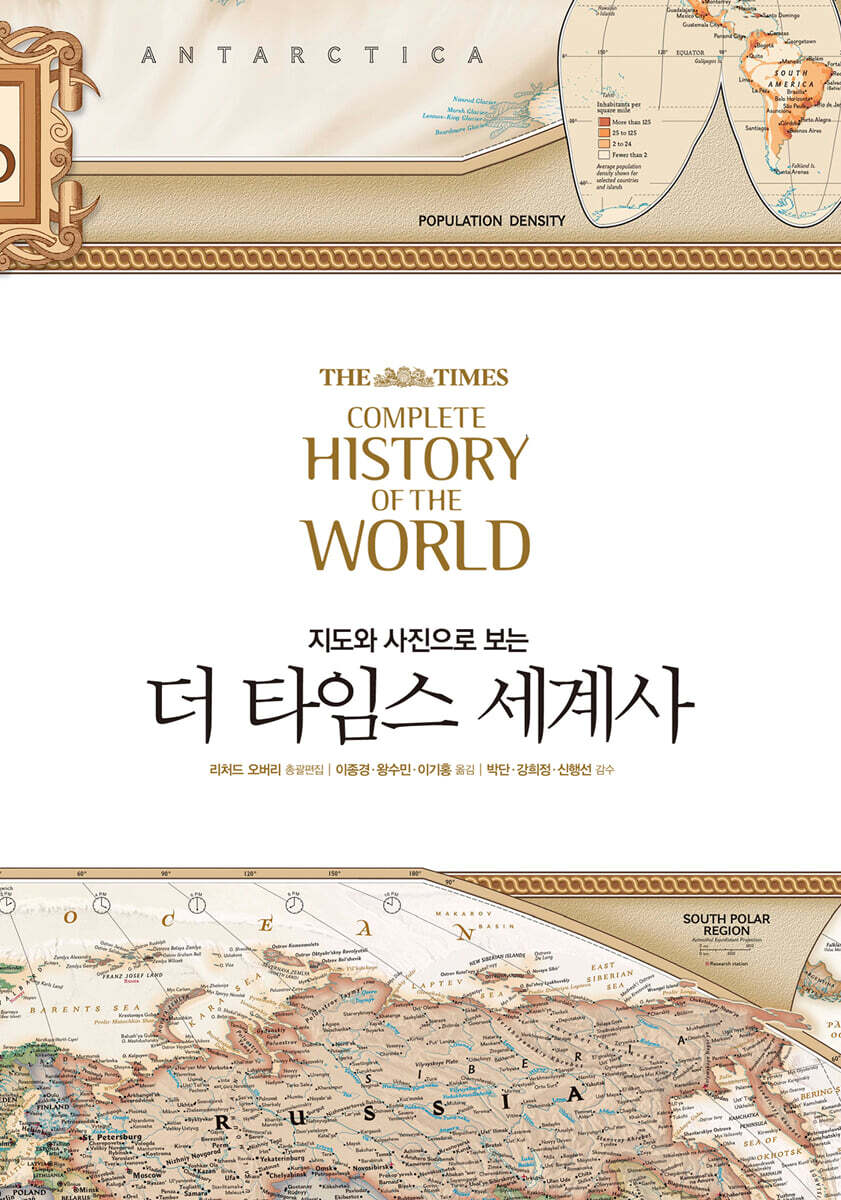 |
Description
Book Introduction
It became the standard for new historical narratives
The Bible of World History
A treasured map created by a single family over six generations, marking the beginning of a masterpiece of world history!
In 1826, a man in Scotland founded a map company that bore his name.
The name of the map book he created for those who dreamed of a new world beyond the sea, an unknown world they did not know, was 『General Atlas』. That is how the map of the Bartholomew family, known as the best map in England and a prestigious family of mapmakers, began.
A map that has been passed down from father to son and from son to grandson for six generations, loved by countless adventurers and navigators, and has influenced British world exploration and geography, changing world history.
The map became the beginning of a book that would later be called a 'masterpiece'.
It was the book that came to be called living history, the definitive edition of world history, 『The Times History of the World』.
The Bible of World History
A treasured map created by a single family over six generations, marking the beginning of a masterpiece of world history!
In 1826, a man in Scotland founded a map company that bore his name.
The name of the map book he created for those who dreamed of a new world beyond the sea, an unknown world they did not know, was 『General Atlas』. That is how the map of the Bartholomew family, known as the best map in England and a prestigious family of mapmakers, began.
A map that has been passed down from father to son and from son to grandson for six generations, loved by countless adventurers and navigators, and has influenced British world exploration and geography, changing world history.
The map became the beginning of a book that would later be called a 'masterpiece'.
It was the book that came to be called living history, the definitive edition of world history, 『The Times History of the World』.
- You can preview some of the book's contents.
Preview
index
Chapter 1: The Origins of Humanity and Early Culture
Origins of Humankind | Spread of Modern Humans | The Ice Age | From Hunting to Agriculture | The Rise of the First Cities | Early Europe | African People and Cultures | People of the Americas | Pre-civilization Southeast Asia | Australia | Melanesia and Polynesia
Chapter 2: The First Civilizations
The Beginnings of Eurasian Civilization | Early Empires of Mesopotamia | Ancient Egypt | The Near East | Peoples of South America and the Caribbean | Peoples of Mesoamerica | Peoples of Early North America | The Beginnings of Chinese Civilization | Minoan and Mycenaean Civilizations
Chapter 3: Classical Civilizations of Eurasia
Eurasia's commercial and cultural ties | The Near East | The Persian Empires | The spread of Greek civilization | The Hellenistic world | The unification of China | China and East Asia | India | The Nordic peoples | Africa | The expansion of Roman power | The golden age of Rome | From Rome to Byzantium | The rise of Christianity
Chapter 4: A Divided World
Settlement of the Germanic peoples in Western Europe|Arabia before Islam|Spread of Islam|Expansion of Christianity|Jewish Diaspora|Rise of the Frankish Kingdom|The Magyars in Europe|Northern and Eastern Europe|The Crusades|The Byzantine Empire|The First Russian State|The German Empire and the Papacy|The English and French Monarchies|Economic Growth in Europe|Japan and the Early Shogunate|Chinese Civilization during the Tang and Song Dynasties|Iran and Central Asia|The Mongol Empire|Hindu Kingdoms in India|The Delhi Sultanate of India|Early Civilizations in Southeast Asia|The Muslim World|The Emergence of States in Africa|The Rise of the Ottoman Empire|The Crisis of 14th-Century Europe|Early Modern States in Renaissance Europe
Chapter 5: The Rising Western World
The World on the Verge of European Expansion | European Voyages of Discovery | Expansion of Trading Empires | Expansion of Russia | Latin America and the Caribbean | Trade and Empires in Africa | China during the Ming Dynasty | The Ottoman Turks | Iran from the Safavids to the Qajar Dynasty | The Mughal Empire in India and the Expansion of Britain | China during the Qing Dynasty | Japan under the Shogunate | Southeast Asia and the European Powers | The Economy of Europe | The Reformation and the Catholic Reform Movement | Europe | The Mediterranean World | The Struggle for Hegemony in the Baltic | The Holy Roman Empire | The Dominance of France | The Struggle for Empire | The Age of Partition | The Emergence of the World Economy | The Beginning of the Industrial Revolution | The Age of Uprising | The French Revolution | Napoleon and the Reshaping of Europe
Chapter 6: The Age of European Dominance
Population growth and migration|Europe's Industrial Revolution|Rise of European nationalism|Germany and Italy|The formation of the United States|The American market revolution|Slavery and the Civil War|America as a country of immigrants|Canada|Latin America|The collapse of the Ottoman Empire|The Russian Empire|The collapse of the Qing Empire|India under British rule|Australia|New Zealand|Africa before partition by European powers|The partition of Africa|Japan's expansion and modernization|European colonial empires|Resistance to the West|Conflicts and alliances in Europe|The formation of the world economy|World War I|India under British rule|The partition of Africa|The formation of the world economy|World War I
Chapter 7: The Age of World Civilization
The Russian Revolution | Imperialism and Nationalism | The Chinese Revolution | The Political Problem in Europe | The Emergence of the American Federal State | The Great Depression | The Outbreak of World War II | Wars in Asia and the Pacific | Wars in Europe | Racism and Forced Migration | Europe | The Cold War | The Decline of Empires | Japan and East Asia | China during the Mao Zedong Era | The Long War in Southeast Asia | Southeast Asia | South Asia | Africa (1957–1989) | Africa (after 1989) | The Horn of Africa | The Democratic Republic of the Congo | Palestine, Zionism, and the Origins of the Arab-Israeli Conflict | The Arab-Israeli Conflict | Nationalism, Islamism, and Reform in the Middle East | The Search for Stability and Development in South America | Mexico, Mesoamerica, and Caribbean Countries | The American Affluent Society | The United States as a Superpower | Soviet Modernization and Crisis | Europe | The American Crisis and Response | Civil Wars in Europe | War | World Terrorism | Iraq and Afghanistan | China | The Collapse of the Soviet Union and the Construction of Russia | The Arab States in Transition The World | The World of the 21st Century | The World Today
Origins of Humankind | Spread of Modern Humans | The Ice Age | From Hunting to Agriculture | The Rise of the First Cities | Early Europe | African People and Cultures | People of the Americas | Pre-civilization Southeast Asia | Australia | Melanesia and Polynesia
Chapter 2: The First Civilizations
The Beginnings of Eurasian Civilization | Early Empires of Mesopotamia | Ancient Egypt | The Near East | Peoples of South America and the Caribbean | Peoples of Mesoamerica | Peoples of Early North America | The Beginnings of Chinese Civilization | Minoan and Mycenaean Civilizations
Chapter 3: Classical Civilizations of Eurasia
Eurasia's commercial and cultural ties | The Near East | The Persian Empires | The spread of Greek civilization | The Hellenistic world | The unification of China | China and East Asia | India | The Nordic peoples | Africa | The expansion of Roman power | The golden age of Rome | From Rome to Byzantium | The rise of Christianity
Chapter 4: A Divided World
Settlement of the Germanic peoples in Western Europe|Arabia before Islam|Spread of Islam|Expansion of Christianity|Jewish Diaspora|Rise of the Frankish Kingdom|The Magyars in Europe|Northern and Eastern Europe|The Crusades|The Byzantine Empire|The First Russian State|The German Empire and the Papacy|The English and French Monarchies|Economic Growth in Europe|Japan and the Early Shogunate|Chinese Civilization during the Tang and Song Dynasties|Iran and Central Asia|The Mongol Empire|Hindu Kingdoms in India|The Delhi Sultanate of India|Early Civilizations in Southeast Asia|The Muslim World|The Emergence of States in Africa|The Rise of the Ottoman Empire|The Crisis of 14th-Century Europe|Early Modern States in Renaissance Europe
Chapter 5: The Rising Western World
The World on the Verge of European Expansion | European Voyages of Discovery | Expansion of Trading Empires | Expansion of Russia | Latin America and the Caribbean | Trade and Empires in Africa | China during the Ming Dynasty | The Ottoman Turks | Iran from the Safavids to the Qajar Dynasty | The Mughal Empire in India and the Expansion of Britain | China during the Qing Dynasty | Japan under the Shogunate | Southeast Asia and the European Powers | The Economy of Europe | The Reformation and the Catholic Reform Movement | Europe | The Mediterranean World | The Struggle for Hegemony in the Baltic | The Holy Roman Empire | The Dominance of France | The Struggle for Empire | The Age of Partition | The Emergence of the World Economy | The Beginning of the Industrial Revolution | The Age of Uprising | The French Revolution | Napoleon and the Reshaping of Europe
Chapter 6: The Age of European Dominance
Population growth and migration|Europe's Industrial Revolution|Rise of European nationalism|Germany and Italy|The formation of the United States|The American market revolution|Slavery and the Civil War|America as a country of immigrants|Canada|Latin America|The collapse of the Ottoman Empire|The Russian Empire|The collapse of the Qing Empire|India under British rule|Australia|New Zealand|Africa before partition by European powers|The partition of Africa|Japan's expansion and modernization|European colonial empires|Resistance to the West|Conflicts and alliances in Europe|The formation of the world economy|World War I|India under British rule|The partition of Africa|The formation of the world economy|World War I
Chapter 7: The Age of World Civilization
The Russian Revolution | Imperialism and Nationalism | The Chinese Revolution | The Political Problem in Europe | The Emergence of the American Federal State | The Great Depression | The Outbreak of World War II | Wars in Asia and the Pacific | Wars in Europe | Racism and Forced Migration | Europe | The Cold War | The Decline of Empires | Japan and East Asia | China during the Mao Zedong Era | The Long War in Southeast Asia | Southeast Asia | South Asia | Africa (1957–1989) | Africa (after 1989) | The Horn of Africa | The Democratic Republic of the Congo | Palestine, Zionism, and the Origins of the Arab-Israeli Conflict | The Arab-Israeli Conflict | Nationalism, Islamism, and Reform in the Middle East | The Search for Stability and Development in South America | Mexico, Mesoamerica, and Caribbean Countries | The American Affluent Society | The United States as a Superpower | Soviet Modernization and Crisis | Europe | The American Crisis and Response | Civil Wars in Europe | War | World Terrorism | Iraq and Afghanistan | China | The Collapse of the Soviet Union and the Construction of Russia | The Arab States in Transition The World | The World of the 21st Century | The World Today
Detailed image
Publisher's Review
There has never been one before and there will never be one again.
A true masterpiece of world history
A bestseller that has sold over 3 million copies since its publication in 1978 and has been translated into 19 languages worldwide.
A must-read world history book that has been consistently loved by intellectuals around the world for 40 years.
The Times World History is a masterpiece, a definitive edition of world history written by over 100 of the world's leading historians, each with their own specialty.
This book, which comprehensively covers the history of over 200 countries across Europe, Africa, and the Americas from the birth of mankind to the present day, has been loved by history enthusiasts and intellectuals around the world for the past 40 years, and its reputation has grown with each edition.
The eighth edition, published this year, maintains the authority, reputation, and unique style of The Times World History, while refreshingly covering the Middle East, Africa, and the Americas, which are hot topics today, and vividly reflecting the latest trends.
A masterpiece that deserves to be called simply a "history book," if you must have just one history book in your library, this is it: The Times World History.
Forget history books that list things in chronological order, a reconstruction of history brimming with insight and vitality.
Do you think the discovery of the American continent is simply the story of the adventurer Columbus? Do you understand the Reformation simply as a conflict between Catholic and Protestant religions? History isn't made up of just one person or one event.
A new perspective on history, a multifaceted insight into understanding the world. This book, "The Times World History," reconstructs world history, previously remembered only by years and people, into a single, eventful story.
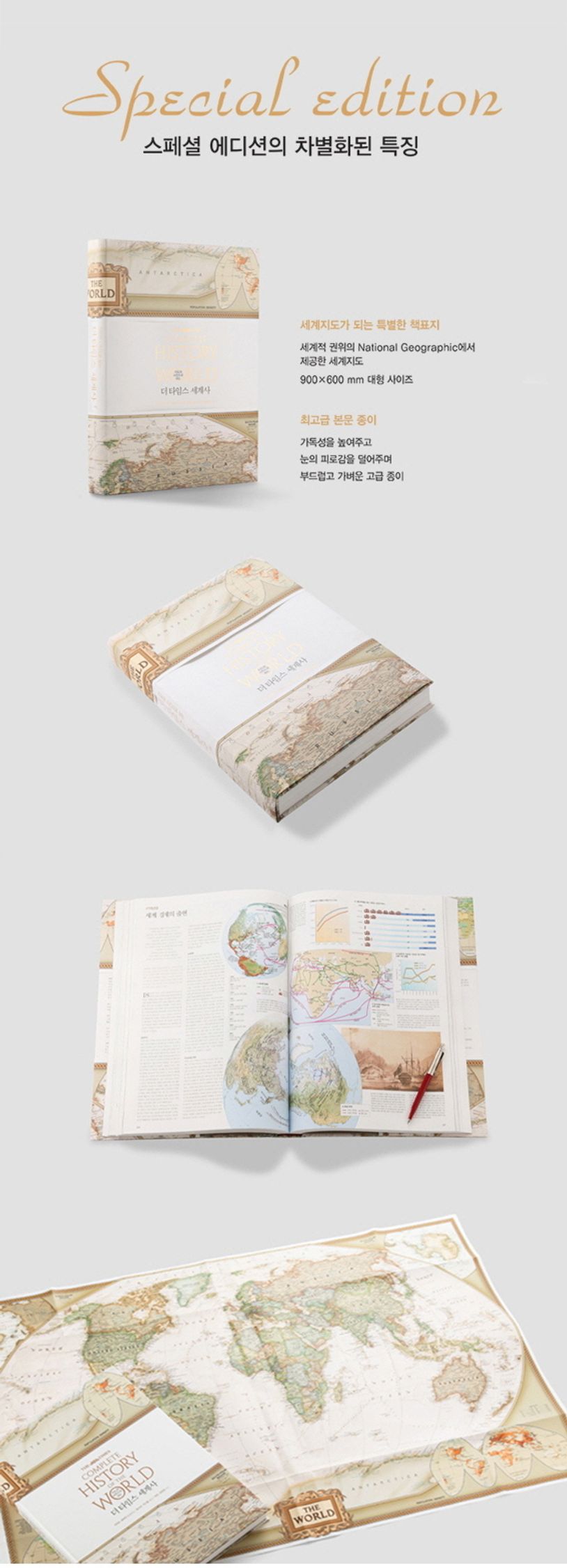
Through visual understanding through maps and infographics, rich and diverse descriptions of people and events, and perspectives on history, history is brought to life, creating an engaging and entertaining history book.
The structure and editing are such that you can understand the context and flow even if you don't read from the beginning, or just find the parts you need and read them.
And, by encompassing content that goes beyond history to geography and humanities, all of this was contained in a single volume, reborn as a true masterpiece of world history.
World historians become editors of The Times World History!
World-renowned historians whose names alone are recognized as authority.
This was a challenge for them too.
The first was Geoffrey Barraclough, an authority on medieval history, the second was Professor Norman Stone of Oxford University, and the third was Professor Geoffrey Parker of Ohio University, and the current Professor Richard Overy of Exeter University.
A book edited by leading scholars representing the field of history, "The Times World History" was a challenge for them, and a lifelong achievement they aspired to achieve as scholars.
The book that has been loved and cherished by historians more than any other world history book is The Times World History.
For those who dream of adventure again in an era that has lost its sense of adventure.
Is there nothing more exciting? Does life, devoid of adventure, sometimes feel sad? Just as a copperplate map made over 200 years ago set you on your journey, this book will serve as a new map for those seeking to navigate life amidst the deluge of information and relationships today.
For the intellectuals of this era who can see the world beyond ethnicity and nation, politics and economics, religion and ideology, and for readers who seek new paths within it, this book will serve as a tool and a path for adventure, and a willing guide to that adventure.
A true masterpiece of world history
A bestseller that has sold over 3 million copies since its publication in 1978 and has been translated into 19 languages worldwide.
A must-read world history book that has been consistently loved by intellectuals around the world for 40 years.
The Times World History is a masterpiece, a definitive edition of world history written by over 100 of the world's leading historians, each with their own specialty.
This book, which comprehensively covers the history of over 200 countries across Europe, Africa, and the Americas from the birth of mankind to the present day, has been loved by history enthusiasts and intellectuals around the world for the past 40 years, and its reputation has grown with each edition.
The eighth edition, published this year, maintains the authority, reputation, and unique style of The Times World History, while refreshingly covering the Middle East, Africa, and the Americas, which are hot topics today, and vividly reflecting the latest trends.
A masterpiece that deserves to be called simply a "history book," if you must have just one history book in your library, this is it: The Times World History.
Forget history books that list things in chronological order, a reconstruction of history brimming with insight and vitality.
Do you think the discovery of the American continent is simply the story of the adventurer Columbus? Do you understand the Reformation simply as a conflict between Catholic and Protestant religions? History isn't made up of just one person or one event.
A new perspective on history, a multifaceted insight into understanding the world. This book, "The Times World History," reconstructs world history, previously remembered only by years and people, into a single, eventful story.
Through visual understanding through maps and infographics, rich and diverse descriptions of people and events, and perspectives on history, history is brought to life, creating an engaging and entertaining history book.
The structure and editing are such that you can understand the context and flow even if you don't read from the beginning, or just find the parts you need and read them.
And, by encompassing content that goes beyond history to geography and humanities, all of this was contained in a single volume, reborn as a true masterpiece of world history.
World historians become editors of The Times World History!
World-renowned historians whose names alone are recognized as authority.
This was a challenge for them too.
The first was Geoffrey Barraclough, an authority on medieval history, the second was Professor Norman Stone of Oxford University, and the third was Professor Geoffrey Parker of Ohio University, and the current Professor Richard Overy of Exeter University.
A book edited by leading scholars representing the field of history, "The Times World History" was a challenge for them, and a lifelong achievement they aspired to achieve as scholars.
The book that has been loved and cherished by historians more than any other world history book is The Times World History.
For those who dream of adventure again in an era that has lost its sense of adventure.
Is there nothing more exciting? Does life, devoid of adventure, sometimes feel sad? Just as a copperplate map made over 200 years ago set you on your journey, this book will serve as a new map for those seeking to navigate life amidst the deluge of information and relationships today.
For the intellectuals of this era who can see the world beyond ethnicity and nation, politics and economics, religion and ideology, and for readers who seek new paths within it, this book will serve as a tool and a path for adventure, and a willing guide to that adventure.
GOODS SPECIFICS
- Date of issue: September 30, 2019
- Format: Hardcover book binding method guide
- Page count, weight, size: 480 pages | 262*362*30mm
- ISBN13: 9788970845463
- ISBN10: 8970845461
You may also like
카테고리
korean


korean

![GQ KOREA Mark (Monthly): December [2025]](http://librairie.coreenne.fr/cdn/shop/files/8ef265dbbfbf186523ed75ba7319009d.jpg?v=1765340328&width=3840)


