

Complete middle school math in one volume
 |
Description
Book Introduction
The essential concepts for the entire curriculum for the first, second, and third year of middle school are summarized into five areas.
You can review and organize the concepts of middle school mathematics, which are the foundation of higher education mathematics, in the shortest period of time.
[Essential Problems] is provided separately so that you can develop your skills by applying essential concepts.
It is a dictionary-style structure that you can always refer back to when you are unsure about a mathematical concept.
You can review and organize the concepts of middle school mathematics, which are the foundation of higher education mathematics, in the shortest period of time.
[Essential Problems] is provided separately so that you can develop your skills by applying essential concepts.
It is a dictionary-style structure that you can always refer back to when you are unsure about a mathematical concept.
- You can preview some of the book's contents.
Preview
index
· The '97 Essential Concepts' presented below are [PART A.
[Essential Concepts] and [PART B.
It consists of [essential problems]!
[Ⅰ.
Numbers and Operations]
1.
factorization
Concept 01.
Prime and composite numbers, prime factorization
Concept 02.
Greatest common divisor and least common multiple
2.
Integers and rational numbers
Concept 03.
Integers and rational numbers
Concept 04.
Absolute value
Concept 05.
Addition and subtraction of integers and rational numbers
Concept 06.
Multiplication and division of integers and rational numbers
3.
Rational numbers and recurring decimals
Concept 07.
Rational numbers and finite decimals
Concept 08.
recurring decimals
4.
Square roots and real numbers
Concept 09.
The meaning and properties of square roots
Concept 10.
Irrational numbers and real numbers
Concept 11.
The relationship between the magnitude of mistakes
Concept 12.
Multiplication and division of square roots, rationalization of denominators
Concept 13.
Addition and subtraction of square roots
[Ⅱ.
Letters and Expressions]
1.
Characters and expressions
Concept 14.
Characters and expressions
Concept 15.
Four basic operations on linear equations
2.
linear equation
Concept 16.
identity
Concept 17.
Solving linear equations
Concept 18.
Concentration of salt water
Concept 19.
Speed and increase and decrease
3.
Calculation of food
Concept 20.
Law of exponents
Concept 21.
Multiplication and division of monomials
Concept 22.
Four basic operations on polynomials
4.
Inequality
Concept 23.
Solution to first-order inequality
Concept 24.
Application of linear inequalities
5.
simultaneous equations
Concept 25.
Solving simultaneous equations
Concept 26.
Various simultaneous equations
Concept 27.
Application of simultaneous equations
6.
Factoring and Quadratic Equations
Concept 28.
Multiplication formula
Concept 29.
Factoring of quadratic equations
Concept 30.
Factoring complex expressions
Concept 31.
Solving quadratic equations
Concept 32.
Quadratic equation root formula
Concept 33.
Relationship between roots and coefficients of quadratic equations
Concept 34.
Finding a quadratic equation
Concept 35.
Applications of quadratic equations
[Ⅲ.
Function]
1.
function
Concept 36.
Ordered pairs and coordinates
Concept 37.
Graph of the function y=ax and direct proportion
Concept 38.
Graph of the function y=a/x and its inverse proportion
2.
linear function
Concept 39.
Functions and function values
Concept 40.
The meaning and graph of linear functions
Concept 41.
Intercept and slope of a linear function
Concept 42.
Properties of the graph of a linear function
Concept 43.
Linear functions and equations
Concept 44.
Finding the equation of a straight line
Concept 45.
The solution to the simultaneous equations and the intersection of two lines
3.
Quadratic function
Concept 46.
The meaning and graph of quadratic functions
Concept 47.
Graph of quadratic function (basic form)
Concept 48.
Graph of quadratic function (standard form)
Concept 49.
Graph of quadratic function (general form)
Concept 50.
Finding the signs and equations of the coefficients of a quadratic function
[Ⅳ.
Probability and Statistics]
1.
Number of cases and probability
Concept 51.
Number of cases
Concept 52.
Several cases - lining them up
Concept 53.
Multiple Cases - Representative Selection
Concept 54.
The meaning and nature of probability
Concept 55.
Calculating probability
2.
Representative values and scatter plots
Concept 56.
Frequency distribution table and relative frequency
Concept 57.
Representative values (mean, median, mode)
Concept 58.
Variance and standard deviation
Concept 59.
Variance and standard deviation in frequency distribution tables
Concept 60.
Scatterplot and correlation
[Ⅴ.
Geometry]
1.
Basic shapes
Concept 61.
straight lines, half-lines, line segments, distance between two points
Concept 62.
Angles, verticals and straight lines
Concept 63.
Positional relationship between a point and a line, a point and a plane, and two lines
Concept 64.
The positional relationship between a straight line and a plane in space, and between two planes
Concept 65.
Properties of corresponding and alternate angles and parallel lines
2.
Congruence and Congruence
Concept 66.
triangle
Concept 67.
Congruence of triangles
3.
Properties of plane and solid figures
Concept 68.
Interior and exterior angles of a polygon
Concept 69.
Circles and sectors
Concept 70.
polyhedron
Concept 71.
Rotating body
Concept 72.
Surface area and volume of cylinders, cones, and spheres
4.
Properties of triangles and quadrilaterals
Concept 73.
isosceles triangle
Concept 74.
circumcenter of a triangle
Concept 75.
Incenter of a triangle
Concept 76.
Application of the inscribed circle of a triangle
Concept 77.
parallelogram
Concept 78.
Various squares
Concept 79.
Relationships between various quadrilaterals, parallel lines and areas
5.
Similarity of shapes
Concept 80.
similar shapes
Concept 81.
Utilizing similarity
Concept 82.
Angle bisectors, parallel lines and line segments
Concept 83.
Properties of the line segment connecting the midpoints of two sides of a triangle
Concept 84.
Median and centroid of a triangle
Concept 85.
Area and volume of similar shapes
6.
Pythagorean theorem
Concept 86.
Pythagorean theorem
Concept 87.
Properties of the Pythagorean theorem
Concept 88.
Pythagorean theorem (properties of shapes)
Concept 89.
Pythagorean theorem (plane application)
Concept 90.
Pythagorean theorem (using solids)
7.
Trigonometric ratios
Concept 91.
Trigonometric ratios
Concept 92.
Application of trigonometric ratios (side lengths)
Concept 93.
Application of trigonometric functions (area of shapes)
8.
Properties of a circle
Concept 94.
The current of the circle
Concept 95.
Tangent of a circle
Concept 96.
central angle
Concept 97.
Application of central angle
[A no-frills commentary (a book within a book)]
[Essential Concepts] and [PART B.
It consists of [essential problems]!
[Ⅰ.
Numbers and Operations]
1.
factorization
Concept 01.
Prime and composite numbers, prime factorization
Concept 02.
Greatest common divisor and least common multiple
2.
Integers and rational numbers
Concept 03.
Integers and rational numbers
Concept 04.
Absolute value
Concept 05.
Addition and subtraction of integers and rational numbers
Concept 06.
Multiplication and division of integers and rational numbers
3.
Rational numbers and recurring decimals
Concept 07.
Rational numbers and finite decimals
Concept 08.
recurring decimals
4.
Square roots and real numbers
Concept 09.
The meaning and properties of square roots
Concept 10.
Irrational numbers and real numbers
Concept 11.
The relationship between the magnitude of mistakes
Concept 12.
Multiplication and division of square roots, rationalization of denominators
Concept 13.
Addition and subtraction of square roots
[Ⅱ.
Letters and Expressions]
1.
Characters and expressions
Concept 14.
Characters and expressions
Concept 15.
Four basic operations on linear equations
2.
linear equation
Concept 16.
identity
Concept 17.
Solving linear equations
Concept 18.
Concentration of salt water
Concept 19.
Speed and increase and decrease
3.
Calculation of food
Concept 20.
Law of exponents
Concept 21.
Multiplication and division of monomials
Concept 22.
Four basic operations on polynomials
4.
Inequality
Concept 23.
Solution to first-order inequality
Concept 24.
Application of linear inequalities
5.
simultaneous equations
Concept 25.
Solving simultaneous equations
Concept 26.
Various simultaneous equations
Concept 27.
Application of simultaneous equations
6.
Factoring and Quadratic Equations
Concept 28.
Multiplication formula
Concept 29.
Factoring of quadratic equations
Concept 30.
Factoring complex expressions
Concept 31.
Solving quadratic equations
Concept 32.
Quadratic equation root formula
Concept 33.
Relationship between roots and coefficients of quadratic equations
Concept 34.
Finding a quadratic equation
Concept 35.
Applications of quadratic equations
[Ⅲ.
Function]
1.
function
Concept 36.
Ordered pairs and coordinates
Concept 37.
Graph of the function y=ax and direct proportion
Concept 38.
Graph of the function y=a/x and its inverse proportion
2.
linear function
Concept 39.
Functions and function values
Concept 40.
The meaning and graph of linear functions
Concept 41.
Intercept and slope of a linear function
Concept 42.
Properties of the graph of a linear function
Concept 43.
Linear functions and equations
Concept 44.
Finding the equation of a straight line
Concept 45.
The solution to the simultaneous equations and the intersection of two lines
3.
Quadratic function
Concept 46.
The meaning and graph of quadratic functions
Concept 47.
Graph of quadratic function (basic form)
Concept 48.
Graph of quadratic function (standard form)
Concept 49.
Graph of quadratic function (general form)
Concept 50.
Finding the signs and equations of the coefficients of a quadratic function
[Ⅳ.
Probability and Statistics]
1.
Number of cases and probability
Concept 51.
Number of cases
Concept 52.
Several cases - lining them up
Concept 53.
Multiple Cases - Representative Selection
Concept 54.
The meaning and nature of probability
Concept 55.
Calculating probability
2.
Representative values and scatter plots
Concept 56.
Frequency distribution table and relative frequency
Concept 57.
Representative values (mean, median, mode)
Concept 58.
Variance and standard deviation
Concept 59.
Variance and standard deviation in frequency distribution tables
Concept 60.
Scatterplot and correlation
[Ⅴ.
Geometry]
1.
Basic shapes
Concept 61.
straight lines, half-lines, line segments, distance between two points
Concept 62.
Angles, verticals and straight lines
Concept 63.
Positional relationship between a point and a line, a point and a plane, and two lines
Concept 64.
The positional relationship between a straight line and a plane in space, and between two planes
Concept 65.
Properties of corresponding and alternate angles and parallel lines
2.
Congruence and Congruence
Concept 66.
triangle
Concept 67.
Congruence of triangles
3.
Properties of plane and solid figures
Concept 68.
Interior and exterior angles of a polygon
Concept 69.
Circles and sectors
Concept 70.
polyhedron
Concept 71.
Rotating body
Concept 72.
Surface area and volume of cylinders, cones, and spheres
4.
Properties of triangles and quadrilaterals
Concept 73.
isosceles triangle
Concept 74.
circumcenter of a triangle
Concept 75.
Incenter of a triangle
Concept 76.
Application of the inscribed circle of a triangle
Concept 77.
parallelogram
Concept 78.
Various squares
Concept 79.
Relationships between various quadrilaterals, parallel lines and areas
5.
Similarity of shapes
Concept 80.
similar shapes
Concept 81.
Utilizing similarity
Concept 82.
Angle bisectors, parallel lines and line segments
Concept 83.
Properties of the line segment connecting the midpoints of two sides of a triangle
Concept 84.
Median and centroid of a triangle
Concept 85.
Area and volume of similar shapes
6.
Pythagorean theorem
Concept 86.
Pythagorean theorem
Concept 87.
Properties of the Pythagorean theorem
Concept 88.
Pythagorean theorem (properties of shapes)
Concept 89.
Pythagorean theorem (plane application)
Concept 90.
Pythagorean theorem (using solids)
7.
Trigonometric ratios
Concept 91.
Trigonometric ratios
Concept 92.
Application of trigonometric ratios (side lengths)
Concept 93.
Application of trigonometric functions (area of shapes)
8.
Properties of a circle
Concept 94.
The current of the circle
Concept 95.
Tangent of a circle
Concept 96.
central angle
Concept 97.
Application of central angle
[A no-frills commentary (a book within a book)]
Detailed image
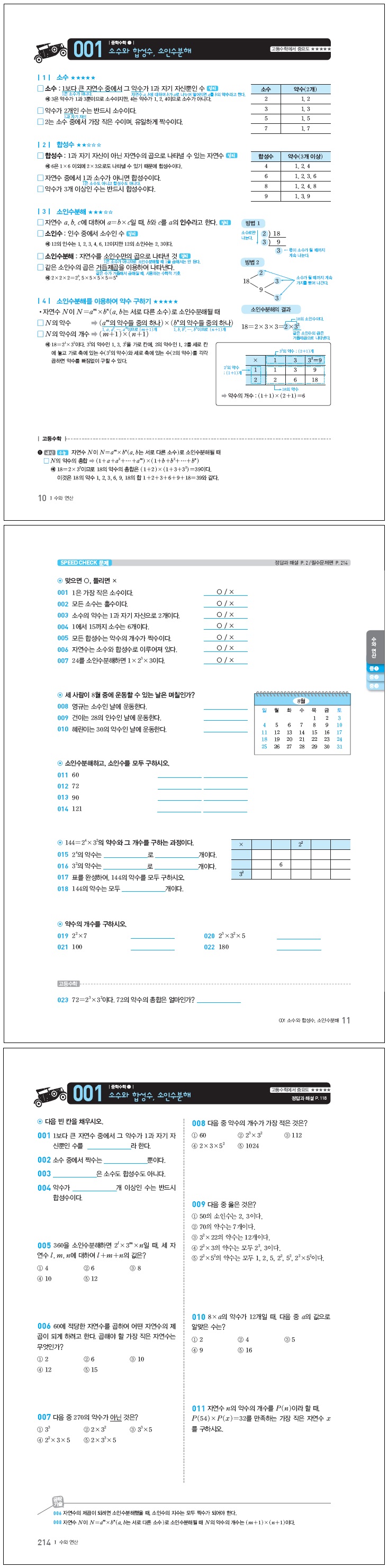
Publisher's Review
· A comprehensive summary of middle school mathematics, condensed into 97 essential concepts.
· Quickly finish the entire middle school math curriculum for 1st, 2nd, and 3rd grades in one book!
· Reflection of the 2022 revised curriculum
· Lecture materials by Mbest teacher Kang Hyeon-jeong
(1) Compressed and organized into 5 areas the essential concepts that are important throughout the 1st, 2nd, and 3rd year of middle school.
(2) Review/organize the concepts of middle school mathematics, which form the basis of higher education mathematics, in the shortest possible time.
(3) [Essential Problems] provided separately so that students can develop their skills by applying essential concepts.
(4) Dictionary-style structure that allows you to always look back when you are unsure about a mathematical concept
· Why is "Complete Middle School Math in One Book" good?
1.
Complete one volume of middle school mathematics
We compared and analyzed all textbooks for the first, second, and third grades of middle school, carefully selected 97 essential concepts, and organized them clearly.
All the important mathematical concepts and problem types covered in middle school mathematics are included in one book, so you can study them quickly and without burden.
Moreover, mathematical concepts that are not very important or are not frequently used in higher mathematics have been boldly deleted to ensure a study without unnecessary details.
2.
A selection of essential concepts
Middle school mathematics is the foundation of higher education mathematics.
If there are any shortcomings, they should be filled in immediately.
For example, just as you can only solve geometry problems on the CSAT math section if you know the properties of the basic shapes covered in middle school math, you need to be well-prepared for middle school math to do well in high school math.
So, whenever you don't remember middle school math concepts and formulas, you always need to look them up and check them, and this book will do that job well.
3.
Integrated grade area composition
The content of three grades was integrated into one and reorganized by area (numbers and operations, letters and expressions, functions, probability and statistics, geometry) to enable continuous study of mathematical concepts.
For example, in the first grade, you learn the meaning of a function, in the second grade, you learn linear functions, and in the third grade, you learn quadratic functions. If you gather all of this into one 'function area' without distinction between grades, you can study continuously without any interruption in the flow.
· Structure and Usage of "Complete Middle School Math in One Volume"
1.
Essential concepts
We compared and analyzed all textbooks for the first, second, and third grades of middle school to clearly organize the key concepts.
Additionally, we added abundant 'editing' throughout to make it easier and faster to understand.
Moreover, '(Example)' is of great help in immediately understanding the previously presented concept, '(Note)' is used when it is confusing and requires attention, and '(True)' is used when supplementary explanation is needed to understand the content.
Here, we have created a corner called 'Advanced Mathematics' to show how middle school mathematics develops and expands into advanced mathematics.
2. SPEED CHECK problem
We have carefully selected and included basic absolute problems with relatively low difficulty so that you can check for yourself whether you have accurately understood the essential concepts and understand mathematical concepts while solving them.
These speed check problems are presented in a wide variety of types, so you should solve them all without missing a single one.
In particular, we frequently include true/false judgment types such as 'If correct, ○, if incorrect, ×' so that you can check whether you understand the mathematical concepts accurately, so please make good use of them.
3.
Essential questions
[PART A.
If the 'Speed Check Problems' in [Essential Concepts] are a tool to check whether you understand the mathematical concepts well or to help you understand the mathematical concepts while solving them, [PART B.
The 'Essential Problems' in [Essential Problems] are carefully selected types that are important enough to appear on school exams or types that can expand thinking skills by applying basic concepts further.
There's no need to be afraid that the difficulty level has increased slightly.
This is because anyone who has studied the ‘essential concepts’ and ‘speed check problems’ thoroughly can solve it without difficulty.
However, if you occasionally encounter a problem or two that you find difficult, please re-read the 'Essential Concepts' section and then try to solve it.
Here, 'strategy' will be of great help.
※ This book is highly recommended for the following students!
〉〉 Middle school 3rd year, high school 1st year: “A student who wants to quickly review the essential concepts of middle school math.”
〉〉 High school freshmen, sophomores, and juniors: “Students who want to review only the core concepts of middle school mathematics that form the foundation for advanced mathematics.”
〉〉 6th grade, 1st and 2nd grade: “Students who want to preview/review the entire middle school math curriculum faster than others.”
· Quickly finish the entire middle school math curriculum for 1st, 2nd, and 3rd grades in one book!
· Reflection of the 2022 revised curriculum
· Lecture materials by Mbest teacher Kang Hyeon-jeong
(1) Compressed and organized into 5 areas the essential concepts that are important throughout the 1st, 2nd, and 3rd year of middle school.
(2) Review/organize the concepts of middle school mathematics, which form the basis of higher education mathematics, in the shortest possible time.
(3) [Essential Problems] provided separately so that students can develop their skills by applying essential concepts.
(4) Dictionary-style structure that allows you to always look back when you are unsure about a mathematical concept
· Why is "Complete Middle School Math in One Book" good?
1.
Complete one volume of middle school mathematics
We compared and analyzed all textbooks for the first, second, and third grades of middle school, carefully selected 97 essential concepts, and organized them clearly.
All the important mathematical concepts and problem types covered in middle school mathematics are included in one book, so you can study them quickly and without burden.
Moreover, mathematical concepts that are not very important or are not frequently used in higher mathematics have been boldly deleted to ensure a study without unnecessary details.
2.
A selection of essential concepts
Middle school mathematics is the foundation of higher education mathematics.
If there are any shortcomings, they should be filled in immediately.
For example, just as you can only solve geometry problems on the CSAT math section if you know the properties of the basic shapes covered in middle school math, you need to be well-prepared for middle school math to do well in high school math.
So, whenever you don't remember middle school math concepts and formulas, you always need to look them up and check them, and this book will do that job well.
3.
Integrated grade area composition
The content of three grades was integrated into one and reorganized by area (numbers and operations, letters and expressions, functions, probability and statistics, geometry) to enable continuous study of mathematical concepts.
For example, in the first grade, you learn the meaning of a function, in the second grade, you learn linear functions, and in the third grade, you learn quadratic functions. If you gather all of this into one 'function area' without distinction between grades, you can study continuously without any interruption in the flow.
· Structure and Usage of "Complete Middle School Math in One Volume"
1.
Essential concepts
We compared and analyzed all textbooks for the first, second, and third grades of middle school to clearly organize the key concepts.
Additionally, we added abundant 'editing' throughout to make it easier and faster to understand.
Moreover, '(Example)' is of great help in immediately understanding the previously presented concept, '(Note)' is used when it is confusing and requires attention, and '(True)' is used when supplementary explanation is needed to understand the content.
Here, we have created a corner called 'Advanced Mathematics' to show how middle school mathematics develops and expands into advanced mathematics.
2. SPEED CHECK problem
We have carefully selected and included basic absolute problems with relatively low difficulty so that you can check for yourself whether you have accurately understood the essential concepts and understand mathematical concepts while solving them.
These speed check problems are presented in a wide variety of types, so you should solve them all without missing a single one.
In particular, we frequently include true/false judgment types such as 'If correct, ○, if incorrect, ×' so that you can check whether you understand the mathematical concepts accurately, so please make good use of them.
3.
Essential questions
[PART A.
If the 'Speed Check Problems' in [Essential Concepts] are a tool to check whether you understand the mathematical concepts well or to help you understand the mathematical concepts while solving them, [PART B.
The 'Essential Problems' in [Essential Problems] are carefully selected types that are important enough to appear on school exams or types that can expand thinking skills by applying basic concepts further.
There's no need to be afraid that the difficulty level has increased slightly.
This is because anyone who has studied the ‘essential concepts’ and ‘speed check problems’ thoroughly can solve it without difficulty.
However, if you occasionally encounter a problem or two that you find difficult, please re-read the 'Essential Concepts' section and then try to solve it.
Here, 'strategy' will be of great help.
※ This book is highly recommended for the following students!
〉〉 Middle school 3rd year, high school 1st year: “A student who wants to quickly review the essential concepts of middle school math.”
〉〉 High school freshmen, sophomores, and juniors: “Students who want to review only the core concepts of middle school mathematics that form the foundation for advanced mathematics.”
〉〉 6th grade, 1st and 2nd grade: “Students who want to preview/review the entire middle school math curriculum faster than others.”
GOODS SPECIFICS
- Date of issue: November 25, 2024
- Page count, weight, size: 500 pages | 974g | 188*257*20mm
- ISBN13: 9791192967189
- ISBN10: 1192967186
- Reference book for use in grades: Common for middle school students
You may also like
카테고리
korean


korean

![ELLE 엘르 스페셜 에디션 A형 : 12월 [2025]](http://librairie.coreenne.fr/cdn/shop/files/b8e27a3de6c9538896439686c6b0e8fb.jpg?v=1766436872&width=3840)


