

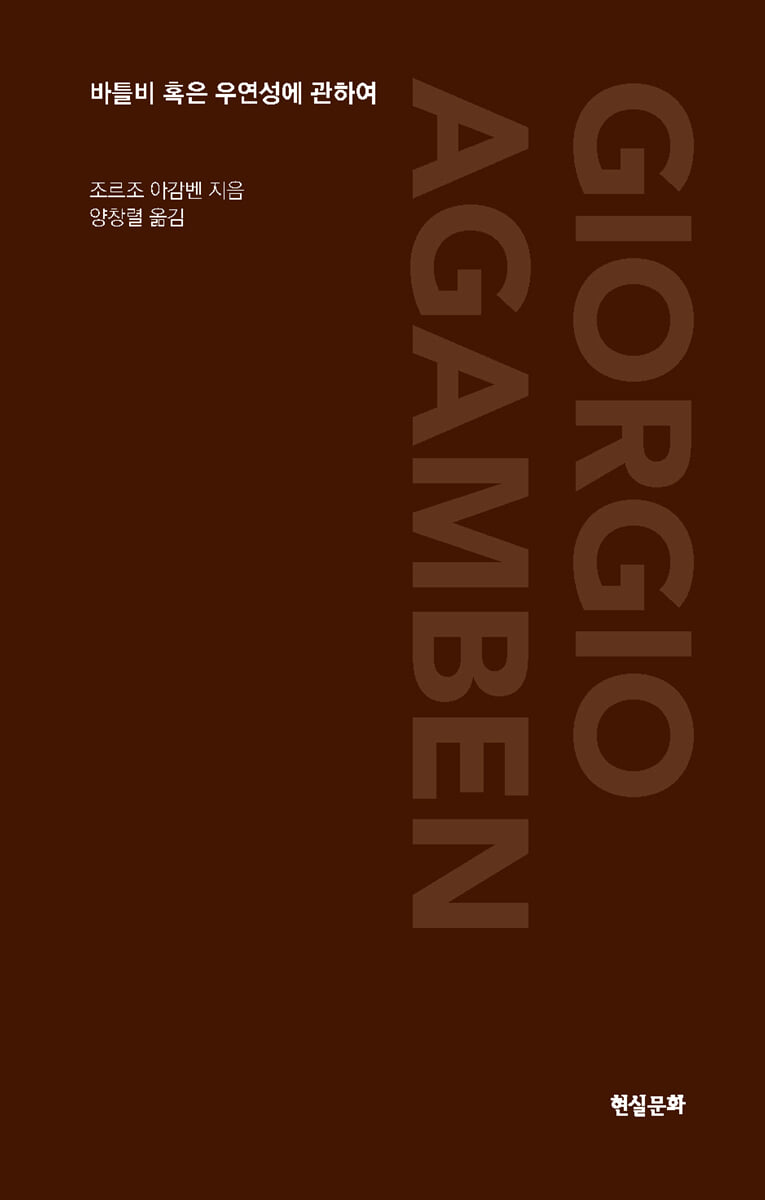
Bartleby, or Concerning Chance
 |
Description
Book Introduction
The paradox of “It would be better not to ~”!
Creation begins not at the moment you write, but at the tip of your fingers when you stop writing!
A philosophy of de-creation that redraws the outlines of existence with unrealized potential!
Bartleby says:
“It would be better not to ~.” Agamben does not read this sentence, repeated by Herman Melville’s scrivener Bartleby, as a classic tale of resistance.
In this single sentence, Agamben asks again about creation and freedom.
We are always asked to do more, better, and faster.
So we get stuck in the necessity of ‘having to do something’.
But in Bartleby's peculiar choice to reject necessity, such as preferring not to write or not to leave the office, Agamben calls out another possibility.
That formula which Bartleby stubbornly repeats is not mere refusal or laziness, but an experiment.
It's an attempt to stop doing and look back at what's possible.
It is an attempt to rearrange life here and now, where countless potentials lie buried and unrealized.
Agamben opens the book by placing Bartleby in a philosophical constellation, in contrast to the constellations of other literary scribes.
Then, he raises the question of potentiality by invoking old metaphors of Western thought surrounding thought or the mind: thought = ink/ink bottle, intellect (potential thought) = blank slate.
Agamben says that potentiality is not a lack, but a unique mode of existence, in that Aristotle regarded the intellect (potential thought) as a slate on which nothing was yet written, and that all potentiality essentially has the ambivalence of 'being able to do' and 'being not able to do'.
But our lives are always under the oppression of 'necessity' that forces us to actualize this potential through action, thereby exhausting the 'potential not to do'.
Bartleby's repeated phrase, "I would rather not," is, in Agamben's view, more than mere apathy or rejection; it is the most powerful philosophical formula that dismantles the very foundations of Western metaphysics.
This is where Bartleby's greatness lies.
He has the 'ability to' do the deed, but uses it to exercise his 'potential not to', thus forever shielding his potential from the obligation to actualize it.
Thus, Bartleby emerges as a scribe who preserves his full potentiality without binding his existence to necessity through the inaction of not copying, that is, the gesture of “I would rather not do ~,” an extreme figure who reveals the ontology of creation at the threshold of contingency and non-potentiality, that is, the figure of the most powerful self-liberation, and the figure of the most solitary and subversive freedom that stands against all compulsion and obligation.
Agamben points out that our ethical tradition has avoided the question of potentiality by focusing on 'what we want' or 'what we ought to do' rather than 'what we can do'.
In this short but dense pamphlet, Bartleby takes the side of potentiality and contingency, which philosophy has failed to adequately address, and thus opens up the possibility of moving toward a second creation, or de-creation, free from the tyranny of necessity and actualization.
Creation begins not at the moment you write, but at the tip of your fingers when you stop writing!
A philosophy of de-creation that redraws the outlines of existence with unrealized potential!
Bartleby says:
“It would be better not to ~.” Agamben does not read this sentence, repeated by Herman Melville’s scrivener Bartleby, as a classic tale of resistance.
In this single sentence, Agamben asks again about creation and freedom.
We are always asked to do more, better, and faster.
So we get stuck in the necessity of ‘having to do something’.
But in Bartleby's peculiar choice to reject necessity, such as preferring not to write or not to leave the office, Agamben calls out another possibility.
That formula which Bartleby stubbornly repeats is not mere refusal or laziness, but an experiment.
It's an attempt to stop doing and look back at what's possible.
It is an attempt to rearrange life here and now, where countless potentials lie buried and unrealized.
Agamben opens the book by placing Bartleby in a philosophical constellation, in contrast to the constellations of other literary scribes.
Then, he raises the question of potentiality by invoking old metaphors of Western thought surrounding thought or the mind: thought = ink/ink bottle, intellect (potential thought) = blank slate.
Agamben says that potentiality is not a lack, but a unique mode of existence, in that Aristotle regarded the intellect (potential thought) as a slate on which nothing was yet written, and that all potentiality essentially has the ambivalence of 'being able to do' and 'being not able to do'.
But our lives are always under the oppression of 'necessity' that forces us to actualize this potential through action, thereby exhausting the 'potential not to do'.
Bartleby's repeated phrase, "I would rather not," is, in Agamben's view, more than mere apathy or rejection; it is the most powerful philosophical formula that dismantles the very foundations of Western metaphysics.
This is where Bartleby's greatness lies.
He has the 'ability to' do the deed, but uses it to exercise his 'potential not to', thus forever shielding his potential from the obligation to actualize it.
Thus, Bartleby emerges as a scribe who preserves his full potentiality without binding his existence to necessity through the inaction of not copying, that is, the gesture of “I would rather not do ~,” an extreme figure who reveals the ontology of creation at the threshold of contingency and non-potentiality, that is, the figure of the most powerful self-liberation, and the figure of the most solitary and subversive freedom that stands against all compulsion and obligation.
Agamben points out that our ethical tradition has avoided the question of potentiality by focusing on 'what we want' or 'what we ought to do' rather than 'what we can do'.
In this short but dense pamphlet, Bartleby takes the side of potentiality and contingency, which philosophy has failed to adequately address, and thus opens up the possibility of moving toward a second creation, or de-creation, free from the tyranny of necessity and actualization.
- You can preview some of the book's contents.
Preview
index
I.
On the Scribe, or Creation
II.
Regarding formality or potential
III.
On experimentation, or de-creation
Translator's Note
Search
On the Scribe, or Creation
II.
Regarding formality or potential
III.
On experimentation, or de-creation
Translator's Note
Search
Into the book
A little further away, like an asteroid belt, are the nameless scribes who appear in Kafka's court.
But there is also a philosophical constellation of Bartleby, and it is possible that this alone contains the essence of the character of which the other constellations [literary constellations] only outline.
--- p.12
Where does this definition, which presents a key figure in the Western philosophical tradition as a scribe, and presents thought as an equally unusual writing activity, come from?
--- p.14
Just as a sensitive layer of wax is suddenly scratched by the scribe's stylus, so the faculty of thought, though not a thing in itself, enables the activity of the intellect to take place.
--- p.19
This is the philosophical constellation to which Bartleby the Scrivener belongs.
Bartleby, the scribe who has ceased to write, is the extreme form of the nothingness from which all creation proceeds, and at the same time the most persistent assertion of this nothingness as pure and absolute potentiality.
--- p.49
To believe that the will has power over capacity [potentiality], that the passage into activity [actuality] is the result of a decision that puts an end to the ambivalence of capacity (which is always the capacity to do and the capacity not to do)—this is the eternal illusion of morality.
--- p.51
Bartleby immediately questions the idea that will is superior to ability.
If God (at least by his definite powers) can truly do only what he wills, then Bartleby can do only what he does not will.
--- p.52
Bartleby does not agree, but he does not simply refuse either.
Nothing is more alien to him than the pathos of heroic denial.
In the history of Western culture, there is only one formula that maintains such a resolute balance between affirmation and negation, acceptance and rejection, insertion and subtraction.
--- p.57
In the ascetic paradise that Bartleby makes his home, there is only piuttosto, completely free from all reason.
It is something like preference and potentiality, no longer used to guarantee the superiority of being over nothing, but exists without reason in the indiscriminate nature of being and nothingness.
--- p.68
Only in an experiment which severes all connection with truth, or with the existence or non-existence of states of things, does Bartleby's "I would rather not" acquire its full meaning (or its meaninglessness).
But there is also a philosophical constellation of Bartleby, and it is possible that this alone contains the essence of the character of which the other constellations [literary constellations] only outline.
--- p.12
Where does this definition, which presents a key figure in the Western philosophical tradition as a scribe, and presents thought as an equally unusual writing activity, come from?
--- p.14
Just as a sensitive layer of wax is suddenly scratched by the scribe's stylus, so the faculty of thought, though not a thing in itself, enables the activity of the intellect to take place.
--- p.19
This is the philosophical constellation to which Bartleby the Scrivener belongs.
Bartleby, the scribe who has ceased to write, is the extreme form of the nothingness from which all creation proceeds, and at the same time the most persistent assertion of this nothingness as pure and absolute potentiality.
--- p.49
To believe that the will has power over capacity [potentiality], that the passage into activity [actuality] is the result of a decision that puts an end to the ambivalence of capacity (which is always the capacity to do and the capacity not to do)—this is the eternal illusion of morality.
--- p.51
Bartleby immediately questions the idea that will is superior to ability.
If God (at least by his definite powers) can truly do only what he wills, then Bartleby can do only what he does not will.
--- p.52
Bartleby does not agree, but he does not simply refuse either.
Nothing is more alien to him than the pathos of heroic denial.
In the history of Western culture, there is only one formula that maintains such a resolute balance between affirmation and negation, acceptance and rejection, insertion and subtraction.
--- p.57
In the ascetic paradise that Bartleby makes his home, there is only piuttosto, completely free from all reason.
It is something like preference and potentiality, no longer used to guarantee the superiority of being over nothing, but exists without reason in the indiscriminate nature of being and nothingness.
--- p.68
Only in an experiment which severes all connection with truth, or with the existence or non-existence of states of things, does Bartleby's "I would rather not" acquire its full meaning (or its meaninglessness).
--- p.79
GOODS SPECIFICS
- Date of issue: November 28, 2025
- Page count, weight, size: 152 pages | 120*188*20mm
- ISBN13: 9788965643142
- ISBN10: 8965643147
You may also like
카테고리
korean


korean

![GQ KOREA Mark (Monthly): December [2025]](http://librairie.coreenne.fr/cdn/shop/files/8ef265dbbfbf186523ed75ba7319009d.jpg?v=1765340328&width=3840)


