

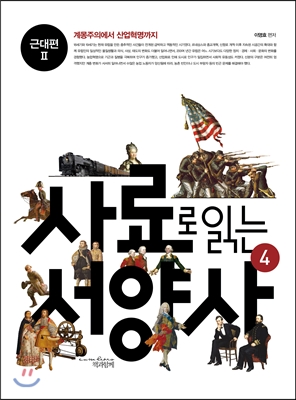
Western History Through Historical Materials 4
 |
Description
Book Introduction
“Primary sources are to historians what molecules are to chemists.
“Just as chemists combine molecules to study the properties of matter, historians use historical records to study the past.”
Readers of the past were mainly satisfied with reading 'secondary things' that historians interpreted and described based on historical materials.
However, recently, there has been a growing number of readers who want to read history more vividly by directly accessing the historical materials used by historians and understanding their intentions.
Furthermore, it can be said that the basic qualifications of a historical researcher are to be able to understand and utilize the historical materials that serve as the basis for many translated or written works and the foundation for historical studies. In addition, if students are to achieve the educational goal of creativity and convergence, they must boldly and actively participate in classes through research and presentation of materials.
Although such in-depth research and self-directed classes require a lot of materials, the reality is not conducive to this.
Conversely, the free information that is irresponsibly distributed on the Internet kills the creativity of researchers and undermines the trust of educators.
To improve this reality even a little, a collection of historical materials directly selected and written by specialized researchers is essential.
In the West, this work has been carried out in a variety of ways, resulting in the publication of many historical collections. In Korea, several historical collections have been published, but they are limited to the field of Korean history.
Western historical sources written in various languages have presented a practical challenge in that they are not easily accessible to anyone other than professional historical researchers due to language and content barriers.
However, we cannot simply translate and use Western historical sources.
It is absolutely necessary to reconstruct, appropriately interpret, and present the material with appropriate explanations to fit our environment and educational goals.
Accordingly, through thorough work of collecting and selecting materials and adding references and explanations, 'Modern Times II' was published following Volume 1, 'Ancient Times' and Volume 2, 'Medieval Times'.
The "Western History Through Historical Materials" series, which covers Western history from ancient times to the 20th century, will be a valuable reference for readers seeking in-depth historical study.
“Just as chemists combine molecules to study the properties of matter, historians use historical records to study the past.”
Readers of the past were mainly satisfied with reading 'secondary things' that historians interpreted and described based on historical materials.
However, recently, there has been a growing number of readers who want to read history more vividly by directly accessing the historical materials used by historians and understanding their intentions.
Furthermore, it can be said that the basic qualifications of a historical researcher are to be able to understand and utilize the historical materials that serve as the basis for many translated or written works and the foundation for historical studies. In addition, if students are to achieve the educational goal of creativity and convergence, they must boldly and actively participate in classes through research and presentation of materials.
Although such in-depth research and self-directed classes require a lot of materials, the reality is not conducive to this.
Conversely, the free information that is irresponsibly distributed on the Internet kills the creativity of researchers and undermines the trust of educators.
To improve this reality even a little, a collection of historical materials directly selected and written by specialized researchers is essential.
In the West, this work has been carried out in a variety of ways, resulting in the publication of many historical collections. In Korea, several historical collections have been published, but they are limited to the field of Korean history.
Western historical sources written in various languages have presented a practical challenge in that they are not easily accessible to anyone other than professional historical researchers due to language and content barriers.
However, we cannot simply translate and use Western historical sources.
It is absolutely necessary to reconstruct, appropriately interpret, and present the material with appropriate explanations to fit our environment and educational goals.
Accordingly, through thorough work of collecting and selecting materials and adding references and explanations, 'Modern Times II' was published following Volume 1, 'Ancient Times' and Volume 2, 'Medieval Times'.
The "Western History Through Historical Materials" series, which covers Western history from ancient times to the 20th century, will be a valuable reference for readers seeking in-depth historical study.
- You can preview some of the book's contents.
Preview
index
* Publishing the series
* At the beginning of the book
Part 1: The Age of Enlightenment and Revolution
1.
18th-Century European Society: Fierce Competition Within and Beyond the Continent
2.
The Enlightenment: Criticizing an Age of Superstition and Ignorance
3.
Enlightened Absolutism: The Monarchs of Prussia, Austria, and Russia
4.
The American Revolution: British colonists establish the first modern republic.
5.
The French Revolution: A tumultuous decade
6.
The Napoleonic Era: Territorial Expansion Becomes Europe's Largest Nation
Part 2: Modern Nation-States and Nationalism
7.
The Congress of Vienna and the Metternich Regime: "Restore the Pre-Revolutionary Status Quo"
8.
Latin America's Independence: Freedom from Spanish and Portuguese Rule
9.
The July and February Revolutions: The French Monarchy in Crisis and Metternich's Retreat
10.
The French Second Empire and the Third Republic: The Fall of Napoleon III and the Establishment of the Republic Constitution
11.
Unification of Italy: The Works of Mazzini, Cavour, and Garibaldi
12.
German Unification: From Fichte to Bismarck
13.
American Westward Expansion and the Civil War: Expanding Territory and Overcoming North-South Conflict
14.
Imperial Russia: Abolition of serfdom and promotion of southward expansion policy
Part 3: Industrialization and the Development of Civil Society
15.
Liberal Reform in Britain: Reform from Above Through Parliamentary Legislation
16.
Industrial Revolution: Machine Invention and Technological Innovation
17.
The Light and Shadow of the Industrial Revolution: The Spread of Industrialization and the Advent of Industrial Society
18.
Socialist Ideology and the Labor Movement: The Emergence and Unity of the Working Class
19.
The Maturity of Modern Culture: The Development of Knowledge and Thought Achieved by Modern Man
* List of illustrations
* Exploration problem
* Search
* At the beginning of the book
Part 1: The Age of Enlightenment and Revolution
1.
18th-Century European Society: Fierce Competition Within and Beyond the Continent
2.
The Enlightenment: Criticizing an Age of Superstition and Ignorance
3.
Enlightened Absolutism: The Monarchs of Prussia, Austria, and Russia
4.
The American Revolution: British colonists establish the first modern republic.
5.
The French Revolution: A tumultuous decade
6.
The Napoleonic Era: Territorial Expansion Becomes Europe's Largest Nation
Part 2: Modern Nation-States and Nationalism
7.
The Congress of Vienna and the Metternich Regime: "Restore the Pre-Revolutionary Status Quo"
8.
Latin America's Independence: Freedom from Spanish and Portuguese Rule
9.
The July and February Revolutions: The French Monarchy in Crisis and Metternich's Retreat
10.
The French Second Empire and the Third Republic: The Fall of Napoleon III and the Establishment of the Republic Constitution
11.
Unification of Italy: The Works of Mazzini, Cavour, and Garibaldi
12.
German Unification: From Fichte to Bismarck
13.
American Westward Expansion and the Civil War: Expanding Territory and Overcoming North-South Conflict
14.
Imperial Russia: Abolition of serfdom and promotion of southward expansion policy
Part 3: Industrialization and the Development of Civil Society
15.
Liberal Reform in Britain: Reform from Above Through Parliamentary Legislation
16.
Industrial Revolution: Machine Invention and Technological Innovation
17.
The Light and Shadow of the Industrial Revolution: The Spread of Industrialization and the Advent of Industrial Society
18.
Socialist Ideology and the Labor Movement: The Emergence and Unity of the Working Class
19.
The Maturity of Modern Culture: The Development of Knowledge and Thought Achieved by Modern Man
* List of illustrations
* Exploration problem
* Search
Into the book
Now, belief in miracles or supernatural mysticism was considered superstition or ignorance, and scientific research methods began to be applied not only to observing and experimenting with individual phenomena in nature and the universe, but also to studying human society and history.
The Enlightenment, or the Enlightenment ideology, is the ideology and intellectual attitude that believes that progress in the natural world and human society can be achieved by applying scientific methods based on faith in human reason. | Data 01 | - Chapter 2, page 42 (Main text)
Data 01 Enlightenment is a break with immaturity _Immanuel Kant, "What is Enlightenment?"
Enlightenment is a break with man's self-induced immaturity.
Immaturity is the state in which a person is unable to use his or her own reason without the guidance of another.
This immaturity is not a lack of reason, but rather a lack of determination and courage to think without the guidance of others.
Dare to know! Dare to use your own understanding! This is the slogan of enlightenment.
Even after being freed from external direction, most humans are lazy, cowardly, and willing to remain in an immature state.
Such laziness and timidity easily lead to others taking over the role of guardian.
Being a minor is so easy! If I have a book that speaks to me, a conscientious priest, and a doctor who can judge my eating habits, I don't have to make any effort.
No need to think about it.
If I don't do it, someone else will do my boring work.
(…) Are we now living in an enlightened age? The answer is no.
We live in an age of enlightenment.
There are still many things that prevent us from exercising our minds properly and clearly in matters related to religion.
But there are clear signs that the obstacles that hinder our escape from self-induced immaturity and universal enlightenment are gradually diminishing, and the space for free action is expanding.
― Chapter 2, page 47 (Reading Materials)
Immanuel Kant, What is Enlightenment?, 1784: In 1784, when the Age of Enlightenment was at its peak, Kant defined the meaning of 'enlightenment', the name of this era, as 'escape from a state of immaturity'.
Enlightenment is the escape from the state of immaturity, and immaturity means the state of not being able to exercise one's own reason without the guidance of others.
Kant defined the era he lived in as not an "enlightened era" but simply an "era of enlightenment," and emphasized that enlightenment must continue.
― Chapter 2, page 70 (source)
------------------------------------------------------------------------------------------
War finally broke out in April 1775 when British garrisons clashed with colonial militia.
The war against colonial policies intensified as Britain recruited natives, black slaves, and German mercenaries as new soldiers and even blockaded colonial ports. After Thomas Paine's "Common Sense," which called for a complete break with Britain, was published in 1776, the colonists' will for independence became even stronger. | Data 04 | - Chapter 4, page 92 (main text)
Material 04 Rise up against British tyranny _Thomas Paine, 〈15.
Common Sense, by Thomas Paine
When power is abused violently over a long period of time, it raises questions about whether it is truly just.
…while the King of England, by his own 'inherent right', seeks to secure the support of Parliament, claiming that what is 'British' is a matter of his own making, the good people of this country are being seriously oppressed by this collusion.
…in the grand scheme of things, what matters to America is also important to all of humanity.
(Omitted) Humanity was originally equal in the order of creation, but this was broken in the following cases.
…it is a naive illusion to say that Europeans will never again engage in such conflicts.
We thought so when the cognitive ordinance was abolished, but we realized the truth after a year or two.
…It is not pride, partisanship, or resentment that has led me to advocate separation and independence.
I am firmly, positively, and conscientiously convinced that this is in the true interest of the American continent.
― Chapter 4, page 99 (Reading Materials)
Thomas Paine (1737–1809), Common Sense, 1776: Paine published a pamphlet urging colonial Americans to achieve complete independence from Britain and establish a new nation based on a republic.
It contained arguments against the arguments for reconciliation with Britain, arguments about the economic benefits of independence, criticism of the irrationality of hereditary monarchy, and arguments about how to form a political representative body under a representative system.
This pamphlet was a bestseller, selling hundreds of thousands of copies immediately after its publication, and had a significant influence on American political leaders as well as the general public, and is considered to have formed the basis for the American Declaration of Independence.
― Chapter 4, page 108 (source)
------------------------------------------------------------------------------------------
The Parlements, which had lost their veto power during the reign of Louis XV, were restored during the reign of Louis XVI, and the nobles, whose power had grown stronger, opposed the king's direct taxation and demanded the convocation of a parliament of estates.
The nobles turned a blind eye to Louis XVI's efforts to overcome the royal financial crisis, the conflict and division between the nobles and the bourgeoisie, high prices and unemployment, and economic stagnation.
The nobles also incurred the wrath of the Third Estate by insisting that the Estates-General should meet by estate and vote separately, which resulted in the publication of the pamphlet "What is the Third Estate?" in January 1789. | Data 04 | - Chapter 5, page 113 (Main text)
Data 04 The Third Estate is All Citizens _ Emmanuel-Joseph Sieyes, What is the Third Estate?
There are three questions we should ask ourselves:
1.
What is the Third Estate? - The whole.
2.
What has been happening in the political hierarchy up to now? - Nothing.
3.
What do you demand? - It is to become something.
…the Third Estate constitutes nineteen-twentieths of the whole, and they are charged with the truly difficult tasks, duties which the privileged classes are unwilling to perform… The honorable and profitable positions are held exclusively by the privileged classes.
…So what is the third estate? It is the whole.
But it is just a whole that is chained and oppressed.
What would it be like without privilege? Whole, but free and healthy.
Without them, nothing would be possible.
…it is not enough to point out that those who have been privileged do not benefit the people, but only weaken and ruin them.
― Chapter 5, page 124 (Reading Materials)
Emmanuel-Joseph Sieyès (1748-1836), What is the Third Estate?, 1789: This pamphlet by Sieyès, which contained the Third Estate's anger against the nobility, was published in January 1789 and caused a great stir.
Sieyes, originally a priest, was elected as a member of the Third Estate, and drew from Rousseau's ideas that the Third Estate was the people and the sovereign.
At that time, the nobility and clergy represented only about 530,000 people out of a total population of 26 million.
This writing reveals a profound contempt for the nobility, a glorification of the Third Estate, and the influence of the Enlightenment on Sieyès's thinking.
― Chapter 5, page 144 (source)
------------------------------------------------------------------------------------------
Greece had been fighting for independence from the long-standing oppression of the Ottoman Empire since 1821, and Metternich defended the legitimacy of Ottoman rule over Greece.
However, Russia declared war on the Ottomans based on its southward policy, and Britain and France intervened to check Russia and support the Greek liberals.
With the Five Powers Alliance thus collapsed, Greek independence was recognized in 1829, and the reactionary and conservative systems of Europe were greatly shaken.
Independent Greece spread a new ideology of nationalism to the various peoples of the Balkan Peninsula. | Data 05 | ― Chapter 7, p. 171 (Main Text)
Data 05 Greece Frees itself from 320 Years of Ottoman Rule _ Greece's Declaration of Independence
The National Assembly to the Greek people,
The Greek people, oppressed by the cruel Ottoman oppression, have resolved to break that yoke at any cost, and in the name of their legitimate representative body assembled in the National Assembly, they declare their independence before God and humanity.
Descendants of a noble and enlightened people… Our suffering has now reached an overflowing point.
We can no longer endure the harsh scourge of Ottoman rule unless we accept the brunt of our cowardice and foolishness.
For four centuries the Turks have trampled upon reason and justice, and we have indignantly taken up arms to avenge the countless harms inflicted upon our country by these arrogant despots.
… Greeks! … Only unity can secure your freedom and independence.
…if officials and the people clearly recognize the true interests of the people and dedicate their utmost efforts, we will succeed in laying the foundation for the prosperity of our country, which we have long longed for.
― Chapter 7, page 177 (Reading Materials)
Greek Declaration of Independence, 1822: When Greece, which had been under Ottoman rule since the 15th century, waged a war of independence, Metternich did not intervene, expecting suppression by the Turks.
Russia supported Greece because it was a member of the Eastern Orthodox Church and because it believed that Greek independence would allow Russia to expand into the Mediterranean.
Then, Britain and France, wary of Russia's expansion of power, also came forward to provide aid.
At the time, pro-Greek sentiment was strong in Europe, and the war of independence was viewed as a recurrence of the 'struggle for freedom'.
The English poet Shelley said, “We are all Greeks,” Byron fought in the war and died on the front lines, and the French painter Delacroix painted “The Massacre at Chios.”
The independence of Greece in 1829 was a major turning point in the unrest of the Vienna regime.
― Chapter 7, page 178 (source)
------------------------------------------------------------------------------------------
The most outstanding leader in the struggle for independence among the Spanish colonies was Simón Bolívar.
He was a military man and politician from the wealthy Criollo nobility of Venezuela, who lived in Europe for five years from 1807 and witnessed the fall of Spain.
After returning home, Bolívar led revolutions against Spanish rule in present-day Colombia, Venezuela, Ecuador, and Bolivia, achieving independence. | Data 04 | ― Chapter 8, page 183 (Main text)
Material 04 Venezuelans, Arm Yourself and Resist Spain - Bolívar's Proclamation, 《Bolívar's Writings》
Venezuelans, your brotherly army from Colombia has come to liberate you.
…we came to destroy the Spaniards, to protect the Americans, and to re-establish the republican government that once formed the Venezuelan Union.
The countries defended by our forces will once again be governed by their former constitutions and courts, while enjoying full freedom and independence.
Our mission is not to exercise sovereignty, but to break the chains of subjugation that still bind our cities.
We could not turn a blind eye to the sufferings you had to endure at the hands of the barbaric Spaniards, who robbed you and left you in ruins and death.
They violated the sacred rights of each nation.
…and you are now guaranteed honor, life, and prosperity.
The single name 'American' will protect you.
Our troops are here to protect you and will not harm any of you.
― Chapter 8, page 189 (Reading Materials)
Simón Bolívar (1783-1830): Bolívar fought against Spain from 1810 and was a hero of the war of independence that liberated five Latin American countries. He is considered the 'father of Latin American independence.'
Bolívar was well aware of the political ideology of the French Revolution, the American Revolution, and the European Enlightenment, and sought to create a single nation by uniting Venezuela, Colombia, and the northern Andes region.
A proclamation issued in 1813 urged Venezuelans to resist Spanish rule.
― Chapter 8, page 192 (source)
------------------------------------------------------------------------------------------
Meanwhile, as reactionary forces within the Republic formed the 'Anti-Jewish League' and Jewish army captain Alfred Dreyfus was falsely sentenced to life imprisonment on charges of passing military secrets to Germany, intellectuals including Émile Zola launched a movement demanding a retrial. | Data 08 | Dreyfus was eventually acquitted in 1899 and returned to the army, but this incident dealt a huge blow to the royalists, military, and Catholic Church who had insisted on Dreyfus's guilt.
― Chapter 23, page 450 (main text)
Data 08 Criticism of Antisemitism _ Émile Zola, "J'Accuse," L'Aurore, January 13, 1898
Mr. President, … the truth is, I'm going to tell you that.
Because if the judiciary is caught up in rules and does not tell the truth clearly and unequivocally, I promised to do so.
It is my duty to say that I do not wish to be an accomplice.
Every night, the ghosts of innocent people who were tortured there to pay for crimes they did not commit will haunt you.
Mr. President, I want to shout directly at you.
This truth, with all the power of righteousness that an honest person has.
I am sure that for your honor you will not ignore the truth.
Who else but you, the highest official in the land, would impeach a vicious group of true criminals? … I have only one passion, the passion of light.
…my burning protest is but the cry of my soul.
I hope you have the courage to drag me to the High Court and interrogate me in broad daylight! ― Chapter 10, page 230 (Reading Materials)
Émile Zola (1840-1902), “J’Accuse,” 1898: When the French military refused to admit its wrongdoing even though Captain Dreyfus, a Jewish soldier who was falsely accused of being a German spy, was found innocent, Émile Zola, who was praised as a great writer of the time, published this article exposing Dreyfus’s innocence in the January 13, 1898, edition of the newspaper L’Aurore.
The newspaper sold 300,000 copies in a matter of hours.
Zola was convicted of false accusations by the French Parliament and went into exile in England, where he was posthumously rehabilitated in 1906.
― Chapter 10, page 231 (source)
------------------------------------------------------------------------------------------
In particular, the emergence of the anti-slavery Republican Party in 1854 intensified the conflict between the North and the South, and when Abraham Lincoln, who did not take a clear stance on slavery, was elected president in 1860, seven states in the South, starting with South Carolina, began to secede from the Union.
The Civil War finally began in 1861, when Confederate forces captured Fort Sumter in South Carolina. | Data 03 | ― Chapter 13, page 271 (Main text)
Data 03 The purpose of the war is to save the Union _〈Lincoln's letter - A reply to Horace Greeley's open letter, Slavery and the Union: The supreme purpose is the restoration of the Union〉, 《New York Times》, August 22, 1862
To the Honorable Horace Greeley
I will save the Federation.
…the sooner the authority of the states is restored, the closer the Federation will come to being 'the Federation that once existed.'
I will not agree with anyone who would not save the Union unless slavery could be preserved.
At the same time, I disagree with those who say that we will not save the Union unless slavery can be destroyed.
If I could save the Union without freeing any slaves, I would do it.
And if we could save the Union by freeing all the slaves, we would do it.
If I could save the Federation by freeing some and leaving others alone, I would do so.
…I have declared my purpose in accordance with the views of the office I hold [as President], and I have no intention of altering in the least my personal wish, which I have often expressed, that all men should be free everywhere.
― Chapter 13, page 277 (Reading Materials)
Lincoln's Letter, 1862: Lincoln's response to a newspaper letter from an abolitionist criticizing Lincoln's actions.
This answer emphasizes that preserving the Union is more important than emancipating slaves.
This response was unusual, as he felt that he could not achieve his goals without securing his ministers and military power.
You can read that change in this speech.
However, the end of the letter suggests that the end of slavery was the purpose of the war.
Thousands of slaves from the South joined the Union Army, and the Emancipation Proclamation was issued a month after this letter was published.
― Chapter 13, page 284 (source)
------------------------------------------------------------------------------------------
To prevent the spread of infectious diseases, the authorities demolished slums and installed sewerage systems to improve sanitary conditions.
Life was particularly poor for unskilled urban workers in small workshops, who suffered from low wages, insecure living conditions, and the fear of unemployment. | Data 03 | In the 1840s, half of the working population in British industrial cities was unemployed, and many were dependent on poor relief or pensions.
― Chapter 17, page 335 (main text)
Data 03: Working Conditions in British Factories as Revealed in the Sadler Committee Report - Parliamentary Reports for 1831-1832
In the case of Matthew Crabtree, who was summoned and questioned
How old are you? - Twenty-two.
? What is your occupation? ― I am a blanket maker.
? At what age did you first go to work in a factory? ― When I was eight.
How many years did you work at that factory? ― Four years.
When you first went to the factory, what were the typical working hours? ― It was from six in the morning to eight in the evening.
? For fourteen hours? ― Yes.
? When was the break time for rest and snacks? ― We had a one-hour break at noon.
? How many hours did you work when you had a lot of work? ― From five in the morning to nine at night.
? For sixteen hours? ― Yes.
How did you keep time? How did you wake up? ― I rarely wake up on my own.
Almost always, they are woken up by their parents or dragged out of bed while they are still asleep.
? Were you always punctual? ― No.
? What happens if you are very late? ― Most of the time you get beaten.
? Did you get hit hard? ― I think it was very bad.
? Did the beatings continue for the rest of the day? ― They continued constantly.
― Chapter 17, page 341 (Reading Materials)
Sadler's Parliamentary Inquiry Report, 1831/1832: When criticism of child labor arose in the British Parliament, the majority of MPs objected, saying, "If the hours of daily labor of children in England were reduced, other countries would benefit."
This report ('Exhibit 3'), written by Sadler, who was the chairman of the committee that investigated working conditions in British factories in 1832, led to major reform measures, including the Factory Act of 1833.
It also provided an important basis for Marx's thesis on the capitalist system.
― Chapter 17, page 351 (source)
------------------------------------------------------------------------------------------
Charles Darwin presented the 'theory of natural selection' in 'The Origin of Species' (1859). | Data 04 | Darwin viewed mutation and natural selection as the primary factors in the creation of new species.
In other words, plants and animals with advantageous traits pass on their inherited characteristics through many generations, and individuals that are not suitable for mutations are continuously eliminated, eventually resulting in the emergence of a new species that succeeds in survival.
Darwin applied his ideas about evolution not only to plant and animal species but also to humans, arguing that apes and humans share a common ancestor in "The Descent of Man and Sexual Selection" (1871). | Data 05 | - Chapter 19, p. 376 (Main text)
Data 04 Evolution occurs gradually over a long period of time. _Charles Darwin, The Origin of Species
Until recently, most naturalists believed that species were immutable and individually created.
…of each species, far more individuals are born than are likely to survive.
So, as a result, because the struggle for survival is repeated frequently, if any being changes in some way to its advantage in the complex and sometimes changing living conditions, its chances of survival improve and as a result, it is naturally selected.
According to strong genetic principles, any selected variant will tend to pass on its new and transformed form.
… Since species are bound to change, I am convinced that anything that is recognized as a variation of a species is a direct descendant of that species, just as anything that is recognized as a variation of a species is a direct descendant of that species, so too things belonging to the same genus are usually, though different, direct descendants of some extinct species.
Moreover, I am convinced that while natural selection is the most important, it is not the only means of change.
― Chapter 19, page 380 (Reading Materials)
Data 05 Natural Selection and Survival of the Fittest _ Charles Darwin, Descent from Man and Sexual Selection
All of this clearly points to the conclusion that humans descend from a common ancestor with other mammals.
…the main conclusion reached in this study, namely that humans descended from some lower form of life, is regrettable and will leave many people feeling very bitter.
But there is no doubt that we descend from savages.
…I will never forget the amazement I felt when I first saw the feast of the Fuego people on that desolate and rugged beach.
The realization that such people were our ancestors came flooding into my mind.
…humans may be proud of having risen to the top among organisms, even if not through their own efforts.
― Chapter 19, page 381 (Reading Materials)
Charles Darwin (1809-1882), On the Origin of Species, 1859: The first edition of On the Origin of Species sold out on the day of publication, and a total of six editions were printed during Darwin's lifetime.
In 1809, French naturalist Lamarck discovered that biological species can change, and in 1858, Alfred Wallace incorporated the principle of 'natural selection' into the system of species change.
After conducting thorough and systematic research while sailing around the world for five years from 1831 to 1836 on the British survey ship HMS Beagle, Darwin announced the theory that species are not created but evolve through repeated mutations.
The core argument is that organisms produce far more offspring than are expected to survive, and that only individuals with advantageous traits that allow them to cope well with changing environmental conditions survive.
― Chapter 19, page 384 (source)
Darwin, The Descent of Man and Sexual Selection, 1871: After Darwin stated in a symposium in 1859 that “man evolved from apes,” in this book he viewed humans as animals and applied the principle of natural selection to explain the origin of humans.
Darwin examined the 'mind' of animals and argued that animals possess a 'social instinct' that gradually develops into a highly developed moral sense.
As moral behavior gradually accumulates and becomes a habit, people with high moral qualities will increase and spread.
And the physical differences between men and women were also seen as the result of a long struggle for survival in which male human ancestors fought to obtain females.
― Chapter 19, page 384 (source)
The Enlightenment, or the Enlightenment ideology, is the ideology and intellectual attitude that believes that progress in the natural world and human society can be achieved by applying scientific methods based on faith in human reason. | Data 01 | - Chapter 2, page 42 (Main text)
Data 01 Enlightenment is a break with immaturity _Immanuel Kant, "What is Enlightenment?"
Enlightenment is a break with man's self-induced immaturity.
Immaturity is the state in which a person is unable to use his or her own reason without the guidance of another.
This immaturity is not a lack of reason, but rather a lack of determination and courage to think without the guidance of others.
Dare to know! Dare to use your own understanding! This is the slogan of enlightenment.
Even after being freed from external direction, most humans are lazy, cowardly, and willing to remain in an immature state.
Such laziness and timidity easily lead to others taking over the role of guardian.
Being a minor is so easy! If I have a book that speaks to me, a conscientious priest, and a doctor who can judge my eating habits, I don't have to make any effort.
No need to think about it.
If I don't do it, someone else will do my boring work.
(…) Are we now living in an enlightened age? The answer is no.
We live in an age of enlightenment.
There are still many things that prevent us from exercising our minds properly and clearly in matters related to religion.
But there are clear signs that the obstacles that hinder our escape from self-induced immaturity and universal enlightenment are gradually diminishing, and the space for free action is expanding.
― Chapter 2, page 47 (Reading Materials)
Immanuel Kant, What is Enlightenment?, 1784: In 1784, when the Age of Enlightenment was at its peak, Kant defined the meaning of 'enlightenment', the name of this era, as 'escape from a state of immaturity'.
Enlightenment is the escape from the state of immaturity, and immaturity means the state of not being able to exercise one's own reason without the guidance of others.
Kant defined the era he lived in as not an "enlightened era" but simply an "era of enlightenment," and emphasized that enlightenment must continue.
― Chapter 2, page 70 (source)
------------------------------------------------------------------------------------------
War finally broke out in April 1775 when British garrisons clashed with colonial militia.
The war against colonial policies intensified as Britain recruited natives, black slaves, and German mercenaries as new soldiers and even blockaded colonial ports. After Thomas Paine's "Common Sense," which called for a complete break with Britain, was published in 1776, the colonists' will for independence became even stronger. | Data 04 | - Chapter 4, page 92 (main text)
Material 04 Rise up against British tyranny _Thomas Paine, 〈15.
Common Sense, by Thomas Paine
When power is abused violently over a long period of time, it raises questions about whether it is truly just.
…while the King of England, by his own 'inherent right', seeks to secure the support of Parliament, claiming that what is 'British' is a matter of his own making, the good people of this country are being seriously oppressed by this collusion.
…in the grand scheme of things, what matters to America is also important to all of humanity.
(Omitted) Humanity was originally equal in the order of creation, but this was broken in the following cases.
…it is a naive illusion to say that Europeans will never again engage in such conflicts.
We thought so when the cognitive ordinance was abolished, but we realized the truth after a year or two.
…It is not pride, partisanship, or resentment that has led me to advocate separation and independence.
I am firmly, positively, and conscientiously convinced that this is in the true interest of the American continent.
― Chapter 4, page 99 (Reading Materials)
Thomas Paine (1737–1809), Common Sense, 1776: Paine published a pamphlet urging colonial Americans to achieve complete independence from Britain and establish a new nation based on a republic.
It contained arguments against the arguments for reconciliation with Britain, arguments about the economic benefits of independence, criticism of the irrationality of hereditary monarchy, and arguments about how to form a political representative body under a representative system.
This pamphlet was a bestseller, selling hundreds of thousands of copies immediately after its publication, and had a significant influence on American political leaders as well as the general public, and is considered to have formed the basis for the American Declaration of Independence.
― Chapter 4, page 108 (source)
------------------------------------------------------------------------------------------
The Parlements, which had lost their veto power during the reign of Louis XV, were restored during the reign of Louis XVI, and the nobles, whose power had grown stronger, opposed the king's direct taxation and demanded the convocation of a parliament of estates.
The nobles turned a blind eye to Louis XVI's efforts to overcome the royal financial crisis, the conflict and division between the nobles and the bourgeoisie, high prices and unemployment, and economic stagnation.
The nobles also incurred the wrath of the Third Estate by insisting that the Estates-General should meet by estate and vote separately, which resulted in the publication of the pamphlet "What is the Third Estate?" in January 1789. | Data 04 | - Chapter 5, page 113 (Main text)
Data 04 The Third Estate is All Citizens _ Emmanuel-Joseph Sieyes, What is the Third Estate?
There are three questions we should ask ourselves:
1.
What is the Third Estate? - The whole.
2.
What has been happening in the political hierarchy up to now? - Nothing.
3.
What do you demand? - It is to become something.
…the Third Estate constitutes nineteen-twentieths of the whole, and they are charged with the truly difficult tasks, duties which the privileged classes are unwilling to perform… The honorable and profitable positions are held exclusively by the privileged classes.
…So what is the third estate? It is the whole.
But it is just a whole that is chained and oppressed.
What would it be like without privilege? Whole, but free and healthy.
Without them, nothing would be possible.
…it is not enough to point out that those who have been privileged do not benefit the people, but only weaken and ruin them.
― Chapter 5, page 124 (Reading Materials)
Emmanuel-Joseph Sieyès (1748-1836), What is the Third Estate?, 1789: This pamphlet by Sieyès, which contained the Third Estate's anger against the nobility, was published in January 1789 and caused a great stir.
Sieyes, originally a priest, was elected as a member of the Third Estate, and drew from Rousseau's ideas that the Third Estate was the people and the sovereign.
At that time, the nobility and clergy represented only about 530,000 people out of a total population of 26 million.
This writing reveals a profound contempt for the nobility, a glorification of the Third Estate, and the influence of the Enlightenment on Sieyès's thinking.
― Chapter 5, page 144 (source)
------------------------------------------------------------------------------------------
Greece had been fighting for independence from the long-standing oppression of the Ottoman Empire since 1821, and Metternich defended the legitimacy of Ottoman rule over Greece.
However, Russia declared war on the Ottomans based on its southward policy, and Britain and France intervened to check Russia and support the Greek liberals.
With the Five Powers Alliance thus collapsed, Greek independence was recognized in 1829, and the reactionary and conservative systems of Europe were greatly shaken.
Independent Greece spread a new ideology of nationalism to the various peoples of the Balkan Peninsula. | Data 05 | ― Chapter 7, p. 171 (Main Text)
Data 05 Greece Frees itself from 320 Years of Ottoman Rule _ Greece's Declaration of Independence
The National Assembly to the Greek people,
The Greek people, oppressed by the cruel Ottoman oppression, have resolved to break that yoke at any cost, and in the name of their legitimate representative body assembled in the National Assembly, they declare their independence before God and humanity.
Descendants of a noble and enlightened people… Our suffering has now reached an overflowing point.
We can no longer endure the harsh scourge of Ottoman rule unless we accept the brunt of our cowardice and foolishness.
For four centuries the Turks have trampled upon reason and justice, and we have indignantly taken up arms to avenge the countless harms inflicted upon our country by these arrogant despots.
… Greeks! … Only unity can secure your freedom and independence.
…if officials and the people clearly recognize the true interests of the people and dedicate their utmost efforts, we will succeed in laying the foundation for the prosperity of our country, which we have long longed for.
― Chapter 7, page 177 (Reading Materials)
Greek Declaration of Independence, 1822: When Greece, which had been under Ottoman rule since the 15th century, waged a war of independence, Metternich did not intervene, expecting suppression by the Turks.
Russia supported Greece because it was a member of the Eastern Orthodox Church and because it believed that Greek independence would allow Russia to expand into the Mediterranean.
Then, Britain and France, wary of Russia's expansion of power, also came forward to provide aid.
At the time, pro-Greek sentiment was strong in Europe, and the war of independence was viewed as a recurrence of the 'struggle for freedom'.
The English poet Shelley said, “We are all Greeks,” Byron fought in the war and died on the front lines, and the French painter Delacroix painted “The Massacre at Chios.”
The independence of Greece in 1829 was a major turning point in the unrest of the Vienna regime.
― Chapter 7, page 178 (source)
------------------------------------------------------------------------------------------
The most outstanding leader in the struggle for independence among the Spanish colonies was Simón Bolívar.
He was a military man and politician from the wealthy Criollo nobility of Venezuela, who lived in Europe for five years from 1807 and witnessed the fall of Spain.
After returning home, Bolívar led revolutions against Spanish rule in present-day Colombia, Venezuela, Ecuador, and Bolivia, achieving independence. | Data 04 | ― Chapter 8, page 183 (Main text)
Material 04 Venezuelans, Arm Yourself and Resist Spain - Bolívar's Proclamation, 《Bolívar's Writings》
Venezuelans, your brotherly army from Colombia has come to liberate you.
…we came to destroy the Spaniards, to protect the Americans, and to re-establish the republican government that once formed the Venezuelan Union.
The countries defended by our forces will once again be governed by their former constitutions and courts, while enjoying full freedom and independence.
Our mission is not to exercise sovereignty, but to break the chains of subjugation that still bind our cities.
We could not turn a blind eye to the sufferings you had to endure at the hands of the barbaric Spaniards, who robbed you and left you in ruins and death.
They violated the sacred rights of each nation.
…and you are now guaranteed honor, life, and prosperity.
The single name 'American' will protect you.
Our troops are here to protect you and will not harm any of you.
― Chapter 8, page 189 (Reading Materials)
Simón Bolívar (1783-1830): Bolívar fought against Spain from 1810 and was a hero of the war of independence that liberated five Latin American countries. He is considered the 'father of Latin American independence.'
Bolívar was well aware of the political ideology of the French Revolution, the American Revolution, and the European Enlightenment, and sought to create a single nation by uniting Venezuela, Colombia, and the northern Andes region.
A proclamation issued in 1813 urged Venezuelans to resist Spanish rule.
― Chapter 8, page 192 (source)
------------------------------------------------------------------------------------------
Meanwhile, as reactionary forces within the Republic formed the 'Anti-Jewish League' and Jewish army captain Alfred Dreyfus was falsely sentenced to life imprisonment on charges of passing military secrets to Germany, intellectuals including Émile Zola launched a movement demanding a retrial. | Data 08 | Dreyfus was eventually acquitted in 1899 and returned to the army, but this incident dealt a huge blow to the royalists, military, and Catholic Church who had insisted on Dreyfus's guilt.
― Chapter 23, page 450 (main text)
Data 08 Criticism of Antisemitism _ Émile Zola, "J'Accuse," L'Aurore, January 13, 1898
Mr. President, … the truth is, I'm going to tell you that.
Because if the judiciary is caught up in rules and does not tell the truth clearly and unequivocally, I promised to do so.
It is my duty to say that I do not wish to be an accomplice.
Every night, the ghosts of innocent people who were tortured there to pay for crimes they did not commit will haunt you.
Mr. President, I want to shout directly at you.
This truth, with all the power of righteousness that an honest person has.
I am sure that for your honor you will not ignore the truth.
Who else but you, the highest official in the land, would impeach a vicious group of true criminals? … I have only one passion, the passion of light.
…my burning protest is but the cry of my soul.
I hope you have the courage to drag me to the High Court and interrogate me in broad daylight! ― Chapter 10, page 230 (Reading Materials)
Émile Zola (1840-1902), “J’Accuse,” 1898: When the French military refused to admit its wrongdoing even though Captain Dreyfus, a Jewish soldier who was falsely accused of being a German spy, was found innocent, Émile Zola, who was praised as a great writer of the time, published this article exposing Dreyfus’s innocence in the January 13, 1898, edition of the newspaper L’Aurore.
The newspaper sold 300,000 copies in a matter of hours.
Zola was convicted of false accusations by the French Parliament and went into exile in England, where he was posthumously rehabilitated in 1906.
― Chapter 10, page 231 (source)
------------------------------------------------------------------------------------------
In particular, the emergence of the anti-slavery Republican Party in 1854 intensified the conflict between the North and the South, and when Abraham Lincoln, who did not take a clear stance on slavery, was elected president in 1860, seven states in the South, starting with South Carolina, began to secede from the Union.
The Civil War finally began in 1861, when Confederate forces captured Fort Sumter in South Carolina. | Data 03 | ― Chapter 13, page 271 (Main text)
Data 03 The purpose of the war is to save the Union _〈Lincoln's letter - A reply to Horace Greeley's open letter, Slavery and the Union: The supreme purpose is the restoration of the Union〉, 《New York Times》, August 22, 1862
To the Honorable Horace Greeley
I will save the Federation.
…the sooner the authority of the states is restored, the closer the Federation will come to being 'the Federation that once existed.'
I will not agree with anyone who would not save the Union unless slavery could be preserved.
At the same time, I disagree with those who say that we will not save the Union unless slavery can be destroyed.
If I could save the Union without freeing any slaves, I would do it.
And if we could save the Union by freeing all the slaves, we would do it.
If I could save the Federation by freeing some and leaving others alone, I would do so.
…I have declared my purpose in accordance with the views of the office I hold [as President], and I have no intention of altering in the least my personal wish, which I have often expressed, that all men should be free everywhere.
― Chapter 13, page 277 (Reading Materials)
Lincoln's Letter, 1862: Lincoln's response to a newspaper letter from an abolitionist criticizing Lincoln's actions.
This answer emphasizes that preserving the Union is more important than emancipating slaves.
This response was unusual, as he felt that he could not achieve his goals without securing his ministers and military power.
You can read that change in this speech.
However, the end of the letter suggests that the end of slavery was the purpose of the war.
Thousands of slaves from the South joined the Union Army, and the Emancipation Proclamation was issued a month after this letter was published.
― Chapter 13, page 284 (source)
------------------------------------------------------------------------------------------
To prevent the spread of infectious diseases, the authorities demolished slums and installed sewerage systems to improve sanitary conditions.
Life was particularly poor for unskilled urban workers in small workshops, who suffered from low wages, insecure living conditions, and the fear of unemployment. | Data 03 | In the 1840s, half of the working population in British industrial cities was unemployed, and many were dependent on poor relief or pensions.
― Chapter 17, page 335 (main text)
Data 03: Working Conditions in British Factories as Revealed in the Sadler Committee Report - Parliamentary Reports for 1831-1832
In the case of Matthew Crabtree, who was summoned and questioned
How old are you? - Twenty-two.
? What is your occupation? ― I am a blanket maker.
? At what age did you first go to work in a factory? ― When I was eight.
How many years did you work at that factory? ― Four years.
When you first went to the factory, what were the typical working hours? ― It was from six in the morning to eight in the evening.
? For fourteen hours? ― Yes.
? When was the break time for rest and snacks? ― We had a one-hour break at noon.
? How many hours did you work when you had a lot of work? ― From five in the morning to nine at night.
? For sixteen hours? ― Yes.
How did you keep time? How did you wake up? ― I rarely wake up on my own.
Almost always, they are woken up by their parents or dragged out of bed while they are still asleep.
? Were you always punctual? ― No.
? What happens if you are very late? ― Most of the time you get beaten.
? Did you get hit hard? ― I think it was very bad.
? Did the beatings continue for the rest of the day? ― They continued constantly.
― Chapter 17, page 341 (Reading Materials)
Sadler's Parliamentary Inquiry Report, 1831/1832: When criticism of child labor arose in the British Parliament, the majority of MPs objected, saying, "If the hours of daily labor of children in England were reduced, other countries would benefit."
This report ('Exhibit 3'), written by Sadler, who was the chairman of the committee that investigated working conditions in British factories in 1832, led to major reform measures, including the Factory Act of 1833.
It also provided an important basis for Marx's thesis on the capitalist system.
― Chapter 17, page 351 (source)
------------------------------------------------------------------------------------------
Charles Darwin presented the 'theory of natural selection' in 'The Origin of Species' (1859). | Data 04 | Darwin viewed mutation and natural selection as the primary factors in the creation of new species.
In other words, plants and animals with advantageous traits pass on their inherited characteristics through many generations, and individuals that are not suitable for mutations are continuously eliminated, eventually resulting in the emergence of a new species that succeeds in survival.
Darwin applied his ideas about evolution not only to plant and animal species but also to humans, arguing that apes and humans share a common ancestor in "The Descent of Man and Sexual Selection" (1871). | Data 05 | - Chapter 19, p. 376 (Main text)
Data 04 Evolution occurs gradually over a long period of time. _Charles Darwin, The Origin of Species
Until recently, most naturalists believed that species were immutable and individually created.
…of each species, far more individuals are born than are likely to survive.
So, as a result, because the struggle for survival is repeated frequently, if any being changes in some way to its advantage in the complex and sometimes changing living conditions, its chances of survival improve and as a result, it is naturally selected.
According to strong genetic principles, any selected variant will tend to pass on its new and transformed form.
… Since species are bound to change, I am convinced that anything that is recognized as a variation of a species is a direct descendant of that species, just as anything that is recognized as a variation of a species is a direct descendant of that species, so too things belonging to the same genus are usually, though different, direct descendants of some extinct species.
Moreover, I am convinced that while natural selection is the most important, it is not the only means of change.
― Chapter 19, page 380 (Reading Materials)
Data 05 Natural Selection and Survival of the Fittest _ Charles Darwin, Descent from Man and Sexual Selection
All of this clearly points to the conclusion that humans descend from a common ancestor with other mammals.
…the main conclusion reached in this study, namely that humans descended from some lower form of life, is regrettable and will leave many people feeling very bitter.
But there is no doubt that we descend from savages.
…I will never forget the amazement I felt when I first saw the feast of the Fuego people on that desolate and rugged beach.
The realization that such people were our ancestors came flooding into my mind.
…humans may be proud of having risen to the top among organisms, even if not through their own efforts.
― Chapter 19, page 381 (Reading Materials)
Charles Darwin (1809-1882), On the Origin of Species, 1859: The first edition of On the Origin of Species sold out on the day of publication, and a total of six editions were printed during Darwin's lifetime.
In 1809, French naturalist Lamarck discovered that biological species can change, and in 1858, Alfred Wallace incorporated the principle of 'natural selection' into the system of species change.
After conducting thorough and systematic research while sailing around the world for five years from 1831 to 1836 on the British survey ship HMS Beagle, Darwin announced the theory that species are not created but evolve through repeated mutations.
The core argument is that organisms produce far more offspring than are expected to survive, and that only individuals with advantageous traits that allow them to cope well with changing environmental conditions survive.
― Chapter 19, page 384 (source)
Darwin, The Descent of Man and Sexual Selection, 1871: After Darwin stated in a symposium in 1859 that “man evolved from apes,” in this book he viewed humans as animals and applied the principle of natural selection to explain the origin of humans.
Darwin examined the 'mind' of animals and argued that animals possess a 'social instinct' that gradually develops into a highly developed moral sense.
As moral behavior gradually accumulates and becomes a habit, people with high moral qualities will increase and spread.
And the physical differences between men and women were also seen as the result of a long struggle for survival in which male human ancestors fought to obtain females.
― Chapter 19, page 384 (source)
--- From the text
Publisher's Review
“Primary sources are to historians what molecules are to chemists.
“Just as chemists combine molecules to study the properties of matter, historians use historical records to study the past.”
Readers of the past were mainly satisfied with reading 'secondary things' that historians interpreted and described based on historical materials.
However, recently, there has been a growing number of readers who want to read history more vividly by directly accessing the historical materials used by historians and understanding their intentions.
Furthermore, it can be said that the basic qualifications of a historical researcher are to be able to understand and utilize the historical materials that serve as the basis for many translated or written works and the foundation for historical studies. In addition, if students are to achieve the educational goal of creativity and convergence, they must boldly and actively participate in classes through research and presentation of materials.
Although such in-depth research and self-directed classes require a lot of materials, the reality is not conducive to this.
Conversely, the free information that is irresponsibly distributed on the Internet kills the creativity of researchers and undermines the trust of educators.
The first collection of Western history materials published in Korea
To improve this reality even a little, a collection of historical materials directly selected and written by specialized researchers is essential.
In the West, this work has been carried out in a variety of ways, resulting in the publication of many historical collections. In Korea, several historical collections have been published, but they are limited to the field of Korean history.
Western historical sources written in various languages have presented a practical challenge in that they are not easily accessible to anyone other than professional historical researchers due to language and content barriers.
However, we cannot simply translate and use Western historical sources.
It is absolutely necessary to reconstruct, appropriately interpret, and present the material with appropriate explanations to fit our environment and educational goals.
Accordingly, through thorough work of collecting and selecting materials and adding references and explanations, 'Modern Times II' was published following Volume 1, 'Ancient Times' and Volume 2, 'Medieval Times'.
The "Western History Through Historical Materials" series, which covers Western history from ancient times to the 20th century, will be a valuable reference for readers seeking in-depth historical study.
A First Step to Vivid and Critical Historical Thinking
As recent discussions about what constitutes historical fact have shown, how we view historical materials can influence not only the content of history but also our historical consciousness.
Perhaps because our historical community has been so focused on the level of general knowledge that it must first know the facts, many translated or original books have been published, but they have not raised any questions about the historical sources that serve as their foundation, and have simply accepted them, riding on the wave of fame.
Therefore, the significance of this series lies in presenting the sources that form the basis of these writings and providing readers with the opportunity to make judgments based on those sources.
Moreover, studying history by reading and understanding historical materials stimulates, above all, the desire to explore.
Reading historical materials can lead to unexpected information, and seeing how history flows in unexpected directions can spark a different kind of curiosity than what you get from studying mathematics or science.
It could be said that this series was created to arouse this kind of interest and curiosity.
Readers will realize that history is made up of historical materials, and will also learn how to handle these materials, allowing them to experience historical thinking.
In that respect, I am confident that the materials presented here will heighten the intellectual interest of the general public and serve as a source of historical insight and reflection.
A general history of Western history centered on historical sources and their interpretation
You don't necessarily have to read this book from beginning to end.
Readers who wish to read a brief overview of Western history will be able to grasp the flow of Western history simply by reading the text of each chapter.
Readers who wish to conduct more in-depth research can refer to 'Reading Materials' and, if necessary, find more materials through the references and sources.
The "Reading Western History through Historical Materials" series, which presents a wide range of historical materials, including not only commonly thought of literature but also sermons, wills, letters, inscriptions, and official documents, will serve as a guide for readers who want to read Western history in depth and vividly, informing them of what materials are available for studying Western history and how to approach these materials. Furthermore, if used as teaching materials for students, it is expected to elevate the current education of Western history to a new level.
“This book focuses on understanding modern Western history through historical sources by organizing the main trends in the development of Western history in the 18th and 19th centuries, while also presenting related primary sources and adding explanations to them.
This period is rich in vivid and diverse historical materials from each Western country, and many collections of historical materials have been translated and organized into English.
(…) In addition to historical materials related to political and social changes, we have included excerpts from literary, philosophical, and scientific writings that were merely introduced in introductory texts to help readers understand.
“I hope that this book, which examines modern Western history through various sources, will be of some help to readers in experiencing and learning about history through the vivid voices of contemporary Westerners that they could not find in existing introductory books.” ― [From the Preface]
“Just as chemists combine molecules to study the properties of matter, historians use historical records to study the past.”
Readers of the past were mainly satisfied with reading 'secondary things' that historians interpreted and described based on historical materials.
However, recently, there has been a growing number of readers who want to read history more vividly by directly accessing the historical materials used by historians and understanding their intentions.
Furthermore, it can be said that the basic qualifications of a historical researcher are to be able to understand and utilize the historical materials that serve as the basis for many translated or written works and the foundation for historical studies. In addition, if students are to achieve the educational goal of creativity and convergence, they must boldly and actively participate in classes through research and presentation of materials.
Although such in-depth research and self-directed classes require a lot of materials, the reality is not conducive to this.
Conversely, the free information that is irresponsibly distributed on the Internet kills the creativity of researchers and undermines the trust of educators.
The first collection of Western history materials published in Korea
To improve this reality even a little, a collection of historical materials directly selected and written by specialized researchers is essential.
In the West, this work has been carried out in a variety of ways, resulting in the publication of many historical collections. In Korea, several historical collections have been published, but they are limited to the field of Korean history.
Western historical sources written in various languages have presented a practical challenge in that they are not easily accessible to anyone other than professional historical researchers due to language and content barriers.
However, we cannot simply translate and use Western historical sources.
It is absolutely necessary to reconstruct, appropriately interpret, and present the material with appropriate explanations to fit our environment and educational goals.
Accordingly, through thorough work of collecting and selecting materials and adding references and explanations, 'Modern Times II' was published following Volume 1, 'Ancient Times' and Volume 2, 'Medieval Times'.
The "Western History Through Historical Materials" series, which covers Western history from ancient times to the 20th century, will be a valuable reference for readers seeking in-depth historical study.
A First Step to Vivid and Critical Historical Thinking
As recent discussions about what constitutes historical fact have shown, how we view historical materials can influence not only the content of history but also our historical consciousness.
Perhaps because our historical community has been so focused on the level of general knowledge that it must first know the facts, many translated or original books have been published, but they have not raised any questions about the historical sources that serve as their foundation, and have simply accepted them, riding on the wave of fame.
Therefore, the significance of this series lies in presenting the sources that form the basis of these writings and providing readers with the opportunity to make judgments based on those sources.
Moreover, studying history by reading and understanding historical materials stimulates, above all, the desire to explore.
Reading historical materials can lead to unexpected information, and seeing how history flows in unexpected directions can spark a different kind of curiosity than what you get from studying mathematics or science.
It could be said that this series was created to arouse this kind of interest and curiosity.
Readers will realize that history is made up of historical materials, and will also learn how to handle these materials, allowing them to experience historical thinking.
In that respect, I am confident that the materials presented here will heighten the intellectual interest of the general public and serve as a source of historical insight and reflection.
A general history of Western history centered on historical sources and their interpretation
You don't necessarily have to read this book from beginning to end.
Readers who wish to read a brief overview of Western history will be able to grasp the flow of Western history simply by reading the text of each chapter.
Readers who wish to conduct more in-depth research can refer to 'Reading Materials' and, if necessary, find more materials through the references and sources.
The "Reading Western History through Historical Materials" series, which presents a wide range of historical materials, including not only commonly thought of literature but also sermons, wills, letters, inscriptions, and official documents, will serve as a guide for readers who want to read Western history in depth and vividly, informing them of what materials are available for studying Western history and how to approach these materials. Furthermore, if used as teaching materials for students, it is expected to elevate the current education of Western history to a new level.
“This book focuses on understanding modern Western history through historical sources by organizing the main trends in the development of Western history in the 18th and 19th centuries, while also presenting related primary sources and adding explanations to them.
This period is rich in vivid and diverse historical materials from each Western country, and many collections of historical materials have been translated and organized into English.
(…) In addition to historical materials related to political and social changes, we have included excerpts from literary, philosophical, and scientific writings that were merely introduced in introductory texts to help readers understand.
“I hope that this book, which examines modern Western history through various sources, will be of some help to readers in experiencing and learning about history through the vivid voices of contemporary Westerners that they could not find in existing introductory books.” ― [From the Preface]
Main text
From the development of the Enlightenment to the spread of industrialization,
A single volume of modern Western history from the 18th to 19th centuries.
Part 1: The Age of Enlightenment and Revolution
In the 18th century, some 300 years after European society had moved toward modernity through the Renaissance, the Reformation, and the exploration of new sea routes, a full-scale shift in ideology, reform, and revolution unfolded across the European continent.
Criticism and attacks on the rigid doctrines and hierarchical order of Christianity began to overflow, and challenges to the absolute rule of secular monarchs also continued.
As a new awareness of politics and religion spreads throughout Europe, a competition unfolds to overcome an age of superstition and ignorance.
Across the Atlantic, the British colonies in the Americas gained independence from the British crown, followed by a bloody revolution in France that resulted in the execution of Louis XVI.
The monarchs of Prussia, Austria, and Russia were also influenced by the new trends of change in Western Europe and tried to propose and implement reform policies.
In each European country, a fierce competition to secure colonies across the Indian and Atlantic Oceans unfolded, while internal changes were turbulent.
Part 2: Modern Nation-States and Nationalism
Europe in the 19th century opened its doors to the Napoleonic regime.
Napoleon conquered Spain, took control of most of mainland Italy, and established the Confederation of the Rhine on Prussian territory.
This vast French Empire was dismantled with the fall of Napoleon, but the liberal ideology of the French Revolution spread throughout Europe, and nationalist ideas emerged in the process of resisting Napoleon's rule.
The Congress of Vienna, held after Napoleon's fall, brought about the Metternich regime, which attempted to restore the pre-revolutionary situation. However, the outbreak of the July Revolution and the February Revolution put the monarchy in crisis and forced Metternich to retreat.
Afterwards, France accelerated its modernization through experiments with empire and republic, and Italy and Germany completed the task of national unification.
The United States also laid the foundation for a truly unified nation-state through the Civil War, and Russia, while realizing imperial reforms through the emancipation of serfs, also pursued territorial expansion through a southward expansion policy.
At the end of the 19th century, European countries completed a solid modern nation-state system and waged imperialist wars by developing foreign policies based on nationalism.
Part 3: Industrialization and the Development of Civil Society
In the 18th and 19th centuries, Europe laid the foundation for economic development through population growth, agricultural innovation, the development of manufacturing, the procurement of raw materials from overseas colonies, and the securing of overseas markets for goods.
Moreover, European countries constantly fought wars and formed and split up to form strategic alliances in a fierce competition to expand their territory.
In this process, Europe achieves unity and unification as a modern nation-state and seeks the path to capitalist modernization.
They gradually accepted the people's demand for the right to vote, a fundamental right, and pursued liberal reforms. At the same time, they joined the ranks of the Industrial Revolution, which was the spread of industrialization that led to the invention of machines and technological innovation.
However, in the process of social change brought about by rapid industrialization, the standard of living of the working class rapidly declined, and socialist ideology emerged to defend and represent their rights.
Workers' organizations and socialist groups advocated for workers' rights, demanding improvements to poor working conditions, wage increases, and the right to vote.
From the development of the Enlightenment to the spread of industrialization,
A single volume of modern Western history from the 18th to 19th centuries.
Part 1: The Age of Enlightenment and Revolution
In the 18th century, some 300 years after European society had moved toward modernity through the Renaissance, the Reformation, and the exploration of new sea routes, a full-scale shift in ideology, reform, and revolution unfolded across the European continent.
Criticism and attacks on the rigid doctrines and hierarchical order of Christianity began to overflow, and challenges to the absolute rule of secular monarchs also continued.
As a new awareness of politics and religion spreads throughout Europe, a competition unfolds to overcome an age of superstition and ignorance.
Across the Atlantic, the British colonies in the Americas gained independence from the British crown, followed by a bloody revolution in France that resulted in the execution of Louis XVI.
The monarchs of Prussia, Austria, and Russia were also influenced by the new trends of change in Western Europe and tried to propose and implement reform policies.
In each European country, a fierce competition to secure colonies across the Indian and Atlantic Oceans unfolded, while internal changes were turbulent.
Part 2: Modern Nation-States and Nationalism
Europe in the 19th century opened its doors to the Napoleonic regime.
Napoleon conquered Spain, took control of most of mainland Italy, and established the Confederation of the Rhine on Prussian territory.
This vast French Empire was dismantled with the fall of Napoleon, but the liberal ideology of the French Revolution spread throughout Europe, and nationalist ideas emerged in the process of resisting Napoleon's rule.
The Congress of Vienna, held after Napoleon's fall, brought about the Metternich regime, which attempted to restore the pre-revolutionary situation. However, the outbreak of the July Revolution and the February Revolution put the monarchy in crisis and forced Metternich to retreat.
Afterwards, France accelerated its modernization through experiments with empire and republic, and Italy and Germany completed the task of national unification.
The United States also laid the foundation for a truly unified nation-state through the Civil War, and Russia, while realizing imperial reforms through the emancipation of serfs, also pursued territorial expansion through a southward expansion policy.
At the end of the 19th century, European countries completed a solid modern nation-state system and waged imperialist wars by developing foreign policies based on nationalism.
Part 3: Industrialization and the Development of Civil Society
In the 18th and 19th centuries, Europe laid the foundation for economic development through population growth, agricultural innovation, the development of manufacturing, the procurement of raw materials from overseas colonies, and the securing of overseas markets for goods.
Moreover, European countries constantly fought wars and formed and split up to form strategic alliances in a fierce competition to expand their territory.
In this process, Europe achieves unity and unification as a modern nation-state and seeks the path to capitalist modernization.
They gradually accepted the people's demand for the right to vote, a fundamental right, and pursued liberal reforms. At the same time, they joined the ranks of the Industrial Revolution, which was the spread of industrialization that led to the invention of machines and technological innovation.
However, in the process of social change brought about by rapid industrialization, the standard of living of the working class rapidly declined, and socialist ideology emerged to defend and represent their rights.
Workers' organizations and socialist groups advocated for workers' rights, demanding improvements to poor working conditions, wage increases, and the right to vote.
A single volume of modern Western history from the 18th to 19th centuries.
Part 1: The Age of Enlightenment and Revolution
In the 18th century, some 300 years after European society had moved toward modernity through the Renaissance, the Reformation, and the exploration of new sea routes, a full-scale shift in ideology, reform, and revolution unfolded across the European continent.
Criticism and attacks on the rigid doctrines and hierarchical order of Christianity began to overflow, and challenges to the absolute rule of secular monarchs also continued.
As a new awareness of politics and religion spreads throughout Europe, a competition unfolds to overcome an age of superstition and ignorance.
Across the Atlantic, the British colonies in the Americas gained independence from the British crown, followed by a bloody revolution in France that resulted in the execution of Louis XVI.
The monarchs of Prussia, Austria, and Russia were also influenced by the new trends of change in Western Europe and tried to propose and implement reform policies.
In each European country, a fierce competition to secure colonies across the Indian and Atlantic Oceans unfolded, while internal changes were turbulent.
Part 2: Modern Nation-States and Nationalism
Europe in the 19th century opened its doors to the Napoleonic regime.
Napoleon conquered Spain, took control of most of mainland Italy, and established the Confederation of the Rhine on Prussian territory.
This vast French Empire was dismantled with the fall of Napoleon, but the liberal ideology of the French Revolution spread throughout Europe, and nationalist ideas emerged in the process of resisting Napoleon's rule.
The Congress of Vienna, held after Napoleon's fall, brought about the Metternich regime, which attempted to restore the pre-revolutionary situation. However, the outbreak of the July Revolution and the February Revolution put the monarchy in crisis and forced Metternich to retreat.
Afterwards, France accelerated its modernization through experiments with empire and republic, and Italy and Germany completed the task of national unification.
The United States also laid the foundation for a truly unified nation-state through the Civil War, and Russia, while realizing imperial reforms through the emancipation of serfs, also pursued territorial expansion through a southward expansion policy.
At the end of the 19th century, European countries completed a solid modern nation-state system and waged imperialist wars by developing foreign policies based on nationalism.
Part 3: Industrialization and the Development of Civil Society
In the 18th and 19th centuries, Europe laid the foundation for economic development through population growth, agricultural innovation, the development of manufacturing, the procurement of raw materials from overseas colonies, and the securing of overseas markets for goods.
Moreover, European countries constantly fought wars and formed and split up to form strategic alliances in a fierce competition to expand their territory.
In this process, Europe achieves unity and unification as a modern nation-state and seeks the path to capitalist modernization.
They gradually accepted the people's demand for the right to vote, a fundamental right, and pursued liberal reforms. At the same time, they joined the ranks of the Industrial Revolution, which was the spread of industrialization that led to the invention of machines and technological innovation.
However, in the process of social change brought about by rapid industrialization, the standard of living of the working class rapidly declined, and socialist ideology emerged to defend and represent their rights.
Workers' organizations and socialist groups advocated for workers' rights, demanding improvements to poor working conditions, wage increases, and the right to vote.
From the development of the Enlightenment to the spread of industrialization,
A single volume of modern Western history from the 18th to 19th centuries.
Part 1: The Age of Enlightenment and Revolution
In the 18th century, some 300 years after European society had moved toward modernity through the Renaissance, the Reformation, and the exploration of new sea routes, a full-scale shift in ideology, reform, and revolution unfolded across the European continent.
Criticism and attacks on the rigid doctrines and hierarchical order of Christianity began to overflow, and challenges to the absolute rule of secular monarchs also continued.
As a new awareness of politics and religion spreads throughout Europe, a competition unfolds to overcome an age of superstition and ignorance.
Across the Atlantic, the British colonies in the Americas gained independence from the British crown, followed by a bloody revolution in France that resulted in the execution of Louis XVI.
The monarchs of Prussia, Austria, and Russia were also influenced by the new trends of change in Western Europe and tried to propose and implement reform policies.
In each European country, a fierce competition to secure colonies across the Indian and Atlantic Oceans unfolded, while internal changes were turbulent.
Part 2: Modern Nation-States and Nationalism
Europe in the 19th century opened its doors to the Napoleonic regime.
Napoleon conquered Spain, took control of most of mainland Italy, and established the Confederation of the Rhine on Prussian territory.
This vast French Empire was dismantled with the fall of Napoleon, but the liberal ideology of the French Revolution spread throughout Europe, and nationalist ideas emerged in the process of resisting Napoleon's rule.
The Congress of Vienna, held after Napoleon's fall, brought about the Metternich regime, which attempted to restore the pre-revolutionary situation. However, the outbreak of the July Revolution and the February Revolution put the monarchy in crisis and forced Metternich to retreat.
Afterwards, France accelerated its modernization through experiments with empire and republic, and Italy and Germany completed the task of national unification.
The United States also laid the foundation for a truly unified nation-state through the Civil War, and Russia, while realizing imperial reforms through the emancipation of serfs, also pursued territorial expansion through a southward expansion policy.
At the end of the 19th century, European countries completed a solid modern nation-state system and waged imperialist wars by developing foreign policies based on nationalism.
Part 3: Industrialization and the Development of Civil Society
In the 18th and 19th centuries, Europe laid the foundation for economic development through population growth, agricultural innovation, the development of manufacturing, the procurement of raw materials from overseas colonies, and the securing of overseas markets for goods.
Moreover, European countries constantly fought wars and formed and split up to form strategic alliances in a fierce competition to expand their territory.
In this process, Europe achieves unity and unification as a modern nation-state and seeks the path to capitalist modernization.
They gradually accepted the people's demand for the right to vote, a fundamental right, and pursued liberal reforms. At the same time, they joined the ranks of the Industrial Revolution, which was the spread of industrialization that led to the invention of machines and technological innovation.
However, in the process of social change brought about by rapid industrialization, the standard of living of the working class rapidly declined, and socialist ideology emerged to defend and represent their rights.
Workers' organizations and socialist groups advocated for workers' rights, demanding improvements to poor working conditions, wage increases, and the right to vote.
GOODS SPECIFICS
- Date of issue: February 25, 2015
- Page count, weight, size: 408 pages | 854g | 190*250*20mm
- ISBN13: 9791186293027
- ISBN10: 1186293020
You may also like
카테고리
korean


korean

![GQ KOREA Mark (Monthly): December [2025]](http://librairie.coreenne.fr/cdn/shop/files/8ef265dbbfbf186523ed75ba7319009d.jpg?v=1765340328&width=3840)


