

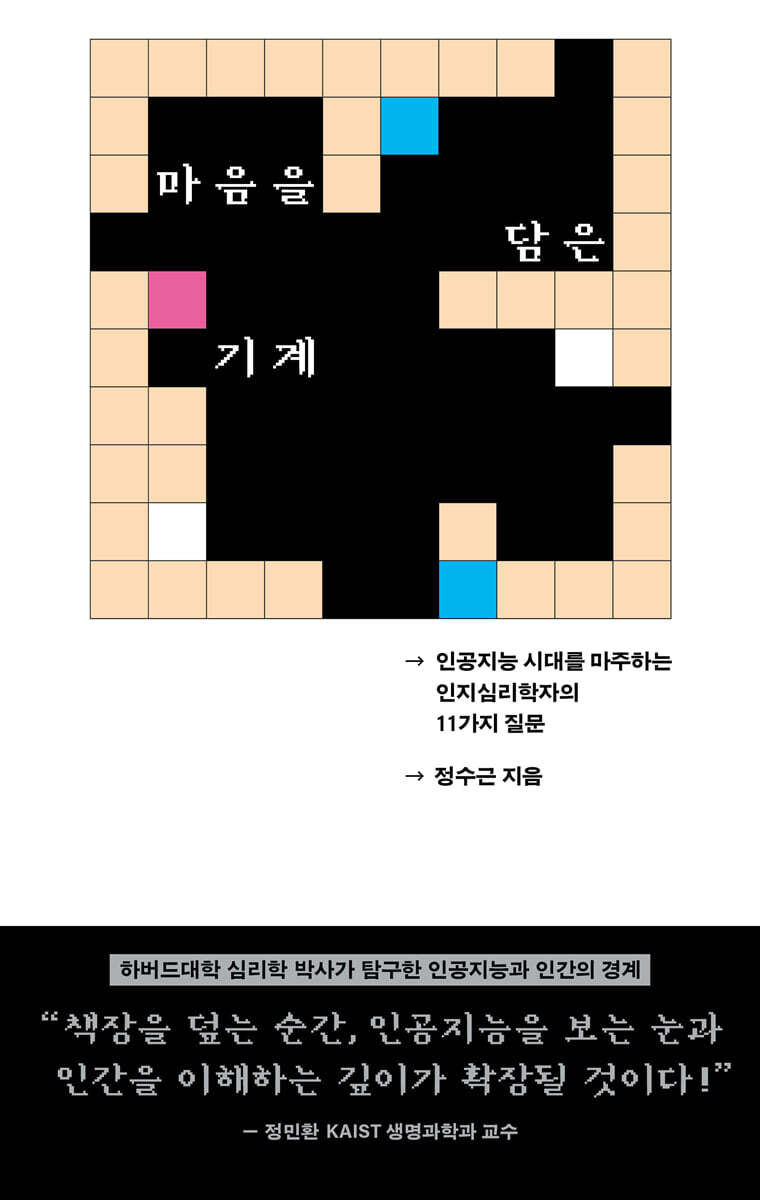
Machine with heart
 |
Description
Book Introduction
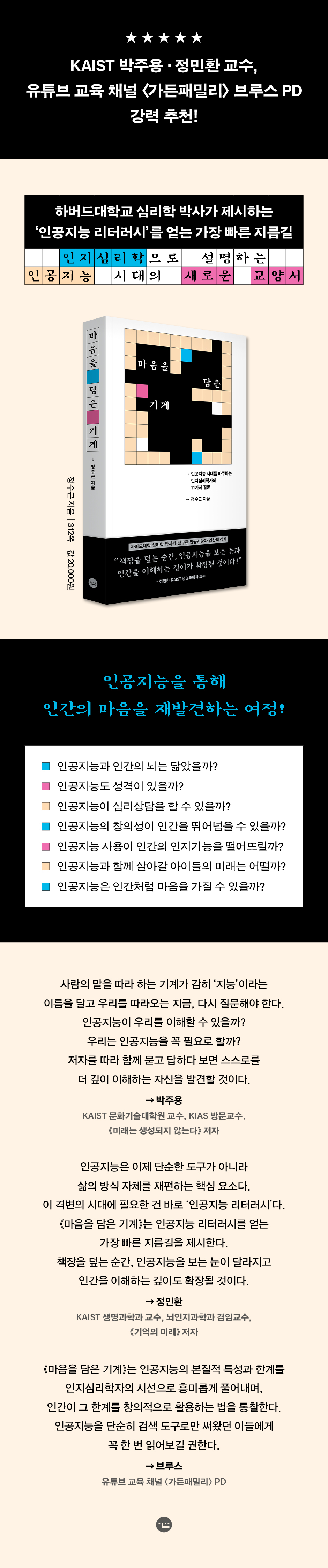
“A machine that imitates human speech dares to be called ‘intelligence’
Now that we are following, we must ask again.
"Can AI understand us? Do we really need AI?"
-Park Joo-yong, Professor, KAIST Graduate School of Culture, Science, and Technology, KIAS Visiting Professor
“The moment you close the bookcase, your perspective on artificial intelligence changes.
“The depth of understanding of humanity also expands.”
Jeong Min-hwan, Professor of Life Sciences and Adjunct Professor of Brain and Cognitive Sciences at KAIST
“Artificial intelligence is no longer an option, it is a necessity.
What matters is how deeply you understand the strengths and limitations of artificial intelligence.
“I recommend this book to anyone who has only used AI as a simple search tool.”
-Bruce, PD of YouTube educational channel "Garden Family"
Can artificial intelligence really understand humans?
The Boundaries Between Artificial Intelligence and Humanity: Explored by a Harvard University Psychology Ph.D.
Artificial intelligence, including chatbots, voice-activated speakers, and self-driving cars, is rapidly infiltrating our lives.
It is no longer an unfamiliar technology.
As artificial intelligence becomes a part of our lives, we face new questions.
Can artificial intelligence truly understand the human mind? How should we coexist with this technology in the future? Professor Jeong Su-geun, a cognitive psychologist who received his Ph.D. in psychology from Harvard University and worked as a postdoctoral researcher at the Princeton University Neuroscience Institute and the Johns Hopkins University Department of Psychology and Brain Science, has published a book titled "Machines with Minds," which answers these questions.
The author states that various artificial intelligence models are being used in recent brain science and psychology research, and he explores human cognitive functions and the workings of the mind through the lens of artificial intelligence in 11 chapters.
First, we compare the structural and functional characteristics of artificial intelligence and the human brain, demonstrating that artificial intelligence can be used as a tool to understand the human brain and mind.
Next, we will examine whether artificial intelligence can have personality or emotions, and whether it can demonstrate creativity superior to that of humans.
In particular, it raises the need for continued discussion, assessing the impact on children who are surrounded by artificial intelligence technology from birth.
Even if artificial intelligence catches up with human cognitive functions, it will inevitably be fundamentally different from humans, who form their identities through the interaction of personal and social memories and experiences.
So the author likens artificial intelligence to a ‘mirror reflecting the human mind.’
Just as the image in the mirror is not the real 'me', artificial intelligence is not human either, but through the similarities and differences between the two, we can glimpse the human mind.
"Machines with a Mind" asks questions that everyone is curious about as we look into this mirror, living alongside artificial intelligence, and answers them through the eyes of a cognitive psychologist.
Drawing on the latest research in psychology, brain science, and artificial intelligence, this book explores the boundaries between artificial intelligence and humans, making it an essential reading for those living in the age of artificial intelligence.
Now that we are following, we must ask again.
"Can AI understand us? Do we really need AI?"
-Park Joo-yong, Professor, KAIST Graduate School of Culture, Science, and Technology, KIAS Visiting Professor
“The moment you close the bookcase, your perspective on artificial intelligence changes.
“The depth of understanding of humanity also expands.”
Jeong Min-hwan, Professor of Life Sciences and Adjunct Professor of Brain and Cognitive Sciences at KAIST
“Artificial intelligence is no longer an option, it is a necessity.
What matters is how deeply you understand the strengths and limitations of artificial intelligence.
“I recommend this book to anyone who has only used AI as a simple search tool.”
-Bruce, PD of YouTube educational channel "Garden Family"
Can artificial intelligence really understand humans?
The Boundaries Between Artificial Intelligence and Humanity: Explored by a Harvard University Psychology Ph.D.
Artificial intelligence, including chatbots, voice-activated speakers, and self-driving cars, is rapidly infiltrating our lives.
It is no longer an unfamiliar technology.
As artificial intelligence becomes a part of our lives, we face new questions.
Can artificial intelligence truly understand the human mind? How should we coexist with this technology in the future? Professor Jeong Su-geun, a cognitive psychologist who received his Ph.D. in psychology from Harvard University and worked as a postdoctoral researcher at the Princeton University Neuroscience Institute and the Johns Hopkins University Department of Psychology and Brain Science, has published a book titled "Machines with Minds," which answers these questions.
The author states that various artificial intelligence models are being used in recent brain science and psychology research, and he explores human cognitive functions and the workings of the mind through the lens of artificial intelligence in 11 chapters.
First, we compare the structural and functional characteristics of artificial intelligence and the human brain, demonstrating that artificial intelligence can be used as a tool to understand the human brain and mind.
Next, we will examine whether artificial intelligence can have personality or emotions, and whether it can demonstrate creativity superior to that of humans.
In particular, it raises the need for continued discussion, assessing the impact on children who are surrounded by artificial intelligence technology from birth.
Even if artificial intelligence catches up with human cognitive functions, it will inevitably be fundamentally different from humans, who form their identities through the interaction of personal and social memories and experiences.
So the author likens artificial intelligence to a ‘mirror reflecting the human mind.’
Just as the image in the mirror is not the real 'me', artificial intelligence is not human either, but through the similarities and differences between the two, we can glimpse the human mind.
"Machines with a Mind" asks questions that everyone is curious about as we look into this mirror, living alongside artificial intelligence, and answers them through the eyes of a cognitive psychologist.
Drawing on the latest research in psychology, brain science, and artificial intelligence, this book explores the boundaries between artificial intelligence and humans, making it an essential reading for those living in the age of artificial intelligence.
- You can preview some of the book's contents.
Preview
index
Introduction:
Why Cognitive Psychologists Study Artificial Intelligence
One day, artificial intelligence entered the classroom | A new tool for studying the mind | Studying the human brain with a machine brain | Artificial intelligence and the human mind | Children who will live with artificial intelligence
Chapter 1: How Similar Are Artificial Intelligence and the Human Brain?
The World as Seen by AI and the World as Seen by Humans | How Humans See the World | How AI Sees the World | AI That Imitates the Human Brain | Understanding Humans with AI | The Brain That Actively Interprets and Infers | The Difference Between the Brain and Artificial Neural Networks
Chapter 2: Can Artificial Intelligence Study the Human Brain?
AI is built on the blueprints of the human brain | Why faces? | Research on facial recognition using AI | Hidden brain regions discovered by AI | The origins of facial recognition
Chapter 3: Does artificial intelligence have personality?
AI Participates in Psychology Research | Diversity in AI | AI More Human Than Humans | Creating AI with Personality | AI with Depression
Chapter 4: Can artificial intelligence embody the human mind?
Programs to Replace Human Counselor | The Effectiveness of AI Psychological Services | Humans Becoming More Honest in the Face of AI | AI Hallucinations and Human Dependence | The Irreplaceable Power of Empathy | Tools for Improving Mental Health
Chapter 5: What is the acceptable range of use of artificial intelligence?
The Research Environment Changed by AI | Can We Trust AI Summaries? | Generating New Research Ideas | AI Research Ethics
Chapter 6: Can AI surpass humans in creativity?
The Requirements for Creativity | AlphaGo and MuZero Catch Up to Human Creativity | The Limits of AI Creativity | Humans Who Value Human Creativity
Chapter 7: Does the use of artificial intelligence impair cognitive function?
Outsourcing Memory | Cognitive Offloading | Automating Thinking That Reduces Cognitive Function | The Impact of AI on the Brain | Why Human Cognitive Function Still Matters | How to Use AI Wisely | The Synergy Between Humans and AI | The Widening Gap of AI | Human Partners
Chapter 8: What kind of future will artificial intelligence lead children to?
The Blurry Line Between the World on TV and Reality | Between the Living and the Inanimate | How Children Perceive AI | AI as a Learning Aid | Proper Understanding Leads to Proper Use | Children Who Will Live with AI
Chapter 9: Can artificial intelligence have a human-like mind?
Distinguishing Humans from AI | What Does It Mean to Have a Mind? | The One Word That Defines Humanity | AI That Reads Minds | Humans Who Give Them a Mind | How Humans Treat AI
Chapter 10: What is the difference between artificial intelligence and human memory?
Memories that Make Me Who I Am | AI's Memory | Human Memory Reconstructing Experiences | Imperfect Memories | Forgetting Helps AI, Too | The Essence of Memory That Distinguishes Humans from AI
Chapter 11: Is Artificial Intelligence Flexible?
Cognitive Flexibility | Being Created Through Context | Reconstructing the World in Your Mind
Outgoing remarks:
What Makes Humans Human
There is no such thing as absolute superiority | Imperfect humans | Does AI necessarily have to resemble humans? | Solving an unfinished puzzle | A mirror reflecting humanity
Huzhou
Source of the illustration
Why Cognitive Psychologists Study Artificial Intelligence
One day, artificial intelligence entered the classroom | A new tool for studying the mind | Studying the human brain with a machine brain | Artificial intelligence and the human mind | Children who will live with artificial intelligence
Chapter 1: How Similar Are Artificial Intelligence and the Human Brain?
The World as Seen by AI and the World as Seen by Humans | How Humans See the World | How AI Sees the World | AI That Imitates the Human Brain | Understanding Humans with AI | The Brain That Actively Interprets and Infers | The Difference Between the Brain and Artificial Neural Networks
Chapter 2: Can Artificial Intelligence Study the Human Brain?
AI is built on the blueprints of the human brain | Why faces? | Research on facial recognition using AI | Hidden brain regions discovered by AI | The origins of facial recognition
Chapter 3: Does artificial intelligence have personality?
AI Participates in Psychology Research | Diversity in AI | AI More Human Than Humans | Creating AI with Personality | AI with Depression
Chapter 4: Can artificial intelligence embody the human mind?
Programs to Replace Human Counselor | The Effectiveness of AI Psychological Services | Humans Becoming More Honest in the Face of AI | AI Hallucinations and Human Dependence | The Irreplaceable Power of Empathy | Tools for Improving Mental Health
Chapter 5: What is the acceptable range of use of artificial intelligence?
The Research Environment Changed by AI | Can We Trust AI Summaries? | Generating New Research Ideas | AI Research Ethics
Chapter 6: Can AI surpass humans in creativity?
The Requirements for Creativity | AlphaGo and MuZero Catch Up to Human Creativity | The Limits of AI Creativity | Humans Who Value Human Creativity
Chapter 7: Does the use of artificial intelligence impair cognitive function?
Outsourcing Memory | Cognitive Offloading | Automating Thinking That Reduces Cognitive Function | The Impact of AI on the Brain | Why Human Cognitive Function Still Matters | How to Use AI Wisely | The Synergy Between Humans and AI | The Widening Gap of AI | Human Partners
Chapter 8: What kind of future will artificial intelligence lead children to?
The Blurry Line Between the World on TV and Reality | Between the Living and the Inanimate | How Children Perceive AI | AI as a Learning Aid | Proper Understanding Leads to Proper Use | Children Who Will Live with AI
Chapter 9: Can artificial intelligence have a human-like mind?
Distinguishing Humans from AI | What Does It Mean to Have a Mind? | The One Word That Defines Humanity | AI That Reads Minds | Humans Who Give Them a Mind | How Humans Treat AI
Chapter 10: What is the difference between artificial intelligence and human memory?
Memories that Make Me Who I Am | AI's Memory | Human Memory Reconstructing Experiences | Imperfect Memories | Forgetting Helps AI, Too | The Essence of Memory That Distinguishes Humans from AI
Chapter 11: Is Artificial Intelligence Flexible?
Cognitive Flexibility | Being Created Through Context | Reconstructing the World in Your Mind
Outgoing remarks:
What Makes Humans Human
There is no such thing as absolute superiority | Imperfect humans | Does AI necessarily have to resemble humans? | Solving an unfinished puzzle | A mirror reflecting humanity
Huzhou
Source of the illustration
Detailed image
Into the book
ChatGP has learned a lot of human-created data.
These materials would reflect people's minds.
So, instead of asking actual people, wouldn't it be possible to use AI like ChatGPIT to peer into the human mind? While psychologists don't believe AI can completely replace human research, for those interested in the human mind, this provides a new tool for studying the mind.
--- p.9~10
Although artificial neural networks have a similar structure to the human brain and exhibit human-level visual information processing capabilities, the brain is fundamentally different in that it actively interprets and infers information using learned prior knowledge and context, and sometimes supplements and reconstructs incomplete input information.
--- p.46
Yet, the reason why conversations with Eliza feel like psychological counseling with a human being is due to the user's own interpretation rather than the program's conversational ability.
Users give meaning to Eliza's ambiguous questions and interpret them in a context that suits them.
Humans tend to personify objects and form emotional attachments.
Just as it's common to name your car and feel sad when you sell or scrap your old one, like parting with a friend, it's not so unusual to feel attached to a computer program you've had a conversation with.
--- p.99
As artificial intelligence is increasingly utilized throughout the research process, a clearer understanding of its limitations and research ethics is increasingly necessary.
As the numerous examples discussed above demonstrate, no matter how plausible the results generated by AI may seem, the ultimate responsibility for reviewing and judging whether the content is true, whether it is biased or distorted, and whether important information has been omitted still lies with human researchers.
--- p.131~132
Creativity is like this too.
Creative thinking is the process of generating new ideas that did not exist before.
However, in order to think creatively, you must first go through a process of learning existing knowledge sufficiently, like learning the basics of martial arts.
And, like linking the basic techniques of various martial arts or using variations, we must go through a process of linking and transforming existing knowledge in various fields.
In the end, just as we break free from established patterns of behavior and move freely, we break free from the framework of existing knowledge and come up with new ideas.
--- p.137
Interestingly, in the brains of highly creative people, several regions are sometimes connected inefficiently.
Instead of brain regions exchanging information in the most efficient way, regions that don't necessarily need to be closely connected are observed exchanging information with each other.
Just as creative thinking comes from combining knowledge from various fields, creativity is also manifested in the brain when areas that were not normally well connected become newly connected and various types of information processing are actively carried out.
--- p.139
However, human creativity is not evaluated simply by the excellence of the results.
It contains the unique intention, effort, and heart of a human being, which distinguishes it from the creativity of artificial intelligence.
Just as we wouldn't consider a monkey a creative musician just because it accidentally strikes a beautiful melody while playing the piano keys, creativity involves the human effort and heart that goes into the result.
In fact, people tend to rate creativity scores lower when they believe that the same result was created by AI.
Ultimately, it is humans who value creativity and evaluate it.
--- p.151
Even as artificial intelligence assists many human cognitive functions, there are further reasons why we must continue to refine our cognitive functions.
As we age, cognitive function naturally declines.
Cognitive decline due to aging occurs in everyone, but the rate and degree of decline vary from person to person.
The ability to maintain cognitive function even as aging or disease progresses is called cognitive reserve.
--- p.171
Will children growing up with AI become smarter, or will they become overly reliant on it and lose the opportunity to think deeply? How will AI impact children's emotional development? Various studies are being conducted to answer these questions, but given the constant advancement of AI, it's difficult to draw definitive conclusions at this point.
However, many studies show that, like many previous emerging technologies, AI has both positive and negative effects on humans.
Therefore, while studying the impact of AI on children, discussions and research on how to utilize AI positively should also be conducted.
--- p.202
It seems unlikely that advanced AI will ever become self-aware and possess a mind, but even if that happens, there is still no way to definitively prove it.
As of now, it appears that artificial intelligence is incapable of self-awareness or internal experiences.
However, humans project a human-like state of mind onto AI even with its limited responses.
The subject who feels emotions is human, and it is also human who bestows emotions on other beings.
Ultimately, the answer to the question, "Can AI have a human-like mind?" depends more on human evaluation of AI than on its own capabilities.
--- p.216
Human memory selectively stores only important information by occasionally forgetting some information, and uses this information to flexibly respond to new situations.
Artificial neural networks can also reduce their tendency to become overly reliant on certain features by intentionally randomly omitting or deleting some computational steps during the learning process.
Reflecting the structure and function of human memory in this way will help develop artificial intelligence that goes beyond simply memorizing data accurately and can make flexible and adaptive decisions in new situations.
--- p.242
However, self-orientation is not limited to simply recognizing the perspective of a character in a game or interpreting a map and representing one's own position.
Self-orientation goes beyond recognizing oneself in physical space to encompass recognizing oneself in other times, other social contexts, or other conceptual contexts.
That is, it is the ability to represent not only the present me in space and time, but also the past or future me, or the me in another context, and to adjust actions based on this.
--- p.256
Artificial intelligence that looks human-like appears very similar to humans, almost like a mirror reflecting our minds.
Of course, just as the me in the mirror is not the real me, artificial intelligence is not a real human being either.
But through their similarities we can glimpse into the human mind.
If we use the "mirror of artificial intelligence" not simply as a tool to judge the superiority of humans and artificial intelligence, but to explore how humans and artificial intelligence are similar and different, we will be able to understand humans more deeply.
These materials would reflect people's minds.
So, instead of asking actual people, wouldn't it be possible to use AI like ChatGPIT to peer into the human mind? While psychologists don't believe AI can completely replace human research, for those interested in the human mind, this provides a new tool for studying the mind.
--- p.9~10
Although artificial neural networks have a similar structure to the human brain and exhibit human-level visual information processing capabilities, the brain is fundamentally different in that it actively interprets and infers information using learned prior knowledge and context, and sometimes supplements and reconstructs incomplete input information.
--- p.46
Yet, the reason why conversations with Eliza feel like psychological counseling with a human being is due to the user's own interpretation rather than the program's conversational ability.
Users give meaning to Eliza's ambiguous questions and interpret them in a context that suits them.
Humans tend to personify objects and form emotional attachments.
Just as it's common to name your car and feel sad when you sell or scrap your old one, like parting with a friend, it's not so unusual to feel attached to a computer program you've had a conversation with.
--- p.99
As artificial intelligence is increasingly utilized throughout the research process, a clearer understanding of its limitations and research ethics is increasingly necessary.
As the numerous examples discussed above demonstrate, no matter how plausible the results generated by AI may seem, the ultimate responsibility for reviewing and judging whether the content is true, whether it is biased or distorted, and whether important information has been omitted still lies with human researchers.
--- p.131~132
Creativity is like this too.
Creative thinking is the process of generating new ideas that did not exist before.
However, in order to think creatively, you must first go through a process of learning existing knowledge sufficiently, like learning the basics of martial arts.
And, like linking the basic techniques of various martial arts or using variations, we must go through a process of linking and transforming existing knowledge in various fields.
In the end, just as we break free from established patterns of behavior and move freely, we break free from the framework of existing knowledge and come up with new ideas.
--- p.137
Interestingly, in the brains of highly creative people, several regions are sometimes connected inefficiently.
Instead of brain regions exchanging information in the most efficient way, regions that don't necessarily need to be closely connected are observed exchanging information with each other.
Just as creative thinking comes from combining knowledge from various fields, creativity is also manifested in the brain when areas that were not normally well connected become newly connected and various types of information processing are actively carried out.
--- p.139
However, human creativity is not evaluated simply by the excellence of the results.
It contains the unique intention, effort, and heart of a human being, which distinguishes it from the creativity of artificial intelligence.
Just as we wouldn't consider a monkey a creative musician just because it accidentally strikes a beautiful melody while playing the piano keys, creativity involves the human effort and heart that goes into the result.
In fact, people tend to rate creativity scores lower when they believe that the same result was created by AI.
Ultimately, it is humans who value creativity and evaluate it.
--- p.151
Even as artificial intelligence assists many human cognitive functions, there are further reasons why we must continue to refine our cognitive functions.
As we age, cognitive function naturally declines.
Cognitive decline due to aging occurs in everyone, but the rate and degree of decline vary from person to person.
The ability to maintain cognitive function even as aging or disease progresses is called cognitive reserve.
--- p.171
Will children growing up with AI become smarter, or will they become overly reliant on it and lose the opportunity to think deeply? How will AI impact children's emotional development? Various studies are being conducted to answer these questions, but given the constant advancement of AI, it's difficult to draw definitive conclusions at this point.
However, many studies show that, like many previous emerging technologies, AI has both positive and negative effects on humans.
Therefore, while studying the impact of AI on children, discussions and research on how to utilize AI positively should also be conducted.
--- p.202
It seems unlikely that advanced AI will ever become self-aware and possess a mind, but even if that happens, there is still no way to definitively prove it.
As of now, it appears that artificial intelligence is incapable of self-awareness or internal experiences.
However, humans project a human-like state of mind onto AI even with its limited responses.
The subject who feels emotions is human, and it is also human who bestows emotions on other beings.
Ultimately, the answer to the question, "Can AI have a human-like mind?" depends more on human evaluation of AI than on its own capabilities.
--- p.216
Human memory selectively stores only important information by occasionally forgetting some information, and uses this information to flexibly respond to new situations.
Artificial neural networks can also reduce their tendency to become overly reliant on certain features by intentionally randomly omitting or deleting some computational steps during the learning process.
Reflecting the structure and function of human memory in this way will help develop artificial intelligence that goes beyond simply memorizing data accurately and can make flexible and adaptive decisions in new situations.
--- p.242
However, self-orientation is not limited to simply recognizing the perspective of a character in a game or interpreting a map and representing one's own position.
Self-orientation goes beyond recognizing oneself in physical space to encompass recognizing oneself in other times, other social contexts, or other conceptual contexts.
That is, it is the ability to represent not only the present me in space and time, but also the past or future me, or the me in another context, and to adjust actions based on this.
--- p.256
Artificial intelligence that looks human-like appears very similar to humans, almost like a mirror reflecting our minds.
Of course, just as the me in the mirror is not the real me, artificial intelligence is not a real human being either.
But through their similarities we can glimpse into the human mind.
If we use the "mirror of artificial intelligence" not simply as a tool to judge the superiority of humans and artificial intelligence, but to explore how humans and artificial intelligence are similar and different, we will be able to understand humans more deeply.
--- p.275~276
Publisher's Review
“Does artificial intelligence have personality?”
Exploring humanity with human-like technology
A new tool for studying the mind: artificial intelligence
Generative artificial intelligence, such as ChatGPiT, Gemini, and Claude, is constantly being developed.
Many also argue that greater investment in artificial intelligence technology is needed.
However, there is a lack of discussion about humans living with rapidly developing artificial intelligence.
The author, who holds a Ph.D. in psychology from Harvard University and is currently a professor of psychology at Catholic University, introduces in "Machines with Minds" how artificial intelligence technology has expanded the way we understand the human brain and mind, and what impact it has had on humans, based on various latest research results, and seeks answers to 11 questions about the present and future of artificial intelligence and humans.
The author, a cognitive psychologist who directly uses and observes artificial intelligence, accompanies readers on a “journey to answers” and provides them with the opportunity to think for themselves.
Artificial neural networks in artificial intelligence are modeled after the human brain and have learned from a vast amount of human-created data.
Because of this, the process of comparing artificial neural networks and the brain provided an opportunity to discover new brain regions that were previously unknown.
It could also be said that we have ‘peeped into the human mind’ through ‘artificial intelligence’.
“In this way, artificial intelligence research is not limited to simply developing artificial intelligence technology itself, but is also used as a powerful tool to explore the development and evolution of the human brain.
“While there are limitations to directly verifying the human brain development or evolution process due to various practical and ethical constraints, artificial intelligence is a tool that allows researchers to repeat virtual evolution and development simulations in the way they desire (p. 68).”
Then we can ask this question:
If AI resembles our brains, could it also have a personality like ours? Personality is a unique psychological trait found in humans and animals alike.
In the case of humans and animals, personality is usually formed and changed by the influence of genetics and environment.
Research shows that AI models react slightly differently depending on the data they are trained on.
Although they do not acquire psychological characteristics in the same way as humans, they develop characteristics that can be called personality traits based on the data they have learned.
In late 2023, it was suggested that ChatGP was becoming lazy.
They gave shorter answers than before, sometimes even leaving it up to the user to figure out the answer themselves, and sometimes they even showed that they couldn't do the work at all.
There were opinions that it resembled seasonal depression symptoms, but it is difficult to clearly diagnose Chatjipti as suffering from depression because it is not affected by many factors that cause depression.
ChatGPi learns by collecting human-generated data, and in the process, it has learned the behavioral pattern of procrastinating at the end of the year when people have a lot of rest.
Although it is not human, it has learned human patterns and behaves like a human.
It's like looking in a mirror.
“Can artificial intelligence surpass humans?”
A partner that grows together with humans,
AI Literacy: The Skills Needed for Maximum Efficiency
The author, who teaches students at a university, has personally witnessed students actively using ChatGPIT to do assignments or study.
Even among fellow professors, there is much discussion about how far ChatGPi should be allowed to be used and whether its use can be restricted.
Not only college students, but we are already actively using artificial intelligence in our daily lives.
Humans engage in 'cognitive offloading' to various auxiliary means to effectively use limited cognitive resources.
Typical examples include saving phone numbers in your phone's address book or writing down to-do items in a notepad.
Cognitive offloading can prevent information distortion or forgetting, freeing up cognitive resources for more important tasks.
Should we be entirely positive about the conveniences gained by utilizing AI tools? Unlike other technologies, AI replaces various cognitive functions.
If this kind of situation repeats itself, even high-level human cognitive functions may become dependent on artificial intelligence.
Concerns that the use of artificial intelligence will diminish human cognitive function are not unfounded.
In fact, when an experiment was conducted to see how using AI tools affected math learning, students who used AI freely received the lowest grades.
Students who studied using limited AI scored similarly to those who studied without AI.
“If AI is not designed to enhance human capabilities, humans will become increasingly dependent on technology, and the short-term convenience provided by AI will in the long run diminish human capabilities, widening the gap between those who are good at using AI and those who are not, and accelerating inequality.
Therefore, rather than emphasizing only the efficiency and automation of AI, we need to design AI as a partner that grows together with humans (p. 182).”
Recently, photos and music generated by artificial intelligence have been winning awards in various competitions.
Has artificial intelligence surpassed human creativity? According to the author, it's still too early to tell.
Artificial intelligence simply combines learned data to produce results.
You can't create something completely new that wasn't included in the training data in the first place.
It is difficult to say that artificial intelligence can fully demonstrate creativity, as the learning data is also human-created.
Moreover, AI does not display creativity of its own accord like humans do.
However, there is an opportunity to enhance human creativity by utilizing artificial intelligence.
AI's ability to quickly connect and reconstruct large amounts of information helps humans come up with new ideas.
Therefore, the author says that we should not try to leave everything to artificial intelligence.
We need to think about where humans and artificial intelligence should each be positioned.
He continued by explaining that it is necessary to keep in mind the relationship between the role of leading and giving clear instructions while drawing the big picture, such as the team leader and team members, the main chef and assistant chef, the main producer and assistant director, and the role of assisting and carrying out the work.
Artificial intelligence is not omnipotent.
To maximize the assistance of AI, human users must be able to clearly direct and judge the appropriateness of the results.
In other words, in the age of artificial intelligence, the roles and abilities that humans must perform will change, but we should not expect artificial intelligence to do everything for us.
This is why 'AI literacy', the ability to properly understand and utilize artificial intelligence, is being emphasized.
“What makes humans human?”
The quest for artificial intelligence is ultimately
It all boils down to an exploration of humanity.
Humans 'remember'.
AI chatbots also have memories, but they are different from humans in some ways.
“Humans do not store experiences as they are.
It doesn't even keep the stored memories intact.
Memories are forgotten, distorted, or altered over time during recall (p. 234).” Inaccurate human memory amplifies creativity and diversity, and is also a key element in the ability to adapt flexibly to environmental conditions.
Recently, attempts are being made to apply characteristics of human memory, such as 'forgetting', to artificial intelligence.
Even so, artificial intelligence will not become completely identical to humans.
Because for humans, memory is more than just a 'storage' of memories.
Memories shape human identity.
Here, ‘memory’ includes not only personal memory but also social memory.
In addition, humans have a 'world model' that reconstructs the world they have experienced in their minds.
The world model is a massive psychological representation that encompasses not only spatial information but also conceptual knowledge, helping humans understand the world, respond flexibly to situations, and predict the future.
In contrast, the current world model of artificial intelligence is limited compared to that of humans.
Because artificial intelligence only forms world models that fit specific situations for which it has been trained, its ability to cope when suddenly presented with a different environment is limited.
"What challenges must AI overcome to be considered human-like? In fact, it's very difficult to answer precisely whether AI possesses a human-like mind, or whether it will one day.
For now, it seems like the answer needs to be found on the human side, not in artificial intelligence.
Rather than asking, 'When will AI have a human-like mind?'
Perhaps we should rephrase the question as, “When will humans grant artificial intelligence a mind?” (p. 215).”
"Machines with a Heart" offers profound insightful answers to 11 questions that ponder the unique realm of humanity that AI cannot surpass and coexistence with AI.
Through a question-and-answer process, the author finds the true value of artificial intelligence in ‘human exploration.’
By comparing humans with artificial intelligence that is similar to humans but different from them, we can discover unique characteristics of humans and discover new aspects of humans that we have not known before.
That is why it is important to explore the relationship between artificial intelligence and humans, even for the sake of humanity.
Of course, these answers could change at any time as new research results emerge, or new questions could arise.
It may seem vague and complicated now, but if you follow the author's guidance step by step, you will soon find yourself perfectly prepared for life with artificial intelligence.
Exploring humanity with human-like technology
A new tool for studying the mind: artificial intelligence
Generative artificial intelligence, such as ChatGPiT, Gemini, and Claude, is constantly being developed.
Many also argue that greater investment in artificial intelligence technology is needed.
However, there is a lack of discussion about humans living with rapidly developing artificial intelligence.
The author, who holds a Ph.D. in psychology from Harvard University and is currently a professor of psychology at Catholic University, introduces in "Machines with Minds" how artificial intelligence technology has expanded the way we understand the human brain and mind, and what impact it has had on humans, based on various latest research results, and seeks answers to 11 questions about the present and future of artificial intelligence and humans.
The author, a cognitive psychologist who directly uses and observes artificial intelligence, accompanies readers on a “journey to answers” and provides them with the opportunity to think for themselves.
Artificial neural networks in artificial intelligence are modeled after the human brain and have learned from a vast amount of human-created data.
Because of this, the process of comparing artificial neural networks and the brain provided an opportunity to discover new brain regions that were previously unknown.
It could also be said that we have ‘peeped into the human mind’ through ‘artificial intelligence’.
“In this way, artificial intelligence research is not limited to simply developing artificial intelligence technology itself, but is also used as a powerful tool to explore the development and evolution of the human brain.
“While there are limitations to directly verifying the human brain development or evolution process due to various practical and ethical constraints, artificial intelligence is a tool that allows researchers to repeat virtual evolution and development simulations in the way they desire (p. 68).”
Then we can ask this question:
If AI resembles our brains, could it also have a personality like ours? Personality is a unique psychological trait found in humans and animals alike.
In the case of humans and animals, personality is usually formed and changed by the influence of genetics and environment.
Research shows that AI models react slightly differently depending on the data they are trained on.
Although they do not acquire psychological characteristics in the same way as humans, they develop characteristics that can be called personality traits based on the data they have learned.
In late 2023, it was suggested that ChatGP was becoming lazy.
They gave shorter answers than before, sometimes even leaving it up to the user to figure out the answer themselves, and sometimes they even showed that they couldn't do the work at all.
There were opinions that it resembled seasonal depression symptoms, but it is difficult to clearly diagnose Chatjipti as suffering from depression because it is not affected by many factors that cause depression.
ChatGPi learns by collecting human-generated data, and in the process, it has learned the behavioral pattern of procrastinating at the end of the year when people have a lot of rest.
Although it is not human, it has learned human patterns and behaves like a human.
It's like looking in a mirror.
“Can artificial intelligence surpass humans?”
A partner that grows together with humans,
AI Literacy: The Skills Needed for Maximum Efficiency
The author, who teaches students at a university, has personally witnessed students actively using ChatGPIT to do assignments or study.
Even among fellow professors, there is much discussion about how far ChatGPi should be allowed to be used and whether its use can be restricted.
Not only college students, but we are already actively using artificial intelligence in our daily lives.
Humans engage in 'cognitive offloading' to various auxiliary means to effectively use limited cognitive resources.
Typical examples include saving phone numbers in your phone's address book or writing down to-do items in a notepad.
Cognitive offloading can prevent information distortion or forgetting, freeing up cognitive resources for more important tasks.
Should we be entirely positive about the conveniences gained by utilizing AI tools? Unlike other technologies, AI replaces various cognitive functions.
If this kind of situation repeats itself, even high-level human cognitive functions may become dependent on artificial intelligence.
Concerns that the use of artificial intelligence will diminish human cognitive function are not unfounded.
In fact, when an experiment was conducted to see how using AI tools affected math learning, students who used AI freely received the lowest grades.
Students who studied using limited AI scored similarly to those who studied without AI.
“If AI is not designed to enhance human capabilities, humans will become increasingly dependent on technology, and the short-term convenience provided by AI will in the long run diminish human capabilities, widening the gap between those who are good at using AI and those who are not, and accelerating inequality.
Therefore, rather than emphasizing only the efficiency and automation of AI, we need to design AI as a partner that grows together with humans (p. 182).”
Recently, photos and music generated by artificial intelligence have been winning awards in various competitions.
Has artificial intelligence surpassed human creativity? According to the author, it's still too early to tell.
Artificial intelligence simply combines learned data to produce results.
You can't create something completely new that wasn't included in the training data in the first place.
It is difficult to say that artificial intelligence can fully demonstrate creativity, as the learning data is also human-created.
Moreover, AI does not display creativity of its own accord like humans do.
However, there is an opportunity to enhance human creativity by utilizing artificial intelligence.
AI's ability to quickly connect and reconstruct large amounts of information helps humans come up with new ideas.
Therefore, the author says that we should not try to leave everything to artificial intelligence.
We need to think about where humans and artificial intelligence should each be positioned.
He continued by explaining that it is necessary to keep in mind the relationship between the role of leading and giving clear instructions while drawing the big picture, such as the team leader and team members, the main chef and assistant chef, the main producer and assistant director, and the role of assisting and carrying out the work.
Artificial intelligence is not omnipotent.
To maximize the assistance of AI, human users must be able to clearly direct and judge the appropriateness of the results.
In other words, in the age of artificial intelligence, the roles and abilities that humans must perform will change, but we should not expect artificial intelligence to do everything for us.
This is why 'AI literacy', the ability to properly understand and utilize artificial intelligence, is being emphasized.
“What makes humans human?”
The quest for artificial intelligence is ultimately
It all boils down to an exploration of humanity.
Humans 'remember'.
AI chatbots also have memories, but they are different from humans in some ways.
“Humans do not store experiences as they are.
It doesn't even keep the stored memories intact.
Memories are forgotten, distorted, or altered over time during recall (p. 234).” Inaccurate human memory amplifies creativity and diversity, and is also a key element in the ability to adapt flexibly to environmental conditions.
Recently, attempts are being made to apply characteristics of human memory, such as 'forgetting', to artificial intelligence.
Even so, artificial intelligence will not become completely identical to humans.
Because for humans, memory is more than just a 'storage' of memories.
Memories shape human identity.
Here, ‘memory’ includes not only personal memory but also social memory.
In addition, humans have a 'world model' that reconstructs the world they have experienced in their minds.
The world model is a massive psychological representation that encompasses not only spatial information but also conceptual knowledge, helping humans understand the world, respond flexibly to situations, and predict the future.
In contrast, the current world model of artificial intelligence is limited compared to that of humans.
Because artificial intelligence only forms world models that fit specific situations for which it has been trained, its ability to cope when suddenly presented with a different environment is limited.
"What challenges must AI overcome to be considered human-like? In fact, it's very difficult to answer precisely whether AI possesses a human-like mind, or whether it will one day.
For now, it seems like the answer needs to be found on the human side, not in artificial intelligence.
Rather than asking, 'When will AI have a human-like mind?'
Perhaps we should rephrase the question as, “When will humans grant artificial intelligence a mind?” (p. 215).”
"Machines with a Heart" offers profound insightful answers to 11 questions that ponder the unique realm of humanity that AI cannot surpass and coexistence with AI.
Through a question-and-answer process, the author finds the true value of artificial intelligence in ‘human exploration.’
By comparing humans with artificial intelligence that is similar to humans but different from them, we can discover unique characteristics of humans and discover new aspects of humans that we have not known before.
That is why it is important to explore the relationship between artificial intelligence and humans, even for the sake of humanity.
Of course, these answers could change at any time as new research results emerge, or new questions could arise.
It may seem vague and complicated now, but if you follow the author's guidance step by step, you will soon find yourself perfectly prepared for life with artificial intelligence.
GOODS SPECIFICS
- Date of issue: October 17, 2025
- Page count, weight, size: 312 pages | 380g | 130*205*20mm
- ISBN13: 9791172540838
- ISBN10: 1172540837
You may also like
카테고리
korean


korean

![GQ KOREA Mark (Monthly): December [2025]](http://librairie.coreenne.fr/cdn/shop/files/8ef265dbbfbf186523ed75ba7319009d.jpg?v=1765340328&width=3840)


