

How Publishers Can Use AI
 |
Description
Book Introduction
A task that would take 3 hours is now done in 30 minutes, and now publishing is changing with AI!
Available to everyone from editors, marketers, managers, and even solo publishers!
A practical manual for generative AI that can be applied throughout the entire publishing process!
Advances in AI technologies like ChatGPT are accelerating transformation in the publishing industry, leading to increased use of AI in diverse fields such as manuscript writing, editing, translation, publishing planning, design, marketing, and management. AI can automate repetitive tasks and leverage data analysis to make publishing planning and marketing more efficient.
Of course, there are still challenges to be addressed, such as accuracy and ethical issues, but the reality is that we can no longer delay the use of AI as an excellent assistant.
Combining human expertise and creativity with AI to improve work efficiency and provide readers with richer and more diverse content has now become essential in publishing.
"How to Use AI for Publishers" is a book by the author, a former developer and now CEO of an IT publishing company, who uses AI for practical application. Drawing on his own experience, the book provides a comprehensive overview of how to leverage AI to achieve effective results across various publishing fields. From how to use AI to manipulate information, to the pros and cons of various AI tools, and through practical examples from A to Z, the book demonstrates how to use which AI tools for which tasks and how to build efficient work processes.
Available to everyone from editors, marketers, managers, and even solo publishers!
A practical manual for generative AI that can be applied throughout the entire publishing process!
Advances in AI technologies like ChatGPT are accelerating transformation in the publishing industry, leading to increased use of AI in diverse fields such as manuscript writing, editing, translation, publishing planning, design, marketing, and management. AI can automate repetitive tasks and leverage data analysis to make publishing planning and marketing more efficient.
Of course, there are still challenges to be addressed, such as accuracy and ethical issues, but the reality is that we can no longer delay the use of AI as an excellent assistant.
Combining human expertise and creativity with AI to improve work efficiency and provide readers with richer and more diverse content has now become essential in publishing.
"How to Use AI for Publishers" is a book by the author, a former developer and now CEO of an IT publishing company, who uses AI for practical application. Drawing on his own experience, the book provides a comprehensive overview of how to leverage AI to achieve effective results across various publishing fields. From how to use AI to manipulate information, to the pros and cons of various AI tools, and through practical examples from A to Z, the book demonstrates how to use which AI tools for which tasks and how to build efficient work processes.
- You can preview some of the book's contents.
Preview
index
introduction
letter.
Implementing AI in Publishing: Where to Start
1.
Current Status and Prospects of AI Utilization in the Publishing Industry
Manuscript writing and editing assistance
Translation and multilingual support
Publication Planning and Reader Analysis
Marketing and Reader Targeting
2.
Let's change the way we work
Let's create habits and processes to always stay informed.
Let's use various artificial intelligence tools.
Let's break away from our existing duties and roles.
Let's turn all data into value.
3. Things to Consider When Using AI Tools
Chapter 1.
A new way to acquire and utilize data
1.
Planning Begins: Gathering Information Efficiently
Now let's look for the latest information abroad: DeepL
Check out the latest information conveniently: web.meco.app
2.
An innovative approach to data research and organization
Let's dig deep and look into the data.
Integrated data management: NotebookLM
Chapter 2. Improving Manuscript Proofreading and Editing Efficiency Using AI
1.
How to Use AI to Understand, Edit, and Analyze Manuscripts
Understanding the Content: Asking the Meaning of Charts and Graphs
First try: Converting text data into tables and graphs.
Second attempt: Converting the uploaded document into various text formats.
Analyze: Analyze data and create graphs.
2.
Creating a Sentence Correction Chatbot
Explaining the basics of creating GPTs (chatbots)
Create your own sentence correction chatbot
Chapter 3.
Book title generation template and cover design using AI
1.
Create a book title generation template
Running the template
Title generation function description
Creating Book Features in NotebookLM
2.
Creating Cover Designs with Generative AI
Designing a cover using icons
Create an image as a vector file
Chapter 4.
Marketing Process Innovation
1.
Creating Marketing Materials Using Unstructured Data Analysis
Getting Started with Data Analyst GPTs
Analyzing book review data
Proceed with marketing using analyzed data
2.
Automation of card news production
Extracting Book Features with NotebookLM
Converting book features to card news format
How to get the images you need for your card news
Chapter 5.
Publishing data analysis anyone can do
1.
Analyzing sales data
2.
Creating a Financial Analysis Chatbot
Creating Prompts for Chatbots
Creating a Chatbot
Running the chatbot
Analyzing your finances with other tools
Appendix A.
Installing Claude for Sheets
1.
Register an Anthropic account
2.
Registering the Claude API
3.
Installing Claude for Sheets
4.
Claude for Sheets: Easy to Use
Appendix B.
Create an automatic royalty email sending sheet
1.
Introducing the automatic royalty email sending sheet
2.
How to Use the Royalty Email Automatic Sending Sheet
3.
Creating an automatic royalty email sending program
letter.
Implementing AI in Publishing: Where to Start
1.
Current Status and Prospects of AI Utilization in the Publishing Industry
Manuscript writing and editing assistance
Translation and multilingual support
Publication Planning and Reader Analysis
Marketing and Reader Targeting
2.
Let's change the way we work
Let's create habits and processes to always stay informed.
Let's use various artificial intelligence tools.
Let's break away from our existing duties and roles.
Let's turn all data into value.
3. Things to Consider When Using AI Tools
Chapter 1.
A new way to acquire and utilize data
1.
Planning Begins: Gathering Information Efficiently
Now let's look for the latest information abroad: DeepL
Check out the latest information conveniently: web.meco.app
2.
An innovative approach to data research and organization
Let's dig deep and look into the data.
Integrated data management: NotebookLM
Chapter 2. Improving Manuscript Proofreading and Editing Efficiency Using AI
1.
How to Use AI to Understand, Edit, and Analyze Manuscripts
Understanding the Content: Asking the Meaning of Charts and Graphs
First try: Converting text data into tables and graphs.
Second attempt: Converting the uploaded document into various text formats.
Analyze: Analyze data and create graphs.
2.
Creating a Sentence Correction Chatbot
Explaining the basics of creating GPTs (chatbots)
Create your own sentence correction chatbot
Chapter 3.
Book title generation template and cover design using AI
1.
Create a book title generation template
Running the template
Title generation function description
Creating Book Features in NotebookLM
2.
Creating Cover Designs with Generative AI
Designing a cover using icons
Create an image as a vector file
Chapter 4.
Marketing Process Innovation
1.
Creating Marketing Materials Using Unstructured Data Analysis
Getting Started with Data Analyst GPTs
Analyzing book review data
Proceed with marketing using analyzed data
2.
Automation of card news production
Extracting Book Features with NotebookLM
Converting book features to card news format
How to get the images you need for your card news
Chapter 5.
Publishing data analysis anyone can do
1.
Analyzing sales data
2.
Creating a Financial Analysis Chatbot
Creating Prompts for Chatbots
Creating a Chatbot
Running the chatbot
Analyzing your finances with other tools
Appendix A.
Installing Claude for Sheets
1.
Register an Anthropic account
2.
Registering the Claude API
3.
Installing Claude for Sheets
4.
Claude for Sheets: Easy to Use
Appendix B.
Create an automatic royalty email sending sheet
1.
Introducing the automatic royalty email sending sheet
2.
How to Use the Royalty Email Automatic Sending Sheet
3.
Creating an automatic royalty email sending program
Detailed image
Into the book
In addition to the basic functionality of answering various questions, ChatGPT is a platform that provides a wide range of functions such as web search, advanced data analysis, and image creation.
In particular, it is leading the market by introducing high-performance features such as Deep Research, which was announced in early February 2025.
Claude specializes in text generation, producing natural-sounding results without the awkwardness typical of artificial intelligence.
It is also noteworthy that the model is designed to learn and make decisions on its own, following ethical guidelines.
Google's Gemini may have been relatively new to the spotlight, but it offers powerful integrations with various Google ecosystems, including YouTube, Google Docs, and Gmail, giving it a distinct competitive edge.
Work in the field is very complex and involves many different steps.
To effectively handle these tasks, it's important to understand the characteristics of each tool and utilize them appropriately for the situation, rather than relying solely on a single AI tool.
For example, when creating a book introduction card news, an effective approach is to utilize the strengths of each tool to the fullest extent, such as extracting features from the book PDF using NotebookLM, generating text using Claude, and generating images using ChatGPT.
--- "Preface.
From "Introducing AI into Publishing: Where to Start?"
Newsletters are a useful way to easily stay informed.
However, if you subscribe to multiple newsletters, it can be difficult to manage them systematically.
Because it's mixed in with tons of general emails, it's easy to miss important news.
web.meco.app is a web service that specializes in managing newsletters.
We provide a convenient feature that allows you to instantly check the contents of newsletters and automatically delete newsletters you have already read from your list.
web.meco.app is registered by linking it to your Google account and is easy to use.
The 'Discover' menu introduces a variety of recommended newsletters (Figure 1-9).
You can browse a variety of recommended foreign newsletters in the Discover menu and select the one that introduces knowledge in your desired field to receive.
Next, the 'Bookmarks' menu provides a function to bookmark important newsletters and manage them separately (Figure 1-10).
With dozens of newsletters arriving every day, it's a good idea to bookmark them to ensure you don't miss important information.
I bookmark and manage newsletters that I deem truly important information separately.
--- 「Chapter 1.
From "New Ways to Acquire and Use Data"
The information in [Figure 2-3] is much more appropriately presented in table form than in text form.
You can analyze the content and create a table yourself, but it is a time-consuming task.
In addition to working with tables, enriching the relevant content with graphs requires additional work time.
In such cases, utilizing generative AI tools can significantly reduce work time and produce high-quality results.
The way it works is very simple.
Just upload the captured image to ChatGPT and request “Please create a table with the contents of the uploaded image.”
Then, ChatGPT will respond in table format (Figure 2-4).
Next, let's graph the table contents.
The prompt for the task is simple:
If you request "Create a dashboard using the data in the table," you'll receive a link to download a dashboard file organized in HTML format (Figure 2-5). Once you download the HTML file and open it, you'll receive a well-organized dashboard file (Figure 2-6).
While achieving these results requires proficiency in Excel or Python, AI allows even those unfamiliar with data analysis to work faster than experts.
--- From "Chapter 2. Improving Manuscript Proofreading and Editing Efficiency Using AI"
One of the most important steps in the final stages of book production is deciding on a title.
An appropriate title captures the reader's attention, effectively conveys the book's content, and has a significant impact on its success after publication.
Typically, titles are conceived based on various book information such as keywords, target audience, similar book titles, and table of contents.
However, this process not only takes a long time, but it is also not easy to obtain satisfactory results.
The 'Book Title Generation Template' introduced this time is a Google Spreadsheet that automatically generates various titles by entering basic book information.
If you're not familiar with tools like Google Spreadsheets or API concepts, it might be a bit difficult to understand.
However, if you find the 'Book Title Creation Template' difficult to write, simply learning how to use it will be of great help in your work.
Follow the steps and learn step by step.
--- 「Chapter 3.
From "Book Title Creation Template and Cover Design Creation Using AI"
The biggest feature of NotebookLM is that it provides answers based on the materials I uploaded.
Unlike existing AI, it can focus on specific data and provide more accurate information.
This approach is technically known as Retrieval-Augmented Generation (RAG) systems. RAG combines knowledge from existing AI models with information retrieved from user-provided documents to generate more accurate and contextually relevant responses.
Extracting book features using NotebookLM is simple.
Go to the NotebookLM website (https://notebooklm.google.com/) and click the '+ New' button (Figure 4-12).
After clicking the button, a pop-up window appears where you can enter various data (Figure 4-13).
Data sources can come in a variety of formats, including PDF or txt files, links from the web or YouTube, and documents in Google Drive.
--- 「Chapter 4.
From “Marketing Process Innovation”
Using Gemini 2.5, released in April 2025, or Genspark.ai's Super Agent feature, you can easily perform financial analysis without complex chatbot setup.
First, let's conduct a financial analysis using Gemini 2.5.
Access the website (https://gemini.google.com/app), select the '2.5 Pro (preview)' model (①), enter the financial statement PDF and prompt (②), select the 'Canvas' button (③), and then click the 'Run' button (④) to run the program (Figure 5-15).
The prompt is:
“You are a financial analysis expert.
Please carefully analyze the uploaded document and turn it into an interactive infographic.
“Mouse over details and create a visual data story with built-in statistics.” The prompt results in financial analysis results that work interactively (Figure 5-16).
(syncopation)
Using the Claude chatbot, using Gemini, and using Genspark.ai all have their own pros and cons.
Claude chatbot always produces consistent reports, Gemini offers interactive reports for free, and Genspark.ai costs more than other AIs but produces well-organized reports.
If you're working on reports using financial data, experiment with different tools and find the one that works best for you.
In particular, it is leading the market by introducing high-performance features such as Deep Research, which was announced in early February 2025.
Claude specializes in text generation, producing natural-sounding results without the awkwardness typical of artificial intelligence.
It is also noteworthy that the model is designed to learn and make decisions on its own, following ethical guidelines.
Google's Gemini may have been relatively new to the spotlight, but it offers powerful integrations with various Google ecosystems, including YouTube, Google Docs, and Gmail, giving it a distinct competitive edge.
Work in the field is very complex and involves many different steps.
To effectively handle these tasks, it's important to understand the characteristics of each tool and utilize them appropriately for the situation, rather than relying solely on a single AI tool.
For example, when creating a book introduction card news, an effective approach is to utilize the strengths of each tool to the fullest extent, such as extracting features from the book PDF using NotebookLM, generating text using Claude, and generating images using ChatGPT.
--- "Preface.
From "Introducing AI into Publishing: Where to Start?"
Newsletters are a useful way to easily stay informed.
However, if you subscribe to multiple newsletters, it can be difficult to manage them systematically.
Because it's mixed in with tons of general emails, it's easy to miss important news.
web.meco.app is a web service that specializes in managing newsletters.
We provide a convenient feature that allows you to instantly check the contents of newsletters and automatically delete newsletters you have already read from your list.
web.meco.app is registered by linking it to your Google account and is easy to use.
The 'Discover' menu introduces a variety of recommended newsletters (Figure 1-9).
You can browse a variety of recommended foreign newsletters in the Discover menu and select the one that introduces knowledge in your desired field to receive.
Next, the 'Bookmarks' menu provides a function to bookmark important newsletters and manage them separately (Figure 1-10).
With dozens of newsletters arriving every day, it's a good idea to bookmark them to ensure you don't miss important information.
I bookmark and manage newsletters that I deem truly important information separately.
--- 「Chapter 1.
From "New Ways to Acquire and Use Data"
The information in [Figure 2-3] is much more appropriately presented in table form than in text form.
You can analyze the content and create a table yourself, but it is a time-consuming task.
In addition to working with tables, enriching the relevant content with graphs requires additional work time.
In such cases, utilizing generative AI tools can significantly reduce work time and produce high-quality results.
The way it works is very simple.
Just upload the captured image to ChatGPT and request “Please create a table with the contents of the uploaded image.”
Then, ChatGPT will respond in table format (Figure 2-4).
Next, let's graph the table contents.
The prompt for the task is simple:
If you request "Create a dashboard using the data in the table," you'll receive a link to download a dashboard file organized in HTML format (Figure 2-5). Once you download the HTML file and open it, you'll receive a well-organized dashboard file (Figure 2-6).
While achieving these results requires proficiency in Excel or Python, AI allows even those unfamiliar with data analysis to work faster than experts.
--- From "Chapter 2. Improving Manuscript Proofreading and Editing Efficiency Using AI"
One of the most important steps in the final stages of book production is deciding on a title.
An appropriate title captures the reader's attention, effectively conveys the book's content, and has a significant impact on its success after publication.
Typically, titles are conceived based on various book information such as keywords, target audience, similar book titles, and table of contents.
However, this process not only takes a long time, but it is also not easy to obtain satisfactory results.
The 'Book Title Generation Template' introduced this time is a Google Spreadsheet that automatically generates various titles by entering basic book information.
If you're not familiar with tools like Google Spreadsheets or API concepts, it might be a bit difficult to understand.
However, if you find the 'Book Title Creation Template' difficult to write, simply learning how to use it will be of great help in your work.
Follow the steps and learn step by step.
--- 「Chapter 3.
From "Book Title Creation Template and Cover Design Creation Using AI"
The biggest feature of NotebookLM is that it provides answers based on the materials I uploaded.
Unlike existing AI, it can focus on specific data and provide more accurate information.
This approach is technically known as Retrieval-Augmented Generation (RAG) systems. RAG combines knowledge from existing AI models with information retrieved from user-provided documents to generate more accurate and contextually relevant responses.
Extracting book features using NotebookLM is simple.
Go to the NotebookLM website (https://notebooklm.google.com/) and click the '+ New' button (Figure 4-12).
After clicking the button, a pop-up window appears where you can enter various data (Figure 4-13).
Data sources can come in a variety of formats, including PDF or txt files, links from the web or YouTube, and documents in Google Drive.
--- 「Chapter 4.
From “Marketing Process Innovation”
Using Gemini 2.5, released in April 2025, or Genspark.ai's Super Agent feature, you can easily perform financial analysis without complex chatbot setup.
First, let's conduct a financial analysis using Gemini 2.5.
Access the website (https://gemini.google.com/app), select the '2.5 Pro (preview)' model (①), enter the financial statement PDF and prompt (②), select the 'Canvas' button (③), and then click the 'Run' button (④) to run the program (Figure 5-15).
The prompt is:
“You are a financial analysis expert.
Please carefully analyze the uploaded document and turn it into an interactive infographic.
“Mouse over details and create a visual data story with built-in statistics.” The prompt results in financial analysis results that work interactively (Figure 5-16).
(syncopation)
Using the Claude chatbot, using Gemini, and using Genspark.ai all have their own pros and cons.
Claude chatbot always produces consistent reports, Gemini offers interactive reports for free, and Genspark.ai costs more than other AIs but produces well-organized reports.
If you're working on reports using financial data, experiment with different tools and find the one that works best for you.
--- 「Chapter 5.
From "Publishing Data Analysis Anyone Can Do"
From "Publishing Data Analysis Anyone Can Do"
Publisher's Review
▶ Even those with no experience with AI tools can apply it immediately in the field.
A guide to using generative AI, written by a current publisher.
Open AI's ChatGPT, released in November 2022, has opened a new chapter in AI technology, and in just a few years, it has permeated every aspect of our lives, driving change.
As the utility of generative AI expands across business areas, the publishing industry is also becoming increasingly interested in the changes AI will bring.
Generative AI can increase productivity across all aspects of publishing, including providing creative ideas and manuscripts, accelerating translation, researching and analyzing trends, proofreading, generating book titles, producing marketing materials, and streamlining management.
While some leading publishers are actively leveraging specialized AI tools to transform their work, many still struggle with where to start implementing AI.
"How to Use AI for Publishers" contains methods for achieving effective results by utilizing AI in various fields of publishing, centered on the author's own experience as the CEO of an IT professional publishing company.
This book explains in detail how to systematically manage a newsletter summarizing the latest news from around the world to obtain useful information, how to research information in depth and manage it comprehensively, how to reinforce manuscript content, add diagrams, and rearrange content, how to find errors in sentences and increase productivity in proofreading, how to efficiently generate creative and attractive title candidates using only basic book information, how to create a cover draft using an image generation AI tool, how to analyze book review data to create graphs and utilize them as valuable data, how to extract book features and change them into a card news format, how to create images needed to create card news or blog content, how to analyze sales and financial data to make effective decisions, and how to create a Google Spreadsheet that automatically sends royalty payment emails.
By following the practical examples in this book and learning how to use AI tools step by step, even those with no prior AI experience will be able to build efficient work processes.
▶ ChatGPT, DeepL, NotebookLM, Gemini, Claude… …
I can immediately select and use only the parts I need from various generative AI tools!
Many people have high expectations when they first encounter AI.
However, in the process of actually using AI, there are cases where people easily give up when they encounter a gap between expectations and reality.
In this book, the author advises that rather than expecting AI to completely replace all jobs, it is advisable to initially set a goal of increasing productivity by around 20%.
A sustainable approach is to build on small successes and gradually expand the scope of application. We must view AI not as a simple computer program but as a collaborative partner requiring interaction, and accept that it will not always produce the same results. To effectively utilize AI, we must learn how to give precise instructions, and it's best to start with tasks where varying results are acceptable.
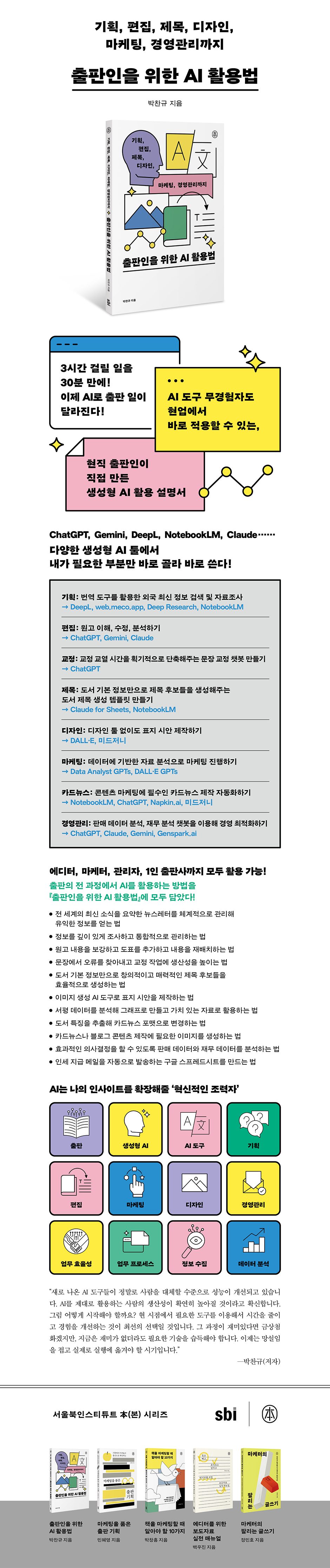
"How to Use AI for Publishers" introduces how to apply various AI tools to different areas of publishing work, as follows:
Planning: Search for the latest foreign information and research materials using translation tools.
→ DeepL, web.meco.app, Deep Research, NotebookLM
· Editing: Understanding, revising, and analyzing the manuscript
→ ChatGPT, Gemini, Claude
· Proofreading: Creating a sentence proofreading chatbot that dramatically reduces proofreading time.
→ ChatGPT
· Title: Create a book title generation template that generates title candidates based on only basic book information.
→ Claude for Sheets, NotebookLM
· Design: Create cover designs without design tools.
→ DALL·E, Midjourney
Marketing: Conducting marketing through data-driven analysis.
→ Data Analyst GPTs, DALL·E GPTs
Card News: Automating the creation of card news, essential for content marketing.
→ NotebookLM, ChatGPT, Napkin.ai, Midjourney
· Business Management: Optimize your business using sales data analysis and financial analysis chatbots.
→ ChatGPT, Claude, Gemini, Genspark.ai
AI is an innovative assistant that will expand my insights.
Now is the time to work in various fields, not just limited to a specific field.
For example, during the book cover creation process, a planner can utilize AI to create a cover image that is more than 50% complete, and then proceed with consultation with a designer.
While the final touches still require the expertise of a designer, this approach significantly reduces the time required and more accurately reflects the designer's or author's intent.
Likewise, designers can now conduct market research and submit proposals directly with the help of AI.
If you're planning a design-related book, there's now a chance that designers can do a better job than planners.
As boundaries blur and the scope of work expands, insights derived from one's own area of expertise become increasingly important. With the help of AI, planners can quickly develop deeper and more diverse plans, and designers can satisfy readers with a much wider range of designs than before.
Therefore, it is important to think of AI as a tool to help rather than something that will take away your role, and to actively utilize it.
The ability to master and apply generative AI tools in your work is now a critical competitive advantage and a fundamental skill for survival in a rapidly changing knowledge ecosystem.
"How to Use AI for Publishers" will help you expand your own insights by understanding the characteristics of AI tools and utilizing them appropriately to effectively handle complex and diverse publishing tasks.
▶ How to survive in an era where AI and humans share tasks
While this book suggests that generative AI tools can boost productivity across the publishing landscape, it also raises several caveats. AI-derived data still contains significant errors, there's a risk of bias due to overreliance on specific data, the potential for bias in language and style when not trained on sufficiently diverse data, and its limitations in truly creative work. Therefore, while AI can be a transformative aid, blindly trusting its results carries significant risks.
So, publishers are trying to divide the work, with AI mainly taking on repetitive tasks or simple review areas, while people focus on creative work and final decision-making.
We also examine the most complex and intertwined areas of AI utilization: ethics and copyright. Whether AI-generated text and images should be fully protected by copyright, or whether they are simply the result of unauthorized reference and learning from other works, is a matter of differing opinions, centered on the gap between technology and law.
Because the medium of books places the author's individuality and sincerity above all else, it is necessary to establish clear industry standards.
A guide to using generative AI, written by a current publisher.
Open AI's ChatGPT, released in November 2022, has opened a new chapter in AI technology, and in just a few years, it has permeated every aspect of our lives, driving change.
As the utility of generative AI expands across business areas, the publishing industry is also becoming increasingly interested in the changes AI will bring.
Generative AI can increase productivity across all aspects of publishing, including providing creative ideas and manuscripts, accelerating translation, researching and analyzing trends, proofreading, generating book titles, producing marketing materials, and streamlining management.
While some leading publishers are actively leveraging specialized AI tools to transform their work, many still struggle with where to start implementing AI.
"How to Use AI for Publishers" contains methods for achieving effective results by utilizing AI in various fields of publishing, centered on the author's own experience as the CEO of an IT professional publishing company.
This book explains in detail how to systematically manage a newsletter summarizing the latest news from around the world to obtain useful information, how to research information in depth and manage it comprehensively, how to reinforce manuscript content, add diagrams, and rearrange content, how to find errors in sentences and increase productivity in proofreading, how to efficiently generate creative and attractive title candidates using only basic book information, how to create a cover draft using an image generation AI tool, how to analyze book review data to create graphs and utilize them as valuable data, how to extract book features and change them into a card news format, how to create images needed to create card news or blog content, how to analyze sales and financial data to make effective decisions, and how to create a Google Spreadsheet that automatically sends royalty payment emails.
By following the practical examples in this book and learning how to use AI tools step by step, even those with no prior AI experience will be able to build efficient work processes.
▶ ChatGPT, DeepL, NotebookLM, Gemini, Claude… …
I can immediately select and use only the parts I need from various generative AI tools!
Many people have high expectations when they first encounter AI.
However, in the process of actually using AI, there are cases where people easily give up when they encounter a gap between expectations and reality.
In this book, the author advises that rather than expecting AI to completely replace all jobs, it is advisable to initially set a goal of increasing productivity by around 20%.
A sustainable approach is to build on small successes and gradually expand the scope of application. We must view AI not as a simple computer program but as a collaborative partner requiring interaction, and accept that it will not always produce the same results. To effectively utilize AI, we must learn how to give precise instructions, and it's best to start with tasks where varying results are acceptable.
"How to Use AI for Publishers" introduces how to apply various AI tools to different areas of publishing work, as follows:
Planning: Search for the latest foreign information and research materials using translation tools.
→ DeepL, web.meco.app, Deep Research, NotebookLM
· Editing: Understanding, revising, and analyzing the manuscript
→ ChatGPT, Gemini, Claude
· Proofreading: Creating a sentence proofreading chatbot that dramatically reduces proofreading time.
→ ChatGPT
· Title: Create a book title generation template that generates title candidates based on only basic book information.
→ Claude for Sheets, NotebookLM
· Design: Create cover designs without design tools.
→ DALL·E, Midjourney
Marketing: Conducting marketing through data-driven analysis.
→ Data Analyst GPTs, DALL·E GPTs
Card News: Automating the creation of card news, essential for content marketing.
→ NotebookLM, ChatGPT, Napkin.ai, Midjourney
· Business Management: Optimize your business using sales data analysis and financial analysis chatbots.
→ ChatGPT, Claude, Gemini, Genspark.ai
AI is an innovative assistant that will expand my insights.
Now is the time to work in various fields, not just limited to a specific field.
For example, during the book cover creation process, a planner can utilize AI to create a cover image that is more than 50% complete, and then proceed with consultation with a designer.
While the final touches still require the expertise of a designer, this approach significantly reduces the time required and more accurately reflects the designer's or author's intent.
Likewise, designers can now conduct market research and submit proposals directly with the help of AI.
If you're planning a design-related book, there's now a chance that designers can do a better job than planners.
As boundaries blur and the scope of work expands, insights derived from one's own area of expertise become increasingly important. With the help of AI, planners can quickly develop deeper and more diverse plans, and designers can satisfy readers with a much wider range of designs than before.
Therefore, it is important to think of AI as a tool to help rather than something that will take away your role, and to actively utilize it.
The ability to master and apply generative AI tools in your work is now a critical competitive advantage and a fundamental skill for survival in a rapidly changing knowledge ecosystem.
"How to Use AI for Publishers" will help you expand your own insights by understanding the characteristics of AI tools and utilizing them appropriately to effectively handle complex and diverse publishing tasks.
▶ How to survive in an era where AI and humans share tasks
While this book suggests that generative AI tools can boost productivity across the publishing landscape, it also raises several caveats. AI-derived data still contains significant errors, there's a risk of bias due to overreliance on specific data, the potential for bias in language and style when not trained on sufficiently diverse data, and its limitations in truly creative work. Therefore, while AI can be a transformative aid, blindly trusting its results carries significant risks.
So, publishers are trying to divide the work, with AI mainly taking on repetitive tasks or simple review areas, while people focus on creative work and final decision-making.
We also examine the most complex and intertwined areas of AI utilization: ethics and copyright. Whether AI-generated text and images should be fully protected by copyright, or whether they are simply the result of unauthorized reference and learning from other works, is a matter of differing opinions, centered on the gap between technology and law.
Because the medium of books places the author's individuality and sincerity above all else, it is necessary to establish clear industry standards.
GOODS SPECIFICS
- Date of issue: September 10, 2025
- Page count, weight, size: 164 pages | 318g | 152*225*11mm
- ISBN13: 9788991691070
You may also like
카테고리
korean


korean

![GQ KOREA Mark (Monthly): December [2025]](http://librairie.coreenne.fr/cdn/shop/files/8ef265dbbfbf186523ed75ba7319009d.jpg?v=1765340328&width=3840)


