

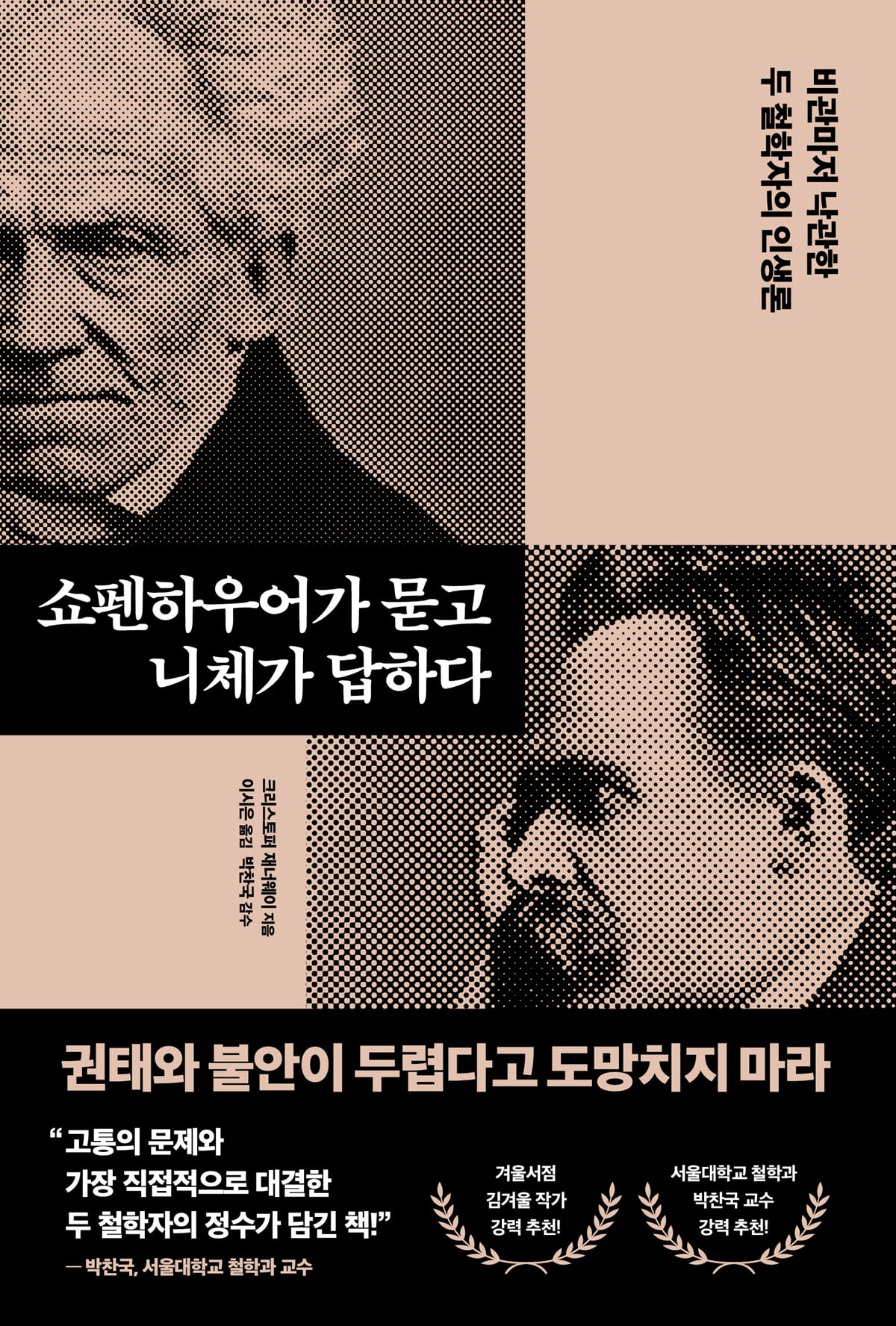
Schopenhauer asks, Nietzsche answers
 |
Description
Book Introduction
★ Highly recommended by Professor Park Chan-guk of the Department of Philosophy at Seoul National University!
★ Highly recommended by author Kim Gyul-wool of 'Winter Bookstore'!
“Doubt like Schopenhauer, act like Nietzsche!”
A philosophy class by two thinkers who have overcome despair and emptiness and embraced life!
To you who seek the meaning of life, Schopenhauer and Nietzsche respond!
Amidst the ongoing craze for Schopenhauer and Nietzsche that swept the publishing world in 2024, a book has been published by 21st Century Books that systematically delves into the thoughts and insights of these two philosophers who delve into the "pain and meaning of life."
Most of the books written by the two philosophers who have been popular so far have been in the form of conveying a few pleasant sentences from the philosophy of Schopenhauer and Nietzsche.
The ideas of the two philosophers were sometimes presented to readers in a misinterpreted form, sometimes like a psychology book, sometimes like a self-help book, with the foundations of philosophy finely tuned.
On the other hand, this book rejects such misinterpretations and deals with the philosophy of Schopenhauer and Nietzsche in a concrete and systematic way.
This book precisely points out how Schopenhauer rejected the intellectual system of his time and asserted his pessimism, and how Nietzsche inherited and developed Schopenhauer's ideas despite a gap of 100 years.
Schopenhauer said that life cannot but be suffering, and Nietzsche said that we must acknowledge this but have the will to discover human potential.
Professor Christopher Janaway, a world-renowned philosopher who studies Schopenhauer and Nietzsche, says that this formula is the essence of the two philosophies, and once again emphasizes the reason for and necessity of philosophy's existence.
If the philosophies of Schopenhauer and Nietzsche have been so easily accessible, it is probably because someone flattened their thoughts and made them easy to sell.
As author Kim Gyul-wool, who wrote the recommendation, said, difficult philosophy must be accepted as it is, because only then can one develop the power of thinking.
This is a must-read book for anyone who wants to learn the profound philosophies of these two philosophers step by step.
Now is the time to learn Schopenhauer's pessimism and realize Nietzsche's will.
★ Highly recommended by author Kim Gyul-wool of 'Winter Bookstore'!
“Doubt like Schopenhauer, act like Nietzsche!”
A philosophy class by two thinkers who have overcome despair and emptiness and embraced life!
To you who seek the meaning of life, Schopenhauer and Nietzsche respond!
Amidst the ongoing craze for Schopenhauer and Nietzsche that swept the publishing world in 2024, a book has been published by 21st Century Books that systematically delves into the thoughts and insights of these two philosophers who delve into the "pain and meaning of life."
Most of the books written by the two philosophers who have been popular so far have been in the form of conveying a few pleasant sentences from the philosophy of Schopenhauer and Nietzsche.
The ideas of the two philosophers were sometimes presented to readers in a misinterpreted form, sometimes like a psychology book, sometimes like a self-help book, with the foundations of philosophy finely tuned.
On the other hand, this book rejects such misinterpretations and deals with the philosophy of Schopenhauer and Nietzsche in a concrete and systematic way.
This book precisely points out how Schopenhauer rejected the intellectual system of his time and asserted his pessimism, and how Nietzsche inherited and developed Schopenhauer's ideas despite a gap of 100 years.
Schopenhauer said that life cannot but be suffering, and Nietzsche said that we must acknowledge this but have the will to discover human potential.
Professor Christopher Janaway, a world-renowned philosopher who studies Schopenhauer and Nietzsche, says that this formula is the essence of the two philosophies, and once again emphasizes the reason for and necessity of philosophy's existence.
If the philosophies of Schopenhauer and Nietzsche have been so easily accessible, it is probably because someone flattened their thoughts and made them easy to sell.
As author Kim Gyul-wool, who wrote the recommendation, said, difficult philosophy must be accepted as it is, because only then can one develop the power of thinking.
This is a must-read book for anyone who wants to learn the profound philosophies of these two philosophers step by step.
Now is the time to learn Schopenhauer's pessimism and realize Nietzsche's will.
- You can preview some of the book's contents.
Preview
index
Recommended Articles | One Step Deeper
Reviewer's Note | Reading Philosophy in a World of Blind Desire
Introduction | Why We Should Read Schopenhauer and Nietzsche Together
Introduction | What is the meaning of human life?
Part 1: Schopenhauer's Will
Chapter 1 The True Nature of Man: Schopenhauer and the Unconscious Will
Chapter 2 Necessity, Responsibility, and Character: Schopenhauer's Free Will
Chapter 3: Schopenhauer and the Purposelessness of the Will
Chapter 4: Denying the Will: Schopenhauer and the Problem of the Highest Good
Part 2 Schopenhauer: Being, Non-Being, and Individuality
Chapter 5 Beyond the Individual: Schopenhauer, Wagner, and the Value of Love
Chapter 6: Schopenhauer's Comforting View of Death
Chapter 7: Is the Best Possible Worse Than Pessimism?
Part 3: Nietzsche's Response to Schopenhauer
Chapter 8: Schopenhauer's Christian Perspective
Chapter 9: On the idea of 'justification of suffering'
Chapter 10: Schopenhauer and Nietzsche's Affect and Cognition
Part 4: Nietzsche: Suffering, Affirmation, and Art
Chapter 11 Beauty is False and Truth is Ugly: Nietzsche's Art and Life
Chapter 12 Attitudes Toward Suffering: Parfit and Nietzsche
Chapter 13: Nietzsche's Morality, Impulse, and Human Greatness
Chapter 14: Who and What Says "Yes" to Life
Acknowledgements
abbreviation
References
Americas
Reviewer's Note | Reading Philosophy in a World of Blind Desire
Introduction | Why We Should Read Schopenhauer and Nietzsche Together
Introduction | What is the meaning of human life?
Part 1: Schopenhauer's Will
Chapter 1 The True Nature of Man: Schopenhauer and the Unconscious Will
Chapter 2 Necessity, Responsibility, and Character: Schopenhauer's Free Will
Chapter 3: Schopenhauer and the Purposelessness of the Will
Chapter 4: Denying the Will: Schopenhauer and the Problem of the Highest Good
Part 2 Schopenhauer: Being, Non-Being, and Individuality
Chapter 5 Beyond the Individual: Schopenhauer, Wagner, and the Value of Love
Chapter 6: Schopenhauer's Comforting View of Death
Chapter 7: Is the Best Possible Worse Than Pessimism?
Part 3: Nietzsche's Response to Schopenhauer
Chapter 8: Schopenhauer's Christian Perspective
Chapter 9: On the idea of 'justification of suffering'
Chapter 10: Schopenhauer and Nietzsche's Affect and Cognition
Part 4: Nietzsche: Suffering, Affirmation, and Art
Chapter 11 Beauty is False and Truth is Ugly: Nietzsche's Art and Life
Chapter 12 Attitudes Toward Suffering: Parfit and Nietzsche
Chapter 13: Nietzsche's Morality, Impulse, and Human Greatness
Chapter 14: Who and What Says "Yes" to Life
Acknowledgements
abbreviation
References
Americas
Detailed image

Into the book
The reason why this book discusses the two thinkers, Schopenhauer and Nietzsche, together is because I discovered that the issues that Nietzsche had to compromise with Schopenhauer, such as the death of God, the meaning of existence, suffering, compassion, will, Christian values, and the affirmation or denial of life, are the most fruitful and core aspects of Nietzsche's philosophy and the area in which Schopenhauer most powerfully participated in the history of philosophy.
(…) For Schopenhauer, the human world was unstable.
He believed that “if the temperature rises even slightly, all the rivers and springs will dry up” and that “nine-tenths of humanity will constantly struggle with poverty, always in danger of ruin, and that only through hardship and effort can they stay in that place.”
I am conscious of writing from a relatively safe position, and I hope that, having navigated the past years of restrictions, lockdowns, incidents, and discrimination, the thoughts of these two philosophers can be placed here and now, providing reflection and comfort to others.
--- From "Introduction: Why You Should Read Schopenhauer and Nietzsche Together"
Several essays in this book illuminate various aspects of the 'will', a central concept throughout Schopenhauer's philosophy.
To give some direction, I will briefly mention a few things about this concept.
First, Schopenhauer often treats ‘will’ and ‘will to life’ as interchangeable concepts.
But in reality, will is a broader and more diverse concept.
As is well known, Schopenhauer argues that things themselves are wills.
In other words, the metaphysical reality that transcends space, time, causality, and individuality, the very essence of which Manuel Kant, in his words, ‘despaired’ of ever being able to know, is the will.
--- From "What is the meaning of human life?"
In many of the situations Schopenhauer describes, human happiness is frustrated or becomes impossible to achieve.
Will invades and interferes with our conscious life.
We have only a perspectival knowledge, in that emotions, passions, hidden impulses, inclinations, aversions, etc., are always “deforming, coloring, and distorting” our judgments and perceptions.
The will wields its power in all matters and never leaves us in peace.
--- From "Chapter 1 The True Nature of Man: Schopenhauer and the Unconscious Will"
If we consider the problem from this perspective, what would Schopenhauer's position be? Schopenhauer also argues that both the action requirement and the explainability requirement must be satisfied, and that both can be satisfied. Furthermore, he argues that the empirical explainability of an action in terms of the agent's character and motivation leaves no room for an empirical explanation of the agent as the "performer of the action."
--- From "Chapter 2 Necessity, Responsibility, and Character: Schopenhauer's Free Will"
Schopenhauer's argument is that if we choose non-existence for the wrong reasons, we lose the opportunity to enter an empirical state of willlessness.
As discussed earlier, the state of willlessness is the highest good for Schopenhauer because it satisfies the desire to be free from individualistic desires.
Of course, there is a difference between satisfying the desire to experience peace or contentment in the absence of individualistic desires and satisfying the desire to eliminate such desires by not existing as an individual at all.
The former, not the latter, is called 'salvation'.
Salvation is not non-existence.
But once you get into this state, fortunately, you lose the sense that your very existence is truly worth maintaining.
Therefore, reaching the highest good, as Schopenhauer speaks of it, is compatible with desiring one's own non-existence, and must at least be accompanied by the recognition that non-existence is desirable.
--- From "Chapter 4: Deny the Will: Schopenhauer and the Problem of the Highest Good"
So far we have argued that Nietzsche's explanation that Schopenhauer's position is a combination of atheism and the ascetic morality of Christianity is essentially correct.
So what about Nietzsche's assessment? Was Schopenhauer "stuck" to atheism and the ascetic morality of Christianity? Did Schopenhauer have to abandon his belief in God along with his "belief" in such views? Schopenhauer's ethical views are somewhat backward-looking, as they draw on centuries of Christian thought.
But the very age of this view is no more a reason to oppose Schopenhauer's ideas than to agree with them.
Another counterargument is that Schopenhauer's ascetic-moral values are inherently rejectable, regardless of their origins.
--- From “Chapter 8: Schopenhauer’s Christian Perspective”
Therefore, human greatness, such as health or strength, is not a binary choice that appears all at once or over several eras.
Greatness now seems to be a matter of degree across all parameters.
Each individual's impulses may be weaker or stronger, more or less intense, more or less intense, more or less intense, and more or less likely to combine.
(…) For Schopenhauer, the human world was unstable.
He believed that “if the temperature rises even slightly, all the rivers and springs will dry up” and that “nine-tenths of humanity will constantly struggle with poverty, always in danger of ruin, and that only through hardship and effort can they stay in that place.”
I am conscious of writing from a relatively safe position, and I hope that, having navigated the past years of restrictions, lockdowns, incidents, and discrimination, the thoughts of these two philosophers can be placed here and now, providing reflection and comfort to others.
--- From "Introduction: Why You Should Read Schopenhauer and Nietzsche Together"
Several essays in this book illuminate various aspects of the 'will', a central concept throughout Schopenhauer's philosophy.
To give some direction, I will briefly mention a few things about this concept.
First, Schopenhauer often treats ‘will’ and ‘will to life’ as interchangeable concepts.
But in reality, will is a broader and more diverse concept.
As is well known, Schopenhauer argues that things themselves are wills.
In other words, the metaphysical reality that transcends space, time, causality, and individuality, the very essence of which Manuel Kant, in his words, ‘despaired’ of ever being able to know, is the will.
--- From "What is the meaning of human life?"
In many of the situations Schopenhauer describes, human happiness is frustrated or becomes impossible to achieve.
Will invades and interferes with our conscious life.
We have only a perspectival knowledge, in that emotions, passions, hidden impulses, inclinations, aversions, etc., are always “deforming, coloring, and distorting” our judgments and perceptions.
The will wields its power in all matters and never leaves us in peace.
--- From "Chapter 1 The True Nature of Man: Schopenhauer and the Unconscious Will"
If we consider the problem from this perspective, what would Schopenhauer's position be? Schopenhauer also argues that both the action requirement and the explainability requirement must be satisfied, and that both can be satisfied. Furthermore, he argues that the empirical explainability of an action in terms of the agent's character and motivation leaves no room for an empirical explanation of the agent as the "performer of the action."
--- From "Chapter 2 Necessity, Responsibility, and Character: Schopenhauer's Free Will"
Schopenhauer's argument is that if we choose non-existence for the wrong reasons, we lose the opportunity to enter an empirical state of willlessness.
As discussed earlier, the state of willlessness is the highest good for Schopenhauer because it satisfies the desire to be free from individualistic desires.
Of course, there is a difference between satisfying the desire to experience peace or contentment in the absence of individualistic desires and satisfying the desire to eliminate such desires by not existing as an individual at all.
The former, not the latter, is called 'salvation'.
Salvation is not non-existence.
But once you get into this state, fortunately, you lose the sense that your very existence is truly worth maintaining.
Therefore, reaching the highest good, as Schopenhauer speaks of it, is compatible with desiring one's own non-existence, and must at least be accompanied by the recognition that non-existence is desirable.
--- From "Chapter 4: Deny the Will: Schopenhauer and the Problem of the Highest Good"
So far we have argued that Nietzsche's explanation that Schopenhauer's position is a combination of atheism and the ascetic morality of Christianity is essentially correct.
So what about Nietzsche's assessment? Was Schopenhauer "stuck" to atheism and the ascetic morality of Christianity? Did Schopenhauer have to abandon his belief in God along with his "belief" in such views? Schopenhauer's ethical views are somewhat backward-looking, as they draw on centuries of Christian thought.
But the very age of this view is no more a reason to oppose Schopenhauer's ideas than to agree with them.
Another counterargument is that Schopenhauer's ascetic-moral values are inherently rejectable, regardless of their origins.
--- From “Chapter 8: Schopenhauer’s Christian Perspective”
Therefore, human greatness, such as health or strength, is not a binary choice that appears all at once or over several eras.
Greatness now seems to be a matter of degree across all parameters.
Each individual's impulses may be weaker or stronger, more or less intense, more or less intense, more or less intense, and more or less likely to combine.
--- From “Chapter 13: Nietzsche’s Morality, Drive, and Human Greatness”
Publisher's Review
“Don’t run away because you’re afraid of boredom and anxiety!”
The Life Philosophy of Two Philosophers Who Were Optimistic Even in Pessimism
A book that will help you delve deeper into the philosophies of Schopenhauer and Nietzsche and develop your thinking skills!
Christopher Jenaway, a professor of philosophy at the University of Southampton in England, is a renowned scholar of the philosophies of Schopenhauer and Nietzsche, and has systematically organized and compared the thoughts of these two philosophers.
Janaway, who is also the editor-in-chief of the Cambridge edition of the Complete Works of Schopenhauer, explains how the two philosophers' signature concepts of pessimism and will are intertwined and how they influence each other across a century.
These two figures rediscovered topics that the 17th and 18th century German philosophy had not yet discovered, such as the death of God, the meaning of existence, suffering and nihilism, compassion and Christian values, and later made the history of Western philosophy realize that 'life is inescapable suffering.'
Schopenhauer, who denied the common sense of his time that maintaining upright 'reason' was the only way to achieve ideas, and Nietzsche, who discovered Schopenhauer in a dusty library, read him all night, and then spread his philosophy to the world.
The fervor of these two philosophers has brought to light the ideas of pessimism and will, but this is only a fragmentary aspect of the two philosophers.
Let's read and compare the philosophies of these two thinkers in more depth, guided by Professor Jennaway.
“We are trapped in our self-centered desires,
“They live a life marred by pain, in conflict with other beings.”
Two philosophers exploring the origins of anxiety and life
First, let's look at Schopenhauer's philosophy.
Schopenhauer displays a duality, constantly discussing the human will to live and the essence of our inner being, while at the same time focusing on a world filled with self-centered desires, egoistic ideas, conflicts with others, and suffering.
His philosophy, while temporarily suspending judgment on the will to live, takes on the form of nothing but 'suffering'.
It repeatedly emphasizes the dystopia of a life designed to be incapable of happiness: what is suffering, why is life suffering, why are we unable to cope with suffering.
On the other hand, Nietzsche succeeded Schopenhauer and criticized his philosophy.
For Nietzsche, morality is a dubious phenomenon, egoism is misused, suffering is the shape of life, and attempts to eliminate it are impoverished.
In other words, although he agrees with Schopenhauer's proposition that 'life is suffering', Nietzsche presents an alternative to this.
Art asserts the concept of 'will', which is not something that is exhausted but something necessary for a fulfilling life, and which allows us to abandon the attitude of hoping for vague salvation and explore our individual potential.
To make the philosophies of Schopenhauer and Nietzsche a little easier to understand, Professor Janaway included an article commenting on a debate between Richard Wagner, one of the greatest thinkers of his time, and Olga Plumacher, a pessimistic analyst.
Through this, we can learn about the lifelong themes of two philosophers who explored anxiety and the will to live.
“I will not run away out of fear of endless suffering.”
A pessimist who insists on living a life of asceticism
The Eternal Returner, who tells us to face our pain and create our own values.
Schopenhauer and Nietzsche's philosophies may seem to point in opposite directions at first glance, but they complement each other and present one grand idea.
Schopenhauer advocated asceticism as a means of escaping suffering, saying that only a life of moderation and abstinence was the way to survive in a world filled with negative energy.
Nietzsche also agreed with his ideas to some extent and invented the concept of 'eternal recurrence', saying that we should accept life, including suffering, but find our own value in it.
Furthermore, while Schopenhauer was influenced by Eastern philosophies such as Buddhism and Hinduism and explained that the purpose of philosophy is to find peace, Nietzsche criticized traditional religions and ordered the creation of new human-centered values, represented by the slogan "God is dead."
Ultimately, Professor Janaway says, if we start with Schopenhauer and work our way through Nietzsche, we will come to these questions and answers.
Life is painful, but let us have the strength to acknowledge it and discover our own worth.
This book is full of philosophical questions that can be approached as a way to address this.
“Human life is eternal suffering without purpose.”
A philosophical journey to awaken you to the boredom and anxiety you need.
Is philosophy a relic of intellectuals who shut themselves away in their rooms and build walls between themselves and the world? Professor Janeway answers no.
Schopenhauer sang of the pain of life in a time when everyone was calling for ideas, and Nietzsche, by saying that God is dead, advocated a philosophy about humans rather than a philosophy about God.
In this way, the thoughts of these two philosophers fundamentally lead to insights into all human beings living among us today.
From the extreme political climate and the disasters caused by cost-cutting and flawed systems, to natural disasters caused by human waste and greed, to the power of hatred for others in a post-truth era.
The world seems to be getting worse and worse, and our lives seem to be becoming more and more miserable.
However, Schopenhauer's philosophy gives us the power to dissect what suffering is in this world.
The first thing to do when a problem arises is to find out why the problem occurred.
In addition, Nietzsche says to solve the problem with 'power and possibility'.
This is none other than the reason why humans study philosophy.
Knowing who I am now and living for a better me in the future.
I am confident that through this book you will be able to face the pain of life and become a better person.
The Life Philosophy of Two Philosophers Who Were Optimistic Even in Pessimism
A book that will help you delve deeper into the philosophies of Schopenhauer and Nietzsche and develop your thinking skills!
Christopher Jenaway, a professor of philosophy at the University of Southampton in England, is a renowned scholar of the philosophies of Schopenhauer and Nietzsche, and has systematically organized and compared the thoughts of these two philosophers.
Janaway, who is also the editor-in-chief of the Cambridge edition of the Complete Works of Schopenhauer, explains how the two philosophers' signature concepts of pessimism and will are intertwined and how they influence each other across a century.
These two figures rediscovered topics that the 17th and 18th century German philosophy had not yet discovered, such as the death of God, the meaning of existence, suffering and nihilism, compassion and Christian values, and later made the history of Western philosophy realize that 'life is inescapable suffering.'
Schopenhauer, who denied the common sense of his time that maintaining upright 'reason' was the only way to achieve ideas, and Nietzsche, who discovered Schopenhauer in a dusty library, read him all night, and then spread his philosophy to the world.
The fervor of these two philosophers has brought to light the ideas of pessimism and will, but this is only a fragmentary aspect of the two philosophers.
Let's read and compare the philosophies of these two thinkers in more depth, guided by Professor Jennaway.
“We are trapped in our self-centered desires,
“They live a life marred by pain, in conflict with other beings.”
Two philosophers exploring the origins of anxiety and life
First, let's look at Schopenhauer's philosophy.
Schopenhauer displays a duality, constantly discussing the human will to live and the essence of our inner being, while at the same time focusing on a world filled with self-centered desires, egoistic ideas, conflicts with others, and suffering.
His philosophy, while temporarily suspending judgment on the will to live, takes on the form of nothing but 'suffering'.
It repeatedly emphasizes the dystopia of a life designed to be incapable of happiness: what is suffering, why is life suffering, why are we unable to cope with suffering.
On the other hand, Nietzsche succeeded Schopenhauer and criticized his philosophy.
For Nietzsche, morality is a dubious phenomenon, egoism is misused, suffering is the shape of life, and attempts to eliminate it are impoverished.
In other words, although he agrees with Schopenhauer's proposition that 'life is suffering', Nietzsche presents an alternative to this.
Art asserts the concept of 'will', which is not something that is exhausted but something necessary for a fulfilling life, and which allows us to abandon the attitude of hoping for vague salvation and explore our individual potential.
To make the philosophies of Schopenhauer and Nietzsche a little easier to understand, Professor Janaway included an article commenting on a debate between Richard Wagner, one of the greatest thinkers of his time, and Olga Plumacher, a pessimistic analyst.
Through this, we can learn about the lifelong themes of two philosophers who explored anxiety and the will to live.
“I will not run away out of fear of endless suffering.”
A pessimist who insists on living a life of asceticism
The Eternal Returner, who tells us to face our pain and create our own values.
Schopenhauer and Nietzsche's philosophies may seem to point in opposite directions at first glance, but they complement each other and present one grand idea.
Schopenhauer advocated asceticism as a means of escaping suffering, saying that only a life of moderation and abstinence was the way to survive in a world filled with negative energy.
Nietzsche also agreed with his ideas to some extent and invented the concept of 'eternal recurrence', saying that we should accept life, including suffering, but find our own value in it.
Furthermore, while Schopenhauer was influenced by Eastern philosophies such as Buddhism and Hinduism and explained that the purpose of philosophy is to find peace, Nietzsche criticized traditional religions and ordered the creation of new human-centered values, represented by the slogan "God is dead."
Ultimately, Professor Janaway says, if we start with Schopenhauer and work our way through Nietzsche, we will come to these questions and answers.
Life is painful, but let us have the strength to acknowledge it and discover our own worth.
This book is full of philosophical questions that can be approached as a way to address this.
“Human life is eternal suffering without purpose.”
A philosophical journey to awaken you to the boredom and anxiety you need.
Is philosophy a relic of intellectuals who shut themselves away in their rooms and build walls between themselves and the world? Professor Janeway answers no.
Schopenhauer sang of the pain of life in a time when everyone was calling for ideas, and Nietzsche, by saying that God is dead, advocated a philosophy about humans rather than a philosophy about God.
In this way, the thoughts of these two philosophers fundamentally lead to insights into all human beings living among us today.
From the extreme political climate and the disasters caused by cost-cutting and flawed systems, to natural disasters caused by human waste and greed, to the power of hatred for others in a post-truth era.
The world seems to be getting worse and worse, and our lives seem to be becoming more and more miserable.
However, Schopenhauer's philosophy gives us the power to dissect what suffering is in this world.
The first thing to do when a problem arises is to find out why the problem occurred.
In addition, Nietzsche says to solve the problem with 'power and possibility'.
This is none other than the reason why humans study philosophy.
Knowing who I am now and living for a better me in the future.
I am confident that through this book you will be able to face the pain of life and become a better person.
GOODS SPECIFICS
- Date of issue: February 3, 2025
- Page count, weight, size: 468 pages | 152*225*30mm
- ISBN13: 9791173570216
- ISBN10: 1173570217
You may also like
카테고리
korean


korean

![GQ KOREA Mark (Monthly): December [2025]](http://librairie.coreenne.fr/cdn/shop/files/8ef265dbbfbf186523ed75ba7319009d.jpg?v=1765340328&width=3840)


