

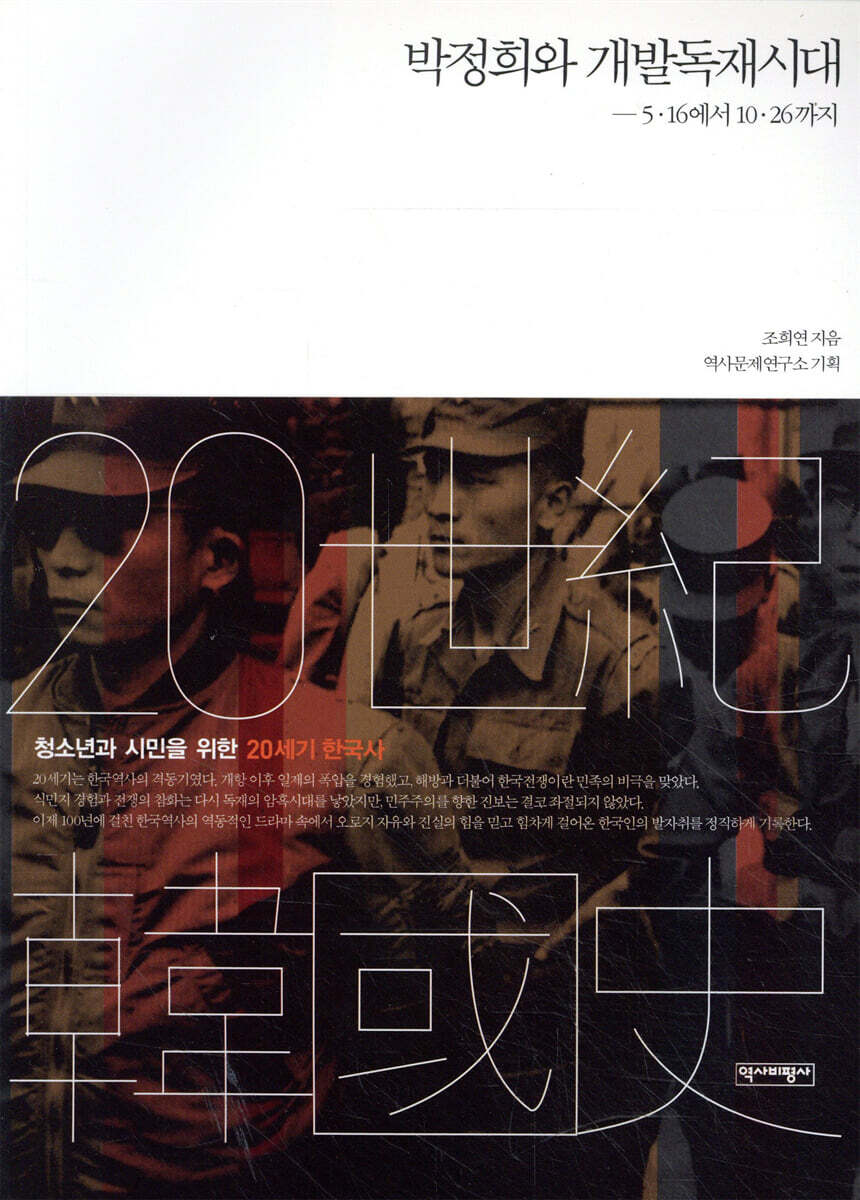
Park Chung-hee and the era of developmental dictatorship
 |
Description
Book Introduction
A history textbook for the general public, not just history majors.
The 20th century was the most turbulent period in Korean history.
After the opening of the country, we experienced Japanese oppression, and after liberation, we faced the national tragedy of the Korean War.
The colonial experience and the devastation of war again gave rise to a dark age of dictatorship, but the progress toward democracy was never thwarted.
Now, in the dynamic drama of Korean history spanning 100 years, we honestly record the footsteps of Koreans who have walked boldly, believing only in the power of freedom and truth.
The 20th century was the most turbulent period in Korean history.
After the opening of the country, we experienced Japanese oppression, and after liberation, we faced the national tragedy of the Korean War.
The colonial experience and the devastation of war again gave rise to a dark age of dictatorship, but the progress toward democracy was never thwarted.
Now, in the dynamic drama of Korean history spanning 100 years, we honestly record the footsteps of Koreans who have walked boldly, believing only in the power of freedom and truth.
- You can preview some of the book's contents.
Preview
index
At the beginning of the book - To read Park Chung-hee again
Chapter 1: The May 16 Military Coup: The Beginning of the Developmental Dictatorship
The duet of reform and control, the early policies of the coup regime / From colonized soldiers to political soldiers / The economic development drive to win the hearts and minds of the people / The new evils beat the old / 〈Special Page〉 America in the Park Chung-hee era
Chapter 2: Amid the growing pains of the Korea-Japan talks, the sails of development are raised.
The military regime's first crisis: the struggle against the Korea-Japan talks / Export or die / Killing two birds with one stone: dispatching troops to Vietnam / The path to a third constitutional amendment / 〈Special Theme〉 How did the anti-dictatorship camp perceive the economy?
Chapter 3: The "Crisis of Success" of the Development Mobilization System
Strengthening the extreme anti-communist regime: "I hate the Communist Party" / The third constitutional amendment opens the way to long-term dictatorship / The largest civil engineering project since Dangun, the opening of the Gyeongbu Expressway / Don't let my death be in vain / The total crisis on the eve of the Yushin era / A new breakthrough: inter-Korean dialogue and welfare policy / 〈Special Theme〉 Corruption in the Park Chung-hee era
Chapter 4: The Emergence of the Yushin Regime for Permanent Power
The Yushin Coup, the fascist reorganization of the regime / The Second Korean War, heavy chemical industrialization / The longer the dictatorship lasts, the more fierce the resistance / "Let's live well", the light and dark of the Saemaul Movement / The emergence of youth culture / 〈Special Theme〉 Patriotism and Sex
Chapter 5: Emergency Measure No. 9 and the Dark Ages of Democracy
The Age of Emergency Measure No. 9 / The Moral Cracks in the Power Elite / The Limits of Economic Concentration and Duplicate Investment / Emergency Measure No. 9 and the Resistance Movement / Workers and Farmers Become Subjects of Resistance / A Leading Nation: The Emergence of a New Generation / 〈Special Theme〉 "I Wish I Could Have My Fill, Even if It's Pollution"
Conclusion - Revisiting Park Chung-hee after Democratization
Competition over the Zeitgeist / Reading Park Chung-hee conservatively / Seeking an alternative model progressively
Appendix: Major Events Log / References / Sources of Photos Used in This Book / Index
Chapter 1: The May 16 Military Coup: The Beginning of the Developmental Dictatorship
The duet of reform and control, the early policies of the coup regime / From colonized soldiers to political soldiers / The economic development drive to win the hearts and minds of the people / The new evils beat the old / 〈Special Page〉 America in the Park Chung-hee era
Chapter 2: Amid the growing pains of the Korea-Japan talks, the sails of development are raised.
The military regime's first crisis: the struggle against the Korea-Japan talks / Export or die / Killing two birds with one stone: dispatching troops to Vietnam / The path to a third constitutional amendment / 〈Special Theme〉 How did the anti-dictatorship camp perceive the economy?
Chapter 3: The "Crisis of Success" of the Development Mobilization System
Strengthening the extreme anti-communist regime: "I hate the Communist Party" / The third constitutional amendment opens the way to long-term dictatorship / The largest civil engineering project since Dangun, the opening of the Gyeongbu Expressway / Don't let my death be in vain / The total crisis on the eve of the Yushin era / A new breakthrough: inter-Korean dialogue and welfare policy / 〈Special Theme〉 Corruption in the Park Chung-hee era
Chapter 4: The Emergence of the Yushin Regime for Permanent Power
The Yushin Coup, the fascist reorganization of the regime / The Second Korean War, heavy chemical industrialization / The longer the dictatorship lasts, the more fierce the resistance / "Let's live well", the light and dark of the Saemaul Movement / The emergence of youth culture / 〈Special Theme〉 Patriotism and Sex
Chapter 5: Emergency Measure No. 9 and the Dark Ages of Democracy
The Age of Emergency Measure No. 9 / The Moral Cracks in the Power Elite / The Limits of Economic Concentration and Duplicate Investment / Emergency Measure No. 9 and the Resistance Movement / Workers and Farmers Become Subjects of Resistance / A Leading Nation: The Emergence of a New Generation / 〈Special Theme〉 "I Wish I Could Have My Fill, Even if It's Pollution"
Conclusion - Revisiting Park Chung-hee after Democratization
Competition over the Zeitgeist / Reading Park Chung-hee conservatively / Seeking an alternative model progressively
Appendix: Major Events Log / References / Sources of Photos Used in This Book / Index
Into the book
Above all, the core problem of economic development was the labor problem.
In the early stages of industrialization, labor-intensive industries were fostered based on 'low wages and long hours' for workers.
Therefore, workers were called industrial mobilities or industrial patriots, and they were content with that identity while adapting to the new industrial reality.
However, starting in the early 1970s, this situation began to change.
An incident occurred that brought about a dramatic change in the labor situation.
On November 13, 1970, Jeon Tae-il committed self-immolation.
Jeon Tae-il suddenly set himself on fire, shouting out such 'ordinary demands'.
His diary contains the following: "Obey the Labor Standards Act! We are not machines! Let us rest on Sundays! Don't overwork workers!"
He also left a simple request in his petition to the president: “I want to extend the monthly holiday by two days so that we can rest every Sunday.”
The shock that Jeon Tae-il's death had on Korean society was enormous.
Jeon Tae-il's lament, "I wish I had a college friend," awakened the consciences of countless intellectuals, religious figures, and college students.
His death brought the labor issue to the forefront of public opinion.
On November 16, about 100 law students from Seoul National University announced that they would take possession of Jeon Tae-il's body and hold a student funeral.
About 400 students from Seoul National University also began an indefinite hunger strike.
On November 22, about 40 college students from Saemunan Church held a fasting prayer meeting to repent and denounce social issues.
With Jeon Tae-il's self-immolation, Christianity became interested in industrial issues and began to engage in industrial missions, and the labor movement also began to spread without restraint, like a wildfire in a field.
Korean society began to pay attention to labor issues only because of Jeon Tae-il, and furthermore, it began to recognize labor issues as unavoidable social and political issues.
In the early stages of industrialization, labor-intensive industries were fostered based on 'low wages and long hours' for workers.
Therefore, workers were called industrial mobilities or industrial patriots, and they were content with that identity while adapting to the new industrial reality.
However, starting in the early 1970s, this situation began to change.
An incident occurred that brought about a dramatic change in the labor situation.
On November 13, 1970, Jeon Tae-il committed self-immolation.
Jeon Tae-il suddenly set himself on fire, shouting out such 'ordinary demands'.
His diary contains the following: "Obey the Labor Standards Act! We are not machines! Let us rest on Sundays! Don't overwork workers!"
He also left a simple request in his petition to the president: “I want to extend the monthly holiday by two days so that we can rest every Sunday.”
The shock that Jeon Tae-il's death had on Korean society was enormous.
Jeon Tae-il's lament, "I wish I had a college friend," awakened the consciences of countless intellectuals, religious figures, and college students.
His death brought the labor issue to the forefront of public opinion.
On November 16, about 100 law students from Seoul National University announced that they would take possession of Jeon Tae-il's body and hold a student funeral.
About 400 students from Seoul National University also began an indefinite hunger strike.
On November 22, about 40 college students from Saemunan Church held a fasting prayer meeting to repent and denounce social issues.
With Jeon Tae-il's self-immolation, Christianity became interested in industrial issues and began to engage in industrial missions, and the labor movement also began to spread without restraint, like a wildfire in a field.
Korean society began to pay attention to labor issues only because of Jeon Tae-il, and furthermore, it began to recognize labor issues as unavoidable social and political issues.
--- p.120~121
GOODS SPECIFICS
- Date of issue: August 10, 2007
- Pages, weight, size: 252 pages | 454g | 150*210*20mm
- ISBN13: 9788976963222
- ISBN10: 8976963229
You may also like
카테고리
korean


korean

![ELLE 엘르 스페셜 에디션 A형 : 12월 [2025]](http://librairie.coreenne.fr/cdn/shop/files/b8e27a3de6c9538896439686c6b0e8fb.jpg?v=1766436872&width=3840)


