

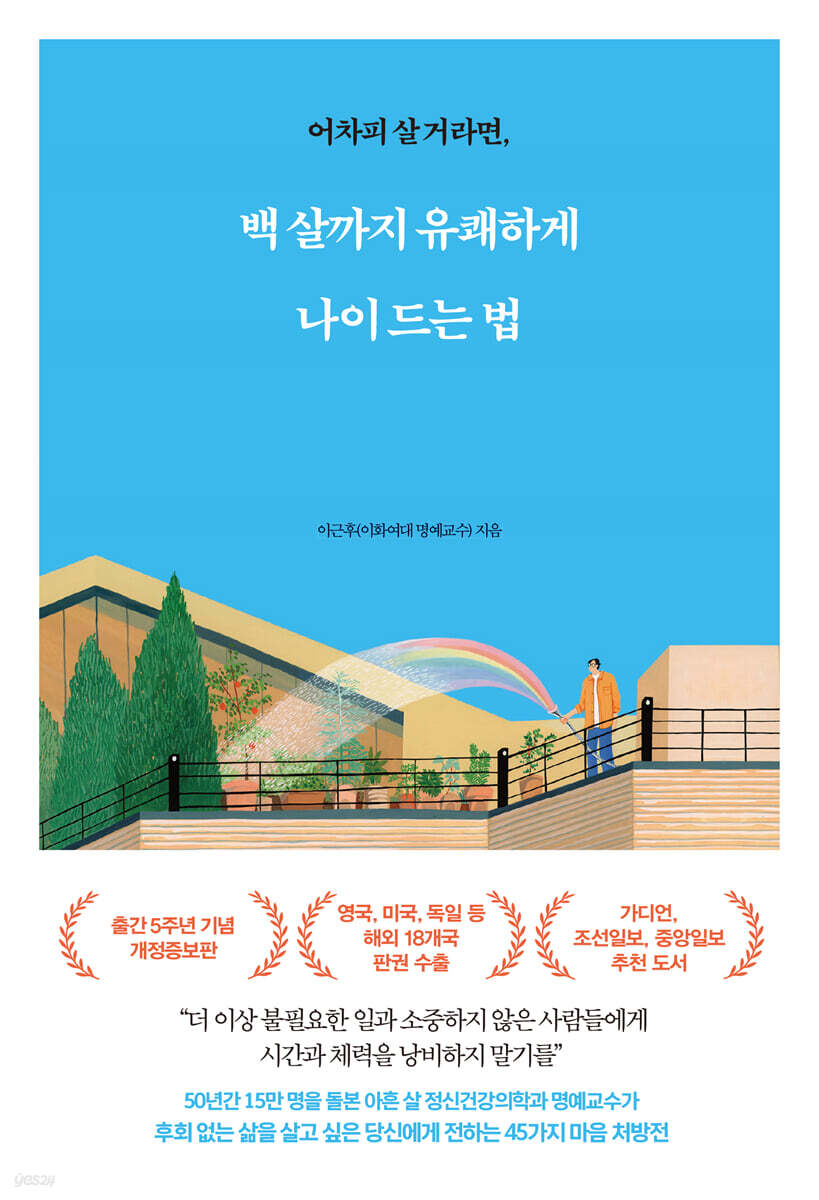
How to Age Gladly to Be a Hundred
 |
Description
Book Introduction
Exported copyrights to 18 countries including the UK, US, and Germany
Revised and expanded edition to commemorate the 5th anniversary of publication
“Stop wasting your time and energy on unnecessary things and people who don’t matter.”
A ninety-year-old professor emeritus of psychiatry who cared for 150,000 people for 50 years
45 Prescriptions for the Mind for Those Who Want to Live a Life Without Regrets
The hit work, "How to Age Cheerfully Until You're 100," by Lee Geun-hu, a bestseller with 500,000 copies sold and professor emeritus at Ewha Womans University, has been reborn as a revised and expanded edition to celebrate its 5th anniversary.
This book, which contains philosophical insights and honest advice on aging, accumulated over a 90-year life, was exported to 18 countries overseas, an interview article was published in full in the British daily newspaper The Guardian, and it became a humanities bestseller immediately after publication, creating various topics.
The revised and expanded edition includes five new manuscripts compiled from lectures and contributions made over the past five years, as well as a revised preface.
The old scholar, who has overcome several near-death experiences and lived with seven illnesses, vows to live cheerfully until the end, gives advice to his juniors who are contemplating 'how to live' after their forties.
“There are not many things in life that can be achieved through willpower alone, and life is often greatly shaken by unexpected trials, but there are still some fortunate aspects.
The truth is that life's sorrows are healed by the small joys of everyday life.
So, people should live happily until the end.
“Life does not fall apart unless you lose the little joys and laughter.”
The author's philosophy is perfectly permeated throughout everyday life.
This book contains no half-baked conjectures or half-baked lessons about life in old age.
On the contrary, it is full of the vivid experiences and wisdom of a cheerful old scholar who is faithful to what he can do here and now and tries to live each day with enjoyment.
That's why The Guardian called him "the perfect guide to navigating middle age," and reporter Kim Ji-soo wrote in an interview article for the Chosun Ilbo that "no matter where you open the book, it overflows with concrete wisdom and the vitality of aging."
As one reader commented, "It's the best indirect experience of a life I've never experienced," this book contains the true story of life that only someone who has lived for ninety years can feel, realize, and convey.
As a psychiatrist with 50 years of experience, he also provides practical and in-depth advice on issues such as work, self, and interpersonal relationships that people face seriously in the middle of their lives.
Don't work yourself to death, gradually create your own time and space, don't spare money on hobbies after you turn 40, make your grown children independent as soon as possible, talk to your parents more while they are still alive, be grateful to your spouse for living with you until now...
Finally, he tells the readers:
“Stop wasting your time and energy on unnecessary things and people who don’t matter to you. From now on, live your life by taking care of yourself first.”
So, this book will be an excellent guide for those who are wondering, 'How should I grow old?' because we only live once.
Revised and expanded edition to commemorate the 5th anniversary of publication
“Stop wasting your time and energy on unnecessary things and people who don’t matter.”
A ninety-year-old professor emeritus of psychiatry who cared for 150,000 people for 50 years
45 Prescriptions for the Mind for Those Who Want to Live a Life Without Regrets
The hit work, "How to Age Cheerfully Until You're 100," by Lee Geun-hu, a bestseller with 500,000 copies sold and professor emeritus at Ewha Womans University, has been reborn as a revised and expanded edition to celebrate its 5th anniversary.
This book, which contains philosophical insights and honest advice on aging, accumulated over a 90-year life, was exported to 18 countries overseas, an interview article was published in full in the British daily newspaper The Guardian, and it became a humanities bestseller immediately after publication, creating various topics.
The revised and expanded edition includes five new manuscripts compiled from lectures and contributions made over the past five years, as well as a revised preface.
The old scholar, who has overcome several near-death experiences and lived with seven illnesses, vows to live cheerfully until the end, gives advice to his juniors who are contemplating 'how to live' after their forties.
“There are not many things in life that can be achieved through willpower alone, and life is often greatly shaken by unexpected trials, but there are still some fortunate aspects.
The truth is that life's sorrows are healed by the small joys of everyday life.
So, people should live happily until the end.
“Life does not fall apart unless you lose the little joys and laughter.”
The author's philosophy is perfectly permeated throughout everyday life.
This book contains no half-baked conjectures or half-baked lessons about life in old age.
On the contrary, it is full of the vivid experiences and wisdom of a cheerful old scholar who is faithful to what he can do here and now and tries to live each day with enjoyment.
That's why The Guardian called him "the perfect guide to navigating middle age," and reporter Kim Ji-soo wrote in an interview article for the Chosun Ilbo that "no matter where you open the book, it overflows with concrete wisdom and the vitality of aging."
As one reader commented, "It's the best indirect experience of a life I've never experienced," this book contains the true story of life that only someone who has lived for ninety years can feel, realize, and convey.
As a psychiatrist with 50 years of experience, he also provides practical and in-depth advice on issues such as work, self, and interpersonal relationships that people face seriously in the middle of their lives.
Don't work yourself to death, gradually create your own time and space, don't spare money on hobbies after you turn 40, make your grown children independent as soon as possible, talk to your parents more while they are still alive, be grateful to your spouse for living with you until now...
Finally, he tells the readers:
“Stop wasting your time and energy on unnecessary things and people who don’t matter to you. From now on, live your life by taking care of yourself first.”
So, this book will be an excellent guide for those who are wondering, 'How should I grow old?' because we only live once.
- You can preview some of the book's contents.
Preview
index
Recommendation
Publishing the revised and expanded edition
Prologue | Those who can laugh in the face of life's tragedies will never fall, even if they despair.
Chapter 1: Thoughts that only come to me when I'm ninety
I shouldn't have felt resentful about getting older.
I should have focused more on what I could change rather than what I couldn't change.
I should have stayed in touch with my loved ones more often.
I shouldn't have worked myself to death
I should have known when to stop
The pain of the body had to be expressed with dignity.
I should have talked to my father more while he was alive.
I should have been more indifferent to my child.
I shouldn't have wasted time regretting my past life.
Anyway, I should have lived each day happily.
Chapter 2: If You Have to Live a Hundred Years Anyway - Attitudes toward Life
If You're Going to Live a Hundred Years Anyway: On Aging
The Secret of Human Relationships I Only Realized at Ninety: About People
I don't like it when people call me grandpa, and I get angry when they don't recognize my age: On attitude
Things You Can Only Know by Living to the End: On Trials
Is there any other right answer besides living my own way?: On Life
The True Meaning of Enduring: On Destiny
What Families Live By: About Love
Becoming a Conversant Adult: On Communication
How Do You Want to Be Remembered?: On Friendship
Chapter 3: Why I Can Laugh at the Absurdity and Ridiculousness of Life - My Attitude to Everyday Life
Getting angry is also a habit: On anger
There may be nothing in the world that cannot be understood: On empathy
Give up the desire to become healthier early: About the body
As we age, we develop the habit of being with others rather than alone: On Loneliness
All the troublesome household affairs are left to the children: On freedom
Don't Think You Know Your Spouse Best: About Couples
Don't Waste Your Life Worrying About Money: On Economic Power
Will you be content to be the grandfather who gives you pocket money or something?: About your grandchildren
Why I, a Poet with No Talent, Have Been Reciting Poetry for 25 Years: About Hobbies
Chapter 4: Living True to Myself and Dying True to Myself - Attitudes toward the World
Do you have your own time and space?: About relaxation
What I Need to Do for Myself Before It's Too Late: About Forgiveness
How Grandfather Got Into His Grandson's Painting: About Family
If you want to reconcile with your aging parents: About Parents
It's a miracle just to be alive: On Gratitude
How to Properly Organize Your Past Life: Regrets
How to Say Goodbye to Life Peacefully: On Death
Seven Kindnesses You Can Give Right Now: To the World
Chapter 5: How to Age Cheerfully Today
Three words of advice to my juniors
Earn money fiercely, but remember one thing:
Make grown children independent as soon as possible.
I am unconditionally grateful to my spouse for living with me until now.
I will resolve to live a challenging life forever.
From the age of forty, don't spare money and time on hobbies.
Be courteous to people at all times
I will live simply, more simply
I will create as many warm memories as possible that make me smile when I think of them.
About Lee Geun-hoo | A look that suits him better
- Lee Kang-baek (playwright, former professor at Seoul Institute of the Arts)
Publishing the revised and expanded edition
Prologue | Those who can laugh in the face of life's tragedies will never fall, even if they despair.
Chapter 1: Thoughts that only come to me when I'm ninety
I shouldn't have felt resentful about getting older.
I should have focused more on what I could change rather than what I couldn't change.
I should have stayed in touch with my loved ones more often.
I shouldn't have worked myself to death
I should have known when to stop
The pain of the body had to be expressed with dignity.
I should have talked to my father more while he was alive.
I should have been more indifferent to my child.
I shouldn't have wasted time regretting my past life.
Anyway, I should have lived each day happily.
Chapter 2: If You Have to Live a Hundred Years Anyway - Attitudes toward Life
If You're Going to Live a Hundred Years Anyway: On Aging
The Secret of Human Relationships I Only Realized at Ninety: About People
I don't like it when people call me grandpa, and I get angry when they don't recognize my age: On attitude
Things You Can Only Know by Living to the End: On Trials
Is there any other right answer besides living my own way?: On Life
The True Meaning of Enduring: On Destiny
What Families Live By: About Love
Becoming a Conversant Adult: On Communication
How Do You Want to Be Remembered?: On Friendship
Chapter 3: Why I Can Laugh at the Absurdity and Ridiculousness of Life - My Attitude to Everyday Life
Getting angry is also a habit: On anger
There may be nothing in the world that cannot be understood: On empathy
Give up the desire to become healthier early: About the body
As we age, we develop the habit of being with others rather than alone: On Loneliness
All the troublesome household affairs are left to the children: On freedom
Don't Think You Know Your Spouse Best: About Couples
Don't Waste Your Life Worrying About Money: On Economic Power
Will you be content to be the grandfather who gives you pocket money or something?: About your grandchildren
Why I, a Poet with No Talent, Have Been Reciting Poetry for 25 Years: About Hobbies
Chapter 4: Living True to Myself and Dying True to Myself - Attitudes toward the World
Do you have your own time and space?: About relaxation
What I Need to Do for Myself Before It's Too Late: About Forgiveness
How Grandfather Got Into His Grandson's Painting: About Family
If you want to reconcile with your aging parents: About Parents
It's a miracle just to be alive: On Gratitude
How to Properly Organize Your Past Life: Regrets
How to Say Goodbye to Life Peacefully: On Death
Seven Kindnesses You Can Give Right Now: To the World
Chapter 5: How to Age Cheerfully Today
Three words of advice to my juniors
Earn money fiercely, but remember one thing:
Make grown children independent as soon as possible.
I am unconditionally grateful to my spouse for living with me until now.
I will resolve to live a challenging life forever.
From the age of forty, don't spare money and time on hobbies.
Be courteous to people at all times
I will live simply, more simply
I will create as many warm memories as possible that make me smile when I think of them.
About Lee Geun-hoo | A look that suits him better
- Lee Kang-baek (playwright, former professor at Seoul Institute of the Arts)
Detailed image

Into the book
This is why we shouldn't judge life rashly, thinking we know it.
The world we see is not everything.
Even if it seems like it's the end, it's never the end.
If you persevere with the determination to try somehow, possibilities that you had not seen before will open up.
So, you have to live life to the end to know it.
No one knows how much of the world I will experience.
--- From "Things You Can Only Know by Living to the End: On Trials"
Raising a child well is simpler than you think.
All you have to do is have a good relationship with your child.
The way you relate to children is no different from any other human relationship.
Just being honest about who I am.
Rather than being oppressed by the image of being a good parent, I will simply strive to become a complete human being.
Then, children will accept the light and dark sides of their parents as they are, and from there, they will know how to live their own lives and blossom.
So there are no good parents or bad parents.
There are only parents.
--- From "I should have been more indifferent to my child"
Don't live a boring life without anything special or fun happening.
If we seek and enjoy, enjoyable things are always right next to us.
The passivity of wanting to be treated well is the biggest factor in conflict with the world.
The fun in life is something you have to actively create for yourself.
That attitude is what makes life really fun.
--- From "I should have lived each day happily anyway"
How can I do everything well?
If you are good at something, one job is enough.
The rest you can enjoy as much as you like.
I have no talent for poetry, but I have enjoyed living with poetry for over 25 years.
You really have to experience it to know how enriching it is to do what you love without having to compete.
--- From "Why I, a Poet with No Talent, Have Been Reciting Poetry for 25 Years: About Hobbies"
As you get older, your relationships expand, but you may also feel more empty.
Even friends who were once close are busy with their own lives, and they are unconsciously hurt by the subtle comparisons they make.
At times like these, you must have time alone to calm your mind and strengthen your inner self.
But after that period of time, there comes a time when you start looking for people again.
When that time comes, don't hesitate and approach your friend first.
Your friends miss you too.
--- From "The Secret of Human Relationships I Only Realized When I Was Ninety: About People"
The end of a life that runs forward without looking back is exhaustion.
Even if you run forward, you must know how to look back sometimes.
That's why I've always advised my juniors to make sure they have enough time and space to take care of themselves.
It meant that we should not put off living a true life because we are caught up in the responsibilities and duties that are hanging in front of us.
And it is good to create your own space and time as early as possible.
When you get older and loneliness and emptiness come rushing in like a tide, it's not easy to suddenly find a place to take refuge.
--- From "Do You Have Your Own Time and Space?: On Rest"
“Teacher, I feel so anxious when I don’t have money.”
This is something I've heard countless times over the past 50 years of counseling.
The reason people can't stop worrying about money is probably because of anxiety.
But I want to say the opposite.
Don't blame your money worries on your anxiety.
No matter how much money you save, anxiety doesn't go away.
The anxiety of not knowing one's identity makes one swayed by money.
Conversely, if we accept that anxiety is not a problem to be solved but a part of human destiny, we will not become anxious indiscriminately.
The mind that only chases money is put on hold.
And you'll have more time to focus on the things that really matter.
--- From "Earn money fiercely, but remember only one thing"
Sometimes I think about that.
If I could go back 50 years, like in the movies, would I live a better life? After pondering it, I finally shake my head.
Knowing more doesn't mean you'll live a better life.
Rather, it was because I didn't know that I could be reckless, and because I didn't know where I was standing that I was able to see it through to the end.
I charged forward because I didn't know I would get hurt, and I challenged myself because I didn't know I would fail.
Even if I had known the days ahead of me, would I have been able to do so? Wouldn't I have spent my days in apathy, depressed, and not even attempting anything?
--- From "I will always resolve to live a challenging life"
However, I just want to tell you to find and enjoy the happiness hidden in everyday life to the fullest.
Anyway, tomorrow I'll be stuck in traffic on my way to work, I'll clash with my boss because of the heavy workload, I'll be exhausted from taking care of my child, and I'll fall asleep with my smartphone in my hand.
If you don't make a drastic change in the direction of your life, it will eventually be an unavoidable day.
If so, why not try to have fun while you're at it?
You can discover something new by observing the people you meet on your way to work, or you can start the morning by offering your boss a cup of coffee.
You can also cook and wash dishes with your child.
If you're going to do something anyway, make it as enjoyable as possible.
That is the secret to enjoying the repetitive daily life and creating many memories.
The world we see is not everything.
Even if it seems like it's the end, it's never the end.
If you persevere with the determination to try somehow, possibilities that you had not seen before will open up.
So, you have to live life to the end to know it.
No one knows how much of the world I will experience.
--- From "Things You Can Only Know by Living to the End: On Trials"
Raising a child well is simpler than you think.
All you have to do is have a good relationship with your child.
The way you relate to children is no different from any other human relationship.
Just being honest about who I am.
Rather than being oppressed by the image of being a good parent, I will simply strive to become a complete human being.
Then, children will accept the light and dark sides of their parents as they are, and from there, they will know how to live their own lives and blossom.
So there are no good parents or bad parents.
There are only parents.
--- From "I should have been more indifferent to my child"
Don't live a boring life without anything special or fun happening.
If we seek and enjoy, enjoyable things are always right next to us.
The passivity of wanting to be treated well is the biggest factor in conflict with the world.
The fun in life is something you have to actively create for yourself.
That attitude is what makes life really fun.
--- From "I should have lived each day happily anyway"
How can I do everything well?
If you are good at something, one job is enough.
The rest you can enjoy as much as you like.
I have no talent for poetry, but I have enjoyed living with poetry for over 25 years.
You really have to experience it to know how enriching it is to do what you love without having to compete.
--- From "Why I, a Poet with No Talent, Have Been Reciting Poetry for 25 Years: About Hobbies"
As you get older, your relationships expand, but you may also feel more empty.
Even friends who were once close are busy with their own lives, and they are unconsciously hurt by the subtle comparisons they make.
At times like these, you must have time alone to calm your mind and strengthen your inner self.
But after that period of time, there comes a time when you start looking for people again.
When that time comes, don't hesitate and approach your friend first.
Your friends miss you too.
--- From "The Secret of Human Relationships I Only Realized When I Was Ninety: About People"
The end of a life that runs forward without looking back is exhaustion.
Even if you run forward, you must know how to look back sometimes.
That's why I've always advised my juniors to make sure they have enough time and space to take care of themselves.
It meant that we should not put off living a true life because we are caught up in the responsibilities and duties that are hanging in front of us.
And it is good to create your own space and time as early as possible.
When you get older and loneliness and emptiness come rushing in like a tide, it's not easy to suddenly find a place to take refuge.
--- From "Do You Have Your Own Time and Space?: On Rest"
“Teacher, I feel so anxious when I don’t have money.”
This is something I've heard countless times over the past 50 years of counseling.
The reason people can't stop worrying about money is probably because of anxiety.
But I want to say the opposite.
Don't blame your money worries on your anxiety.
No matter how much money you save, anxiety doesn't go away.
The anxiety of not knowing one's identity makes one swayed by money.
Conversely, if we accept that anxiety is not a problem to be solved but a part of human destiny, we will not become anxious indiscriminately.
The mind that only chases money is put on hold.
And you'll have more time to focus on the things that really matter.
--- From "Earn money fiercely, but remember only one thing"
Sometimes I think about that.
If I could go back 50 years, like in the movies, would I live a better life? After pondering it, I finally shake my head.
Knowing more doesn't mean you'll live a better life.
Rather, it was because I didn't know that I could be reckless, and because I didn't know where I was standing that I was able to see it through to the end.
I charged forward because I didn't know I would get hurt, and I challenged myself because I didn't know I would fail.
Even if I had known the days ahead of me, would I have been able to do so? Wouldn't I have spent my days in apathy, depressed, and not even attempting anything?
--- From "I will always resolve to live a challenging life"
However, I just want to tell you to find and enjoy the happiness hidden in everyday life to the fullest.
Anyway, tomorrow I'll be stuck in traffic on my way to work, I'll clash with my boss because of the heavy workload, I'll be exhausted from taking care of my child, and I'll fall asleep with my smartphone in my hand.
If you don't make a drastic change in the direction of your life, it will eventually be an unavoidable day.
If so, why not try to have fun while you're at it?
You can discover something new by observing the people you meet on your way to work, or you can start the morning by offering your boss a cup of coffee.
You can also cook and wash dishes with your child.
If you're going to do something anyway, make it as enjoyable as possible.
That is the secret to enjoying the repetitive daily life and creating many memories.
--- From "I will create as many warm memories as possible that make me smile when I think of them"
Publisher's Review
“Teacher, if you had your life to live over again, how would you live it?”
To those in their 40s who are worried about 'how to live'
A ninety-year-old scholar offers honest and philosophical insights on aging.
Lee Geun-hoo is the grandfather with the coolest smile.
Although he is 90 years old this year, many people still seek him out.
After caring for patients and teaching students at Ewha Womans University for 50 years, he established the Family Academia non-profit organization after retirement and ran various educational programs. He also provided medical services in Nepal for over 35 years and sponsored children at Gwangmyeong Orphanage for over 50 years.
Not only that, he has written over 20 books over the past 40 years, including “I Want to Live a Fun Life Until I Die,” which sold 400,000 copies, and the “Yeti Poetry Recitation Society,” which was formed around him, has been studying literature and doing volunteer work for over 25 years.
Even now, he greets guests every day, writes commissioned manuscripts, and films YouTube videos.
Perhaps that's why people consider his life special and ask, "How did you live such an interesting life?"
But you'll be surprised to learn of his health condition.
This is because he suffers from seven diseases, including severe visual impairment, diabetes, high blood pressure, herniated disc, and coronary artery stenosis.
Moreover, nine years ago, he came close to death again when he tripped and fell while going down the stairs, sustaining a serious head injury.
He spent his childhood in extreme poverty and war, and after participating in the April 19 and May 16 protests and being imprisoned, he had to raise four children without a decent job and struggled financially.
In this way, his life was closer to a life that did not go as planned, contrary to people's expectations.
Through the hardships of life, he realized one thing.
Life is more governed by chance than necessity, and the world is a more absurd and ridiculous place than we think.
There are not many things that can be accomplished as one wishes, and life is greatly shaken by unexpected trials.
So, living is a sad thing.
Because it is a process of realizing the fragility of one's existence.
But there is a silver lining.
The fact is that the trials of life that cannot be overcome on one's own can be overcome through the small joys of everyday life.
The late Mr. Shin Young-bok said:
“Even if you are so deeply sad that you want to dig a hole in the ground and bury yourself there, what is truly mysterious is that such profound sadness is comforted by the smallest joy.
“A great sorrow does not necessarily require an equally great joy to be endured and overcome.” So one must live cheerfully until the end.
Life doesn't fall apart unless you lose the little joys and laughter.
And such joy can be found all around us if we put our minds to it.
Trying not to miss out on small joys even in difficult situations.
This is why the author, who lived a life that others saw as special, lived a truly satisfying life.
"Ultimately, living happily is my answer to the question of how I will die."
A psychiatry professor with 50 years of experience shares his approach to life.
People often ask this question to a psychiatrist professor who has lived for ninety years.
“Teacher, what do you regret most?” His answer is incredibly bland.
“What good is regretting?
“I can’t turn back.” It’s not that I don’t have regrets, but it’s painful to live with regrets, so I try my best not to have regrets.
Then people ask again:
“If you had 30 years left, how would you live?” This time, the answer defied expectations.
“I have never lived with such a distant view of the future.
“I live looking forward to the day, whether in the past or present.” When I was young, I was too busy trying to make a living to think about the future, and as I got older, I couldn’t look forward to the future, so I live looking forward to today.
Although it may not be a plausible answer, it is the biggest insight he has gained from caring for patients for 50 years as a professor of psychiatry.
Treating 150,000 patients, he explored what causes the human mind to suffer.
There are two main causes.
One is regret about the past, and the other is anxiety about the future.
But these two are difficult to resolve as intended.
Because no matter how much you regret, it is a past that cannot be changed, and no matter how much you worry, it is a future that cannot be avoided.
What's worse is that these two things eat away at the joys of life that can be fully enjoyed here and now.
So he tries not to regret the past and not to worry about the future.
Instead, focus on the 'today' that is right in front of you.
These days, when I can barely see with both eyes, I feel frustrated, uncomfortable, and sometimes even angry, but I suppress those feelings and think about 'what I can do.'
There are still people looking for him, and there are manuscripts to write.
With the help of a caregiver, you can participate in interviews and go for walks.
Even when you feel like you're in trouble, if you look closely, there's always something to do and enjoy.
Even if it seems like a weak struggle, such attempts accumulate and become habits and behavior patterns.
This is what it means to live life enjoyably.
Nevertheless, choosing to find and do what you can do here and now, those choices accumulate and determine the direction of your life.
“Now that I actually live, I realize that focusing on today isn’t such a bad thing.
If you set your goals for the future, today will always be unfinished.
But if we focus on today, there is much to accomplish.
(Omitted) You might think that this is the leisure of an older person.
But there is no difference between a forty-year-old, a fifty-year-old, or a ninety-year-old.
Because no matter how old you are, you still don't know what tomorrow will bring.
Life is such that even young people with bright futures sometimes suffer terrible accidents.
No one knows what will happen tomorrow.
Therefore, we have no choice but to be faithful to today, or more narrowly, to this very moment.
“It’s just moments like that that accumulate to make up life.”
“If I have to live a hundred years anyway”
How can I live my life and die my life?
People fear old age.
The first thing that comes to mind is being sick, poor, and lonely.
But the author says:
The reason we are afraid of something is because we do not know it well.
The more you know about life in old age, the less fear you will have, and the more you will be able to dream of and prepare for your own old age.
So, the author vividly and unvarnishedly wrote about his daily life in old age in this book.
The real reason why you keep repeating the same things as you get older, your own know-how for accepting the unfamiliar way of thinking of young people, one word that stopped your wife from nagging you for 60 years, the first time you felt emotional when you were treated as an elderly person, the inner thoughts of 'I'm still sane' whenever you hear greetings from your juniors, the story of how you take pity on your children's worries and resolve to 'live as a good grandfather who listens well', how to express physical pain with dignity, etc.
As I laugh and follow the honest stories told by those who have experienced it firsthand, the sadness that comes with aging subsides and the thought that life is still worth living comes to mind.
“If you know something, you have nothing to fear.
Life is the same.
The more you experience and experience the different ways of life that each person has, the more concretely you can prepare for the life that lies ahead.
“I hope my ninety-year story will be of help in that preparation process.”
Now, I want to live for people who take care of themselves first.
Honest advice on work, self, and relationships, cultivated over 90 years of life.
About halfway through life, people begin to seriously consider the question, 'How should I live?'
If you have lived your life focusing on achievements, accomplishments, responsibilities, and duties until now, you will now be able to focus on the life you truly want, a life that is worth living.
Regarding this, Carl Jung said, “When you turn forty, an earthquake occurs in your mind.
He also expressed it as “an inner signal telling me to become my true self.”
This book contains precious advice from a senior who has lived 90 years before him to his juniors.
Don't work yourself to death, gradually create your own time and space, don't spare money on hobbies after you turn 40, make your grown children independent as soon as possible, talk to your parents more while they are still alive, be grateful to your spouse for living with you until now, and in any case, live each day happily...
As a psychiatrist with 50 years of experience, he offers practical yet philosophical insights into life's challenges that everyone faces at least once in their mid-life.
The 45 insights he shares will serve as excellent guidance for those who want to live a life where they take care of themselves first and foremost.
Lee Geun-hoo is the perfect guide to help you navigate midlife.
Having lived through 90 years of Korean history, he acknowledges his past life as it was, without pretense or self-praise.
This is obviously not an easy task.
- The Guardian
If you're afraid of growing older, tired of trying to keep up with society's established goals, depressed because you've lost your purpose in life, or suffering from "money anxiety syndrome," listen to the story of a ninety-year-old man.
- JoongAng Ilbo
To those in their 40s who are worried about 'how to live'
A ninety-year-old scholar offers honest and philosophical insights on aging.
Lee Geun-hoo is the grandfather with the coolest smile.
Although he is 90 years old this year, many people still seek him out.
After caring for patients and teaching students at Ewha Womans University for 50 years, he established the Family Academia non-profit organization after retirement and ran various educational programs. He also provided medical services in Nepal for over 35 years and sponsored children at Gwangmyeong Orphanage for over 50 years.
Not only that, he has written over 20 books over the past 40 years, including “I Want to Live a Fun Life Until I Die,” which sold 400,000 copies, and the “Yeti Poetry Recitation Society,” which was formed around him, has been studying literature and doing volunteer work for over 25 years.
Even now, he greets guests every day, writes commissioned manuscripts, and films YouTube videos.
Perhaps that's why people consider his life special and ask, "How did you live such an interesting life?"
But you'll be surprised to learn of his health condition.
This is because he suffers from seven diseases, including severe visual impairment, diabetes, high blood pressure, herniated disc, and coronary artery stenosis.
Moreover, nine years ago, he came close to death again when he tripped and fell while going down the stairs, sustaining a serious head injury.
He spent his childhood in extreme poverty and war, and after participating in the April 19 and May 16 protests and being imprisoned, he had to raise four children without a decent job and struggled financially.
In this way, his life was closer to a life that did not go as planned, contrary to people's expectations.
Through the hardships of life, he realized one thing.
Life is more governed by chance than necessity, and the world is a more absurd and ridiculous place than we think.
There are not many things that can be accomplished as one wishes, and life is greatly shaken by unexpected trials.
So, living is a sad thing.
Because it is a process of realizing the fragility of one's existence.
But there is a silver lining.
The fact is that the trials of life that cannot be overcome on one's own can be overcome through the small joys of everyday life.
The late Mr. Shin Young-bok said:
“Even if you are so deeply sad that you want to dig a hole in the ground and bury yourself there, what is truly mysterious is that such profound sadness is comforted by the smallest joy.
“A great sorrow does not necessarily require an equally great joy to be endured and overcome.” So one must live cheerfully until the end.
Life doesn't fall apart unless you lose the little joys and laughter.
And such joy can be found all around us if we put our minds to it.
Trying not to miss out on small joys even in difficult situations.
This is why the author, who lived a life that others saw as special, lived a truly satisfying life.
"Ultimately, living happily is my answer to the question of how I will die."
A psychiatry professor with 50 years of experience shares his approach to life.
People often ask this question to a psychiatrist professor who has lived for ninety years.
“Teacher, what do you regret most?” His answer is incredibly bland.
“What good is regretting?
“I can’t turn back.” It’s not that I don’t have regrets, but it’s painful to live with regrets, so I try my best not to have regrets.
Then people ask again:
“If you had 30 years left, how would you live?” This time, the answer defied expectations.
“I have never lived with such a distant view of the future.
“I live looking forward to the day, whether in the past or present.” When I was young, I was too busy trying to make a living to think about the future, and as I got older, I couldn’t look forward to the future, so I live looking forward to today.
Although it may not be a plausible answer, it is the biggest insight he has gained from caring for patients for 50 years as a professor of psychiatry.
Treating 150,000 patients, he explored what causes the human mind to suffer.
There are two main causes.
One is regret about the past, and the other is anxiety about the future.
But these two are difficult to resolve as intended.
Because no matter how much you regret, it is a past that cannot be changed, and no matter how much you worry, it is a future that cannot be avoided.
What's worse is that these two things eat away at the joys of life that can be fully enjoyed here and now.
So he tries not to regret the past and not to worry about the future.
Instead, focus on the 'today' that is right in front of you.
These days, when I can barely see with both eyes, I feel frustrated, uncomfortable, and sometimes even angry, but I suppress those feelings and think about 'what I can do.'
There are still people looking for him, and there are manuscripts to write.
With the help of a caregiver, you can participate in interviews and go for walks.
Even when you feel like you're in trouble, if you look closely, there's always something to do and enjoy.
Even if it seems like a weak struggle, such attempts accumulate and become habits and behavior patterns.
This is what it means to live life enjoyably.
Nevertheless, choosing to find and do what you can do here and now, those choices accumulate and determine the direction of your life.
“Now that I actually live, I realize that focusing on today isn’t such a bad thing.
If you set your goals for the future, today will always be unfinished.
But if we focus on today, there is much to accomplish.
(Omitted) You might think that this is the leisure of an older person.
But there is no difference between a forty-year-old, a fifty-year-old, or a ninety-year-old.
Because no matter how old you are, you still don't know what tomorrow will bring.
Life is such that even young people with bright futures sometimes suffer terrible accidents.
No one knows what will happen tomorrow.
Therefore, we have no choice but to be faithful to today, or more narrowly, to this very moment.
“It’s just moments like that that accumulate to make up life.”
“If I have to live a hundred years anyway”
How can I live my life and die my life?
People fear old age.
The first thing that comes to mind is being sick, poor, and lonely.
But the author says:
The reason we are afraid of something is because we do not know it well.
The more you know about life in old age, the less fear you will have, and the more you will be able to dream of and prepare for your own old age.
So, the author vividly and unvarnishedly wrote about his daily life in old age in this book.
The real reason why you keep repeating the same things as you get older, your own know-how for accepting the unfamiliar way of thinking of young people, one word that stopped your wife from nagging you for 60 years, the first time you felt emotional when you were treated as an elderly person, the inner thoughts of 'I'm still sane' whenever you hear greetings from your juniors, the story of how you take pity on your children's worries and resolve to 'live as a good grandfather who listens well', how to express physical pain with dignity, etc.
As I laugh and follow the honest stories told by those who have experienced it firsthand, the sadness that comes with aging subsides and the thought that life is still worth living comes to mind.
“If you know something, you have nothing to fear.
Life is the same.
The more you experience and experience the different ways of life that each person has, the more concretely you can prepare for the life that lies ahead.
“I hope my ninety-year story will be of help in that preparation process.”
Now, I want to live for people who take care of themselves first.
Honest advice on work, self, and relationships, cultivated over 90 years of life.
About halfway through life, people begin to seriously consider the question, 'How should I live?'
If you have lived your life focusing on achievements, accomplishments, responsibilities, and duties until now, you will now be able to focus on the life you truly want, a life that is worth living.
Regarding this, Carl Jung said, “When you turn forty, an earthquake occurs in your mind.
He also expressed it as “an inner signal telling me to become my true self.”
This book contains precious advice from a senior who has lived 90 years before him to his juniors.
Don't work yourself to death, gradually create your own time and space, don't spare money on hobbies after you turn 40, make your grown children independent as soon as possible, talk to your parents more while they are still alive, be grateful to your spouse for living with you until now, and in any case, live each day happily...
As a psychiatrist with 50 years of experience, he offers practical yet philosophical insights into life's challenges that everyone faces at least once in their mid-life.
The 45 insights he shares will serve as excellent guidance for those who want to live a life where they take care of themselves first and foremost.
Lee Geun-hoo is the perfect guide to help you navigate midlife.
Having lived through 90 years of Korean history, he acknowledges his past life as it was, without pretense or self-praise.
This is obviously not an easy task.
- The Guardian
If you're afraid of growing older, tired of trying to keep up with society's established goals, depressed because you've lost your purpose in life, or suffering from "money anxiety syndrome," listen to the story of a ninety-year-old man.
- JoongAng Ilbo
GOODS SPECIFICS
- Date of issue: August 9, 2024
- Page count, weight, size: 320 pages | 420g | 140*205*20mm
- ISBN13: 9791190538695
- ISBN10: 1190538695
You may also like
카테고리
korean


korean

![GQ KOREA Mark (Monthly): December [2025]](http://librairie.coreenne.fr/cdn/shop/files/8ef265dbbfbf186523ed75ba7319009d.jpg?v=1765340328&width=3840)


