

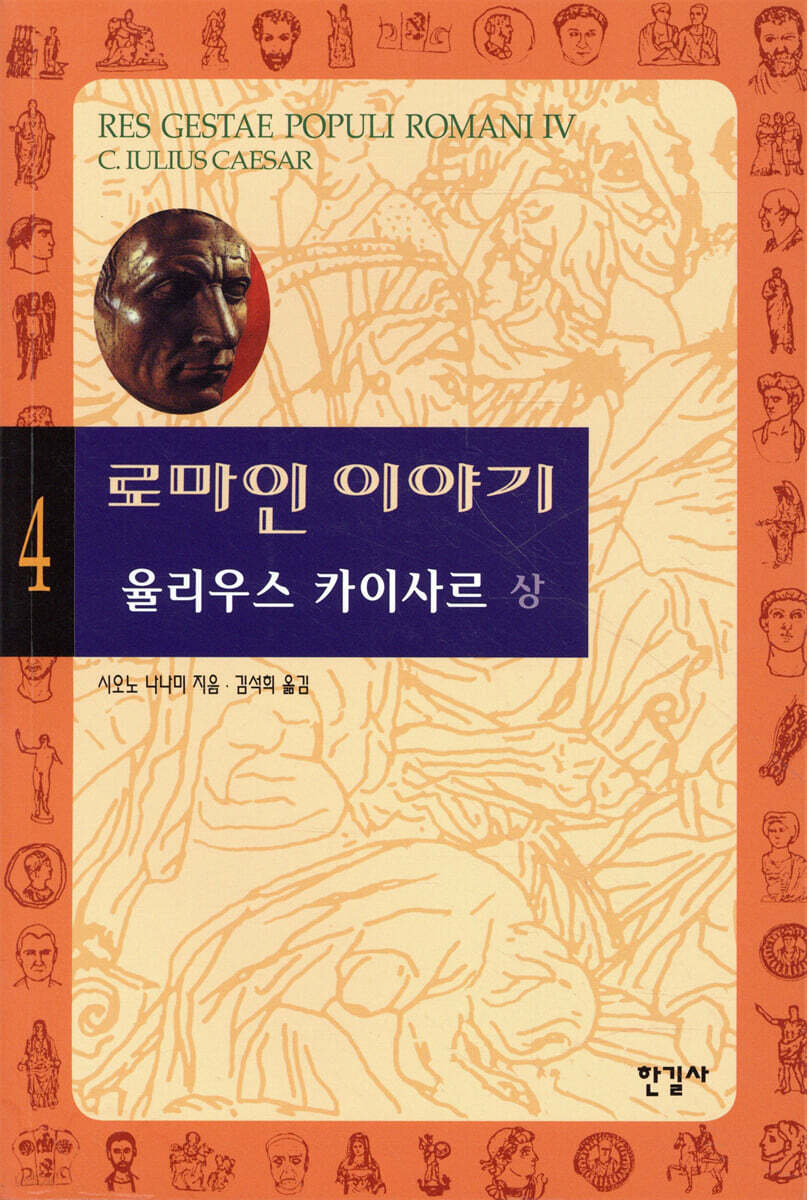
Roman Tales 4
 |
Description
Book Introduction
Julius Caesar, a Roman among the Romans.
Caesar, the hero who became a legend because of his unprecedented feats and amazing human charm.
A must-read for both business leaders and politicians.
Caesar, the hero who became a legend because of his unprecedented feats and amazing human charm.
A must-read for both business leaders and politicians.
- You can preview some of the book's contents.
Preview
index
1.
Childhood
2.
Youth
3.
middle age
4.
middle age
5.
Maturity
6.
March 15th
7.
Antony and Cleopatra vs. Octavian
8.
Caesar's Annals
9.
References
Childhood
2.
Youth
3.
middle age
4.
middle age
5.
Maturity
6.
March 15th
7.
Antony and Cleopatra vs. Octavian
8.
Caesar's Annals
9.
References
Into the book
Caesar had to take several measures at once.
Raising the red flag.
This is to order the soldiers to run to the place where the weapons are placed and take up their weapons.
Blowing the assembly trumpet.
This is to order the soldiers engaged in the work of setting up the camp to stop their work and assemble, and to also call back the soldiers who went to collect the materials needed for setting up the camp.
In addition, there was a need to blow trumpets to get the troops in line, make speeches to encourage the soldiers, and blow trumpets to signal the start of battle.
However, this becomes mostly impossible when the enemy surprises you.
Caesar did not obsess over what he thought was impossible.
Raising the red flag.
This is to order the soldiers to run to the place where the weapons are placed and take up their weapons.
Blowing the assembly trumpet.
This is to order the soldiers engaged in the work of setting up the camp to stop their work and assemble, and to also call back the soldiers who went to collect the materials needed for setting up the camp.
In addition, there was a need to blow trumpets to get the troops in line, make speeches to encourage the soldiers, and blow trumpets to signal the start of battle.
However, this becomes mostly impossible when the enemy surprises you.
Caesar did not obsess over what he thought was impossible.
--- pp.
257-258
257-258
The five qualities required of a leader are as follows:
Intelligence, persuasiveness, endurance, self-control, and persistent will.
Only Caesar possessed all these qualities.
- The following five qualities are required of a history textbook leader used in general high schools in Italy.
Intelligence, persuasiveness, endurance, self-control, and persistent will.
Only Caesar possessed all these qualities.
- History textbook used in regular high schools in Italy
Intelligence, persuasiveness, endurance, self-control, and persistent will.
Only Caesar possessed all these qualities.
- The following five qualities are required of a history textbook leader used in general high schools in Italy.
Intelligence, persuasiveness, endurance, self-control, and persistent will.
Only Caesar possessed all these qualities.
- History textbook used in regular high schools in Italy
--- From the preface
The die has been cast.
The die has been cast.
The die has been cast.
--- p.507
The most impressive passage is... I think it's when you cross the Rubicon River.
As I finish volume 4...
The crossing of the Rubicon River was the biggest change in Caesar's history...
Caesar spoke to his staff nearby.
'It's already spilt milk... (omitted)' and he said to the soldiers...
'Let us go forward, to where the gods await, to where the enemy who has defiled our honor awaits.
The die is cast~!' The most memorable phrase is... I think it was when crossing the Rubicon River.
As I finish volume 4...
The crossing of the Rubicon River was the biggest change in Caesar's history...
Caesar spoke to his staff nearby.
'It's already spilt milk... (omitted)' and he said to the soldiers...
'Let us go forward, to where the gods await, to where the enemy who has defiled our honor awaits.
The die is cast~!'
As I finish volume 4...
The crossing of the Rubicon River was the biggest change in Caesar's history...
Caesar spoke to his staff nearby.
'It's already spilt milk... (omitted)' and he said to the soldiers...
'Let us go forward, to where the gods await, to where the enemy who has defiled our honor awaits.
The die is cast~!' The most memorable phrase is... I think it was when crossing the Rubicon River.
As I finish volume 4...
The crossing of the Rubicon River was the biggest change in Caesar's history...
Caesar spoke to his staff nearby.
'It's already spilt milk... (omitted)' and he said to the soldiers...
'Let us go forward, to where the gods await, to where the enemy who has defiled our honor awaits.
The die is cast~!'
--- p.508
It's already spilt milk.
If I cross this river, the human world will become miserable, and if I don't cross it, I will be destroyed.'
'Let us go forward, to where the gods await, to where the enemy who has defiled our honor awaits.
The die is cast!'
The soldiers responded with a loud shout.
Then, following Caesar who was riding ahead, they crossed the Rubicon River as one body.
It's already spilt milk.
If I cross this river, the human world will become miserable, and if I don't cross it, I will be destroyed.'
'Let us go forward, to where the gods await, to where the enemy who has defiled our honor awaits.
The die is cast!'
The soldiers responded with a loud shout.
Then, following Caesar who was riding ahead, they crossed the Rubicon River as one body.
If I cross this river, the human world will become miserable, and if I don't cross it, I will be destroyed.'
'Let us go forward, to where the gods await, to where the enemy who has defiled our honor awaits.
The die is cast!'
The soldiers responded with a loud shout.
Then, following Caesar who was riding ahead, they crossed the Rubicon River as one body.
It's already spilt milk.
If I cross this river, the human world will become miserable, and if I don't cross it, I will be destroyed.'
'Let us go forward, to where the gods await, to where the enemy who has defiled our honor awaits.
The die is cast!'
The soldiers responded with a loud shout.
Then, following Caesar who was riding ahead, they crossed the Rubicon River as one body.
--- p.508
When it comes to delegating tasks to someone, people can be divided into two groups depending on how they do it.
Some people give very detailed instructions and leave it to the person to do, while others give the person a task but don't give detailed instructions and just leave it to that person to do.
It has little to do with whether you completely trust the other person or not.
The former is someone who works easily when given detailed instructions, while the latter is just the opposite.
Caesar belonged to the latter group.
However, choosing the latter is a gamble, so it often doesn't work out well.
In such cases, the person who assigned the work must take care of the aftermath.
Even cases that don't go well can be divided into two categories.
Not everything may go well, or some things may go well, but others may not.
Therefore, you need to decide whether you need to deal with the aftermath right away or whether you can leave it as is for the time being.
When it comes to delegating tasks to someone, people can be divided into two groups depending on how they do it.
Some people give very detailed instructions and leave it to the person to do, while others give the person a task but don't give detailed instructions and just leave it to that person to do.
It has little to do with whether you completely trust the other person or not.
The former is someone who works easily when given detailed instructions, while the latter is just the opposite.
Caesar belonged to the latter group.
However, choosing the latter is a gamble, so it often doesn't work out well.
In such cases, the person who assigned the work must take care of the aftermath.
Even cases that don't go well can be divided into two categories.
Not everything may go well, or some things may go well, but others may not.
Therefore, you need to decide whether you need to deal with the aftermath right away or whether you can leave it as is for the time being.
Some people give very detailed instructions and leave it to the person to do, while others give the person a task but don't give detailed instructions and just leave it to that person to do.
It has little to do with whether you completely trust the other person or not.
The former is someone who works easily when given detailed instructions, while the latter is just the opposite.
Caesar belonged to the latter group.
However, choosing the latter is a gamble, so it often doesn't work out well.
In such cases, the person who assigned the work must take care of the aftermath.
Even cases that don't go well can be divided into two categories.
Not everything may go well, or some things may go well, but others may not.
Therefore, you need to decide whether you need to deal with the aftermath right away or whether you can leave it as is for the time being.
When it comes to delegating tasks to someone, people can be divided into two groups depending on how they do it.
Some people give very detailed instructions and leave it to the person to do, while others give the person a task but don't give detailed instructions and just leave it to that person to do.
It has little to do with whether you completely trust the other person or not.
The former is someone who works easily when given detailed instructions, while the latter is just the opposite.
Caesar belonged to the latter group.
However, choosing the latter is a gamble, so it often doesn't work out well.
In such cases, the person who assigned the work must take care of the aftermath.
Even cases that don't go well can be divided into two categories.
Not everything may go well, or some things may go well, but others may not.
Therefore, you need to decide whether you need to deal with the aftermath right away or whether you can leave it as is for the time being.
--- p.234
marriage
Cinna, who had been proclaiming himself Marius' successor, felt the urgent need to establish countermeasures for Sulla, who would one day return home, when news of Sulla's success in the Orient reached him.
He was confident of the public's support because he had enacted many policies that had received public applause.
But, as the word "demokratia" suggests, the past three years have been a "dictatorship of the majority."
marriage
Cinna, who had been proclaiming himself Marius' successor, felt the urgent need to establish countermeasures for Sulla, who would one day return home, when news of Sulla's success in the Orient reached him.
He was confident of the public's support because he had enacted many policies that had received public applause.
But, as the word "demokratia" suggests, the past three years have been a "dictatorship of the majority."
Cinna, who had been proclaiming himself Marius' successor, felt the urgent need to establish countermeasures for Sulla, who would one day return home, when news of Sulla's success in the Orient reached him.
He was confident of the public's support because he had enacted many policies that had received public applause.
But, as the word "demokratia" suggests, the past three years have been a "dictatorship of the majority."
marriage
Cinna, who had been proclaiming himself Marius' successor, felt the urgent need to establish countermeasures for Sulla, who would one day return home, when news of Sulla's success in the Orient reached him.
He was confident of the public's support because he had enacted many policies that had received public applause.
But, as the word "demokratia" suggests, the past three years have been a "dictatorship of the majority."
--- p.48
Publisher's Review
There is no doubt that Shiono Nanami is a sincere and diligent writer.
He has kept his promise to write a comprehensive history of the Roman Empire, one volume per year, totaling 15 volumes, by the year 2006.
Moreover, when we consider that this was not a promise made in a half-hearted manner, but rather a promise made through meticulous preparation and tenacious persistence, we realize anew that we cannot dismiss that slender Japanese woman as a writer.
Countless readers awaited the publication of "The Roman Story," and Shiono did not disappoint.
He has prepared a story that is perfect for today, when we are closing the millennium and opening the new one.
"A serious crisis befell the Roman Empire, which lasted five hundred years! How did the Romans overcome it?" This is the theme Shiono explores in Volume 8, "Crisis and Overcoming."
What Shiono possesses as a writer is, above all, his exquisite ability to capture the timeliness of his writing.
Shiono never neglects to read the present and look to the future using the meticulously revealed history of the Romans as a mirror.
He has kept his promise to write a comprehensive history of the Roman Empire, one volume per year, totaling 15 volumes, by the year 2006.
Moreover, when we consider that this was not a promise made in a half-hearted manner, but rather a promise made through meticulous preparation and tenacious persistence, we realize anew that we cannot dismiss that slender Japanese woman as a writer.
Countless readers awaited the publication of "The Roman Story," and Shiono did not disappoint.
He has prepared a story that is perfect for today, when we are closing the millennium and opening the new one.
"A serious crisis befell the Roman Empire, which lasted five hundred years! How did the Romans overcome it?" This is the theme Shiono explores in Volume 8, "Crisis and Overcoming."
What Shiono possesses as a writer is, above all, his exquisite ability to capture the timeliness of his writing.
Shiono never neglects to read the present and look to the future using the meticulously revealed history of the Romans as a mirror.
GOODS SPECIFICS
- Date of issue: March 1, 1996
- Page count, weight, size: 510 pages | 620g | 148*210*35mm
- ISBN13: 9788935610273
- ISBN10: 8935610275
You may also like
카테고리
korean


korean

![ELLE 엘르 스페셜 에디션 A형 : 12월 [2025]](http://librairie.coreenne.fr/cdn/shop/files/b8e27a3de6c9538896439686c6b0e8fb.jpg?v=1766436872&width=3840)


