

End, book
 |
Description
Book Introduction
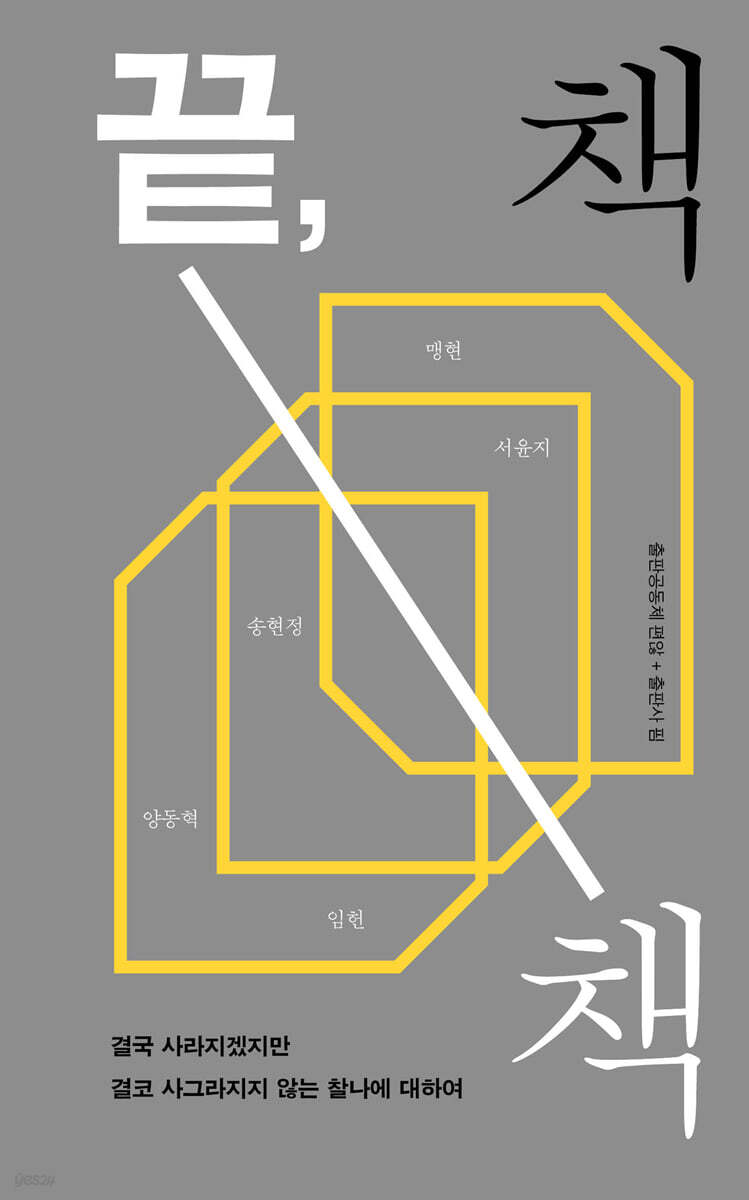
Without quotation marks, they ripple through each other, and in the midst of countless interferences between waves, they ask that the ownership of the concentric circles be neutralized.
Where will the disappeared publishing companies go?
What path will an in-house designer at a major publishing company take after becoming independent?
How do an editor-turned-comedian/novelist and a designer-turned-pictures-book author view the "end of the book"?
How does an author whose first book almost went out of print endure time?
What kind of books are the descendants of Korea's first publishers creating?
What will be the struggle of the editor to protect the 'empty space' together with the writer and the readers?
What would be the thoughts of someone who continues to think about and practice the end of the publishing company he runs?
『The End, Book: About the Moment That Will Eventually Disappear But Never Subside』(hereafter referred to as 『The End, Book』) began with this curiosity.
As can be easily guessed, 『The End, Book』 does not simply end with the story of closing down a business, starting a business, changing careers, or going out of print or being republished.
The intimate stories of people in the publishing industry, who encounter books through different paths, leave and return, and endure the 'end' in their own ways, are intertwined.
What is noteworthy is that this book is a collection of interviews in which the interviewer is more important than the interviewee.
Moving away from the traditional question-and-answer, interview-centered interview, the interviewer's perspective, interpretation, and emotions come to the forefront.
Experimental designs that blur or overlap the interviewee's speech, or even boldly obscure it, are also attempts to capture 'interference between people, the lingering feeling after the conversation itself.'
"The End, Book" is also the result of collaboration and solidarity between publishers.
Because it was created through a joint project between the publishing community Pyeonan and the publisher Pim, this fact was clearly stated on the cover and copyright page.
In addition, we attempted to implement a 'publishing process as a community' by having fellow students from the seminar (Journalism Seminar) who had studied and pondered 'journalism' together participate in the writing.
These diverse writers, each with a different style and perspective, participate in the conversation, and this polyphonic dialogue is combined with experimental techniques of editorial design.
Thanks to this, the text of this book can be read as if it were 'concentric circles created by various waves colliding.'
In fact, the opaque and imperfect moments of our relationship or our position are revealed as they are, such as when the interviewer and interviewee cross-interrupt each other's words, or when sentences are erased at the request of one side.
In the end, we may have wanted to reveal that we can only exist in the space between ourselves and others.
Where will the disappeared publishing companies go?
What path will an in-house designer at a major publishing company take after becoming independent?
How do an editor-turned-comedian/novelist and a designer-turned-pictures-book author view the "end of the book"?
How does an author whose first book almost went out of print endure time?
What kind of books are the descendants of Korea's first publishers creating?
What will be the struggle of the editor to protect the 'empty space' together with the writer and the readers?
What would be the thoughts of someone who continues to think about and practice the end of the publishing company he runs?
『The End, Book: About the Moment That Will Eventually Disappear But Never Subside』(hereafter referred to as 『The End, Book』) began with this curiosity.
As can be easily guessed, 『The End, Book』 does not simply end with the story of closing down a business, starting a business, changing careers, or going out of print or being republished.
The intimate stories of people in the publishing industry, who encounter books through different paths, leave and return, and endure the 'end' in their own ways, are intertwined.
What is noteworthy is that this book is a collection of interviews in which the interviewer is more important than the interviewee.
Moving away from the traditional question-and-answer, interview-centered interview, the interviewer's perspective, interpretation, and emotions come to the forefront.
Experimental designs that blur or overlap the interviewee's speech, or even boldly obscure it, are also attempts to capture 'interference between people, the lingering feeling after the conversation itself.'
"The End, Book" is also the result of collaboration and solidarity between publishers.
Because it was created through a joint project between the publishing community Pyeonan and the publisher Pim, this fact was clearly stated on the cover and copyright page.
In addition, we attempted to implement a 'publishing process as a community' by having fellow students from the seminar (Journalism Seminar) who had studied and pondered 'journalism' together participate in the writing.
These diverse writers, each with a different style and perspective, participate in the conversation, and this polyphonic dialogue is combined with experimental techniques of editorial design.
Thanks to this, the text of this book can be read as if it were 'concentric circles created by various waves colliding.'
In fact, the opaque and imperfect moments of our relationship or our position are revealed as they are, such as when the interviewer and interviewee cross-interrupt each other's words, or when sentences are erased at the request of one side.
In the end, we may have wanted to reveal that we can only exist in the space between ourselves and others.
- You can preview some of the book's contents.
Preview
index
Song Hyun-jung, the end
Where Does the Disappeared Publisher Go? × Oh Kyung-cheol (Former Publisher of Evening Book, Current Author)
When you have work to do, it's hard to think about the end × Ham Ji-eun (former Open Books designer, current CEO of Sangnok)
Im Heon, the end
We eventually reach the end of the book, but ⑴ × Won So-yoon (former editor, current stand-up comedian and novelist)
We eventually reach the end of the book, but ⑵ × Danjeonghwa (former designer, current picture book author)
Maeng Hyeon, the end
I can tolerate sadness, but I can't tolerate sloppy things × ●●●(●●●●, ●●●●●●●●)
Guard, a way to endure the passage of time × Go Jeong-sun (picture book author)
Seo Yoon-ji, the end
Moments of Caring for Side Branches × Yoo Ji-hee (CEO of Teoria)
The Heart that Protects the Vacant Space × Song Ji-hyeon (Editor of Gilbut Children's Books)
Yang Dong-hyuk, the end
Building a House Without Me × Lee Han-beom (CEO of Spiral Press)
After the party, the rate of return |
Where Does the Disappeared Publisher Go? × Oh Kyung-cheol (Former Publisher of Evening Book, Current Author)
When you have work to do, it's hard to think about the end × Ham Ji-eun (former Open Books designer, current CEO of Sangnok)
Im Heon, the end
We eventually reach the end of the book, but ⑴ × Won So-yoon (former editor, current stand-up comedian and novelist)
We eventually reach the end of the book, but ⑵ × Danjeonghwa (former designer, current picture book author)
Maeng Hyeon, the end
I can tolerate sadness, but I can't tolerate sloppy things × ●●●(●●●●, ●●●●●●●●)
Guard, a way to endure the passage of time × Go Jeong-sun (picture book author)
Seo Yoon-ji, the end
Moments of Caring for Side Branches × Yoo Ji-hee (CEO of Teoria)
The Heart that Protects the Vacant Space × Song Ji-hyeon (Editor of Gilbut Children's Books)
Yang Dong-hyuk, the end
Building a House Without Me × Lee Han-beom (CEO of Spiral Press)
After the party, the rate of return |
Into the book
I thought again that the evening book was like a star that had now disappeared.
Stars are born from clumps of gas and dust.
A star that begins from a combination of unclear factors ends its life after a fierce evolutionary process.
When a star dies, the material that made up the star is ejected, and this material spreads out into space to become the material for new stars and planets.
The moment of life ending is not the end, but a new possibility.
Evening Book went out of business, closed its doors.
None of the words that signify the end of a publishing company were desirable, so they put the word 'return' in the place.
Just as a lost star returns to space, all the materials that made up the evening book are returning to their places and forming the publishing world.
--- From "Song Hyun-jung - Where Do Disappearing Publishing Companies Go?"
I once thought that if there is a utopia in reality, it would be the publishing industry.
I nodded in agreement with actor Park Jung-min (also CEO of the publishing company Muje) who said in an interview, "The purpose of the publishing market is to create good books and introduce them to readers, and I like that they don't try to outdo each other."
(Regardless of the reality) Ham Ji-eun's answer was so beautiful that I had a feeling that this interview would make the 'publishing industry' I had in my eyes even stronger.
I also had a vague premonition that I might not be able to get the vicious, cold, and unhesitating ending I expected from Ham Ji-eun.
--- From "Song Hyun-jung - When there is work to do, it is difficult to think about the end"
While preparing the interview questionnaire, my days at publishing school came back to me.
The process of entering publishing school is not easy.
There are three stages to pass: document screening, written exam, and final interview.
Moreover, although the publishing industry is known as a declining industry, there are still people who dream of creating books. However, this, coupled with the fact that publishers are having a hard time recruiting new employees, makes the competition rate higher than expected.
Above all, it was quite difficult to prove how much I was serious about books and how serious my philosophy was about book making when I had no experience making books yet.
All the friends I met in the editorial department were full of enthusiasm for books.
It made sense, since 24 book lovers met in a small space.
Just as there are no two identical books in the world, the reasons why each of the 24 people wanted to become (or had to become) editors would all be different.
I wanted to hear about Soyun's first thoughts when she entered the world of publishing.
I wondered why I had set foot here and what my time here was like.
--- From "Im Heon - We eventually face the end of the book (1)"
The author said he wanted to do an interview after hearing about the planning intention of "The End, Book," but he was a little hesitant.
The reason was that the design was for a ‘textbook’ rather than a single volume.
Contrary to the author's concerns, I found it more interesting and meaningful.
Although many books have been published on the publishing industry, most of them have focused on single volume publications.
I thought that conducting this interview would shed light, however briefly, on another area of the publishing world.
There was no need to further divide and categorize the already narrow publishing world.
Above all, as a children's book editor, I was driven by pure curiosity.
To be honest, the books that are closer to children these days are not creative fairy tales, poetry collections, or picture books, but rather educational materials.
I wanted to take a look at the scenery there and see what kind of thoughts and feelings go into creating the textbook.
--- From "Im Heon - We eventually face the end of the book (2)"
All the PR and marketing I tried were failures.
I've failed so many times, and I wonder how they all knew about it. This year, I've been asked to present at the "Marketing Failure Case Study Sharing Session" three times.
The director of the center at the last institution I visited said after the sharing session, “Make money by teaching with this.
He also gave feedback saying, “That’s the answer.”
National book talks, author events in conjunction with local cultural foundations, our own events like the "Story Pawn Shop," author lectures, bookstore shelf advertising, our own book review team, book review teams run by PR agencies, book introductions through influencers, event merchandise, package deals from specialized book marketing companies, package deals from general marketing companies, paid SNS advertising, press release releases, and outsourcing copywriting are some of the things I've done so far.
In a publishing marketing class, they said that 10-15% of the book production cost is a typical marketing cost, but I've spent up to 50% of that amount on marketing.
--- From "Maeng Hyeon - I can tolerate sadness, but I can't tolerate sloppiness"
I was very happy when writer Go Jeong-sun was chosen as the interviewee for this book.
To be honest, I have been an aspiring writer for 15 years since I first dreamed of becoming a writer.
You could say that time was 'the time without business cards', but living without a business card for more than 10 years means living in your 20s, holding on to only your dreams, and living in your 30s as 'nothing' in society.
Even so, when you look back on the time of someone who has become something now and look at 13 or 15 years, it may feel like nothing (or not that long), but enduring your 20s and 30s as 'nothing' means enduring feelings of shame, shame, and even humiliation towards yourself, so it is not an easy time even if you think about it normally.
--- From "Maeng Hyeon - Guard, a way to endure the passage of time"
In those words, I thought again about the essence of publishing.
What is publishing? Perhaps publishing isn't about creating something new, but rather about preserving something that will eventually disappear.
To not miss the moment before your eyes, like sand slipping through your fingers, you bind the bookshelves together in the name of records.
The work of collecting and recording things that are easily forgotten and neglected.
The same was true of the already out-of-print book, “A History of Footnotes: How Footnotes Became Witnesses to History” (Anthony Grafton, translated by Jihye Kim, 2016).
It was a book that was listed at a used price of 150,000 won.
While preparing for the interview, I was looking through materials to see if there were any books I didn't know about, and I found out about this book that I wanted to get but couldn't get my hands on.
The representative said with a smile.
--- From "Seo Yoon-ji - Moments of Caring for Side Branches"
Editor Song Ji-hyeon's attempts did not stop at readers.
Growing up with writers with whom he had a long-standing relationship was also rewarding for him.
Do you ever work with artists you've worked with before? He pulled out his phone and showed me an Instagram cartoon from one artist.
He smiled and said that he was the Yoda holding the lightsaber in the painting by Popuragi.
I could see the comfortable and close relationship between the writer and the editor.
I first met author Popuragi at a French publishing company where he moved after creating the “Guksikkoraengi Neighborhood” series.
The artist Popuragi studied meticulously to prepare his work, and did not draw even the smallest detail carelessly.
A profound and respectable attitude.
It was exactly as I had imagined when I read his book.
The editor has no choice but to trust and wait for this writer with boundless talent.
The author has been working on 『Yeolha Diary』 for teenagers for three years.
--- From "Seo Yoon-ji - The Heart that Protects the Empty Space"
After much deliberation, he reached the conclusion that there was a lack of reading culture.
There is no culture of reading books created by spirals.
Although the book appears to be silent on the surface, it actually contains a wealth of musical elements.
When you begin to read, the text resonates in your head, creating an acoustic effect that could be called a performance.
Some books are called 'Largo', meaning they only begin to make sense when read very slowly, and some are called 'page-turners', meaning they are more enjoyable when read quickly rather than carefully savoring each word.
Books like classical music can truly be appreciated when you quietly savor the text, and their beauty is fully conveyed. Books like jazz can truly be "swinged" only when you actively participate in the free-spirited dialogue that the text unfolds in a more relaxed state.
However, classical music sounds best in professionally designed concert halls, while jazz truly shines in club performances.
A listening culture is created at the concert hall.
No, the concert hall fosters a listening culture.
When we say that culture blossoms through place, the diagnosis of the absence of a reading culture leads to the prescription of building a house of reading.
--- From "Yang Dong-hyuk - Building a House Without Me"
This book began with a certain connection to 『The Publisher's First Book』, in which I participated as an interviewee in the publishing community, and a certain solidarity with the publisher Pim.
In the early stages of planning, I envisioned a collection of interviews about 'The Publisher's Last Book' with a similar structure to that book.
So, it could be the last book published by a publishing company that has gone out of business, or the last book worked on by an editor or designer who has changed jobs, transferred, or retired, or a plan that was never realized, or a fantasy that never existed, or something like that.
Is it because I have been focusing my whole life on destruction rather than creation, on death rather than life?
I think I also tried to express some kind of failure, frustration, and sadness.
About that moment just before something no longer lasts.
however,
Stars are born from clumps of gas and dust.
A star that begins from a combination of unclear factors ends its life after a fierce evolutionary process.
When a star dies, the material that made up the star is ejected, and this material spreads out into space to become the material for new stars and planets.
The moment of life ending is not the end, but a new possibility.
Evening Book went out of business, closed its doors.
None of the words that signify the end of a publishing company were desirable, so they put the word 'return' in the place.
Just as a lost star returns to space, all the materials that made up the evening book are returning to their places and forming the publishing world.
--- From "Song Hyun-jung - Where Do Disappearing Publishing Companies Go?"
I once thought that if there is a utopia in reality, it would be the publishing industry.
I nodded in agreement with actor Park Jung-min (also CEO of the publishing company Muje) who said in an interview, "The purpose of the publishing market is to create good books and introduce them to readers, and I like that they don't try to outdo each other."
(Regardless of the reality) Ham Ji-eun's answer was so beautiful that I had a feeling that this interview would make the 'publishing industry' I had in my eyes even stronger.
I also had a vague premonition that I might not be able to get the vicious, cold, and unhesitating ending I expected from Ham Ji-eun.
--- From "Song Hyun-jung - When there is work to do, it is difficult to think about the end"
While preparing the interview questionnaire, my days at publishing school came back to me.
The process of entering publishing school is not easy.
There are three stages to pass: document screening, written exam, and final interview.
Moreover, although the publishing industry is known as a declining industry, there are still people who dream of creating books. However, this, coupled with the fact that publishers are having a hard time recruiting new employees, makes the competition rate higher than expected.
Above all, it was quite difficult to prove how much I was serious about books and how serious my philosophy was about book making when I had no experience making books yet.
All the friends I met in the editorial department were full of enthusiasm for books.
It made sense, since 24 book lovers met in a small space.
Just as there are no two identical books in the world, the reasons why each of the 24 people wanted to become (or had to become) editors would all be different.
I wanted to hear about Soyun's first thoughts when she entered the world of publishing.
I wondered why I had set foot here and what my time here was like.
--- From "Im Heon - We eventually face the end of the book (1)"
The author said he wanted to do an interview after hearing about the planning intention of "The End, Book," but he was a little hesitant.
The reason was that the design was for a ‘textbook’ rather than a single volume.
Contrary to the author's concerns, I found it more interesting and meaningful.
Although many books have been published on the publishing industry, most of them have focused on single volume publications.
I thought that conducting this interview would shed light, however briefly, on another area of the publishing world.
There was no need to further divide and categorize the already narrow publishing world.
Above all, as a children's book editor, I was driven by pure curiosity.
To be honest, the books that are closer to children these days are not creative fairy tales, poetry collections, or picture books, but rather educational materials.
I wanted to take a look at the scenery there and see what kind of thoughts and feelings go into creating the textbook.
--- From "Im Heon - We eventually face the end of the book (2)"
All the PR and marketing I tried were failures.
I've failed so many times, and I wonder how they all knew about it. This year, I've been asked to present at the "Marketing Failure Case Study Sharing Session" three times.
The director of the center at the last institution I visited said after the sharing session, “Make money by teaching with this.
He also gave feedback saying, “That’s the answer.”
National book talks, author events in conjunction with local cultural foundations, our own events like the "Story Pawn Shop," author lectures, bookstore shelf advertising, our own book review team, book review teams run by PR agencies, book introductions through influencers, event merchandise, package deals from specialized book marketing companies, package deals from general marketing companies, paid SNS advertising, press release releases, and outsourcing copywriting are some of the things I've done so far.
In a publishing marketing class, they said that 10-15% of the book production cost is a typical marketing cost, but I've spent up to 50% of that amount on marketing.
--- From "Maeng Hyeon - I can tolerate sadness, but I can't tolerate sloppiness"
I was very happy when writer Go Jeong-sun was chosen as the interviewee for this book.
To be honest, I have been an aspiring writer for 15 years since I first dreamed of becoming a writer.
You could say that time was 'the time without business cards', but living without a business card for more than 10 years means living in your 20s, holding on to only your dreams, and living in your 30s as 'nothing' in society.
Even so, when you look back on the time of someone who has become something now and look at 13 or 15 years, it may feel like nothing (or not that long), but enduring your 20s and 30s as 'nothing' means enduring feelings of shame, shame, and even humiliation towards yourself, so it is not an easy time even if you think about it normally.
--- From "Maeng Hyeon - Guard, a way to endure the passage of time"
In those words, I thought again about the essence of publishing.
What is publishing? Perhaps publishing isn't about creating something new, but rather about preserving something that will eventually disappear.
To not miss the moment before your eyes, like sand slipping through your fingers, you bind the bookshelves together in the name of records.
The work of collecting and recording things that are easily forgotten and neglected.
The same was true of the already out-of-print book, “A History of Footnotes: How Footnotes Became Witnesses to History” (Anthony Grafton, translated by Jihye Kim, 2016).
It was a book that was listed at a used price of 150,000 won.
While preparing for the interview, I was looking through materials to see if there were any books I didn't know about, and I found out about this book that I wanted to get but couldn't get my hands on.
The representative said with a smile.
--- From "Seo Yoon-ji - Moments of Caring for Side Branches"
Editor Song Ji-hyeon's attempts did not stop at readers.
Growing up with writers with whom he had a long-standing relationship was also rewarding for him.
Do you ever work with artists you've worked with before? He pulled out his phone and showed me an Instagram cartoon from one artist.
He smiled and said that he was the Yoda holding the lightsaber in the painting by Popuragi.
I could see the comfortable and close relationship between the writer and the editor.
I first met author Popuragi at a French publishing company where he moved after creating the “Guksikkoraengi Neighborhood” series.
The artist Popuragi studied meticulously to prepare his work, and did not draw even the smallest detail carelessly.
A profound and respectable attitude.
It was exactly as I had imagined when I read his book.
The editor has no choice but to trust and wait for this writer with boundless talent.
The author has been working on 『Yeolha Diary』 for teenagers for three years.
--- From "Seo Yoon-ji - The Heart that Protects the Empty Space"
After much deliberation, he reached the conclusion that there was a lack of reading culture.
There is no culture of reading books created by spirals.
Although the book appears to be silent on the surface, it actually contains a wealth of musical elements.
When you begin to read, the text resonates in your head, creating an acoustic effect that could be called a performance.
Some books are called 'Largo', meaning they only begin to make sense when read very slowly, and some are called 'page-turners', meaning they are more enjoyable when read quickly rather than carefully savoring each word.
Books like classical music can truly be appreciated when you quietly savor the text, and their beauty is fully conveyed. Books like jazz can truly be "swinged" only when you actively participate in the free-spirited dialogue that the text unfolds in a more relaxed state.
However, classical music sounds best in professionally designed concert halls, while jazz truly shines in club performances.
A listening culture is created at the concert hall.
No, the concert hall fosters a listening culture.
When we say that culture blossoms through place, the diagnosis of the absence of a reading culture leads to the prescription of building a house of reading.
--- From "Yang Dong-hyuk - Building a House Without Me"
This book began with a certain connection to 『The Publisher's First Book』, in which I participated as an interviewee in the publishing community, and a certain solidarity with the publisher Pim.
In the early stages of planning, I envisioned a collection of interviews about 'The Publisher's Last Book' with a similar structure to that book.
So, it could be the last book published by a publishing company that has gone out of business, or the last book worked on by an editor or designer who has changed jobs, transferred, or retired, or a plan that was never realized, or a fantasy that never existed, or something like that.
Is it because I have been focusing my whole life on destruction rather than creation, on death rather than life?
I think I also tried to express some kind of failure, frustration, and sadness.
About that moment just before something no longer lasts.
however,
--- From "Jida Yul - After the House, Ki"
GOODS SPECIFICS
- Date of issue: October 1, 2025
- Page count, weight, size: 160 pages | 125*200*20mm
- ISBN13: 9791198873378
- ISBN10: 119887337X
You may also like
카테고리
korean


korean

![GQ KOREA Mark (Monthly): December [2025]](http://librairie.coreenne.fr/cdn/shop/files/8ef265dbbfbf186523ed75ba7319009d.jpg?v=1765340328&width=3840)


