

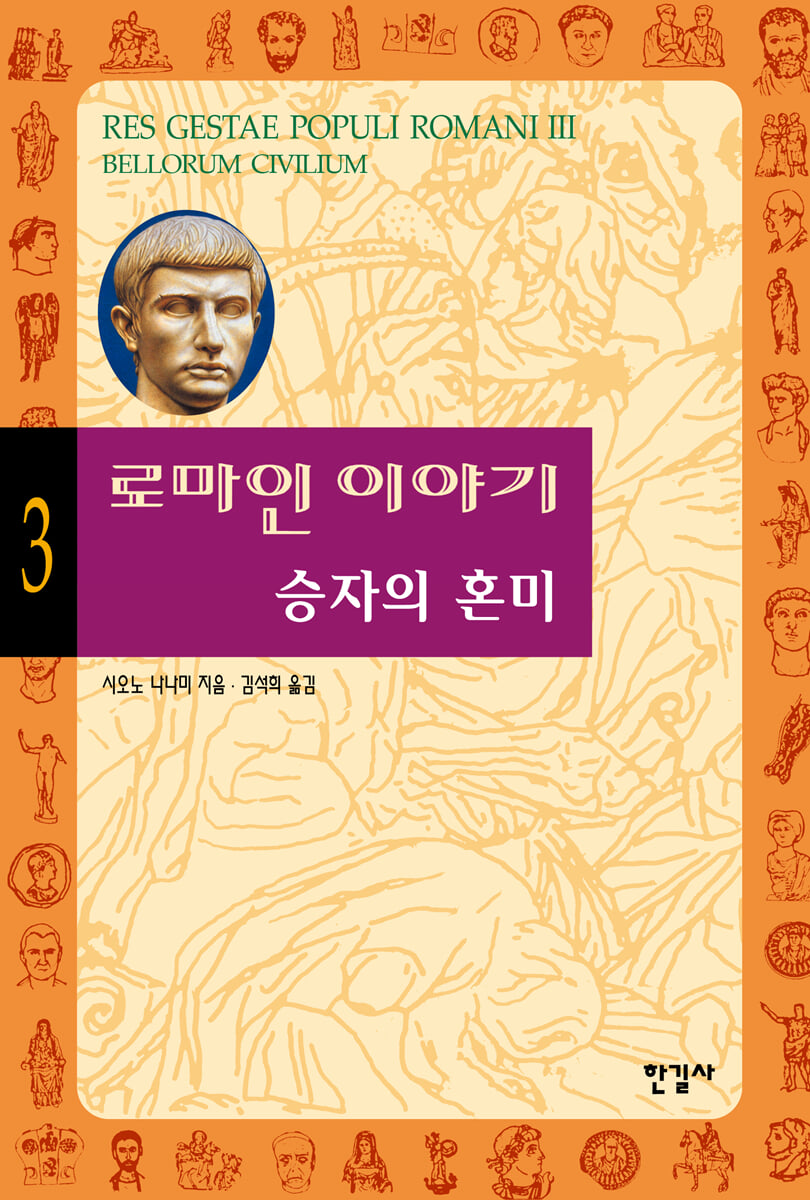
Roman Tales 3
 |
Description
Book Introduction
The third story, which covers the period from the fall of Carthage to the appearance of Caesar on the historical stage.
The story of Rome, which achieved outstanding external achievements but suffered from severe internal problems such as divisions, is described in detail in connection with the problems of the system.
The story of Rome, which achieved outstanding external achievements but suffered from severe internal problems such as divisions, is described in detail in connection with the problems of the system.
- You can preview some of the book's contents.
Preview
index
1.
prolog
2.
The Age of the Gracchi Brothers
3.
The Age of Marius and Sulla
4.
Pompey's era
5.
annual report
6.
References
prolog
2.
The Age of the Gracchi Brothers
3.
The Age of Marius and Sulla
4.
Pompey's era
5.
annual report
6.
References
Into the book
Although Tiberius reigned for only seven months and Gaius for only two years, and most of the reforms he implemented during that time ended up in vain, the Gracchi brothers marked the beginning of a new era for Rome, marking the end of an era of steady growth.
This is their historical raison d'être.
The Romans also experienced some twists and turns later, but eventually they followed the milestones set by the Gracchi brothers.
This is their historical raison d'être.
The Romans also experienced some twists and turns later, but eventually they followed the milestones set by the Gracchi brothers.
--- p.
79
79
If a nation's prosperity is due to its system, not to the power of individuals, then chaos should also be attributed to the system, not to the decline of individual capabilities.
Although they may not have been fully aware of it themselves because they were young, it is thought that what the Gracchi brothers left the Roman people was a question about the very republican system led by the Senate.
If a nation's prosperity is due to its system, not to the power of individuals, then chaos should also be attributed to the system, not to the decline of individual capabilities.
Although they may not have been fully aware of it themselves because they were young, it is thought that what the Gracchi brothers left the Roman people was a question about the very republican system led by the Senate.
Although they may not have been fully aware of it themselves because they were young, it is thought that what the Gracchi brothers left the Roman people was a question about the very republican system led by the Senate.
If a nation's prosperity is due to its system, not to the power of individuals, then chaos should also be attributed to the system, not to the decline of individual capabilities.
Although they may not have been fully aware of it themselves because they were young, it is thought that what the Gracchi brothers left the Roman people was a question about the very republican system led by the Senate.
--- p.
79
79
You cannot demand equal duties from someone who does not have equal rights.
If you want to impose equal obligations, you must also give equal rights.
If you demand the obligations that come with a right from someone who does not share the right, it becomes an indirect internal affair.
Although the Roman citizens did not understand the true meaning of the reforms promoted by the Gracchi brothers, they deeply mourned their deaths.
You cannot demand equal duties from someone who does not have equal rights.
If you want to impose equal obligations, you must also give equal rights.
If you demand the obligations that come with a right from someone who does not share the right, it becomes an indirect internal affair.
Although the Roman citizens did not understand the true meaning of the reforms promoted by the Gracchi brothers, they deeply mourned their deaths.
If you want to impose equal obligations, you must also give equal rights.
If you demand the obligations that come with a right from someone who does not share the right, it becomes an indirect internal affair.
Although the Roman citizens did not understand the true meaning of the reforms promoted by the Gracchi brothers, they deeply mourned their deaths.
You cannot demand equal duties from someone who does not have equal rights.
If you want to impose equal obligations, you must also give equal rights.
If you demand the obligations that come with a right from someone who does not share the right, it becomes an indirect internal affair.
Although the Roman citizens did not understand the true meaning of the reforms promoted by the Gracchi brothers, they deeply mourned their deaths.
--- p.53, --- p.79
I also want to point out that the confusion in Rome, which began during the time of the Gracchus brothers, was not caused by the luxury or decadence of the Romans, as most researchers assume.
That was their agony.
The enemy is not outside, but within.
That was the real 'confusion'.
I also want to point out that the confusion in Rome, which began during the time of the Gracchus brothers, was not caused by the luxury or decadence of the Romans, as most researchers assume.
That was their agony.
The enemy is not outside, but within.
That was the real 'confusion'.
That was their agony.
The enemy is not outside, but within.
That was the real 'confusion'.
I also want to point out that the confusion in Rome, which began during the time of the Gracchus brothers, was not caused by the luxury or decadence of the Romans, as most researchers assume.
That was their agony.
The enemy is not outside, but within.
That was the real 'confusion'.
--- p.81
Publisher's Review
The cruel historical lesson that those who have won once are sure to lose once {The Confusion of the Winner} The third volume of Roman stories {The Confusion of the Winner} depicts the period from the fall of Carthage to the appearance of Caesar on the historical stage.
The story of Rome, which achieved outstanding external achievements but suffered from severe internal problems such as divisions, is described in detail in connection with the problems of the system.
As a result of the three Punic Wars, which began unexpectedly, Rome became a hegemonic power that occupied most of the map of Europe, but the reality at home was very different from what was seen from the outside.
Rome, which had overcome discord between classes and achieved social stability through the proper functioning of the Senate, consuls, and citizen assemblies, now had the power of the Senate become unnecessarily large as the decisions of the Senate were still being implemented as policies even after the war.
Even among Roman citizens, those who belonged to the senatorial class and those who did not became fixed, and as the number of vast lands and cheap labor force of slaves increased due to repeated victories in war, Roman citizens gradually became excluded from free competition.
Eventually, they fell into the proletariat, refusing military service, and as they lost their reason for existence, their psychological damage grew and society gradually became unstable.
Book 3 of The Story of the Romans, {The Confusion of the Victors}, which consists of three chapters covering the period of the Gracchi brothers (133 BC - 120 BC), the period of Marius and Sulla (120 BC - 78 BC), and the period of Pompey (78 BC - 63 BC), depicts a Rome that, as a result of focusing all its energy on external enemies, now has internal enemies, all the social balance that had been maintained until then is broken, and the social systems that had been built up over 500 years are no longer functioning properly.
In conclusion, Book 1 of The Roman Story explains how a country creates a system, Book 2 explains how that system functions, and Book 3 explains how to reorganize a system that has become dysfunctional.
{The Confusion of the Victor}, which poignantly depicts the price that the victor must pay, effectively teaches us in our confused political situation the cold-blooded historical lesson that those who have won once are bound to lose once.
The story of Rome, which achieved outstanding external achievements but suffered from severe internal problems such as divisions, is described in detail in connection with the problems of the system.
As a result of the three Punic Wars, which began unexpectedly, Rome became a hegemonic power that occupied most of the map of Europe, but the reality at home was very different from what was seen from the outside.
Rome, which had overcome discord between classes and achieved social stability through the proper functioning of the Senate, consuls, and citizen assemblies, now had the power of the Senate become unnecessarily large as the decisions of the Senate were still being implemented as policies even after the war.
Even among Roman citizens, those who belonged to the senatorial class and those who did not became fixed, and as the number of vast lands and cheap labor force of slaves increased due to repeated victories in war, Roman citizens gradually became excluded from free competition.
Eventually, they fell into the proletariat, refusing military service, and as they lost their reason for existence, their psychological damage grew and society gradually became unstable.
Book 3 of The Story of the Romans, {The Confusion of the Victors}, which consists of three chapters covering the period of the Gracchi brothers (133 BC - 120 BC), the period of Marius and Sulla (120 BC - 78 BC), and the period of Pompey (78 BC - 63 BC), depicts a Rome that, as a result of focusing all its energy on external enemies, now has internal enemies, all the social balance that had been maintained until then is broken, and the social systems that had been built up over 500 years are no longer functioning properly.
In conclusion, Book 1 of The Roman Story explains how a country creates a system, Book 2 explains how that system functions, and Book 3 explains how to reorganize a system that has become dysfunctional.
{The Confusion of the Victor}, which poignantly depicts the price that the victor must pay, effectively teaches us in our confused political situation the cold-blooded historical lesson that those who have won once are bound to lose once.
GOODS SPECIFICS
- Date of issue: November 1, 1995
- Page count, weight, size: 298 pages | 450g | 148*210*20mm
- ISBN13: 9788935610266
- ISBN10: 8935610267
You may also like
카테고리
korean


korean

![ELLE 엘르 스페셜 에디션 A형 : 12월 [2025]](http://librairie.coreenne.fr/cdn/shop/files/b8e27a3de6c9538896439686c6b0e8fb.jpg?v=1766436872&width=3840)


