

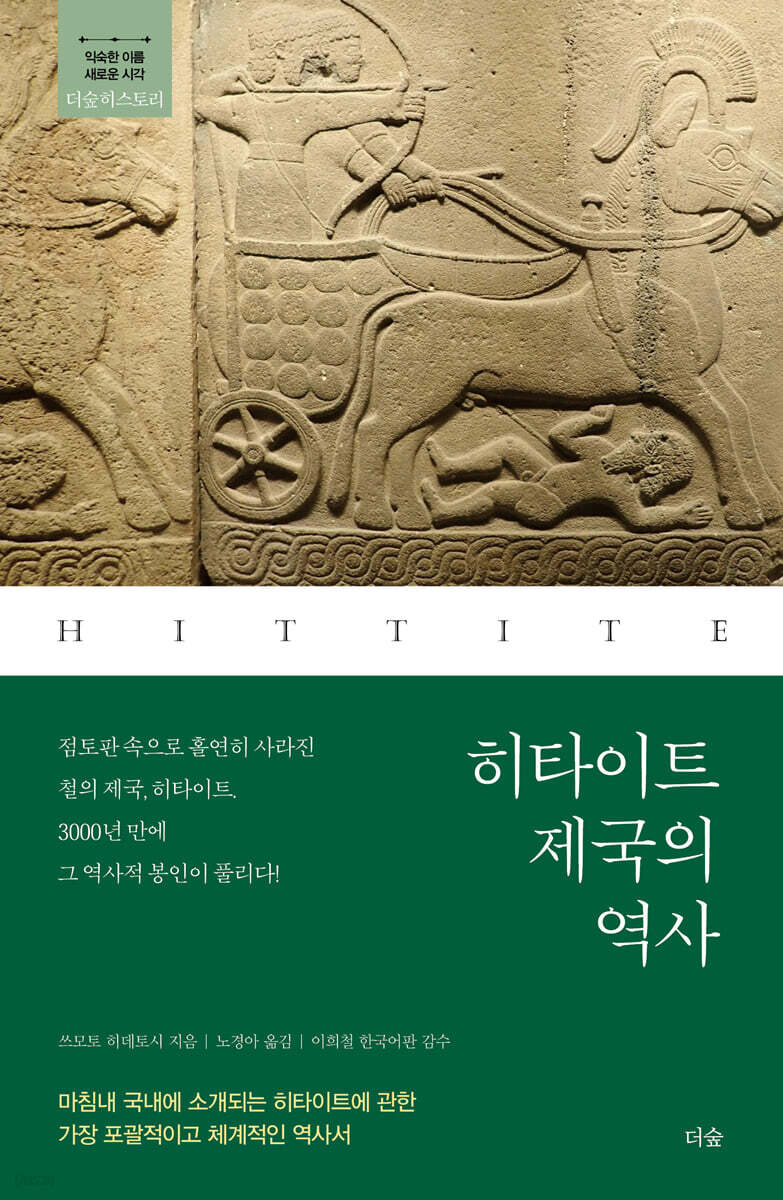
History of the Hittite Empire
 |
Description
Book Introduction
The Hittite Empire, an iron empire that suddenly disappeared into clay tablets.
After 3000 years, the historical seal is broken!
Finally, about the Hittites being introduced in Korea
The most up-to-date, comprehensive, and systematic history
Recently, interest in the Hittite Empire, the world's first iron empire, has grown more than ever in Korea.
To commemorate the first anniversary of the Gaya Tombs being listed as a World Heritage Site, the first Hittite artifact exhibition in Korea is being held, and content on the Hittite theme is actively being featured on YouTube and various broadcasting media, attracting the attention of history enthusiasts.
The recently published "History of the Hittite Empire" is a comprehensive and systematic history book that explains the entire Hittite Empire based on the most up-to-date historical materials and research.
The Hittites were an ancient state that ruled the area of present-day Turkey and Syria from the 17th century BC to the 12th century BC and led the international order. Along with Egypt and Assyria, they were one of the three great empires and hegemons of the ancient Orient world.
It demonstrated outstanding diplomatic prowess and global leadership by concluding the world's first peace treaty, and was the oldest and largest political system to emerge from ancient Anatolia.
It was also a cultural empire with the oldest written records of the Indo-European language family, massive temple buildings, and its own legal code.
These characteristics make the Hittites an interesting and mysterious empire, often described as the "first" and "largest."
But how did this splendid empire become almost completely forgotten by history until the 20th century?
There are only three books on the Hittites in Korea, and only one on Hittite history was published about 20 years ago.
This is why the publication of “History of the Hittite Empire” is significant.
This book vividly and engagingly brings the forgotten Hittite empire back to life, drawing on the latest research and data, and providing readers with a fresh introduction to its dazzling history.
It will also remind us of the true value of history books and remind modern readers of the profound meaning they hold.
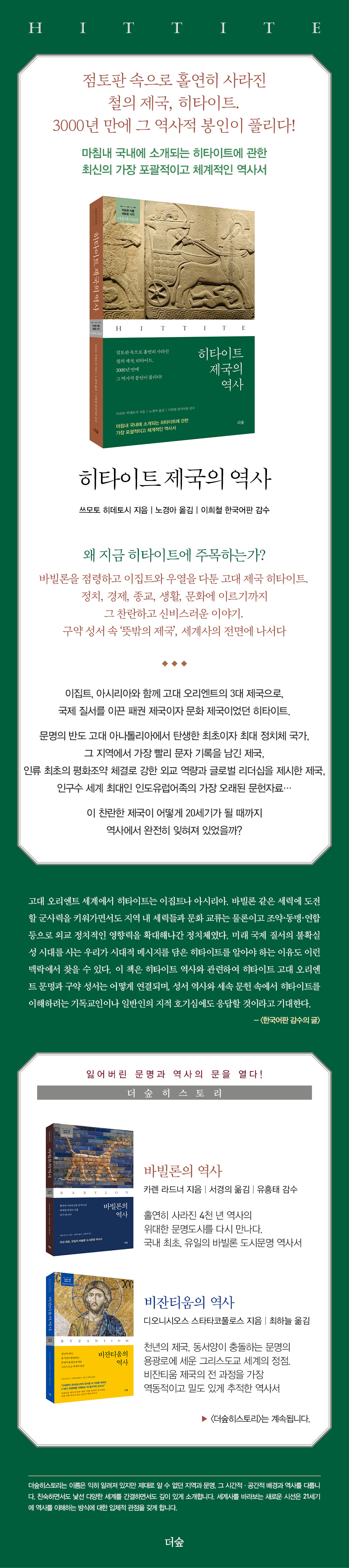
《History of the Hittite Empire》 is the third book in 'The Forest History', which opens the door to lost civilizations and history, following 《History of Babylon》 and 《History of Byzantium》.
After 3000 years, the historical seal is broken!
Finally, about the Hittites being introduced in Korea
The most up-to-date, comprehensive, and systematic history
Recently, interest in the Hittite Empire, the world's first iron empire, has grown more than ever in Korea.
To commemorate the first anniversary of the Gaya Tombs being listed as a World Heritage Site, the first Hittite artifact exhibition in Korea is being held, and content on the Hittite theme is actively being featured on YouTube and various broadcasting media, attracting the attention of history enthusiasts.
The recently published "History of the Hittite Empire" is a comprehensive and systematic history book that explains the entire Hittite Empire based on the most up-to-date historical materials and research.
The Hittites were an ancient state that ruled the area of present-day Turkey and Syria from the 17th century BC to the 12th century BC and led the international order. Along with Egypt and Assyria, they were one of the three great empires and hegemons of the ancient Orient world.
It demonstrated outstanding diplomatic prowess and global leadership by concluding the world's first peace treaty, and was the oldest and largest political system to emerge from ancient Anatolia.
It was also a cultural empire with the oldest written records of the Indo-European language family, massive temple buildings, and its own legal code.
These characteristics make the Hittites an interesting and mysterious empire, often described as the "first" and "largest."
But how did this splendid empire become almost completely forgotten by history until the 20th century?
There are only three books on the Hittites in Korea, and only one on Hittite history was published about 20 years ago.
This is why the publication of “History of the Hittite Empire” is significant.
This book vividly and engagingly brings the forgotten Hittite empire back to life, drawing on the latest research and data, and providing readers with a fresh introduction to its dazzling history.
It will also remind us of the true value of history books and remind modern readers of the profound meaning they hold.
《History of the Hittite Empire》 is the third book in 'The Forest History', which opens the door to lost civilizations and history, following 《History of Babylon》 and 《History of Byzantium》.
- You can preview some of the book's contents.
Preview
index
Korean edition review note
introduction
Chapter 1: The Rise of the Hittites and the Establishment of City-States
Where did the Hittites come from?
Anatolia, where multiple languages coexist
Social aspects of city-states as recorded by Assyrian merchants
Chapter 2: The Hittite Old Kingdom, the Founding of the Hittite Kingdom
Hattusili I, who conquered Syria
Hittite kings agonized over succession issues
Efforts to maintain stable production volume
Chapter 3: The Hittite Middle Kingdom: Chaos in the Hittite Kingdom
Confusion surrounding the throne and the threat from Mitanni
Tudhaliya I, who made Kijuwatna a protectorate
Hittites devastated by the attacks of the Kaskas
Chapter 4: The Hittite Empire: The Hittites' Rise as an Empire
Suppiluliuma I, who regained hegemony in Anatolia
A surprising offer from Tutankhamun's wife
A young king suffering from an epidemic of plague
The Battle of Kadesh from a Hittite Perspective
Chapter 5: The Fall of the Hittite Empire: A Fall from the Top
Mursili III, who was usurped from the throne by his uncle
Signing the world's first peace treaty with Egypt
Construction magnate Tudhaliya IV
Civil war, independence of vassal states, great drought
Chapter 6: The Late Hittite Period: The Reorganization of Western Asian Power
What is the truth about the fall of the Hittites?
Sub-kingdoms that survived the fall of the Hittite Empire
Are Palestine a people mentioned in the Old Testament?
Later Hittite states annexed by Assyria
Chapter 7: The Hittite State and Society Governed by Morality and Justice
The prince and queen also serve as priests.
A scribe in charge of the administration of the Hittite Empire
A village elder who mediated disputes between landlords and tenant farmers
The Hittite Code, which covered everything from the prices of goods to civil and criminal law.
Chapter 8: A Country That Valued Rituals More Than Military Action
The world of 'A Thousand Gods', where even the gods of enemy nations are accepted
A grand ritual held over a long period of time
Temple architecture style introduced to the Assyrian Empire
Hittite royal tombs still undiscovered
Chapter 9: Was the Hittites really an 'Iron Kingdom'?
Why the Hittite Empire Was Known as the "Iron Kingdom"
Iron used for decoration, like gold or jewels
Evidence that the Hittites did not hide their ironmaking technology.
Chapter 10: Long-distance Expeditions, War, and Active Diplomacy
War also follows sorcery and oracles.
A Hittite vassal state guaranteed full autonomy except for military service
What weapons were used in the war?
The power of the Hittite chariot
Chapter 11: Hittite Cities and Infrastructure
The majesty of Hattusa, the Hittite capital for about 400 years
The construction process of Hattusa as inferred from the restoration of the city walls.
Royal palaces and temples surrounded by walls
A city equipped with water supply facilities such as waterworks and reservoirs
Chapter 12: The Life and Lives of the Hittites
Granaries and reservoirs to prepare for crop failures
The Hittites valued cattle and loved bread.
Wine, a ceremonial luxury drink, and beer, a common drink
'Clothes' and 'House', which have not yet been studied
Chapter 13: Until the Hittites were Rediscovered
The Hittites disappeared from historical records
Are the 'Hittites' mentioned in the Bible real people who existed in history?
From the discovery of cuneiform script to the successful decipherment of Hittite
Developments in Anatolian Archaeological Research
Hittite kings and achievements featured in this book
Search
References
introduction
Chapter 1: The Rise of the Hittites and the Establishment of City-States
Where did the Hittites come from?
Anatolia, where multiple languages coexist
Social aspects of city-states as recorded by Assyrian merchants
Chapter 2: The Hittite Old Kingdom, the Founding of the Hittite Kingdom
Hattusili I, who conquered Syria
Hittite kings agonized over succession issues
Efforts to maintain stable production volume
Chapter 3: The Hittite Middle Kingdom: Chaos in the Hittite Kingdom
Confusion surrounding the throne and the threat from Mitanni
Tudhaliya I, who made Kijuwatna a protectorate
Hittites devastated by the attacks of the Kaskas
Chapter 4: The Hittite Empire: The Hittites' Rise as an Empire
Suppiluliuma I, who regained hegemony in Anatolia
A surprising offer from Tutankhamun's wife
A young king suffering from an epidemic of plague
The Battle of Kadesh from a Hittite Perspective
Chapter 5: The Fall of the Hittite Empire: A Fall from the Top
Mursili III, who was usurped from the throne by his uncle
Signing the world's first peace treaty with Egypt
Construction magnate Tudhaliya IV
Civil war, independence of vassal states, great drought
Chapter 6: The Late Hittite Period: The Reorganization of Western Asian Power
What is the truth about the fall of the Hittites?
Sub-kingdoms that survived the fall of the Hittite Empire
Are Palestine a people mentioned in the Old Testament?
Later Hittite states annexed by Assyria
Chapter 7: The Hittite State and Society Governed by Morality and Justice
The prince and queen also serve as priests.
A scribe in charge of the administration of the Hittite Empire
A village elder who mediated disputes between landlords and tenant farmers
The Hittite Code, which covered everything from the prices of goods to civil and criminal law.
Chapter 8: A Country That Valued Rituals More Than Military Action
The world of 'A Thousand Gods', where even the gods of enemy nations are accepted
A grand ritual held over a long period of time
Temple architecture style introduced to the Assyrian Empire
Hittite royal tombs still undiscovered
Chapter 9: Was the Hittites really an 'Iron Kingdom'?
Why the Hittite Empire Was Known as the "Iron Kingdom"
Iron used for decoration, like gold or jewels
Evidence that the Hittites did not hide their ironmaking technology.
Chapter 10: Long-distance Expeditions, War, and Active Diplomacy
War also follows sorcery and oracles.
A Hittite vassal state guaranteed full autonomy except for military service
What weapons were used in the war?
The power of the Hittite chariot
Chapter 11: Hittite Cities and Infrastructure
The majesty of Hattusa, the Hittite capital for about 400 years
The construction process of Hattusa as inferred from the restoration of the city walls.
Royal palaces and temples surrounded by walls
A city equipped with water supply facilities such as waterworks and reservoirs
Chapter 12: The Life and Lives of the Hittites
Granaries and reservoirs to prepare for crop failures
The Hittites valued cattle and loved bread.
Wine, a ceremonial luxury drink, and beer, a common drink
'Clothes' and 'House', which have not yet been studied
Chapter 13: Until the Hittites were Rediscovered
The Hittites disappeared from historical records
Are the 'Hittites' mentioned in the Bible real people who existed in history?
From the discovery of cuneiform script to the successful decipherment of Hittite
Developments in Anatolian Archaeological Research
Hittite kings and achievements featured in this book
Search
References
Detailed image
Into the book
In the ancient Orient world, the Hittites were like Egypt or Assyria.
It was a political entity that expanded its diplomatic and political influence through treaties, alliances, and coalitions, as well as cultural exchanges with regional powers, while also developing military power to challenge powers like Babylon.
The reason why we, living in an age of uncertainty regarding the future international order, need to understand the Hittites, which contain a message for the times, can be found in this context.
This book explores the connection between the Hittite civilization and the Old Testament in relation to Hittite history, and is expected to respond to the intellectual curiosity of both Christians and the general public who seek to understand the Hittites within the context of biblical history and secular literature.
---From the Korean edition review
Tudhaliya I, known as the father of the revival of the Hittite Empire, is said to have been particularly successful in the west after conducting active expeditions immediately after ascending to the throne, securing 600 chariots and over 10,000 prisoners.
Thanks to this, the Hittite Empire expanded its power to the Aegean Sea.
---From "Tudhaliya I, who made Kijuwatna a protectorate"
Wheat was primarily processed into bread.
Hittite written sources mention 146 types of bread, varying in raw grain, degree of grinding, additives, seasonings, size, shape, and color.
There are practical breads, such as dried bread suitable for workers' and soldiers' lunch boxes, as well as decorative breads, such as breads shaped like animals or gods for use in rituals, which shows how much the Hittites loved bread.
Even today, the taste of Turkish bread is famous, and it seems that the love of bread from our distant ancestors has continued to this day.
---From "The Hittites Who Valued Cows and Loved Bread"
Hattusili's greatest achievement was concluding a peace treaty with Egypt (Ramses II), with whom he had long been in conflict over Syria, and strengthening the bond through a political marriage.
Queen Puduhepa also seems to have contributed to improving relations between the two great powers by exchanging letters with Ramses separately.
Hattusili's challenge to the 'diplomatic revolution' of promising peace with Egypt may have been to counter the rising powers of Assyria in the south and Ahiya in the west, with whom relations had deteriorated.
---From "Signing the World's First Peace Treaty with Egypt"
The Hittites remained in an indirect rule, concluding treaties with vassal states and recognizing a certain degree of independence.
This is in contrast to Egypt's attempts to partially control its vassal states, such as by sending governors to Syria and Palestine and bringing young people there to Egypt for education.
---From "A Surprising Proposal from Tutankhamun's Wife"
The last written documents in Hittite disappear around 1180 BC.
After that, the only relic that tells us about the history of the Hittite Empire is the inscription about the 'War with the Sea Peoples' left by Ramses III of Egypt, an ally of the Hittites, at Medinat Habu (a temple dedicated to Ramses III).
---From "Civil War, Independence of Colonial States, and the Great Drought"
Although later Hittite states remained in Anatolia, they eventually came under the rule of Assyrian kings.
Later, both the countries that inherited the Hittite traditions and the Hittite culture itself disappeared around the 7th century BC.
The first merchants to introduce writing to Anatolia were Assyrians, but it was also the Assyrians who destroyed the Hittite culture that had emerged in Anatolia.
---From "Later Hittite States Annexed by Assyria"
The Hittite Code, which was more of a collection of case laws than a code of laws, differed significantly from the well-known Code of Hammurabi (c. 1750 BC).
First of all, there is no law that allows for revenge by the same means, and the overall weight is placed on compensation for the victim (the amount of compensation for bodily harm between free people is 20 shekels).
However, the verdict varied depending on the status or severity of the crime.
---From "The Hittite Code, Covering Everything from the Price of Goods to Civil and Criminal Law"
As we enter the imperial period, or New Kingdom period, and especially in the later 13th century BC, the frequency of references to iron in documents increases dramatically.
Not only has the frequency of mentions increased, but the types of iron products mentioned have also diversified.
Beyond decorative items such as animal or human figures, practical items such as swords, daggers, and spearheads began to appear.
---From "Iron used for decoration like gold or jewels"
The excavations at Kushakl revealed for the first time the complete ruins of a Hittite city other than Boazköy, and provided a wealth of information about Hittite life and technology.
Thanks to the application of this achievement to other sites including Boazköy, it was possible to reveal the existence of a water supply system including aqueducts and reservoirs in Boazköy.
---Among “cities with water supply facilities such as waterworks and reservoirs”
In 1893, the French excavator Ernest Chantre conducted excavations at Alajahöyük, Boazköy, and Kültepe.
At this time, clay tablets written in an unknown language were discovered in Boazköy.
It was an indecipherable document, written in cuneiform script like the already deciphered Akkadian and Babylonian, so it could be read, that is, pronounced, but the meaning was unknown.
It was the moment when Hittite cuneiform first appeared in the world.
It was a political entity that expanded its diplomatic and political influence through treaties, alliances, and coalitions, as well as cultural exchanges with regional powers, while also developing military power to challenge powers like Babylon.
The reason why we, living in an age of uncertainty regarding the future international order, need to understand the Hittites, which contain a message for the times, can be found in this context.
This book explores the connection between the Hittite civilization and the Old Testament in relation to Hittite history, and is expected to respond to the intellectual curiosity of both Christians and the general public who seek to understand the Hittites within the context of biblical history and secular literature.
---From the Korean edition review
Tudhaliya I, known as the father of the revival of the Hittite Empire, is said to have been particularly successful in the west after conducting active expeditions immediately after ascending to the throne, securing 600 chariots and over 10,000 prisoners.
Thanks to this, the Hittite Empire expanded its power to the Aegean Sea.
---From "Tudhaliya I, who made Kijuwatna a protectorate"
Wheat was primarily processed into bread.
Hittite written sources mention 146 types of bread, varying in raw grain, degree of grinding, additives, seasonings, size, shape, and color.
There are practical breads, such as dried bread suitable for workers' and soldiers' lunch boxes, as well as decorative breads, such as breads shaped like animals or gods for use in rituals, which shows how much the Hittites loved bread.
Even today, the taste of Turkish bread is famous, and it seems that the love of bread from our distant ancestors has continued to this day.
---From "The Hittites Who Valued Cows and Loved Bread"
Hattusili's greatest achievement was concluding a peace treaty with Egypt (Ramses II), with whom he had long been in conflict over Syria, and strengthening the bond through a political marriage.
Queen Puduhepa also seems to have contributed to improving relations between the two great powers by exchanging letters with Ramses separately.
Hattusili's challenge to the 'diplomatic revolution' of promising peace with Egypt may have been to counter the rising powers of Assyria in the south and Ahiya in the west, with whom relations had deteriorated.
---From "Signing the World's First Peace Treaty with Egypt"
The Hittites remained in an indirect rule, concluding treaties with vassal states and recognizing a certain degree of independence.
This is in contrast to Egypt's attempts to partially control its vassal states, such as by sending governors to Syria and Palestine and bringing young people there to Egypt for education.
---From "A Surprising Proposal from Tutankhamun's Wife"
The last written documents in Hittite disappear around 1180 BC.
After that, the only relic that tells us about the history of the Hittite Empire is the inscription about the 'War with the Sea Peoples' left by Ramses III of Egypt, an ally of the Hittites, at Medinat Habu (a temple dedicated to Ramses III).
---From "Civil War, Independence of Colonial States, and the Great Drought"
Although later Hittite states remained in Anatolia, they eventually came under the rule of Assyrian kings.
Later, both the countries that inherited the Hittite traditions and the Hittite culture itself disappeared around the 7th century BC.
The first merchants to introduce writing to Anatolia were Assyrians, but it was also the Assyrians who destroyed the Hittite culture that had emerged in Anatolia.
---From "Later Hittite States Annexed by Assyria"
The Hittite Code, which was more of a collection of case laws than a code of laws, differed significantly from the well-known Code of Hammurabi (c. 1750 BC).
First of all, there is no law that allows for revenge by the same means, and the overall weight is placed on compensation for the victim (the amount of compensation for bodily harm between free people is 20 shekels).
However, the verdict varied depending on the status or severity of the crime.
---From "The Hittite Code, Covering Everything from the Price of Goods to Civil and Criminal Law"
As we enter the imperial period, or New Kingdom period, and especially in the later 13th century BC, the frequency of references to iron in documents increases dramatically.
Not only has the frequency of mentions increased, but the types of iron products mentioned have also diversified.
Beyond decorative items such as animal or human figures, practical items such as swords, daggers, and spearheads began to appear.
---From "Iron used for decoration like gold or jewels"
The excavations at Kushakl revealed for the first time the complete ruins of a Hittite city other than Boazköy, and provided a wealth of information about Hittite life and technology.
Thanks to the application of this achievement to other sites including Boazköy, it was possible to reveal the existence of a water supply system including aqueducts and reservoirs in Boazköy.
---Among “cities with water supply facilities such as waterworks and reservoirs”
In 1893, the French excavator Ernest Chantre conducted excavations at Alajahöyük, Boazköy, and Kültepe.
At this time, clay tablets written in an unknown language were discovered in Boazköy.
It was an indecipherable document, written in cuneiform script like the already deciphered Akkadian and Babylonian, so it could be read, that is, pronounced, but the meaning was unknown.
It was the moment when Hittite cuneiform first appeared in the world.
---From “From the excavation of cuneiform to the successful decipherment of Hittite”
Publisher's Review
Why focus on the Hittites now?
The Old Testament's "Unexpected Empire" Comes to the forefront of world history.
Despite its central role in the ancient Orient, the Hittites became known to the world only about 100 years ago.
The Hittites disappeared from almost all records only a few centuries after their fall, and even the Greeks and Romans knew little about the empire that lived in Hattusa.
In this way, the Hittites remained a 'forgotten empire' that suddenly disappeared from ancient history.
As a result, the history of the Late Bronze Age, including Anatolia, remained an unsolved mystery among scholars for a long time.
It was not until the 20th century that the West truly recognized the importance of ancient Oriental civilization.
Until then, the only information about the Hittites was a brief mention in the Old Testament as the 'Hittites'.
Although they appear in the Bible as a minority group rather than a major power, several passages mention Egyptian pharaohs and Hittite kings side by side, suggesting that the Hittites were one of the major powers of the time.
Today, we cannot discuss the history of human culture without considering the ancient Oriental civilizations, and we have come to know that the religions, laws, and philosophies that have become the pillars of Western civilization also originated in the ancient Oriental world.
Archaeological excavations in Turkic Turkey (then Asia Minor or the Anatolian Peninsula) beginning in the late 19th century revealed the ruins of Hattusha (present-day Boazköy), the Hittite capital and a large fortress city.
Thanks to the dedicated research of archaeologists, anthropologists, historians, and linguists, the Hittites, once buried in the Old Testament, have now emerged from the "forgotten history of the world" into a significant historical puzzle, with the discovery of over 30,000 clay tablets and numerous archaeological sites.
The Hittites, an ancient empire that conquered Babylon and competed with Egypt for supremacy.
From politics, economy, religion, life, and culture
That splendid and mysterious story
This book covers the epic story of the Hittites, from their founding as a city-state to their fierce wars with surrounding powers, the formation of vassal states and the expansion of the empire, and the rise and fall of the empire that ruled its people through a brilliant culture and legal system.
The life and unique culture of the Hittites, who worshipped over a thousand gods, valued cattle, and loved bread, beer, and wine, are also depicted in an interesting way.
Based on recent excavations, meticulously organized historical narratives and interpretations vividly bring to life this ancient civilization, which emerged after 3,000 years.
Starting with the stories of outstanding monarchs such as Hattusili I, who conquered Syria as the first king, Tudhaliya I, the father of the revival of the Hittite Empire who expanded its power to the Aegean Sea through active expeditions immediately after ascending to the throne, and Suppiluliuma I, who regained hegemony in Anatolia and made it a great nation in the ancient Orient, the various stories that led to the rise and fall of the Hittite Empire, including the fierce power struggles surrounding the throne, the spread of epidemics, the Hittite law code that covered everything from the prices of goods to civil and criminal law, disputes between landlords and tenants, successive crop failures, and efforts to maintain stable productivity, accurately capture the reality we face today.
In addition, the author shares vivid behind-the-scenes stories about the process of deciphering clay tablets and excavating ruins, based on his experience participating in the excavation of a Turkish ruins site.
The book unfolds the moments when the Hittites, shrouded in mystery for 3,000 years, are revealed to the world in a thrilling drama-like manner, and readers will have the experience of viewing Hittite relics in a museum.
The Old Testament's "Unexpected Empire" Comes to the forefront of world history.
Despite its central role in the ancient Orient, the Hittites became known to the world only about 100 years ago.
The Hittites disappeared from almost all records only a few centuries after their fall, and even the Greeks and Romans knew little about the empire that lived in Hattusa.
In this way, the Hittites remained a 'forgotten empire' that suddenly disappeared from ancient history.
As a result, the history of the Late Bronze Age, including Anatolia, remained an unsolved mystery among scholars for a long time.
It was not until the 20th century that the West truly recognized the importance of ancient Oriental civilization.
Until then, the only information about the Hittites was a brief mention in the Old Testament as the 'Hittites'.
Although they appear in the Bible as a minority group rather than a major power, several passages mention Egyptian pharaohs and Hittite kings side by side, suggesting that the Hittites were one of the major powers of the time.
Today, we cannot discuss the history of human culture without considering the ancient Oriental civilizations, and we have come to know that the religions, laws, and philosophies that have become the pillars of Western civilization also originated in the ancient Oriental world.
Archaeological excavations in Turkic Turkey (then Asia Minor or the Anatolian Peninsula) beginning in the late 19th century revealed the ruins of Hattusha (present-day Boazköy), the Hittite capital and a large fortress city.
Thanks to the dedicated research of archaeologists, anthropologists, historians, and linguists, the Hittites, once buried in the Old Testament, have now emerged from the "forgotten history of the world" into a significant historical puzzle, with the discovery of over 30,000 clay tablets and numerous archaeological sites.
The Hittites, an ancient empire that conquered Babylon and competed with Egypt for supremacy.
From politics, economy, religion, life, and culture
That splendid and mysterious story
This book covers the epic story of the Hittites, from their founding as a city-state to their fierce wars with surrounding powers, the formation of vassal states and the expansion of the empire, and the rise and fall of the empire that ruled its people through a brilliant culture and legal system.
The life and unique culture of the Hittites, who worshipped over a thousand gods, valued cattle, and loved bread, beer, and wine, are also depicted in an interesting way.
Based on recent excavations, meticulously organized historical narratives and interpretations vividly bring to life this ancient civilization, which emerged after 3,000 years.
Starting with the stories of outstanding monarchs such as Hattusili I, who conquered Syria as the first king, Tudhaliya I, the father of the revival of the Hittite Empire who expanded its power to the Aegean Sea through active expeditions immediately after ascending to the throne, and Suppiluliuma I, who regained hegemony in Anatolia and made it a great nation in the ancient Orient, the various stories that led to the rise and fall of the Hittite Empire, including the fierce power struggles surrounding the throne, the spread of epidemics, the Hittite law code that covered everything from the prices of goods to civil and criminal law, disputes between landlords and tenants, successive crop failures, and efforts to maintain stable productivity, accurately capture the reality we face today.
In addition, the author shares vivid behind-the-scenes stories about the process of deciphering clay tablets and excavating ruins, based on his experience participating in the excavation of a Turkish ruins site.
The book unfolds the moments when the Hittites, shrouded in mystery for 3,000 years, are revealed to the world in a thrilling drama-like manner, and readers will have the experience of viewing Hittite relics in a museum.
GOODS SPECIFICS
- Date of issue: November 8, 2024
- Page count, weight, size: 316 pages | 516g | 145*222*20mm
- ISBN13: 9791194273059
- ISBN10: 119427305X
You may also like
카테고리
korean


korean

![ELLE 엘르 스페셜 에디션 A형 : 12월 [2025]](http://librairie.coreenne.fr/cdn/shop/files/b8e27a3de6c9538896439686c6b0e8fb.jpg?v=1766436872&width=3840)


