

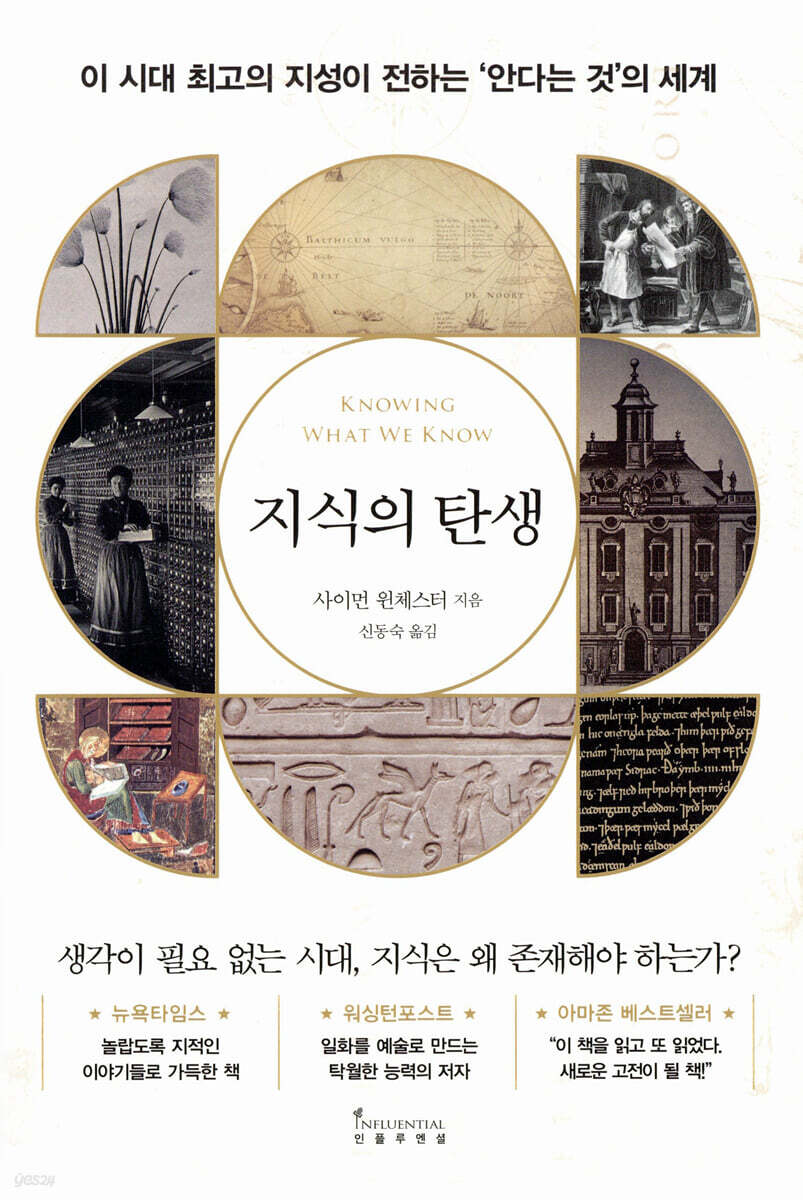
The Birth of Knowledge
 |
Description
Book Introduction
- A word from MD
- [Where Does Knowledge Come From?] Everything about the world of human knowledge explored by Simon Winchester, the greatest intellect of our time.
It talks about what knowledge is, how it is transmitted, and how it has evolved over time.
In modern society, where knowledge is easy to find but difficult to accumulate, we are forced to reconsider what it truly means to “know.”
- Ahn Hyeon-jae, History PD
Where does all the world's knowledge come from?
A remarkable chronicle of the origins of knowledge, from the beginning of learning to the end of intelligence.
* The New York Times, The Wall Street Journal, The Washington Post, The Times, etc.
A hot topic that received rave reviews from media outlets around the world
* #1 in History on Amazon in the US and UK / Amazon Editors' Pick
* A new book by Simon Winchester, the world's most popular author
With the advent of the Internet and smartphones, we can instantly find out anything we want to know.
With auto-completion and spell checker, you no longer need to memorize difficult and long words, find your way to your desired destination, or run around looking for a cheaper item.
Now that computers perform difficult calculations, artificial intelligence performs complex thinking, and we have a wealth of knowledge at our fingertips, what does "knowing" mean to us?
What should the human brain, which has accumulated knowledge through various experiences and learning since the first human being, do now?
Simon Winchester, a leading intellectual who has captivated millions of readers around the world with his expeditions around the world, including "The Professor and the Madman," "The Map that Changed the World," and "The Perfectionists," has written a new book that explores the world of human knowledge, not the physical world.
Knowing What We Know tells the story of what knowledge is, how it has been transmitted to humanity from countless sources, and how the means of transmission have evolved over thousands of years.
From schools that impart knowledge, to libraries built to preserve knowledge passed down through experience, to the birth of encyclopedias and information retrieval, to modern artificial intelligence that replaces human intellectual labor, everything about knowledge is contained in one book.
Simon Winchester, who witnessed the most heated scenes of the 20th century and has built a world-renowned reputation as a witness to the changing history of the 21st century, poses a profound question about the restoration of wisdom in a modern society where the value of knowledge is disappearing, with his erudite discourse and elegant writing style.
A remarkable chronicle of the origins of knowledge, from the beginning of learning to the end of intelligence.
* The New York Times, The Wall Street Journal, The Washington Post, The Times, etc.
A hot topic that received rave reviews from media outlets around the world
* #1 in History on Amazon in the US and UK / Amazon Editors' Pick
* A new book by Simon Winchester, the world's most popular author
With the advent of the Internet and smartphones, we can instantly find out anything we want to know.
With auto-completion and spell checker, you no longer need to memorize difficult and long words, find your way to your desired destination, or run around looking for a cheaper item.
Now that computers perform difficult calculations, artificial intelligence performs complex thinking, and we have a wealth of knowledge at our fingertips, what does "knowing" mean to us?
What should the human brain, which has accumulated knowledge through various experiences and learning since the first human being, do now?
Simon Winchester, a leading intellectual who has captivated millions of readers around the world with his expeditions around the world, including "The Professor and the Madman," "The Map that Changed the World," and "The Perfectionists," has written a new book that explores the world of human knowledge, not the physical world.
Knowing What We Know tells the story of what knowledge is, how it has been transmitted to humanity from countless sources, and how the means of transmission have evolved over thousands of years.
From schools that impart knowledge, to libraries built to preserve knowledge passed down through experience, to the birth of encyclopedias and information retrieval, to modern artificial intelligence that replaces human intellectual labor, everything about knowledge is contained in one book.
Simon Winchester, who witnessed the most heated scenes of the 20th century and has built a world-renowned reputation as a witness to the changing history of the 21st century, poses a profound question about the restoration of wisdom in a modern society where the value of knowledge is disappearing, with his erudite discourse and elegant writing style.
- You can preview some of the book's contents.
Preview
index
Prologue | All I know is that I didn't know anything.
Chapter 1 | The Beginning of Learning
Chapter 2 | The First Library
Chapter 3 | The March of Intellect
Chapter 4 | Chronicles of Manipulation
Chapter 5 | An Era Without Thinking
Chapter 6 | Footsteps of a Great Mind
Acknowledgements
Glossary of Terms
Image source
Search
Chapter 1 | The Beginning of Learning
Chapter 2 | The First Library
Chapter 3 | The March of Intellect
Chapter 4 | Chronicles of Manipulation
Chapter 5 | An Era Without Thinking
Chapter 6 | Footsteps of a Great Mind
Acknowledgements
Glossary of Terms
Image source
Search
Detailed image

Into the book
All of life's footsteps are made through the continuous accumulation of knowledge.
Consciousness is necessary for knowledge to be transmitted to the mind of a sentient being, but an open and curious mind is also important.
And this process is repetitive and undergoes continuous change.
---From "Prologue | All I Know Is That I Knew Nothing"
As technology defines the era we live in, we are both awed by the infinite number of ways and means by which knowledge is conveyed, and yet we begin to question it.
'Isn't the change in the way knowledge is conveyed too extreme and rapid?
---From "Prologue | All I Know Is That I Knew Nothing"
If knowledge is iron filings, curiosity is a magnet, and its pull is as powerful, at least for some people, as something made of neodymium.
Curiosity, like a sponge or gravity, draws elements of knowledge to it with an inescapable force, ultimately transforming everyone who gains knowledge.
---From "Chapter 1: The Beginning of Learning"
The English word 'education' is a compound word of the Latin verb 'educare', meaning 'to nurture', and the Latin verb 'educere', meaning 'to lead'.
Simply put, education is the attempt by adult members of any human society to impart their knowledge to the next generation in order to raise them up according to what they consider to be the best ideals of life.
---From "Chapter 1: The Beginning of Learning"
Since the advent of writing, we have sought ways to collect, preserve, and protect what is known and learned, what can be taught, discussed, challenged, debated, and decided.
(…) “Knowledge is here.” Although this statement has some subtle ambiguities in its meaning, it is a fundamental belief of the library that we certainly recognize.
---From "Chapter 2: The First Library"
Because scrolls were so precious and fragile, debates often arose among librarians over whether they should be stored upright or on their sides, as in the Library of Alexandria.
---From "Chapter 2: The First Library"
Newspapers soon became an essential element of a free world society, serving for the next 400 years to collect and disseminate a specific product (i.e., news).
It is difficult to simply explain the relationship between knowledge and news.
The definition of knowledge was already proposed by Plato long ago, but how exactly should we define news?
---From "Chapter 3: The March of Intelligence"
The perception that cigarettes were a beacon of freedom emerged within days as a beacon of liberty, calming men's sexual fears like the Statue of Liberty's torch and inspiring women to think of themselves as small steps toward equality and justice.
(…) From then until the smoking fad began to fade after 1964, women smoked as much as men, and tobacco companies reaped huge profits.
---From "Chapter 4: The Chronicle of Manipulation"
Hill & Knowlton were paid about $12 million to use a tried-and-true strategy that had worked so well in World War I: atrocities, especially those involving babies.
Telling a story about a child being subjected to a terrible ordeal was the surest way to condemn the perpetrator to eternal propaganda hell.
---From "Chapter 4: The Chronicle of Manipulation"
The Google effect, or now called the Siri effect, is clearly affecting our minds, whether we think of it as brain-eating or as a means of sharpening our intellect.
We'll have to wait for more data to tell which way the truth is.
---From "Chapter 5: The Age of No Thinking"
Even without delving further into such events in world history, we can suggest a simple, perhaps easy, conclusion: the extent to which wisdom is applied in making decisions depends on whether those decisions build or destroy something.
Building something takes time, planning, and dedication, but tearing something down is always quick, messy, and requires far less thought.
Consciousness is necessary for knowledge to be transmitted to the mind of a sentient being, but an open and curious mind is also important.
And this process is repetitive and undergoes continuous change.
---From "Prologue | All I Know Is That I Knew Nothing"
As technology defines the era we live in, we are both awed by the infinite number of ways and means by which knowledge is conveyed, and yet we begin to question it.
'Isn't the change in the way knowledge is conveyed too extreme and rapid?
---From "Prologue | All I Know Is That I Knew Nothing"
If knowledge is iron filings, curiosity is a magnet, and its pull is as powerful, at least for some people, as something made of neodymium.
Curiosity, like a sponge or gravity, draws elements of knowledge to it with an inescapable force, ultimately transforming everyone who gains knowledge.
---From "Chapter 1: The Beginning of Learning"
The English word 'education' is a compound word of the Latin verb 'educare', meaning 'to nurture', and the Latin verb 'educere', meaning 'to lead'.
Simply put, education is the attempt by adult members of any human society to impart their knowledge to the next generation in order to raise them up according to what they consider to be the best ideals of life.
---From "Chapter 1: The Beginning of Learning"
Since the advent of writing, we have sought ways to collect, preserve, and protect what is known and learned, what can be taught, discussed, challenged, debated, and decided.
(…) “Knowledge is here.” Although this statement has some subtle ambiguities in its meaning, it is a fundamental belief of the library that we certainly recognize.
---From "Chapter 2: The First Library"
Because scrolls were so precious and fragile, debates often arose among librarians over whether they should be stored upright or on their sides, as in the Library of Alexandria.
---From "Chapter 2: The First Library"
Newspapers soon became an essential element of a free world society, serving for the next 400 years to collect and disseminate a specific product (i.e., news).
It is difficult to simply explain the relationship between knowledge and news.
The definition of knowledge was already proposed by Plato long ago, but how exactly should we define news?
---From "Chapter 3: The March of Intelligence"
The perception that cigarettes were a beacon of freedom emerged within days as a beacon of liberty, calming men's sexual fears like the Statue of Liberty's torch and inspiring women to think of themselves as small steps toward equality and justice.
(…) From then until the smoking fad began to fade after 1964, women smoked as much as men, and tobacco companies reaped huge profits.
---From "Chapter 4: The Chronicle of Manipulation"
Hill & Knowlton were paid about $12 million to use a tried-and-true strategy that had worked so well in World War I: atrocities, especially those involving babies.
Telling a story about a child being subjected to a terrible ordeal was the surest way to condemn the perpetrator to eternal propaganda hell.
---From "Chapter 4: The Chronicle of Manipulation"
The Google effect, or now called the Siri effect, is clearly affecting our minds, whether we think of it as brain-eating or as a means of sharpening our intellect.
We'll have to wait for more data to tell which way the truth is.
---From "Chapter 5: The Age of No Thinking"
Even without delving further into such events in world history, we can suggest a simple, perhaps easy, conclusion: the extent to which wisdom is applied in making decisions depends on whether those decisions build or destroy something.
Building something takes time, planning, and dedication, but tearing something down is always quick, messy, and requires far less thought.
---From "Chapter 6: Footsteps of Great Intellect"
Publisher's Review
In an age where thinking is unnecessary, why does knowledge exist?
The world of "knowing" conveyed by the greatest minds of this era.
Living in modern society, we have become overwhelmed by the flood of information and have come to know too much.
Thanks to the advancement of the internet, smartphones, and artificial intelligence, any information you want, from country populations to real-time exchange rates and stock prices, is readily available at any time.
However, just because you have a lot of information doesn't mean it's all stored in your head.
Rather, the more you accept something, the easier and faster it is to forget it.
We can call our friends anytime and go wherever we want, but the thought of memorizing phone numbers or finding our way to our destinations has long since disappeared from our minds.
What does knowledge mean now, when countless pieces of information are connected and stored but not accumulated as my own knowledge?
Simon Winchester, the world's most beloved history writer, asks us, living in an age where we are overwhelmed by information and no longer need to think, what it means to "know."
Advances in technology have made it easier for anyone to get anything they want, but people who know everything, like polymaths or sages, no longer exist.
The world of 'knowledge' that is embodied through self-experience, learning from others, and going through a process of confirmation may now be coming to an end.
How is knowledge created, preserved, and transmitted?
From the beginning of learning to the birth of books and the tragedy of libraries
The book begins in a small school in Bangalore, a city in south-central India.
Shukla Bose founded schools in slum areas to teach children, and the children who attended these schools transformed their parents and families.
The beginning of knowledge begins with learning.
Brushing your teeth and wearing clean clothes are all part of education.
Going back in history, what did they teach in the first schools established in Mesopotamia some 4,000 years ago? Surprisingly, it wasn't much different from what we have today.
They were taught to hold pencils, read and write, and as they advanced in grade level, they had to learn more difficult knowledge.
Historically, invaders have sought to eradicate the cultures of conquered nations, beginning with the destruction of libraries. ISIS, upon invading Iraq, first destroyed the Mosul Library. World-renowned libraries, including the Jaffna Library in Sri Lanka and the National Library of Poland, have all met with tragedy.
Since the advent of writing, we have sought ways to collect, preserve, and protect what is known and learned, what can be taught, discussed, challenged, debated, and decided.
As a result, a book was born and was kept in a library.
Knowledge has long been a precious thing that must not be simply stored, but kept safe and secure.
In this book, Simon Winchester talks about what knowledge is, how it is created, and how it is passed down.
Everything about human knowledge and understanding is contained here, from the knowledge acquired through experience, to the role of schools, the invention of writing, the birth of books, libraries for safekeeping, the birth of encyclopedias and information retrieval, and even the knowledge of truth and lies, to modern artificial intelligence that replaces human knowledge labor.
What does 'knowing' mean to us now?
A Chronicle of Manipulation Created by Propaganda and Fake News
This book is a chronicle of knowledge, but it is also a chronicle of the media, fake news, and propaganda.
It was the American public relations agency Hill & Knowlton that escalated the Gulf War, turning Iraq into an enemy of the world, by planning the testimony of the fake victim, Naira, from Kuwait.
It was not the culture of ordinary households that created the iconic American breakfast dish of bacon and eggs, but an advertisement by Edward Bernays, Sigmund Freud's nephew.
He used his uncle's world-renowned status and psychoanalytic theory to manipulate public sentiment by linking smoking to women's liberation, and became a hero to the tobacco industry.
Behind the photographs that captivated the world but changed the lives of many, there was a controlled meaning.
The shock of the photo is due to the omission of the context of the story.
Manipulation of the press had nothing to do with the freedom of the state.
The author's own story of covering the events of Bloody Sunday in Northern Ireland, which the UK remained silent about, and the Tiananmen Square incident, which became a global controversy but was unknown to the public, are part of a chronicle of fake knowledge in which society and the media collude to spread false information to the public. We are forced to go beyond what we know and ask questions about what is true.
Simon Winchester, who witnessed the most heated scenes of the 20th century and has built a global reputation as a witness to the changing history of the 21st century, uses his erudite wit and elegant writing style to convey the definition and meaning of knowledge, as well as the colorful stories that follow.
What do we need now that the value of knowledge is disappearing?
If you follow the questions he asks, you will reach the ultimate answer: the restoration of wisdom.
The world of "knowing" conveyed by the greatest minds of this era.
Living in modern society, we have become overwhelmed by the flood of information and have come to know too much.
Thanks to the advancement of the internet, smartphones, and artificial intelligence, any information you want, from country populations to real-time exchange rates and stock prices, is readily available at any time.
However, just because you have a lot of information doesn't mean it's all stored in your head.
Rather, the more you accept something, the easier and faster it is to forget it.
We can call our friends anytime and go wherever we want, but the thought of memorizing phone numbers or finding our way to our destinations has long since disappeared from our minds.
What does knowledge mean now, when countless pieces of information are connected and stored but not accumulated as my own knowledge?
Simon Winchester, the world's most beloved history writer, asks us, living in an age where we are overwhelmed by information and no longer need to think, what it means to "know."
Advances in technology have made it easier for anyone to get anything they want, but people who know everything, like polymaths or sages, no longer exist.
The world of 'knowledge' that is embodied through self-experience, learning from others, and going through a process of confirmation may now be coming to an end.
How is knowledge created, preserved, and transmitted?
From the beginning of learning to the birth of books and the tragedy of libraries
The book begins in a small school in Bangalore, a city in south-central India.
Shukla Bose founded schools in slum areas to teach children, and the children who attended these schools transformed their parents and families.
The beginning of knowledge begins with learning.
Brushing your teeth and wearing clean clothes are all part of education.
Going back in history, what did they teach in the first schools established in Mesopotamia some 4,000 years ago? Surprisingly, it wasn't much different from what we have today.
They were taught to hold pencils, read and write, and as they advanced in grade level, they had to learn more difficult knowledge.
Historically, invaders have sought to eradicate the cultures of conquered nations, beginning with the destruction of libraries. ISIS, upon invading Iraq, first destroyed the Mosul Library. World-renowned libraries, including the Jaffna Library in Sri Lanka and the National Library of Poland, have all met with tragedy.
Since the advent of writing, we have sought ways to collect, preserve, and protect what is known and learned, what can be taught, discussed, challenged, debated, and decided.
As a result, a book was born and was kept in a library.
Knowledge has long been a precious thing that must not be simply stored, but kept safe and secure.
In this book, Simon Winchester talks about what knowledge is, how it is created, and how it is passed down.
Everything about human knowledge and understanding is contained here, from the knowledge acquired through experience, to the role of schools, the invention of writing, the birth of books, libraries for safekeeping, the birth of encyclopedias and information retrieval, and even the knowledge of truth and lies, to modern artificial intelligence that replaces human knowledge labor.
What does 'knowing' mean to us now?
A Chronicle of Manipulation Created by Propaganda and Fake News
This book is a chronicle of knowledge, but it is also a chronicle of the media, fake news, and propaganda.
It was the American public relations agency Hill & Knowlton that escalated the Gulf War, turning Iraq into an enemy of the world, by planning the testimony of the fake victim, Naira, from Kuwait.
It was not the culture of ordinary households that created the iconic American breakfast dish of bacon and eggs, but an advertisement by Edward Bernays, Sigmund Freud's nephew.
He used his uncle's world-renowned status and psychoanalytic theory to manipulate public sentiment by linking smoking to women's liberation, and became a hero to the tobacco industry.
Behind the photographs that captivated the world but changed the lives of many, there was a controlled meaning.
The shock of the photo is due to the omission of the context of the story.
Manipulation of the press had nothing to do with the freedom of the state.
The author's own story of covering the events of Bloody Sunday in Northern Ireland, which the UK remained silent about, and the Tiananmen Square incident, which became a global controversy but was unknown to the public, are part of a chronicle of fake knowledge in which society and the media collude to spread false information to the public. We are forced to go beyond what we know and ask questions about what is true.
Simon Winchester, who witnessed the most heated scenes of the 20th century and has built a global reputation as a witness to the changing history of the 21st century, uses his erudite wit and elegant writing style to convey the definition and meaning of knowledge, as well as the colorful stories that follow.
What do we need now that the value of knowledge is disappearing?
If you follow the questions he asks, you will reach the ultimate answer: the restoration of wisdom.
GOODS SPECIFICS
- Date of issue: August 30, 2024
- Format: Hardcover book binding method guide
- Page count, weight, size: 584 pages | 950g | 145*218*37mm
- ISBN13: 9791168342255
- ISBN10: 1168342252
You may also like
카테고리
korean


korean

![ELLE 엘르 스페셜 에디션 A형 : 12월 [2025]](http://librairie.coreenne.fr/cdn/shop/files/b8e27a3de6c9538896439686c6b0e8fb.jpg?v=1766436872&width=3840)


