

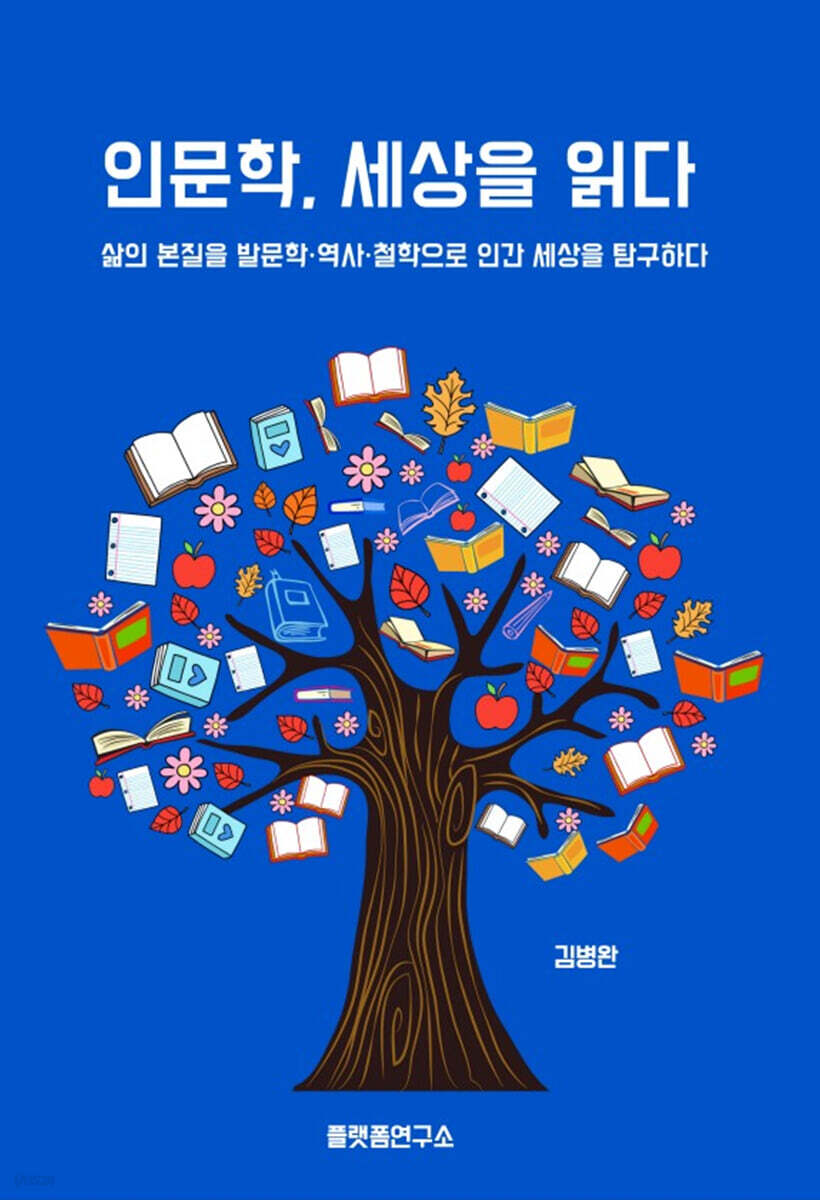
Humanities, Reading the World
 |
Description
Book Introduction
Books! Exploring the humanities.
'Beware of those who have read only one book!'
This quote from British politician Disraeli allows us to gauge how important reading is to our lives.
What kind of books do you read, and what kind of people do you admire? The books you read become who you are.
Therefore, the question of what books you read is the same as the question of what kind of person you will become.
A famous French gourmet said, 'Tell me what you eat.
Then I will try to guess what kind of person you are,' he said.
But there is an area where this saying can be applied more precisely: reading books.
'Beware of those who have read only one book!'
This quote from British politician Disraeli allows us to gauge how important reading is to our lives.
What kind of books do you read, and what kind of people do you admire? The books you read become who you are.
Therefore, the question of what books you read is the same as the question of what kind of person you will become.
A famous French gourmet said, 'Tell me what you eat.
Then I will try to guess what kind of person you are,' he said.
But there is an area where this saying can be applied more precisely: reading books.
index
Prologue_Books! Exploring the Humanities.
Part 1.
Books, exploring the humanities.
_ How to read classics
Chapter 1.
Explore literature.
Literary works are not worth reading?
Literature is the meeting of imagination and language.
Humans! That strange being? _ Sophocles, Oedipus the King, Antigone
Three ways to read literature.
Literary works, this is not how you should read them.
The life we long for is literature.
_ Goethe's "Faust"
Questions you must ask yourself when reading literature.
To live or to die, that is literature.
_ Shakespeare's "Hamlet"
Chapter 2.
Explore history.
What is history and why should we care?
Why you should read mythology.
How to read history books well.
Enduring the Lightness of Human Existence _ Sima Qian, Records of the Grand Historian
Questions to ask when reading history books.
All history books are products of the author's imagination!
Learn from wise people.
_ Homer's Odyssey
Chapter 3.
Explore philosophy.
What is philosophy and what are philosophy books?
A Philosophy Book for Everyone _ Nietzsche, Thus Spoke Zarathustra
Affirm yourself as you are - Nietzsche's advice!
Governing the world with half a volume of the Analects!_ Confucius's Analects
How Should We Live? _ Plato, Apology
What is the Good Life? _ Aristotle, Nicomachean Ethics
The Great Book of the World _ Descartes, Discourse on the Method
Appendix _ How to Secure Time to Read
Part 1.
Books, exploring the humanities.
_ How to read classics
Chapter 1.
Explore literature.
Literary works are not worth reading?
Literature is the meeting of imagination and language.
Humans! That strange being? _ Sophocles, Oedipus the King, Antigone
Three ways to read literature.
Literary works, this is not how you should read them.
The life we long for is literature.
_ Goethe's "Faust"
Questions you must ask yourself when reading literature.
To live or to die, that is literature.
_ Shakespeare's "Hamlet"
Chapter 2.
Explore history.
What is history and why should we care?
Why you should read mythology.
How to read history books well.
Enduring the Lightness of Human Existence _ Sima Qian, Records of the Grand Historian
Questions to ask when reading history books.
All history books are products of the author's imagination!
Learn from wise people.
_ Homer's Odyssey
Chapter 3.
Explore philosophy.
What is philosophy and what are philosophy books?
A Philosophy Book for Everyone _ Nietzsche, Thus Spoke Zarathustra
Affirm yourself as you are - Nietzsche's advice!
Governing the world with half a volume of the Analects!_ Confucius's Analects
How Should We Live? _ Plato, Apology
What is the Good Life? _ Aristotle, Nicomachean Ethics
The Great Book of the World _ Descartes, Discourse on the Method
Appendix _ How to Secure Time to Read
Detailed image
Publisher's Review
Books! Exploring the humanities.
'Beware of those who have read only one book!'
This quote from British politician Disraeli allows us to gauge how important reading is to our lives.
What kind of books do you read, and what kind of people do you admire? The books you read become who you are.
Therefore, the question of what books you read is the same as the question of what kind of person you will become.
A famous French gourmet said, 'Tell me what you eat.
Then I will try to guess what kind of person you are,' he said.
But there is an area where this saying can be applied more precisely: reading books.
'Tell me what book you read.
Then I'll try to guess what kind of person you are.'
There is a reason why we should explore the humanities.
That's because people who don't read humanities end up trapped in their own lives.
What if we grabbed someone off the street, threw them into a prison cell, and kept them there, unable to do anything? Imagine someone locking themselves up for 15 years, like in the movie "Oldboy."
We can't stand it.
So why is it unbearable? Because it's a fixed life, no different from yesterday, a passive life, a life devoid of freedom, a life devoid of growth and development, a dead life.
So what if you don't read the humanities? You live each day, your entire life, perhaps unaware that you're trapped, so it's only natural that you should feel even more anger.
But many people don't do that.
So it is clear that they are people who are truly trapped and living.
People who don't read the humanities just live the lives others have laid out for them, and they lack the ability to think for themselves and their imagination about what life is, what they should do to live, why they should live, what the true meaning and value of life is, and what kind of life they should create.
There is a difference between those who read and those who don't, but there is also a difference between those who read humanities and those who simply read bestsellers.
A person who only reads books that promise to follow the trend, make a lot of money, and get promoted at work can never become a leader or a leader.
Because leaders and leaders must have a humanistic imagination.
People who innovate, create, and lead are all people who read the humanities.
In that respect, it can be said that reading humanities is what makes the biggest difference in life.
People who only read bestsellers that follow the trend are no different from TV viewers who passively watch TV images passing by.
So, most people who complain that their lives don't change even though they read a lot of books are people who read this type of books.
However, those who engage in humanistic reading actively reflect on their lives, immerse themselves in a world of rich imagination that transcends thousands of years of time and space, and take each step toward approaching the essence of human existence more closely.
Bestselling books are books that convey someone else's thoughts, experiences, know-how, and knowledge, so we accept them without thinking.
It's literally spoon-fed.
But humanities books must dig into and discover what's inside them themselves.
That's why active reading is necessary.
Because of these differences, those who have been reading mostly bestsellers find reading humanities books burdensome, difficult, and uninteresting, and as a result, reading in this way becomes ineffective.
Strictly speaking, general reading methods and humanistic reading methods can be divided into two types: those that appreciate music and those that create new music together.
From the outside, it looks like they are both reading, but one side is appreciating and the other is creating.
So, reading is ultimately different even when reading the same book depending on one's level of thinking and consciousness.
That is also why we need to learn how to read humanities properly.
Some might ask, what is the difference?
But the difference can be said to be very large.
Why must Goethe, the great genius who wrote 115 books, have said the following?
“Most people don’t realize that it takes a long time to learn how to read.
It took me eight years, and I still can't say I'm perfect."
The reason we must explore the humanities through books is to live a broad life, and even to live many lives.
Czech author Milan Kundera once said, "Those who don't read live only one life, but those who read live many lives." To live many lives through books, you must read humanities books.
The first of the series on classics and humanities revealed by author Kim Byeong-wan, the 'God of Writing' who published 100 books in 10 years, is the Classics series. The first volume is 'The Classics Reading Revolution_The Art of Reading Books that Reinvent Humans', and the second volume is 'Become the God of Classics_The Secret of Enjoyable Classics Reading that Revolutionizes Life'.
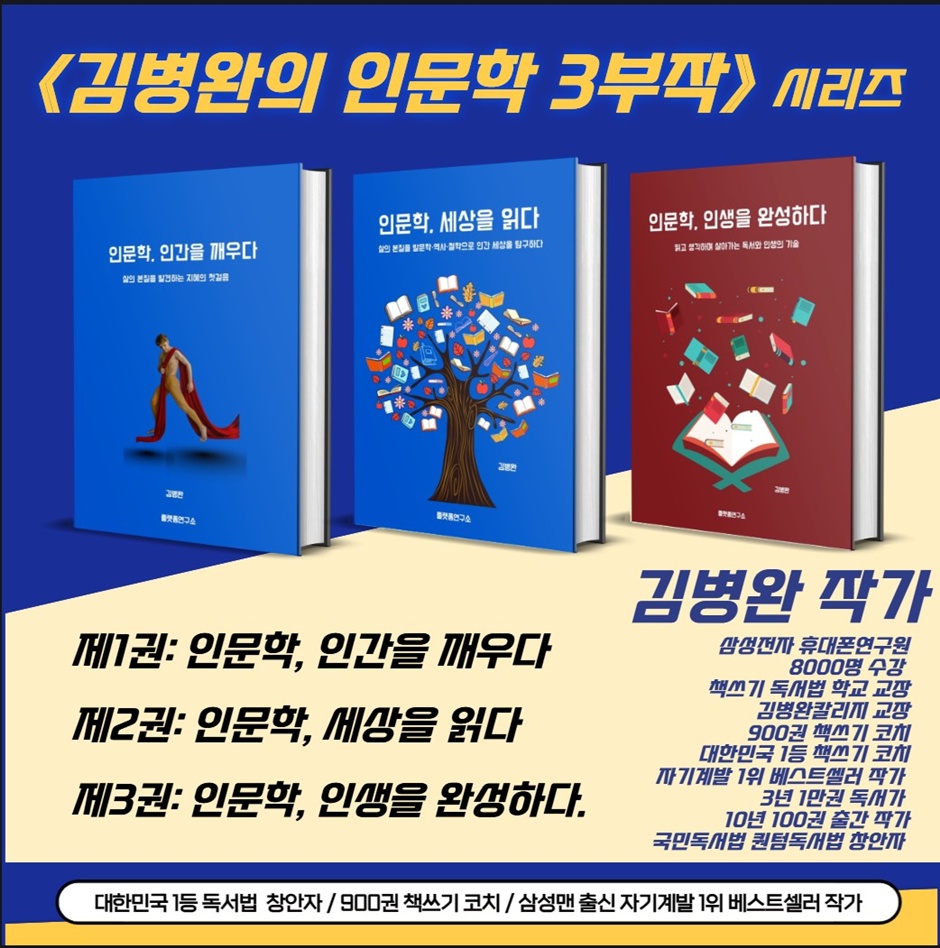
And this book is the second series, the humanities series, the first volume is Humanities, Awakening Humanity - The first step to wisdom in discovering the essence of life, the second volume is Humanities, Reading the World - Exploring the human world through literature, history, and philosophy, and the third volume is Humanities, Completing Life - Reading and Life Skills for Reading, Thinking, and Living.
(The first of the series on classics and humanities revealed by author Kim Byeong-wan, the 'God of Writing' who has published 100 books in 10 years and who hosted 'Kim Byeong-wan's Unbeatable Classics' every Friday on EBS FM's 'Reading Classics' is the Classics Series. The first volume is 'Revolution in Reading Classics_The Art of Reading Books that Reinvents Humanity', and the second volume is 'Become the God of Classics_The Secret of Enjoyable Classic Reading that Revolutionizes Life'.
And this book is the second series, the humanities series, the first volume is Humanities, Awakening Humanity - The first step to wisdom in discovering the essence of life, the second volume is Humanities, Reading the World - Exploring the human world through literature, history, and philosophy, and the third volume is Humanities, Completing Life - Reading and Life Skills for Reading, Thinking, and Living.
This book is a revised and expanded edition of a book published 13 years ago.)
'Beware of those who have read only one book!'
This quote from British politician Disraeli allows us to gauge how important reading is to our lives.
What kind of books do you read, and what kind of people do you admire? The books you read become who you are.
Therefore, the question of what books you read is the same as the question of what kind of person you will become.
A famous French gourmet said, 'Tell me what you eat.
Then I will try to guess what kind of person you are,' he said.
But there is an area where this saying can be applied more precisely: reading books.
'Tell me what book you read.
Then I'll try to guess what kind of person you are.'
There is a reason why we should explore the humanities.
That's because people who don't read humanities end up trapped in their own lives.
What if we grabbed someone off the street, threw them into a prison cell, and kept them there, unable to do anything? Imagine someone locking themselves up for 15 years, like in the movie "Oldboy."
We can't stand it.
So why is it unbearable? Because it's a fixed life, no different from yesterday, a passive life, a life devoid of freedom, a life devoid of growth and development, a dead life.
So what if you don't read the humanities? You live each day, your entire life, perhaps unaware that you're trapped, so it's only natural that you should feel even more anger.
But many people don't do that.
So it is clear that they are people who are truly trapped and living.
People who don't read the humanities just live the lives others have laid out for them, and they lack the ability to think for themselves and their imagination about what life is, what they should do to live, why they should live, what the true meaning and value of life is, and what kind of life they should create.
There is a difference between those who read and those who don't, but there is also a difference between those who read humanities and those who simply read bestsellers.
A person who only reads books that promise to follow the trend, make a lot of money, and get promoted at work can never become a leader or a leader.
Because leaders and leaders must have a humanistic imagination.
People who innovate, create, and lead are all people who read the humanities.
In that respect, it can be said that reading humanities is what makes the biggest difference in life.
People who only read bestsellers that follow the trend are no different from TV viewers who passively watch TV images passing by.
So, most people who complain that their lives don't change even though they read a lot of books are people who read this type of books.
However, those who engage in humanistic reading actively reflect on their lives, immerse themselves in a world of rich imagination that transcends thousands of years of time and space, and take each step toward approaching the essence of human existence more closely.
Bestselling books are books that convey someone else's thoughts, experiences, know-how, and knowledge, so we accept them without thinking.
It's literally spoon-fed.
But humanities books must dig into and discover what's inside them themselves.
That's why active reading is necessary.
Because of these differences, those who have been reading mostly bestsellers find reading humanities books burdensome, difficult, and uninteresting, and as a result, reading in this way becomes ineffective.
Strictly speaking, general reading methods and humanistic reading methods can be divided into two types: those that appreciate music and those that create new music together.
From the outside, it looks like they are both reading, but one side is appreciating and the other is creating.
So, reading is ultimately different even when reading the same book depending on one's level of thinking and consciousness.
That is also why we need to learn how to read humanities properly.
Some might ask, what is the difference?
But the difference can be said to be very large.
Why must Goethe, the great genius who wrote 115 books, have said the following?
“Most people don’t realize that it takes a long time to learn how to read.
It took me eight years, and I still can't say I'm perfect."
The reason we must explore the humanities through books is to live a broad life, and even to live many lives.
Czech author Milan Kundera once said, "Those who don't read live only one life, but those who read live many lives." To live many lives through books, you must read humanities books.
The first of the series on classics and humanities revealed by author Kim Byeong-wan, the 'God of Writing' who published 100 books in 10 years, is the Classics series. The first volume is 'The Classics Reading Revolution_The Art of Reading Books that Reinvent Humans', and the second volume is 'Become the God of Classics_The Secret of Enjoyable Classics Reading that Revolutionizes Life'.
And this book is the second series, the humanities series, the first volume is Humanities, Awakening Humanity - The first step to wisdom in discovering the essence of life, the second volume is Humanities, Reading the World - Exploring the human world through literature, history, and philosophy, and the third volume is Humanities, Completing Life - Reading and Life Skills for Reading, Thinking, and Living.
(The first of the series on classics and humanities revealed by author Kim Byeong-wan, the 'God of Writing' who has published 100 books in 10 years and who hosted 'Kim Byeong-wan's Unbeatable Classics' every Friday on EBS FM's 'Reading Classics' is the Classics Series. The first volume is 'Revolution in Reading Classics_The Art of Reading Books that Reinvents Humanity', and the second volume is 'Become the God of Classics_The Secret of Enjoyable Classic Reading that Revolutionizes Life'.
And this book is the second series, the humanities series, the first volume is Humanities, Awakening Humanity - The first step to wisdom in discovering the essence of life, the second volume is Humanities, Reading the World - Exploring the human world through literature, history, and philosophy, and the third volume is Humanities, Completing Life - Reading and Life Skills for Reading, Thinking, and Living.
This book is a revised and expanded edition of a book published 13 years ago.)
GOODS SPECIFICS
- Date of issue: November 10, 2025
- Page count, weight, size: 245 pages | 128*188*20mm
- ISBN13: 9791191396782
- ISBN10: 1191396789
You may also like
카테고리
korean


korean

![GQ KOREA Mark (Monthly): December [2025]](http://librairie.coreenne.fr/cdn/shop/files/8ef265dbbfbf186523ed75ba7319009d.jpg?v=1765340328&width=3840)


