

It's better not to assert the truth of life.
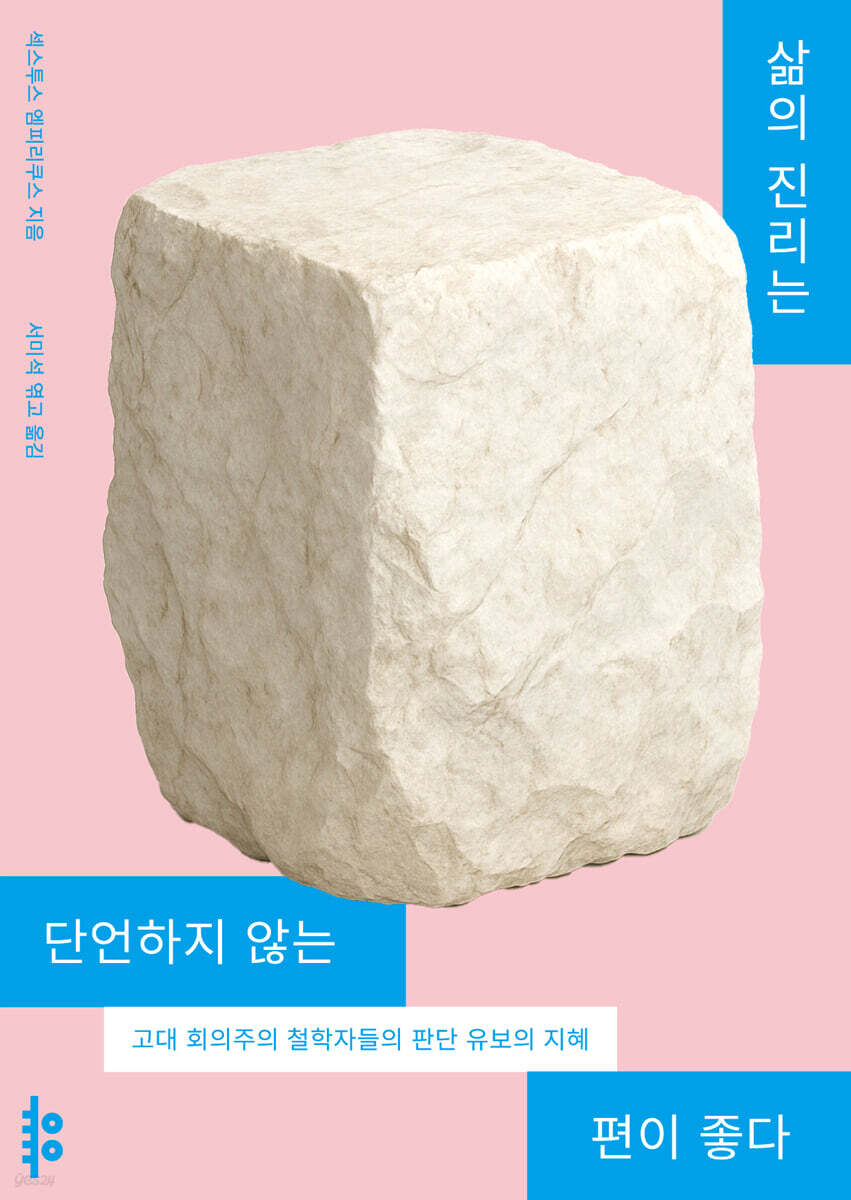 |
Description
Book Introduction
A book that reinterprets the works of Sextus Empiricus, which summarize the ideas of Pyrrho, the founder of ancient skepticism, in modern language.
Focusing on the core concepts of Pyrrhonism, 'suspension of judgment' and 'equanimity,' this book calmly and kindly guides us through the true nature of skepticism, which we often misunderstand.
There are only a handful of books that properly deal with Pyrrhonism, an ancient form of skepticism.
But in these times of uncertainty, conflict, and blind certainty, their teachings serve as a compass.
An attitude of not rushing to judgment, acknowledging each other's differences, and accepting them provisionally without asserting any 'truth'.
It is a true 'open mind' and a way of thinking that is absolutely necessary in our times.
Focusing on the core concepts of Pyrrhonism, 'suspension of judgment' and 'equanimity,' this book calmly and kindly guides us through the true nature of skepticism, which we often misunderstand.
There are only a handful of books that properly deal with Pyrrhonism, an ancient form of skepticism.
But in these times of uncertainty, conflict, and blind certainty, their teachings serve as a compass.
An attitude of not rushing to judgment, acknowledging each other's differences, and accepting them provisionally without asserting any 'truth'.
It is a true 'open mind' and a way of thinking that is absolutely necessary in our times.
- You can preview some of the book's contents.
Preview
index
Introduction: A Philosophy of Reservation of Judgment and Equanimity
1 What is Pyrrhonism?
2. Pyrrhonism's Argumentation Method
3. Pyrrhonist Expression and Thinking Style
4. Criticism of Logic
5 Criticism of Natural Science
6 Criticism of Ethics
1 What is Pyrrhonism?
2. Pyrrhonism's Argumentation Method
3. Pyrrhonist Expression and Thinking Style
4. Criticism of Logic
5 Criticism of Natural Science
6 Criticism of Ethics
Publisher's Review
A truly open mind begins with questioning your own thoughts.
The English word 'skepticism' comes from the ancient Greek word 'σκ?πτομαι', meaning 'to see, to consider'.
A skeptic originally meant a person who does not judge hastily but thinks carefully, and a person who silently explores the essence of truth through contemplation rather than argument.
But over time, its meaning seems to have faded.
Today, the word skeptic is often used to mean someone who doubts everything, denies the very idea of worrying, or is passive about everything, claiming that there is no such thing as truth in the world.
Perhaps because of this, the philosophy of skepticism has never been properly introduced until now.
There are only a handful of academic books on this topic, and it has rarely been covered as a general philosophy book for the general reader.
But if we go back to this very etymology, we can discover the true nature of skepticism, a philosophy that is completely different from what it is today.
2,500 years ago, the ancient Greek philosopher Pyrrho believed that blind faith in 'truth' actually creates human anxiety.
He believed that one could reach peace of mind, or ataraxia, by practicing 'epoché' (suspending judgment) without asserting the truth and by temporarily suspending all judgment.
Sextus Empiricus, a physician and philosopher who compiled his thoughts in his Outline of Pyrrhonism, fiercely explored the limits of human cognition and showed that skeptical thinking is the path to peace.
This book summarizes, translates, and reorganizes the classic work by Empiricus, "The Truth of Life is Better Left Unsaid," so that anyone can read it with ease.
From the origins of Pyrrhonism to the concepts of "suspension of judgment" and "equanimity" to the ten arguments for judgment, the core of ancient skeptical philosophy has been refined for easy reading.
Why should we pay attention to skeptical philosophy now?
The skepticism this book presents is not a philosophy of doubt, but of humble tolerance.
Accepting various argument methods, questioning dogmatic claims, reserving judgment in the face of truth, and reaching a state of composure are not indecision or evasion of responsibility, but rather are thinking skills for actively navigating the world.
In a society that is constantly confrontational and driven by the need for certainty, skepticism, which teaches us to acknowledge differing opinions and even to temporarily set aside our own judgments, serves as a compass in today's society, which is filled with conflict and uncertainty.
This attitude is the philosophy of an 'open mind' and shows why it is important to think with an open mind.
If the previously introduced Cynic philosophy book, "It's Better to Live Like a Dog," asked "How should we live?", "It's Better Not to Assert the Truth of Life" asks "How should we think?"
The courage to think hard but not judge rashly, the wisdom to not deny the truth but not assert it.
It is a guiding philosophy that will bring peace and flexibility to a modern society filled with polarization and uncompromising partisan debate.
The English word 'skepticism' comes from the ancient Greek word 'σκ?πτομαι', meaning 'to see, to consider'.
A skeptic originally meant a person who does not judge hastily but thinks carefully, and a person who silently explores the essence of truth through contemplation rather than argument.
But over time, its meaning seems to have faded.
Today, the word skeptic is often used to mean someone who doubts everything, denies the very idea of worrying, or is passive about everything, claiming that there is no such thing as truth in the world.
Perhaps because of this, the philosophy of skepticism has never been properly introduced until now.
There are only a handful of academic books on this topic, and it has rarely been covered as a general philosophy book for the general reader.
But if we go back to this very etymology, we can discover the true nature of skepticism, a philosophy that is completely different from what it is today.
2,500 years ago, the ancient Greek philosopher Pyrrho believed that blind faith in 'truth' actually creates human anxiety.
He believed that one could reach peace of mind, or ataraxia, by practicing 'epoché' (suspending judgment) without asserting the truth and by temporarily suspending all judgment.
Sextus Empiricus, a physician and philosopher who compiled his thoughts in his Outline of Pyrrhonism, fiercely explored the limits of human cognition and showed that skeptical thinking is the path to peace.
This book summarizes, translates, and reorganizes the classic work by Empiricus, "The Truth of Life is Better Left Unsaid," so that anyone can read it with ease.
From the origins of Pyrrhonism to the concepts of "suspension of judgment" and "equanimity" to the ten arguments for judgment, the core of ancient skeptical philosophy has been refined for easy reading.
Why should we pay attention to skeptical philosophy now?
The skepticism this book presents is not a philosophy of doubt, but of humble tolerance.
Accepting various argument methods, questioning dogmatic claims, reserving judgment in the face of truth, and reaching a state of composure are not indecision or evasion of responsibility, but rather are thinking skills for actively navigating the world.
In a society that is constantly confrontational and driven by the need for certainty, skepticism, which teaches us to acknowledge differing opinions and even to temporarily set aside our own judgments, serves as a compass in today's society, which is filled with conflict and uncertainty.
This attitude is the philosophy of an 'open mind' and shows why it is important to think with an open mind.
If the previously introduced Cynic philosophy book, "It's Better to Live Like a Dog," asked "How should we live?", "It's Better Not to Assert the Truth of Life" asks "How should we think?"
The courage to think hard but not judge rashly, the wisdom to not deny the truth but not assert it.
It is a guiding philosophy that will bring peace and flexibility to a modern society filled with polarization and uncompromising partisan debate.
GOODS SPECIFICS
- Date of issue: November 4, 2025
- Page count, weight, size: 166 pages | 144g | 107*148*14mm
- ISBN13: 9791167701398
- ISBN10: 1167701399
You may also like
카테고리
korean


korean

![GQ KOREA Mark (Monthly): December [2025]](http://librairie.coreenne.fr/cdn/shop/files/8ef265dbbfbf186523ed75ba7319009d.jpg?v=1765340328&width=3840)


