

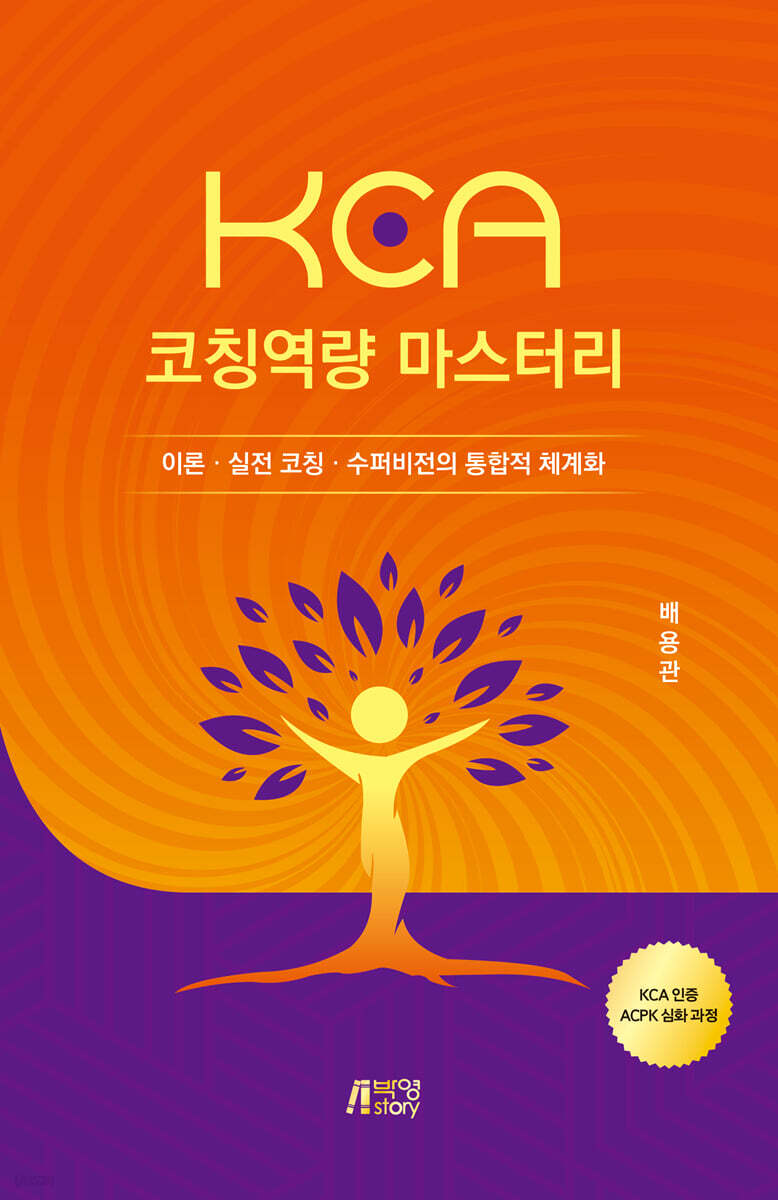
KCA Coaching Competency Mastery
 |
Description
Book Introduction
Although coaching has been introduced to Korea for over 20 years and over 15,000 coaches have been trained, many coaches still face the challenges of the gap between theory and practice, the lack of systematic training methods, and the practical internalization of coaching skills.
This book aims to establish coaching as a systematic and scientific professional field, rather than a simple conversational technique or collection of skills.
We present a new training paradigm that integrates theory, practice, and supervision, centered on the coaching competency system of the Korea Coaching Association (KCA).
This book aims to establish coaching as a systematic and scientific professional field, rather than a simple conversational technique or collection of skills.
We present a new training paradigm that integrates theory, practice, and supervision, centered on the coaching competency system of the Korea Coaching Association (KCA).
- You can preview some of the book's contents.
Preview
index
Introduction: 17 Basic Principles of Coaching Conversation Training
PART I
Systematic understanding and application of KCA coaching capabilities
Chapter 1: Understanding the Eight Coaching Competencies of KCA 43
Chapter 2: Practical Application of KCA Coaching Competencies 57
Chapter 3: Modeling Coaching Conversations and Application by Qualification 77
PART II
Practical Coaching Mastery
Chapter 4: Attitude and Language for Effective Coaching 95
Chapter 5: Core Coaching Skills Training 113
Chapter 6: Context-Specific Approach Strategies for Coaching Conversations 151
PART III
Supervision Mastery
Chapter 7: Theoretical Systematization of Coaching Training 187
Chapter 8: Sophisticated Semi-Structured Training 203
Chapter 9: Practical Supervision 235
Appendix 1: KCA Coaching Competencies vs. ICF Coaching Competencies 266
Appendix 2: KCA Coaching Competency Mastery: A New Path to Coach Growth 276
Reference 281
PART I
Systematic understanding and application of KCA coaching capabilities
Chapter 1: Understanding the Eight Coaching Competencies of KCA 43
Chapter 2: Practical Application of KCA Coaching Competencies 57
Chapter 3: Modeling Coaching Conversations and Application by Qualification 77
PART II
Practical Coaching Mastery
Chapter 4: Attitude and Language for Effective Coaching 95
Chapter 5: Core Coaching Skills Training 113
Chapter 6: Context-Specific Approach Strategies for Coaching Conversations 151
PART III
Supervision Mastery
Chapter 7: Theoretical Systematization of Coaching Training 187
Chapter 8: Sophisticated Semi-Structured Training 203
Chapter 9: Practical Supervision 235
Appendix 1: KCA Coaching Competencies vs. ICF Coaching Competencies 266
Appendix 2: KCA Coaching Competency Mastery: A New Path to Coach Growth 276
Reference 281
Publisher's Review
Coaching Conversation System: A New Perspective
Coaching conversations are not impromptu conversations.
Just as customer orders, recipes, ingredients, and cooking utensils work organically in a Chinese restaurant, a coaching conversation is also a goal-oriented system in which the customer situation, coaching conversation context, coaching techniques, and coaching language systematically interact.
This systems perspective allows us to understand coaching as an integrated and organic process, rather than a list of techniques.
UMP+AA+SA: A Systematic Capacity Development Model
The UMP+AA+SA model is proposed as a training principle for systematic development of coaching capabilities.
The UMP of Understanding, Memorization, and Practice is the stage for building fundamentals, while the AA stage of Analysis and Application develops the ability to discern and apply coaching techniques in various situations.
The SA stages of Synthesis and Application are the stages where you creatively integrate various models and techniques and reflect interactive dynamics to form your own coaching style.
Sophisticated Semi-Structured: A Fusion of Structured and Sophisticated Unstructured
To overcome the limitations of the structured approach of existing coaching conversation models, we propose the concept of ‘sophisticated semi-structured’.
This approach harmonizes structured frameworks with unstructured creativity. Inspired by the figure skating judging criteria, coaching competencies are trained by dividing them into competency elements (coaching skills) and dynamic elements (interaction).
Through this, you can lead a natural and dynamic conversation, as if you were 'dancing with the customer', based on systematic technology.
Integration of Practical Coaching Mastery and Practical Supervision Mastery
Ultimately, KCA Coaching Competency Mastery presents specific techniques for implementing KCA's eight coaching competencies in actual conversations and a differentiated coaching conversation model for each qualification, while Practical Supervision Mastery supports the growth of individual coaches through the systematic operation of mentor coaching, coach-the-coach, and coaching supervision.
Through organic integration of the two areas, we implement an ecosystem-based approach encompassing everything from individual coach competency development to qualitative improvement across the entire coaching field, and present a new professional development model that cyclically links theoretical learning with practical experience.
Through this, we aim to establish a foundation for sustainable development of Korean coaching.
I hope this book will be of practical help to all those studying coaching, and contribute to the creation of a healthy coaching ecosystem by enhancing the professionalism and qualitative advancement of the Korean coaching community.
Acknowledgements
I know better than anyone that this book could never have been completed by one person.
To the coaching clients and coaching training participants who shared the breath of the field with me, your questions, silences, and even the smallest expressions became the coordinates for my research.
I would also like to express my deepest gratitude to Professor Yoo Chung-yeol, my fellow professors, junior researchers, and alumni of the Department of Coaching at the Graduate School of Theological Seminary.
Passionate discussions and sharp feedback have solidified the framework of this manuscript and expanded my thinking further.
I would also like to express my gratitude to many officials and colleagues, including President Bae Jae-hoon of the Korea Coaching Association, and President Kim Eung-ja of the Korea Coaching Association, for their warm support.
The community-based companionship with the Dream Team (Director Young-Hwan Cho, Coach Seung-Cheon Kang, Coach Jeong-Ah Min, Coach Tae-Seung Ha) who are equipped with practical wisdom in the field of small and medium-sized business management coaching, the B-Avengers (Business Coaching Avengers) team who are preparing for the future of management coaching, the Su-Bengers (Supervision Avengers) team who are leading Coach the Coach and Mentor Coaching while encouraging transformational growth, and the Sa-Gun-Ja team gave me strong strength and deep inspiration to walk the journey of 'sophisticated semi-structured' to the end.
I am deeply grateful to the many leaders in the corporate world who have shown us their trust and support by joining us as partners in transforming organizational culture.
The trial and error and reflections along the way have brought vivid life to the examples and tools in this book.
This book was only possible thanks to the dedication and focus of the writing, editing, and design teams who stayed up all night and worked with us until the very last minute.
First and foremost, I would like to express my deepest gratitude to my family.
Without the warm support and generous sponsorship of my wife, Lee Sun-hee, my lovely granddaughter, a shining star and pretty genius, Bae Jae-yi, who always inspires me with her intelligence, and the interest and love of my eldest son and his wife, who quietly supported me and provided encouragement and warmth in my daily life, and the support of my younger son and his wife, who sent me warm encouragement from afar, this long-winded writing would not have been possible to complete.
I dedicate this book to my Father and Mother, who rest in peace in heaven, and I engrave their teachings and love as the light of my life.
And now, to the readers who have opened this book, I say:
This book is not a complete answer, but an invitation to deeper insight.
This book will be completed in your hands only when 'coaching skills' and 'interaction' dance together in your respective fields.
I sincerely congratulate you on your next step, and I hope that our journey together will lead to even greater change and growth.
- Gouljjang Bae Yong-kwan
Coaching conversations are not impromptu conversations.
Just as customer orders, recipes, ingredients, and cooking utensils work organically in a Chinese restaurant, a coaching conversation is also a goal-oriented system in which the customer situation, coaching conversation context, coaching techniques, and coaching language systematically interact.
This systems perspective allows us to understand coaching as an integrated and organic process, rather than a list of techniques.
UMP+AA+SA: A Systematic Capacity Development Model
The UMP+AA+SA model is proposed as a training principle for systematic development of coaching capabilities.
The UMP of Understanding, Memorization, and Practice is the stage for building fundamentals, while the AA stage of Analysis and Application develops the ability to discern and apply coaching techniques in various situations.
The SA stages of Synthesis and Application are the stages where you creatively integrate various models and techniques and reflect interactive dynamics to form your own coaching style.
Sophisticated Semi-Structured: A Fusion of Structured and Sophisticated Unstructured
To overcome the limitations of the structured approach of existing coaching conversation models, we propose the concept of ‘sophisticated semi-structured’.
This approach harmonizes structured frameworks with unstructured creativity. Inspired by the figure skating judging criteria, coaching competencies are trained by dividing them into competency elements (coaching skills) and dynamic elements (interaction).
Through this, you can lead a natural and dynamic conversation, as if you were 'dancing with the customer', based on systematic technology.
Integration of Practical Coaching Mastery and Practical Supervision Mastery
Ultimately, KCA Coaching Competency Mastery presents specific techniques for implementing KCA's eight coaching competencies in actual conversations and a differentiated coaching conversation model for each qualification, while Practical Supervision Mastery supports the growth of individual coaches through the systematic operation of mentor coaching, coach-the-coach, and coaching supervision.
Through organic integration of the two areas, we implement an ecosystem-based approach encompassing everything from individual coach competency development to qualitative improvement across the entire coaching field, and present a new professional development model that cyclically links theoretical learning with practical experience.
Through this, we aim to establish a foundation for sustainable development of Korean coaching.
I hope this book will be of practical help to all those studying coaching, and contribute to the creation of a healthy coaching ecosystem by enhancing the professionalism and qualitative advancement of the Korean coaching community.
Acknowledgements
I know better than anyone that this book could never have been completed by one person.
To the coaching clients and coaching training participants who shared the breath of the field with me, your questions, silences, and even the smallest expressions became the coordinates for my research.
I would also like to express my deepest gratitude to Professor Yoo Chung-yeol, my fellow professors, junior researchers, and alumni of the Department of Coaching at the Graduate School of Theological Seminary.
Passionate discussions and sharp feedback have solidified the framework of this manuscript and expanded my thinking further.
I would also like to express my gratitude to many officials and colleagues, including President Bae Jae-hoon of the Korea Coaching Association, and President Kim Eung-ja of the Korea Coaching Association, for their warm support.
The community-based companionship with the Dream Team (Director Young-Hwan Cho, Coach Seung-Cheon Kang, Coach Jeong-Ah Min, Coach Tae-Seung Ha) who are equipped with practical wisdom in the field of small and medium-sized business management coaching, the B-Avengers (Business Coaching Avengers) team who are preparing for the future of management coaching, the Su-Bengers (Supervision Avengers) team who are leading Coach the Coach and Mentor Coaching while encouraging transformational growth, and the Sa-Gun-Ja team gave me strong strength and deep inspiration to walk the journey of 'sophisticated semi-structured' to the end.
I am deeply grateful to the many leaders in the corporate world who have shown us their trust and support by joining us as partners in transforming organizational culture.
The trial and error and reflections along the way have brought vivid life to the examples and tools in this book.
This book was only possible thanks to the dedication and focus of the writing, editing, and design teams who stayed up all night and worked with us until the very last minute.
First and foremost, I would like to express my deepest gratitude to my family.
Without the warm support and generous sponsorship of my wife, Lee Sun-hee, my lovely granddaughter, a shining star and pretty genius, Bae Jae-yi, who always inspires me with her intelligence, and the interest and love of my eldest son and his wife, who quietly supported me and provided encouragement and warmth in my daily life, and the support of my younger son and his wife, who sent me warm encouragement from afar, this long-winded writing would not have been possible to complete.
I dedicate this book to my Father and Mother, who rest in peace in heaven, and I engrave their teachings and love as the light of my life.
And now, to the readers who have opened this book, I say:
This book is not a complete answer, but an invitation to deeper insight.
This book will be completed in your hands only when 'coaching skills' and 'interaction' dance together in your respective fields.
I sincerely congratulate you on your next step, and I hope that our journey together will lead to even greater change and growth.
- Gouljjang Bae Yong-kwan
GOODS SPECIFICS
- Date of issue: October 20, 2025
- Page count, weight, size: 284 pages | 171*244*20mm
- ISBN13: 9791172791759
- ISBN10: 1172791759
You may also like
카테고리
korean


korean

![GQ KOREA Mark (Monthly): December [2025]](http://librairie.coreenne.fr/cdn/shop/files/8ef265dbbfbf186523ed75ba7319009d.jpg?v=1765340328&width=3840)


