

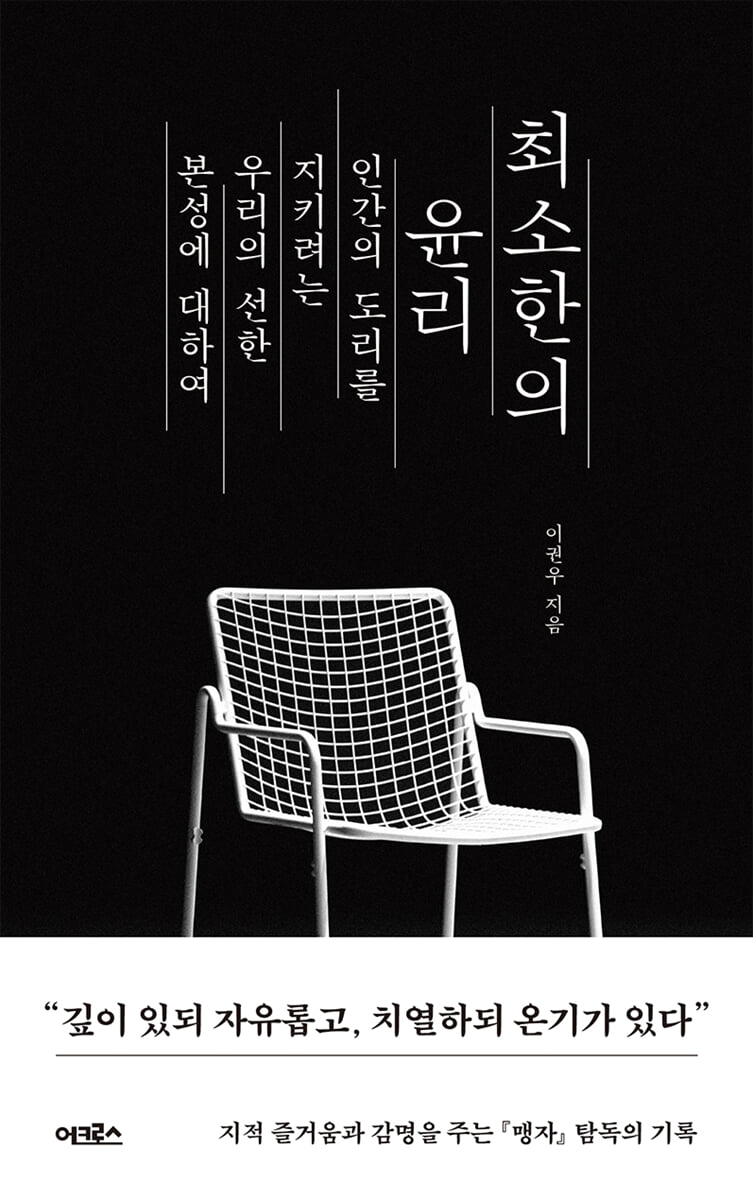
Minimum ethics
 |
Description
Book Introduction
Book critic Lee Kwon-woo, long respected for his in-depth reviews, has published a record of his voracious reading of Mencius during a time of chaos and crisis.
《Minimum Ethics》 draws its answer from the Eastern classic 《Mencius》 to the question of what we must not lose in order to uphold human morality in today's world where profit and desire are paramount.
During the Warring States period, 2,300 years ago when Mencius was active, war was a daily occurrence, power struggles between nations were constant, and even rulers were out to seek profit.
It is a mirror image of today's era, where the zeitgeist is dominated by profit values that encourage winner-take-all and limitless competition.
Mencius, who wanted to create a world where people can live together free from the fear of mutual destruction, advocated for the spirit of 'benevolence', that is, love and righteousness.
The author says that the minimum ethics we must possess to live as beings of relationships without succumbing to endless desires and self-interest are to protect our innate good nature, to cultivate and not lose the spirit of benevolence, and to expand that heart from ourselves to reach others.
This book meticulously weaves together the core themes of Mencius and contemporary concerns, and presents the values we should pursue through critical thinking.
Readers will be deeply moved and enjoy the intellectual richness that comes from reading a classic properly.
《Minimum Ethics》 draws its answer from the Eastern classic 《Mencius》 to the question of what we must not lose in order to uphold human morality in today's world where profit and desire are paramount.
During the Warring States period, 2,300 years ago when Mencius was active, war was a daily occurrence, power struggles between nations were constant, and even rulers were out to seek profit.
It is a mirror image of today's era, where the zeitgeist is dominated by profit values that encourage winner-take-all and limitless competition.
Mencius, who wanted to create a world where people can live together free from the fear of mutual destruction, advocated for the spirit of 'benevolence', that is, love and righteousness.
The author says that the minimum ethics we must possess to live as beings of relationships without succumbing to endless desires and self-interest are to protect our innate good nature, to cultivate and not lose the spirit of benevolence, and to expand that heart from ourselves to reach others.
This book meticulously weaves together the core themes of Mencius and contemporary concerns, and presents the values we should pursue through critical thinking.
Readers will be deeply moved and enjoy the intellectual richness that comes from reading a classic properly.
- You can preview some of the book's contents.
Preview
index
Opening Remarks: Towards a World of Coexistence Beyond Fear
How did King Yang Hye become a villain?
Why do you have to talk about profit, Your Majesty!
There is only benevolence
The first evolutionary philosopher of intellectual history
Four clues to how humans differ from animals
Politics of Profit and Politics of Virtue
The dictatorial 'Torai' can be replaced.
Philosophy of humanity and relationships
Was Mencius a socialist?
A new era doesn't come by itself.
A harder path than walking on a knife's edge
Controversy surrounding funerals
Is filial piety only about not disobeying your parents' wishes?
A disciple who attacks his master
A person who has shouldered the mission of the times
Studying to become a good and useful person
A simple life
Conclusion: The Star That Shined on Me
main
References
How did King Yang Hye become a villain?
Why do you have to talk about profit, Your Majesty!
There is only benevolence
The first evolutionary philosopher of intellectual history
Four clues to how humans differ from animals
Politics of Profit and Politics of Virtue
The dictatorial 'Torai' can be replaced.
Philosophy of humanity and relationships
Was Mencius a socialist?
A new era doesn't come by itself.
A harder path than walking on a knife's edge
Controversy surrounding funerals
Is filial piety only about not disobeying your parents' wishes?
A disciple who attacks his master
A person who has shouldered the mission of the times
Studying to become a good and useful person
A simple life
Conclusion: The Star That Shined on Me
main
References
Detailed image
Into the book
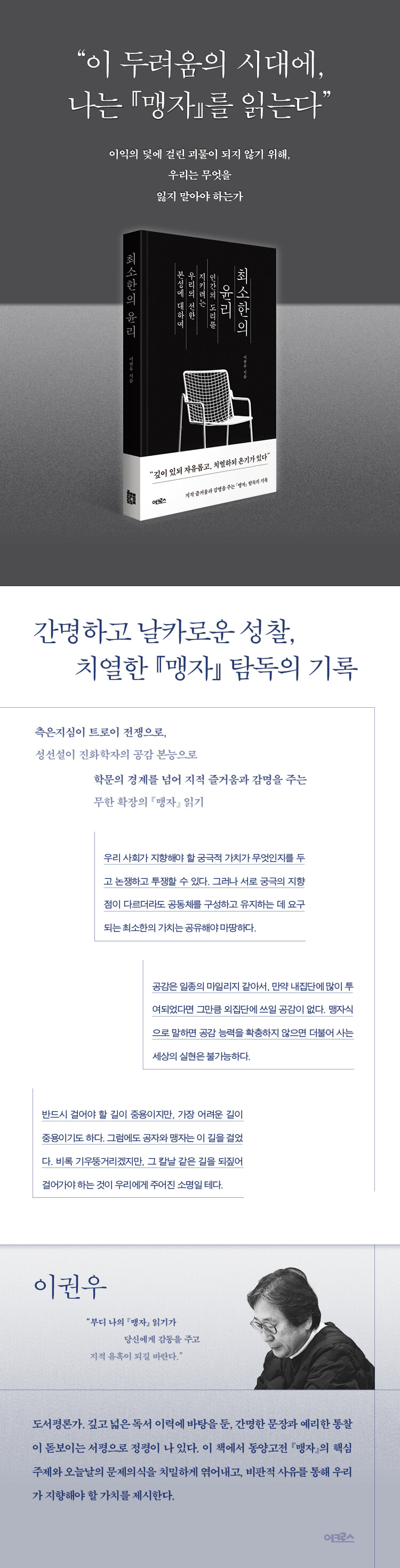
We can debate and fight over what ultimate values our society should pursue.
However, even if our ultimate goals are different, we must share the minimum values required to form and maintain a community.
Otherwise, there is a high probability that an ideological civil war will unfold.
The minimal ethics proposed by Mencius will serve as a stepping stone to overcome the crisis of mutual destruction we face today and move toward a world where we can live together.
--- From the "Opening Remarks"
The story of King Jeseon changing a cow into a sheep out of pity after seeing it tremble in fear, or the thought experiment of immediately picking up a child who crawled into a well without knowing anything, are similar to the emotional empathy that today's evolutionary scientists talk about, and they also agree with the claim that it is human nature.
So, don't dismiss Mencius as some stale, 2300-year-old nonsense or the idle talk of a desk-bound person.
--- From "The First Evolutionary Philosopher of the Intellectual History"
There is no right answer.
The important thing is to end the era of ontology that encourages infinite desire and reopen the world of relationalism.
Otherwise, we are destined to become the culprits of the sixth extinction.
Now, based on the human relations described in Mencius, let us consider what kind of relational virtues are needed in our time.
The newly established human relationships are the last emergency exit that can save me, my country, and humanity from a catastrophic crisis.
--- From "The Philosophy of Humanity and Relationships"
The path that must be taken is the middle path, but it is also the most difficult path.
This is because it is a steep and narrow path that can lead to extreme ruin if you take just one wrong step.
So, the lament arises, “The virtue of moderation is supreme, but it has long since disappeared from the world!”
Also, “it can make the world and the country equally fair.
You may not receive a title or salary.
You might step on a sharp blade.
However, the lament arises, “The life of moderation cannot be fully practiced!”
Nevertheless, Confucius and Mencius walked this path.
Even though it may be unsteady, it is our calling to retrace our steps along that sharp path.
However, even if our ultimate goals are different, we must share the minimum values required to form and maintain a community.
Otherwise, there is a high probability that an ideological civil war will unfold.
The minimal ethics proposed by Mencius will serve as a stepping stone to overcome the crisis of mutual destruction we face today and move toward a world where we can live together.
--- From the "Opening Remarks"
The story of King Jeseon changing a cow into a sheep out of pity after seeing it tremble in fear, or the thought experiment of immediately picking up a child who crawled into a well without knowing anything, are similar to the emotional empathy that today's evolutionary scientists talk about, and they also agree with the claim that it is human nature.
So, don't dismiss Mencius as some stale, 2300-year-old nonsense or the idle talk of a desk-bound person.
--- From "The First Evolutionary Philosopher of the Intellectual History"
There is no right answer.
The important thing is to end the era of ontology that encourages infinite desire and reopen the world of relationalism.
Otherwise, we are destined to become the culprits of the sixth extinction.
Now, based on the human relations described in Mencius, let us consider what kind of relational virtues are needed in our time.
The newly established human relationships are the last emergency exit that can save me, my country, and humanity from a catastrophic crisis.
--- From "The Philosophy of Humanity and Relationships"
The path that must be taken is the middle path, but it is also the most difficult path.
This is because it is a steep and narrow path that can lead to extreme ruin if you take just one wrong step.
So, the lament arises, “The virtue of moderation is supreme, but it has long since disappeared from the world!”
Also, “it can make the world and the country equally fair.
You may not receive a title or salary.
You might step on a sharp blade.
However, the lament arises, “The life of moderation cannot be fully practiced!”
Nevertheless, Confucius and Mencius walked this path.
Even though it may be unsteady, it is our calling to retrace our steps along that sharp path.
--- From "A Path More Difficult Than Walking on a Knife's Edge"
Publisher's Review
“In this age of fear, I read the Mencius.”
Book critic Lee Kwon-woo chronicles his profound and intense reading of Mencius.
Book critic Lee Kwon-woo, long respected for his in-depth reviews, has published a record of his voracious reading of Mencius during a time of chaos and crisis.
The new book, "Minimum Ethics," draws its answer from the Eastern classic, "Mencius," to the question: What must we not lose to uphold human morality in today's world, where profit and desire are paramount?
During the Warring States period, 2,300 years ago when Mencius was active, war was a daily occurrence and the struggle for hegemony between countries was constant.
As the coffers of the powerful overflowed with wealth, the shadows of poverty, hunger, and suffering fell upon the faces of the people.
The situation during the Warring States period, when even rulers were out to seek profit, mirrors the present day, when the zeitgeist has become centered on the values of profit, which encourage the winner to take all and limitless competition.
Mencius, who wanted to create a world where people can live together free from the fear of mutual destruction, advocated for the spirit of 'benevolence', that is, love and righteousness.
In this book, the author states that protecting our innate good nature and fostering a spirit of benevolence and righteousness, and expanding that heart from ourselves to reach others, is the minimum ethics we must possess to live as beings of relationships without succumbing to endless desires and self-interest.
This book meticulously weaves together the core themes of the Eastern classic Mencius with contemporary concerns, and, through critical thinking, presents the values we should pursue. It is an excellent example that vividly demonstrates why and how we should read the classics.
Readers who have been disappointed with the self-improvement style of reading classics based on trendy aphorisms will find that this book will allow them to fully experience what it means to read classics properly, based on broad and deep reading, and gain intellectual fulfillment and profound inspiration.
To uphold human morality,
To avoid becoming a monster caught in the trap of profit
We need the spirit of 'in-ui'
The core of the classics of Eastern philosophy is always placed at the forefront.
The core keywords of the Analects are ‘learning’ and ‘practice’, the core keywords of the Tao Te Ching are ‘the Way’, and the core keywords of the Zhuangzi are ‘transformation’.
So what is the core of the Mencius? To understand it, we must carefully examine the opening chapter, "King Hui of Liang."
The Liang Dynasty, originally called Wei, declined after being attacked by neighboring countries such as Jin, Zhao, and Qi, and moved its capital en masse, becoming known as the Liang Dynasty.
King Hui, who was in crisis, invited Mencius to ask him how to rebuild the country and restore its glory.
“What is the way to benefit my country?” At first glance, it seems like a question asking for a way to improve the lives of the people through a rich and strong country, but in reality, it is a question aimed solely at the king’s own benefit.
Mencius, who saw through this, speaks firmly.
“Why do you always talk about profit, Your Majesty!” When the king thinks about how to benefit his country, the ruling class thinks about how to benefit their own family, and the common people also look for ways to benefit themselves. If everyone puts their own interests first, the world will fall into greater chaos, he said bitterly to King Hui of Liang.
So what did Mencius advocate instead of profit? It was "benevolence," the spirit of love and righteousness.
'In' means loving parents and siblings, being true to oneself, considering one's own situation to understand others' situations, being considerate of others, and building relationships and harmony.
'Ui' means fulfilling one's role and duty, practicing righteousness, and correcting injustice.
The reason Mencius emphasized benevolence and righteousness was because the situation during the Warring States period in which Mencius lived was so urgent.
Confucius, who lived in the Spring and Autumn Period about 100 years before Mencius, emphasized 'benevolence'.
However, Mencius believed that 'humanity' alone could not overcome the world's crisis.
The struggle for hegemony among the seven feudal states during the Warring States period reached its peak, and the lives of the people fell into even more misery.
Mencius expressed his despair by saying, “I am afraid of this situation (吾爲此懼),” and with a desperate feeling that he could not lose even this, he put forward the alternative of ‘benevolence’.
The author diagnoses that we are facing a crisis today no less severe than that of the Warring States Period.
Inequality is deepening, war threatens our lives directly and indirectly, and the climate crisis is heading towards catastrophe.
Despite this situation, people are busy enjoying the abundance right in front of them.
The author emphasizes that to overcome today's crisis, which mirrors the chaotic Warring States period, we must seek the path from Mencius, who, despite trembling with fear, presented an alternative called benevolence and righteousness.
Compassion led to the Trojan War,
The theory of human nature is an evolutionary scientist's instinct for empathy.
Reading Mencius, an infinitely expansive text that transcends academic boundaries
The author has been active as a book critic for 30 years since serving as the editor-in-chief of the book review magazine Publishing Journal. Through his extensive reading and solid book reviews across a wide range of fields, including literature, philosophy, history, politics and society, and even science, he has built trust in the publishing and media industries for a long time.
Jeong Eun-sook, CEO of Maumsanchaek, said of his writing, “His praise and criticism always have a valid basis.
He said that it has the characteristics of good writing that is easy, concise, and persuasive, saying, “It speaks honestly, almost as if whispering, without resorting to particularly complex rhetoric or whimsy.” (From the recommendation for “Living and Learning with Books,” by Lee Kwon-woo)
The author's writing, based on his broad and deep reading, stands out for its expansiveness and freedom, not confined by academic boundaries.
This is exactly the case when Mencius is referred to as 'the first evolutionary philosopher in the history of human intellect.'
Mencius said that if anyone happened to see a child crawling into a well without knowing it, they would feel compassion and try to save the child.
He also advocated the theory of human nature, which states that everyone has the heart to not ignore someone else's suffering.
In this section, the author reminds us that today's evolutionary scientists, such as Frans de Waal and Jang Dae-ik, have revealed through various studies, including mirror neurons, that empathy is a human instinct for human prosperity, and argues that Mencius's theory of human nature being good is not different from the empathy instinct of evolutionary scientists.
The author's 'crossing of the line' does not stop here.
Mencius spoke of expansion, that is, the idea that good nature should not be confined to oneself and one's family, but should extend to others.
I was tempted to connect this to what evolutionary scientist Jang Dae-ik called "cognitive empathy" (the ability to understand another person's perspective and put oneself in their shoes), but then I was transported to a scene from the Greek classic "Iliad."
The author sees the scene where Achilles, who was consumed by anger and revenge and had Hector's body dragged by his chariot, gives Hector's body to Priam upon hearing the plea of Hector's father, Priam, and thinking of his own father back home, as a manifestation of the 'expansion' Mencius spoke of.
By referring to complete translations and commentaries of Mencius, the author actively embraces the meaning of the original text and various interpretations, while connecting it with Eastern and Western classics and various educational books, leading readers to a richer reading experience.
Through the author's method of reading that transcends the boundaries of time, space, and academia, readers will be able to satisfy their intellectual curiosity and experience a whole new pleasure in reading classics.
Book critic Lee Kwon-woo chronicles his profound and intense reading of Mencius.
Book critic Lee Kwon-woo, long respected for his in-depth reviews, has published a record of his voracious reading of Mencius during a time of chaos and crisis.
The new book, "Minimum Ethics," draws its answer from the Eastern classic, "Mencius," to the question: What must we not lose to uphold human morality in today's world, where profit and desire are paramount?
During the Warring States period, 2,300 years ago when Mencius was active, war was a daily occurrence and the struggle for hegemony between countries was constant.
As the coffers of the powerful overflowed with wealth, the shadows of poverty, hunger, and suffering fell upon the faces of the people.
The situation during the Warring States period, when even rulers were out to seek profit, mirrors the present day, when the zeitgeist has become centered on the values of profit, which encourage the winner to take all and limitless competition.
Mencius, who wanted to create a world where people can live together free from the fear of mutual destruction, advocated for the spirit of 'benevolence', that is, love and righteousness.
In this book, the author states that protecting our innate good nature and fostering a spirit of benevolence and righteousness, and expanding that heart from ourselves to reach others, is the minimum ethics we must possess to live as beings of relationships without succumbing to endless desires and self-interest.
This book meticulously weaves together the core themes of the Eastern classic Mencius with contemporary concerns, and, through critical thinking, presents the values we should pursue. It is an excellent example that vividly demonstrates why and how we should read the classics.
Readers who have been disappointed with the self-improvement style of reading classics based on trendy aphorisms will find that this book will allow them to fully experience what it means to read classics properly, based on broad and deep reading, and gain intellectual fulfillment and profound inspiration.
To uphold human morality,
To avoid becoming a monster caught in the trap of profit
We need the spirit of 'in-ui'
The core of the classics of Eastern philosophy is always placed at the forefront.
The core keywords of the Analects are ‘learning’ and ‘practice’, the core keywords of the Tao Te Ching are ‘the Way’, and the core keywords of the Zhuangzi are ‘transformation’.
So what is the core of the Mencius? To understand it, we must carefully examine the opening chapter, "King Hui of Liang."
The Liang Dynasty, originally called Wei, declined after being attacked by neighboring countries such as Jin, Zhao, and Qi, and moved its capital en masse, becoming known as the Liang Dynasty.
King Hui, who was in crisis, invited Mencius to ask him how to rebuild the country and restore its glory.
“What is the way to benefit my country?” At first glance, it seems like a question asking for a way to improve the lives of the people through a rich and strong country, but in reality, it is a question aimed solely at the king’s own benefit.
Mencius, who saw through this, speaks firmly.
“Why do you always talk about profit, Your Majesty!” When the king thinks about how to benefit his country, the ruling class thinks about how to benefit their own family, and the common people also look for ways to benefit themselves. If everyone puts their own interests first, the world will fall into greater chaos, he said bitterly to King Hui of Liang.
So what did Mencius advocate instead of profit? It was "benevolence," the spirit of love and righteousness.
'In' means loving parents and siblings, being true to oneself, considering one's own situation to understand others' situations, being considerate of others, and building relationships and harmony.
'Ui' means fulfilling one's role and duty, practicing righteousness, and correcting injustice.
The reason Mencius emphasized benevolence and righteousness was because the situation during the Warring States period in which Mencius lived was so urgent.
Confucius, who lived in the Spring and Autumn Period about 100 years before Mencius, emphasized 'benevolence'.
However, Mencius believed that 'humanity' alone could not overcome the world's crisis.
The struggle for hegemony among the seven feudal states during the Warring States period reached its peak, and the lives of the people fell into even more misery.
Mencius expressed his despair by saying, “I am afraid of this situation (吾爲此懼),” and with a desperate feeling that he could not lose even this, he put forward the alternative of ‘benevolence’.
The author diagnoses that we are facing a crisis today no less severe than that of the Warring States Period.
Inequality is deepening, war threatens our lives directly and indirectly, and the climate crisis is heading towards catastrophe.
Despite this situation, people are busy enjoying the abundance right in front of them.
The author emphasizes that to overcome today's crisis, which mirrors the chaotic Warring States period, we must seek the path from Mencius, who, despite trembling with fear, presented an alternative called benevolence and righteousness.
Compassion led to the Trojan War,
The theory of human nature is an evolutionary scientist's instinct for empathy.
Reading Mencius, an infinitely expansive text that transcends academic boundaries
The author has been active as a book critic for 30 years since serving as the editor-in-chief of the book review magazine Publishing Journal. Through his extensive reading and solid book reviews across a wide range of fields, including literature, philosophy, history, politics and society, and even science, he has built trust in the publishing and media industries for a long time.
Jeong Eun-sook, CEO of Maumsanchaek, said of his writing, “His praise and criticism always have a valid basis.
He said that it has the characteristics of good writing that is easy, concise, and persuasive, saying, “It speaks honestly, almost as if whispering, without resorting to particularly complex rhetoric or whimsy.” (From the recommendation for “Living and Learning with Books,” by Lee Kwon-woo)
The author's writing, based on his broad and deep reading, stands out for its expansiveness and freedom, not confined by academic boundaries.
This is exactly the case when Mencius is referred to as 'the first evolutionary philosopher in the history of human intellect.'
Mencius said that if anyone happened to see a child crawling into a well without knowing it, they would feel compassion and try to save the child.
He also advocated the theory of human nature, which states that everyone has the heart to not ignore someone else's suffering.
In this section, the author reminds us that today's evolutionary scientists, such as Frans de Waal and Jang Dae-ik, have revealed through various studies, including mirror neurons, that empathy is a human instinct for human prosperity, and argues that Mencius's theory of human nature being good is not different from the empathy instinct of evolutionary scientists.
The author's 'crossing of the line' does not stop here.
Mencius spoke of expansion, that is, the idea that good nature should not be confined to oneself and one's family, but should extend to others.
I was tempted to connect this to what evolutionary scientist Jang Dae-ik called "cognitive empathy" (the ability to understand another person's perspective and put oneself in their shoes), but then I was transported to a scene from the Greek classic "Iliad."
The author sees the scene where Achilles, who was consumed by anger and revenge and had Hector's body dragged by his chariot, gives Hector's body to Priam upon hearing the plea of Hector's father, Priam, and thinking of his own father back home, as a manifestation of the 'expansion' Mencius spoke of.
By referring to complete translations and commentaries of Mencius, the author actively embraces the meaning of the original text and various interpretations, while connecting it with Eastern and Western classics and various educational books, leading readers to a richer reading experience.
Through the author's method of reading that transcends the boundaries of time, space, and academia, readers will be able to satisfy their intellectual curiosity and experience a whole new pleasure in reading classics.
GOODS SPECIFICS
- Date of issue: September 17, 2025
- Page count, weight, size: 260 pages | 398g | 135*215*17mm
- ISBN13: 9791167742353
You may also like
카테고리
korean


korean

![GQ KOREA Mark (Monthly): December [2025]](http://librairie.coreenne.fr/cdn/shop/files/8ef265dbbfbf186523ed75ba7319009d.jpg?v=1765340328&width=3840)


