

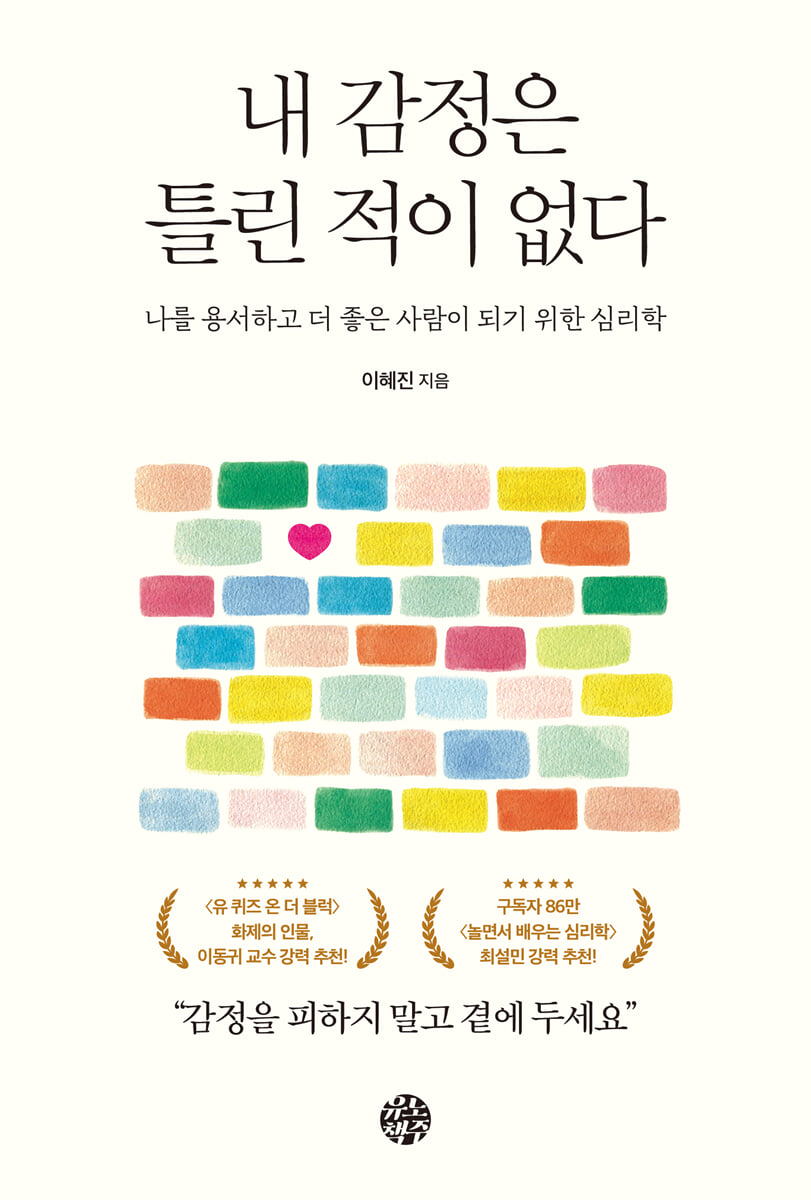
My feelings are never wrong
 |
Description
Book Introduction
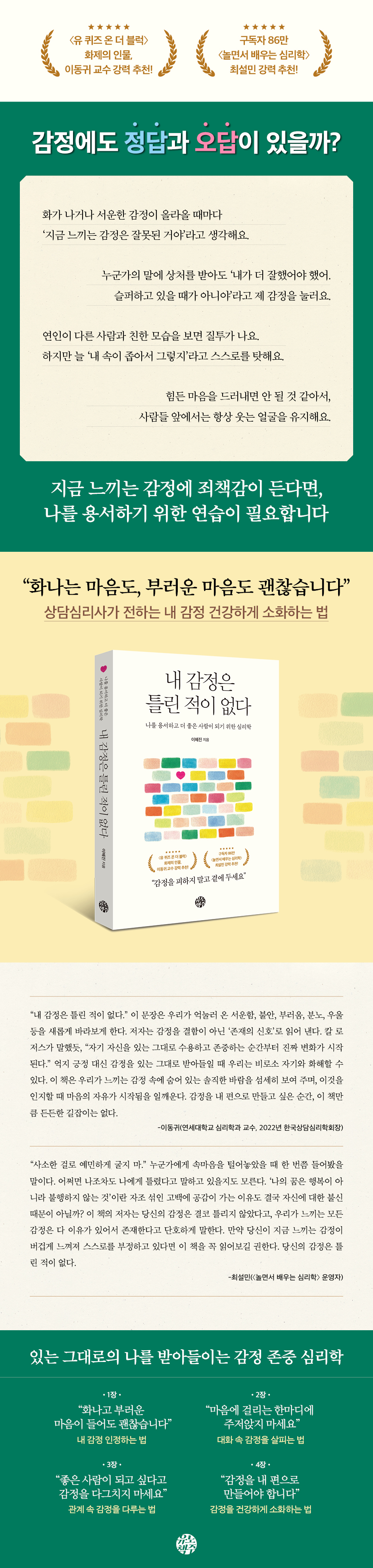
Strongly recommend Lee Dong-gwi, the hot topic on "You Quiz on the Block"!
Choi Seol-min highly recommends "Psychology Through Play"!
“It’s okay to feel angry or envious.”
How to Digest All Emotions Healthily
We are stingy with regret, anxiety, envy, anger, and depression.
This is because we have been taught since childhood that these emotions should be suppressed and not expressed.
However, the author, who has been comforting the hearts of clients for 14 years, asserts:
“Your feelings are never wrong.” This book is based on the author’s own experiences and the stories of clients who are confused by their inability to properly understand their emotions or who blame themselves for feeling such emotions.
It doesn't stop there, but it also presents questions you can ask yourself when you feel such emotions.
Rather than feeling guilty about your emotions, it teaches you how to accept them as they are and face them.
These days, young people live their lives with a set ‘correct answer’ even when it comes to emotions.
If you deviate from that standard, you immediately blame yourself and ask, 'Am I weird?'
When sadness comes, we empathize with the characters in the drama, shed tears, and sympathize, but we actually control our own emotions by saying things like, “You shouldn’t feel this way,” “This is an inappropriate emotion,” “You shouldn’t get angry over something so trivial,” and “Why are you so sensitive about such trivial things?”
These are the words that clients often bring up in the counseling room.
In the end, you end up treating each and every emotion as a 'wrong answer' and pushing yourself.
"My Feelings Are Never Wrong" teaches us how to embrace our emotions rather than avoid them.
It covers everything from how to face your feelings that you often hide from others, to how to examine the subtle emotions hidden in conversation, to how to deal with the emotions you keep suppressing because you want to be a good person, and finally, how to make all your emotions your own without erasing them.
This book delivers a message to those who have hated themselves for the emotions they felt: "It's time to forgive myself."
It emphasizes that emotions are just emotions, and that there are no right or wrong emotions.
The author says that emotions are signals that tell us about our current state.
Distraction isn't a problem that's bothering me, it's that I'm confused because I can't prioritize.
If someone keeps bothering you, it may be because you see flaws in them.
Let's not miss this moment and listen to what our hearts want and what they are saying right now.
This book will help me speak to my emotions and, more broadly, become a starting point for making peace with myself.
Choi Seol-min highly recommends "Psychology Through Play"!
“It’s okay to feel angry or envious.”
How to Digest All Emotions Healthily
We are stingy with regret, anxiety, envy, anger, and depression.
This is because we have been taught since childhood that these emotions should be suppressed and not expressed.
However, the author, who has been comforting the hearts of clients for 14 years, asserts:
“Your feelings are never wrong.” This book is based on the author’s own experiences and the stories of clients who are confused by their inability to properly understand their emotions or who blame themselves for feeling such emotions.
It doesn't stop there, but it also presents questions you can ask yourself when you feel such emotions.
Rather than feeling guilty about your emotions, it teaches you how to accept them as they are and face them.
These days, young people live their lives with a set ‘correct answer’ even when it comes to emotions.
If you deviate from that standard, you immediately blame yourself and ask, 'Am I weird?'
When sadness comes, we empathize with the characters in the drama, shed tears, and sympathize, but we actually control our own emotions by saying things like, “You shouldn’t feel this way,” “This is an inappropriate emotion,” “You shouldn’t get angry over something so trivial,” and “Why are you so sensitive about such trivial things?”
These are the words that clients often bring up in the counseling room.
In the end, you end up treating each and every emotion as a 'wrong answer' and pushing yourself.
"My Feelings Are Never Wrong" teaches us how to embrace our emotions rather than avoid them.
It covers everything from how to face your feelings that you often hide from others, to how to examine the subtle emotions hidden in conversation, to how to deal with the emotions you keep suppressing because you want to be a good person, and finally, how to make all your emotions your own without erasing them.
This book delivers a message to those who have hated themselves for the emotions they felt: "It's time to forgive myself."
It emphasizes that emotions are just emotions, and that there are no right or wrong emotions.
The author says that emotions are signals that tell us about our current state.
Distraction isn't a problem that's bothering me, it's that I'm confused because I can't prioritize.
If someone keeps bothering you, it may be because you see flaws in them.
Let's not miss this moment and listen to what our hearts want and what they are saying right now.
This book will help me speak to my emotions and, more broadly, become a starting point for making peace with myself.
- You can preview some of the book's contents.
Preview
index
Prologue: Respect all your feelings.
Chapter 1: "It's Okay to Feel Angry and Envious" / How to Acknowledge Your Feelings
The illusion that emotions contain the answer
When you can't concentrate, start by examining your emotions.
There are feelings that cannot be spoken of freely.
Why Feeling Left Behind Leaves a Wound
Other people can't understand me 100 percent.
How to Respect Your Emotions to Not Lose Yourself
There are no right or wrong feelings.
Why emotions suddenly arise even from small stimuli
Chapter 2: "Don't Be Hesitant About a Word That Triggers You" / How to Detect Emotions in Conversation
Why we hold back what we want to say
How to Deal with People Who Point Out Things as Quickly as They Breathe
Gaslighting Signals Flowing Through Conversations
If it seems like only my words are being ignored
When it feels like someone is talking about me behind my back
How to use the 'Pause' button
What You Need to Know If You Don't Want to Cry When You're Drunk
If you don't want your mood to become your attitude
Emotions remember the past
Chapter 3: "Don't Squeeze Your Emotions to Be a Good Person" / How to Handle Emotions in Relationships
Why would you hurt someone who is family?
Don't obsess over being 'close'
The feelings that come after an encounter determine the relationship.
Why are we afraid of missing meetings?
How to Control Envy and Jealousy
The illusion of 'people similar to me'
The Secret Hidden Between Similarity and Difference
The reason why that person is particularly annoying
How to Deal with Uncomfortable Relationships
It's okay to want to keep your distance
The one most important condition when loving
Chapter 4: "Make Your Emotions Your Ally" / How to Digest Your Emotions Healthily
Finding My 'Core Emotion'
When the world feels colder, check your fatigue level.
If I feel jealous without realizing it,
Things Change When I Acknowledge My Feelings
“It’s hard to see that person doing well.”
The art of attracting attention from others
Distinguishing Between Emotions That Help Me Grow and Emotions That Put Me Down
A calm attitude toward living with emotions
Emotional Release Practice
Let's simply acknowledge that we might be anxious.
We are getting better
References
Chapter 1: "It's Okay to Feel Angry and Envious" / How to Acknowledge Your Feelings
The illusion that emotions contain the answer
When you can't concentrate, start by examining your emotions.
There are feelings that cannot be spoken of freely.
Why Feeling Left Behind Leaves a Wound
Other people can't understand me 100 percent.
How to Respect Your Emotions to Not Lose Yourself
There are no right or wrong feelings.
Why emotions suddenly arise even from small stimuli
Chapter 2: "Don't Be Hesitant About a Word That Triggers You" / How to Detect Emotions in Conversation
Why we hold back what we want to say
How to Deal with People Who Point Out Things as Quickly as They Breathe
Gaslighting Signals Flowing Through Conversations
If it seems like only my words are being ignored
When it feels like someone is talking about me behind my back
How to use the 'Pause' button
What You Need to Know If You Don't Want to Cry When You're Drunk
If you don't want your mood to become your attitude
Emotions remember the past
Chapter 3: "Don't Squeeze Your Emotions to Be a Good Person" / How to Handle Emotions in Relationships
Why would you hurt someone who is family?
Don't obsess over being 'close'
The feelings that come after an encounter determine the relationship.
Why are we afraid of missing meetings?
How to Control Envy and Jealousy
The illusion of 'people similar to me'
The Secret Hidden Between Similarity and Difference
The reason why that person is particularly annoying
How to Deal with Uncomfortable Relationships
It's okay to want to keep your distance
The one most important condition when loving
Chapter 4: "Make Your Emotions Your Ally" / How to Digest Your Emotions Healthily
Finding My 'Core Emotion'
When the world feels colder, check your fatigue level.
If I feel jealous without realizing it,
Things Change When I Acknowledge My Feelings
“It’s hard to see that person doing well.”
The art of attracting attention from others
Distinguishing Between Emotions That Help Me Grow and Emotions That Put Me Down
A calm attitude toward living with emotions
Emotional Release Practice
Let's simply acknowledge that we might be anxious.
We are getting better
References
Detailed image
Into the book
Heejung said that when she sees someone eating tteokbokki while watching a video, she unconsciously orders tteokbokki.
Only after eating like that do I see the ingredients I had bought in the fridge and realize that I was swayed by something again.
It may seem like a momentary impulse because it was an unplanned action, but in fact, that desire may have been inside me from the beginning.
It's just that a desire that had not risen to the surface of the water was 'turned on' by some stimulus.
In times like these, rather than feeling guilty, I examine what stimuli I easily react to.
(Omitted) What stimulus is before my eyes at this very moment? There's a high probability that this stimulus will touch my emotions at any moment.
--- From "Why emotions suddenly arise even from small stimuli"
Many people, when their emotions explode, pour out their feelings in words.
But most of those words leave us with regrets.
In severe cases, those words can even end the relationship.
Expressing one's feelings also means expressing them verbally.
We know all too well that those words cannot be taken back.
If you decide to practice 'pause', you must first resist the urge to pull something out right away.
Let's use that moment as a time to sort out our emotions.
This is especially true if the person in front of me is someone I value.
Instead of throwing out my emotions, I first sort out my own.
Only after I calm my mind like that can I clearly see what I really want to say and what my intentions are.
When I can protect my own emotions, I can also protect my precious relationships.
--- From "How to Use the 'Pause' Button"
When you look at social media, you unconsciously compare yourself to others.
Then, my gaze goes to ‘people who are similar to me but live a better life.’
Why do I keep irritating that person? (Omitted) Since the Paleolithic era, humans have likely sat around a campfire, chatted, compared each other, and been envious or jealous of each other.
Because forming social hierarchies, deciding who to cooperate with, and who will have more resources were important factors for survival and group living.
Comparing your mother's friend's son, your mother's friend's daughter, or your cousin's cousin during holidays like Chuseok and Seollal is in the same vein.
As information technology developed, comparisons moved into the Internet space.
--- From "How to Control Envy and Jealousy"
A asked B, “Did I attack you directly?” and then answered himself, “No.”
He then asked B, “Did I directly criticize you?” and then replied, “No.
“I never once attacked or criticized you,” he replied to himself.
Then B quietly replied to A, “You always talk nonsense.” A got angry and said, “You misunderstood, didn’t you? Do you admit that you misunderstood? (Suddenly speaking formally) Listen.
Just look at the facts.
“Did the other person have any intention of attacking?” he asked, and answered alone, “No.”
B said no more.
(Omitted) This kind of scene is actually not that rare.
This is a common conversation among many couples and close friends.
They say there is no one who has criticized, but there are people who have been criticized.
Why does this happen so often?
Only after eating like that do I see the ingredients I had bought in the fridge and realize that I was swayed by something again.
It may seem like a momentary impulse because it was an unplanned action, but in fact, that desire may have been inside me from the beginning.
It's just that a desire that had not risen to the surface of the water was 'turned on' by some stimulus.
In times like these, rather than feeling guilty, I examine what stimuli I easily react to.
(Omitted) What stimulus is before my eyes at this very moment? There's a high probability that this stimulus will touch my emotions at any moment.
--- From "Why emotions suddenly arise even from small stimuli"
Many people, when their emotions explode, pour out their feelings in words.
But most of those words leave us with regrets.
In severe cases, those words can even end the relationship.
Expressing one's feelings also means expressing them verbally.
We know all too well that those words cannot be taken back.
If you decide to practice 'pause', you must first resist the urge to pull something out right away.
Let's use that moment as a time to sort out our emotions.
This is especially true if the person in front of me is someone I value.
Instead of throwing out my emotions, I first sort out my own.
Only after I calm my mind like that can I clearly see what I really want to say and what my intentions are.
When I can protect my own emotions, I can also protect my precious relationships.
--- From "How to Use the 'Pause' Button"
When you look at social media, you unconsciously compare yourself to others.
Then, my gaze goes to ‘people who are similar to me but live a better life.’
Why do I keep irritating that person? (Omitted) Since the Paleolithic era, humans have likely sat around a campfire, chatted, compared each other, and been envious or jealous of each other.
Because forming social hierarchies, deciding who to cooperate with, and who will have more resources were important factors for survival and group living.
Comparing your mother's friend's son, your mother's friend's daughter, or your cousin's cousin during holidays like Chuseok and Seollal is in the same vein.
As information technology developed, comparisons moved into the Internet space.
--- From "How to Control Envy and Jealousy"
A asked B, “Did I attack you directly?” and then answered himself, “No.”
He then asked B, “Did I directly criticize you?” and then replied, “No.
“I never once attacked or criticized you,” he replied to himself.
Then B quietly replied to A, “You always talk nonsense.” A got angry and said, “You misunderstood, didn’t you? Do you admit that you misunderstood? (Suddenly speaking formally) Listen.
Just look at the facts.
“Did the other person have any intention of attacking?” he asked, and answered alone, “No.”
B said no more.
(Omitted) This kind of scene is actually not that rare.
This is a common conversation among many couples and close friends.
They say there is no one who has criticized, but there are people who have been criticized.
Why does this happen so often?
--- From "The One Condition Most Necessary When Loving"
Publisher's Review
“My feelings are never wrong.” This sentence allows us to look at the resentment, anxiety, envy, anger, depression, etc. that we have suppressed in a new way.
The author reads emotions as 'signs of existence' rather than flaws.
As Carl Rogers said, “Real change begins the moment you accept and respect yourself as you are.” Only when we accept our emotions as they are, instead of forcing positivity, can we truly make peace with ourselves.
This book delicately reveals the honest desires hidden within the emotions we feel, and reminds us that freedom of the heart begins when we recognize this.
When you want to turn your emotions to your side, there's no guide as solid as this book.
Lee Dong-gwi (Professor of Psychology, Yonsei University, 2022 President of the Korean Counseling Psychology Association)
“Don’t be so sensitive about little things.” You’ve probably heard this at least once when you’ve confided in someone.
Maybe even I am telling myself that I am wrong.
Perhaps the reason we resonate with the self-deprecating confession, "My dream is not happiness, but not to be unhappy," stems ultimately from self-distrust. The author of this book firmly asserts that your feelings are never wrong, that every emotion we feel exists for a reason.
If you are feeling overwhelmed by the emotions you are feeling right now and are denying yourself, I highly recommend reading this book.
Your feelings are never wrong.
-Choi Seol-min (operator of the YouTube channel "Learn Psychology While Playing")
Client A appears to be a bright and cheerful person who never gets angry.
He always has a smiling face and has good relationships with people around him.
People often say to Mr. A, “I’ve never seen you angry before,” or “Are you sure you’re okay?”
So, is Mr. A truly incapable of feeling anger or envy? In fact, Mr. A simply cannot express what are considered "bad emotions."
When I'm with people, I pretend to be okay, but when I get home, I'm tormented by my pent-up emotions.
Like everyone else, I get angry, depressed, and envious.
However, Mr. A is afraid that people will leave him if he expresses such feelings, and he considers feeling such feelings to be 'wrong'.
So I'm going to press it down and try to erase it completely.
We are no different from Mr. A.
We try to keep only 'good emotions' like joy, happiness, and excitement, and ignore emotions like sadness, anger, and jealousy.
However, the author warns that pursuing forced positivity can make life empty.
Emotions are merely signals that tell us about our current state, and are not concepts that can be divided into good or bad.
Yet, we try to define right and wrong in our own emotions and force ourselves to fit those standards.
This attitude only eats away at us.
The author has spent 14 years examining the hearts of countless clients and redefining the emotions we find uncomfortable.
We talk about how to handle all emotions in a healthy way, from how to face them, to how to deal with the subtle emotions that flow in relationships and conversations, to how to turn emotions on your side.
In addition, it presents various questions you can ask yourself when you feel guilty about the emotions you are currently feeling.
This gives me an opportunity to have an honest conversation with my heart.
“There are no right or wrong answers when it comes to emotions.”
Emotional Respect Psychology: Understanding and Forgiving Me
《My Emotions Are Never Wrong》 consists of four chapters and guides you through the process of understanding and dealing with emotions.
Chapter 1 talks about how to acknowledge and accept feelings we often consider “negative” such as sadness, anxiety, anger, and depression.
It tells us that emotions are not things to be suppressed or suppressed, but signals to be looked at and respected.
Chapter 2 explores how to capture and handle the subtle emotions that pass by in conversations with others.
Let's think together about how to overcome moments when we are hurt by others' words and regret what we said.
Chapter 3 tells the story of people who suppress their emotions in order to become 'good people'.
For those who are too busy meeting the expectations of others to take care of their own feelings, this book offers suggestions on how to express your emotions while protecting yourself in relationships.
Chapter 4 covers how to make your emotions your ally rather than your enemy and how to live with them.
Ultimately, it tells us that emotions are not something to be suppressed, but rather friends who help us understand ourselves more deeply.
The author says that emotions enable us to change and grow.
Change begins when you feel so uncomfortable that you can't stand it without changing something.
Envy toward someone leads to a determination to live harder tomorrow, and by facing the sadness we feel now, we become more mature.
The only one who can change me is myself.
Let's listen to what emotions I'm feeling right now and what they're trying to tell me.
The secret to making a better me is hidden within it.
The author reads emotions as 'signs of existence' rather than flaws.
As Carl Rogers said, “Real change begins the moment you accept and respect yourself as you are.” Only when we accept our emotions as they are, instead of forcing positivity, can we truly make peace with ourselves.
This book delicately reveals the honest desires hidden within the emotions we feel, and reminds us that freedom of the heart begins when we recognize this.
When you want to turn your emotions to your side, there's no guide as solid as this book.
Lee Dong-gwi (Professor of Psychology, Yonsei University, 2022 President of the Korean Counseling Psychology Association)
“Don’t be so sensitive about little things.” You’ve probably heard this at least once when you’ve confided in someone.
Maybe even I am telling myself that I am wrong.
Perhaps the reason we resonate with the self-deprecating confession, "My dream is not happiness, but not to be unhappy," stems ultimately from self-distrust. The author of this book firmly asserts that your feelings are never wrong, that every emotion we feel exists for a reason.
If you are feeling overwhelmed by the emotions you are feeling right now and are denying yourself, I highly recommend reading this book.
Your feelings are never wrong.
-Choi Seol-min (operator of the YouTube channel "Learn Psychology While Playing")
Client A appears to be a bright and cheerful person who never gets angry.
He always has a smiling face and has good relationships with people around him.
People often say to Mr. A, “I’ve never seen you angry before,” or “Are you sure you’re okay?”
So, is Mr. A truly incapable of feeling anger or envy? In fact, Mr. A simply cannot express what are considered "bad emotions."
When I'm with people, I pretend to be okay, but when I get home, I'm tormented by my pent-up emotions.
Like everyone else, I get angry, depressed, and envious.
However, Mr. A is afraid that people will leave him if he expresses such feelings, and he considers feeling such feelings to be 'wrong'.
So I'm going to press it down and try to erase it completely.
We are no different from Mr. A.
We try to keep only 'good emotions' like joy, happiness, and excitement, and ignore emotions like sadness, anger, and jealousy.
However, the author warns that pursuing forced positivity can make life empty.
Emotions are merely signals that tell us about our current state, and are not concepts that can be divided into good or bad.
Yet, we try to define right and wrong in our own emotions and force ourselves to fit those standards.
This attitude only eats away at us.
The author has spent 14 years examining the hearts of countless clients and redefining the emotions we find uncomfortable.
We talk about how to handle all emotions in a healthy way, from how to face them, to how to deal with the subtle emotions that flow in relationships and conversations, to how to turn emotions on your side.
In addition, it presents various questions you can ask yourself when you feel guilty about the emotions you are currently feeling.
This gives me an opportunity to have an honest conversation with my heart.
“There are no right or wrong answers when it comes to emotions.”
Emotional Respect Psychology: Understanding and Forgiving Me
《My Emotions Are Never Wrong》 consists of four chapters and guides you through the process of understanding and dealing with emotions.
Chapter 1 talks about how to acknowledge and accept feelings we often consider “negative” such as sadness, anxiety, anger, and depression.
It tells us that emotions are not things to be suppressed or suppressed, but signals to be looked at and respected.
Chapter 2 explores how to capture and handle the subtle emotions that pass by in conversations with others.
Let's think together about how to overcome moments when we are hurt by others' words and regret what we said.
Chapter 3 tells the story of people who suppress their emotions in order to become 'good people'.
For those who are too busy meeting the expectations of others to take care of their own feelings, this book offers suggestions on how to express your emotions while protecting yourself in relationships.
Chapter 4 covers how to make your emotions your ally rather than your enemy and how to live with them.
Ultimately, it tells us that emotions are not something to be suppressed, but rather friends who help us understand ourselves more deeply.
The author says that emotions enable us to change and grow.
Change begins when you feel so uncomfortable that you can't stand it without changing something.
Envy toward someone leads to a determination to live harder tomorrow, and by facing the sadness we feel now, we become more mature.
The only one who can change me is myself.
Let's listen to what emotions I'm feeling right now and what they're trying to tell me.
The secret to making a better me is hidden within it.
GOODS SPECIFICS
- Date of issue: September 22, 2025
- Page count, weight, size: 288 pages | 400g | 142*210*20mm
- ISBN13: 9791171831371
- ISBN10: 1171831374
You may also like
카테고리
korean


korean

![GQ KOREA Mark (Monthly): December [2025]](http://librairie.coreenne.fr/cdn/shop/files/8ef265dbbfbf186523ed75ba7319009d.jpg?v=1765340328&width=3840)


