

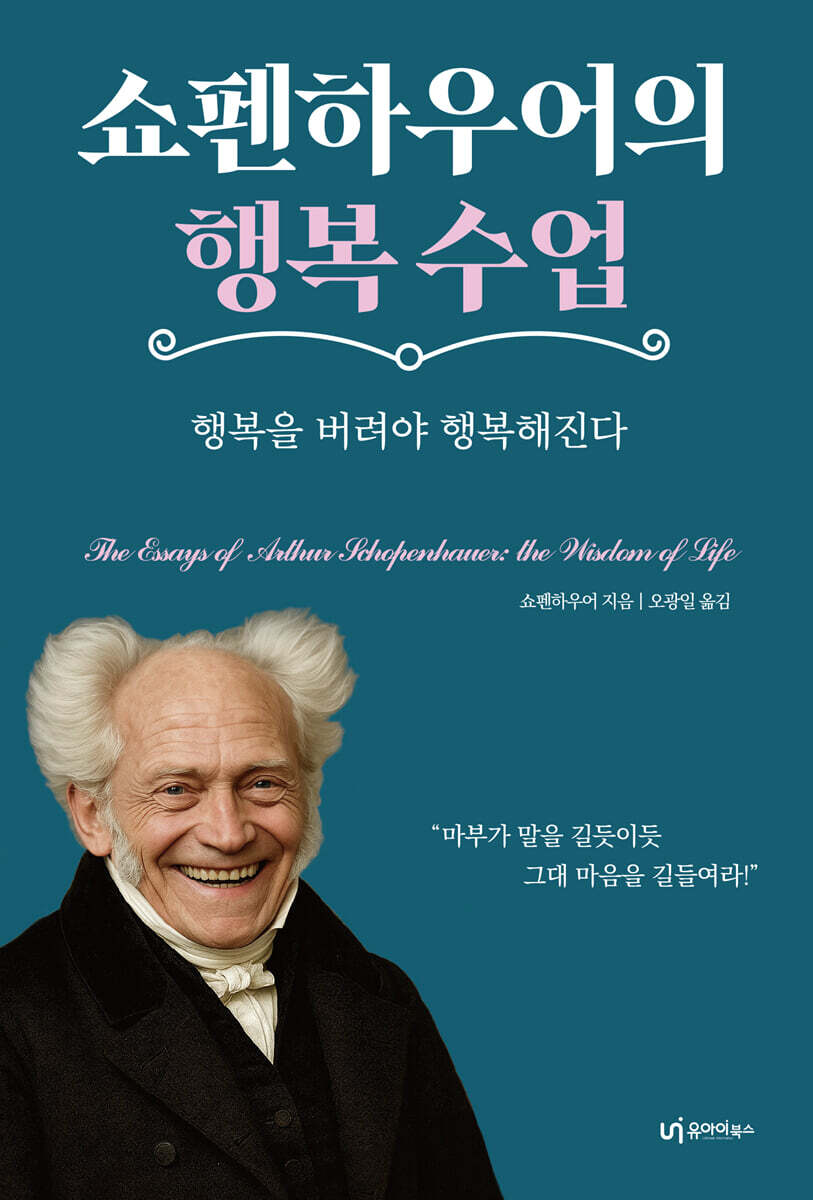
Schopenhauer's Happiness Lessons
 |
Description
Book Introduction
The most realistic and paradoxical philosophical book on happiness
The shocking truth that the pursuit of happiness is actually the cause of unhappiness.
The paradox of happiness and the true wisdom of life, revealed by a philosopher 200 years ago.
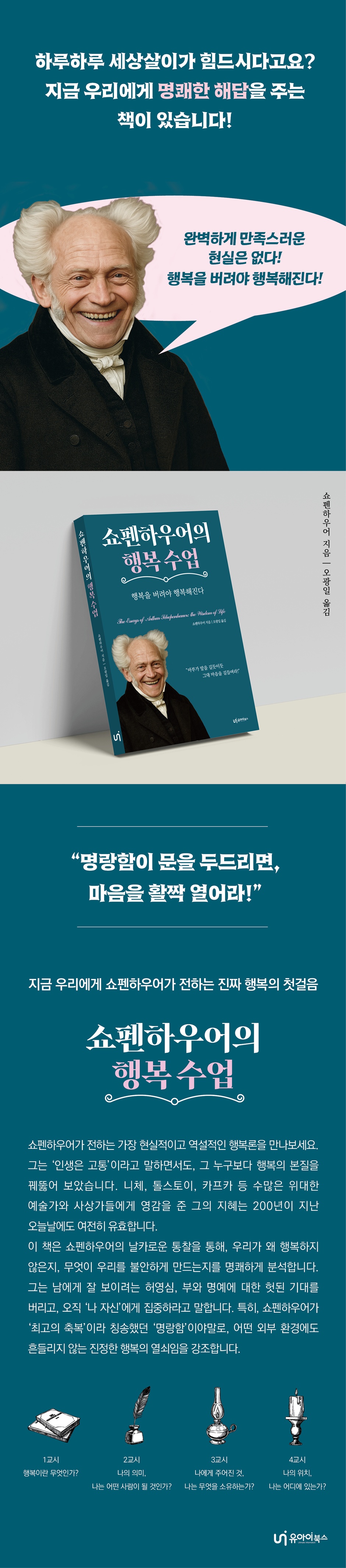
“If you laugh a lot, you will be happy.
“If you cry a lot, you will be unhappy.”
Schopenhauer, in his youth, happened to find these words while opening an old book.
It was such an obvious and simple statement, but he never forgot it his entire life.
It is because of that very simplicity and clarity.
Schopenhauer says:
“What makes us most directly happy is a healthy soul.
A cheerful and joyful person has a cheerful soul itself.
“When cheerfulness knocks on the door, we must open it wide.”
"Schopenhauer's Philosophy of Happiness" is an essay that contains Arthur Schopenhauer's insights into human happiness and the meaning of life.
This book is a simple Korean translation of Schopenhauer's essay "The Wisdom of Life."
The original title, 'The Wisdom of Life', means 'the wisdom of life' in Korean, and refers to the technique of organizing life in an orderly manner to achieve joy and success.
In a word, it can be called 'the science of happiness' or 'theory of happiness', and this book introduces how to live happily with Schopenhauer's unique wisdom and insight.
When Schopenhauer was alive, he was given negative labels such as 'pessimist, nihilist, pessimist', but in fact, he was a philosopher who loved life and humanity more than anyone else.
He argued that this world is full of suffering and unhappiness, and that human happiness depends on how much suffering and unhappiness can be reduced, and that a world filled with happiness is only possible in imagination, not reality.
This book emphasizes that true happiness can be found not through material success or external conditions, but through inner peace and self-sufficiency, and offers a philosophical reflection on the value and wisdom of life.
It contains practical lessons that can be applied to everyday life, making it a book that is still useful to readers living today.
The shocking truth that the pursuit of happiness is actually the cause of unhappiness.
The paradox of happiness and the true wisdom of life, revealed by a philosopher 200 years ago.
“If you laugh a lot, you will be happy.
“If you cry a lot, you will be unhappy.”
Schopenhauer, in his youth, happened to find these words while opening an old book.
It was such an obvious and simple statement, but he never forgot it his entire life.
It is because of that very simplicity and clarity.
Schopenhauer says:
“What makes us most directly happy is a healthy soul.
A cheerful and joyful person has a cheerful soul itself.
“When cheerfulness knocks on the door, we must open it wide.”
"Schopenhauer's Philosophy of Happiness" is an essay that contains Arthur Schopenhauer's insights into human happiness and the meaning of life.
This book is a simple Korean translation of Schopenhauer's essay "The Wisdom of Life."
The original title, 'The Wisdom of Life', means 'the wisdom of life' in Korean, and refers to the technique of organizing life in an orderly manner to achieve joy and success.
In a word, it can be called 'the science of happiness' or 'theory of happiness', and this book introduces how to live happily with Schopenhauer's unique wisdom and insight.
When Schopenhauer was alive, he was given negative labels such as 'pessimist, nihilist, pessimist', but in fact, he was a philosopher who loved life and humanity more than anyone else.
He argued that this world is full of suffering and unhappiness, and that human happiness depends on how much suffering and unhappiness can be reduced, and that a world filled with happiness is only possible in imagination, not reality.
This book emphasizes that true happiness can be found not through material success or external conditions, but through inner peace and self-sufficiency, and offers a philosophical reflection on the value and wisdom of life.
It contains practical lessons that can be applied to everyday life, making it a book that is still useful to readers living today.
- You can preview some of the book's contents.
Preview
index
Schopenhauer's Philosophy and Thought... 7
What is "The Wisdom of Life"? ··· 11
Before we begin class - are you happy now? Or are you deluding yourself into thinking you are? ··· 15
1st period.
What is happiness? ··· 19
- True happiness comes from being rich within... 20
- Subjectivity determines objectivity... 26
- We are trapped within the limits of consciousness... 29
- The Limits of Innate Nature... 35
2nd period.
My meaning, what kind of person will I become? ··· 39
Cheerfulness is the greatest blessing... 43
- Health determines 90% of happiness... 50
- The influence of innate temperament... 51
The Risks of Extreme Depression... 56
- The value of charm... 58
- Humans, who move between pain and boredom... 60
The Difference Between a Fool and a Genius... 65
- Human Nature in Card Games... 68
Leisure time is the flower and fruit of life... 71
- Find true happiness in solitude... 77
- The Three Sources of Joy... 82
- The Life of the Crowd and the Life of the Intellectual... 87
Life with and without an inner center... 90
- The true image of a free person... 95
- Philistines, the characteristics of vulgar people... 100
3rd Period: What's Given to Me, What Do I Own? ··· 107
The Relativity of Property and Desire... 110
The Inconvenient Truth About Money... 112
The Difference Between Talent and Capital... 114
The Paradox of Fear of Poverty... 117
The True Value of Property... 119
4th period.
My Position, Where Am I? ··· 127
- Section 1.
Reputation, the Shadow Created by Vanity of the Mind... 129
- Section 2.
Pride, a sense of pride... 150
- Section 3.
Status, the label attached to me... 160
- Section 4.
Honor, a heart that must be protected... 170
- Section 5.
Fame, the heart that must be earned... 180
Ending the Class - Don't Waste Your Life Trying to Look Good to Others... 188
What is "The Wisdom of Life"? ··· 11
Before we begin class - are you happy now? Or are you deluding yourself into thinking you are? ··· 15
1st period.
What is happiness? ··· 19
- True happiness comes from being rich within... 20
- Subjectivity determines objectivity... 26
- We are trapped within the limits of consciousness... 29
- The Limits of Innate Nature... 35
2nd period.
My meaning, what kind of person will I become? ··· 39
Cheerfulness is the greatest blessing... 43
- Health determines 90% of happiness... 50
- The influence of innate temperament... 51
The Risks of Extreme Depression... 56
- The value of charm... 58
- Humans, who move between pain and boredom... 60
The Difference Between a Fool and a Genius... 65
- Human Nature in Card Games... 68
Leisure time is the flower and fruit of life... 71
- Find true happiness in solitude... 77
- The Three Sources of Joy... 82
- The Life of the Crowd and the Life of the Intellectual... 87
Life with and without an inner center... 90
- The true image of a free person... 95
- Philistines, the characteristics of vulgar people... 100
3rd Period: What's Given to Me, What Do I Own? ··· 107
The Relativity of Property and Desire... 110
The Inconvenient Truth About Money... 112
The Difference Between Talent and Capital... 114
The Paradox of Fear of Poverty... 117
The True Value of Property... 119
4th period.
My Position, Where Am I? ··· 127
- Section 1.
Reputation, the Shadow Created by Vanity of the Mind... 129
- Section 2.
Pride, a sense of pride... 150
- Section 3.
Status, the label attached to me... 160
- Section 4.
Honor, a heart that must be protected... 170
- Section 5.
Fame, the heart that must be earned... 180
Ending the Class - Don't Waste Your Life Trying to Look Good to Others... 188
Detailed image
Into the book
“We are trapped within the limits set by our consciousness, and we cannot go beyond those limits.
It's like it can't even penetrate the thickness of the skin covering our body.
So outside help is of little use to us.”
--- p.29
“Cheerfulness is the greatest blessing.
A cheerful and happy person always has a reason.
“Because the soul itself is joyful.”
--- p.43
“Health determines 90% of happiness.
“When you are healthy, everything is enjoyable, but when you lose your health, nothing is enjoyable.”
--- p.50
“The world a person lives in is determined by the way he or she views the world.
Therefore, each person’s world is bound to be different.”
--- p.26
“Don’t waste your life trying to impress others. Just as a groom trains his horse, you must train your mind to achieve happiness.”
--- p.188
“If you laugh a lot, you will be happy.
“If you cry a lot, you will be unhappy.”
--- p.43
“Cheerfulness has direct and immediate benefits.
“Unlike a check you deposit in the bank, it’s like cash that gives you happiness right now, at this very moment.”
--- p.45
“Leisure time is the flower and fruit of life.”
--- p.71
“Find true happiness in solitude.”
--- p.77
“People are not influenced by things, but by their thoughts about things.”
--- p.49
“It is not wealth that endures, but nature.”
--- p.41
“Vitality is movement.”
--- p.47
“All movements become more intense the faster they are made.”
--- p.48
“Happiness depends on our mind, and our mind is also affected by our health.”
--- p.50
“Let us remember that nothing can come before health.”
--- p.51
“The misfortunes that befall people of a melancholic temperament are created by the imagination of what might happen, even though they never actually happened.”
--- p.54
“People waste their time and pursue all kinds of luxuries because their souls are empty.”
--- p.61
“Inner abundance, that is, a rich mind, is a great protection against this emptiness.”
--- p.62
“A wise man seeks above all things freedom from pain and trouble, quiet and leisure.”
--- p.63
“The more we have inside, the less we expect from others.”
It's like it can't even penetrate the thickness of the skin covering our body.
So outside help is of little use to us.”
--- p.29
“Cheerfulness is the greatest blessing.
A cheerful and happy person always has a reason.
“Because the soul itself is joyful.”
--- p.43
“Health determines 90% of happiness.
“When you are healthy, everything is enjoyable, but when you lose your health, nothing is enjoyable.”
--- p.50
“The world a person lives in is determined by the way he or she views the world.
Therefore, each person’s world is bound to be different.”
--- p.26
“Don’t waste your life trying to impress others. Just as a groom trains his horse, you must train your mind to achieve happiness.”
--- p.188
“If you laugh a lot, you will be happy.
“If you cry a lot, you will be unhappy.”
--- p.43
“Cheerfulness has direct and immediate benefits.
“Unlike a check you deposit in the bank, it’s like cash that gives you happiness right now, at this very moment.”
--- p.45
“Leisure time is the flower and fruit of life.”
--- p.71
“Find true happiness in solitude.”
--- p.77
“People are not influenced by things, but by their thoughts about things.”
--- p.49
“It is not wealth that endures, but nature.”
--- p.41
“Vitality is movement.”
--- p.47
“All movements become more intense the faster they are made.”
--- p.48
“Happiness depends on our mind, and our mind is also affected by our health.”
--- p.50
“Let us remember that nothing can come before health.”
--- p.51
“The misfortunes that befall people of a melancholic temperament are created by the imagination of what might happen, even though they never actually happened.”
--- p.54
“People waste their time and pursue all kinds of luxuries because their souls are empty.”
--- p.61
“Inner abundance, that is, a rich mind, is a great protection against this emptiness.”
--- p.62
“A wise man seeks above all things freedom from pain and trouble, quiet and leisure.”
--- p.63
“The more we have inside, the less we expect from others.”
--- p.64
Publisher's Review
Why does the more we pursue happiness, the more unhappy we become?
A philosophical insight that breaks modern people's obsession with happiness.
“Are you happy? Are you joyful and cheerful?”
Not many people would readily answer yes to this statement.
As we live, difficult things happen and life is not easy every day.
We seek material happiness to temporarily forget the pain of life, but soon our hearts become empty.
Modern people constantly strive to be happy.
I read self-help books, meditate, and try to cultivate positive thinking.
But why are we still unhappy? "Schopenhauer's Philosophy of Happiness" offers the most realistic answer to this dilemma, offered by a philosopher 200 years ago.
Schopenhauer believes that the direct pursuit of happiness is actually the cause of unhappiness.
Just as the more you try to catch a shadow, the farther it gets, the more you chase after happiness, the more it runs away.
Instead, he advises focusing on reducing pain and unhappiness.
The most striking feature of this book is its realistic approach.
Schopenhauer does not say that perfect happiness is possible.
Given human nature, complete satisfaction is impossible, and the best we can do is to minimize suffering.
This perspective is the exact opposite message of today's 'positive psychology' and 'happiness industry'.
His insights into social media culture and conspicuous consumption, particularly in modern society, are remarkably prophetic.
Although it is a book written 200 years ago, it accurately captures the image of modern people who are obsessed with the gaze of others.
His advice, “Don’t waste your life trying to look good to others,” resonates even more deeply with modern people who are obsessed with the number of “likes” and “followers.”
This book also helps us rediscover the value of 'solitude'.
For modern people who suffer from the compulsion to be constantly connected, it reminds us how precious alone time is.
His message that a truly free person is one who has built his own inner world without relying on others remains valid today.
90% of happiness is determined by health?
Schopenhauer divides happiness into three categories.
These are ‘What kind of person am I?’, ‘What do I have?’, and ‘How do others evaluate me?’
The most important of these is the first one, ‘What kind of person am I?’
It is our inner qualities, such as health, courage, charm, temperament, morality, and intelligence, that are the source of true happiness.
In particular, he asserts that “health determines 90% of happiness.”
Because when you are healthy, everything is enjoyable, but when you lose your health, nothing is enjoyable.
His words that 'cheerfulness' is the 'greatest blessing' and 'the key to happiness' that leads to happiness have a special meaning for modern people suffering from depression and anxiety.
Cheerfulness is a direct reward in itself, and unlike a check you deposit in the bank, it's like cash that gives you happiness right now, in this moment.
True freedom found in solitude
Modern society constantly emphasizes relationships with others.
Networking, social media, and various gatherings fill our lives.
But Schopenhauer conveys the exact opposite message.
“Find true happiness in solitude.”
He says, “Leisure time is the flower and fruit of life,” and argues that through alone time, one can look into one’s inner self and discover one’s true self.
A life with your own inner center is much richer than a life spent trying to be accepted by the crowd.
In the passage explaining “the difference between a fool and a genius,” he emphasizes the importance of intellectual ability.
To a person with exceptional mental abilities, many events can be exciting and adventurous experiences, but to a person with a dull mind, they are nothing more than a boring routine.
The Trap of Vanity and External Evaluation
The latter part of the book deals with the pitfall that most modern people fall into: 'the gaze of others.'
It shows how futile it is to cling to external evaluations such as reputation, self-esteem, status, honor, and fame.
Schopenhauer criticizes the illusion of reputation with the expression “shadows created by the vanity of the mind.”
Most of the things we pursue are actually just illusions created by the vanity of our minds.
His advice, “Don’t waste your life trying to look good to others,” is even more urgent for modern people living in the social media age.
His message that happiness can only be achieved by taming one's mind, just as a groom tames a horse, remains fresh and powerful even today, in a world overflowing with self-help books.
Inner peace, not material success
What sets this book apart from other happiness theories is its realistic approach.
Schopenhauer does not claim that perfect happiness can be achieved.
Instead, I believe that happiness depends on how much pain and unhappiness we can reduce.
Through “the relativity of wealth and desire,” he explains that material abundance does not necessarily guarantee happiness.
Redefining the true meaning of wealth through the paradox of fear of poverty and the difference between talent and capital.
The chapter on “The Inconvenient Truth About Money” provides a sobering analysis of the role and limitations of money in modern capitalist society.
Money is only a means and cannot be an end in itself, and pursuing money itself ultimately only brings emptiness.
Timeless wisdom spanning 200 years
Schopenhauer's Philosophy of Happiness is not simply a book of philosophy.
It is a guide to life that provides concrete and practical solutions to the real-world problems we face today.
Schopenhauer's ideas often appeared as material in literature and opera, and had a great influence on Marcel Proust and André Gide in France and Thomas Mann in Germany.
Friedrich Nietzsche called him “a true philosopher who deals with the profound questions of ethics and art,” and Carl Jung, the founder of analytical psychology, said of him “the first to speak of the pain and suffering that surround us so clearly and visibly.”
This book will offer Schopenhauer's unique wisdom of life to those who are wondering how to maintain peace in the midst of pain and anxiety.
It provides a new perspective and comfort, especially to readers who are tired of the competition and stress of modern society.
A philosophical insight that breaks modern people's obsession with happiness.
“Are you happy? Are you joyful and cheerful?”
Not many people would readily answer yes to this statement.
As we live, difficult things happen and life is not easy every day.
We seek material happiness to temporarily forget the pain of life, but soon our hearts become empty.
Modern people constantly strive to be happy.
I read self-help books, meditate, and try to cultivate positive thinking.
But why are we still unhappy? "Schopenhauer's Philosophy of Happiness" offers the most realistic answer to this dilemma, offered by a philosopher 200 years ago.
Schopenhauer believes that the direct pursuit of happiness is actually the cause of unhappiness.
Just as the more you try to catch a shadow, the farther it gets, the more you chase after happiness, the more it runs away.
Instead, he advises focusing on reducing pain and unhappiness.
The most striking feature of this book is its realistic approach.
Schopenhauer does not say that perfect happiness is possible.
Given human nature, complete satisfaction is impossible, and the best we can do is to minimize suffering.
This perspective is the exact opposite message of today's 'positive psychology' and 'happiness industry'.
His insights into social media culture and conspicuous consumption, particularly in modern society, are remarkably prophetic.
Although it is a book written 200 years ago, it accurately captures the image of modern people who are obsessed with the gaze of others.
His advice, “Don’t waste your life trying to look good to others,” resonates even more deeply with modern people who are obsessed with the number of “likes” and “followers.”
This book also helps us rediscover the value of 'solitude'.
For modern people who suffer from the compulsion to be constantly connected, it reminds us how precious alone time is.
His message that a truly free person is one who has built his own inner world without relying on others remains valid today.
90% of happiness is determined by health?
Schopenhauer divides happiness into three categories.
These are ‘What kind of person am I?’, ‘What do I have?’, and ‘How do others evaluate me?’
The most important of these is the first one, ‘What kind of person am I?’
It is our inner qualities, such as health, courage, charm, temperament, morality, and intelligence, that are the source of true happiness.
In particular, he asserts that “health determines 90% of happiness.”
Because when you are healthy, everything is enjoyable, but when you lose your health, nothing is enjoyable.
His words that 'cheerfulness' is the 'greatest blessing' and 'the key to happiness' that leads to happiness have a special meaning for modern people suffering from depression and anxiety.
Cheerfulness is a direct reward in itself, and unlike a check you deposit in the bank, it's like cash that gives you happiness right now, in this moment.
True freedom found in solitude
Modern society constantly emphasizes relationships with others.
Networking, social media, and various gatherings fill our lives.
But Schopenhauer conveys the exact opposite message.
“Find true happiness in solitude.”
He says, “Leisure time is the flower and fruit of life,” and argues that through alone time, one can look into one’s inner self and discover one’s true self.
A life with your own inner center is much richer than a life spent trying to be accepted by the crowd.
In the passage explaining “the difference between a fool and a genius,” he emphasizes the importance of intellectual ability.
To a person with exceptional mental abilities, many events can be exciting and adventurous experiences, but to a person with a dull mind, they are nothing more than a boring routine.
The Trap of Vanity and External Evaluation
The latter part of the book deals with the pitfall that most modern people fall into: 'the gaze of others.'
It shows how futile it is to cling to external evaluations such as reputation, self-esteem, status, honor, and fame.
Schopenhauer criticizes the illusion of reputation with the expression “shadows created by the vanity of the mind.”
Most of the things we pursue are actually just illusions created by the vanity of our minds.
His advice, “Don’t waste your life trying to look good to others,” is even more urgent for modern people living in the social media age.
His message that happiness can only be achieved by taming one's mind, just as a groom tames a horse, remains fresh and powerful even today, in a world overflowing with self-help books.
Inner peace, not material success
What sets this book apart from other happiness theories is its realistic approach.
Schopenhauer does not claim that perfect happiness can be achieved.
Instead, I believe that happiness depends on how much pain and unhappiness we can reduce.
Through “the relativity of wealth and desire,” he explains that material abundance does not necessarily guarantee happiness.
Redefining the true meaning of wealth through the paradox of fear of poverty and the difference between talent and capital.
The chapter on “The Inconvenient Truth About Money” provides a sobering analysis of the role and limitations of money in modern capitalist society.
Money is only a means and cannot be an end in itself, and pursuing money itself ultimately only brings emptiness.
Timeless wisdom spanning 200 years
Schopenhauer's Philosophy of Happiness is not simply a book of philosophy.
It is a guide to life that provides concrete and practical solutions to the real-world problems we face today.
Schopenhauer's ideas often appeared as material in literature and opera, and had a great influence on Marcel Proust and André Gide in France and Thomas Mann in Germany.
Friedrich Nietzsche called him “a true philosopher who deals with the profound questions of ethics and art,” and Carl Jung, the founder of analytical psychology, said of him “the first to speak of the pain and suffering that surround us so clearly and visibly.”
This book will offer Schopenhauer's unique wisdom of life to those who are wondering how to maintain peace in the midst of pain and anxiety.
It provides a new perspective and comfort, especially to readers who are tired of the competition and stress of modern society.
GOODS SPECIFICS
- Date of issue: September 10, 2025
- Page count, weight, size: 200 pages | 270g | 127*188*12mm
- ISBN13: 9791163221784
- ISBN10: 1163221783
You may also like
카테고리
korean


korean

![GQ KOREA Mark (Monthly): December [2025]](http://librairie.coreenne.fr/cdn/shop/files/8ef265dbbfbf186523ed75ba7319009d.jpg?v=1765340328&width=3840)


