

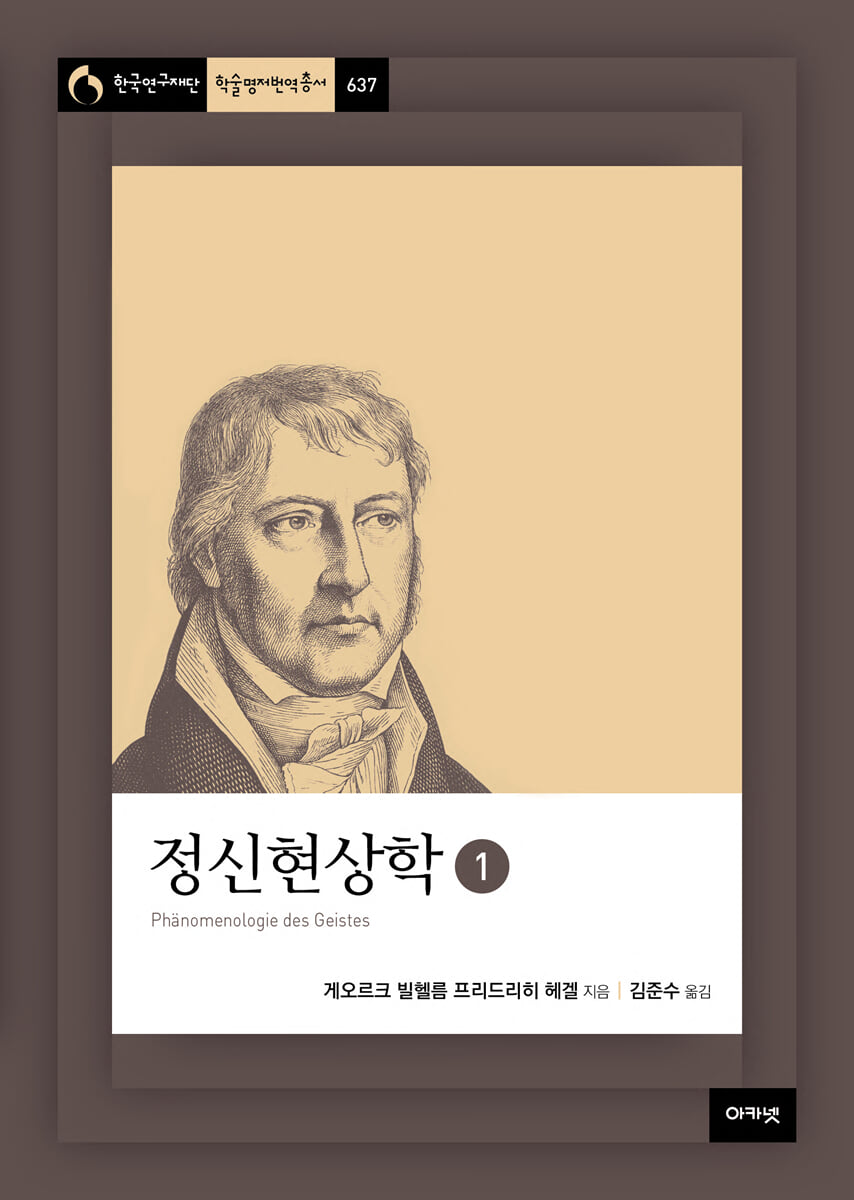
Phenomenology of Mind 1
 |
Description
Book Introduction
Hegel's representative work during his youth and the greatest work of Western philosophy
A new translation faithful to the latest standard research.
The Phenomenology of Spirit is not only Hegel's major work from his youth, but also the most controversial work in the history of Western philosophy.
In this book, Hegel summarizes the theory of consciousness, philosophy of history, dialectical logic, philosophy of nature, history of philosophy, political economy, theory of civil society, theory of the state, philosophical reflections on the French Revolution, ethics, and philosophy of religion, and describes the movement toward the development and completion of the total spirit through the process of experiencing individual consciousness.
With this first volume published by himself, Hegel was able to establish himself as a philosopher representing German idealism, surpassing Fichte and Schelling.
Moreover, from the perspective of the history of mind, 『Phenomenology of Spirit』 is a groundbreaking work that achieved a paradigm shift from the philosophy of substance that traditional metaphysics and modern philosophy still adhered to to the philosophy of the subject.
The numerous topics covered in the Phenomenology of Spirit, such as 'The Inverted World', 'The Dialectic of Master and Slave', 'Unhappy Consciousness', 'Morality and Absolute Evil', 'The Tragedy of Antigone', 'Enlightenment and Alienation', 'Freedom and Fear in the French Revolution', and 'Religion and Reconciliation', still provide much inspiration not only in philosophical discourse but also in the field of art.
This Korean edition attempts to overcome the problems seen in existing translations by using the Felix Minor edition (1980), which faithfully embodies the originality of the Phenomenology of Spirit and has become the standard for Hegel studies.
Felix Minor's edition differs from the existing translations published after Hegel's death (1832 edition) in that it takes as its original text the only edition published by Hegel himself (1807 edition).
A new critical collection, published over a long period of time by Felix Minor, is becoming a standard for current research, and a new Pinkard edition has also been published in the English-speaking world based on this critical edition.
The second edition published this time has supplemented expressions that were not used consistently in the first edition.
A new translation faithful to the latest standard research.
The Phenomenology of Spirit is not only Hegel's major work from his youth, but also the most controversial work in the history of Western philosophy.
In this book, Hegel summarizes the theory of consciousness, philosophy of history, dialectical logic, philosophy of nature, history of philosophy, political economy, theory of civil society, theory of the state, philosophical reflections on the French Revolution, ethics, and philosophy of religion, and describes the movement toward the development and completion of the total spirit through the process of experiencing individual consciousness.
With this first volume published by himself, Hegel was able to establish himself as a philosopher representing German idealism, surpassing Fichte and Schelling.
Moreover, from the perspective of the history of mind, 『Phenomenology of Spirit』 is a groundbreaking work that achieved a paradigm shift from the philosophy of substance that traditional metaphysics and modern philosophy still adhered to to the philosophy of the subject.
The numerous topics covered in the Phenomenology of Spirit, such as 'The Inverted World', 'The Dialectic of Master and Slave', 'Unhappy Consciousness', 'Morality and Absolute Evil', 'The Tragedy of Antigone', 'Enlightenment and Alienation', 'Freedom and Fear in the French Revolution', and 'Religion and Reconciliation', still provide much inspiration not only in philosophical discourse but also in the field of art.
This Korean edition attempts to overcome the problems seen in existing translations by using the Felix Minor edition (1980), which faithfully embodies the originality of the Phenomenology of Spirit and has become the standard for Hegel studies.
Felix Minor's edition differs from the existing translations published after Hegel's death (1832 edition) in that it takes as its original text the only edition published by Hegel himself (1807 edition).
A new critical collection, published over a long period of time by Felix Minor, is becoming a standard for current research, and a new Pinkard edition has also been published in the English-speaking world based on this critical edition.
The second edition published this time has supplemented expressions that were not used consistently in the first edition.
- You can preview some of the book's contents.
Preview
index
Note
introduction
introduction
(A) Consciousness
(B) Self-consciousness
(C) (AA) Reason
introduction
introduction
(A) Consciousness
(B) Self-consciousness
(C) (AA) Reason
Into the book
“Of course, it must be justified through the description of the system itself, but in my view, the crucial issue is to grasp and express the truth not only as a substance but also as a subject.
At the same time, it should be noted that substantiality implies the immediacy of universals or knowledge, and equally so the immediacy of being or knowledge.
…furthermore, a living entity is truly a subject, or, what is the same thing, a truly real entity only insofar as it is a movement that establishes itself, or a medium between itself and its otherness.
The substance as a subject is pure and simple negativity, and precisely because of this it is a division of the simple.
Or such an entity is a duality that opposes itself to itself, which in turn is the negation of this irrelevant difference and the opposition between the two.
It is not the fundamental unity itself or the immediate unity itself, but only this self-reconstructing identity or the reflection within oneself in the other that is true.
“Truth is the creation of oneself, a circle that takes one’s own end as its purpose, takes it as its starting point, and only by carrying oneself out and reaching the end does it become real.”
--- p.15∼16
“Among the various conclusions drawn from what has been discussed so far, the following points can be highlighted:
That is, it is real and can be described only as a discipline or system.
Furthermore, even if the so-called fundamental propositions or principles of philosophy are true, they are already false simply because they are fundamental propositions or principles.
- That is why it is easy to refute the fundamental proposition.
The refutation lies in exposing its flaws.
But the fundamental proposition is already flawed because it is merely a universal, a principle, a beginning.
If the refutation of a fundamental proposition is thorough, it is developed from the fundamental proposition itself, and not implemented from outside through assertions or ideas opposing it.
Therefore, if the refutation does not fall into the self-delusion of focusing only on its own negative aspects and not being conscious of its own progress and results in terms of its positive aspects, then the refutation is in fact a development of the fundamental proposition being refuted, and thus a supplement to its defects.”
--- p.21∼22
“It will be shown that natural consciousness is merely a concept of knowledge or unreal knowledge.
However, since natural consciousness regards itself as directly real, this journey has a negative meaning for natural consciousness, and realizing the concept is regarded as a loss of itself for natural consciousness.
Because natural consciousness loses its own truth on this path.
Therefore, this path can be considered as a path of doubt or, more accurately, a path of despair.
…the series of forms that consciousness passes through on this journey is rather a detailed history of consciousness's own progress toward learning.”
--- p.78∼79
“Self-consciousness is about self-consciousness.
Only through this does self-consciousness truly exist.
Because only then is unity with oneself in one's other-being created in self-consciousness.
…therefore, the concept of spirit already exists for us.
What happens next for consciousness is the experience of what mind is.
The mind is the absolute entity, the unity of the different self-consciousnesses that exist independently, in their complete freedom and independence, that is, we who are I and I who are we.
“Only in self-consciousness, which is the concept of the mind, does consciousness attain the turning point where it escapes the colorful illusions of the sensory realm and the empty night of the supersensible realm and enters the spiritual daylight of the present.”
--- p.177
“The goal here is a concept that has already occurred to us, namely, an approved self-consciousness that has confidence in itself within another free self-consciousness and that possesses its own truth within that very self-consciousness.
If we accept this goal in its reality, or if we raise this still inner spirit to the status of a substance that has already grown into our own being, then the kingdom of humanity is opened within this very concept.
Because humanity is nothing but the absolute spiritual unity of the essence of individuals within their independent reality.
That is, humanity is in itself a universal self-consciousness.
At this point, the universal self-consciousness itself is real to itself within the consciousness of another, so that while the consciousness of the other possesses complete independence, or while the consciousness of the other is a thing for this self-consciousness, it is precisely in this very process that self-consciousness is conscious of its unity with the consciousness of the other, and only in this unity with the objective entity does it become self-consciousness.”
At the same time, it should be noted that substantiality implies the immediacy of universals or knowledge, and equally so the immediacy of being or knowledge.
…furthermore, a living entity is truly a subject, or, what is the same thing, a truly real entity only insofar as it is a movement that establishes itself, or a medium between itself and its otherness.
The substance as a subject is pure and simple negativity, and precisely because of this it is a division of the simple.
Or such an entity is a duality that opposes itself to itself, which in turn is the negation of this irrelevant difference and the opposition between the two.
It is not the fundamental unity itself or the immediate unity itself, but only this self-reconstructing identity or the reflection within oneself in the other that is true.
“Truth is the creation of oneself, a circle that takes one’s own end as its purpose, takes it as its starting point, and only by carrying oneself out and reaching the end does it become real.”
--- p.15∼16
“Among the various conclusions drawn from what has been discussed so far, the following points can be highlighted:
That is, it is real and can be described only as a discipline or system.
Furthermore, even if the so-called fundamental propositions or principles of philosophy are true, they are already false simply because they are fundamental propositions or principles.
- That is why it is easy to refute the fundamental proposition.
The refutation lies in exposing its flaws.
But the fundamental proposition is already flawed because it is merely a universal, a principle, a beginning.
If the refutation of a fundamental proposition is thorough, it is developed from the fundamental proposition itself, and not implemented from outside through assertions or ideas opposing it.
Therefore, if the refutation does not fall into the self-delusion of focusing only on its own negative aspects and not being conscious of its own progress and results in terms of its positive aspects, then the refutation is in fact a development of the fundamental proposition being refuted, and thus a supplement to its defects.”
--- p.21∼22
“It will be shown that natural consciousness is merely a concept of knowledge or unreal knowledge.
However, since natural consciousness regards itself as directly real, this journey has a negative meaning for natural consciousness, and realizing the concept is regarded as a loss of itself for natural consciousness.
Because natural consciousness loses its own truth on this path.
Therefore, this path can be considered as a path of doubt or, more accurately, a path of despair.
…the series of forms that consciousness passes through on this journey is rather a detailed history of consciousness's own progress toward learning.”
--- p.78∼79
“Self-consciousness is about self-consciousness.
Only through this does self-consciousness truly exist.
Because only then is unity with oneself in one's other-being created in self-consciousness.
…therefore, the concept of spirit already exists for us.
What happens next for consciousness is the experience of what mind is.
The mind is the absolute entity, the unity of the different self-consciousnesses that exist independently, in their complete freedom and independence, that is, we who are I and I who are we.
“Only in self-consciousness, which is the concept of the mind, does consciousness attain the turning point where it escapes the colorful illusions of the sensory realm and the empty night of the supersensible realm and enters the spiritual daylight of the present.”
--- p.177
“The goal here is a concept that has already occurred to us, namely, an approved self-consciousness that has confidence in itself within another free self-consciousness and that possesses its own truth within that very self-consciousness.
If we accept this goal in its reality, or if we raise this still inner spirit to the status of a substance that has already grown into our own being, then the kingdom of humanity is opened within this very concept.
Because humanity is nothing but the absolute spiritual unity of the essence of individuals within their independent reality.
That is, humanity is in itself a universal self-consciousness.
At this point, the universal self-consciousness itself is real to itself within the consciousness of another, so that while the consciousness of the other possesses complete independence, or while the consciousness of the other is a thing for this self-consciousness, it is precisely in this very process that self-consciousness is conscious of its unity with the consciousness of the other, and only in this unity with the objective entity does it become self-consciousness.”
--- p.340
Publisher's Review
A translation that is faithful to the originality and stable as the times demand.
Verification of translations with different versions, and reexamination of translations from the original text
Since its first complete translation in the late 1980s, 『Phenomenology of Spirit』 has served as a catalyst for the expansion of full-scale research in a time of heightened interest in Hegel's philosophy.
However, now, academic discourse has accumulated to an incomparable degree compared to that of the past, and there is a demand for translations that are appropriate for these changes.
There is widespread agreement among Hegel scholars that a new translation is urgently needed that can be cited with confidence.
Translator Professor Kim Jun-su (Pusan National University) reviewed the existing translation from scratch to meet the needs of these readers, and checked in the footnotes each phrase or sentence that showed significant differences from the existing translations in different editions.
The complexity, obfuscation, and structural ambiguity of the original text of the Phenomenology of Spirit are well known.
Moreover, the writing process was time-consuming and there were many twists and turns, such as changes to the title and table of contents during the publishing process.
Nevertheless, this Korean edition reflects the form and structure of the original work, even if it is sometimes incomplete, because “it takes into account the fact that Hegel also intentionally used the difficulty of syntax to shake and awaken the reader’s thinking.”
This translation also has implications for the interpretation of Hegel's philosophy, namely, that it emphasizes the process of constructing the absolute spirit by translating the text from the immanent perspective of the actor.
Verification of translations with different versions, and reexamination of translations from the original text
Since its first complete translation in the late 1980s, 『Phenomenology of Spirit』 has served as a catalyst for the expansion of full-scale research in a time of heightened interest in Hegel's philosophy.
However, now, academic discourse has accumulated to an incomparable degree compared to that of the past, and there is a demand for translations that are appropriate for these changes.
There is widespread agreement among Hegel scholars that a new translation is urgently needed that can be cited with confidence.
Translator Professor Kim Jun-su (Pusan National University) reviewed the existing translation from scratch to meet the needs of these readers, and checked in the footnotes each phrase or sentence that showed significant differences from the existing translations in different editions.
The complexity, obfuscation, and structural ambiguity of the original text of the Phenomenology of Spirit are well known.
Moreover, the writing process was time-consuming and there were many twists and turns, such as changes to the title and table of contents during the publishing process.
Nevertheless, this Korean edition reflects the form and structure of the original work, even if it is sometimes incomplete, because “it takes into account the fact that Hegel also intentionally used the difficulty of syntax to shake and awaken the reader’s thinking.”
This translation also has implications for the interpretation of Hegel's philosophy, namely, that it emphasizes the process of constructing the absolute spirit by translating the text from the immanent perspective of the actor.
GOODS SPECIFICS
- Date of issue: August 15, 2025
- Format: Hardcover book binding method guide
- Page count, weight, size: 444 pages | 152*215*30mm
- ISBN13: 9788957339947
- ISBN10: 8957339949
You may also like
카테고리
korean


korean

![GQ KOREA Mark (Monthly): December [2025]](http://librairie.coreenne.fr/cdn/shop/files/8ef265dbbfbf186523ed75ba7319009d.jpg?v=1765340328&width=3840)


