

It's not sinking, it's deepening
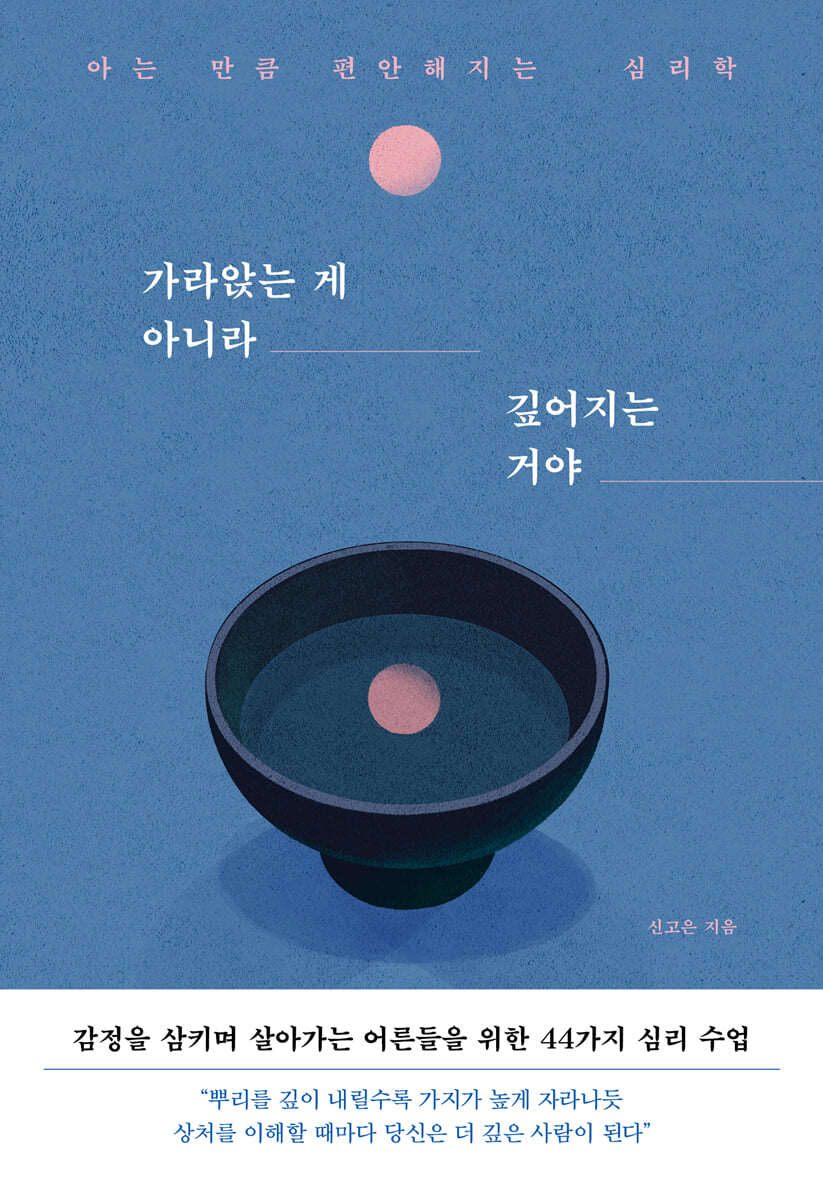 |
Description
Book Introduction
“Every time you overcome a wound, you become a deeper, stronger person.”
44 Psychology Lessons for Adults Who Swallow Their Emotions
"To You, Who Always Tried to Do Well," which brought comfort and courage to many readers, has returned with more refined sentences and deeper psychological insight.
The revised and republished edition of "It's Not Sinking, It's Deepening" shows that the heavy feeling of sinking in the midst of relationships, work, and the struggle with oneself is actually a process of becoming firmly rooted in life.
Psychologist Shin Go-eun has been closely observing the worries that people repeatedly experience through her long-term lectures.
Based on that experience, I applied various psychological theories and research to everyday problems and solved them in 44 psychology lessons, which are included in this book.
Part 1 begins with the realization that “I know myself least,” and covers basic concepts for understanding myself, such as ego and self-discrepancy, the supposed self, and defense mechanisms.
Part 2 helps you understand the nature of relationships through personality types, attachment theory, etc., and Part 3 teaches you healthy relationship skills to protect yourself and others, such as self-esteem and child messages.
Part 4 introduces psychological tools that change your thinking patterns, such as social exchange theory, cognitive errors, and status quo bias. Part 5 teaches you how to choose a better version of yourself through self-regulation, attribution theory, and positive psychology.
The stories in the book do not remain abstract comfort or sentimentality.
With real-life examples and psychological evidence, it helps readers understand and manage their own minds right now.
This will allow readers to shift their focus from 'Why am I having such a hard time?' to 'How can I become stronger?'
This book is a warm and practical guide from a psychologist for all adults who want to learn how to stand firm in their own ways, even if they're not perfect and have wounds.
Rather than fearing the moment of sinking, it will serve as a strong guide for those who want to turn that time into a process of deepening that nurtures them.
44 Psychology Lessons for Adults Who Swallow Their Emotions
"To You, Who Always Tried to Do Well," which brought comfort and courage to many readers, has returned with more refined sentences and deeper psychological insight.
The revised and republished edition of "It's Not Sinking, It's Deepening" shows that the heavy feeling of sinking in the midst of relationships, work, and the struggle with oneself is actually a process of becoming firmly rooted in life.
Psychologist Shin Go-eun has been closely observing the worries that people repeatedly experience through her long-term lectures.
Based on that experience, I applied various psychological theories and research to everyday problems and solved them in 44 psychology lessons, which are included in this book.
Part 1 begins with the realization that “I know myself least,” and covers basic concepts for understanding myself, such as ego and self-discrepancy, the supposed self, and defense mechanisms.
Part 2 helps you understand the nature of relationships through personality types, attachment theory, etc., and Part 3 teaches you healthy relationship skills to protect yourself and others, such as self-esteem and child messages.
Part 4 introduces psychological tools that change your thinking patterns, such as social exchange theory, cognitive errors, and status quo bias. Part 5 teaches you how to choose a better version of yourself through self-regulation, attribution theory, and positive psychology.
The stories in the book do not remain abstract comfort or sentimentality.
With real-life examples and psychological evidence, it helps readers understand and manage their own minds right now.
This will allow readers to shift their focus from 'Why am I having such a hard time?' to 'How can I become stronger?'
This book is a warm and practical guide from a psychologist for all adults who want to learn how to stand firm in their own ways, even if they're not perfect and have wounds.
Rather than fearing the moment of sinking, it will serve as a strong guide for those who want to turn that time into a process of deepening that nurtures them.
- You can preview some of the book's contents.
Preview
index
In publishing the revised edition
Prologue - To you who will do it slowly but surely
01 Now I've decided to look at myself properly.
The one who knew me least was myself: the ego and the self
Why I've Always Been Worse Than That Kid: Self-Discrepancy Theory
Trying not to try: the ought self
Anxious, Depressed, and Angry Days: Emotions Lessons
What Made Me: Reflective Assessment
That the shield was a wall that imprisoned me: a defense mechanism
When You Need Courage to Say What You Want: Irrational Beliefs
There was a moment when I lost myself while trying to resemble others: the chameleon effect.
The reason I couldn't fully enjoy happiness: Happy Day
02 If someone told you that relationships are inherently difficult
A Curious Tool That Reveals Differences: Personality Type Tests
Everyone Lives in Their Own World: Perspective Capability
Parents Raise Me, and I Complete Myself: Attachment Theory
Instead of being born, I was filled and completed: Tabula Rasa
Sibling Conflict: Birth Order
Winning Apologies, Winning Forgiveness: Primacy and Recent Effects
There Are No Bad Personalities: The Five Factor Personality Theory
Words That Make You Feel Offended: Perceptual Defenses
03 When I come first, we also exist.
I Don't Pray for Your Misfortune Anymore: The Ego Depletion Theory
I thought it was disadvantageous to open the pack: immune effect
Letting go of relationships where you struggle alone: Gaslighting
I deserve praise for no reason: unconditional respect
Mistakes Become Life-Saving Variables: The Mistake Effect
Acknowledged Practice, the Art of Building Myself: Self-Esteem
Good Words Make Good Relationships: The Psychology of Flattery
How to Fight Better Instead of Fighting Less: Child Messages
Rotten fruit falls on its own: The Zeigarnik effect
04 Change your thoughts and the world will look different.
Altruism ultimately stems from selfishness: Equity theory
If there are separate givers and receivers: Social Exchange Theory
I can't read other people's minds: cognitive error
When I Can't Protect Myself, My Body Betrays Me: General Adaptation Syndrome
Rejecting Uncomfortable Jokes: The Superiority Theory of Humor
A synonym for consideration is discrimination: relative deprivation.
No One Deserves to Be Unhappy: The Fair World Fallacy
If you're going to live like that, don't regret it. If you're going to regret it, don't live like that: Status Quo Bias
Gratitude for Nothing: Strengthening the Talisman
05 I choose to live my own way, but better.
Expressing Anger Instead of Getting Angry: The Purification Hypothesis
I Don't Care About Others Anymore, I'm Happy: Social Comparison Theory
The Mind Shaped by Expression: The Facial Feedback Effect
To Be a Pretty Good Person: The Conditions of Liking
To avoid repeating the same mistakes: The climax ending theory
Blaming Me Helps Me Grow: Attribution Theory
How to Spend Today for a Better Tomorrow: Self-Regulation
Once you say it, it will come true: a self-fulfilling prophecy
Even if my life ends in 5 minutes: Positive Psychology
Epilogue - You'll suddenly discover a better version of yourself than yesterday.
Prologue - To you who will do it slowly but surely
01 Now I've decided to look at myself properly.
The one who knew me least was myself: the ego and the self
Why I've Always Been Worse Than That Kid: Self-Discrepancy Theory
Trying not to try: the ought self
Anxious, Depressed, and Angry Days: Emotions Lessons
What Made Me: Reflective Assessment
That the shield was a wall that imprisoned me: a defense mechanism
When You Need Courage to Say What You Want: Irrational Beliefs
There was a moment when I lost myself while trying to resemble others: the chameleon effect.
The reason I couldn't fully enjoy happiness: Happy Day
02 If someone told you that relationships are inherently difficult
A Curious Tool That Reveals Differences: Personality Type Tests
Everyone Lives in Their Own World: Perspective Capability
Parents Raise Me, and I Complete Myself: Attachment Theory
Instead of being born, I was filled and completed: Tabula Rasa
Sibling Conflict: Birth Order
Winning Apologies, Winning Forgiveness: Primacy and Recent Effects
There Are No Bad Personalities: The Five Factor Personality Theory
Words That Make You Feel Offended: Perceptual Defenses
03 When I come first, we also exist.
I Don't Pray for Your Misfortune Anymore: The Ego Depletion Theory
I thought it was disadvantageous to open the pack: immune effect
Letting go of relationships where you struggle alone: Gaslighting
I deserve praise for no reason: unconditional respect
Mistakes Become Life-Saving Variables: The Mistake Effect
Acknowledged Practice, the Art of Building Myself: Self-Esteem
Good Words Make Good Relationships: The Psychology of Flattery
How to Fight Better Instead of Fighting Less: Child Messages
Rotten fruit falls on its own: The Zeigarnik effect
04 Change your thoughts and the world will look different.
Altruism ultimately stems from selfishness: Equity theory
If there are separate givers and receivers: Social Exchange Theory
I can't read other people's minds: cognitive error
When I Can't Protect Myself, My Body Betrays Me: General Adaptation Syndrome
Rejecting Uncomfortable Jokes: The Superiority Theory of Humor
A synonym for consideration is discrimination: relative deprivation.
No One Deserves to Be Unhappy: The Fair World Fallacy
If you're going to live like that, don't regret it. If you're going to regret it, don't live like that: Status Quo Bias
Gratitude for Nothing: Strengthening the Talisman
05 I choose to live my own way, but better.
Expressing Anger Instead of Getting Angry: The Purification Hypothesis
I Don't Care About Others Anymore, I'm Happy: Social Comparison Theory
The Mind Shaped by Expression: The Facial Feedback Effect
To Be a Pretty Good Person: The Conditions of Liking
To avoid repeating the same mistakes: The climax ending theory
Blaming Me Helps Me Grow: Attribution Theory
How to Spend Today for a Better Tomorrow: Self-Regulation
Once you say it, it will come true: a self-fulfilling prophecy
Even if my life ends in 5 minutes: Positive Psychology
Epilogue - You'll suddenly discover a better version of yourself than yesterday.
Detailed image

Into the book
The main role of depression is to make you lose your vitality.
Constantly ruminating on negative memories perpetuates that state.
Reflecting on my failures makes me conclude that I can't do it.
Depression also sends signals that push people away.
This is why we want to comfort sad people, but not stay with depressed people.
By removing the opportunity for social support in situations where comfort, empathy, and support are needed, the possibility of recovery is also reduced.
So, we must do our best to grieve without falling into depression.
Because sadness disappears into sadness, but depression stays in depression.
Let's be sad.
Let's find the strength to recover like that.
--- p.39
We are beings who cannot fully enjoy happiness.
Because I am anxious because I don't know when happiness will end.
But the moment happiness comes, you become happy.
Because I believe that happiness will come soon.
What if today, no matter what day it is, felt like Friday? That is, with the anticipation that something is about to happen.
You never know if it will actually happen or not, or if it will be brilliant or not.
But what can I do, I'm still waiting for the weekend, which may or may not be fun.
Doesn't being unhappy now mean there's only happiness ahead? If you're living an unhappy day, let's hope that tomorrow will be different.
Then, today, waiting for tomorrow, not tomorrow itself, will be happy.
--- p.79
Attachment begins at the very beginning of life and carries us to the very end.
So, on the one hand, it is a bitter theory.
It is said that my childhood experiences determine my future.
But the fact that a caregiver can create a future for a child also gives hope that another future can be created from a new caregiver.
The caregiver does not necessarily have to be a parent.
Because all relationships can be about supporting and growing each other.
Just as my past became my present, our present can create our future.
--- p.103~104
When you can't understand the difference in personality, think of personality as height.
Some people are born with genes that make them tall or short.
There may be preferences, but they cannot be forced.
It's like saying, 'Why can't you be taller than 170 centimeters? Try a little harder.'
It means that you can't try to be more extroverted, more sincere, or more open-minded.
Although the high and low levels of each personality dimension can vary, these differences cannot be the standard for right and wrong.
When someone's appearance is different from mine, just think simply.
Oh, that could be so, (not me, but you) that could be so! That's enough.
-- p.142
No one confides their unhappiness to a happy person.
Because showing flaws is like losing a game of chance.
At some point, that fact creates a fear that you might lose out in the competition.
So, you only maintain superficial relationships with perfect people.
But when I find out that the other person has a story, the secrets start to come out without me knowing.
His shortcomings and mine are balanced, and we become intimate, revealing our weaknesses without hesitation.
--- p.175
We envy the specialness of others and see them as beneficiaries, but our ordinariness also benefits someone else.
That's the benefit.
Ordinary life is not the default.
Every moment that feels ordinary is an additional option.
Because there are people who live relatively impoverished lives.
So we need the courage to share that option.
The beginning of that courage is the belief that the world is unfair and that I am enjoying more within that unfairness.
--- p.252
What kind of life are you living now? Is it worth living, or are you just holding on, unable to die?
When people are cornered, they choose one of two things.
Either hang on until you drop dead or find a new way.
It is better to take a new path than to fall and die.
But we lack the courage to change direction even by just one degree.
If you trust me then you will naturally know which direction to walk.
Just one step can change your mindset, and that mindset can become confidence, empowering you to take action.
That's how expectations become closer to reality.
To you who are wandering in the darkness right now, to you who don't know what will become of you, I want to tell you to have some faith.
Where darkness passes, light is sure to appear.
I hope you find hope by following that light.
If you keep completing the small tasks that are given to you like that, you will find yourself reaching that point before you know it.
really.
Constantly ruminating on negative memories perpetuates that state.
Reflecting on my failures makes me conclude that I can't do it.
Depression also sends signals that push people away.
This is why we want to comfort sad people, but not stay with depressed people.
By removing the opportunity for social support in situations where comfort, empathy, and support are needed, the possibility of recovery is also reduced.
So, we must do our best to grieve without falling into depression.
Because sadness disappears into sadness, but depression stays in depression.
Let's be sad.
Let's find the strength to recover like that.
--- p.39
We are beings who cannot fully enjoy happiness.
Because I am anxious because I don't know when happiness will end.
But the moment happiness comes, you become happy.
Because I believe that happiness will come soon.
What if today, no matter what day it is, felt like Friday? That is, with the anticipation that something is about to happen.
You never know if it will actually happen or not, or if it will be brilliant or not.
But what can I do, I'm still waiting for the weekend, which may or may not be fun.
Doesn't being unhappy now mean there's only happiness ahead? If you're living an unhappy day, let's hope that tomorrow will be different.
Then, today, waiting for tomorrow, not tomorrow itself, will be happy.
--- p.79
Attachment begins at the very beginning of life and carries us to the very end.
So, on the one hand, it is a bitter theory.
It is said that my childhood experiences determine my future.
But the fact that a caregiver can create a future for a child also gives hope that another future can be created from a new caregiver.
The caregiver does not necessarily have to be a parent.
Because all relationships can be about supporting and growing each other.
Just as my past became my present, our present can create our future.
--- p.103~104
When you can't understand the difference in personality, think of personality as height.
Some people are born with genes that make them tall or short.
There may be preferences, but they cannot be forced.
It's like saying, 'Why can't you be taller than 170 centimeters? Try a little harder.'
It means that you can't try to be more extroverted, more sincere, or more open-minded.
Although the high and low levels of each personality dimension can vary, these differences cannot be the standard for right and wrong.
When someone's appearance is different from mine, just think simply.
Oh, that could be so, (not me, but you) that could be so! That's enough.
-- p.142
No one confides their unhappiness to a happy person.
Because showing flaws is like losing a game of chance.
At some point, that fact creates a fear that you might lose out in the competition.
So, you only maintain superficial relationships with perfect people.
But when I find out that the other person has a story, the secrets start to come out without me knowing.
His shortcomings and mine are balanced, and we become intimate, revealing our weaknesses without hesitation.
--- p.175
We envy the specialness of others and see them as beneficiaries, but our ordinariness also benefits someone else.
That's the benefit.
Ordinary life is not the default.
Every moment that feels ordinary is an additional option.
Because there are people who live relatively impoverished lives.
So we need the courage to share that option.
The beginning of that courage is the belief that the world is unfair and that I am enjoying more within that unfairness.
--- p.252
What kind of life are you living now? Is it worth living, or are you just holding on, unable to die?
When people are cornered, they choose one of two things.
Either hang on until you drop dead or find a new way.
It is better to take a new path than to fall and die.
But we lack the courage to change direction even by just one degree.
If you trust me then you will naturally know which direction to walk.
Just one step can change your mindset, and that mindset can become confidence, empowering you to take action.
That's how expectations become closer to reality.
To you who are wandering in the darkness right now, to you who don't know what will become of you, I want to tell you to have some faith.
Where darkness passes, light is sure to appear.
I hope you find hope by following that light.
If you keep completing the small tasks that are given to you like that, you will find yourself reaching that point before you know it.
really.
--- p.320
Publisher's Review
“I find other people’s mistakes cute,
To you, the perfectionist who can't stand your own flaws"
A psychological theory that achieves happiness by setting the subject of the sentence "life" as "I"
There are people who are generous to others, but infinitely harsh to themselves.
Even the smallest mistake can break your heart, and you rarely allow yourself the moment when you think, 'This is enough.'
As a result, happiness is seen as a reward that can only be obtained by proving one's qualifications.
But happiness is not a report card given only after passing an exam.
It starts from the moment I accept myself as I am, imperfect as I am.
People who feel happy often don't wait.
Create your own happiness.
I first notice what I like, when I laugh, and what moments fill my heart.
It's not about finding success that others envy, but about finding your own joy.
Let go of the compulsion that you have to be perfect to smile, and accept that you can be happy even in imperfect moments.
Ultimately, happiness is active.
The moment we make 'I' the subject of the sentence 'life', we become the main character of a comedy.
Breaking free from the shackles of perfectionism that says, "I can only smile if I do well," and making myself the protagonist of this moment, that is the surest way to live with a smile and no regrets.
“When everything grows upward, the mind grows downward.”
Knowing your shortcomings allows you to improve, and allowing yourself to grieve allows you to recover.
We usually think of growth as going 'upward'.
Higher achievements, more recognition… .
But growth of the mind also takes place in other directions.
It gets deeper 'downwards'.
So it's okay to experience sadness, failure, and loss, and to feel your heart sinking under the weight of life.
Because you will become a person as deep and strong as that weight.
Acknowledging your shortcomings is not giving up.
It is a process that must be gone through in order to move forward.
Feeling your grief without suppressing it is not about breaking down, it is about preparing for recovery.
Instead of trying to force a smile, once you've gotten to the bottom of your heart, you'll have the strength to stand up again.
As the mind grows downward, life becomes broader and deeper.
Just as deeply rooted roots grow back strongly upward, only those who have experienced frustration and pain can experience greater joy.
The moment we face our wounds instead of avoiding them, we have already begun to heal.
To you, the perfectionist who can't stand your own flaws"
A psychological theory that achieves happiness by setting the subject of the sentence "life" as "I"
There are people who are generous to others, but infinitely harsh to themselves.
Even the smallest mistake can break your heart, and you rarely allow yourself the moment when you think, 'This is enough.'
As a result, happiness is seen as a reward that can only be obtained by proving one's qualifications.
But happiness is not a report card given only after passing an exam.
It starts from the moment I accept myself as I am, imperfect as I am.
People who feel happy often don't wait.
Create your own happiness.
I first notice what I like, when I laugh, and what moments fill my heart.
It's not about finding success that others envy, but about finding your own joy.
Let go of the compulsion that you have to be perfect to smile, and accept that you can be happy even in imperfect moments.
Ultimately, happiness is active.
The moment we make 'I' the subject of the sentence 'life', we become the main character of a comedy.
Breaking free from the shackles of perfectionism that says, "I can only smile if I do well," and making myself the protagonist of this moment, that is the surest way to live with a smile and no regrets.
“When everything grows upward, the mind grows downward.”
Knowing your shortcomings allows you to improve, and allowing yourself to grieve allows you to recover.
We usually think of growth as going 'upward'.
Higher achievements, more recognition… .
But growth of the mind also takes place in other directions.
It gets deeper 'downwards'.
So it's okay to experience sadness, failure, and loss, and to feel your heart sinking under the weight of life.
Because you will become a person as deep and strong as that weight.
Acknowledging your shortcomings is not giving up.
It is a process that must be gone through in order to move forward.
Feeling your grief without suppressing it is not about breaking down, it is about preparing for recovery.
Instead of trying to force a smile, once you've gotten to the bottom of your heart, you'll have the strength to stand up again.
As the mind grows downward, life becomes broader and deeper.
Just as deeply rooted roots grow back strongly upward, only those who have experienced frustration and pain can experience greater joy.
The moment we face our wounds instead of avoiding them, we have already begun to heal.
GOODS SPECIFICS
- Date of issue: September 1, 2025
- Page count, weight, size: 336 pages | 490g | 140*204*22mm
- ISBN13: 9791194530572
- ISBN10: 1194530575
You may also like
카테고리
korean


korean

![GQ KOREA Mark (Monthly): December [2025]](http://librairie.coreenne.fr/cdn/shop/files/8ef265dbbfbf186523ed75ba7319009d.jpg?v=1765340328&width=3840)


