

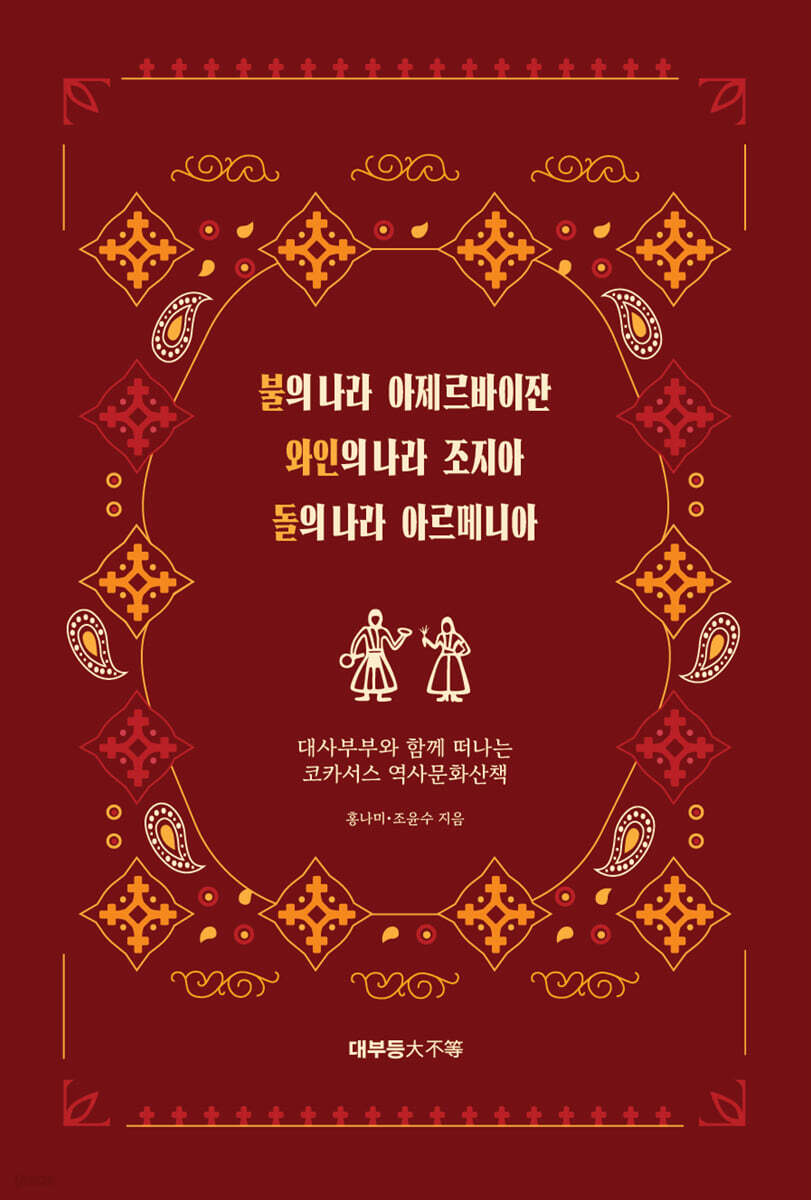
Azerbaijan, the land of fire, Georgia, the land of wine, and Armenia, the land of stone.
 |
Description
Book Introduction
“The Caucasus is a hidden treasure that has not revealed its true nature to us.”
A travelogue of three Caucasus countries by a diplomat husband and a composer wife.
Traveling to the Caucasus, a place so far away both geographically and emotionally, was a new challenge.
The husband, a diplomat who dreamed of becoming a historian, prepared for a trip to three Caucasus countries by researching John Steinbeck's "Russian Journal" and various materials on Amazon Books, sketching out each destination. His wife, with her delicate sensibilities, paid attention to details that others might overlook, and incorporated the history, culture, and lifestyle of each country into her travelogue.
In Azerbaijan, the land of fire, I visited the Nizami Literature Museum, the Rostropovich Museum, and the Heydar Aliyev Center in Baku, places that other tourists don't visit, to understand their cultural background. I also saw the Gobustan Petroglyphs and compared them with the Bangudae Petroglyphs in Ulsan, Korea.
In Georgia, the land of wine, I enjoyed the beautiful nature that Russians admire and praise, and also experienced the unique culture of Supra, where wine, food, and toasts continue without end while mingling with the locals.
When I was taking the funicular to Mtatsminda Park, I got off at a middle platform where no one was getting off and visited the deeply buried Church of St. David. Perhaps because it was a place that John Steinbeck had visited decades ago, I felt a different kind of excitement.
Looking at the hand axes on display at the National Museums of Georgia and Armenia, I was reminded of the hand axe discovered in Jeongok-ri, Yeoncheon-gun, Gyeonggi-do, South Korea.
In Armenia, the land of stone, I felt their deep faith in the Khachkar stone culture, which is made by carving crosses, and I learned that they take great pride in being the first country to recognize Christianity.
Mount Ararat, which Armenians regard as a sacred mountain and where Noah's Ark is believed to have landed, is now part of Turkey.
When you look at Mount Ararat, covered in snow, from the hill of Hor Virap, a Catholic holy site, you can't help but exclaim in awe at the sight.
Additionally, the author has drawn a map himself to help readers plan their travel itinerary by providing a glimpse into the Caucasus region, which is still unfamiliar to us.
From small episodes of the trip to the food of the Caucasus and even information necessary for travel, this book will help readers planning to visit the Caucasus draw up a rough outline of their trip, and readers who have already been there will be able to relive their memories.
There are few books that connect the history, culture and travel of the Caucasus.
Therefore, I believe that this book will be of great help to readers who are interested in the Caucasus region or are planning a trip there.
A travelogue of three Caucasus countries by a diplomat husband and a composer wife.
Traveling to the Caucasus, a place so far away both geographically and emotionally, was a new challenge.
The husband, a diplomat who dreamed of becoming a historian, prepared for a trip to three Caucasus countries by researching John Steinbeck's "Russian Journal" and various materials on Amazon Books, sketching out each destination. His wife, with her delicate sensibilities, paid attention to details that others might overlook, and incorporated the history, culture, and lifestyle of each country into her travelogue.
In Azerbaijan, the land of fire, I visited the Nizami Literature Museum, the Rostropovich Museum, and the Heydar Aliyev Center in Baku, places that other tourists don't visit, to understand their cultural background. I also saw the Gobustan Petroglyphs and compared them with the Bangudae Petroglyphs in Ulsan, Korea.
In Georgia, the land of wine, I enjoyed the beautiful nature that Russians admire and praise, and also experienced the unique culture of Supra, where wine, food, and toasts continue without end while mingling with the locals.
When I was taking the funicular to Mtatsminda Park, I got off at a middle platform where no one was getting off and visited the deeply buried Church of St. David. Perhaps because it was a place that John Steinbeck had visited decades ago, I felt a different kind of excitement.
Looking at the hand axes on display at the National Museums of Georgia and Armenia, I was reminded of the hand axe discovered in Jeongok-ri, Yeoncheon-gun, Gyeonggi-do, South Korea.
In Armenia, the land of stone, I felt their deep faith in the Khachkar stone culture, which is made by carving crosses, and I learned that they take great pride in being the first country to recognize Christianity.
Mount Ararat, which Armenians regard as a sacred mountain and where Noah's Ark is believed to have landed, is now part of Turkey.
When you look at Mount Ararat, covered in snow, from the hill of Hor Virap, a Catholic holy site, you can't help but exclaim in awe at the sight.
Additionally, the author has drawn a map himself to help readers plan their travel itinerary by providing a glimpse into the Caucasus region, which is still unfamiliar to us.
From small episodes of the trip to the food of the Caucasus and even information necessary for travel, this book will help readers planning to visit the Caucasus draw up a rough outline of their trip, and readers who have already been there will be able to relive their memories.
There are few books that connect the history, culture and travel of the Caucasus.
Therefore, I believe that this book will be of great help to readers who are interested in the Caucasus region or are planning a trip there.
- You can preview some of the book's contents.
Preview
index
Entering
Map of the Caucasus
Standing in the Caucasus
1.
Azerbaijan, the land of fire
Heydar Aliyev International Airport
ㆍHistory of Azerbaijan
ㆍThe burning country on the shores of the Caspian Sea
ㆍWalking around the capital city of Baku
- The Royal Palace in the Old City, the Shirvanshahs' Palace, and the Maiden's Tower
- Heydar Aliyev Center
- Rostropovich Museum
- Nizami Ganjavi Literature Museum
- Baku Nobel Oil Club, Azerbaijan Oil
ㆍTo the outskirts of Baku...
- Bibi Heybat Mosque
- Mud volcano
- Gobustan Petroglyphs
- Mountain of Fire, Temple of Fire, Zoroastrianism
ㆍAncient city of Caucasus Albania: Gabala
ㆍSilk Road World Heritage City: Seki
2.
Georgia, the land of wine
Shota Rustaveli International Airport
ㆍHistory of Georgia
ㆍCathedrals and monasteries of Georgia
ㆍWalking around the capital city of Tbilisi
- Sioni Cathedral, Bridge of Peace, Mother Georgia Statue, Narikala Fortress
- Metekhi Church, Gorgasali King Equestrian Statue, Abanotubini Sulphur Baths
- Tsminda Sameba Cathedral, Mtatsminda David Church, Prospero Book Cafe
- National Museum
- National Gallery
ㆍLeaving Tbilisi...
- Mtskheta, the old capital of Georgia
- Jvari Monastery
- Samtavro Monastery
- Svetitskhoveli Cathedral
- Mount Kazbegi, which stands tall in the Caucasus Mountains
- Ananuri Citadel
- Gudauri Observatory
- Mount Kazbegi and Gergeti Trinity Church
- Gori, Stalin's hometown
- Georgia and Russia
- Signagi and wine
- Bodbe Monastery
- To learn more about Georgian wine...
Georgia, a country loved by literary figures, and Georgian culture
3.
Armenia, the land of stone
ㆍCrossing the border
ㆍHistory of Armenia
ㆍWalking around the capital city of Yerevan
- The pink city of Yerevan and the Cascades
- Matenadaran Museum of Ancient Documents
- Opera Theater, Khachaturian Museum
- From Liberty Square to Republic Square
- National Museum of History, National Gallery
- Vernissage Market
- Genocide Memorial Park
- Yerebuni, the ancient wall of the Kingdom of Urartu
- Korea and Russia met in Yerevan
ㆍOut of Yerevan...
- Northeast of Yerevan: Lake Sevan and Sevanna Monastery
- West of Yerevan: Church of St. Khrushchev, Church of St. Gayane,
Echmiadzin Cathedral, Zvartnots Monastery
- East of Yerevan: Geghard Monastery, Garni Temple, Garni Columnar Joints
- South of Yerevan: Khor Virap Monastery, Mount Ararat, and Areni-1 Cave
4.
Caucasian food
5.
Caucasus Travel Information
6.
Books referenced
Map of the Caucasus
Standing in the Caucasus
1.
Azerbaijan, the land of fire
Heydar Aliyev International Airport
ㆍHistory of Azerbaijan
ㆍThe burning country on the shores of the Caspian Sea
ㆍWalking around the capital city of Baku
- The Royal Palace in the Old City, the Shirvanshahs' Palace, and the Maiden's Tower
- Heydar Aliyev Center
- Rostropovich Museum
- Nizami Ganjavi Literature Museum
- Baku Nobel Oil Club, Azerbaijan Oil
ㆍTo the outskirts of Baku...
- Bibi Heybat Mosque
- Mud volcano
- Gobustan Petroglyphs
- Mountain of Fire, Temple of Fire, Zoroastrianism
ㆍAncient city of Caucasus Albania: Gabala
ㆍSilk Road World Heritage City: Seki
2.
Georgia, the land of wine
Shota Rustaveli International Airport
ㆍHistory of Georgia
ㆍCathedrals and monasteries of Georgia
ㆍWalking around the capital city of Tbilisi
- Sioni Cathedral, Bridge of Peace, Mother Georgia Statue, Narikala Fortress
- Metekhi Church, Gorgasali King Equestrian Statue, Abanotubini Sulphur Baths
- Tsminda Sameba Cathedral, Mtatsminda David Church, Prospero Book Cafe
- National Museum
- National Gallery
ㆍLeaving Tbilisi...
- Mtskheta, the old capital of Georgia
- Jvari Monastery
- Samtavro Monastery
- Svetitskhoveli Cathedral
- Mount Kazbegi, which stands tall in the Caucasus Mountains
- Ananuri Citadel
- Gudauri Observatory
- Mount Kazbegi and Gergeti Trinity Church
- Gori, Stalin's hometown
- Georgia and Russia
- Signagi and wine
- Bodbe Monastery
- To learn more about Georgian wine...
Georgia, a country loved by literary figures, and Georgian culture
3.
Armenia, the land of stone
ㆍCrossing the border
ㆍHistory of Armenia
ㆍWalking around the capital city of Yerevan
- The pink city of Yerevan and the Cascades
- Matenadaran Museum of Ancient Documents
- Opera Theater, Khachaturian Museum
- From Liberty Square to Republic Square
- National Museum of History, National Gallery
- Vernissage Market
- Genocide Memorial Park
- Yerebuni, the ancient wall of the Kingdom of Urartu
- Korea and Russia met in Yerevan
ㆍOut of Yerevan...
- Northeast of Yerevan: Lake Sevan and Sevanna Monastery
- West of Yerevan: Church of St. Khrushchev, Church of St. Gayane,
Echmiadzin Cathedral, Zvartnots Monastery
- East of Yerevan: Geghard Monastery, Garni Temple, Garni Columnar Joints
- South of Yerevan: Khor Virap Monastery, Mount Ararat, and Areni-1 Cave
4.
Caucasian food
5.
Caucasus Travel Information
6.
Books referenced
Into the book
To travel to a certain region, you must first have an attraction to it.
But even if you want to go, you can't make up your mind because of all the thoughts that come to mind, such as whether it will be safe, whether you will be able to experience the travel experience as much as you wanted, whether it will be expensive, and what the food will be like.
We also had such thoughts about the Caucasus region, but after our trip, we found out that our worries were unfounded.
All three countries (Azerbaijan, Georgia, and Armenia) have a long history and culture comparable to ours, and each has its own unique characteristics.
There was also a lot to see, the food was delicious, the cost of travel was reasonable, and the people were warm and friendly.
--- From "Entering"
Why is it called the Land of Fire? The people who lived here believed that sacred fire was preserved in this place, where oil had long been mined.
In some areas, gas erupted from the ground, giving the impression that the hills were on fire.
In this region, fire was a part of life, and the belief that fire was sacred was naturally passed down.
Among the oils produced in Azerbaijan, there are some that are used for medicinal purposes.
This is Naftalan, mined in Azerbaijan, which does not burn but has the effect of healing external and internal wounds of the body.
This oil is very rare, and its effects were discovered by accident.
In the Middle Ages, a camel driver saw a sick camel rolling around in an oil field and left, thinking it was dead.
However, when he returned to the place a few weeks later, he was surprised to see that the camel had completely healed, and so he began using the oil as a remedy.
The usefulness of this oil is also mentioned in the poems of the great 12th-century Azerbaijani poet Nizami Ganjami and in the records of Marco Polo in the 13th century.
Marco Polo wrote that camels came from far away to collect this oil because it was effective in preventing dandruff and scabies.
--- From "Azerbaijan"
The view of Mount Kazbegi from the courtyard outside the church is so beautiful.
Mount Kazbegi, which appears in Greek mythology and is 5,000 meters above sea level, is a rugged rock mountain where Prometheus is said to have been chained.
Zeus punished Prometheus for giving humans fire, which was meant for the gods only, by chaining him to Mount Kazbegi with a strong iron chain and having an eagle peck out his liver every day. Prometheus suffered until Hercules freed him.
When talking about Georgian food culture, wine cannot be left out.
The Caucasus region has a suitable climate for growing and ripening grapes, with hot, dry summers and ample sunlight.
Wine is known to have been first cultivated in Georgia about 8,000 years ago.
Just as the French are proud of their wine, Georgians are also proud of being the first people in the world to produce wine and create a wine civilization.
In Georgia, wine is a part of everyday life, always served with lunch and dinner, and is also a major export.
Alexander Pushkin, Russia's favorite author, once said, "Every Georgian dish is poetry," and indeed, Georgians are proud of their food and food culture.
In Georgia, a dinner party is a celebration, and the person hosting it plays a crucial role.
This person is called Tamada (Toastmaster) as explained above, and the success of this festival is determined by Tamada's ability.
Tamada knows the personalities of the people invited to the festival well, so he introduces them in an appropriate order, and the person introduced says a few words to suit the mood, and then proposes a toast.
--- From "Georgia"
Many Armenians have emigrated abroad, leaving only about 3 million Armenians living in Armenia, while there are about 8 million Armenians living abroad, meaning there are more Armenians living abroad than in the country.
When an ethnic group leaves their original land and moves to another region to live, it is called a diaspora. The countries with the largest Armenian diaspora are Russia (approximately 2.5 to 2.8 million people), the United States (approximately 1.5 to 1.6 million people), and France (approximately 690,000 to 700,000 people).
Among these successful entrepreneurs, many have financially supported various Armenian businesses. The main gate at the entrance to Echmiadzin Cathedral, called the "Gregory's Gate," was also built in 2001 with donations from the Armenian diaspora.
Armenians believe they are descendants of Noah and take great pride in the fact that Armenia was the first country in the world to recognize Christianity.
With that pride, they preserved their religion and language even amid constant invasions by powerful nations.
Moreover, thanks to that pride, the Armenian diaspora still maintains a strong bond and contributes not only to the preservation of religion and culture, but also to the advancement of education and science, serving as a strong support.
When we arrived at Hor Virap Monastery, we could clearly see Mount Ararat up close.
Mount Ararat is known as the place where Noah's Ark landed and is considered a sacred mountain by Armenians.
The view of Mount Ararat, covered in snow, from the hill where the monastery where St. Gregory was imprisoned and Hor Virap are located is worth a visit in itself.
Mount Ararat is so special to Armenians that fragments of Noah's Ark discovered on Mount Ararat are preserved as sacred relics in the museum in Echmiadzin.
--- From "Armenia"
Qutab from Azerbaijan: A traditional bread made with a dough filled with various fillings such as meat, vegetables like spinach, and pumpkin, cooked on a thin iron plate called a saj and rolled into thin rolls.
Depending on the contents, it is called meat kutap, vegetable kutap, pumpkin kutap, and intestine kutap.
Also, the kutops are slightly different in each region, and are called by adding the name of the region to the front, such as Ganja kutops or Nakhchivan kutops.
It is served as an appetizer before the main course and is also good as a snack. (p 279)
Georgian Shoti: A traditional Georgian bread baked in an oven.
The dough is made into long pieces and thrown onto the inner wall of the oven to stick to it before baking. It is light and crispy, but not hard, so it has a taste that you won't get tired of.
I saw them being baked in a kiln near my hotel in Tbilisi and during my tour of Sighnaghi, and the taste of freshly baked shoti is unforgettable.
Day trips to Georgia often include a tour of the shorty-making process. (p 283)
Armenian Lavash: If Georgia's oven-baked bread is shorty, Armenia has lavash.
Shorty is thicker and has a bready taste, while Lavash has a light taste like Indian naan.
While Shorty rolls the dough into long strips, Lavash rolls the dough into circles as thin as possible.
Lavash, like shorty, can be attached to the inside wall of the oven and then taken out after a while.
Lavash can be eaten as is, or it can be rolled up with meat or vegetables and eaten like a kebab.
Lavash is listed on UNESCO's Intangible Cultural Heritage list, and like shorty, lavaash-making is often included in day trips.
But even if you want to go, you can't make up your mind because of all the thoughts that come to mind, such as whether it will be safe, whether you will be able to experience the travel experience as much as you wanted, whether it will be expensive, and what the food will be like.
We also had such thoughts about the Caucasus region, but after our trip, we found out that our worries were unfounded.
All three countries (Azerbaijan, Georgia, and Armenia) have a long history and culture comparable to ours, and each has its own unique characteristics.
There was also a lot to see, the food was delicious, the cost of travel was reasonable, and the people were warm and friendly.
--- From "Entering"
Why is it called the Land of Fire? The people who lived here believed that sacred fire was preserved in this place, where oil had long been mined.
In some areas, gas erupted from the ground, giving the impression that the hills were on fire.
In this region, fire was a part of life, and the belief that fire was sacred was naturally passed down.
Among the oils produced in Azerbaijan, there are some that are used for medicinal purposes.
This is Naftalan, mined in Azerbaijan, which does not burn but has the effect of healing external and internal wounds of the body.
This oil is very rare, and its effects were discovered by accident.
In the Middle Ages, a camel driver saw a sick camel rolling around in an oil field and left, thinking it was dead.
However, when he returned to the place a few weeks later, he was surprised to see that the camel had completely healed, and so he began using the oil as a remedy.
The usefulness of this oil is also mentioned in the poems of the great 12th-century Azerbaijani poet Nizami Ganjami and in the records of Marco Polo in the 13th century.
Marco Polo wrote that camels came from far away to collect this oil because it was effective in preventing dandruff and scabies.
--- From "Azerbaijan"
The view of Mount Kazbegi from the courtyard outside the church is so beautiful.
Mount Kazbegi, which appears in Greek mythology and is 5,000 meters above sea level, is a rugged rock mountain where Prometheus is said to have been chained.
Zeus punished Prometheus for giving humans fire, which was meant for the gods only, by chaining him to Mount Kazbegi with a strong iron chain and having an eagle peck out his liver every day. Prometheus suffered until Hercules freed him.
When talking about Georgian food culture, wine cannot be left out.
The Caucasus region has a suitable climate for growing and ripening grapes, with hot, dry summers and ample sunlight.
Wine is known to have been first cultivated in Georgia about 8,000 years ago.
Just as the French are proud of their wine, Georgians are also proud of being the first people in the world to produce wine and create a wine civilization.
In Georgia, wine is a part of everyday life, always served with lunch and dinner, and is also a major export.
Alexander Pushkin, Russia's favorite author, once said, "Every Georgian dish is poetry," and indeed, Georgians are proud of their food and food culture.
In Georgia, a dinner party is a celebration, and the person hosting it plays a crucial role.
This person is called Tamada (Toastmaster) as explained above, and the success of this festival is determined by Tamada's ability.
Tamada knows the personalities of the people invited to the festival well, so he introduces them in an appropriate order, and the person introduced says a few words to suit the mood, and then proposes a toast.
--- From "Georgia"
Many Armenians have emigrated abroad, leaving only about 3 million Armenians living in Armenia, while there are about 8 million Armenians living abroad, meaning there are more Armenians living abroad than in the country.
When an ethnic group leaves their original land and moves to another region to live, it is called a diaspora. The countries with the largest Armenian diaspora are Russia (approximately 2.5 to 2.8 million people), the United States (approximately 1.5 to 1.6 million people), and France (approximately 690,000 to 700,000 people).
Among these successful entrepreneurs, many have financially supported various Armenian businesses. The main gate at the entrance to Echmiadzin Cathedral, called the "Gregory's Gate," was also built in 2001 with donations from the Armenian diaspora.
Armenians believe they are descendants of Noah and take great pride in the fact that Armenia was the first country in the world to recognize Christianity.
With that pride, they preserved their religion and language even amid constant invasions by powerful nations.
Moreover, thanks to that pride, the Armenian diaspora still maintains a strong bond and contributes not only to the preservation of religion and culture, but also to the advancement of education and science, serving as a strong support.
When we arrived at Hor Virap Monastery, we could clearly see Mount Ararat up close.
Mount Ararat is known as the place where Noah's Ark landed and is considered a sacred mountain by Armenians.
The view of Mount Ararat, covered in snow, from the hill where the monastery where St. Gregory was imprisoned and Hor Virap are located is worth a visit in itself.
Mount Ararat is so special to Armenians that fragments of Noah's Ark discovered on Mount Ararat are preserved as sacred relics in the museum in Echmiadzin.
--- From "Armenia"
Qutab from Azerbaijan: A traditional bread made with a dough filled with various fillings such as meat, vegetables like spinach, and pumpkin, cooked on a thin iron plate called a saj and rolled into thin rolls.
Depending on the contents, it is called meat kutap, vegetable kutap, pumpkin kutap, and intestine kutap.
Also, the kutops are slightly different in each region, and are called by adding the name of the region to the front, such as Ganja kutops or Nakhchivan kutops.
It is served as an appetizer before the main course and is also good as a snack. (p 279)
Georgian Shoti: A traditional Georgian bread baked in an oven.
The dough is made into long pieces and thrown onto the inner wall of the oven to stick to it before baking. It is light and crispy, but not hard, so it has a taste that you won't get tired of.
I saw them being baked in a kiln near my hotel in Tbilisi and during my tour of Sighnaghi, and the taste of freshly baked shoti is unforgettable.
Day trips to Georgia often include a tour of the shorty-making process. (p 283)
Armenian Lavash: If Georgia's oven-baked bread is shorty, Armenia has lavash.
Shorty is thicker and has a bready taste, while Lavash has a light taste like Indian naan.
While Shorty rolls the dough into long strips, Lavash rolls the dough into circles as thin as possible.
Lavash, like shorty, can be attached to the inside wall of the oven and then taken out after a while.
Lavash can be eaten as is, or it can be rolled up with meat or vegetables and eaten like a kebab.
Lavash is listed on UNESCO's Intangible Cultural Heritage list, and like shorty, lavaash-making is often included in day trips.
--- From "Caucasian Food"
GOODS SPECIFICS
- Date of issue: June 24, 2025
- Page count, weight, size: 303 pages | 152*225*30mm
- ISBN13: 9788996018278
- ISBN10: 8996018279
You may also like
카테고리
korean


korean

![ELLE 엘르 스페셜 에디션 A형 : 12월 [2025]](http://librairie.coreenne.fr/cdn/shop/files/b8e27a3de6c9538896439686c6b0e8fb.jpg?v=1766436872&width=3840)


