

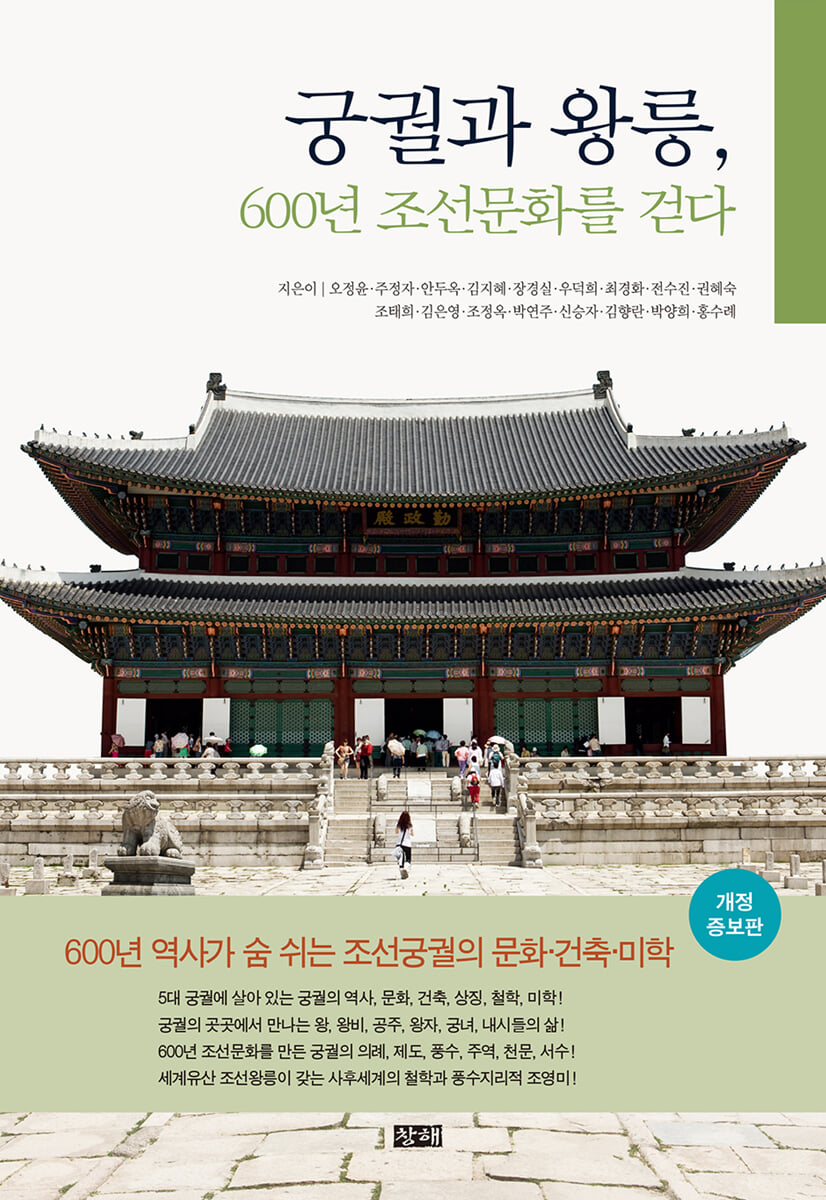
Palaces and Royal Tombs: A Walk Through 600 Years of Joseon Culture
 |
Description
Book Introduction
A guidebook to palaces and royal tombs, vividly illustrated!
The recently published revised and expanded edition of "Palaces and Royal Tombs, Walking Through 600 Years of Joseon Culture" is a guidebook that vividly presents the history, culture, architecture, science, rituals, systems, and symbols of the Joseon palaces and royal tombs representing the cultural heritage of Hanyang, Seoul, along with educational and field trip content.
The recently published revised and expanded edition of "Palaces and Royal Tombs, Walking Through 600 Years of Joseon Culture" is a guidebook that vividly presents the history, culture, architecture, science, rituals, systems, and symbols of the Joseon palaces and royal tombs representing the cultural heritage of Hanyang, Seoul, along with educational and field trip content.
- You can preview some of the book's contents.
Preview
index
Foreword: Palaces and Royal Tombs: A Walk Through 600 Years of Joseon Culture - Oh Jeong-yoon
1 King, Recording a Day in the Palace - Choi Kyung-hwa
1.
Etymology of king
2.
The role and powers of a king, and what privileges does a king have?
3.
From the birth of the king to the crown prince period
4.
A monarch's daily routine begins with a court appearance.
5.
A special event attended by the king
6.
What did the king do in his free time?
7.
Surat table, a table where the king's body was nourished with food from all over the country
2 Queen, in charge of palace affairs - Hong Su-rye
1.
Chinese characters meaning queen
2.
Titles for the monarch's female elders and wives
3.
The status of the queen
4.
The rank of queen created by power
5.
Joseon Dynasty internal register
6.
Path to becoming a queen
7.
The Queen's official status and duties
8.
Gagwanchinyeongrye (假館親迎禮) and Sarim ideology
9.
The distance between possibility and reality, selection
10.
The Queen, a peek into the palace's life
3 Princes and Princesses: Living Autonomously and by Other Means - Shin Seung-ja
1.
How are titles determined?
2.
The 'placenta' of a precious descendant is treated with respect.
3.
Born from the same thing but living different destinies
4.
How does a prince who cannot become a king live?
5.
From princess to concubine, and then to nun…
6.
When princesses get married, they leave the palace and go to Saga.
7.
There were no women's names in Joseon.
8.
Give life lessons.
4 Court Lady: Meet the Female Professionals in the Palace - Park Yeon-ju
1.
The origin and scope of court ladies
2.
Selection of palace maids
3.
The life and leisure time of a court lady
4.
The last years and death of a court lady
5.
finish
5 Eunuchs, Living in the King's Shadow - Joo Jeong-ja
1.
Eunuch, about his birth
2.
Eunuchs, the birth and fall of a family
3.
The existence and work of eunuchs
4.
Eunuchs and Eunuchs in History
5.
Eunuch, what traces of the eunuchs remain today?
6 Dragons, Symbolizing the Dignity of the Palace - Jo Tae-hee
1.
Etymology of dragon
2.
The Dragon Sutra, Telling All About Dragons
3.
Son of the Dragon, Yongsaengguja
4.
The King and the Dragon
5.
Dragons encountered in the palace
7. The Guardians of the Palace - Ahn Du-ok
1.
The etymology of miscellaneous statues
2.
Miscellaneous images on record
3.
Structure and name of eaves
4.
The role of the eaves ridge statue
5.
Symbol of traditional wall painting
6.
Miscellaneous details of eaves in Chinese architecture
7.
The names and roles of Chinese merchants
8.
Miscellaneous images of Sangwado (portrait tile painting)
9.
Miscellaneous Items and Names of the Korean Painting Catalog 2
10.
The statues guard every corner of the palace
8 Palaces, the Principles of the Book of Changes Unfold - Kim Eun-young
1 The Book of Changes and Architecture
2 The core content of the 『Book of Changes』 and Gyeongbokgung Palace
3.
Theory of Yin-Yang and the Five Elements - The Principle of Mutual Growth and Mutual Repression as Implemented in Gangnyeongjeon
4.
The principles of the Book of Changes contained in Gyeongbokgung Palace
5.
The Book of Changes as an Architectural Concept and Gyeongbokgung Palace
The Five Rites of the King, Putting Confucian Ideals into Practice - Jo Jeong-ok
1.
What is etiquette?
2.
What is the political and cultural significance of the five rites in the Joseon Dynasty?
3.
What literature is there related to the five rites?
4.
What types of rituals are there?
5.
Five rites met at the palace
6.
Concluding the ceremony…
10 Grade Training Works: A Look at a Manager's Resume - Jeon Su-jin
1.
officials and officials
2.
Quality training
3.
Palace rank stone
4.
Conclusion
11. The Power Outage, Realizing the Law of Heaven - Jang Gyeong-sil
1.
Establishing the Dharma Palace and the Jeonggung Palace, the Center of Heaven's Mandate and Rule
2.
The Armistice, Establishing the Center of National Administration
3.
Geunjeongjeon: Reading the Aesthetics of Example
4.
Inquiry, adjustment
12 Walking through Hanseongbu, the Heart of Joseon - Woo Deok-hee
1.
Introduction
2.
Background of the formation of Hanseongbu
3.
spatial features
4.
Hanseongbu's software
5.
Conclusion
13 Royal Titles: Defining East Asian Monarchs - Kim Ji-hye
1.
The secret hidden in the king's name, the foundation of the nation's legitimacy and decency
2.
King's name, childhood name, nickname, pen name, and nickname
3.
The titles of investiture received by the king, titles of appointment and titles of investiture (冊封名)
4.
The most important name while alive, your honorific
5.
The title of the king representing heaven, the reign title
6.
Judge a life by its name, posthumous name
7.
Names for the places where the spirit and body of the king are kept: tomb name (陵號), temple name (廟號), and hall name (殿號)
8.
Conclusion
14 Royal Tomb, Where the King and Queen Sleep - Kim Hyang-ran
1.
The King's Death
2.
Establishment of the Sanreungdogam
3.
Director
4.
Neungho
5.
Construction of royal tombs, feng shui
6.
Structure of the royal tomb
7.
Trees of the Royal Tomb
8.
The value of the royal tomb forest
15. Jongmyo, Wandering the Afterlife - Kwon Hye-sook
1.
History of Jongmyo
2.
Jongmyo's location
3.
Placement of the ancestral tablets at Jongmyo Shrine
4.
Jongmyo Shrine architecture (Jeongjeon, Yeongnyeongjeon, Gongsindang, Chilsadang)
5.
Jongmyo Shrine of the Korean Empire
6.
Conclusion
16. The Jade Seal, Engraving Power and Authority - Park Yang-hee
1.
The concept of the royal seal and the national seal
2.
The origin of the jade seal
3.
Symbolism of the Jade Seal
4.
The purpose and function of the jade seal
5.
Types of seals
6.
The production of the jade seal
7.
The historical flow of our country's national seal
17 〈Appendix〉 Palace Aesthetics, the Beauty and Fragrance of Cultural Heritage Flows! - Oh Jeong-yoon
1.
The cultural value of the palace
2.
Seoul Palaces, Experience Cultural Content
3.
Palace aesthetics, encounter the style and fragrance of the palace!
4.
Reasoning and Insights Necessary for Understanding the Palace
1 King, Recording a Day in the Palace - Choi Kyung-hwa
1.
Etymology of king
2.
The role and powers of a king, and what privileges does a king have?
3.
From the birth of the king to the crown prince period
4.
A monarch's daily routine begins with a court appearance.
5.
A special event attended by the king
6.
What did the king do in his free time?
7.
Surat table, a table where the king's body was nourished with food from all over the country
2 Queen, in charge of palace affairs - Hong Su-rye
1.
Chinese characters meaning queen
2.
Titles for the monarch's female elders and wives
3.
The status of the queen
4.
The rank of queen created by power
5.
Joseon Dynasty internal register
6.
Path to becoming a queen
7.
The Queen's official status and duties
8.
Gagwanchinyeongrye (假館親迎禮) and Sarim ideology
9.
The distance between possibility and reality, selection
10.
The Queen, a peek into the palace's life
3 Princes and Princesses: Living Autonomously and by Other Means - Shin Seung-ja
1.
How are titles determined?
2.
The 'placenta' of a precious descendant is treated with respect.
3.
Born from the same thing but living different destinies
4.
How does a prince who cannot become a king live?
5.
From princess to concubine, and then to nun…
6.
When princesses get married, they leave the palace and go to Saga.
7.
There were no women's names in Joseon.
8.
Give life lessons.
4 Court Lady: Meet the Female Professionals in the Palace - Park Yeon-ju
1.
The origin and scope of court ladies
2.
Selection of palace maids
3.
The life and leisure time of a court lady
4.
The last years and death of a court lady
5.
finish
5 Eunuchs, Living in the King's Shadow - Joo Jeong-ja
1.
Eunuch, about his birth
2.
Eunuchs, the birth and fall of a family
3.
The existence and work of eunuchs
4.
Eunuchs and Eunuchs in History
5.
Eunuch, what traces of the eunuchs remain today?
6 Dragons, Symbolizing the Dignity of the Palace - Jo Tae-hee
1.
Etymology of dragon
2.
The Dragon Sutra, Telling All About Dragons
3.
Son of the Dragon, Yongsaengguja
4.
The King and the Dragon
5.
Dragons encountered in the palace
7. The Guardians of the Palace - Ahn Du-ok
1.
The etymology of miscellaneous statues
2.
Miscellaneous images on record
3.
Structure and name of eaves
4.
The role of the eaves ridge statue
5.
Symbol of traditional wall painting
6.
Miscellaneous details of eaves in Chinese architecture
7.
The names and roles of Chinese merchants
8.
Miscellaneous images of Sangwado (portrait tile painting)
9.
Miscellaneous Items and Names of the Korean Painting Catalog 2
10.
The statues guard every corner of the palace
8 Palaces, the Principles of the Book of Changes Unfold - Kim Eun-young
1 The Book of Changes and Architecture
2 The core content of the 『Book of Changes』 and Gyeongbokgung Palace
3.
Theory of Yin-Yang and the Five Elements - The Principle of Mutual Growth and Mutual Repression as Implemented in Gangnyeongjeon
4.
The principles of the Book of Changes contained in Gyeongbokgung Palace
5.
The Book of Changes as an Architectural Concept and Gyeongbokgung Palace
The Five Rites of the King, Putting Confucian Ideals into Practice - Jo Jeong-ok
1.
What is etiquette?
2.
What is the political and cultural significance of the five rites in the Joseon Dynasty?
3.
What literature is there related to the five rites?
4.
What types of rituals are there?
5.
Five rites met at the palace
6.
Concluding the ceremony…
10 Grade Training Works: A Look at a Manager's Resume - Jeon Su-jin
1.
officials and officials
2.
Quality training
3.
Palace rank stone
4.
Conclusion
11. The Power Outage, Realizing the Law of Heaven - Jang Gyeong-sil
1.
Establishing the Dharma Palace and the Jeonggung Palace, the Center of Heaven's Mandate and Rule
2.
The Armistice, Establishing the Center of National Administration
3.
Geunjeongjeon: Reading the Aesthetics of Example
4.
Inquiry, adjustment
12 Walking through Hanseongbu, the Heart of Joseon - Woo Deok-hee
1.
Introduction
2.
Background of the formation of Hanseongbu
3.
spatial features
4.
Hanseongbu's software
5.
Conclusion
13 Royal Titles: Defining East Asian Monarchs - Kim Ji-hye
1.
The secret hidden in the king's name, the foundation of the nation's legitimacy and decency
2.
King's name, childhood name, nickname, pen name, and nickname
3.
The titles of investiture received by the king, titles of appointment and titles of investiture (冊封名)
4.
The most important name while alive, your honorific
5.
The title of the king representing heaven, the reign title
6.
Judge a life by its name, posthumous name
7.
Names for the places where the spirit and body of the king are kept: tomb name (陵號), temple name (廟號), and hall name (殿號)
8.
Conclusion
14 Royal Tomb, Where the King and Queen Sleep - Kim Hyang-ran
1.
The King's Death
2.
Establishment of the Sanreungdogam
3.
Director
4.
Neungho
5.
Construction of royal tombs, feng shui
6.
Structure of the royal tomb
7.
Trees of the Royal Tomb
8.
The value of the royal tomb forest
15. Jongmyo, Wandering the Afterlife - Kwon Hye-sook
1.
History of Jongmyo
2.
Jongmyo's location
3.
Placement of the ancestral tablets at Jongmyo Shrine
4.
Jongmyo Shrine architecture (Jeongjeon, Yeongnyeongjeon, Gongsindang, Chilsadang)
5.
Jongmyo Shrine of the Korean Empire
6.
Conclusion
16. The Jade Seal, Engraving Power and Authority - Park Yang-hee
1.
The concept of the royal seal and the national seal
2.
The origin of the jade seal
3.
Symbolism of the Jade Seal
4.
The purpose and function of the jade seal
5.
Types of seals
6.
The production of the jade seal
7.
The historical flow of our country's national seal
17 〈Appendix〉 Palace Aesthetics, the Beauty and Fragrance of Cultural Heritage Flows! - Oh Jeong-yoon
1.
The cultural value of the palace
2.
Seoul Palaces, Experience Cultural Content
3.
Palace aesthetics, encounter the style and fragrance of the palace!
4.
Reasoning and Insights Necessary for Understanding the Palace
Into the book
The king's day began with Paru.
Paru was the sound that the king made on behalf of the heavens to announce the dawn to the people of Joseon.
At around 4 a.m., the bell rang 33 times.
The king had to rise up in the Paru to set an example for the people.
The king had to get up from his seat and basically greet the elders.
When I was too busy to greet you in person, I sent a eunuch instead.
Next, he attended the lectures and discussed the scriptures and current issues with the officials.
After the competition, we had breakfast and had a roll call.
The court meeting consisted of the Jocham, where all civil and military officials met with the king on the 5th, 11th, 21st, and 25th of each month, and the Sangcham, where officials met with the king in the side hall every day.
--- From "The King, Recording a Day in the Palace"
The queen's most important duty was, above all, to produce the next monarch.
In the society of the nobility, where there was a distinction between the status of the wife and concubine and the commoners, whether the successor to the monarch was a legitimate son or an illegitimate son was a factor that directly showed the structure of the conflict between royal authority and divine authority.
Therefore, the queen's production of a legitimate heir was the most important task in establishing the legitimacy of the royal authority.
--- From "The Queen, Responsible for the Palace's Household"
If a prince becomes a crown prince and then a king, that is the best life, and if he fails to become a crown prince and lives a life unnoticed by the royal family, that is also the best life.
For a princess, too, it would be the best life to leave the palace, start a family, and live the life of an ordinary woman.
--- From "The Prince and the Princess, Living Autonomously and by Other Means"
There was a clear distinction between the court ladies and the court ladies, who were referred to as court ladies in the narrow sense.
There were usually three ranks of court ladies: Sanggung, Nain, and Aeginain.
These also had different levels of rank depending on the time of entry into the palace and the department they belonged to, and their own hierarchy was formed, with the highest position being held by the court lady.
Below the court lady were the maids, whose roles were almost the same as those of the court lady, but who mainly assisted the court lady.
Below Nine was Aeginaine, an apprentice Nine.
--- From "Palace Maid, Meet Female Professionals in the Palace"
It is assumed that the eunuchs were of humble origin.
Perhaps, due to difficult circumstances, they ultimately gave their children up for adoption to eunuchs. This is a conceivable scenario, and it's likely that such cases were common.
If you become a eunuch, your livelihood problems will be solved, and sometimes you can obtain a high position or a lot of land.
Most of the eunuchs known to have lived near Seoul today are wealthy.
--- From "Eunuch, Living in the King's Shadow"
The auspicious beasts called the sons of the dragon are placed throughout the palace.
On the legs of the tripod, a three-legged cauldron located on the left and right of Geunjeongjeon Hall in Gyeongbokgung Palace, there are sanye (traditional Korean wind chimes), a jopung (a Korean wind chime) sticks out its head from the end of the eaves, and a paeha (traditional Korean wind chimes) sits on the legs' water bowls.
--- From “The Dragon, Symbolizing the Dignity of the Palace”
In addition to its function as a wall, the eaves also serve to protect the roof tiles and eaves, but it also has a high visual effect that enhances the overall aesthetics of the building.
It also allows us to determine the importance of a building based on the number and size of the statues sitting on the eaves.
The guardian angels of the palace, Japsang, are a cultural heritage that highlights the aesthetics of Korean palaces.
--- From “Miscellaneous Statues, Guarding Everywhere in the Palace”
The worldview of the Book of Changes can be found in traditional Korean architecture, especially palace architecture.
Traditional architecture is a medium (means) for explaining something before it becomes a living space for humans to stay in.
Therefore, in traditional architecture, the ‘meaning’ contained in the building is most important.
This 'meaning' refers to the thought behind the construction of a building, which is called 'architectural design thought'.
Practicality and aesthetics are matters that come after ‘meaning.’
--- From "The Palace, the Principles of the Book of Changes Unfold"
Confucianism in the palace should be seen as not only an academic ideology but also as having a very strong religious character.
No, it would be more correct to view it as a religion.
Joseon put a lot of effort into religious rituals because Confucianism was a ruling method in Joseon that valued loyalty and filial piety, and it was also a way to gain the support of the literati.
In the palace, Confucianism had a lot of yin-yang culture and a lot of fortune-telling culture.
--- From “The King’s Five Rites, Putting Confucian Ideals into Practice”
Rank and title is a concept that symbolizes ruling power in ancient society.
Nobles and officials inherited their status and bloodline through official titles and positions called ranks.
Therefore, the Pumgyehunjak is an official resume that shows the rank, career, and status of the officials.
--- From "Pumgyehunjak, Looking into the Manager's Resume"
The architectural style of Jeongjeon shows some differences in the hierarchy and operation of the palace, such as the number of rooms and the arrangement of pillars, but in terms of form, they all show a common appearance.
There is a main gate of the palace used for the king's coronation ceremony or when going on a tour, and a 'haengnang' is installed on all four sides around the wall, and a 'jojeong' is built with a stone floor.
In the middle of the court, a ‘eodo’ and a ‘stairs’ are built, and on top of that, a ‘dang’ is built by building a high platform and creating a flat area.
--- From "Blackout, Realizing the Law of Heaven"
The name Seoul (徐?) first appears in the book “Han-gyeong-ji-ryak (漢京識略)” written by Yu Bon-ye, the son of Yu Deuk-gong.
In this book, Yoo Bon-ye introduces the history of Hanyang and says that Seoul (徐?) originated from Seorabeol (徐那伐) in Gyeongju.
--- From "Hansungbu, Walking the Heart of Joseon"
In the case of the king, there were numerous honorifics that symbolized the king in addition to his highness.
For example, there were names such as Lord, High, Holy, and Dangjeo.
These honorifics were always used by officials when referring to the king.
Only after the death of the previous king could the successor ascend to the throne.
But in political reality, there can be no such thing as principles alone.
There were times when a successor king ascended to the throne while the previous king was still alive.
In such cases, the king who abdicated from the throne was called the King of the Upper World, the King of the Old Upper World, or the King of the Great Upper World.
--- From "The King's Title, Defining East Asian Monarchs"
The artisans required for the construction of Joseon royal tombs participated in the form of conscription during the early Joseon Dynasty, but from the late Joseon Dynasty onwards, this changed to the form of recruitment by employment.
In the case of artisans who were in charge of specific tasks requiring advanced skills, such as carving, the craftsmanship was passed down through family members, forming a family of artisans.
--- From "The Royal Tomb, Where the King and Queen Sleep"
Jongmyo Shrine is one of the UNESCO World Heritage Sites, and is a place that many people are interested in and love for its architectural beauty, comparing it to the Parthenon in Greece.
On the other hand, some people think of Jongmyo as a type of royal tomb, so it feels like an unfamiliar space to us.
Jongmyo is a royal Confucian shrine that houses the spirit tablets of the kings and queens of the Joseon Dynasty, as well as those who were posthumously honored.
--- From "Jongmyo, Wandering the World of the Afterlife"
The royal seal was a highly artistic assembly.
In the process of producing the jade seal, sophisticated techniques and skills were used, including calligraphy, engraving, painting, and sculpture, and the pinnacle of royal culture was captured in the jade seal under the leadership of the state.
Also, in making the jade seal, we did not simply pursue ‘beauty.’
The seal contains various symbolic and philosophical meanings. Examples include the nine-fold bending of strokes on the seal surface according to the principles of yin-yang and the five elements, and symbolic symbols engraved on the seal that are thought to exert supernatural powers.
Paru was the sound that the king made on behalf of the heavens to announce the dawn to the people of Joseon.
At around 4 a.m., the bell rang 33 times.
The king had to rise up in the Paru to set an example for the people.
The king had to get up from his seat and basically greet the elders.
When I was too busy to greet you in person, I sent a eunuch instead.
Next, he attended the lectures and discussed the scriptures and current issues with the officials.
After the competition, we had breakfast and had a roll call.
The court meeting consisted of the Jocham, where all civil and military officials met with the king on the 5th, 11th, 21st, and 25th of each month, and the Sangcham, where officials met with the king in the side hall every day.
--- From "The King, Recording a Day in the Palace"
The queen's most important duty was, above all, to produce the next monarch.
In the society of the nobility, where there was a distinction between the status of the wife and concubine and the commoners, whether the successor to the monarch was a legitimate son or an illegitimate son was a factor that directly showed the structure of the conflict between royal authority and divine authority.
Therefore, the queen's production of a legitimate heir was the most important task in establishing the legitimacy of the royal authority.
--- From "The Queen, Responsible for the Palace's Household"
If a prince becomes a crown prince and then a king, that is the best life, and if he fails to become a crown prince and lives a life unnoticed by the royal family, that is also the best life.
For a princess, too, it would be the best life to leave the palace, start a family, and live the life of an ordinary woman.
--- From "The Prince and the Princess, Living Autonomously and by Other Means"
There was a clear distinction between the court ladies and the court ladies, who were referred to as court ladies in the narrow sense.
There were usually three ranks of court ladies: Sanggung, Nain, and Aeginain.
These also had different levels of rank depending on the time of entry into the palace and the department they belonged to, and their own hierarchy was formed, with the highest position being held by the court lady.
Below the court lady were the maids, whose roles were almost the same as those of the court lady, but who mainly assisted the court lady.
Below Nine was Aeginaine, an apprentice Nine.
--- From "Palace Maid, Meet Female Professionals in the Palace"
It is assumed that the eunuchs were of humble origin.
Perhaps, due to difficult circumstances, they ultimately gave their children up for adoption to eunuchs. This is a conceivable scenario, and it's likely that such cases were common.
If you become a eunuch, your livelihood problems will be solved, and sometimes you can obtain a high position or a lot of land.
Most of the eunuchs known to have lived near Seoul today are wealthy.
--- From "Eunuch, Living in the King's Shadow"
The auspicious beasts called the sons of the dragon are placed throughout the palace.
On the legs of the tripod, a three-legged cauldron located on the left and right of Geunjeongjeon Hall in Gyeongbokgung Palace, there are sanye (traditional Korean wind chimes), a jopung (a Korean wind chime) sticks out its head from the end of the eaves, and a paeha (traditional Korean wind chimes) sits on the legs' water bowls.
--- From “The Dragon, Symbolizing the Dignity of the Palace”
In addition to its function as a wall, the eaves also serve to protect the roof tiles and eaves, but it also has a high visual effect that enhances the overall aesthetics of the building.
It also allows us to determine the importance of a building based on the number and size of the statues sitting on the eaves.
The guardian angels of the palace, Japsang, are a cultural heritage that highlights the aesthetics of Korean palaces.
--- From “Miscellaneous Statues, Guarding Everywhere in the Palace”
The worldview of the Book of Changes can be found in traditional Korean architecture, especially palace architecture.
Traditional architecture is a medium (means) for explaining something before it becomes a living space for humans to stay in.
Therefore, in traditional architecture, the ‘meaning’ contained in the building is most important.
This 'meaning' refers to the thought behind the construction of a building, which is called 'architectural design thought'.
Practicality and aesthetics are matters that come after ‘meaning.’
--- From "The Palace, the Principles of the Book of Changes Unfold"
Confucianism in the palace should be seen as not only an academic ideology but also as having a very strong religious character.
No, it would be more correct to view it as a religion.
Joseon put a lot of effort into religious rituals because Confucianism was a ruling method in Joseon that valued loyalty and filial piety, and it was also a way to gain the support of the literati.
In the palace, Confucianism had a lot of yin-yang culture and a lot of fortune-telling culture.
--- From “The King’s Five Rites, Putting Confucian Ideals into Practice”
Rank and title is a concept that symbolizes ruling power in ancient society.
Nobles and officials inherited their status and bloodline through official titles and positions called ranks.
Therefore, the Pumgyehunjak is an official resume that shows the rank, career, and status of the officials.
--- From "Pumgyehunjak, Looking into the Manager's Resume"
The architectural style of Jeongjeon shows some differences in the hierarchy and operation of the palace, such as the number of rooms and the arrangement of pillars, but in terms of form, they all show a common appearance.
There is a main gate of the palace used for the king's coronation ceremony or when going on a tour, and a 'haengnang' is installed on all four sides around the wall, and a 'jojeong' is built with a stone floor.
In the middle of the court, a ‘eodo’ and a ‘stairs’ are built, and on top of that, a ‘dang’ is built by building a high platform and creating a flat area.
--- From "Blackout, Realizing the Law of Heaven"
The name Seoul (徐?) first appears in the book “Han-gyeong-ji-ryak (漢京識略)” written by Yu Bon-ye, the son of Yu Deuk-gong.
In this book, Yoo Bon-ye introduces the history of Hanyang and says that Seoul (徐?) originated from Seorabeol (徐那伐) in Gyeongju.
--- From "Hansungbu, Walking the Heart of Joseon"
In the case of the king, there were numerous honorifics that symbolized the king in addition to his highness.
For example, there were names such as Lord, High, Holy, and Dangjeo.
These honorifics were always used by officials when referring to the king.
Only after the death of the previous king could the successor ascend to the throne.
But in political reality, there can be no such thing as principles alone.
There were times when a successor king ascended to the throne while the previous king was still alive.
In such cases, the king who abdicated from the throne was called the King of the Upper World, the King of the Old Upper World, or the King of the Great Upper World.
--- From "The King's Title, Defining East Asian Monarchs"
The artisans required for the construction of Joseon royal tombs participated in the form of conscription during the early Joseon Dynasty, but from the late Joseon Dynasty onwards, this changed to the form of recruitment by employment.
In the case of artisans who were in charge of specific tasks requiring advanced skills, such as carving, the craftsmanship was passed down through family members, forming a family of artisans.
--- From "The Royal Tomb, Where the King and Queen Sleep"
Jongmyo Shrine is one of the UNESCO World Heritage Sites, and is a place that many people are interested in and love for its architectural beauty, comparing it to the Parthenon in Greece.
On the other hand, some people think of Jongmyo as a type of royal tomb, so it feels like an unfamiliar space to us.
Jongmyo is a royal Confucian shrine that houses the spirit tablets of the kings and queens of the Joseon Dynasty, as well as those who were posthumously honored.
--- From "Jongmyo, Wandering the World of the Afterlife"
The royal seal was a highly artistic assembly.
In the process of producing the jade seal, sophisticated techniques and skills were used, including calligraphy, engraving, painting, and sculpture, and the pinnacle of royal culture was captured in the jade seal under the leadership of the state.
Also, in making the jade seal, we did not simply pursue ‘beauty.’
The seal contains various symbolic and philosophical meanings. Examples include the nine-fold bending of strokes on the seal surface according to the principles of yin-yang and the five elements, and symbolic symbols engraved on the seal that are thought to exert supernatural powers.
--- From "The Seal, Engraving Power and Authority"
Publisher's Review
“Citizens living in Seoul can experience the beauty, comfort, and amazing architectural beauty of the palaces at every moment by visiting them, taking walks through them, and touring them on a daily basis.
Those who live in the area make the effort to visit the palace during their one-time trip to Seoul.
In the case of special field trips to places that are not commonly seen, the emotions felt are bound to be different.
But what exactly are the special characteristics of our palaces? Simply explain their aesthetic uniqueness. Many people are left speechless.
Why is this so? It's because, while we possess a wealth of superficial knowledge and understanding of the palace's history, architecture, and events, we lack the skills to reflect on them, understand them through insight, and understand them from a philosophical perspective.
Therefore, in this revised and expanded edition, we have included a special feature on “Palace Aesthetics” as an appendix.
We have summarized 15 characteristics of our palaces and 9 architectural philosophies of palace aesthetics.
The recently revised and expanded 『Palaces and Royal Tombs』 is a palace guidebook for general readers, but it is also a palace guidebook specifically for palace guides who provide palace guidance and explanations.
If we observe the palace philosophically and aesthetically, and understand and interpret it based on this, we will gain a new perspective on its value and perspective.
In addition, the palace should be understood and viewed in a comprehensive and integrated manner from the perspective of palace studies, going beyond palace guidance and commentary.
Palace integration refers to a comprehensive view of the political system, governance, Joseon history, Joseon culture, and architectural aesthetics centered on the palace.
Therefore, palace fusion refers to the ability to provide one's own palace guidance, understanding, and interpretation based on this knowledge and experience of integration, regardless of the object, time, or method encountered.
I hope that this short piece will provide some nourishment for confidently introducing and explaining our palace.”
- From Reasons and Insights Necessary for Understanding the Palace (Oh Jeong-yoon)
“The palaces and royal tombs of the Joseon Dynasty, which are widely located in the city center and suburbs of Hanyang, Seoul, and the Hanyangdoseong and Seonggyungwan Confucian Shrines connected to these cultural assets, are cultural heritages representing the history and culture of the Joseon Dynasty.
Currently, the royal tombs of Joseon, Changdeokgung Palace, and Jongmyo Shrine are registered as World Cultural Heritage sites, and Jongmyo Jerye (Jongmyo Jerye) and Jongmyo Jeryeak (Jongmyo Jeryeak Music) are World Intangible Cultural Heritage sites, and Hanyangdoseong (Seongyang City Wall) and Seonggyungwan Confucian Shrine are candidates for registration as World Cultural Heritage sites.
『Palaces and Royal Tombs, Walking Through 600 Years of Joseon Culture』 selects themes that best reflect spatiality, symbolism and historical meaning, cultural value, Confucian rituals and Neo-Confucian ideology, and cultural institutions among the palaces, royal tombs, ceremonial spaces, symbols, and sculptures that represent the history and culture of the Joseon Dynasty, and classifies them into four categories: ① palaces and people, ② palaces and symbols, ③ palaces and institutions, and ④ palaces and ceremonies.
First, ① in the palace and people section, the lives and roles of the king, queen, princes and princesses, palace maids and eunuchs were highlighted, and ② in the palace and symbols section, dragons, miscellaneous statues, and the traditional cultural principles of the Book of Changes and the palace were selected.
In addition, ③ in the palaces and institutions, the five rites of the state, the Pumgye Hunjak, the resume of government officials, the palace Jeongjeon and Hanseongbu were described, and ④ in the palaces and rites, the king's achievements and titles, the king's tomb, the royal shrine, and the royal seal were dealt with.
Through this, we aimed to show the true nature of 600 years of Joseon culture, its historical value, and its aesthetic perspective from a unified perspective as much as possible.”
- From the preface
Those who live in the area make the effort to visit the palace during their one-time trip to Seoul.
In the case of special field trips to places that are not commonly seen, the emotions felt are bound to be different.
But what exactly are the special characteristics of our palaces? Simply explain their aesthetic uniqueness. Many people are left speechless.
Why is this so? It's because, while we possess a wealth of superficial knowledge and understanding of the palace's history, architecture, and events, we lack the skills to reflect on them, understand them through insight, and understand them from a philosophical perspective.
Therefore, in this revised and expanded edition, we have included a special feature on “Palace Aesthetics” as an appendix.
We have summarized 15 characteristics of our palaces and 9 architectural philosophies of palace aesthetics.
The recently revised and expanded 『Palaces and Royal Tombs』 is a palace guidebook for general readers, but it is also a palace guidebook specifically for palace guides who provide palace guidance and explanations.
If we observe the palace philosophically and aesthetically, and understand and interpret it based on this, we will gain a new perspective on its value and perspective.
In addition, the palace should be understood and viewed in a comprehensive and integrated manner from the perspective of palace studies, going beyond palace guidance and commentary.
Palace integration refers to a comprehensive view of the political system, governance, Joseon history, Joseon culture, and architectural aesthetics centered on the palace.
Therefore, palace fusion refers to the ability to provide one's own palace guidance, understanding, and interpretation based on this knowledge and experience of integration, regardless of the object, time, or method encountered.
I hope that this short piece will provide some nourishment for confidently introducing and explaining our palace.”
- From Reasons and Insights Necessary for Understanding the Palace (Oh Jeong-yoon)
“The palaces and royal tombs of the Joseon Dynasty, which are widely located in the city center and suburbs of Hanyang, Seoul, and the Hanyangdoseong and Seonggyungwan Confucian Shrines connected to these cultural assets, are cultural heritages representing the history and culture of the Joseon Dynasty.
Currently, the royal tombs of Joseon, Changdeokgung Palace, and Jongmyo Shrine are registered as World Cultural Heritage sites, and Jongmyo Jerye (Jongmyo Jerye) and Jongmyo Jeryeak (Jongmyo Jeryeak Music) are World Intangible Cultural Heritage sites, and Hanyangdoseong (Seongyang City Wall) and Seonggyungwan Confucian Shrine are candidates for registration as World Cultural Heritage sites.
『Palaces and Royal Tombs, Walking Through 600 Years of Joseon Culture』 selects themes that best reflect spatiality, symbolism and historical meaning, cultural value, Confucian rituals and Neo-Confucian ideology, and cultural institutions among the palaces, royal tombs, ceremonial spaces, symbols, and sculptures that represent the history and culture of the Joseon Dynasty, and classifies them into four categories: ① palaces and people, ② palaces and symbols, ③ palaces and institutions, and ④ palaces and ceremonies.
First, ① in the palace and people section, the lives and roles of the king, queen, princes and princesses, palace maids and eunuchs were highlighted, and ② in the palace and symbols section, dragons, miscellaneous statues, and the traditional cultural principles of the Book of Changes and the palace were selected.
In addition, ③ in the palaces and institutions, the five rites of the state, the Pumgye Hunjak, the resume of government officials, the palace Jeongjeon and Hanseongbu were described, and ④ in the palaces and rites, the king's achievements and titles, the king's tomb, the royal shrine, and the royal seal were dealt with.
Through this, we aimed to show the true nature of 600 years of Joseon culture, its historical value, and its aesthetic perspective from a unified perspective as much as possible.”
- From the preface
GOODS SPECIFICS
- Date of issue: June 13, 2025
- Page count, weight, size: 312 pages | 474g | 153*224*18mm
- ISBN13: 9791171740437
- ISBN10: 1171740433
You may also like
카테고리
korean


korean

![ELLE 엘르 스페셜 에디션 A형 : 12월 [2025]](http://librairie.coreenne.fr/cdn/shop/files/b8e27a3de6c9538896439686c6b0e8fb.jpg?v=1766436872&width=3840)


