

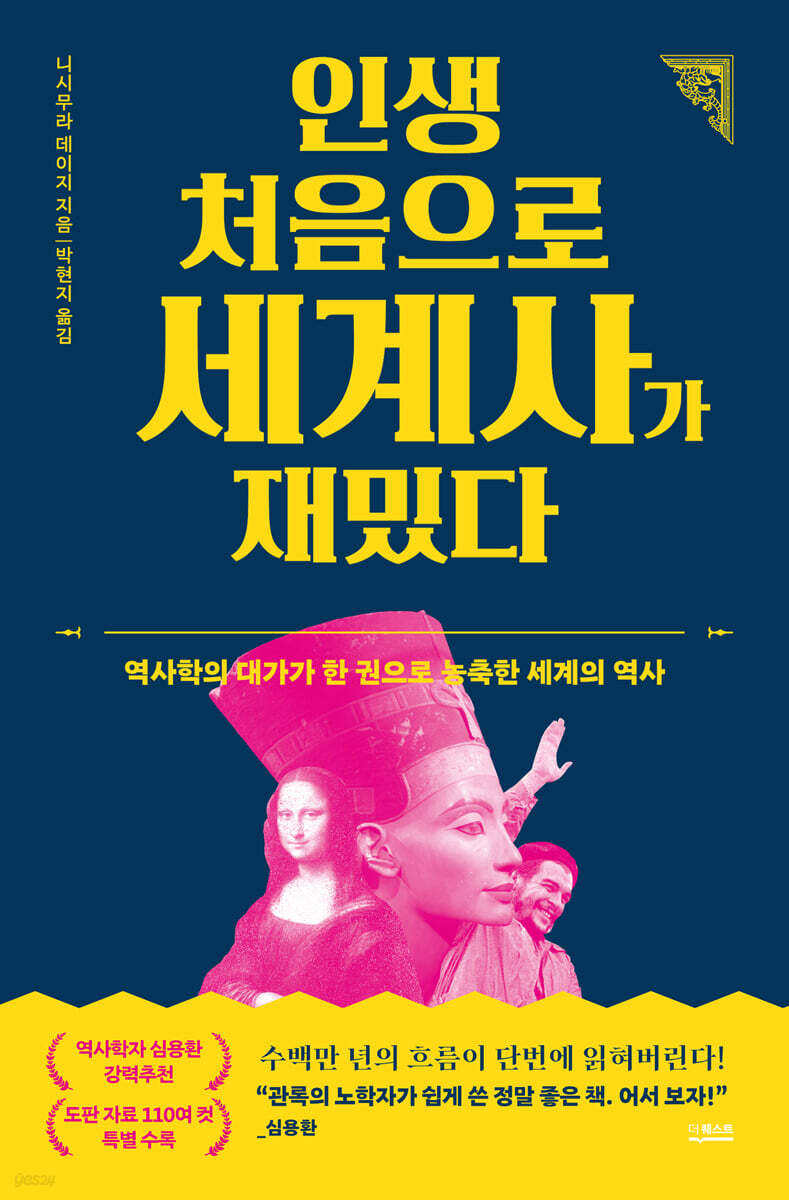
For the first time in my life, world history is interesting.
 |
Description
Book Introduction
“In life,
“There will definitely come a time when you will need knowledge of world history!”
A classic of world history, beloved by readers for decades.
A total of 672 pages, 110 illustrations, the entire history of mankind in one volume.
A story told by a master of history
World history stories that will be useful for a lifetime
The world history textbook, "World History is Fun for the First Time in My Life," which has been loved by readers for 30 years since its publication, is finally available to domestic readers.
This is a rare opportunity to encounter world history from prehistoric times to the present in a single volume, with a total of 672 pages and over 110 precious illustrations.
A respected scholar in the academic world, who hopes that “even just one more person can experience the fun of world history,” has compiled the world history he has studied throughout his life for the first time for the general public.
This book is written in a way that is easy for anyone, from middle school students to working adults, to understand, and it contains in-depth and informative information about the most important turning points in history.
The history of global civilization unfolds in a coherent flow, from the secrets of ancient civilizations and the innovations of the Renaissance, through two world wars, to the independence of Africa and South America, and the turmoil of East Asia.
The illustrations that aid understanding have been carefully selected to vividly portray historical scenes.
The book's highlight is the master's penmanship, which incorporates essential insights throughout, such as the explanation that "The Renaissance was the result of the medieval mind, which had been suppressed for 1,000 years, becoming hyper-focused internally, and the Age of Exploration was the explosion of that mind externally."
Marie Antoinette's final appearance on her way to the guillotine resembled that of her mother.
The Russian emperor, who longed for the refined West, actually preferred to drink in a rustic cabin.
Through these hidden stories of history, readers will experience not a "dry world history," but a "sentimental world history" that exudes the vivid scent of human life.
In Japan, it became a bestseller immediately after its publication, and was distributed in paperback, where it is still called a "classic of world history" to this day.
The content is so captivating that one reader exclaimed, “I read it in one sitting and was deeply moved.”
This one book may leave you captivated, you may be amazed by the scholar's insight, or you may be left heartbroken by the unexpectedly long aftertaste.
From beginners hesitant about unfamiliar names in world history to readers seeking profound knowledge, I am confident that everyone will discover "the first truly engaging world history" as they turn the pages of this book.
“There will definitely come a time when you will need knowledge of world history!”
A classic of world history, beloved by readers for decades.
A total of 672 pages, 110 illustrations, the entire history of mankind in one volume.
A story told by a master of history
World history stories that will be useful for a lifetime
The world history textbook, "World History is Fun for the First Time in My Life," which has been loved by readers for 30 years since its publication, is finally available to domestic readers.
This is a rare opportunity to encounter world history from prehistoric times to the present in a single volume, with a total of 672 pages and over 110 precious illustrations.
A respected scholar in the academic world, who hopes that “even just one more person can experience the fun of world history,” has compiled the world history he has studied throughout his life for the first time for the general public.
This book is written in a way that is easy for anyone, from middle school students to working adults, to understand, and it contains in-depth and informative information about the most important turning points in history.
The history of global civilization unfolds in a coherent flow, from the secrets of ancient civilizations and the innovations of the Renaissance, through two world wars, to the independence of Africa and South America, and the turmoil of East Asia.
The illustrations that aid understanding have been carefully selected to vividly portray historical scenes.
The book's highlight is the master's penmanship, which incorporates essential insights throughout, such as the explanation that "The Renaissance was the result of the medieval mind, which had been suppressed for 1,000 years, becoming hyper-focused internally, and the Age of Exploration was the explosion of that mind externally."
Marie Antoinette's final appearance on her way to the guillotine resembled that of her mother.
The Russian emperor, who longed for the refined West, actually preferred to drink in a rustic cabin.
Through these hidden stories of history, readers will experience not a "dry world history," but a "sentimental world history" that exudes the vivid scent of human life.
In Japan, it became a bestseller immediately after its publication, and was distributed in paperback, where it is still called a "classic of world history" to this day.
The content is so captivating that one reader exclaimed, “I read it in one sitting and was deeply moved.”
This one book may leave you captivated, you may be amazed by the scholar's insight, or you may be left heartbroken by the unexpectedly long aftertaste.
From beginners hesitant about unfamiliar names in world history to readers seeking profound knowledge, I am confident that everyone will discover "the first truly engaging world history" as they turn the pages of this book.
- You can preview some of the book's contents.
Preview
index
Entering
Ⅰ.
Stories of ancient civilizations
1.
The oldest person in the world 2.
The boy's surprising discovery 3.
Egyptian Civilization 4.
The Amazing Pyramid 5.
Mesopotamian civilization 6.
Phoenicians and Hebrews 7.
Moses and the Ten Commandments of God 8.
Aegean Civilization 9.
The Persian Wars and Athens 10.
The Peloponnesian War and Sparta 11.
Alexander the Great's Dream 12.
Rome's domination of the Mediterranean world 13.
Brutus, you too are 14.
The Roman Empire and Christianity 15.
Augustine and Leo I 16.
Buddhism and Hinduism 17.
Yellow River Civilization 18.
Confucius and Buddha 19.
The first unified state, the Qin Dynasty 20.
The prosperity of a nation
· Ancient civilizations at a glance
Ⅱ.
East Asian Stories
21.
World Empires, Sui and Tang Dynasties 22.
In the East, poppy; in the West, Cleopatra 23.
Going on the Silk Road 24.
Northern Song and Southern Song 25.
Wang Anshi and Zhu Xi 26.
Mongol Empire 27.
Emperor Hongwu and Emperor Yongle 28.
Peasant Revolt in China 29.
Chinese Empire, Qing Dynasty 30.
Emperor Kangxi 31.
Other countries in Asia
· East Asia at a glance
Ⅲ.
Stories from Southwest Asia
32.
Muhammad and the Quran 33.
Expansion of the Islamic World 34.
High-level Islamic culture 35.
Central Asia and India 36.
The rise of the Ottoman Empire
· A glance at the world of Southwest Asia
Ⅳ.
The story of how Europe was created
37.
The Great Migration of the Germanic Peoples 38.
The coronation of Charlemagne 39.
The heyday of the Roman Church 40.
The structure of feudal society 41.
The air in the city is free 42.
The Glory of the Byzantine Empire 43.
Crusade 44.
Tectonic shifts in the Middle Ages 45.
Plague pandemic 46.
Human Hymn 47.
Mona Lisa's Smile 48.
The protagonist of the Age of Exploration 49.
India Business 50.
The Prelude to the Reformation 51.
I am standing here 52.
Two Jesuit monks 53.
The Wandering Emperor 54.
The Evolution of the British Monarchy 55.
Destruction of the Invincible Fleet 56.
Joan of Arc and Catherine de Medici 57.
The Sun King of Versailles 58.
Patron saint of the Netherlands 59.
Hyoung Wallenstein 60.
Origin of International Conferences 61.
Enlightened Despot 62.
The Northern Loser 63.
Two Empresses 64.
English Revolution 65.
The embodiment of Puritanism 66.
British Industrial Revolution 67.
Three Faces of a Philosopher
· The Birth of Europe at a Glance
V.
19th Century World Stories
68.
American Revolutionary War 69.
French Revolution 70.
Capture of the Bastille 71.
Napoleon, the man of destiny 72.
Fires of Moscow 73.
The meeting is dancing 74.
Paris, Vienna, and Berlin in 1848 75.
Cavour and Bismarck 76.
The Rise of America 77.
President's Beard 78.
Imperialism Era 79.
80. Invasion of Asia by the great powers.
The Opium Wars and the Taiping Rebellion 81.
The last emperor of the Qing Dynasty, 82.
The revolution that has not yet been completed 83.
It's late, Scott.
· A glance at the 19th century world
Ⅵ.
20th Century World Stories
84.
The Triple Alliance and the 3B Policy 85.
A Step of Destiny 86.
Results of World War I 87.
88 before and after the Russian Revolution.
Two Revolutionaries 89.
Contradictions of the Versailles System 90.
The Rise of Fascism 91.
Hitler's Munich Uprising 92.
Outbreak of World War II 93.
Independence of Asia and Africa 94.
Cold War 95.
Season of Melting Ice 96.
The Zionist Controversy 97.
Prague Spring 98.
Hot Winds of Central and South America 99.
Turbulent modern times
· The 20th Century World at a Glance
100.
Two fin-de-siècles
Ⅰ.
Stories of ancient civilizations
1.
The oldest person in the world 2.
The boy's surprising discovery 3.
Egyptian Civilization 4.
The Amazing Pyramid 5.
Mesopotamian civilization 6.
Phoenicians and Hebrews 7.
Moses and the Ten Commandments of God 8.
Aegean Civilization 9.
The Persian Wars and Athens 10.
The Peloponnesian War and Sparta 11.
Alexander the Great's Dream 12.
Rome's domination of the Mediterranean world 13.
Brutus, you too are 14.
The Roman Empire and Christianity 15.
Augustine and Leo I 16.
Buddhism and Hinduism 17.
Yellow River Civilization 18.
Confucius and Buddha 19.
The first unified state, the Qin Dynasty 20.
The prosperity of a nation
· Ancient civilizations at a glance
Ⅱ.
East Asian Stories
21.
World Empires, Sui and Tang Dynasties 22.
In the East, poppy; in the West, Cleopatra 23.
Going on the Silk Road 24.
Northern Song and Southern Song 25.
Wang Anshi and Zhu Xi 26.
Mongol Empire 27.
Emperor Hongwu and Emperor Yongle 28.
Peasant Revolt in China 29.
Chinese Empire, Qing Dynasty 30.
Emperor Kangxi 31.
Other countries in Asia
· East Asia at a glance
Ⅲ.
Stories from Southwest Asia
32.
Muhammad and the Quran 33.
Expansion of the Islamic World 34.
High-level Islamic culture 35.
Central Asia and India 36.
The rise of the Ottoman Empire
· A glance at the world of Southwest Asia
Ⅳ.
The story of how Europe was created
37.
The Great Migration of the Germanic Peoples 38.
The coronation of Charlemagne 39.
The heyday of the Roman Church 40.
The structure of feudal society 41.
The air in the city is free 42.
The Glory of the Byzantine Empire 43.
Crusade 44.
Tectonic shifts in the Middle Ages 45.
Plague pandemic 46.
Human Hymn 47.
Mona Lisa's Smile 48.
The protagonist of the Age of Exploration 49.
India Business 50.
The Prelude to the Reformation 51.
I am standing here 52.
Two Jesuit monks 53.
The Wandering Emperor 54.
The Evolution of the British Monarchy 55.
Destruction of the Invincible Fleet 56.
Joan of Arc and Catherine de Medici 57.
The Sun King of Versailles 58.
Patron saint of the Netherlands 59.
Hyoung Wallenstein 60.
Origin of International Conferences 61.
Enlightened Despot 62.
The Northern Loser 63.
Two Empresses 64.
English Revolution 65.
The embodiment of Puritanism 66.
British Industrial Revolution 67.
Three Faces of a Philosopher
· The Birth of Europe at a Glance
V.
19th Century World Stories
68.
American Revolutionary War 69.
French Revolution 70.
Capture of the Bastille 71.
Napoleon, the man of destiny 72.
Fires of Moscow 73.
The meeting is dancing 74.
Paris, Vienna, and Berlin in 1848 75.
Cavour and Bismarck 76.
The Rise of America 77.
President's Beard 78.
Imperialism Era 79.
80. Invasion of Asia by the great powers.
The Opium Wars and the Taiping Rebellion 81.
The last emperor of the Qing Dynasty, 82.
The revolution that has not yet been completed 83.
It's late, Scott.
· A glance at the 19th century world
Ⅵ.
20th Century World Stories
84.
The Triple Alliance and the 3B Policy 85.
A Step of Destiny 86.
Results of World War I 87.
88 before and after the Russian Revolution.
Two Revolutionaries 89.
Contradictions of the Versailles System 90.
The Rise of Fascism 91.
Hitler's Munich Uprising 92.
Outbreak of World War II 93.
Independence of Asia and Africa 94.
Cold War 95.
Season of Melting Ice 96.
The Zionist Controversy 97.
Prague Spring 98.
Hot Winds of Central and South America 99.
Turbulent modern times
· The 20th Century World at a Glance
100.
Two fin-de-siècles
Detailed image

Into the book
No matter how daring and unscrupulous a tomb robber is, he cannot carry the pyramids.
Because it's so huge.
If the building had been small and compact in the middle of the desert, it would have been swallowed up by the sand long ago.
I am simply amazed at the architectural design of the Egyptians, which took even the local climate into consideration.
--- p.39
'The Troy depicted by Homer did exist.' Schliemann wanted to prove this fact by digging up incontrovertible evidence from the ruins.
He could be considered lucky, having achieved his lifelong dream.
Although future generations may not necessarily judge you favorably by saying things like you're a visionary, a demagogue, or archaeologically crude, in the field of discovery and invention, it's important to first conjure up an image in your head.
--- p.68
Peasant revolts are a frequent occurrence.
However, it is difficult to find examples of peasant revolts of a magnitude that could overthrow a dynasty anywhere in the world, except in China.
--- p.201
The word 'excommunication' doesn't really resonate with us living in modern times.
However, at that time, if the emperor or king was excommunicated, the vassals no longer had to be loyal to the king, and the common people did not hold a funeral for him even when he died.
In English, the word for excommunication is 'Excommunication'.
This means to be expelled from the community.
--- p.284
Charles V tried to inspire the spirit of the crusades in Europe, but no one responded.
On the contrary, Francis I of France was not averse to forming alliances even with Islamic countries.
In a situation where the pursuit of national interests had become the task of a modern state, the spirit of the Crusades was an anachronism.
--- p.369
Living to be 77 was difficult in those days.
The reason Louis XIV was able to live so long was because he was healthy.
Although he seemed to live as he pleased, he was strict with himself, and order and discipline made life at the court of Versailles consistent.
More broadly speaking, this is a manifestation of the French spirit.
--- p.397
The Elizabethan era, just half a century ago, was a time of burning national enthusiasm and a cheerful atmosphere.
Cromwell's era, on the other hand, was dark and gloomy, like an autumn frost, and forced the people into a cramped life.
But isn't it true that the human heart cannot remain oppressed by asceticism forever?
Because it's so huge.
If the building had been small and compact in the middle of the desert, it would have been swallowed up by the sand long ago.
I am simply amazed at the architectural design of the Egyptians, which took even the local climate into consideration.
--- p.39
'The Troy depicted by Homer did exist.' Schliemann wanted to prove this fact by digging up incontrovertible evidence from the ruins.
He could be considered lucky, having achieved his lifelong dream.
Although future generations may not necessarily judge you favorably by saying things like you're a visionary, a demagogue, or archaeologically crude, in the field of discovery and invention, it's important to first conjure up an image in your head.
--- p.68
Peasant revolts are a frequent occurrence.
However, it is difficult to find examples of peasant revolts of a magnitude that could overthrow a dynasty anywhere in the world, except in China.
--- p.201
The word 'excommunication' doesn't really resonate with us living in modern times.
However, at that time, if the emperor or king was excommunicated, the vassals no longer had to be loyal to the king, and the common people did not hold a funeral for him even when he died.
In English, the word for excommunication is 'Excommunication'.
This means to be expelled from the community.
--- p.284
Charles V tried to inspire the spirit of the crusades in Europe, but no one responded.
On the contrary, Francis I of France was not averse to forming alliances even with Islamic countries.
In a situation where the pursuit of national interests had become the task of a modern state, the spirit of the Crusades was an anachronism.
--- p.369
Living to be 77 was difficult in those days.
The reason Louis XIV was able to live so long was because he was healthy.
Although he seemed to live as he pleased, he was strict with himself, and order and discipline made life at the court of Versailles consistent.
More broadly speaking, this is a manifestation of the French spirit.
--- p.397
The Elizabethan era, just half a century ago, was a time of burning national enthusiasm and a cheerful atmosphere.
Cromwell's era, on the other hand, was dark and gloomy, like an autumn frost, and forced the people into a cramped life.
But isn't it true that the human heart cannot remain oppressed by asceticism forever?
--- p.444
Publisher's Review
**Highly praised by historian Shim Yong-hwan**
“It responds to the intellectual aspirations of Koreans,
It is faithful to global civilization and modern and contemporary history.
To understand the world with the most advanced perspective
“This is a really good book written in an easy-to-understand manner by a seasoned scholar. Come check it out!”
Your view of the 'now'
The greatest knowledge journey ever, expanding your horizons 360 degrees
The desire to understand the flow of world history is particularly growing among Koreans these days.
This is because we are increasingly realizing that complex events covered in international news—such as the Russo-Ukrainian war, the refugee crisis, North Korea's nuclear tests, and the US-China semiconductor hegemony competition—can no longer be viewed as someone else's problem, and that current problems stem from a historical context.
Additionally, as overseas travel and cultural experiences become routine, it has become common to feel hesitant when faced with the ruins of an unfamiliar city, unable to understand its past.
In this era, world history is gaining attention as a living knowledge directly connected to real life, going beyond an elective subject for school days.
Author Richard Paul Evans said, “The more I study world history, the more I realize how little humanity has changed.
“There is no new script, just different actors,” he said.
As the saying goes, "For the first time in my life, world history is interesting" completely broadens your perspective, allowing you to view the reality before your eyes from a historical perspective.
For example, 2,500 years ago, Athens was driven by impulsive and fickle mob psychology rather than civic debate, fueled by the demagoguery of politicians.
The author points out that this is the 'decisive reason why hegemony left Athens.'
It is strikingly similar to today's situation, where the number of discussion programs is decreasing and everyone is competing to dominate public opinion.
It also has important economic implications.
Historically, when economic recessions hit, developed countries turned to protectionism.
Despite claiming to be a world leader, when faced with a crisis, the United States devalued the dollar and Britain focused solely on trade with its colonies.
The fact that backward capitalist countries, unable to even cope with such situations, ultimately sought survival through invasion and war makes us carefully reflect on the current trend of rising protectionism.
This book, along with insights that reinterpret the present and envision the future, is filled with knowledge and stories that can be naturally applied in everyday life.
Beyond taking pretty pictures of cultural heritage sites, the conversations you can have will be richer than you can imagine, such as why the Egyptian pyramids were built so large in the first place, why the Palace of Versailles resembles the French, and how the construction of St. Peter's Basilica relates to the Reformation.
Let us fully savor this masterpiece by a master of Western history who devoted his life to the study of history.
The power to know world history will be a valuable asset for life.
“It responds to the intellectual aspirations of Koreans,
It is faithful to global civilization and modern and contemporary history.
To understand the world with the most advanced perspective
“This is a really good book written in an easy-to-understand manner by a seasoned scholar. Come check it out!”
Your view of the 'now'
The greatest knowledge journey ever, expanding your horizons 360 degrees
The desire to understand the flow of world history is particularly growing among Koreans these days.
This is because we are increasingly realizing that complex events covered in international news—such as the Russo-Ukrainian war, the refugee crisis, North Korea's nuclear tests, and the US-China semiconductor hegemony competition—can no longer be viewed as someone else's problem, and that current problems stem from a historical context.
Additionally, as overseas travel and cultural experiences become routine, it has become common to feel hesitant when faced with the ruins of an unfamiliar city, unable to understand its past.
In this era, world history is gaining attention as a living knowledge directly connected to real life, going beyond an elective subject for school days.
Author Richard Paul Evans said, “The more I study world history, the more I realize how little humanity has changed.
“There is no new script, just different actors,” he said.
As the saying goes, "For the first time in my life, world history is interesting" completely broadens your perspective, allowing you to view the reality before your eyes from a historical perspective.
For example, 2,500 years ago, Athens was driven by impulsive and fickle mob psychology rather than civic debate, fueled by the demagoguery of politicians.
The author points out that this is the 'decisive reason why hegemony left Athens.'
It is strikingly similar to today's situation, where the number of discussion programs is decreasing and everyone is competing to dominate public opinion.
It also has important economic implications.
Historically, when economic recessions hit, developed countries turned to protectionism.
Despite claiming to be a world leader, when faced with a crisis, the United States devalued the dollar and Britain focused solely on trade with its colonies.
The fact that backward capitalist countries, unable to even cope with such situations, ultimately sought survival through invasion and war makes us carefully reflect on the current trend of rising protectionism.
This book, along with insights that reinterpret the present and envision the future, is filled with knowledge and stories that can be naturally applied in everyday life.
Beyond taking pretty pictures of cultural heritage sites, the conversations you can have will be richer than you can imagine, such as why the Egyptian pyramids were built so large in the first place, why the Palace of Versailles resembles the French, and how the construction of St. Peter's Basilica relates to the Reformation.
Let us fully savor this masterpiece by a master of Western history who devoted his life to the study of history.
The power to know world history will be a valuable asset for life.
GOODS SPECIFICS
- Date of issue: January 9, 2025
- Page count, weight, size: 672 pages | 138*210*35mm
- ISBN13: 9791140714407
- ISBN10: 1140714406
You may also like
카테고리
korean


korean

![ELLE 엘르 스페셜 에디션 A형 : 12월 [2025]](http://librairie.coreenne.fr/cdn/shop/files/b8e27a3de6c9538896439686c6b0e8fb.jpg?v=1766436872&width=3840)


